Leviticus 3:17

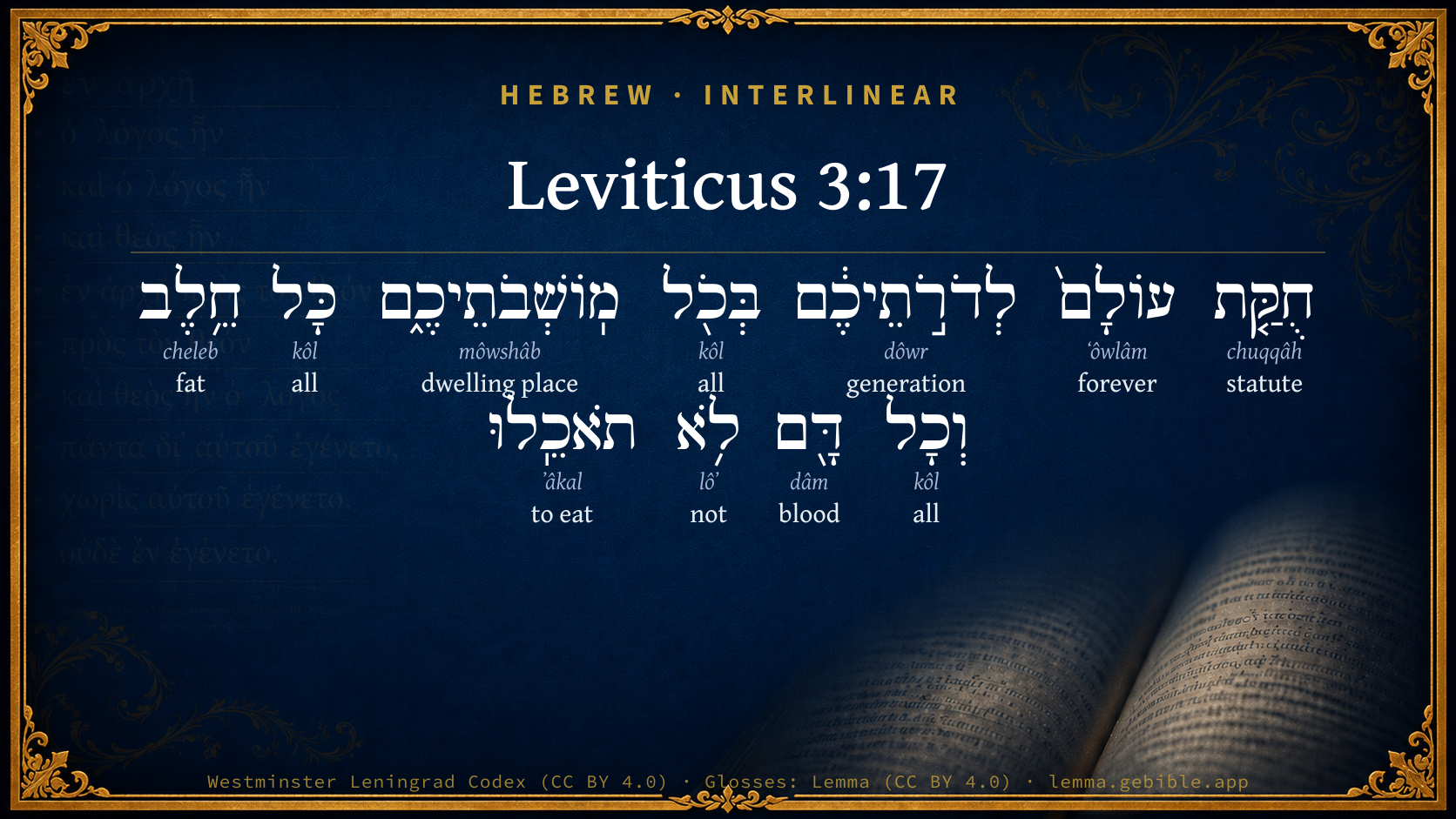
Hebrew (Westminster Leningrad Codex) Leviticus 3:17 appears in the Hebrew Old Testament. The text above is from the Westminster Leningrad Codex. Each word links to its Strong’s number, a concise gloss, and parsing drawn from the Open Scriptures Hebrew Bible morphology. Click any word for its full Brown-Driver-Briggs (BDB) entry.
Download image
Cite this verse

Leviticus 3:17 (World English Bible). Public Domain. Lemma interlinear Bible study tool, https://lemma.gebible.app/v/leviticus/3/17.

Show BibTeX & RIS
BibTeX
RIS
English Translation
"'It shall be a perpetual statute throughout your generations in all your dwellings, that you shall eat neither fat nor blood.'"
World English Bible · Public Domain
Download a study sheet

One document with this verse’s original text, its word-by-word gloss line, the meaning frame, cross-references with their text, attributed commentary, and full source and license credits — printable, and it pastes into notes with its structure intact.

This verse Autodidact and up

Study sheet (.html) Plain text (.txt)

A passage Seminary Student

Up to 50 verses in one chapter. A passage sheet keeps up to 6 commentary sources and 12 cross-references per verse, in the order this page ranks them, and says so on the sheet whenever that leaves anything out. Ask for a single verse and you get the Autodidact verse sheet above.

Everything on this page stays free to read, with no account — the sheet is a download of what is already on screen, not access to it.

Want to remove ads? Support Godless Engineer
Compare translations 3

The same verse in 3 English versions, stacked beneath the original-language interlinear above. Click any original word for its lexicon entry.

Each is an independent rendering of the whole verse — the interlinear is not word-aligned to these translations.

Highlighted words mark where these versions differ — a whole-verse word diff, not a word-by-word alignment.

  • World English Bible Public Domain
    "'It shall be a perpetual statute throughout your generations in all your dwellings, that you shall eat neither fat nor blood.'"
  • King James Version Public Domain
    It shall be a perpetual statute for your generations throughout all your dwellings, that ye eat neither fat nor blood.
  • unfoldingWord Literal Text CC BY-SA 4.0
    A statute of eternity for your generations in all your dwelling places: you shall not eat any fat or any blood.’”

unfoldingWord Literal Text — © unfoldingWord, licensed CC BY-SA 4.0. Word-aligned USFM3 via Door43 (git.door43.org/unfoldingWord/en_ult).

Versions to compare (up to 4)

3 of 4 selected

Show all 18 translations

Every available English version of this verse, each an independent rendering of the whole verse.

  • World English Bible Public Domain
    "'It shall be a perpetual statute throughout your generations in all your dwellings, that you shall eat neither fat nor blood.'"
  • Berean Standard Bible Public Domain
    This is a permanent statute for the generations to come, wherever you live: You must not eat any fat or any blood.”
  • Majority Standard Bible Public Domain
    This is a permanent statute for the generations to come, wherever you live: You must not eat any fat or any blood.”
  • King James Version Public Domain
    It shall be a perpetual statute for your generations throughout all your dwellings, that ye eat neither fat nor blood.
  • American Standard Version (1901) Public Domain
    It shall be a perpetual statute throughout your generations in all your dwellings, that ye shall eat neither fat nor blood.
  • Revised Version (1885) Public Domain
    It shall be a perpetual statute throughout your generations in all your dwellings, that ye shall eat neither fat nor blood.
  • Geneva Bible (1599) Public Domain
    This shalbe a perpetual ordinance for your generations, throughout al your dwellings, so that ye shall eate neither fatte nor blood.
  • Douay-Rheims (1899) Public Domain
    By a perpetual law for your generations, and in all your habitations: neither blood nor fat shall you eat at all.
  • Young's Literal Translation Public Domain
    `A statute age-during to your generations in all your dwellings: any fat or any blood ye do not eat.'
  • Literal Standard Version CC BY-SA 4.0
    [This is] a continuous statute throughout your generations in all your dwellings: you do not eat any fat or any blood.”
  • Unlocked Literal Bible CC BY-SA 4.0
    It will be a permanent statute throughout your people's generations in every place you make your home, that you must not eat fat or blood.'”
  • unfoldingWord Literal Text CC BY-SA 4.0
    A statute of eternity for your generations in all your dwelling places: you shall not eat any fat or any blood.’”
  • Darby Bible Public Domain
    [It is] an everlasting statute for your generations throughout all your dwellings: no fat and no blood shall ye eat.
  • World Messianic Bible Public Domain
    “‘It shall be a perpetual statute throughout your generations in all your dwellings, that you shall eat neither fat nor blood.’”
  • Webster's Bible Public Domain
    It shall be a perpetual statute for your generations throughout all your dwellings, that ye eat neither fat nor blood.
  • Free Bible Version CC BY-SA 4.0
    You must not eat any fat or any blood. This regulation is for all time and for all future generations everywhere you live.”
  • Bible in Basic English Public Domain
    Let it be an order for ever, through all your generations, in all your houses, that you are not to take fat or blood for food.
  • JPS Tanakh (1917) Public Domain
    It shall be a perpetual statute throughout your generations in all your dwellings, that ye shall eat neither fat nor blood.

Literal Standard Version (2020), Covenant Press — licensed CC BY-SA 4.0. Text via the HelloAO Bible API (eBible.org). Unlocked Literal Bible (unfoldingWord) — licensed CC BY-SA 4.0. Text via the HelloAO Bible API (eBible.org). unfoldingWord Literal Text — © unfoldingWord, licensed CC BY-SA 4.0. Word-aligned USFM3 via Door43 (git.door43.org/unfoldingWord/en_ult). Free Bible Version, Dr. Jonathan Gallagher — licensed CC BY-SA 4.0. Text via the HelloAO Bible API (eBible.org).

Word by word

More ways to search: Search by grammar → Find every occurrence → Compare this word →

Practice this passage: Drill this verse → Learn its vocabulary →

מֽוֹשְׁבֹתֵיכֶ֑ם
môwshâb
H4186
“dwelling places · your”
Noun, Common, Masculine, Plural, Construct + Suffix, Personal, 2nd Person, Masculine, Plural
Part of Speech
Noun
Type
Common
Gender
Masculine
Number
Plural
State
Construct
Full BDB Definition

Origin: from H3427 ; a seat

TWOT: 922c

seat, assembly, dwelling-place, dwelling, dwellers - seat, sitting, those sitting, sitting company or assembly - dwelling place, dwelling - situation, location - time of dwelling - those dwelling, dweller
  1. חֻקַּ֤ת chuqqâh H2708 “statute of” Noun, Common, Both, Singular, Construct
  2. עוֹלָם֙ ʻôwlâm H5769 “forever” Noun, Common, Masculine, Singular, Absolute
  3. לְדֹרֹ֣תֵיכֶ֔ם dôwr H1755 “to/for · generations · your” Preposition + Noun, Common, Masculine, Plural, Construct + Suffix, Personal, 2nd Person, Masculine, Plural
  4. בְּכֹ֖ל kôl H3605 “in/at · all of” Preposition + Noun, Common, Masculine, Singular, Construct
  5. כָּל kôl H3605 “all of” Noun, Common, Masculine, Singular, Construct
  6. חֵ֥לֶב cheleb H2459 “fat” Noun, Common, Masculine, Singular, Absolute
  7. וְכָל kôl H3605 “and · all of” Conjunction + Noun, Common, Masculine, Singular, Construct
  8. דָּ֖ם dâm H1818 “blood” Noun, Common, Masculine, Singular, Absolute
  9. לֹ֥א lôʼ H3808 “not” Particle, Negative
  10. תֹאכֵֽלוּ ʼâkal H398 “to eat” Verb, Qal, Imperfect, 2nd Person, Masculine, Plural

About this verse

These counts appear in no published source. They are computed here, from the morphology-tagged text and Lemma’s own curated glosses. What Lemma adds →

11
words
9
distinct lemmas
Pentateuch
section

Shared distinctive vocabulary

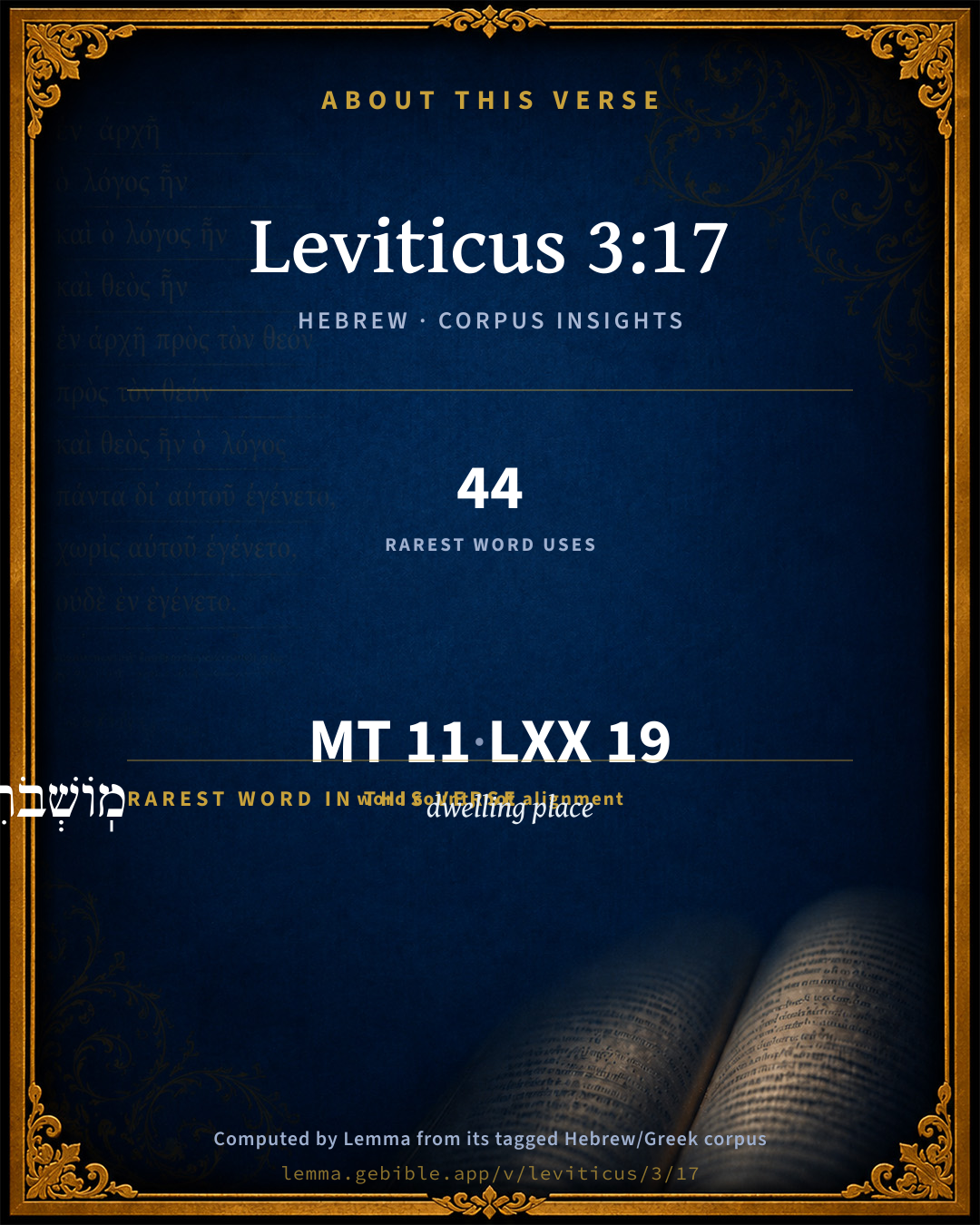
מֽוֹשְׁבֹתֵיכֶ֑ם dwelling place H4186 occurs in 43 verses of the Hebrew Bible. Also found in:

Grammatical profile

  • 1 verb
  • 9 nouns
  • 1 particle

Verb forms

  • תֹאכֵֽלוּ Qal · Imperfect

Repetition

A word recurs within this verse — often emphatic in Hebrew:

  • בְּכֹ֖ל all H3605 ×3

Hebrew & Septuagint length

In English translation the verse runs 21 words from the Hebrew and 20 from the Septuagint (LXX English) — closely comparable.

A rough comparison of the two English renderings, which tokenize alike — not a word-level alignment.

Word counts can differ between the Hebrew and the Greek without any difference in meaning — e.g. the Hebrew direct-object marker אֵת has no separate Greek word, and Greek often adds the article ὁ.

In the original languages it is 11 Hebrew tokens and 19 Greek tokens — but the two are counted differently (Hebrew bundles its prefixes and suffixes into one token; the Greek is in lemma form), so that isn’t a like-for-like length.

Cross-references

27

Topical passages linked to Leviticus 3:17 in the Treasury of Scripture Knowledge — connected by theme and wording, ordered by reader-vote popularity; previews shown in the World English Bible.

  • Genesis 9:4 But flesh with the life of it, the blood of it, you shall not eat.
  • Matthew 26:28 for this is my blood of the new covenant, which is poured out for many for the remission of sins.
  • Deuteronomy 15:23 Only you shall not eat its blood; you shall pour it out on the ground as water.
  • Leviticus 7:23 "Speak to the children of Israel, saying, 'You shall eat no fat, of ox, or sheep, or goat.
  • Deuteronomy 12:23 Only be sure that you don't eat the blood: for the blood is the life; and you shall not eat the life with the flesh.
  • Leviticus 3:16 The priest shall burn them on the altar: it is the food of the offering made by fire, for a sweet savor; all the fat is Yahweh's.
  • Leviticus 6:18 Every male among the children of Aaron shall eat of it, as their portion forever throughout your generations, from the offerings of Yahweh made by fire. Whoever touches them shall be holy.'"
  • Leviticus 17:7 They shall no more sacrifice their sacrifices to the goat idols, after which they play the prostitute. This shall be a statute forever to them throughout their generations.'
  • Deuteronomy 12:16 Only you shall not eat the blood; you shall pour it out on the earth as water.
  • Leviticus 7:36 which Yahweh commanded to be given them of the children of Israel, in the day that he anointed them. It is their portion forever throughout their generations.
  • Leviticus 17:10–16 "'Any man of the house of Israel, or of the strangers who live as foreigners among them, who eats any kind of blood, I will set my face against that soul who eats blood, and will cut him off from among his people.
  • Leviticus 23:14 You shall eat neither bread, nor roasted grain, nor fresh grain, until this same day, until you have brought the offering of your God. This is a statute forever throughout your generations in all your dwellings.
  • Deuteronomy 32:14 Butter of the herd, and milk of the flock, With fat of lambs, Rams of the breed of Bashan, and goats, With the finest of the wheat; Of the blood of the grape you drank wine.
  • Ezekiel 33:25 Therefore tell them, Thus says the Lord Yahweh: You eat with the blood, and lift up your eyes to your idols, and shed blood: and shall you possess the land?
  • Ezekiel 44:15 But the priests the Levites, the sons of Zadok, who kept the charge of my sanctuary when the children of Israel went astray from me, they shall come near to me to minister to me; and they shall stand before me to offer to me the fat and the blood, says the Lord Yahweh:
  • Acts 15:29 that you abstain from things sacrificed to idols, from blood, from things strangled, and from sexual immorality, from which if you keep yourselves, it will be well with you. Farewell."
  • Ephesians 1:7 in whom we have our redemption through his blood, the forgiveness of our trespasses, according to the riches of his grace,
  • Ephesians 5:26 that he might sanctify it, having cleansed it by the washing of water with the word,
  • Ezekiel 44:7 in that you have brought in foreigners, uncircumcised in heart and uncircumcised in flesh, to be in my sanctuary, to profane it, even my house, when you offer my bread, the fat and the blood, and they have broken my covenant, [to add] to all your abominations.
  • Matthew 16:24 Then Jesus said to his disciples, "If anyone desires to come after me, let him deny himself, and take up his cross, and follow me.
  • Acts 15:20–21 but that we write to them that they abstain from the pollution of idols, from sexual immorality, from what is strangled, and from blood.
  • 1 Timothy 4:4 For every creature of God is good, and nothing is to be rejected, if it is received with thanksgiving.
  • Leviticus 7:25–27 For whoever eats the fat of the animal, of which men offer an offering made by fire to Yahweh, even the soul who eats it shall be cut off from his people.
  • Leviticus 16:34 "This shall be an everlasting statute for you, to make atonement for the children of Israel once in the year because of all their sins." It was done as Yahweh commanded Moses.
  • Numbers 19:21 It shall be a perpetual statute to them: and he who sprinkles the water for impurity shall wash his clothes, and he who touches the water for impurity shall be unclean until even.
  • 1 Samuel 14:32–34 and the people flew on the spoil, and took sheep, and oxen, and calves, and killed them on the ground; and the people ate them with the blood.
  • Nehemiah 8:10 Then he said to them, Go your way, eat the fat, and drink the sweet, and send portions to him for whom nothing is prepared; for this day is holy to our Lord: neither be you grieved; for the joy of Yahweh is your strength.

Cross-references courtesy of OpenBible.info (CC BY 4.0).

Hebrew and Greek witnesses Masoretic Hebrew ↔ Greek Septuagint

The same verse in the two great witnesses to the Old Testament, shown verse-for-verse.

These are two independent witnesses, not word-aligned to each other, and the Septuagint is shown in lemma (dictionary) form.

Hebrew Leviticus 3:17 Masoretic · Westminster Leningrad Codex

חֻקַּ֤ת עוֹלָם֙ לְדֹרֹ֣תֵיכֶ֔ם בְּכֹ֖ל מֽוֹשְׁבֹתֵיכֶ֑ם כָּל חֵ֥לֶב וְכָל דָּ֖ם לֹ֥א תֹאכֵֽלוּ

"'It shall be a perpetual statute throughout your generations in all your dwellings, that you shall eat neither fat nor blood.'"

World English Bible · Public Domain

Greek LXX Leviticus 3:17 Septuagint · lemma form

νόμιμος εἰς ὁ αἰών εἰς ὁ γενεά σύ ἐν πᾶς κατοικία σύ πᾶς στέαρ καί πᾶς αἷμα οὐ ἐσθίω

It is a perpetual statute throughout your generations, in all your habitations; you⌃ shall eat no fat and no blood.

LXX2012 (modern English Septuagint) · Public Domain

Hebrew: Westminster Leningrad Codex (CC BY 4.0). Greek: Septuagint (public domain); English from LXX2012 (modern English Septuagint) (Public Domain). How the Septuagint differs from the Hebrew →

Targum (Aramaic paraphrase)

2

The Targum is the ancient Jewish Aramaic paraphrase of the Hebrew Scriptures — an interpretive translation, not the Hebrew text itself. Onkelos (literal) and Pseudo-Jonathan (expansive) render the Torah, and Jonathan the Prophets. Coverage is partial: where no permissively-licensed English translation exists for a verse, only the Aramaic is shown. This is verse-level text, not a word-by-word alignment to the Hebrew.

  1. Targum Onkelos Torah (Genesis–Deuteronomy)
    קְיָם עָלָם לְדָרָתֵיכוֹן בְּכָל מוֹתְבָנֵיכוֹן כָּל תַּרְבָּא וְכָל דְמָא לָא תֵיכְלוּן

    (no public-domain English translation for this verse)

    Targum Onkelos — Aramaic: “Onkelos Genesis” (public domain); “Onkelos Exodus” (public domain); “Onkelos Leviticus” (public domain); “Onkelos Numbers” (public domain); “Onkelos Deuteronomy” (public domain). English: “Sefaria Community Translation” (CC0 1.0 (public-domain dedication)); “J.W. Etheridge. The Targums of Onkelos and Jonathan Ben Uzziel on the Pentateuch. London: Longmans, Green, 1862” (public domain). Text via Sefaria.

  2. Targum Pseudo-Jonathan Torah (Genesis–Deuteronomy)
    קְיַם עֲלָם לְדָרֵיכוֹן בְּכָל מוֹתְבָנֵיכוֹן כָּל תְּרֵיב וְכָל אֲדַם לָא תֵיכְלוּן עַל גַבֵּי מַדְבְּחָא יִתְקְרֵיב לִשְׁמָא דַיְיָ

    It is an everlasting statute unto all your generations, that neither the fat nor the blood shall be eaten in any of your dwellings, but upon the back of the altar it shall be sacrificed unto the Name of the Lord.

    Targum Pseudo-Jonathan — Aramaic: “Targum Jonathan on Genesis” (public domain); “Targum Jonathan on Exodus” (public domain); “Targum Jonathan on Leviticus” (public domain); “Targum Jonathan on Numbers” (public domain); “Targum Jonathan on Deuteronomy” (public domain). English: “The Targum of Jonathan ben Uzziel, trans. J. W. Etheridge, London, 1862” (public domain). Text via Sefaria.

Commentary

Notes on Leviticus 3:17 from classic Christian and Jewish commentators (each source and its license shown beneath its notes). The classic Christian expositions comment on the surrounding passage and are grouped to its opening verse, so a note may address several verses; the Jewish commentaries on the Tanakh (Rashi and others) are per-verse, so they appear only where the commentator wrote on this verse.

Lemma curates 59 commentaries, every one of them public domain or Creative Commons licensed, each selected and text-cleaned for this edition rather than reprinted as found. About our sources →

Trapp's Complete Commentary

John Trapp

Lev 3:17 [It shall be] a perpetual statute for your generations throughout all your dwellings, that ye eat neither fat nor blood.

Ver. 17. That ye neither eat fat nor blood.] Neither be carnal nor cruel; but let your souls delight in the fatness and sweetness of God’s ordinances.

John Trapp, A Commentary or Exposition upon All the Books of the Old and New Testament (1647–1656) — public domain. Text from a community e-Sword module.

Joseph Benson's Commentary

Lev 3:17. All your dwellings — Not only at or near the tabernacle, not only of those beasts which you actually sacrifice, but also in your several dwellings, and of all that kind of beasts. Fat — Was forbidden, 1st, To preserve the reverence of the holy rites and sacrifices. 2d, That they may be taught hereby to acknowledge God as their Lord, and the Lord of all the creatures, who might reserve what he pleased to himself. 3d, To exercise them in obedience to God, and self-denial and mortification of their appetites, even in those things which probably many of them would much desire. Blood — Was forbidden, partly to maintain reverence to God and his worship; partly, according to Maimonides, out of opposition to idolaters, who used to drink the blood of their sacrifices; partly, with respect to Christ’s blood, thereby manifestly signified. God would not permit the very shadows of this to be used as a common thing. Nor will he allow us, though we have the comfort of the atonement made, to assume to ourselves any share in the honour of making it.

Joseph Benson's Commentary on the Old and New Testaments (1811–1818) — public domain. Text from a community e-Sword module.

Tyndale Open Study Notes

Tyndale Open Resources

3:17 Human beings were not permitted to eat the fat or blood (see 1:5, 8 and study notes).

Tyndale Open Study Notes — © Tyndale Open Resources, licensed CC BY-SA 4.0. Text via the HelloAO Bible API.

Geneva Bible (1599)

Geneva Bible translators

By eating fat, was meant to be carnal, and by blood eating, was signified cruelty.

Geneva Bible (1599) marginal notes — public domain. Text via Bolls.life.

Jamieson, Fausset & Brown

Robert Jamieson, A. R. Fausset & David Brown

ye eat neither fat nor blood--The details given above distinctly define the fat in animals which was not to be eaten, so that all the rest, whatever adhered to other parts, or was intermixed with them, might be used. The prohibition of blood rested on a different foundation, being intended to preserve their reverence for the Messiah, who was to shed His blood as an stoning sacrifice for the sins of the world [BROWN].

Next: Leviticus Chapter 4

Jamieson, Fausset & Brown — Commentary Critical and Explanatory on the Whole Bible (1871) — public domain (CC PDM 1.0). Text via the HelloAO Bible API.

Adam Clarke's Commentary

Verse 17. That ye eat neither fat nor blood.] It is not likely that the fat should be forbidden in the same manner and in the same latitude as the blood. The blood was the life of the beast, and that was offered to make an atonement for their souls; consequently, this was never eaten in all their generations: but it was impossible to separate the fat from the flesh, which in many parts is so intimately intermixed with the muscular fibres; but the blood, being contained in separate vessels, the arteries and veins, might with great ease be entirely removed by cutting the throat of the animal, which was the Jewish method. By the fat therefore mentioned here and in the preceding verse, we may understand any fat that exists in a separate or unmixed state, such as the omentum or caul, the fat of the mesentery, the fat on the kidneys, and whatever else of the internal fat was easily separable, together with the whole of the tail already described. And probably it was the fat of such animals only as were offered to God in sacrifice, that was unlawful to be eaten.

As all temporal as well as spiritual blessings come from God, he has a right to require that such of them should be dedicated to his service as he may think proper to demand. He required the most perfect of all the animals, and the best parts of these perfect animals. This he did, not that he needed any thing, but to show the perfection of his nature and the purity of his service. Had he condescended to receive the meanest animals and the meanest parts of animals as his offerings, what opinion could his worshippers have entertained of the perfection of his nature? If such imperfect offerings were worthy of this God, then his nature must be only worthy of such offerings. It is necessary that every thing employed in the worship of God should be the most perfect of its kind that the time and circumstances can afford. As sensible things are generally the medium through which spiritual impressions are made, and the impression usually partakes of the nature of the medium through which these impressions are communicated; hence every thing should not only be decent, but as far as circumstances will admit dignified, in the worship of God: the object of religious worship, the place in which he is worshipped, and the worship itself, should have the strongest and most impressive correspondence possible.

Adam Clarke's Commentary on the Bible (1810–1826) — public domain. Text from a community e-Sword/MySword module.

Ellicott's Commentary for English Readers

(17) A perpetual statute for your generations throughout all your dwellings.—Better, a statute for ever throughout your generations in all your dwellings; so the Authorised Version in the only three other passages in which it occurs. (Comp. Lev_23:14; Lev_23:21, where it is inverted; and 31.) That is, the law not to eat fat of beeves, sheep, or goats, is to be binding upon the Israelites throughout all their future generations, and is applicable to any place wherever they may dwell. As the full legislative formula only occurs four times in the Pentateuch, and is restricted to this book, it is important to render it uniformly in all the four passages. For the import of this statute see Lev_7:23-25.

A Bible Commentary for English Readers, edited by Charles John Ellicott (1878–1897) — public domain. Text from a community e-Sword module.

The Cambridge Bible for Schools and Colleges

gen. ed. J. J. S. Perowne

17. Fat and blood forbidden

The prohibition is repeated more fully in Lev_7:23-27; cp. Lev_17:10 f. Note the 2nd pers. plur., and for the expression ‘a perpetual statute, etc.’ cp. Lev_23:14; Lev_23:21; Lev_23:31; Exo_12:14; Exo_12:17; Exo_12:24.

The Cambridge Bible for Schools and Colleges (gen. ed. J. J. S. Perowne; Cambridge University Press, 1878–1918) — public domain. Text from a community e-Sword module.

Albert Barnes' Notes on the Bible

Blood - See Lev 17:11 note.

Throughout all your dwellings - The suet was neither to be eaten in sacrificial meals in the sanctuary, nor in ordinary meals in private houses.

Albert Barnes' Notes on the Bible (1834–1885) — public domain. Text from a community e-Sword/MySword module.

Haydock's Catholic Bible Commentary

Fat. It is meant of the fat, which by the prescription of the law was to be offered on God’s altar: not of the fat of meat, such as we commonly eat. (Challoner) --- This distinction is sufficiently insinuated; (chap. vii. 25,) whence it also appears that the fat, here forbidden, is only that, which, in all sacrifices, appertains to the Lord, ver. 9, 10. The fat which was intermingled with the flesh might be eaten, and even the rest if the animal was not sacrificed. God repeatedly forbade the use of blood, chap. xvii. 13. Yet the Jews abstain from the fat also of all oxen, sheep, and goats; (Josephus, [Antiquities?] iii. 10,) and some, adhering to the words of this text, forbid the use of fat indiscriminately. (Calmet) --- Cornelius a Lapide condemns it, if the animal might be offered in sacrifice, though it were slain at home.

George Leo Haydock (1774–1849), Haydock's Catholic Family Bible and Commentary, 1859 edition — public domain. Excludes Psalms (Douay-Rheims chapter numbering differs from Protestant) and Deuterocanonical books (Catholic canon only).

Matthew Poole's English Annotations

Throughout all your dwellings; not only at or near the tabernacle, nor only of those beasts which you actually sacrifice, but also in your several dwellings, and of all that kind of beasts.

That ye eat neither fat: this was forbidden,

1. To preserve the reverence of the holy rites and sacrifices.

2. That they might be taught hereby to acknowledge God as their Lord, and the Lord of all the creatures, who might reserve what he pleased to himself.

3. To exercise them in obedience to God, and self-denial, and mortification of their appetites, even in those things which probably many of them would much desire.

Nor blood: this was forbidden, partly, to maintain reverence to God and his worship; partly, out of opposition to idolaters, who used to drink the blood of their sacrifices; partly, with respect unto Christ’s blood, thereby manifestly signified; and partly, for moral admonition about avoiding cruelty, &c.

Matthew Poole's English Annotations on the Holy Bible (1683–1685) — public domain. Text from a community e-Sword/MySword module.

Whedon's Commentary on the Bible

Daniel D. Whedon

17. A perpetual statute — The Hebrew word olam, here translated perpetual, is sometimes used for future duration without end, as the eternal existence of God, (Gen_21:33,) but it often signifies an indefinite future time, conditioned by the context or by the nature of the subject. Hence it may extend to only a few years, as the servant who refused to be made free, after his ear was bored with an awl became a servant, olam, forever. Therefore the modern Jew cannot logically allege that the perpetual statutes of the Levitical law bind him to the burdensome repetition of types long since done away by the presence of the glorious Antitype in his temple on Mount Moriah, and that the everlasting covenant compels him to feed his hungry soul with the shadows of good things yet to come centuries after the substance, the living Bread, has come down from heaven. The plain meaning of the perpetual statute is, that so long as the Jewish dispensation continues, and the ceremonial law retains its significance, the requirement shall stand.

Eat neither fat nor blood — The prohibition extends only to the suet, and not to the fat diffused in small particles through the flesh, and to the blood in the larger veins and arteries which flows from the animal when the jugular vein is cut. The minute globules of blood in the small veins spreading through the flesh it would be impossible to remove. The prohibition does not extend to the eating of these, since it would have been a virtual interdict of the eating of any flesh. The law relates not only to all sacrifices, but also to all animals slain for food. See notes on Lev_7:23; Lev_7:25.

Daniel D. Whedon (gen. ed.), Commentary on the Old and New Testaments (1874–1909) — public domain. Text from a community e-Sword module.

The Pulpit Commentary

Eat neither fat nor blood. These are forbidden to be eaten, as belonging to God. The fat, that is, the internal fat, is his portion in the common feast of the peace offering, and the blood is presented to him in all the animal sacrifices, as the material vehicle of life. (see Lev_7:22-27) The remaining regulations as to the various sorts of the peace offerings, the priests" portions of them, and the festive meal on the sacrifices, are given in Lev_7:11-34.

The guardian of sacred feeling.

No little stress is laid on the prohibition of two things the fat and the blood of slain animals: it was to be "a perpetual statute for your generations throughout all your dwellings." The fat thus interdicted was that which was offered in sacrifice (verses 3, 4, 9, 10), not that which was interlined with the lean. (Neh_8:10) We may look at

I THE MEANING OF THIS PROHIBITION IN THEIR CASE. Evidently both the fat and the blood were disallowed as food because they were offered in sacrifice to Jehovah. On this account they were to be preserved sacred. They were not to be treated as ordinary things, vulgarized, lowered in public estimation; a feeling of their sacredness was to be cherished and carefully preserved by daily habit. To be continually using these parts as meat and drink at table would have the effect which was to be deprecated. It was, therefore, an act of religious duty to abstain from them. By such abstinence their feelings of reverence and piety would be guarded and preserved. Was it not for a similar reason, viz. that no violation should be done to the sacred sentiment of maternity, that the law was thrice repeated, "Thou shalt not seethe a kid in his mother"s milk"? (Exo_23:19, etc.) The influence of daily habit on the finer sentiments of the soul is very gradual and imperceptible, but in the end it is very great: it is often decisive for good or evil.

II ITS BEARING ON OUR OWN RELIGIOUS LIFE. We are to guard most sedulously our sacred feelings; to "keep our heart above all keeping". (Pro_4:23) Among other perils to be avoided is that of allowing sacred things to be vulgarized by too frequent use, to lose their force and virtue by reason of over-familiarity. With this end in view, there will be, on the part of the prudent, a certain measure of:

1. Wise limitation. This will apply to

(1) the use of the Divine name (the avoidance of profanity);

(2) the employment of pious phraseology in ordinary speech (the avoidance of offensive and injurious cant);

(3) the repetition of sacred formulae (the avoidance of a Pharisaic formalism);

(4) the multiplication of holy days. (Rom_14:6)

(5) These matters, and such as these, are questions of expediency, to be determined by practical Christian wisdom. Both extremes are to be avoided the neglect of good things and so the loss of spiritual help, and their excessive use resulting in the loss of the sense of sacredness. The latter is a subtle and strong evil, for when sacred things have lost their sanctity to us, there is little left to elevate and restore. "If the salt have lost its savour," etc. But beside wise limitation, there must be:

2. Positive spiritual endeavour. It will by no means suffice to conform to good rules of speech and behaviour: such abstinences will not preserve a reverent and loving spirit; we must think seriously and pray earnestly.

(1) By serious thought we must be frequently realizing how great is our indebtedness to the heavenly Father; how real is our need, as sinners, of the Divine Saviour; how urgent is our want, as weak and struggling souls, of the influence of the Holy Spirit!

(2) By earnest prayer we must be drawing down from on high that spiritual replenishment which God is willing to bestow on all seeking souls, and without which all life will languish, all means and methods prove fruitless and vain. C.

The Pulpit Commentary (1880–1919), ed. H.D.M. Spence-Jones & Joseph S. Exell — public domain. Text from a community e-Sword module.

John Wesley's Explanatory Notes

All your dwellings - Not only at or near the tabernacle, not only of those beasts which you actually sacrifice, but also in your several dwellings, and of all that kind of beasts. Fat - Was forbidden,

1. To preserve the reverence of the holy rites and sacrifices.

2. That they might be taught hereby to acknowledge God as their Lord, and the Lord of all the creatures, who might reserve what he pleased to himself.

3. To exercise them in obedience to God, and self-denial and mortification of their appetites, even in those things which probably many of them would much desire. Blood - Was forbidden partly to maintain reverence to God and his worship; partly out of opposition to idolaters, who used to drink the blood of their sacrifices; partly with respect to Christ's Blood, thereby manifestly signified. God would not permit the very shadows of this to be used as a common thing. Nor will he allow us, tho' we have the comfort of the atonement made, to assume to ourselves any share in the honour of making it.

John Wesley, Explanatory Notes Upon the Whole Bible (1754–1765) — public domain. Text via the GEBible commentary corpus.

Rashi

Rabbi Shlomo Yitzchaki (Rashi)

חקת עולם This whole verse is well expounded in Torath Cohanim (Sifra, Vayikra Dibbura d'Nedavah, Chapter 20 6-8).

Rashi on the Tanakh — English translations: “The Judaica Press complete Tanach with Rashi, translated by A. J. Rosenberg” (CC BY 4.0); “Pentateuch with Rashi's commentary by M. Rosenbaum and A.M. Silbermann, 1929-1934” (public domain); “The Metsudah Tanach series, Lakewood, N.J” (CC BY 4.0); and “The Book of Joshua, Metsudah Publications, 1997” (CC BY 4.0). Text via Sefaria.

Lesson kit

Teaching starters — assembled from the data on this page, not authored interpretation. Every prompt links to the verse data it draws on. Edit before teaching.

Leviticus, in the Pentateuch, opens this verse with 11 words (9 distinct Hebrew lemmas). Its most distinctive word is môwshâb (“dwelling place”). A historical commentator’s framing appears above. Read the whole chapter for the surrounding context.

Discussion questions

  1. How does “dwelling place” (môwshâb) shape what this verse is saying?
  2. How does Genesis 10:30, which shares the word «dwelling place», read alongside this verse?
  3. What does the repetition of “all” (3× in this one verse) do in this verse?
  4. The translations on this page render this verse differently — a whole-verse word diff, not a word-by-word alignment. What might account for the different wordings?
  5. «תֹאכֵֽלוּ» is a Qal Imperfect verb. How does that grammatical form shape the action described?
  6. Compare how Trapp's Complete Commentary and Joseph Benson's Commentary read this verse. Where do they agree or differ?

Things to notice

Reading settings

Reading text

Shown beneath each verse's original-language words.

Old Testament
Old Testament edition

Read the OT as the Masoretic Hebrew (MT) or the Greek Septuagint (LXX).

English shown for the Greek Septuagint (in the Hebrew ↔ Greek comparison).

Comparing translations? Open the Compare panel on any verse page to stack up to four side by side.