
1 Kings 22:38

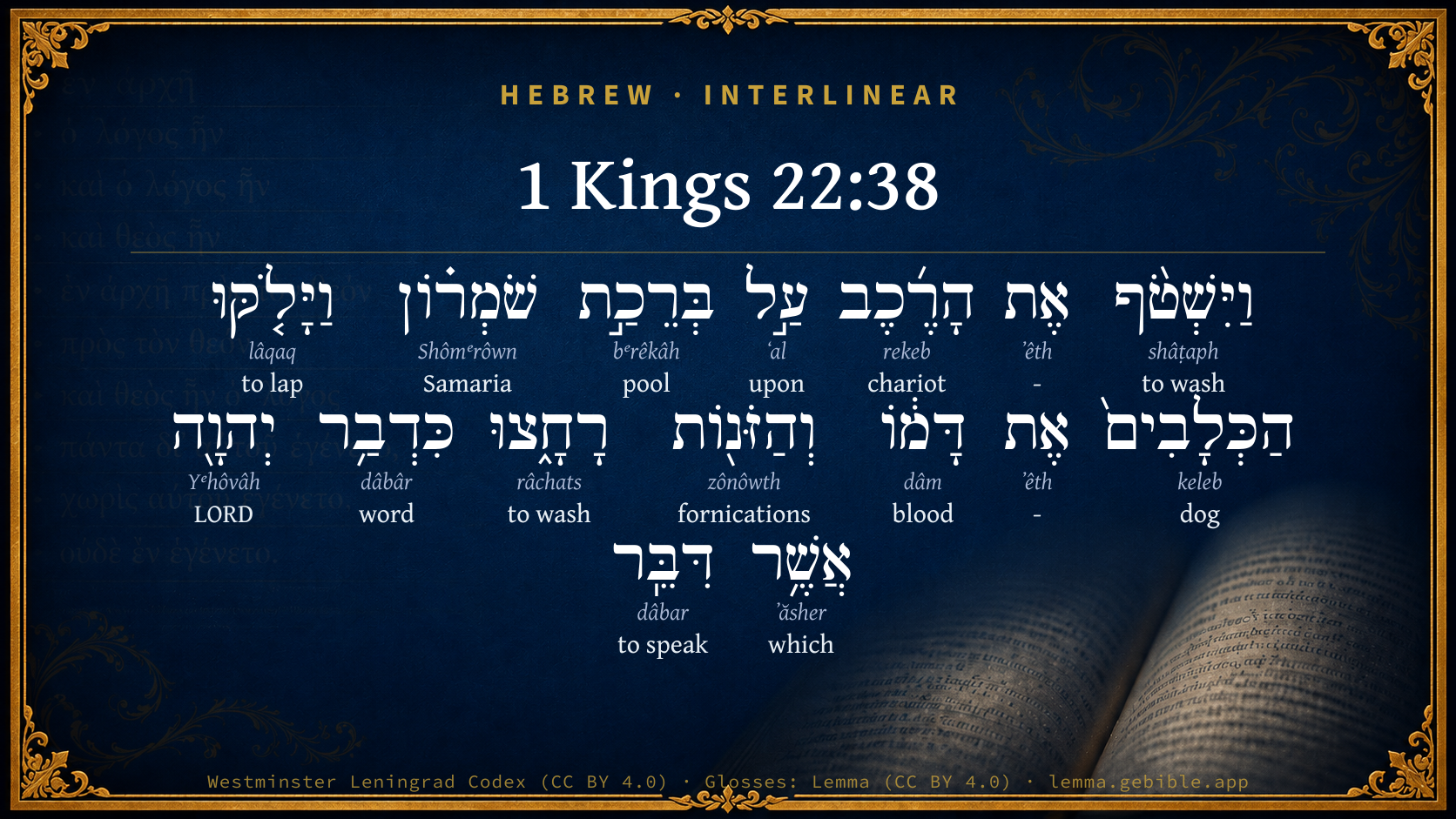
Hebrew (Westminster Leningrad Codex) 1 Kings 22:38 appears in the Hebrew Old Testament. The text above is from the Westminster Leningrad Codex. Each word links to its Strong’s number, a concise gloss, and parsing drawn from the Open Scriptures Hebrew Bible morphology. Click any word for its full Brown-Driver-Briggs (BDB) entry.
Download image
Cite this verse

1 Kings 22:38 (World English Bible). Public Domain. Lemma interlinear Bible study tool, https://lemma.gebible.app/v/1-kings/22/38.

Show BibTeX & RIS
BibTeX
RIS
English Translation
They washed the chariot by the pool of Samaria; and the dogs licked up his blood (now the prostitutes washed themselves [there]); according to the word of Yahweh which he spoke.
World English Bible · Public Domain
Download a study sheet

One document with this verse’s original text, its word-by-word gloss line, the meaning frame, cross-references with their text, attributed commentary, and full source and license credits — printable, and it pastes into notes with its structure intact.

This verse Autodidact and up

Study sheet (.html) Plain text (.txt)

A passage Seminary Student

Up to 50 verses in one chapter. A passage sheet keeps up to 6 commentary sources and 12 cross-references per verse, in the order this page ranks them, and says so on the sheet whenever that leaves anything out. Ask for a single verse and you get the Autodidact verse sheet above.

Everything on this page stays free to read, with no account — the sheet is a download of what is already on screen, not access to it.

Want to remove ads? Support Godless Engineer
Compare translations 3

The same verse in 3 English versions, stacked beneath the original-language interlinear above. Click any original word for its lexicon entry.

Each is an independent rendering of the whole verse — the interlinear is not word-aligned to these translations.

Highlighted words mark where these versions differ — a whole-verse word diff, not a word-by-word alignment.

  • World English Bible Public Domain
    They washed the chariot by the pool of Samaria; and the dogs licked up his blood (now the prostitutes washed themselves [there]); according to the word of Yahweh which he spoke.
  • King James Version Public Domain
    And one washed the chariot in the pool of Samaria; and the dogs licked up his blood; and they washed his armor; according unto the word of the LORD which he spake.
  • unfoldingWord Literal Text CC BY-SA 4.0
    And one washed the chariot at the pool of Samaria. And dogs licked up his blood (now the prostitutes bathed ), according to the word of Yahweh that he had spoken.

unfoldingWord Literal Text — © unfoldingWord, licensed CC BY-SA 4.0. Word-aligned USFM3 via Door43 (git.door43.org/unfoldingWord/en_ult).

Versions to compare (up to 4)

3 of 4 selected

Show all 18 translations

Every available English version of this verse, each an independent rendering of the whole verse.

  • World English Bible Public Domain
    They washed the chariot by the pool of Samaria; and the dogs licked up his blood (now the prostitutes washed themselves [there]); according to the word of Yahweh which he spoke.
  • Berean Standard Bible Public Domain
    And the chariot was washed at the pool of Samaria where the prostitutes bathed, and the dogs licked up Ahab’s blood, according to the word that the LORD had spoken.
  • Majority Standard Bible Public Domain
    And the chariot was washed at the pool of Samaria where the prostitutes bathed, and the dogs licked up Ahab’s blood, according to the word that the LORD had spoken.
  • King James Version Public Domain
    And one washed the chariot in the pool of Samaria; and the dogs licked up his blood; and they washed his armor; according unto the word of the LORD which he spake.
  • American Standard Version (1901) Public Domain
    And they washed the chariot by the pool of Samaria; and the dogs licked up his blood (now the harlots washed themselves `there'); according unto the word of Jehovah which he spake.
  • Revised Version (1885) Public Domain
    And they washed the chariot by the pool of Samaria; and the dogs licked up his blood; (now the harlots washed themselves there;) according unto the word of the LORD which he spake.
  • Geneva Bible (1599) Public Domain
    And one washed the charet in the poole of Samaria, and the dogs licked vp his blood (and they washed his armour) according vnto the word of the Lord which he spake.
  • Douay-Rheims (1899) Public Domain
    And they washed his chariot in the pool of Samaria, and the dogs licked up his blood, and they washed the reins, according to the word of the Lord which he had spoken.
  • Young's Literal Translation Public Domain
    and `one' rinseth the chariot by the pool of Samaria, and the dogs lick his blood -- when the armour they had washed -- according to the word of Jehovah that He spake.
  • Literal Standard Version CC BY-SA 4.0
    and [one] rinses the chariot by the pool of Samaria, and the dogs lick his blood when they had washed the armor, according to the word of YHWH that He spoke.
  • Unlocked Literal Bible CC BY-SA 4.0
    They washed the chariot by the pool of Samaria, and the dogs licked up his blood (this was where the prostitutes bathed), just as the word of Yahweh had declared.
  • unfoldingWord Literal Text CC BY-SA 4.0
    And one washed the chariot at the pool of Samaria. And dogs licked up his blood (now the prostitutes bathed ), according to the word of Yahweh that he had spoken.
  • Darby Bible Public Domain
    And one washed the chariot in the pool of Samaria; and the dogs licked his blood, where the harlots bathed: according to the word of Jehovah, which he had spoken.
  • World Messianic Bible Public Domain
    They washed the chariot by the pool of Samaria; and the dogs licked up his blood where the prostitutes washed themselves, according to the LORD’s word which he spoke.
  • Webster's Bible Public Domain
    And one washed the chariot in the pool of Samaria; and the dogs licked up his blood; and they washed his armor; according to the word of the LORD which he spoke.
  • Free Bible Version CC BY-SA 4.0
    They washed his chariot at a pool in Samaria where the prostitutes came to bathe, and dogs licked up his blood, just as the Lord had said.
  • Bible in Basic English Public Domain
    And the war-carriage was washed by the pool of Samaria, which was the bathing-place of the loose women, and the dogs were drinking his blood there, as the Lord had said.
  • JPS Tanakh (1917) Public Domain
    And they washed the chariot by the pool of Samaria; and the dogs licked up his blood; the harlots also washed themselves there; according unto the word of the LORD which He spoke.

Literal Standard Version (2020), Covenant Press — licensed CC BY-SA 4.0. Text via the HelloAO Bible API (eBible.org). Unlocked Literal Bible (unfoldingWord) — licensed CC BY-SA 4.0. Text via the HelloAO Bible API (eBible.org). unfoldingWord Literal Text — © unfoldingWord, licensed CC BY-SA 4.0. Word-aligned USFM3 via Door43 (git.door43.org/unfoldingWord/en_ult). Free Bible Version, Dr. Jonathan Gallagher — licensed CC BY-SA 4.0. Text via the HelloAO Bible API (eBible.org).

Word by word

More ways to search: Search by grammar → Find every occurrence → Compare this word →

Practice this passage: Drill this verse → Learn its vocabulary →

וְהַזֹּנ֖וֹת
zônôwth
H2185
“and · the · fornications”
Conjunction + Particle, Definite Article + Verb, Qal, Participle Active, Feminine, Plural, Absolute
Part of Speech
Conjunction + Particle + Verb
Stem
Qal
Form
Participle Active
Gender
Feminine
Number
Plural
State
Absolute
Full BDB Definition

Origin: regarded by some as if from H2109 or an unused root, and applied to military equipments

TWOT: but evidently the act. participle of 02181

fornications - armour (used in warfare not sanctioned by Jehovah) (figuratively)
  1. וַיִּשְׁטֹ֨ף shâṭaph H7857 “and · to wash” Conjunction + Verb, Qal, Sequential Imperfect, 3rd Person, Masculine, Singular
  2. אֶת ʼêth H853 “-” Particle, Direct Object
  3. הָרֶ֜כֶב rekeb H7393 “the · chariot” Particle, Definite Article + Noun, Common, Masculine, Singular, Absolute
  4. עַ֣ל ʻal H5921 “upon” Preposition
  5. בְּרֵכַ֣ת bᵉrêkâh H1295 “pool of” Noun, Common, Feminine, Singular, Construct
  6. שֹׁמְר֗וֹן Shômᵉrôwn H8111 “Samaria” Noun, Proper
  7. וַיָּלֹ֤קּוּ lâqaq H3952 “and · to lap” Conjunction + Verb, Qal, Sequential Imperfect, 3rd Person, Masculine, Plural
  8. הַכְּלָבִים֙ keleb H3611 “the · dogs” Particle, Definite Article + Noun, Common, Masculine, Plural, Absolute
  9. אֶת ʼêth H853 “-” Particle, Direct Object
  10. דָּמ֔וֹ dâm H1818 “blood · his” Noun, Common, Masculine, Singular, Construct + Suffix, Personal, 3rd Person, Masculine, Singular
  11. רָחָ֑צוּ râchats H7364 “to wash” Verb, Qal, Perfect, 3rd Person, Common, Plural
  12. כִּדְבַ֥ר dâbâr H1697 “like/as · word of” Preposition + Noun, Common, Masculine, Singular, Construct
  13. יְהוָ֖ה Yᵉhôvâh H3068 “LORD” Noun, Proper
  14. אֲשֶׁ֥ר ʼăsher H834 “which” Particle, Relative
  15. דִּבֵּֽר dâbar H1696 “to speak” Verb, Piel, Perfect, 3rd Person, Masculine, Singular

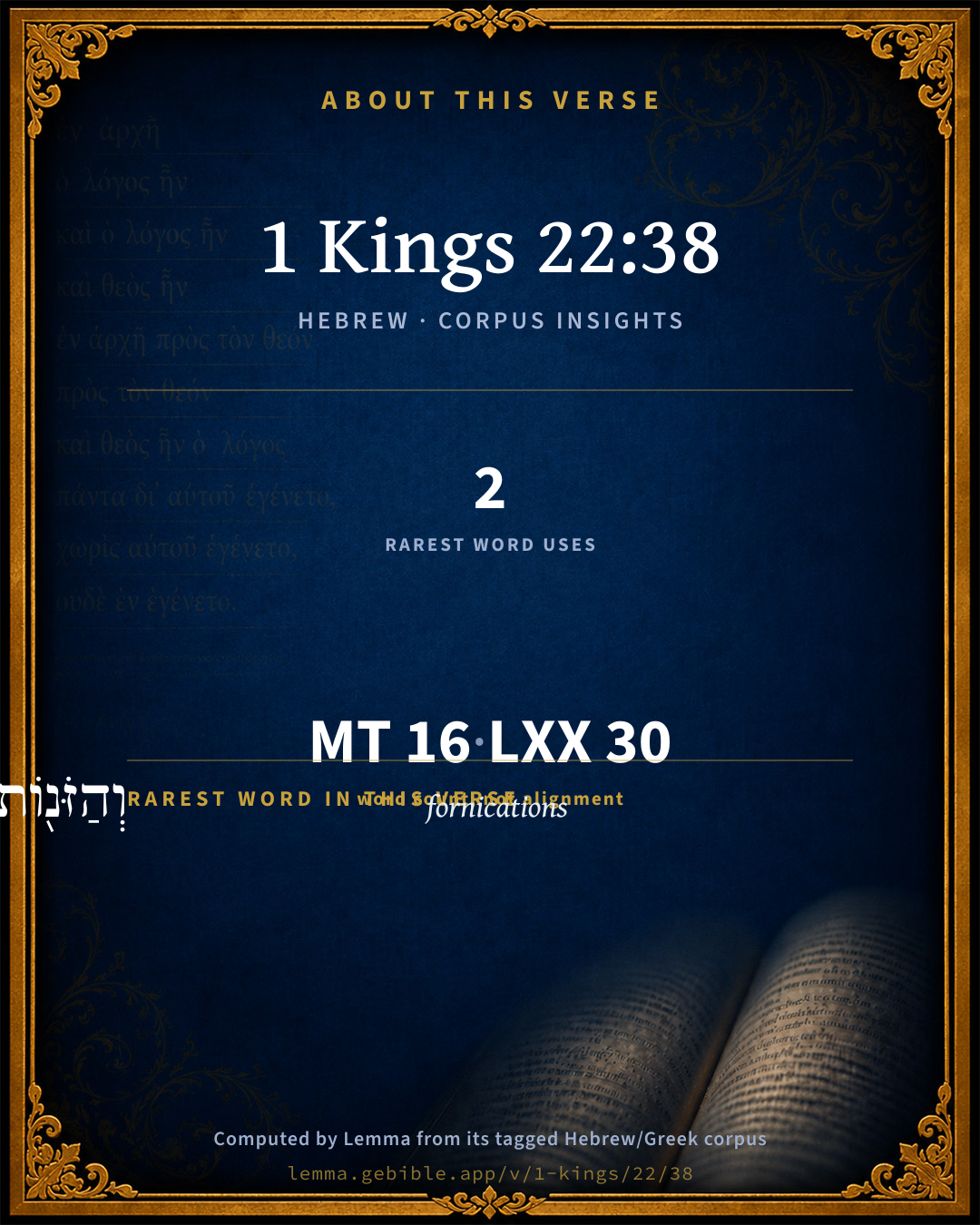
About this verse

These counts appear in no published source. They are computed here, from the morphology-tagged text and Lemma’s own curated glosses. What Lemma adds →

16
words
15
distinct lemmas
Historical
section

Notable vocabulary

The rarest word here is וְהַזֹּנ֖וֹת fornications H2185 — appearing just 2 times in the whole Hebrew Bible.

Shared distinctive vocabulary

וְהַזֹּנ֖וֹת fornications H2185 occurs in 2 verses of the Hebrew Bible. Also found in:

Grammatical profile

  • 5 verbs
  • 7 nouns
  • 1 preposition
  • 3 particles

Verb forms

  • וַיִּשְׁטֹ֨ף Qal · Sequential Imperfect
  • וַיָּלֹ֤קּוּ Qal · Sequential Imperfect
  • וְהַזֹּנ֖וֹת Qal · Participle Active
  • רָחָ֑צוּ Qal · Perfect
  • דִּבֵּֽר Piel · Perfect

Hebrew & Septuagint length

In English translation the verse runs 31 words from the Hebrew and 38 from the Septuagint (LXX English) — closely comparable.

A rough comparison of the two English renderings, which tokenize alike — not a word-level alignment.

Word counts can differ between the Hebrew and the Greek without any difference in meaning — e.g. the Hebrew direct-object marker אֵת has no separate Greek word, and Greek often adds the article ὁ.

In the original languages it is 16 Hebrew tokens and 30 Greek tokens — but the two are counted differently (Hebrew bundles its prefixes and suffixes into one token; the Greek is in lemma form), so that isn’t a like-for-like length.

Cross-references

7

Topical passages linked to 1 Kings 22:38 in the Treasury of Scripture Knowledge — connected by theme and wording, ordered by reader-vote popularity; previews shown in the World English Bible.

  • 1 Kings 21:19 You shall speak to him, saying, Thus says Yahweh, Have you killed and also taken possession? You shall speak to him, saying, Thus says Yahweh, In the place where dogs licked the blood of Naboth shall dogs lick your blood, even yours.
  • Matthew 24:35 Heaven and earth will pass away, but my words will not pass away.
  • Joshua 23:14–15 Behold, this day I am going the way of all the earth: and you know in all your hearts and in all your souls, that not one thing has failed of all the good things which Yahweh your God spoke concerning you; all are happen to you, not one thing has failed of it.
  • Isaiah 44:25–26 who frustrates the signs of the liars, and makes diviners mad; who turns wise men backward, and makes their knowledge foolish;
  • Isaiah 48:3–5 I have declared the former things from of old; yes, they went forth out of my mouth, and I shown them: suddenly I did them, and they happened.
  • Jeremiah 44:21–23 The incense that you burned in the cities of Judah, and in the streets of Jerusalem, you and your fathers, your kings and your princes, and the people of the land, didn't Yahweh remember them, and didn't it come into his mind?
  • Zechariah 1:4–6 Don't you be like your fathers, to whom the former prophets proclaimed, saying: Thus says Yahweh of hosts, 'Return now from your evil ways, and from your evil doings;' but they did not hear, nor listen to me, says Yahweh.

Cross-references courtesy of OpenBible.info (CC BY 4.0).

Hebrew and Greek witnesses Masoretic Hebrew ↔ Greek Septuagint

The same verse in the two great witnesses to the Old Testament, shown verse-for-verse.

These are two independent witnesses, not word-aligned to each other, and the Septuagint is shown in lemma (dictionary) form.

Hebrew 1 Kings 22:38 Masoretic · Westminster Leningrad Codex

וַיִּשְׁטֹ֨ף אֶת הָרֶ֜כֶב עַ֣ל בְּרֵכַ֣ת שֹׁמְר֗וֹן וַיָּלֹ֤קּוּ הַכְּלָבִים֙ אֶת דָּמ֔וֹ וְהַזֹּנ֖וֹת רָחָ֑צוּ כִּדְבַ֥ר יְהוָ֖ה אֲשֶׁ֥ר דִּבֵּֽר

They washed the chariot by the pool of Samaria; and the dogs licked up his blood (now the prostitutes washed themselves [there]); according to the word of Yahweh which he spoke.

World English Bible · Public Domain

Greek LXX 1 Kings 22:38 Septuagint · lemma form

καί ἀπονίπτω ὁ ἅρμα ἐπί ὁ κρήνη σαμαρεία καί ἐκλείχω ὁ ὗς καί ὁ κύων ὁ αἷμα καί ὁ πόρνη λούω ἐν ὁ αἷμα κατά ὁ ῥῆμα κύριος ὅς λαλέω

And they washed the chariot at the fountain of Samaria; and the swine and the dogs licked up the blood, and the harlots washed themselves in the blood, according to the word of the Lord which he spoke.

LXX2012 (modern English Septuagint) · Public Domain

On this verse, Adam Clarke's Commentary discusses the Septuagint’s reading. Read the note in Commentary ↓

Hebrew: Westminster Leningrad Codex (CC BY 4.0). Greek: Septuagint (public domain); English from LXX2012 (modern English Septuagint) (Public Domain). How the Septuagint differs from the Hebrew →

Targum (Aramaic paraphrase)

1

The Targum is the ancient Jewish Aramaic paraphrase of the Hebrew Scriptures — an interpretive translation, not the Hebrew text itself. Onkelos (literal) and Pseudo-Jonathan (expansive) render the Torah, and Jonathan the Prophets. Coverage is partial: where no permissively-licensed English translation exists for a verse, only the Aramaic is shown. This is verse-level text, not a word-by-word alignment to the Hebrew.

  1. Targum Jonathan Prophets (Joshua–Malachi)
    וּשְׁטַף יַת רְתִיכַיָא עַל בְּרֵיכָתָא דְשֹׁמְרוֹן וּלְחָכוּ כַלְבַּיָא יַת דְמֵיהּ וּמָנֵי זְיָנָא שְׁטָפוּ כְּפִתְגָמָא דֵיָי דְמַלֵיל:

    (no public-domain English translation for this verse)

    Targum Jonathan — Aramaic: “Mikraot Gedolot” (public domain). English: “Sefaria Community Translation” (CC0 1.0 (public-domain dedication)); “London "Chaldee Paraphrase," 1871” (public domain). Text via Sefaria.

Commentary

Notes on 1 Kings 22:38 from classic Christian and Jewish commentators (each source and its license shown beneath its notes). The classic Christian expositions comment on the surrounding passage and are grouped to its opening verse, so a note may address several verses; the Jewish commentaries on the Tanakh (Rashi and others) are per-verse, so they appear only where the commentator wrote on this verse.

Lemma curates 59 commentaries, every one of them public domain or Creative Commons licensed, each selected and text-cleaned for this edition rather than reprinted as found. About our sources →

Trapp's Complete Commentary

John Trapp

1Ki 22:38 And [one] washed the chariot in the pool of Samaria; and the dogs licked up his blood; and they washed his armour; according unto the word of the LORD which he spake.

Ver. 38. In the pool of Samaria.] So the pool in Jezreel might be called, for the reason above given, on 1Ki 21:19.

John Trapp, A Commentary or Exposition upon All the Books of the Old and New Testament (1647–1656) — public domain. Text from a community e-Sword module.

Joseph Benson's Commentary

1Ki 22:38. The dogs licked up his blood — Together with the water wherewith it was mixed. This circumstance is noticed because it was the accomplishment of one part of Elijah’s prophecy concerning him. Now Naboth’s blood was avenged!

Joseph Benson's Commentary on the Old and New Testaments (1811–1818) — public domain. Text from a community e-Sword module.

Geneva Bible (1599)

Geneva Bible translators

1 Kings 31:19

Or, the harlots washed it.

Geneva Bible (1599) marginal notes — public domain. Text via Bolls.life.

Adam Clarke's Commentary

Verse 38. The dogs licked up his blood] Some of the rabbins think that this was in the very place where Naboth was stoned; see on 1Kg 21:19. The Septuagint translates this verse strangely: "And the swine and the dogs licked his blood, and the whores bathed themselves in his blood, according to the word of the Lord." It is certain that the Hebrew words, הזנות רחצו hazzonoth rachatsu, "washed his armour," might be translated as the Septuagint have done; "and the whores (or public women) washed," c. And so the rabbins seem to have understood the words but then they suppose that Jezebel had made him two images of prostitutes, which he had with him in the chariot. It is not worth inquiring into the use for which they say these images were made. See Kimchi and Jarchi.

Adam Clarke's Commentary on the Bible (1810–1826) — public domain. Text from a community e-Sword/MySword module.

Ellicott's Commentary for English Readers

(38) They washed his armour.—There seems little doubt that this is a mistranslation, and that the LXX. rendering (supported also by Josephus) is correct: “And the harlots bathed in it,” that is, in the bloodstained pool, the usual public bathing-place of their shamelessness. The dog and the harlot are the animal and human types of uncleanness.

According unto the word of the Lord.—The reference to the emphatic prophecy of Elijah is unmistakable, and the context fixes its fulfilment plainly as having taken place in Samaria. The difficulty is, of course, the notice in 2Ki_9:25, where the dead body of Jehoram is cast “in the portion of the field of Naboth,” evidently at Jezreel; with quotation of the “burden of the Lord laid upon him,” “I will requite thee in this plot, saith the Lord.” The reconcilement is, with our knowledge, difficult, if not impossible. But the reference in the text is so much clearer, that it must outweigh the other. Naboth, in any case, is likely to have had land in his native place, which would be forfeited to the king; and there would still be an appropriate judgment in making it also the scene of the dishonoured death of the last king of Ahab’s house. We may notice, moreover, that the quotation in 2 Kings 9 is not taken from Elijah’s words against Ahab, nor does it contain the characteristic notice of the “dogs licking the blood;” though it is noticed as a fulfilment of the subsequent prophecy of chapter 21:24 against Ahab’s house.

A Bible Commentary for English Readers, edited by Charles John Ellicott (1878–1897) — public domain. Text from a community e-Sword module.

The Cambridge Bible for Schools and Colleges

gen. ed. J. J. S. Perowne

38. And one [R.V. they] washed the chariot in [R.V. by] the pool of Samaria] The first change substitutes an English for a Hebrew idiom; the second renders more exactly the preposition of the original. It was necessary in the East to provide large reservoirs outside each town that the supplies of water in the rainy season might be kept for times of drought. Many such pools are mentioned in Scripture, and some, for example those at Bethlehem, remain to the present day. To the side of such a tank the royal equipage was brought to be washed. Thus Ahab’s blood came to be licked up by the dogs in the same sort of spot, outside the city walls, as that where Naboth’s blood was licked up near Jezreel.

and the dogs licked, &c.] Here as above in 1Ki_21:19 the LXX. adds ‘the swine’ to the dogs.

and they washed his armour] R.V. Now the harlots washed themselves there. This change, which is the rendering of the LXX., is no doubt correct. The Hebrew word זנות occurs often in the O. Test. and means nothing else but ‘harlots,’ while the verb in the sentence is not one applied to washing articles that need cleaning but to bathing the body. Cf. Exo_30:19; Exo_30:21; Exo_40:12; Exo_40:31; Lev_16:4; Lev_16:24; Lev_16:26; Lev_16:28, and in Num_19:19 another verb is used for ‘wash his clothes’ and the present verb rendered ‘bathe himself,’ and in the verse before us another verb is employed to describe the washing of the chariot.

The R.V. by placing this clause in a parenthesis seems to treat it as a subsidiary feature in the description. This was the place to which they usually came to bathe. Some have however suggested that the women alluded to were those attached (as such persons were) to the temples of Baal and Ashtoreth, and that thus a greater indignity still was offered to this fosterer of idolatrous worship. This interpretation however reads a good deal into the text which is not there. And surely it was indignity enough for the royal blood to be washed into the waters of the harlots’ bath. It should be mentioned that Josephus, and, among the Fathers, Theodoret, support the rendering of R.V. The A.V. is derived from the Chaldee and the Syriac versions.

The Cambridge Bible for Schools and Colleges (gen. ed. J. J. S. Perowne; Cambridge University Press, 1878–1918) — public domain. Text from a community e-Sword module.

John Gill's Exposition

And he walked in all the ways of Asa his father,.... Who was a good prince:

he turned not aside from doing that which was right in the eyes of the Lord; in his moral conversation, religious worship, and civil government:

nevertheless, the high places were not taken away, for the people offered and burnt incense yet in the high places; he took away the high places and groves for idolatrous worship, Ch2 17:6, but not the high places in which sacrifices were offered to the Lord, which ought to have been, especially since the temple was built; and those in the tribes of Judah and Benjamin were altogether inexcusable, being near to the temple, and under no restraint, as those of the ten tribes were; but the people were fond of them, because of their antiquity, and it was difficult for religious princes to remove them, if inclined.

John Gill's Exposition of the Whole Bible (1746–1763) — public domain (CC PDM 1.0). Text via the HelloAO Bible API.

Albert Barnes' Notes on the Bible

They washed his armour - Rather, “the harlots bathed in it.” The “pool of Samaria,” which was stained with Ahab’s blood by the washing of his chariot in it, was, according to Josephus, the usual bathing-place of the Samaritan harlots. A large tank or reservoir, probably identical with this pool, still remains on the slope of the hill of Samaria, immediately outside the walls.

Albert Barnes' Notes on the Bible (1834–1885) — public domain. Text from a community e-Sword/MySword module.

Haydock's Catholic Bible Commentary

Of Samaria. Josephus says, of Jezara, (Jezrahel) conformably to the prediction. But God had relented in that particular, on Achab’s repentance; (Calmet; Chap. xxi. 24, 29.) unless it regarded his son Joram. (Haydock) (Salien) --- Reins. Hebrew zonoth, may also signify "arms," (Munster) and "harlots." (Septuagint) Some suspect that such were painted on the chariot. Josephus intimates, with the Septuagint, that "harlots bathed in the blood," (Antiquities viii. 15.) which would tend to the greater contempt of Achab. (Menochius) --- Spoken, respecting dogs licking up Achab’s blood. No mention had been made of the chariot. God was thus pleased to shew how easily he could have executed the sentence in all its rigour.

George Leo Haydock (1774–1849), Haydock's Catholic Family Bible and Commentary, 1859 edition — public domain. Excludes Psalms (Douay-Rheims chapter numbering differs from Protestant) and Deuterocanonical books (Catholic canon only).

Matthew Poole's English Annotations

The dogs licked up his blood, together with the water wherewith it was mixed.

According unto the word of the Lord; of which See Poole "1Ki 21:19".

Matthew Poole's English Annotations on the Holy Bible (1683–1685) — public domain. Text from a community e-Sword/MySword module.

Whedon's Commentary on the Bible

Daniel D. Whedon

38. Dogs licked up his blood — The blood which all that day had been trickling through his armour and falling down upon the chariot. Thus was partially fulfilled the words of Elijah. 1Ki_21:19.

And they washed his armour — Rather, and harlots bathed; that is, harlots came and bathed in the water of the pool while it was yet stained with the blood of the fallen king. This fact is recorded to show the unconcern and contempt with which the death of Ahab was regarded even in his own metropolis.

Daniel D. Whedon (gen. ed.), Commentary on the Old and New Testaments (1874–1909) — public domain. Text from a community e-Sword module.

The Pulpit Commentary

And one washed the chariot in or at; Heb. l the pool of Samaria. Nearly all Eastern cities had their tanks or pools, often outside the city gate. Jerusalem has several of these, and we read of one at Hebron (2Sa_14:12) and Gibeon. (2Sa_2:13) Cf. Son_7:4. The Hebrew word hkreB is preserved in the modern Arabic Birkeh; and the dogs The LXX has the swine and the dogs. The mention of swine is hardly likely to have been omitted, had it formed part of the original text licked up his blood cf. 1Ki_21:19, note. According to Josephus, the chariot was washed "in the fountain of Jezreel." The alteration would appear to have been made to avoid the difficulty occasioned by the discrepancy between the statement of the text, and that of, (1Ki_21:19) and they washed his armour So the Chaldaic and the Syriac. But this translation is now abandoned,

(1) because it is contrary.to the usage of the language to make twOnOz the object; and

(2) because that word occurs in the Old Testament only in the sense of harlots (Bahr). The true meaning is that given by the LXX, kairnai ejlousanto. jr does not require any object such as chariot," or corpse," for it is found in the sense of bathe (intrans.) in Num_19:19; Ru 3 2Ki_5:10. Bahr reminds us that harlots are elsewhere associated with dogs (Deu_23:19; Rev_22:15) This fact is mentioned as a proof of the just judgment of God. Even if these harlots were not prostitutes devoted to the service of the Phoenician deities, whose cultus Ahab had sought to establish in Israel, still the result of his religious policy had been the spread of prostitution. It is a fine example of the lex tolionis. "He which is filthy, let him be filthy still"; according unto the word of the Lord which he spake the reference is to. (1Ki_21:19)

The Pulpit Commentary (1880–1919), ed. H.D.M. Spence-Jones & Joseph S. Exell — public domain. Text from a community e-Sword module.

Rashi

Rabbi Shlomo Yitzchaki (Rashi)

And the dogs licked his blood. I say that Novos was killed there, for the prophet said, “In the place where the dogs licked the blood of Navos, etc.”

And they washed the weapons [there]. And they washed off blood from the weapons there, [Targum] Yonoson rendered it in this manner. But our Rabbis said, “Achov was a cold person, so Ezevel made for him the image of two prostitutes in his chariot.

Rashi on the Tanakh — English translations: “The Judaica Press complete Tanach with Rashi, translated by A. J. Rosenberg” (CC BY 4.0); “Pentateuch with Rashi's commentary by M. Rosenbaum and A.M. Silbermann, 1929-1934” (public domain); “The Metsudah Tanach series, Lakewood, N.J” (CC BY 4.0); and “The Book of Joshua, Metsudah Publications, 1997” (CC BY 4.0). Text via Sefaria.

Lesson kit

Teaching starters — assembled from the data on this page, not authored interpretation. Every prompt links to the verse data it draws on. Edit before teaching.

1 Kings, in the Historical, opens this verse with 16 words (15 distinct Hebrew lemmas). Its most distinctive word is zônôwth (“fornications”). A historical commentator’s framing appears above. Read the whole chapter for the surrounding context.

Discussion questions

  1. The word zônôwth carries the sense “fornications.” How does it shape the verse?
  2. 1 Kings 3:16 shares the word «fornications» with this verse. How do the two illuminate each other?
  3. These translations render this verse differently. What is at stake in choosing one wording over another?
  4. The verb «וַיִּשְׁטֹ֨ף» is Qal Sequential Imperfect. How does its form color the action?
  5. Reading how Trapp's Complete Commentary and Joseph Benson's Commentary read this verse, where do the two commentators agree and where do they part?

Things to notice

Reading settings

Reading text

Shown beneath each verse's original-language words.

Old Testament
Old Testament edition

Read the OT as the Masoretic Hebrew (MT) or the Greek Septuagint (LXX).

English shown for the Greek Septuagint (in the Hebrew ↔ Greek comparison).

Comparing translations? Open the Compare panel on any verse page to stack up to four side by side.