
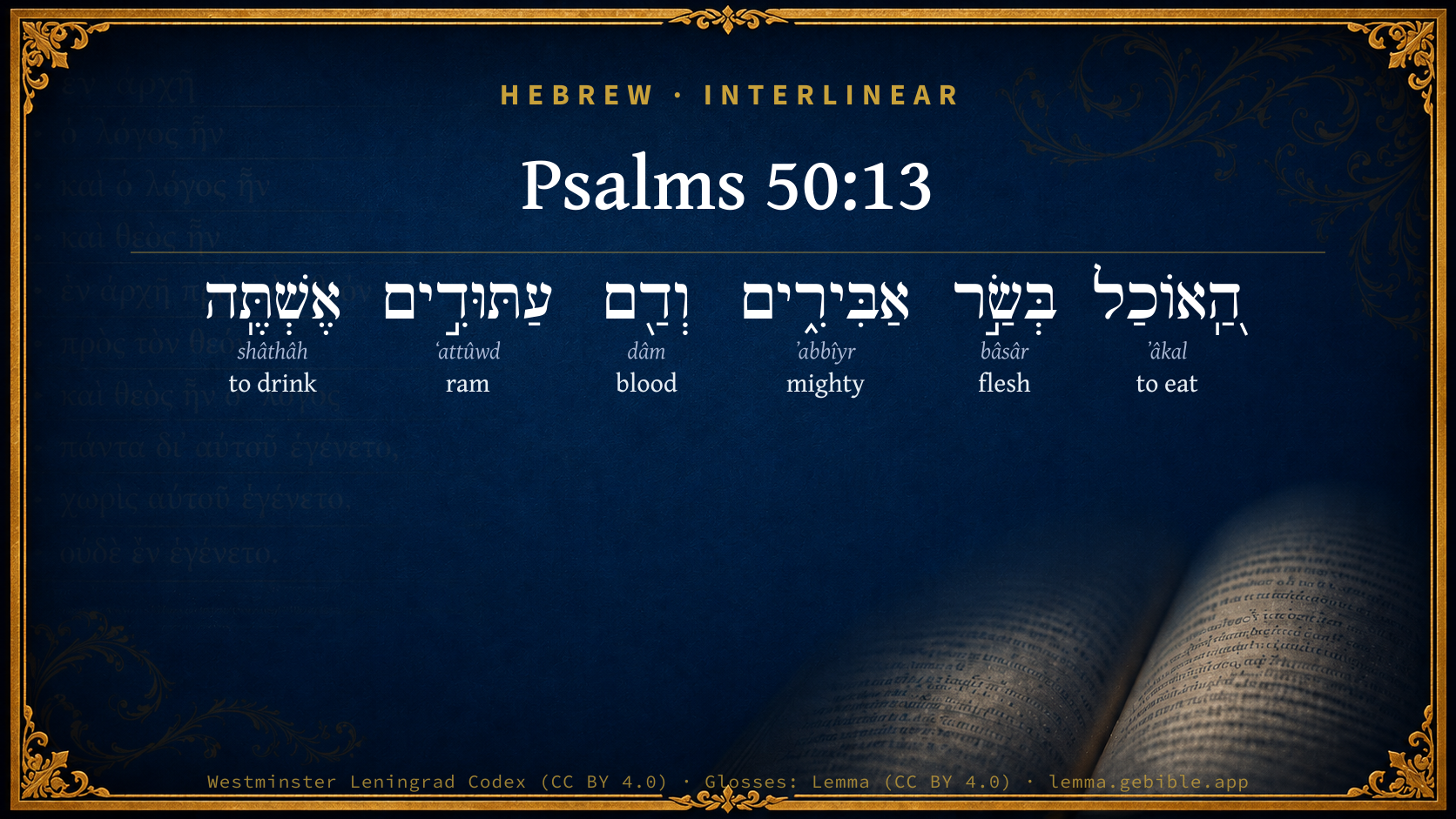
Psalms 50:13

Hebrew (Westminster Leningrad Codex) Psalms 50:13 appears in the Hebrew Old Testament. The text above is from the Westminster Leningrad Codex. Each word links to its Strong’s number, a concise gloss, and parsing drawn from the Open Scriptures Hebrew Bible morphology. Click any word for its full Brown-Driver-Briggs (BDB) entry.
Download image
Cite this verse

Psalms 50:13 (World English Bible). Public Domain. Lemma interlinear Bible study tool, https://lemma.gebible.app/v/psalms/50/13.

Show BibTeX & RIS
BibTeX
RIS
English Translation
Will I eat the flesh of bulls, Or drink the blood of goats?
World English Bible · Public Domain
Download a study sheet

One document with this verse’s original text, its word-by-word gloss line, the meaning frame, cross-references with their text, attributed commentary, and full source and license credits — printable, and it pastes into notes with its structure intact.

This verse Autodidact and up

Study sheet (.html) Plain text (.txt)

A passage Seminary Student

Up to 50 verses in one chapter. A passage sheet keeps up to 6 commentary sources and 12 cross-references per verse, in the order this page ranks them, and says so on the sheet whenever that leaves anything out. Ask for a single verse and you get the Autodidact verse sheet above.

Everything on this page stays free to read, with no account — the sheet is a download of what is already on screen, not access to it.

Want to remove ads? Support Godless Engineer
Compare translations 3

The same verse in 3 English versions, stacked beneath the original-language interlinear above. Click any original word for its lexicon entry.

Each is an independent rendering of the whole verse — the interlinear is not word-aligned to these translations.

Highlighted words mark where these versions differ — a whole-verse word diff, not a word-by-word alignment.

  • World English Bible Public Domain
    Will I eat the flesh of bulls, Or drink the blood of goats?
  • King James Version Public Domain
    Will I eat the flesh of bulls, or drink the blood of goats?
  • unfoldingWord Literal Text CC BY-SA 4.0
    Do I eat the flesh of bulls, or do I drink the blood of goats?

unfoldingWord Literal Text — © unfoldingWord, licensed CC BY-SA 4.0. Word-aligned USFM3 via Door43 (git.door43.org/unfoldingWord/en_ult).

Versions to compare (up to 4)

3 of 4 selected

Show all 18 translations

Every available English version of this verse, each an independent rendering of the whole verse.

  • World English Bible Public Domain
    Will I eat the flesh of bulls, Or drink the blood of goats?
  • Berean Standard Bible Public Domain
    Do I eat the flesh of bulls, or drink the blood of goats?
  • Majority Standard Bible Public Domain
    Do I eat the flesh of bulls, or drink the blood of goats?
  • King James Version Public Domain
    Will I eat the flesh of bulls, or drink the blood of goats?
  • American Standard Version (1901) Public Domain
    Will I eat the flesh of bulls, Or drink the blood of goats?
  • Revised Version (1885) Public Domain
    Will I eat the flesh of bulls, or drink the blood of goats?
  • Geneva Bible (1599) Public Domain
    Will I eate the flesh of bulles? or drinke the blood of goates?
  • Douay-Rheims (1899) Public Domain
    Shall I eat the flesh of bullocks? or shall I drink the blood of goats?
  • Young's Literal Translation Public Domain
    Do I eat the flesh of bulls, And drink the blood of he-goats?
  • Literal Standard Version CC BY-SA 4.0
    Do I eat the flesh of bulls, || And drink the blood of male goats?
  • Unlocked Literal Bible CC BY-SA 4.0
    Will I eat the flesh of bulls or drink the blood of goats?
  • unfoldingWord Literal Text CC BY-SA 4.0
    Do I eat the flesh of bulls, or do I drink the blood of goats?
  • Darby Bible Public Domain
    Should I eat the flesh of bulls, and drink the blood of goats?
  • World Messianic Bible Public Domain
    Will I eat the meat of bulls, or drink the blood of goats?
  • Webster's Bible Public Domain
    Will I eat the flesh of bulls, or drink the blood of goats?
  • Free Bible Version CC BY-SA 4.0
    Do I eat the flesh of bulls or drink the blood of goats?
  • Bible in Basic English Public Domain
    Am I to take the flesh of the ox for my food, or the blood of goats for my drink?
  • JPS Tanakh (1917) Public Domain
    Do I eat the flesh of bulls, or drink the blood of goats?

Literal Standard Version (2020), Covenant Press — licensed CC BY-SA 4.0. Text via the HelloAO Bible API (eBible.org). Unlocked Literal Bible (unfoldingWord) — licensed CC BY-SA 4.0. Text via the HelloAO Bible API (eBible.org). unfoldingWord Literal Text — © unfoldingWord, licensed CC BY-SA 4.0. Word-aligned USFM3 via Door43 (git.door43.org/unfoldingWord/en_ult). Free Bible Version, Dr. Jonathan Gallagher — licensed CC BY-SA 4.0. Text via the HelloAO Bible API (eBible.org).

Word by word

More ways to search: Search by grammar → Find every occurrence → Compare this word →

Practice this passage: Drill this verse → Learn its vocabulary →

About this verse

These counts appear in no published source. They are computed here, from the morphology-tagged text and Lemma’s own curated glosses. What Lemma adds →

6
words
6
distinct lemmas
Wisdom
section

Notable vocabulary

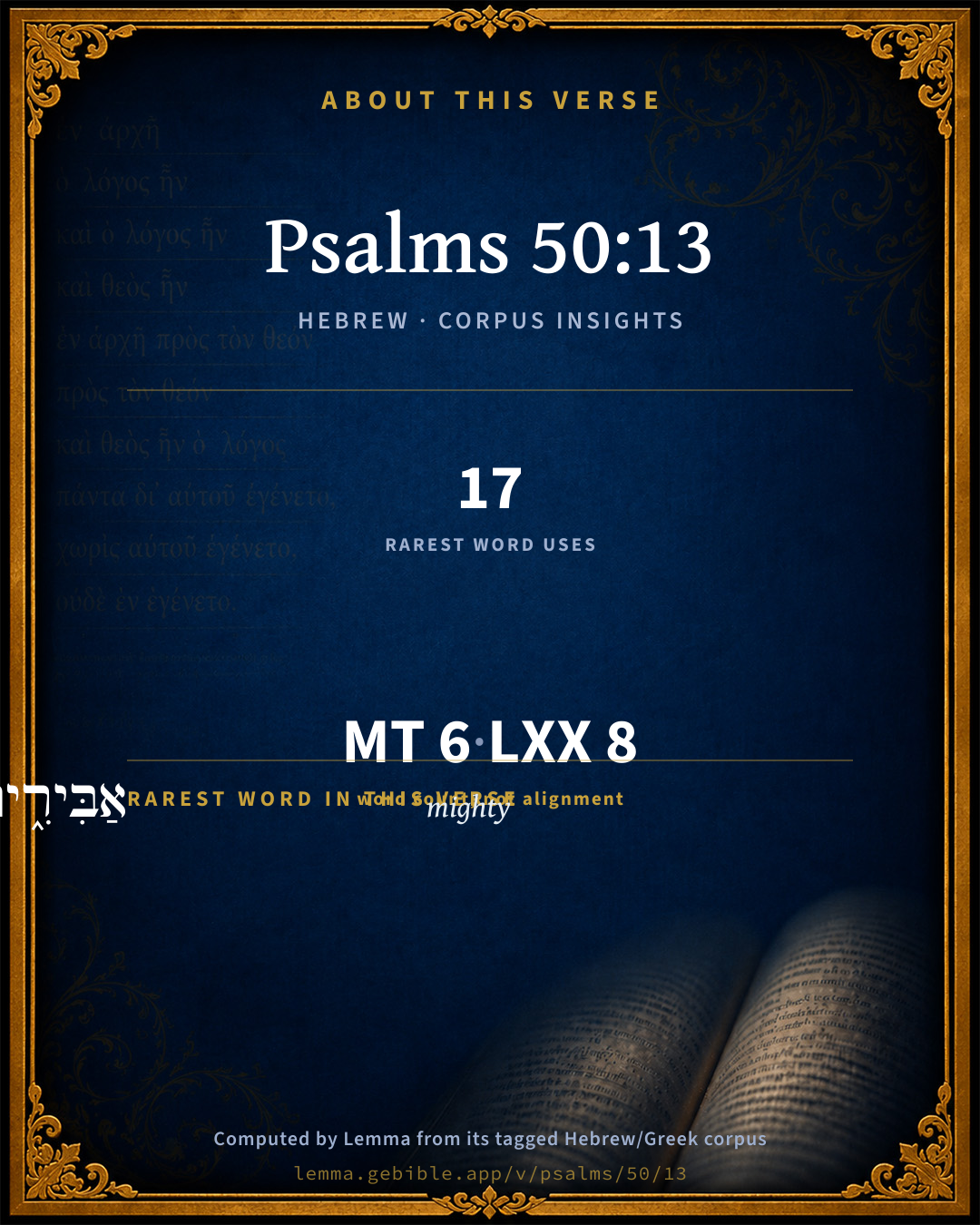
The rarest word here is אַבִּירִ֑ים mighty H47 — appearing just 17 times in the whole Hebrew Bible.

Shared distinctive vocabulary

אַבִּירִ֑ים mighty H47 occurs in 17 verses of the Hebrew Bible. Also found in:

Grammatical profile

  • 2 verbs
  • 3 nouns
  • 1 adjective

Verb forms

  • הַֽ֭אוֹכַל Qal · Imperfect
  • אֶשְׁתֶּֽה Qal · Imperfect

Hebrew & Septuagint length

In English translation the verse runs 13 words from the Hebrew and 13 from the Septuagint (LXX English) — the same length.

A rough comparison of the two English renderings, which tokenize alike — not a word-level alignment.

Word counts can differ between the Hebrew and the Greek without any difference in meaning — e.g. the Hebrew direct-object marker אֵת has no separate Greek word, and Greek often adds the article ὁ.

In the original languages it is 6 Hebrew tokens and 8 Greek tokens — but the two are counted differently (Hebrew bundles its prefixes and suffixes into one token; the Greek is in lemma form), so that isn’t a like-for-like length.

Hebrew and Greek witnesses Masoretic Hebrew ↔ Greek Septuagint

The same verse in the two great witnesses to the Old Testament, shown verse-for-verse.

You’re reading Greek Psalm 49 (Hebrew Psalm 50). The Septuagint counts the superscription, so verse numbers can differ from the Hebrew — chapter-level alignment, not verse-by-verse. Numbering follows Rahlfs.

These are two independent witnesses, not word-aligned to each other, and the Septuagint is shown in lemma (dictionary) form.

Hebrew Psalms 50:13 Masoretic · Westminster Leningrad Codex

הַֽ֭אוֹכַל בְּשַׂ֣ר אַבִּירִ֑ים וְדַ֖ם עַתּוּדִ֣ים אֶשְׁתֶּֽה

Will I eat the flesh of bulls, Or drink the blood of goats?

World English Bible · Public Domain

Greek LXX Greek Psalm 49:13 Septuagint · lemma form

μή ἐσθίω κρέας ταῦρος ἤ αἷμα τράγος πίνω

Will I eat the flesh of bulls, or drink the blood of goats?

LXX2012 (modern English Septuagint) · Public Domain

Hebrew: Westminster Leningrad Codex (CC BY 4.0). Greek: Septuagint (public domain); English from LXX2012 (modern English Septuagint) (Public Domain). How the Septuagint differs from the Hebrew →

Commentary

Notes on Psalms 50:13 from classic Christian and Jewish commentators (each source and its license shown beneath its notes). The classic Christian expositions comment on the surrounding passage and are grouped to its opening verse, so a note may address several verses; the Jewish commentaries on the Tanakh (Rashi and others) are per-verse, so they appear only where the commentator wrote on this verse.

Lemma curates 59 commentaries, every one of them public domain or Creative Commons licensed, each selected and text-cleaned for this edition rather than reprinted as found. About our sources →

Trapp's Complete Commentary

John Trapp

Psa 50:13 Will I eat the flesh of bulls, or drink the blood of goats?

Ver. 13. Will I eat the flesh of bulls, &c.?] q.d. Are you so thick brained as to think so?

Vervecum in patria, crassoque sub aere nati?

No; "He that killeth an ox" (unless he kill his corruptions too) "is as if he slew a man; he that sacrificeth a lamb" (unless he see his own guilt, and be carried out to the immaculate Lamb of God, who taketh away the sins of the world) is "as if he cut off a dog’s neck; he that offereth an oblation" (unless therewith he offer up himself for a whole burnt sacrifice, Rom 12:1) is "as if he offered swine’s blood; he that burneth incense" (unless he lift up holy hands in prayer without wrath, and without doubting, 1Ti 2:8) is "as if he blessed an idol," Isa 66:3.

John Trapp, A Commentary or Exposition upon All the Books of the Old and New Testament (1647–1656) — public domain. Text from a community e-Sword module.

J. A. Alexander on Psalms

Joseph Addison Alexander

13. (Psa 50:13) Will I eat the flesh of bulls and drink the blood of goats? The future of the Hebrew verb is very expressive, suggesting the ideas of possibility, necessity, and desire. Do I desire the flesh and blood of beasts for my refreshment? Do I need them for my sustenance? Or is it even possible for me to use them in the way that you imagine? The negative answer, which is obviously expected to these questions, presupposes the great doctrine that Jehovah is a spirit, and as such exempt from all corporeal necessities. This, then, is another refutation of the gross and impious error that he needed their oblations. If they were necessary in themselves, he could obtain them elsewhere; and that they are not necessary follows, as an inevitable consequence, from the spirituality of the divine nature. This is not the language of dry and formal ratiocination, which, on such a subject and in such a connection, would be not only misplaced but revolting. It is rather the language of impassioned. and indignant expostulation, holding up the absurdities, to which the error of the formal worshipper inevitably tended, as a refutation of the error itself,

Joseph Addison Alexander, The Psalms Translated and Explained (1850) — public domain. Text from a community e-Sword module.

Geneva Bible (1599)

Geneva Bible translators

Though man’s life for the infirmity thereof hath need of food, yet God whose life quickeneth all the world, hath no need of such means.

Geneva Bible (1599) marginal notes — public domain. Text via Bolls.life.

Adam Clarke's Commentary

Verse 13. Will I eat the flesh of bulls] Can ye be so simple as to suppose that I appointed such sacrifices for my own gratification? All these were significative of a spiritual worship, and of the sacrifice of that Lamb of God which, in the fulness of time, was to take away, in an atoning manner, the sin of the world.

Adam Clarke's Commentary on the Bible (1810–1826) — public domain. Text from a community e-Sword/MySword module.

The Cambridge Bible for Schools and Colleges

gen. ed. J. J. S. Perowne

13. Such a gross and material notion of sacrifice was common in heathen countries, and the survival of the phrase ‘bread’ or ‘food of Jehovah’ seems to indicate that it once existed even in Israel. See Lev_3:11; Lev_21:6; Lev_21:8; Lev_21:17; Lev_21:21; &c. See Robertson Smith, Religion of the Semites, p. 207.

The Cambridge Bible for Schools and Colleges (gen. ed. J. J. S. Perowne; Cambridge University Press, 1878–1918) — public domain. Text from a community e-Sword module.

John Gill's Exposition

Will I eat the flesh of bulls, or drink the blood of goats? That is, express a pleasure, take delight and satisfaction, in such kind of sacrifices, which can never take away sin: no, I will not; wherefore other sacrifices, more agreeable to his nature, mind, and will, and to the Gospel dispensation, are next mentioned.

Will I eat the flesh of bulls, or drink the blood of goats? That is, express a pleasure, take delight and satisfaction, in such kind of sacrifices, which can never take away sin: no, I will not; wherefore other sacrifices, more agreeable to his nature, mind, and will, and to the Gospel dispensation, are next mentioned.

Psalms 50:14

psa 50:14

psa 50:14

psa 50:14Offer unto God thanksgiving,.... Which is a sacrifice, Psa 50:23; and the Jews say (x), that all sacrifices will cease in future time, the times of the Messiah, but the sacrifice of praise; and this should be offered up for all mercies, temporal and spiritual; and unto God, because they all come from him; and because such sacrifices are well pleasing to him, and are no other than our reasonable service, and agreeably to his will; and then are they offered up aright when they are offered up through Christ, the great High Priest, by whom they are acceptable unto God, and upon him the altar, which sanctifies every gift, and by faith in him, without which it is impossible to please God. Some render the word "confession" (y); and in all thanksgivings it is necessary that men should confess their sins and unworthiness, and acknowledge the goodness of God, and ascribe all the glory to him; for to him, and him only, is this sacrifice to be offered: not to man; for that would be to sacrifice to his own net, and burn incense to his drag;

and pay thy vows unto the most High: meaning not ceremonial ones, as the vow of the Nazarite; nor to offer such and such a sacrifice, since these are distinguished from and opposed unto the sacrifices of the ceremonial law before mentioned; and much less monastic ones, as the vow of celibacy, and abstinence from certain meats at certain times; but moral, or spiritual and evangelical ones; such as devoting one's self to the Lord and to his service and worship, under the influence and in the strength of grace; signified by saying, I am the Lord's, and the giving up ourselves to him and to his churches, to walk with them in all his commands and ordinances, to which his love and grace constrain and oblige; see Isa 44:5; and particularly by them may be meant giving God the glory and praise of every mercy and deliverance, as was promised previous to it; hence those are put together, Psa 65:1. This Scripture does not oblige to the making of vows, but to the payment of them when made; see Ecc 5:4; and may refer to everything a man lays himself in a solemn manner under obligation to perform, especially in religious affairs.

(x) Vajikra Rabba, fol. 153. 1. & 168. 4. (y) "confessionem", Montanus, Cocceius, Gejerus, Michaelis; so Ainsworth.

John Gill's Exposition of the Whole Bible (1746–1763) — public domain (CC PDM 1.0). Text via the HelloAO Bible API.

Albert Barnes' Notes on the Bible

Will I eat the flesh of bulls, or drink the blood of goats? - This is said to show still further the absurdity of the views which seem to have prevailed among those who offered sacrifices. They offered them “as if” they were needed by God; “as if” they laid him under obligation; “as if” in some way they contributed to his happiness, or were essential to his welfare. The only supposition on which this could be true was, that he needed the flesh of the one for food, and the blood of the other for drink; or that he was sustained as creatures are. Yet this was a supposition, which, when it was stated in a formal manner, must be at once seen to be absurd; and hence the emphatic question in this verse. It may serve to illustrate this, also, to remark, that, among the pagan, the opinion did undoubtedly prevail that the gods ate and drank what was offered to them in sacrifice; whereas the truth was, that these things were consumed by the priests who attended on pagan altars, and conducted the devotions of pagan temples, and who found that it contributed much to their own support, and did much to secure the liberality of the people, to keep up the impression that what was thus offered was consumed by the gods. God appeals here to his own people in this earnest manner because it was to be presumed that “they” had higher conceptions of him than the pagan had; and that, enlightened as they were, they could not for a moment suppose these offerings necessary for him. This is one of the passages in the Old Testament which imply that God is a Spirit, and that, as such, he is to be worshipped in spirit and in truth. Compare Joh 4:24.

Albert Barnes' Notes on the Bible (1834–1885) — public domain. Text from a community e-Sword/MySword module.

Matthew Poole's English Annotations

If I did want anything, hast thou such carnal and gross conceptions of me, that I need or delight in the blood of brute creature.

Matthew Poole's English Annotations on the Holy Bible (1683–1685) — public domain. Text from a community e-Sword/MySword module.

The Treasury of David

Charles H. Spurgeon

Ver. 13. Will I eat the flesh of bulls, or drink the blood of goats? Are you so infatuated as to think this? Is the great I AM subject to corporeal wants, and are they to be thus grossly satisfied? Heathens thought thus of their idols, but dare ye think thus of the God who made the heavens and the earth? Can ye have fallen so low as to think thus of me, O Israel? What vivid reasoning is here! How the fire flashes dart into the idiot faces of trusters in outward forms! Ye dupes of Rome, can ye read this and be unmoved? The expostulation is indignant; the questions utterly confound; the conclusion is inevitable; heart worship only can be acceptable with the true God. It is inconceivable that outward things can gratify him, except so far as through them our faith and love express themselves.

Ver. 13. Will I eat the flesh of bulls, or drink the blood of goats? That is, did I want anything I would not tell thee; but hast thou indeed such gross notions of me, as to imagine that I have appointed and required the blood and flesh of animals for their own sake and not with some design? Dost thou think I am pleased with these, when they are offered without faith, love, and gratitude? Nay, offer the sacrifice of praise, etc. Render to me a spiritual and reasonable service, performing thy engagements, and then thou wilt find me a very present help in trouble. B. Boothroyd.

Ver. 13-15. What sacrifices are not, and what are acceptable with God.

Psalms 50:14*

Ver. 13-15. What sacrifices are not, and what are acceptable with God.

Charles H. Spurgeon's The Treasury of David (1869–1885) — public domain. Psalms only. Text from a community e-Sword/MySword module.

Whedon's Commentary on the Bible

Daniel D. Whedon

13. Will I eat the flesh of bulls—Such gross ideas of worship as linger in the mere forms, as if God delighted in them, arise from gross ideas of God, and this is the source of corruption in all heathenism and false religions.

Daniel D. Whedon (gen. ed.), Commentary on the Old and New Testaments (1874–1909) — public domain. Text from a community e-Sword module.

The Pulpit Commentary

Will I eat the flesh of bulls, or drink the blood of goats? But is it to be supposed, can any suppose it possible, that I, the Lord of heaven and earth, the invisible Author of all things, both visible and invisible, can need material sustenance, and can condescend to find any sustenance in bulls" flesh and goats" blood? Scarcely did even the grossest of the heathen take this view. A vapour, an odour (knissh ), was thought to ascend from the victims sacrificed, and this penetrated to the Olympian abodes, and gratified, or, as some would say, "fed" the gods. But such coarse feeding as that suggested in the text was hardly imagined by any, unless it were by utter savages and barbarians.

The Pulpit Commentary (1880–1919), ed. H.D.M. Spence-Jones & Joseph S. Exell — public domain. Text from a community e-Sword module.

Rashi

Rabbi Shlomo Yitzchaki (Rashi)

Will I eat the flesh of bulls I did not order you to bring a sacrifice because I need to eat, but it is My pleasure that I spoke and My will was performed.

Rashi on the Tanakh — English translations: “The Judaica Press complete Tanach with Rashi, translated by A. J. Rosenberg” (CC BY 4.0); “Pentateuch with Rashi's commentary by M. Rosenbaum and A.M. Silbermann, 1929-1934” (public domain); “The Metsudah Tanach series, Lakewood, N.J” (CC BY 4.0); and “The Book of Joshua, Metsudah Publications, 1997” (CC BY 4.0). Text via Sefaria.

Lesson kit

Teaching starters — assembled from the data on this page, not authored interpretation. Every prompt links to the verse data it draws on. Edit before teaching.

Psalms, in the Wisdom, opens this verse with 6 words (6 distinct Hebrew lemmas). Its most distinctive word is ʼabbîyr (“mighty”). A historical commentator’s framing appears above. Read the whole chapter for the surrounding context.

Discussion questions

  1. How does “mighty” (ʼabbîyr) shape what this verse is saying?
  2. How does Judges 5:22, which shares the word «mighty», read alongside this verse?
  3. These translations render this verse differently. What is at stake in choosing one wording over another?
  4. «הַֽ֭אוֹכַל» is a Qal Imperfect verb. How does that grammatical form shape the action described?
  5. Compare how Trapp's Complete Commentary and J. A. Alexander on Psalms read this verse. Where do they agree or differ?

Things to notice

Reading settings

Reading text

Shown beneath each verse's original-language words.

Old Testament
Old Testament edition

Read the OT as the Masoretic Hebrew (MT) or the Greek Septuagint (LXX).

English shown for the Greek Septuagint (in the Hebrew ↔ Greek comparison).

Comparing translations? Open the Compare panel on any verse page to stack up to four side by side.