
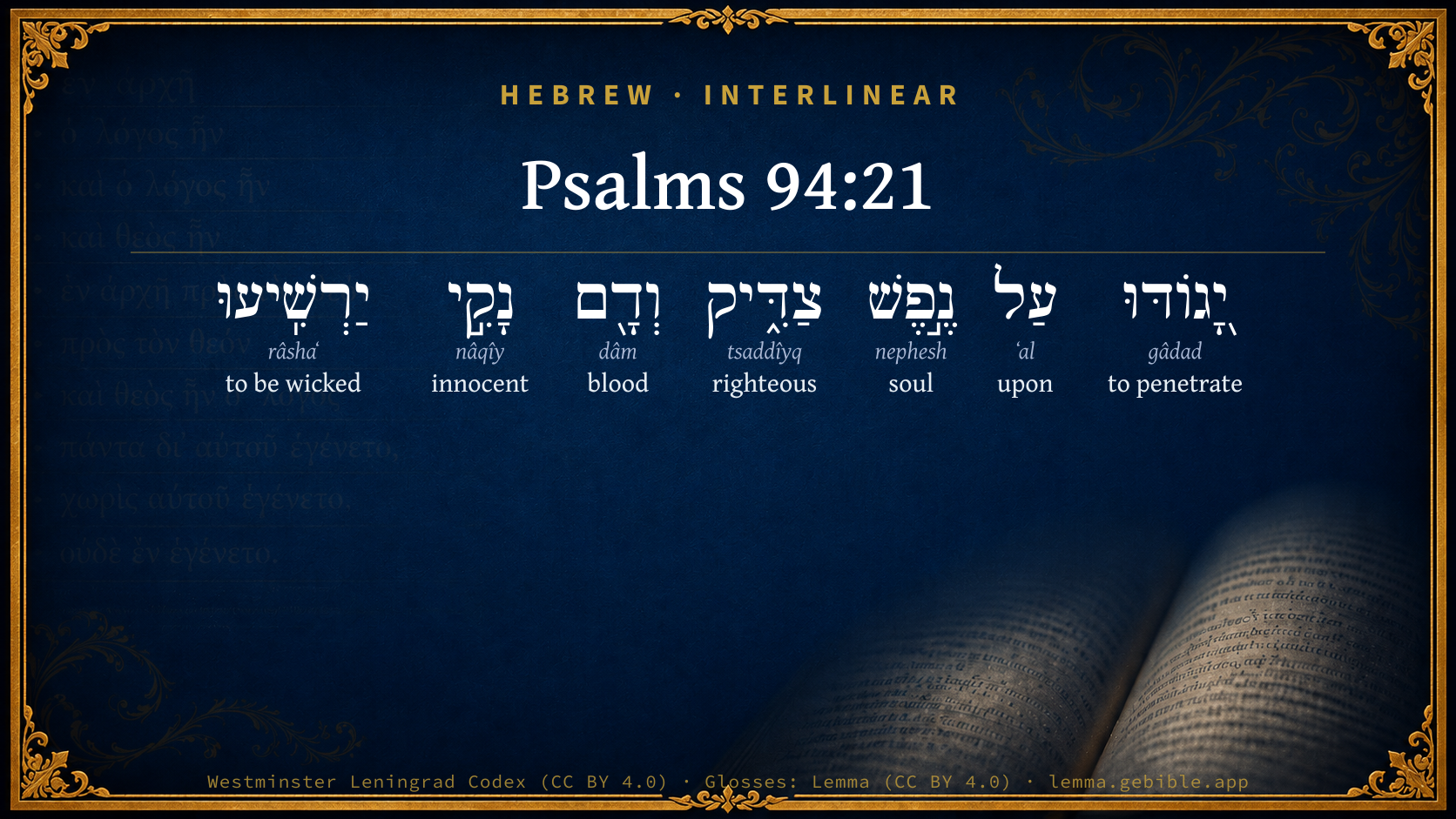
Psalms 94:21

Hebrew (Westminster Leningrad Codex) Psalms 94:21 appears in the Hebrew Old Testament. The text above is from the Westminster Leningrad Codex. Each word links to its Strong’s number, a concise gloss, and parsing drawn from the Open Scriptures Hebrew Bible morphology. Click any word for its full Brown-Driver-Briggs (BDB) entry.
Download image
Cite this verse

Psalms 94:21 (World English Bible). Public Domain. Lemma interlinear Bible study tool, https://lemma.gebible.app/v/psalms/94/21.

Show BibTeX & RIS
BibTeX
RIS
English Translation
They gather themselves together against the soul of the righteous, And condemn the innocent blood.
World English Bible · Public Domain
Download a study sheet

One document with this verse’s original text, its word-by-word gloss line, the meaning frame, cross-references with their text, attributed commentary, and full source and license credits — printable, and it pastes into notes with its structure intact.

This verse Autodidact and up

Study sheet (.html) Plain text (.txt)

A passage Seminary Student

Up to 50 verses in one chapter. A passage sheet keeps up to 6 commentary sources and 12 cross-references per verse, in the order this page ranks them, and says so on the sheet whenever that leaves anything out. Ask for a single verse and you get the Autodidact verse sheet above.

Everything on this page stays free to read, with no account — the sheet is a download of what is already on screen, not access to it.

Want to remove ads? Support Godless Engineer
Compare translations 3

The same verse in 3 English versions, stacked beneath the original-language interlinear above. Click any original word for its lexicon entry.

Each is an independent rendering of the whole verse — the interlinear is not word-aligned to these translations.

Highlighted words mark where these versions differ — a whole-verse word diff, not a word-by-word alignment.

  • World English Bible Public Domain
    They gather themselves together against the soul of the righteous, And condemn the innocent blood.
  • King James Version Public Domain
    They gather themselves together against the soul of the righteous, and condemn the innocent blood.
  • unfoldingWord Literal Text CC BY-SA 4.0
    They conspire together against the life of the righteous and they condemn innocent blood.

unfoldingWord Literal Text — © unfoldingWord, licensed CC BY-SA 4.0. Word-aligned USFM3 via Door43 (git.door43.org/unfoldingWord/en_ult).

Versions to compare (up to 4)

3 of 4 selected

Show all 18 translations

Every available English version of this verse, each an independent rendering of the whole verse.

  • World English Bible Public Domain
    They gather themselves together against the soul of the righteous, And condemn the innocent blood.
  • Berean Standard Bible Public Domain
    They band together against the righteous and condemn the innocent to death.
  • Majority Standard Bible Public Domain
    They band together against the righteous and condemn the innocent to death.
  • King James Version Public Domain
    They gather themselves together against the soul of the righteous, and condemn the innocent blood.
  • American Standard Version (1901) Public Domain
    They gather themselves together against the soul of the righteous, And condemn the innocent blood.
  • Revised Version (1885) Public Domain
    They gather themselves together against the soul of the righteous, and condemn the innocent blood.
  • Geneva Bible (1599) Public Domain
    They gather them together against the soule of the righteous, and condemne the innocent blood.
  • Douay-Rheims (1899) Public Domain
    They will hunt after the soul of the just, and will condemn innocent blood.
  • Young's Literal Translation Public Domain
    They decree against the soul of the righteous, And innocent blood declare wicked.
  • Literal Standard Version CC BY-SA 4.0
    They decree against the soul of the righteous, || And declare innocent blood wicked.
  • Unlocked Literal Bible CC BY-SA 4.0
    They conspire together to take the life of the righteous and they condemn the innocent to death.
  • unfoldingWord Literal Text CC BY-SA 4.0
    They conspire together against the life of the righteous and they condemn innocent blood.
  • Darby Bible Public Domain
    They band together against the soul of the righteous, and condemn innocent blood.
  • World Messianic Bible Public Domain
    They gather themselves together against the soul of the righteous, and condemn the innocent blood.
  • Webster's Bible Public Domain
    They assemble themselves against the soul of the righteous, and condemn the innocent blood.
  • Free Bible Version CC BY-SA 4.0
    They work together to destroy good people; they condemn those who are innocent to death.
  • Bible in Basic English Public Domain
    They are banded together against the soul of the upright, to give decisions against those who have done no wrong.
  • JPS Tanakh (1917) Public Domain
    They gather themselves together against the soul of the righteous, and condemn innocent blood.

Literal Standard Version (2020), Covenant Press — licensed CC BY-SA 4.0. Text via the HelloAO Bible API (eBible.org). Unlocked Literal Bible (unfoldingWord) — licensed CC BY-SA 4.0. Text via the HelloAO Bible API (eBible.org). unfoldingWord Literal Text — © unfoldingWord, licensed CC BY-SA 4.0. Word-aligned USFM3 via Door43 (git.door43.org/unfoldingWord/en_ult). Free Bible Version, Dr. Jonathan Gallagher — licensed CC BY-SA 4.0. Text via the HelloAO Bible API (eBible.org).

Word by word

More ways to search: Search by grammar → Find every occurrence → Compare this word →

Practice this passage: Drill this verse → Learn its vocabulary →

About this verse

These counts appear in no published source. They are computed here, from the morphology-tagged text and Lemma’s own curated glosses. What Lemma adds →

7
words
7
distinct lemmas
Wisdom
section

Notable vocabulary

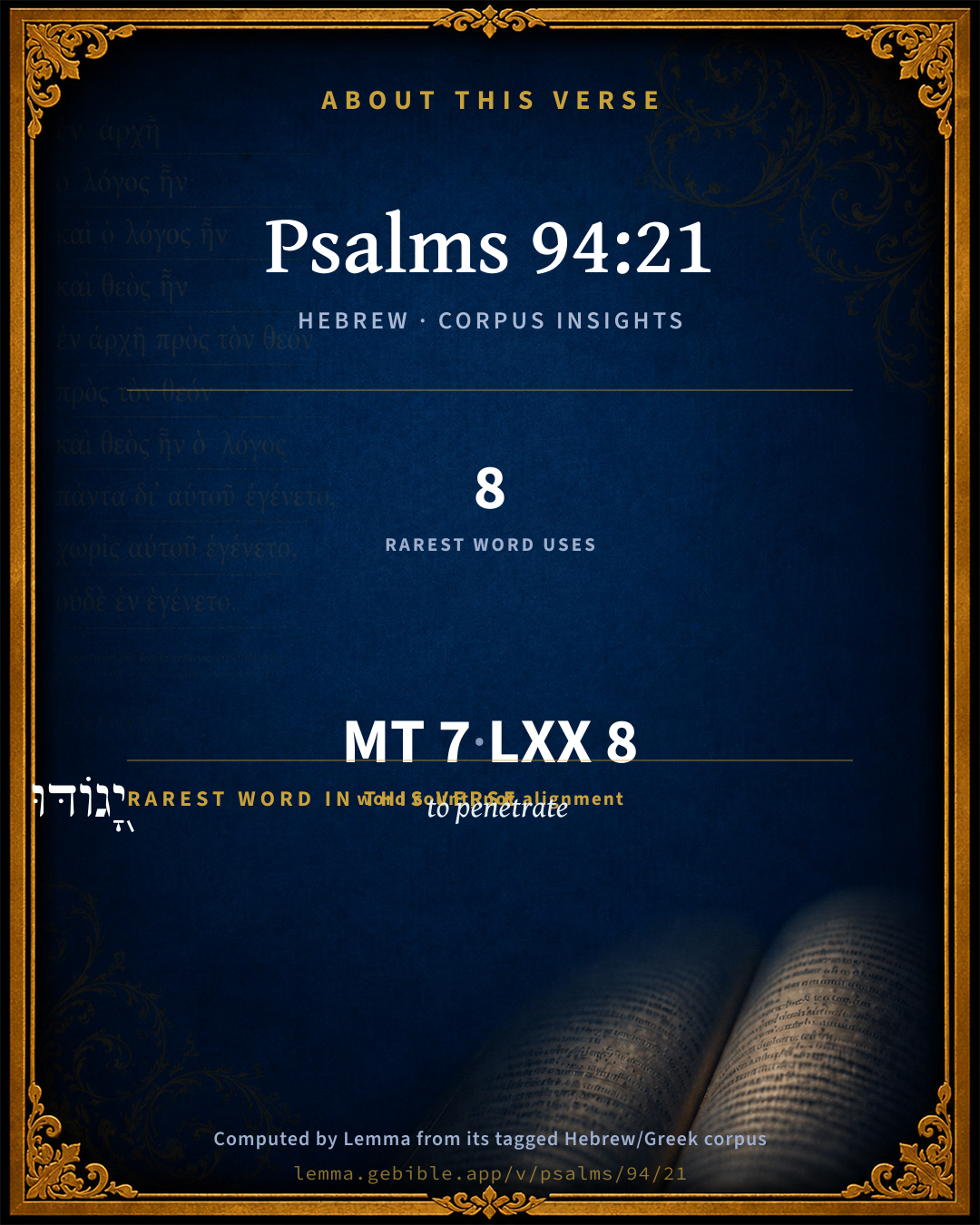
The rarest word here is יָ֭גוֹדּוּ to penetrate H1413 — appearing just 8 times in the whole Hebrew Bible.

Shared distinctive vocabulary

יָ֭גוֹדּוּ to penetrate H1413 occurs in 8 verses of the Hebrew Bible. Also found in:

Grammatical profile

  • 2 verbs
  • 2 nouns
  • 2 adjectives
  • 1 preposition

Verb forms

  • יָ֭גוֹדּוּ Qal · Imperfect
  • יַרְשִֽׁיעוּ Hiphil · Imperfect

Hebrew & Septuagint length

In English translation the verse runs 15 words from the Hebrew and 13 from the Septuagint (LXX English) — closely comparable.

A rough comparison of the two English renderings, which tokenize alike — not a word-level alignment.

Word counts can differ between the Hebrew and the Greek without any difference in meaning — e.g. the Hebrew direct-object marker אֵת has no separate Greek word, and Greek often adds the article ὁ.

In the original languages it is 7 Hebrew tokens and 8 Greek tokens — but the two are counted differently (Hebrew bundles its prefixes and suffixes into one token; the Greek is in lemma form), so that isn’t a like-for-like length.

Cross-references

23

Topical passages linked to Psalms 94:21 in the Treasury of Scripture Knowledge — connected by theme and wording, ordered by reader-vote popularity; previews shown in the World English Bible.

  • Psalms 59:3 For, behold, they lie in wait for my soul. The mighty gather themselves together against me, Not for my disobedience, nor for my sin, Yahweh.
  • Proverbs 17:15 He who justifies the wicked, and he who condemns the righteous, Both of them alike are an abomination to Yahweh.
  • Matthew 27:1 Now when morning had come, all the chief priests and the elders of the people took counsel against Jesus to put him to death:
  • Exodus 23:7 "Keep far from a false charge, and don't kill the innocent and righteous: for I will not justify the wicked.
  • Revelation 17:6 I saw the woman drunken with the blood of the saints, and with the blood of the martyrs of Jesus. When I saw her, I wondered with great amazement.
  • 1 Kings 21:19 You shall speak to him, saying, Thus says Yahweh, Have you killed and also taken possession? You shall speak to him, saying, Thus says Yahweh, In the place where dogs licked the blood of Naboth shall dogs lick your blood, even yours.
  • Psalms 2:1–3 Why do the nations rage, And the peoples plot a vain thing?
  • Psalms 22:16 For dogs have surrounded me. A company of evil-doers have enclosed me. They pierced my hands and my feet.
  • Proverbs 1:11 If they say, "Come with us, Let's lay in wait for blood; Let's lurk secretly for the innocent without cause;
  • Ezekiel 22:12 In you have they taken bribes to shed blood; you have taken interest and increase, and you have greedily gained of your neighbors by oppression, and have forgotten me, says the Lord Yahweh.
  • Ezekiel 22:27 Her princes in the midst of it are like wolves ravening the prey, to shed blood, [and] to destroy souls, that they may get dishonest gain.
  • Matthew 27:4 saying, "I have sinned in that I betrayed innocent blood." But they said, "What is that to us? You see to it."
  • Acts 7:58–60 They threw him out of the city, and stoned him. The witnesses placed their garments at the feet of a young man named Saul.
  • James 5:6 You have condemned, you have murdered the righteous one. He doesn't resist you.
  • Psalms 56:6 They conspire and lurk, Watching my steps, they are eager to take my life.
  • Psalms 106:38 They shed innocent blood, Even the blood of their sons and of their daughters, Whom they sacrificed to the idols of Canaan. The land was polluted with blood.
  • Proverbs 1:16 For their feet run to evil. They hurry to shed blood.
  • Jeremiah 26:15 Only know for certain that, if you put me to death, you will bring innocent blood on yourselves, and on this city, and on the inhabitants of it; for of a truth Yahweh has sent me to you to speak all these words in your ears.
  • Ezekiel 22:6 Behold, the princes of Israel, everyone according to his power, have been in you to shed blood.
  • Matthew 23:32–36 Fill up, then, the measure of your fathers.
  • Acts 4:5–7 It happened in the morning, that their rulers, elders, and scribes were gathered together in Jerusalem.
  • Acts 4:27–28 For truly, in this city against your holy servant, Jesus, whom you anointed, both Herod and Pontius Pilate, with the Gentiles and the people of Israel, were gathered together
  • Acts 7:52 Which of the prophets didn't your fathers persecute? They killed those who foretold the coming of the Righteous One, of whom you have now become betrayers and murderers.

Cross-references courtesy of OpenBible.info (CC BY 4.0).

Hebrew and Greek witnesses Masoretic Hebrew ↔ Greek Septuagint

The same verse in the two great witnesses to the Old Testament, shown verse-for-verse.

You’re reading Greek Psalm 93 (Hebrew Psalm 94). The Septuagint counts the superscription, so verse numbers can differ from the Hebrew — chapter-level alignment, not verse-by-verse. Numbering follows Rahlfs.

These are two independent witnesses, not word-aligned to each other, and the Septuagint is shown in lemma (dictionary) form.

Hebrew Psalms 94:21 Masoretic · Westminster Leningrad Codex

יָ֭גוֹדּוּ עַל נֶ֣פֶשׁ צַדִּ֑יק וְדָ֖ם נָקִ֣י יַרְשִֽׁיעוּ

They gather themselves together against the soul of the righteous, And condemn the innocent blood.

World English Bible · Public Domain

Greek LXX Greek Psalm 93:21 Septuagint · lemma form

θηρεύω ἐπί ψυχή δίκαιος καί αἷμα ἀθῷος καταδικάζω

They will hunt for the soul of the righteous, and condemn innocent blood.

LXX2012 (modern English Septuagint) · Public Domain

On this verse, Ellicott's Commentary for English Readers discusses the Septuagint’s reading. Read the note in Commentary ↓

Hebrew: Westminster Leningrad Codex (CC BY 4.0). Greek: Septuagint (public domain); English from LXX2012 (modern English Septuagint) (Public Domain). How the Septuagint differs from the Hebrew →

Commentary

Notes on Psalms 94:21 from classic Christian and Jewish commentators (each source and its license shown beneath its notes). The classic Christian expositions comment on the surrounding passage and are grouped to its opening verse, so a note may address several verses; the Jewish commentaries on the Tanakh (Rashi and others) are per-verse, so they appear only where the commentator wrote on this verse.

Lemma curates 59 commentaries, every one of them public domain or Creative Commons licensed, each selected and text-cleaned for this edition rather than reprinted as found. About our sources →

Trapp's Complete Commentary

John Trapp

Psa 94:21 They gather themselves together against the soul of the righteous, and condemn the innocent blood.

Ver. 21. They gather together] Heb. run by troops, as thieves do.

Against the soul] Which they would gladly destroy if it lay in their power. This the Popish persecutors oft attempted, but God hath better provided, Mat 10:28.

John Trapp, A Commentary or Exposition upon All the Books of the Old and New Testament (1647–1656) — public domain. Text from a community e-Sword module.

The Treasury of David

Charles H. Spurgeon

Ver. 21. They gather themselves together against the soul of the righteous, so many are there of them that they crowd their assemblies, and carry their hard measures with enthusiasm; they are the popular party, and are eager to put down the saints. In counsel, and in action, they are unanimous; their one resolve is to hold their own tyrannical position, and put down the godly party.

And condemn the innocent blood. They are great at slander and false accusation, nor do they stick at murder; no crime is too great for them, if only they can trample on the servants of the Lord. This description is historically true in reference to persecuting times; it has been fulfilled in England, and may be again if Popery is to advance in future time at the same rate as in the past few years. The dominant sect has the law on its side, and blasts that it is the national church; but the law which establishes and endows one religion rather than another is radically an injustice. God has no fellowship with it, and therefore the synagogue of Ritualism will yet be a stench in the nostrils of all sane men. What evil times are in store for us it is not for us to prophesy; it is ours to leave the matter in the hands of him who cannot be in fellowship with an oppressive system, and will not always endure to be insulted to his face by Popish idols, and their priests.

Ver. 21-22.

1. The Danger of the righteous (Ps 94:21).

2. Their Defence (Ps 94:22). G. R.

Ver. 21-23.

1. Sentence passed in the court of injustice (Ps 94:21).

2. An element in the case not considered by the court (Ps 94:22).

3. The sentence consequently alighting on the right heads (Ps 94:23). (This passage, under a very thin veil, exhibits Christ. Mt 27:1) C.A.D.

Psalms 94:22*

Charles H. Spurgeon's The Treasury of David (1869–1885) — public domain. Psalms only. Text from a community e-Sword/MySword module.

Joseph Benson's Commentary

Psa 94:21-23. They gather themselves against the soul of the righteous — Against the life, as the word here rendered soul commonly signifies, and as the next clause explains it. They are not satisfied with the spoils of the estates of the righteous, but do also thirst after their lives. And condemn the innocent blood — They shed the blood of those innocent persons whom they have wickedly condemned. Innocent blood is here put for the blood of innocent persons. But the Lord is my defence — Let them decree what they please, and be too hard for all laws; the Lord, who hates unrighteousness, will be my defence; he, who hath long been very gracious to me, will secure me from their violence. He is the rock of my refuge — In the clefts of which I may take shelter, and on the top of which I may set my feet, and be out of the reach of danger. He shall bring upon them their own iniquity — The fruit and punishment of their iniquity. He shall deal with them according to their desert; and that very mischief which they designed against God’s people shall be brought upon themselves. He shall cut them off in their own wickedness — Either in the midst of their sins, or by their own wicked devices, the mischief whereof he will cause to fall upon their own heads. The Lord our God — The God of Jacob, of whom they said, he did not see, nor regard them, shall cut them off — And they shall find themselves mistaken in their false views and expectations of impunity, to their sorrow; he shall cut them off out of the land of the living; shall cut them off from any fellowship with himself, and so shall make them completely miserable; and their pomp and power shall stand them in no stead.

Joseph Benson's Commentary on the Old and New Testaments (1811–1818) — public domain. Text from a community e-Sword module.

J. A. Alexander on Psalms

Joseph Addison Alexander

21. (Psa 94:21) They crowd upon the soul of the righteous, and innocent blood they condemn. The first verb means to rush in crowds or troops, and may therefore be expressed in English by the verbs, to crowd, to troop. Condemn, literally make guilty, i.e. recognise and treat as such. The futures, as usual, suggest the probable continuance of the evil in question.

Joseph Addison Alexander, The Psalms Translated and Explained (1850) — public domain. Text from a community e-Sword module.

Adam Clarke's Commentary

Verse 21. They gather themselves together] In every thing that is evil, they are in unity. The devil, his angels, and his children, all join and draw together when they have for their object the destruction of the works of the Lord. But this was particularly the case with respect to the poor Jews among the Babylonians: they were objects of their continual hatred, and they laboured for their destruction.

This and the following verses have been applied to our Lord, and the treatment he met with both from his own countrymen and from the Romans. They pretended to "judge him according to the law, and framed mischief against him;" they "assembled together against the life of the righteous one," and "condemned innocent blood;" but God evidently interposed, and "brought upon them their own iniquity," according to their horrible imprecation: "His blood be upon us and upon our children!" God "cut them off in their own iniquity." All this had, in reference to him, a most literal fulfilment.

Adam Clarke's Commentary on the Bible (1810–1826) — public domain. Text from a community e-Sword/MySword module.

John Calvin's Commentaries

21. They will gather together against the soul of the righteous As the Hebrew word גדד, gadad, or גוד, gud, signifies to collect forces or a band of men, the Psalmist evidently intimates that he had to do with leading persons of influence, and not with those merely in private station. The term implies too, that it was not merely one or two private individuals who persecuted him, and others of the Lord’s people, but a public convention. Melancholy and disgraceful must the state of matters have been, when the wicked thus ruled in lawful assembly, and those who formed the college of judges were no better than a band of robbers. The case becomes doubly vexatious, when the innocent victims of oppression are not only injured, but have a stigma fixed upon their character. And what more unseemly spectacle, than when the whole course of judicial administration is just a foul conspiracy against good and innocent men? The instance here recorded should prepare us for a like emergency, if it chance to occur in our own day, when the wicked may be permitted, in the providence of God, to mount the seat of judgment, and launch destruction upon the upright and the righteous, under color of law. Intolerable as it might seem at first sight, that persons innocent of any crime should meet with cruel persecution, even from the hands of judges, so as to be loaded with ignominy, we see that God tried his children in other times by this double species of oppression, and that we must learn to bear submissively not only with unrighteous violence, but with charges most injurious to our character, and most undeserved.

John Calvin's Commentaries (1540-1563) — public domain. Text from the Calvin Translation Society English edition (1840s-50s) via the Christian Classics Ethereal Library (ccel.org). Calvin's coverage is partial (roughly two-thirds of the Bible); uncommented books and verses are honest gaps, never fabricated. The 19th-century editor's footnotes and remarks are omitted so the notes are faithfully Calvin's own voice.

Ellicott's Commentary for English Readers

(21) They gather—i.e., possibly, They crowd into the courts of law to take part in the unjust condemnation of the just, or more generally, “They attack the life of the righteous.” LXX., “they hunt.” (Comp. Psa_35:15.)

A Bible Commentary for English Readers, edited by Charles John Ellicott (1878–1897) — public domain. Text from a community e-Sword module.

The Cambridge Bible for Schools and Colleges

gen. ed. J. J. S. Perowne

21. They gather themselves together] So the Targ. and Jer., possibly reading yâgûrû, as in Psa_56:6; Psa_59:3. The Mass. text however seems to mean they make raids upon the life of the righteous.

condemn the innocent blood] I.e. condemn the innocent to death.

The Cambridge Bible for Schools and Colleges (gen. ed. J. J. S. Perowne; Cambridge University Press, 1878–1918) — public domain. Text from a community e-Sword module.

John Gill's Exposition

They gather themselves together,.... As "in troops" (h), as the word signifies; in great armies; so the antichristian kings and states will, at the instigation of Popish emissaries; see Rev 16:17,

against the soul of the righteous; or "the life" of them; in order to take away their lives; to cut them off, root and branch, and destroy at once the whole interest of Christ; for it will be to make war with him, and them his followers, who are the righteous here meant, made so by his righteousness, that they will be gathered together in such great numbers:

and condemn the innocent blood; condemn innocent persons to death, shed their blood, and drink it, and to such a degree as to be drunk with it; for in them will be found the blood of the prophets and saints, and of all that are slain on earth, Rev 17:6.

(h) "turmatim conveniunt", Vatablus, Piscator.

John Gill's Exposition of the Whole Bible (1746–1763) — public domain (CC PDM 1.0). Text via the HelloAO Bible API.

Albert Barnes' Notes on the Bible

They gather themselves together against the soul of the righteous - Against the life of the righteous; that is, to take their lives. The Hebrew word rendered “gather together,” means to press or crowd upon anyone; to rush in crowds or troops. It would refer particularly to a tumultuous gathering - “a mob” - intent on accomplishing its purpose.

And condemn the innocent blood - literally, make guilty; that is, they hold that blood to be guilty; or, they treat the innocent as if they were guilty.

Albert Barnes' Notes on the Bible (1834–1885) — public domain. Text from a community e-Sword/MySword module.

Matthew Poole's English Annotations

Against the soul; against the life, as the soul commonly signifies, and as the next clause explains it. They are not satisfied with the spoil of their estates, but do also thirst after their lives.

Condemn the innocent blood; they shed the blood of those innocent persons whom they have wickedly condemned. Innocent blood is here put for the blood or life of an innocent person, as it is also 1Sa 19:5; Mat 27:4.

Matthew Poole's English Annotations on the Holy Bible (1683–1685) — public domain. Text from a community e-Sword/MySword module.

The Pulpit Commentary

They gather themselves together against the soul of the righteous, and condemn the innocent blood. (comp. 2Ki_21:16 Psa_10:8 Pro_6:17 Isa_1:21 Isa_59:3, 7 Jer_7:6 Jer_22:3, Jer_22:17, etc.) A Messianic allusion is possible, but not necessary.

The Pulpit Commentary (1880–1919), ed. H.D.M. Spence-Jones & Joseph S. Exell — public domain. Text from a community e-Sword module.

Rashi

Rabbi Shlomo Yitzchaki (Rashi)

They gather Troops gather upon a Jewish soul to kill [him].

and condemn Heb. ירשיעו. They condemn in judgment to kill him.

Rashi on the Tanakh — English translations: “The Judaica Press complete Tanach with Rashi, translated by A. J. Rosenberg” (CC BY 4.0); “Pentateuch with Rashi's commentary by M. Rosenbaum and A.M. Silbermann, 1929-1934” (public domain); “The Metsudah Tanach series, Lakewood, N.J” (CC BY 4.0); and “The Book of Joshua, Metsudah Publications, 1997” (CC BY 4.0). Text via Sefaria.

Lesson kit

Teaching starters — assembled from the data on this page, not authored interpretation. Every prompt links to the verse data it draws on. Edit before teaching.

Psalms, in the Wisdom, opens this verse with 7 words (7 distinct Hebrew lemmas). Its most distinctive word is gâdad (“to penetrate”). A historical commentator’s framing appears above. Read the whole chapter for the surrounding context.

Discussion questions

  1. The word gâdad carries the sense “to penetrate.” How does it shape the verse?
  2. Deuteronomy 14:1 shares the word «to penetrate» with this verse. How do the two illuminate each other?
  3. The translations on this page render this verse differently — a whole-verse word diff, not a word-by-word alignment. What might account for the different wordings?
  4. The verb «יָ֭גוֹדּוּ» is Qal Imperfect. How does its form color the action?
  5. Reading how Trapp's Complete Commentary and The Treasury of David read this verse, where do the two commentators agree and where do they part?

Things to notice

Reading settings

Reading text

Shown beneath each verse's original-language words.

Old Testament
Old Testament edition

Read the OT as the Masoretic Hebrew (MT) or the Greek Septuagint (LXX).

English shown for the Greek Septuagint (in the Hebrew ↔ Greek comparison).

Comparing translations? Open the Compare panel on any verse page to stack up to four side by side.