Leviticus 1:11

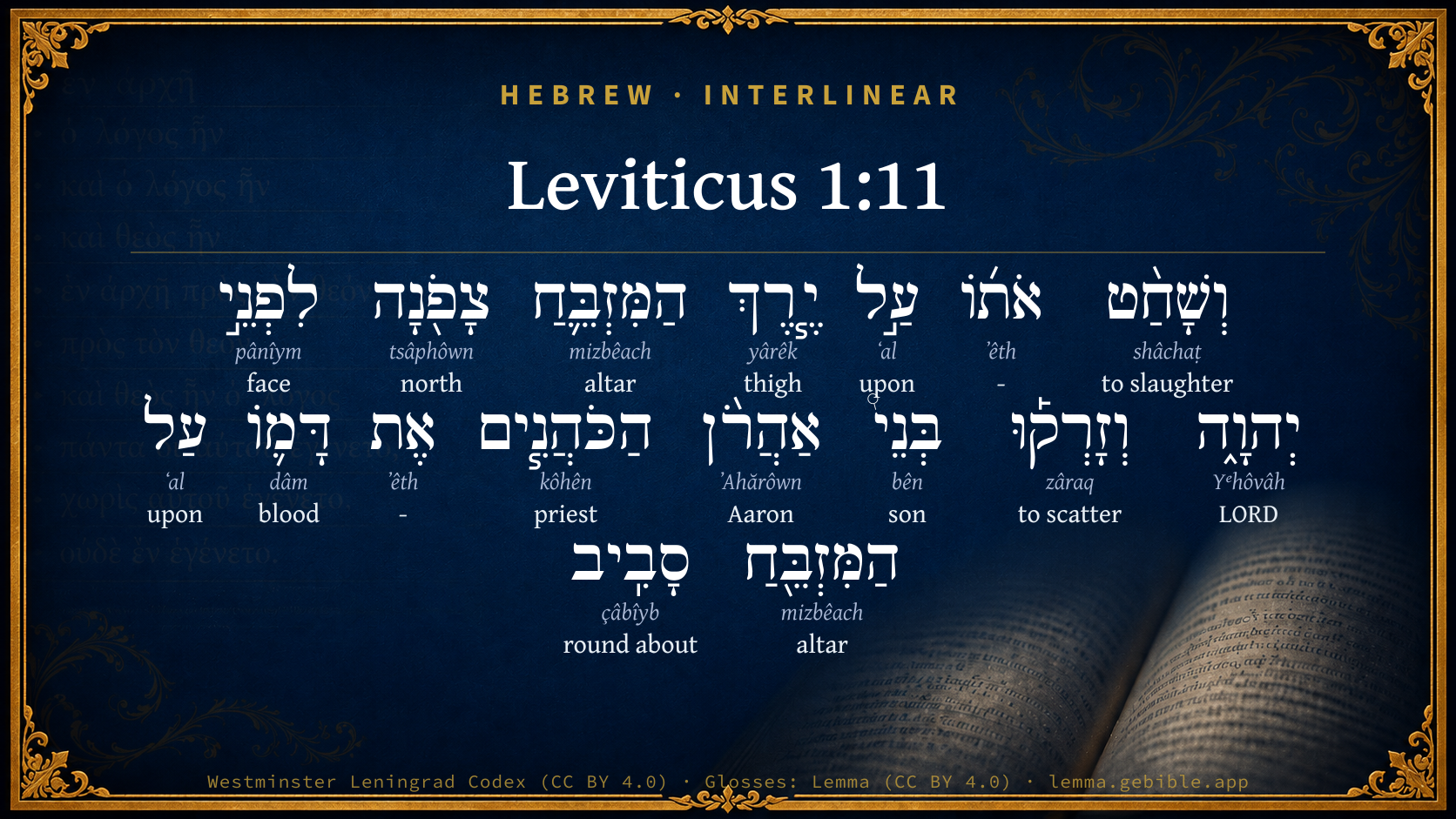
Hebrew (Westminster Leningrad Codex) Leviticus 1:11 appears in the Hebrew Old Testament. The text above is from the Westminster Leningrad Codex. Each word links to its Strong’s number, a concise gloss, and parsing drawn from the Open Scriptures Hebrew Bible morphology. Click any word for its full Brown-Driver-Briggs (BDB) entry.
Download image
Cite this verse

Leviticus 1:11 (World English Bible). Public Domain. Lemma interlinear Bible study tool, https://lemma.gebible.app/v/leviticus/1/11.

Show BibTeX & RIS
BibTeX
RIS
English Translation
He shall kill it on the north side of the altar before Yahweh. Aaron's sons, the priests, shall sprinkle its blood around on the altar.
World English Bible · Public Domain
Download a study sheet

One document with this verse’s original text, its word-by-word gloss line, the meaning frame, cross-references with their text, attributed commentary, and full source and license credits — printable, and it pastes into notes with its structure intact.

This verse Autodidact and up

Study sheet (.html) Plain text (.txt)

A passage Seminary Student

Up to 50 verses in one chapter. A passage sheet keeps up to 6 commentary sources and 12 cross-references per verse, in the order this page ranks them, and says so on the sheet whenever that leaves anything out. Ask for a single verse and you get the Autodidact verse sheet above.

Everything on this page stays free to read, with no account — the sheet is a download of what is already on screen, not access to it.

Want to remove ads? Support Godless Engineer
Compare translations 3

The same verse in 3 English versions, stacked beneath the original-language interlinear above. Click any original word for its lexicon entry.

Each is an independent rendering of the whole verse — the interlinear is not word-aligned to these translations.

Highlighted words mark where these versions differ — a whole-verse word diff, not a word-by-word alignment.

  • World English Bible Public Domain
    He shall kill it on the north side of the altar before Yahweh. Aaron's sons, the priests, shall sprinkle its blood around on the altar.
  • King James Version Public Domain
    And he shall kill it on the side of the altar northward before the LORD: and the priests, Aaron's sons, shall sprinkle his blood round about upon the altar.
  • unfoldingWord Literal Text CC BY-SA 4.0
    And he shall slaughter it on the side of the altar northward to the face of Yahweh. And the sons of Aaron, the priests, shall splash its blood on the altar all around.

unfoldingWord Literal Text — © unfoldingWord, licensed CC BY-SA 4.0. Word-aligned USFM3 via Door43 (git.door43.org/unfoldingWord/en_ult).

Versions to compare (up to 4)

3 of 4 selected

Show all 18 translations

Every available English version of this verse, each an independent rendering of the whole verse.

  • World English Bible Public Domain
    He shall kill it on the north side of the altar before Yahweh. Aaron's sons, the priests, shall sprinkle its blood around on the altar.
  • Berean Standard Bible Public Domain
    He shall slaughter it on the north side of the altar before the LORD, and Aaron’s sons the priests are to sprinkle its blood against the altar on all sides.
  • Majority Standard Bible Public Domain
    He shall slaughter it on the north side of the altar before the LORD, and Aaron’s sons the priests are to splatter its blood against the altar on all sides.
  • King James Version Public Domain
    And he shall kill it on the side of the altar northward before the LORD: and the priests, Aaron's sons, shall sprinkle his blood round about upon the altar.
  • American Standard Version (1901) Public Domain
    And he shall kill it on the side of the altar northward before Jehovah: and Aaron's sons, the priests, shall sprinkle its blood upon the altar round about.
  • Revised Version (1885) Public Domain
    And he shall kill it on the side of the altar northward before the LORD: and Aaron’s sons, the priests, shall sprinkle its blood upon the altar round about.
  • Geneva Bible (1599) Public Domain
    And he shall kill it on the Northside of the altar before the Lord, and the Priestes Aarons sonnes shall sprinckle the blood thereof rounde about vpon the altar.
  • Douay-Rheims (1899) Public Domain
    And he shall immolate it at the side of the altar that looketh to the north, before the Lord: but the sons of Aaron shall pour the blood thereof upon the altar round about:
  • Young's Literal Translation Public Domain
    and he hath slaughtered it by the side of the altar northward, before Jehovah; and sons of Aaron, the priests, have sprinkled its blood on the altar round about;
  • Literal Standard Version CC BY-SA 4.0
    and he has slaughtered it by the side of the altar northward, before YHWH; and sons of Aaron, the priests, have sprinkled its blood around the altar;
  • Unlocked Literal Bible CC BY-SA 4.0
    He must kill it on the north side of the altar before Yahweh. Aaron's sons, the priests, will sprinkle its blood on every side of the altar.
  • unfoldingWord Literal Text CC BY-SA 4.0
    And he shall slaughter it on the side of the altar northward to the face of Yahweh. And the sons of Aaron, the priests, shall splash its blood on the altar all around.
  • Darby Bible Public Domain
    And he shall slaughter it on the side of the altar northward before Jehovah; and Aaron's sons, the priests, shall sprinkle its blood on the altar round about.
  • World Messianic Bible Public Domain
    He shall kill it on the north side of the altar before the LORD. Aaron’s sons, the priests, shall sprinkle its blood around on the altar.
  • Webster's Bible Public Domain
    And he shall kill it on the side of the altar northward before the LORD: and the priests, Aaron's sons, shall sprinkle his blood around upon the altar:
  • Free Bible Version CC BY-SA 4.0
    You are to kill it on the north side of the altar in the Lord's presence, and Aaron's sons, the priests, are to take the blood and sprinkle it on all sides of the altar.
  • Bible in Basic English Public Domain
    And he is to put it to death on the north side of the altar before the Lord: and Aaron's sons, the priests, are to put some of the blood on and round the altar.
  • JPS Tanakh (1917) Public Domain
    And he shall kill it on the side of the altar northward before the LORD; and Aaron's sons, the priests, shall dash its blood against the altar round about.

Literal Standard Version (2020), Covenant Press — licensed CC BY-SA 4.0. Text via the HelloAO Bible API (eBible.org). Unlocked Literal Bible (unfoldingWord) — licensed CC BY-SA 4.0. Text via the HelloAO Bible API (eBible.org). unfoldingWord Literal Text — © unfoldingWord, licensed CC BY-SA 4.0. Word-aligned USFM3 via Door43 (git.door43.org/unfoldingWord/en_ult). Free Bible Version, Dr. Jonathan Gallagher — licensed CC BY-SA 4.0. Text via the HelloAO Bible API (eBible.org).

Word by word

More ways to search: Search by grammar → Find every occurrence → Compare this word →

Practice this passage: Drill this verse → Learn its vocabulary →

יֶ֧רֶךְ
yârêk
H3409
“thigh of”
Noun, Common, Feminine, Singular, Construct
Part of Speech
Noun
Type
Common
Gender
Feminine
Number
Singular
State
Construct
Full BDB Definition

Origin: from an unused root meaning to be soft

TWOT: 916a

thigh, side, loin, base - thigh - outside of thigh (where sword was worn) - loins (as the seat of procreative power) - side (flank) (of object) - base
  1. וְשָׁחַ֨ט shâchaṭ H7819 “and · to slaughter” Conjunction + Verb, Qal, Sequential Perfect, 3rd Person, Masculine, Singular
  2. אֹת֜וֹ ʼêth H853 “- · him” Particle, Direct Object + Suffix, Personal, 3rd Person, Masculine, Singular
  3. עַ֣ל ʻal H5921 “upon” Preposition
  4. הַמִּזְבֵּ֛חַ mizbêach H4196 “the · altar” Particle, Definite Article + Noun, Common, Masculine, Singular, Absolute
  5. צָפֹ֖נָה tsâphôwn H6828 “north · toward” Noun, Common, Feminine, Singular, Absolute + Suffix, Demonstrative
  6. לִפְנֵ֣י pânîym H6440 “to/for · face(s) of” Preposition + Noun, Common, Both, Plural, Construct
  7. יְהוָ֑ה Yᵉhôvâh H3068 “LORD” Noun, Proper
  8. וְזָרְק֡וּ zâraq H2236 “and · to scatter” Conjunction + Verb, Qal, Sequential Perfect, 3rd Person, Common, Plural
  9. בְּנֵי֩ bên H1121 “sons of” Noun, Common, Masculine, Plural, Construct
  10. אַהֲרֹ֨ן ʼAhărôwn H175 “Aaron” Noun, Proper
  11. הַכֹּהֲנִ֧ים kôhên H3548 “the · priests” Particle, Definite Article + Noun, Common, Masculine, Plural, Absolute
  12. אֶת ʼêth H853 “-” Particle, Direct Object
  13. דָּמ֛וֹ dâm H1818 “blood · his” Noun, Common, Masculine, Singular, Construct + Suffix, Personal, 3rd Person, Masculine, Singular
  14. עַל ʻal H5921 “upon” Preposition
  15. הַמִּזְבֵּ֖חַ mizbêach H4196 “the · altar” Particle, Definite Article + Noun, Common, Masculine, Singular, Absolute
  16. סָבִֽיב çâbîyb H5439 “round about” Noun, Common, Both, Singular, Absolute

About this verse

These counts appear in no published source. They are computed here, from the morphology-tagged text and Lemma’s own curated glosses. What Lemma adds →

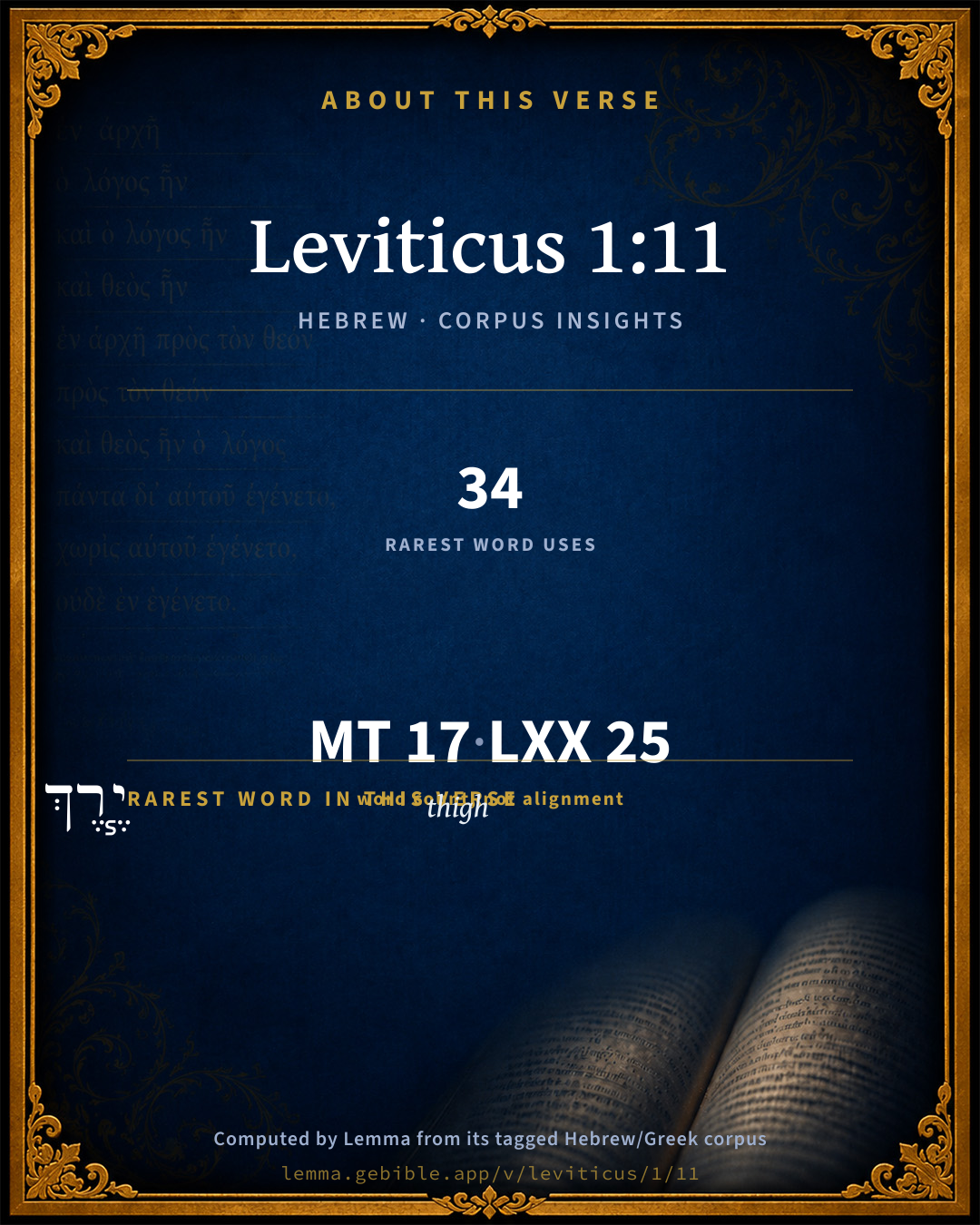
17
words
14
distinct lemmas
Pentateuch
section

Shared distinctive vocabulary

יֶ֧רֶךְ thigh H3409 occurs in 32 verses of the Hebrew Bible. Also found in:

Grammatical profile

  • 2 verbs
  • 11 nouns
  • 2 prepositions
  • 2 particles

Verb forms

  • וְשָׁחַ֨ט Qal · Sequential Perfect
  • וְזָרְק֡וּ Qal · Sequential Perfect

Repetition

Words recur within this verse — often emphatic in Hebrew:

  • עַ֣ל upon H5921 ×2
  • הַמִּזְבֵּ֛חַ altar H4196 ×2

Hebrew & Septuagint length

In English translation the verse runs 25 words from the Hebrew and 42 from the Septuagint (LXX English) — the Septuagint runs noticeably longer here. See the side-by-side →

A rough comparison of the two English renderings, which tokenize alike — not a word-level alignment.

Word counts can differ between the Hebrew and the Greek without any difference in meaning — e.g. the Hebrew direct-object marker אֵת has no separate Greek word, and Greek often adds the article ὁ.

In the original languages it is 17 Hebrew tokens and 25 Greek tokens — but the two are counted differently (Hebrew bundles its prefixes and suffixes into one token; the Greek is in lemma form), so that isn’t a like-for-like length.

Cross-references

7

Topical passages linked to Leviticus 1:11 in the Treasury of Scripture Knowledge — connected by theme and wording, ordered by reader-vote popularity; previews shown in the World English Bible.

  • Leviticus 1:5 He shall kill the bull before Yahweh. Aaron's sons, the priests, shall present the blood and sprinkle the blood around on the altar that is at the door of the Tent of Meeting.
  • Exodus 40:22 He put the table in the tent of meeting, on the side of the tent northward, outside of the veil.
  • Leviticus 1:7–9 The sons of Aaron the priest shall put fire on the altar, and lay wood in order on the fire;
  • Leviticus 6:25 "Speak to Aaron and to his sons, saying, 'This is the law of the sin offering: in the place where the burnt offering is killed, the sin offering shall be killed before Yahweh. It is most holy.
  • Leviticus 7:2 In the place where they kill the burnt offering, he shall kill the trespass offering; and its blood he shall sprinkle on the altar round about.
  • Leviticus 9:12–14 He killed the burnt offering; and Aaron's sons delivered the blood to him, and he sprinkled it on the altar round about.
  • Ezekiel 8:5 Then said he to me, Son of man, lift up your eyes now the way toward the north. So I lifted up my eyes the way toward the north, and see, northward of the gate of the altar this image of jealousy in the entry.

Cross-references courtesy of OpenBible.info (CC BY 4.0).

Hebrew and Greek witnesses Masoretic Hebrew ↔ Greek Septuagint

The same verse in the two great witnesses to the Old Testament, shown verse-for-verse.

Here the Septuagint runs noticeably longer than the Hebrew — LXX2012 (modern English Septuagint) 42 words vs World English Bible 25. A rough length comparison of the two English translations, not a word-level alignment — read both below.

These are two independent witnesses, not word-aligned to each other, and the Septuagint is shown in lemma (dictionary) form.

Hebrew Leviticus 1:11 Masoretic · Westminster Leningrad Codex

וְשָׁחַ֨ט אֹת֜וֹ עַ֣ל יֶ֧רֶךְ הַמִּזְבֵּ֛חַ צָפֹ֖נָה לִפְנֵ֣י יְהוָ֑ה וְזָרְק֡וּ בְּנֵי֩ אַהֲרֹ֨ן הַכֹּהֲנִ֧ים אֶת דָּמ֛וֹ עַל הַמִּזְבֵּ֖חַ סָבִֽיב

He shall kill it on the north side of the altar before Yahweh. Aaron's sons, the priests, shall sprinkle its blood around on the altar.

World English Bible · Public Domain

Greek LXX Leviticus 1:11 Septuagint · lemma form

καί σφάζω αὐτός ἐκ πλάγιος ὁ θυσιαστήριον πρός βορέας ἔναντι κύριος καί προςχέω ὁ υἱός ἀαρών ὁ ἱερεύς ὁ αἷμα αὐτός ἐπί ὁ θυσιαστήριον κύκλος

And he shall lay his hand on its head; and they shall kill it by the side of the altar, toward the north before the Lord, and the sons of Aaron the priests shall pour its blood on the altar round about.

LXX2012 (modern English Septuagint) · Public Domain

Hebrew: Westminster Leningrad Codex (CC BY 4.0). Greek: Septuagint (public domain); English from LXX2012 (modern English Septuagint) (Public Domain). How the Septuagint differs from the Hebrew →

Targum (Aramaic paraphrase)

2

The Targum is the ancient Jewish Aramaic paraphrase of the Hebrew Scriptures — an interpretive translation, not the Hebrew text itself. Onkelos (literal) and Pseudo-Jonathan (expansive) render the Torah, and Jonathan the Prophets. Coverage is partial: where no permissively-licensed English translation exists for a verse, only the Aramaic is shown. This is verse-level text, not a word-by-word alignment to the Hebrew. Some Onkelos verses here show an unreviewed machine translation (clearly flagged), not a published edition.

  1. Targum Onkelos Torah (Genesis–Deuteronomy)
    וְיִכּוֹס יָתֵיהּ עַל צִדָא דְמַדְבְּחָא צִפּוּנָא קֳדָם יְיָ וְיִזְרְקוּן בְּנֵי אַהֲרֹן כָּהֲנַיָא יָת דְמֵיהּ עַל מַדְבְּחָא סְחוֹר סְחוֹר

    Unreviewed machine translation (Claude Sonnet 5) — not public domain confidence: high

    And he shall slaughter it on the side of the altar, northward, before the Lord; and the sons of Aaron the priests shall sprinkle its blood upon the altar round about.

    Generated by an AI translate-then-audit pipeline and checked against an independent public-domain English translation of the underlying Hebrew for drift only. Not a published edition; pending human review.

    Aramaic base: public-domain Targum Onkelos (via Sefaria). The English above is the unreviewed machine translation, not public domain.

  2. Targum Pseudo-Jonathan Torah (Genesis–Deuteronomy)
    וְיִכּוֹס יָתֵיהּ טַבְּחָא עַל שִׁיפּוּלֵי מַדְבְּחָא בִּסְטַר צִיפּוּנָא קֳדָם יְיָ וְיִדְרְקוּן בְּנֵי אַהֲרן כַּהֲנַיָא יַת אַדְמֵיהּ בְּמִזְרְקַיָא עַל מַדְבְּחָא חֲזוֹר חֲזוֹר

    And the slayer shall kill it at the foot of the altar on the north side, before the Lord, and the priests the sons of Aharon shall sprinkle the blood that is in the basins upon the altar round about.

    Targum Pseudo-Jonathan — Aramaic: “Targum Jonathan on Genesis” (public domain); “Targum Jonathan on Exodus” (public domain); “Targum Jonathan on Leviticus” (public domain); “Targum Jonathan on Numbers” (public domain); “Targum Jonathan on Deuteronomy” (public domain). English: “The Targum of Jonathan ben Uzziel, trans. J. W. Etheridge, London, 1862” (public domain). Text via Sefaria.

Commentary

Notes on Leviticus 1:11 from classic Christian and Jewish commentators (each source and its license shown beneath its notes). The classic Christian expositions comment on the surrounding passage and are grouped to its opening verse, so a note may address several verses; the Jewish commentaries on the Tanakh (Rashi and others) are per-verse, so they appear only where the commentator wrote on this verse.

Lemma curates 59 commentaries, every one of them public domain or Creative Commons licensed, each selected and text-cleaned for this edition rather than reprinted as found. About our sources →

Trapp's Complete Commentary

John Trapp

Lev 1:11 And he shall kill it on the side of the altar northward before the LORD: and the priests, Aaron’s sons, shall sprinkle his blood round about upon the altar.

Ver. 11. On the side of the altar northward.] Not eastward, as the heathen sacrifices: or to note the obscurity of the legal ceremonies.

John Trapp, A Commentary or Exposition upon All the Books of the Old and New Testament (1647–1656) — public domain. Text from a community e-Sword module.

Joseph Benson's Commentary

Lev 1:11. Northward — Here this and other kinds of sacrifices were killed, (Lev 6:25; Lev 7:2,) because here seems to have been the largest and most convenient place for that work, the altar being probably near the middle of the east end of the building, and the entrance being on the south side.

Joseph Benson's Commentary on the Old and New Testaments (1811–1818) — public domain. Text from a community e-Sword module.

Geneva Bible (1599)

Geneva Bible translators

Read verse 5.

Before the altar of the Lord.

Geneva Bible (1599) marginal notes — public domain. Text via Bolls.life.

Ellicott's Commentary for English Readers

(11) On the side of the altar northward.—As the place for the refuse was on the east side (see Lev_1:16), as the laver stood on the west side, and as the ascent to the altar was on the south side, the north side was the most convenient for slaughtering the victims. This also applies to the sin and trespass offerings (Lev_4:24; Lev_4:29; Lev_4:33; Lev_6:25; Lev_7:2; Lev_14:13, &c.).

A Bible Commentary for English Readers, edited by Charles John Ellicott (1878–1897) — public domain. Text from a community e-Sword module.

John Gill's Exposition

And he shall kill it on the side of the altar northward before the Lord,.... This is a circumstance not mentioned in the killing of the bullock: Maimonides (g) says, there was a square place from the wall of the altar northward, to the wall of the court, and it was sixty cubits, and all that was over against the breadth of this, from the wall of the porch to the eastern wall, and it is seventy six cubits; and this foursquare place is called the "north", for the slaying of the most holy things; so that it seems this being a large place, was fittest for this purpose. Aben Ezra intimates, as if some respect was had to the situation of Mount Zion; his note is, "on the side of the altar northward", i.e. without, and so "the sides of the north", Psa 48:2 for so many mistake who say that the tower of Zion was in the midst of Jerusalem; and with this agrees Mr. Ainsworth's note on Lev 6:25 hereby was figured, that Christ our sin offering should be killed by the priests in Jerusalem, and Mount Sion, which was on "the sides of the north", Psa 48:2 crucified on Mount Calvary, which was on the northwest side of Jerusalem; as by the Jews' tradition, the morning sacrifice was killed at the northwest horn of the altar (h):

and the priests, Aaron's sons, shall sprinkle the blood round about upon the altar; See Gill on Lev 1:5.

(g) In Misn. Zebachim, c. 5. sect. 1. (h) Misn. Tamid, c. 4. sect. 1.

John Gill's Exposition of the Whole Bible (1746–1763) — public domain (CC PDM 1.0). Text via the HelloAO Bible API.

Albert Barnes' Notes on the Bible

Northward before the Lord - That is, on the north side of the altar. See also Lev 4:24, Lev 4:29, Lev 4:33; Lev 7:2. This was probably an arrangement of some practical convenience. On the west side of the altar stood the laver; on the east side was the place of ashes (see Lev 1:16 note); and the south side, where appears to have been the slope by which the priests went up to the altar, must have been left clear for a path.

Albert Barnes' Notes on the Bible (1834–1885) — public domain. Text from a community e-Sword/MySword module.

Matthew Poole's English Annotations

This and other kinds of sacrifices were killed

on the side of the altar northward, Lev 6:25; 7:2, because here seems to have been the largest and most convenient place for that work, the altar being probably near the middle of the east end of the building, and the entrance being on the south side; so the north side was the only vacant place. Besides, this might design the place of Christ’s death, both more generally, to wit, in Jerusalem, which was

in the sides of the north, Psa 48:2; and more specially, to wit, on Mount Calvary, which was on the north and west side of Jerusalem.

Matthew Poole's English Annotations on the Holy Bible (1683–1685) — public domain. Text from a community e-Sword/MySword module.

The Pulpit Commentary

He shall kill it on the side of the altar, northward before the Lord. In the sacrifice of the bullock it is only "before the Lord" (verse 5). No doubt the same place is meant in both cases, but it is specified with more exactness here. On the western side of the altar was the tabernacle, on the east side the heap of ashes, (Lev_1:16) on the south side probably the ascent to the altar (see Josephus, "De Bell. Jud:," 5:5, 6); on the north side, therefore, was the most convenient slaughtering place, and this is probably the reason for the injunction.

The Pulpit Commentary (1880–1919), ed. H.D.M. Spence-Jones & Joseph S. Exell — public domain. Text from a community e-Sword module.

Rashi

Rabbi Shlomo Yitzchaki (Rashi)

על ירך המזבח means ON THE SIDE OF THE ALTAR (cf. Rashi on Exodus 40:22).

'צפנה לפני ה NORTHWARD BEFORE THE LORD — but the law of slaughtering northward is not necessarily applicable in the case of a “Bamah” (i. e. an animal offered on a “Bamah” as an עולה need not be slaughtered at its north side, for it states here: northward before the Lord, the last words being used only of the Tabernacle and the Temple; cf. Zevachim 119b and Rashi on 'לפני ה‎ וסמך, v. 3).

Rashi on the Tanakh — English translations: “The Judaica Press complete Tanach with Rashi, translated by A. J. Rosenberg” (CC BY 4.0); “Pentateuch with Rashi's commentary by M. Rosenbaum and A.M. Silbermann, 1929-1934” (public domain); “The Metsudah Tanach series, Lakewood, N.J” (CC BY 4.0); and “The Book of Joshua, Metsudah Publications, 1997” (CC BY 4.0). Text via Sefaria.

Lesson kit

Teaching starters — assembled from the data on this page, not authored interpretation. Every prompt links to the verse data it draws on. Edit before teaching.

Leviticus, in the Pentateuch, opens this verse with 17 words (14 distinct Hebrew lemmas). Its most distinctive word is yârêk (“thigh”). The Greek Septuagint runs longer here. A historical commentator’s framing appears above. Read the whole chapter for the surrounding context.

Discussion questions

  1. The word yârêk carries the sense “thigh.” How does it shape the verse?
  2. How does Genesis 24:2, which shares the word «thigh», read alongside this verse?
  3. What does the repetition of “upon” (2× in this one verse) do in this verse?
  4. The Septuagint runs longer here than the Hebrew. What might account for the difference?
  5. These translations render this verse differently. What is at stake in choosing one wording over another?
  6. «וְשָׁחַ֨ט» is a Qal Sequential Perfect verb. How does that grammatical form shape the action described?
  7. Compare how Trapp's Complete Commentary and Joseph Benson's Commentary read this verse. Where do they agree or differ?

Things to notice

Reading settings

Reading text

Shown beneath each verse's original-language words.

Old Testament
Old Testament edition

Read the OT as the Masoretic Hebrew (MT) or the Greek Septuagint (LXX).

English shown for the Greek Septuagint (in the Hebrew ↔ Greek comparison).

Comparing translations? Open the Compare panel on any verse page to stack up to four side by side.