
Leviticus 8:23

Hebrew (Westminster Leningrad Codex) Leviticus 8:23 appears in the Hebrew Old Testament. The text above is from the Westminster Leningrad Codex. Each word links to its Strong’s number, a concise gloss, and parsing drawn from the Open Scriptures Hebrew Bible morphology. Click any word for its full Brown-Driver-Briggs (BDB) entry.
Download image
Cite this verse

Leviticus 8:23 (World English Bible). Public Domain. Lemma interlinear Bible study tool, https://lemma.gebible.app/v/leviticus/8/23.

Show BibTeX & RIS
BibTeX
RIS
English Translation
He killed it; and Moses took some of its blood, and put it on the tip of Aaron's right ear, and on the thumb of his right hand, and on the great toe of his right foot.
World English Bible · Public Domain
Download a study sheet

One document with this verse’s original text, its word-by-word gloss line, the meaning frame, cross-references with their text, attributed commentary, and full source and license credits — printable, and it pastes into notes with its structure intact.

This verse Autodidact and up

Study sheet (.html) Plain text (.txt)

A passage Seminary Student

Up to 50 verses in one chapter. A passage sheet keeps up to 6 commentary sources and 12 cross-references per verse, in the order this page ranks them, and says so on the sheet whenever that leaves anything out. Ask for a single verse and you get the Autodidact verse sheet above.

Everything on this page stays free to read, with no account — the sheet is a download of what is already on screen, not access to it.

Want to remove ads? Support Godless Engineer
Compare translations 3

The same verse in 3 English versions, stacked beneath the original-language interlinear above. Click any original word for its lexicon entry.

Each is an independent rendering of the whole verse — the interlinear is not word-aligned to these translations.

Highlighted words mark where these versions differ — a whole-verse word diff, not a word-by-word alignment.

  • World English Bible Public Domain
    He killed it; and Moses took some of its blood, and put it on the tip of Aaron's right ear, and on the thumb of his right hand, and on the great toe of his right foot.
  • King James Version Public Domain
    And he slew it; and Moses took of the blood of it, and put it upon the tip of Aaron's right ear, and upon the thumb of his right hand, and upon the great toe of his right foot.
  • unfoldingWord Literal Text CC BY-SA 4.0
    And he slaughtered, and Moses took some of its blood, and he put on the earlobe of the right ear of Aaron and on the thumb of his right hand and on the big toe of his right foot.

unfoldingWord Literal Text — © unfoldingWord, licensed CC BY-SA 4.0. Word-aligned USFM3 via Door43 (git.door43.org/unfoldingWord/en_ult).

Versions to compare (up to 4)

3 of 4 selected

Show all 18 translations

Every available English version of this verse, each an independent rendering of the whole verse.

  • World English Bible Public Domain
    He killed it; and Moses took some of its blood, and put it on the tip of Aaron's right ear, and on the thumb of his right hand, and on the great toe of his right foot.
  • Berean Standard Bible Public Domain
    Moses slaughtered the ram and took some of its blood and put it on Aaron’s right earlobe, on the thumb of his right hand, and on the big toe of his right foot.
  • Majority Standard Bible Public Domain
    Moses slaughtered the ram and took some of its blood and put it on Aaron’s right earlobe, on the thumb of his right hand, and on the big toe of his right foot.
  • King James Version Public Domain
    And he slew it; and Moses took of the blood of it, and put it upon the tip of Aaron's right ear, and upon the thumb of his right hand, and upon the great toe of his right foot.
  • American Standard Version (1901) Public Domain
    And he slew it; and Moses took of the blood thereof, and put it upon the tip of Aaron's right ear, and upon the thumb of his right hand, and upon the great toe of his right foot.
  • Revised Version (1885) Public Domain
    And he slew it; and Moses took of the blood thereof, and put it upon the tip of Aaron’s right ear, and upon the thumb of his right hand, and upon the great toe of his right foot.
  • Geneva Bible (1599) Public Domain
    Which Moses slewe, and tooke of the blood of it, and put it vpon the lappe of Aarons right eare, and vpon the thumbe of his right hand, and vpon the great toe of his right foote.
  • Douay-Rheims (1899) Public Domain
    And when Moses had immolated it, he took of the blood thereof, and touched the tip of Aaron's right ear, and the thumb of his right hand, and in like manner also the great toe of his right foot.
  • Young's Literal Translation Public Domain
    and `one' slaughtereth, and Moses taketh of its blood, and putteth on the tip of the right ear of Aaron, and on the thumb of his right hand, and on the great toe of his right foot;
  • Literal Standard Version CC BY-SA 4.0
    and [one] slaughters, and Moses takes of its blood, and puts [it] on the tip of the right ear of Aaron, and on the thumb of his right hand, and on the great toe of his right foot;
  • Unlocked Literal Bible CC BY-SA 4.0
    Aaron killed it, and Moses took some of its blood and put it on the tip of Aaron's right ear, on the thumb of his right hand, and on the big toe of his right foot.
  • unfoldingWord Literal Text CC BY-SA 4.0
    And he slaughtered, and Moses took some of its blood, and he put on the earlobe of the right ear of Aaron and on the thumb of his right hand and on the big toe of his right foot.
  • Darby Bible Public Domain
    and one slaughtered [it]; and Moses took of its blood, and put [it] on the tip of Aaron's right ear, and on the thumb of his right hand, and on the great toe of his right foot;
  • World Messianic Bible Public Domain
    He killed it; and Moses took some of its blood, and put it on the tip of Aaron’s right ear, and on the thumb of his right hand, and on the great toe of his right foot.
  • Webster's Bible Public Domain
    And he slew it; and Moses took of its blood, and put it upon the tip of Aaron's right ear, and upon the thumb of his right hand, and upon the great toe of his right foot.
  • Free Bible Version CC BY-SA 4.0
    Moses killed the ram and took some of its blood. He put it on Aaron's right earlobe, on the thumb of his right hand, and on the big toe of his right foot.
  • Bible in Basic English Public Domain
    And he put it to death; and Moses took some of the blood and put it on the point of Aaron's right ear and on the thumb of his right hand and on the great toe of his right foot.
  • JPS Tanakh (1917) Public Domain
    And when it was slain, Moses took of the blood thereof, and put it upon the tip of Aaron's right ear, and upon the thumb of his right hand, and upon the great toe of his right foot.

Literal Standard Version (2020), Covenant Press — licensed CC BY-SA 4.0. Text via the HelloAO Bible API (eBible.org). Unlocked Literal Bible (unfoldingWord) — licensed CC BY-SA 4.0. Text via the HelloAO Bible API (eBible.org). unfoldingWord Literal Text — © unfoldingWord, licensed CC BY-SA 4.0. Word-aligned USFM3 via Door43 (git.door43.org/unfoldingWord/en_ult). Free Bible Version, Dr. Jonathan Gallagher — licensed CC BY-SA 4.0. Text via the HelloAO Bible API (eBible.org).

Word by word

More ways to search: Search by grammar → Find every occurrence → Compare this word →

Practice this passage: Drill this verse → Learn its vocabulary →

תְּנ֥וּךְ
tᵉnûwk
H8571
“lobe of”
Noun, Common, Masculine, Singular, Construct
Part of Speech
Noun
Type
Common
Gender
Masculine
Number
Singular
State
Construct
Full BDB Definition

Origin: perhaps from the same as H594 through the idea of protraction

TWOT: 2527a

tip, lobe (of ear)
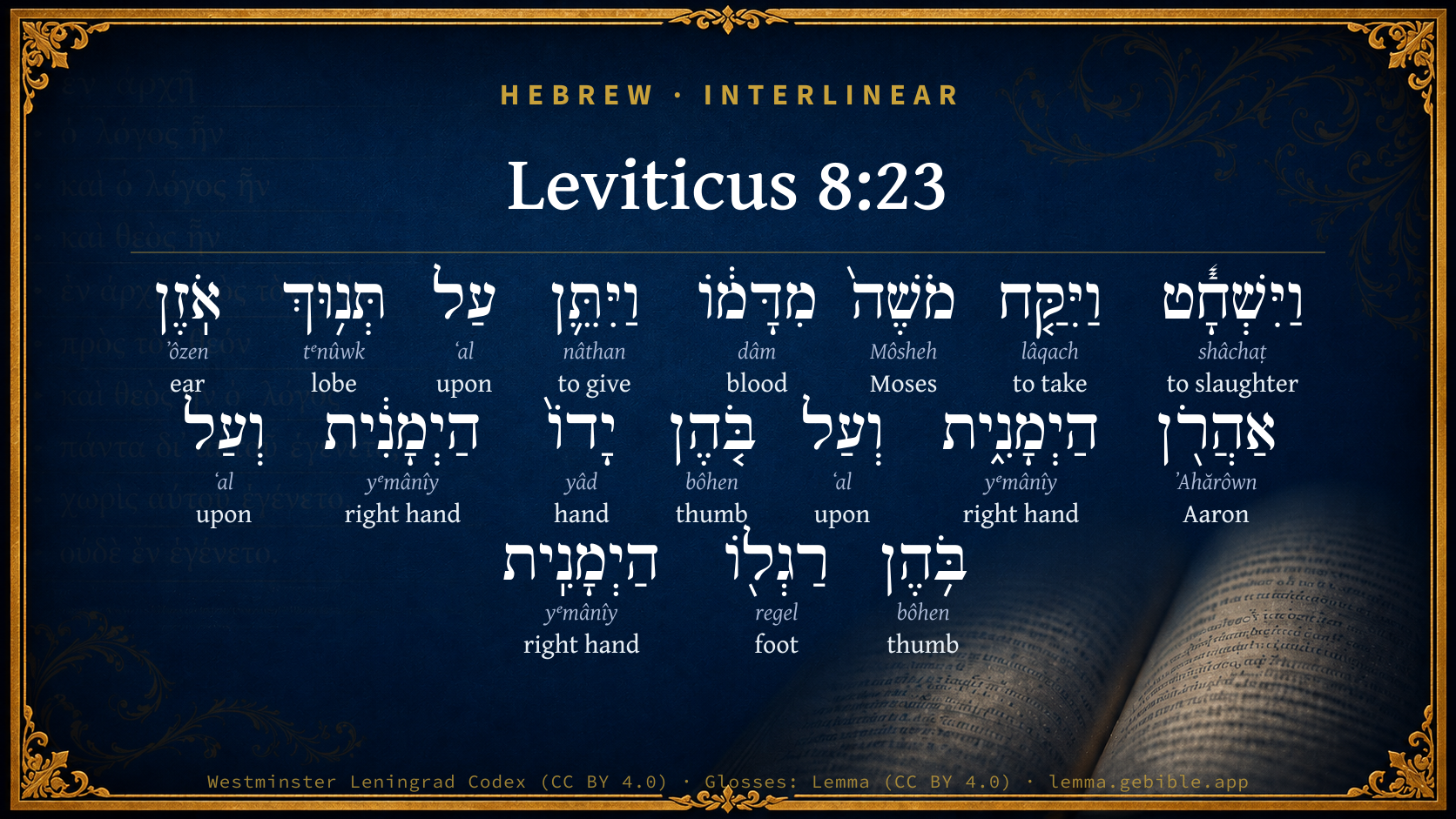
  1. וַיִּשְׁחָ֓ט shâchaṭ H7819 “and · to slaughter” Conjunction + Verb, Qal, Sequential Imperfect, 3rd Person, Masculine, Singular
  2. וַיִּקַּ֤ח lâqach H3947 “and · to take” Conjunction + Verb, Qal, Sequential Imperfect, 3rd Person, Masculine, Singular
  3. מֹשֶׁה֙ Môsheh H4872 “Moses” Noun, Proper
  4. מִדָּמ֔וֹ dâm H1818 “from · blood · his” Preposition + Noun, Common, Masculine, Singular, Construct + Suffix, Personal, 3rd Person, Masculine, Singular
  5. וַיִּתֵּ֛ן nâthan H5414 “and · to give” Conjunction + Verb, Qal, Sequential Imperfect, 3rd Person, Masculine, Singular
  6. עַל ʻal H5921 “upon” Preposition
  7. אֹֽזֶן ʼôzen H241 “ear of” Noun, Common, Feminine, Singular, Construct
  8. אַהֲרֹ֖ן ʼAhărôwn H175 “Aaron” Noun, Proper
  9. הַיְמָנִ֑ית yᵉmânîy H3233 “the · right hand” Particle, Definite Article + Adjective, Adjective, Feminine, Singular, Absolute
  10. וְעַל ʻal H5921 “and · upon” Conjunction + Preposition
  11. בֹּ֤הֶן bôhen H931 “thumb of” Noun, Common, Feminine, Singular, Construct
  12. יָדוֹ֙ yâd H3027 “hand · his” Noun, Common, Both, Singular, Construct + Suffix, Personal, 3rd Person, Masculine, Singular
  13. הַיְמָנִ֔ית yᵉmânîy H3233 “the · right hand” Particle, Definite Article + Adjective, Adjective, Feminine, Singular, Absolute
  14. וְעַל ʻal H5921 “and · upon” Conjunction + Preposition
  15. בֹּ֥הֶן bôhen H931 “thumb of” Noun, Common, Feminine, Singular, Construct
  16. רַגְל֖וֹ regel H7272 “foot · his” Noun, Common, Feminine, Singular, Construct + Suffix, Personal, 3rd Person, Masculine, Singular
  17. הַיְמָנִֽית yᵉmânîy H3233 “the · right hand” Particle, Definite Article + Adjective, Adjective, Feminine, Singular, Absolute

About this verse

These counts appear in no published source. They are computed here, from the morphology-tagged text and Lemma’s own curated glosses. What Lemma adds →

18
words
13
distinct lemmas
Pentateuch
section

Notable vocabulary

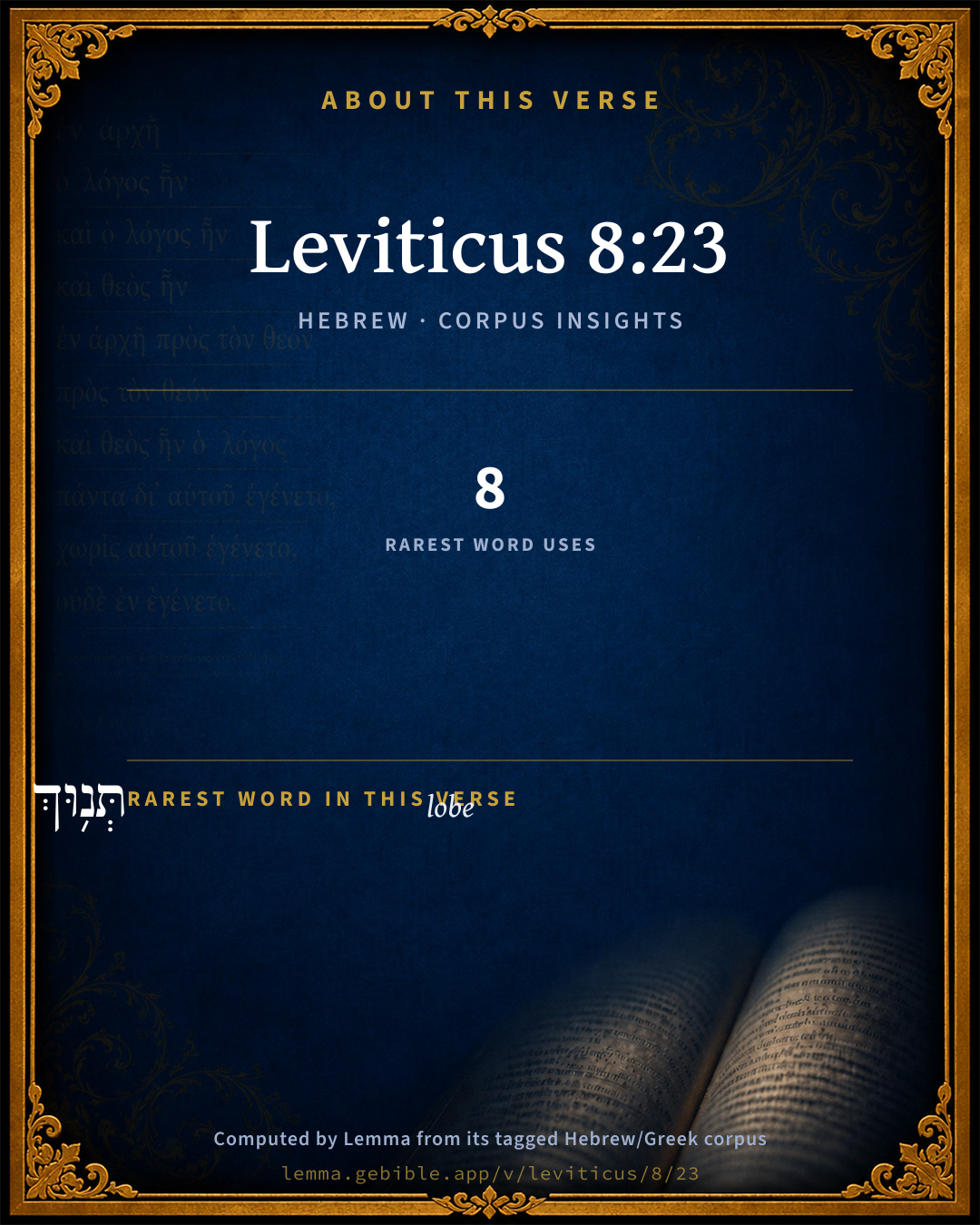
The rarest word here is תְּנ֥וּךְ lobe H8571 — appearing just 8 times in the whole Hebrew Bible.

Shared distinctive vocabulary

תְּנ֥וּךְ lobe H8571 occurs in 7 verses of the Hebrew Bible. Also found in:

Grammatical profile

  • 3 verbs
  • 9 nouns
  • 3 adjectives
  • 3 prepositions

Verb forms

  • וַיִּשְׁחָ֓ט Qal · Sequential Imperfect
  • וַיִּקַּ֤ח Qal · Sequential Imperfect
  • וַיִּתֵּ֛ן Qal · Sequential Imperfect

Repetition

Words recur within this verse — often emphatic in Hebrew:

  • עַל upon H5921 ×3
  • הַיְמָנִ֑ית right hand H3233 ×3
  • בֹּ֤הֶן thumb H931 ×2

Hebrew & Septuagint length

In English translation the verse runs 37 words from the Hebrew and 49 from the Septuagint (LXX English) — closely comparable.

A rough comparison of the two English renderings, which tokenize alike — not a word-level alignment.

Word counts can differ between the Hebrew and the Greek without any difference in meaning — e.g. the Hebrew direct-object marker אֵת has no separate Greek word, and Greek often adds the article ὁ.

Cross-references

15

Topical passages linked to Leviticus 8:23 in the Treasury of Scripture Knowledge — connected by theme and wording, ordered by reader-vote popularity; previews shown in the World English Bible.

  • Exodus 29:20 Then you shall kill the ram, and take some of its blood, and put it on the tip of the right ear of Aaron, and on the tip of the right ear of his sons, and on the thumb of their right hand, and on the big toe of their right foot, and sprinkle the blood on the altar round about.
  • Leviticus 14:14 The priest shall take some of the blood of the trespass offering, and the priest shall put it on the tip of the right ear of him who is to be cleansed, and on the thumb of his right hand, and on the big toe of his right foot.
  • Leviticus 14:17 The priest shall put some of the rest of the oil that is in his hand on the tip of the right ear of him who is to be cleansed, and on the thumb of his right hand, and on the big toe of his right foot, upon the blood of the trespass offering.
  • Romans 12:1 Therefore I urge you, brothers, by the mercies of God, to present your bodies a living sacrifice, holy, acceptable to God, which is your spiritual service.
  • Leviticus 14:28 Then the priest shall put some of the oil that is in his hand on the tip of the right ear of him who is to be cleansed, and on the thumb of his right hand, and on the big toe of his right foot, on the place of the blood of the trespass offering.
  • Romans 6:13 Neither present your members to sin as instruments of unrighteousness, but present yourselves to God, as alive from the dead, and your members as instruments of righteousness to God.
  • Romans 6:19 I speak in human terms because of the weakness of your flesh, for as you presented your members as servants to uncleanness and to wickedness upon wickedness, even so now present your members as servants to righteousness for sanctification.
  • 1 Corinthians 1:2 to the assembly of God which is at Corinth; those who are sanctified in Christ Jesus, called to be saints, with all who call on the name of our Lord Jesus Christ in every place, both theirs and ours:
  • 1 Corinthians 1:30 But of him, you are in Christ Jesus, who was made to us wisdom from God, and righteousness and sanctification, and redemption:
  • 1 Corinthians 6:20 for you were bought with a price. Therefore glorify God in your body and in your spirit, which are God's.
  • Philippians 1:20 according to my earnest expectation and hope, that I will in no way be disappointed, but with all boldness, as always, now also Christ will be magnified in my body, whether by life, or by death.
  • Philippians 2:17 Yes, and if I am poured out on the sacrifice and service of your faith, I rejoice, and rejoice with you all.
  • 1 Thessalonians 5:22 Abstain from every form of evil.
  • Hebrews 2:10 For it became him, for whom are all things, and through whom are all things, in bringing many children to glory, to make the author of their salvation perfect through sufferings.
  • Hebrews 5:8 though he was a Son, yet learned obedience by the things which he suffered.

Cross-references courtesy of OpenBible.info (CC BY 4.0).

Hebrew and Greek witnesses Masoretic Hebrew ↔ Greek Septuagint

The same verse in the two great witnesses to the Old Testament, shown verse-for-verse.

These are two independent witnesses, not word-aligned to each other, and the Septuagint is shown in lemma (dictionary) form.

Hebrew Leviticus 8:23 Masoretic · Westminster Leningrad Codex

וַיִּשְׁחָ֓ט וַיִּקַּ֤ח מֹשֶׁה֙ מִדָּמ֔וֹ וַיִּתֵּ֛ן עַל תְּנ֥וּךְ אֹֽזֶן אַהֲרֹ֖ן הַיְמָנִ֑ית וְעַל בֹּ֤הֶן יָדוֹ֙ הַיְמָנִ֔ית וְעַל בֹּ֥הֶן רַגְל֖וֹ הַיְמָנִֽית

He killed it; and Moses took some of its blood, and put it on the tip of Aaron's right ear, and on the thumb of his right hand, and on the great toe of his right foot.

World English Bible · Public Domain

Greek LXX Leviticus 8:23 Septuagint · lemma form

καί σφάζω αὐτός καί λαμβάνω μωυσῆς ἀπό ὁ αἷμα αὐτός καί ἐπιτίθημι ἐπί ὁ λοβός ὁ οὖς ἀαρών ὁ δεξιός καί ἐπί ὁ ἄκρος ὁ χείρ ὁ δεξιός καί ἐπί ὁ ἄκρος ὁ πούς ὁ δεξιός

And Moses brought near the sons of Aaron; and Moses put of the blood on the tips of their right ears, and on the thumbs of their right hands, and on the great toes of their right feet, and Moses poured out the blood on the altar round about.

LXX2012 (modern English Septuagint) · Public Domain

Hebrew: Westminster Leningrad Codex (CC BY 4.0). Greek: Septuagint (public domain); English from LXX2012 (modern English Septuagint) (Public Domain). How the Septuagint differs from the Hebrew →

Targum (Aramaic paraphrase)

2

The Targum is the ancient Jewish Aramaic paraphrase of the Hebrew Scriptures — an interpretive translation, not the Hebrew text itself. Onkelos (literal) and Pseudo-Jonathan (expansive) render the Torah, and Jonathan the Prophets. Coverage is partial: where no permissively-licensed English translation exists for a verse, only the Aramaic is shown. This is verse-level text, not a word-by-word alignment to the Hebrew.

  1. Targum Onkelos Torah (Genesis–Deuteronomy)
    וּנְכֵס וּנְסִיב מֹשֶׁה מִן דְמָא וִיהַב עַל רוּם אוּדְנָא דְאַהֲרֹן דְיַמִינָא וְעַל אִלְיוֹן יְדֵהּ דְיַמִינָא וְעַל אִלְיוֹן רַגְלֵהּ דְיַמִינָא

    (no public-domain English translation for this verse)

    Targum Onkelos — Aramaic: “Onkelos Genesis” (public domain); “Onkelos Exodus” (public domain); “Onkelos Leviticus” (public domain); “Onkelos Numbers” (public domain); “Onkelos Deuteronomy” (public domain). English: “Sefaria Community Translation” (CC0 1.0 (public-domain dedication)); “J.W. Etheridge. The Targums of Onkelos and Jonathan Ben Uzziel on the Pentateuch. London: Longmans, Green, 1862” (public domain). Text via Sefaria.

  2. Targum Pseudo-Jonathan Torah (Genesis–Deuteronomy)
    וּנְכֵיס יַת דִיכְרָא וּנְסֵיב משֶׁה מִן אַדְמֵיהּ וִיהַב עַל חַסְחוֹס אוּדְנָא דְאַהֲרן דְהוּא גְדֵירָא דִמְצִיעָאָה דְאוֹדַן יְמִינָא וְעַל פּוּרְקָא מִיצְעָא דְיַדֵיהֶן דְיַמִינָא וְעַל פּוּרְקָא מְצִיעָאָה דְרִגְלֵיהּ יְמִינָא

    And he killed the ram, and Mosheh took of its blood, and put it upon the etremity of Aharon's ear, the middle cartilage of the right ear, and upon the middle joint of his right foot.

    Targum Pseudo-Jonathan — Aramaic: “Targum Jonathan on Genesis” (public domain); “Targum Jonathan on Exodus” (public domain); “Targum Jonathan on Leviticus” (public domain); “Targum Jonathan on Numbers” (public domain); “Targum Jonathan on Deuteronomy” (public domain). English: “The Targum of Jonathan ben Uzziel, trans. J. W. Etheridge, London, 1862” (public domain). Text via Sefaria.

Commentary

Notes on Leviticus 8:23 from classic Christian and Jewish commentators (each source and its license shown beneath its notes). The classic Christian expositions comment on the surrounding passage and are grouped to its opening verse, so a note may address several verses; the Jewish commentaries on the Tanakh (Rashi and others) are per-verse, so they appear only where the commentator wrote on this verse.

Lemma curates 59 commentaries, every one of them public domain or Creative Commons licensed, each selected and text-cleaned for this edition rather than reprinted as found. About our sources →

Tyndale Open Study Notes

Tyndale Open Resources

8:23 Aaron’s [ear]lobe, thumb, and big toe represented his total person. This act emphasized the role of the priestly office, with the blood stressing the ties to the sacrificial system. The priest’s basic function was mediation between God and his people. To do this effectively, he needed ears that could hear the words of God and the needs of his people, hands ready to do God’s bidding, and feet ready to take him where he was needed.

Tyndale Open Study Notes — © Tyndale Open Resources, licensed CC BY-SA 4.0. Text via the HelloAO Bible API.

Geneva Bible (1599)

Geneva Bible translators

Moses did this because that the Priests were not yet established in their office.

Geneva Bible (1599) marginal notes — public domain. Text via Bolls.life.

Adam Clarke's Commentary

Verse 23. Put it upon the tip of Aaron's right ear, c.] See this significant ceremony explained in the note on Ex 29:20. See Clarke on Ex 29:20.

Calmet remarks that the consecration of the high priest among the Romans bore a considerable resemblance to the consecration of the Jewish high priest. "The Roman priest, clothed with a garment of silk, his head covered with a crown of gold adorned with sacred ribbons, was conducted into a subterranean place, over which there was a floor of planks pierced through with many holes. On this floor they sacrificed a bullock, whose blood was freely poured out on the planks or floor, which running through the holes fell upon the priest, who stood under to receive this sacred aspersion, and who, in order to be completely covered with the blood, took care to present the whole of his body, his clothes, face, eyes, nose, lips, and even his tongue, to receive the drops of blood falling through the pierced floor above. Being completely covered with this sanguineous shower, he ascended from his subterranean place, and was acknowledged and adored by the people as Pontifex Maximus, or supreme high priest." These rites, which bear a striking allusion to those used in the consecration of Aaron, and from which they were probably borrowed, and disguised by the introduction of their own superstitions, are particularly described by Aurelius Prudentius, in his poem entitled Romani Martyris Supplicium, from which I shall select those verses, the subject of which is given above, as the passage is curious, and the work not common.

"Summus sacerdos nempe sub terram scrobe

Acta in profundum consecrandus mergitur,

Mire infulatus, festa vittis tempora

Nectens, corona tum repexus aurea,

Cinctu Gabino sericam fultus togam.

Tabulis superne strata texunt pulpita,

Rimosa rari pegmatis compagibus,

Scindunt subinde vel terebrant aream,

Crebroque lignum perforant acumine,

Pateat minutis ut frequens hiatibus. -

Hic ut statuta est immolanda bellua,

Pectus sacrata dividunt venabulo,

Eructat amplum volnus undam sanguinis - c.

Tum per frequentes mille rimarum vias

Illapsus imber, tabidum rorem pluit,

Defossus intus quem sacerdos excipit,

Guttas ad omnes turpe subjectans caput,

Et veste et omni putrefactus corpore:

Quin os supinat, obvias offert genas

Supponit aures, labra, nares objicit,

Oculos et ipsos perluit liquoribus,

Nec jam palato parcit, et linguam rigat,

Donec cruorem totus atrum combibat. -

Procedit inde pontifex vlsu horridus-&c.

Omnes salutant atque adorant eminus,

Vilis quod illum sanguls, et bos mortuus

Foedis latentem sub cavernis laverint."

Of these lines the reader will not be displeased to find the following poetical version: -

"For when, with sacred pomp and solemn state,

Their great high priest the Romans consecrate,

His silken vest in Gabine cincture bound,

A festal fillet twines his temples round:

And, while aloft the gorgeous mitre shines,

His awful brow a golden crown confines.

In a deep dyke, for mystic ritual made,

He stands, surrounded with terrific shade.

High o'er his holy head a stage they place,

Adorn with paintings, and with statues grace

Then with keen piercers perforate the floor,

Till thronging apertures admit no more.

Thither the victim ox is now convey'd,

To glut the vengeance of the thirsty blade.

The sacred spear his sturdy throat divides,

Down, instant streaming, gush the gory tides,

Through countless crevices the gaping wood

Distils corrupted dew and smoking blood

Drop after drop, in swift succession shed,

Falls on the holy pontiff's mitred head;

While, to imbibe the sanctifying power,

His outspread garments drink the crimson shower;

Then on his back in reeking streams he lies,

And laves in livid blood his lips and eyes;

Bares every limb, exposes every pore,

To catch the virtue of the streaming gore;

With open mouth expects the falling flood,

Moistens his palate and his tongue with blood;

Extends his ears to meet the sanguine rain,

Nor lets a single drop descend in vain.

Then from the gloomy cave comes forth to light,

Bathed in black blood, and horrible to sight! -

By the vile torrent, and the victim slain,

In the dark cavern cleansed from mortal stain,

Their priest, enveloped in atoning gore,

With trembling awe surrounding throngs adore."

Prudentius was born about the middle of the fourth century, and was no doubt intimately acquainted with the circumstances he describes.

Adam Clarke's Commentary on the Bible (1810–1826) — public domain. Text from a community e-Sword/MySword module.

Ellicott's Commentary for English Readers

(23) And he slew it.—Better, and he killed, as the same word is rendered in the Authorised Version in Lev_8:19, that is, Moses killed it.

And put it upon the tip of Aaron’s right ear.—To teach him that, as the mediator between God and His people, it was his bounden duty to hearken to the commandments of the Lord.

And upon the thumb of his right hand.—To remind him that henceforth he is to execute God’s will, and walk in the way of His commandments.

A Bible Commentary for English Readers, edited by Charles John Ellicott (1878–1897) — public domain. Text from a community e-Sword module.

Haydock's Catholic Bible Commentary

Foot. The whole person was thus sensibly consecrated to God’s service. (Haydock) --- The pagan high priest, among the Romans, was adorned in silk and ribbands, with a crown of gold. Being conducted under ground, the blood of an ox, which had been sacrificed, came upon his head, ears, and other parts of his body, through little holes, made in a board; and thus besmeared, he was recognized by the people. (Prudent. hym. S. Romani, Saumaise. &c.)

George Leo Haydock (1774–1849), Haydock's Catholic Family Bible and Commentary, 1859 edition — public domain. Excludes Psalms (Douay-Rheims chapter numbering differs from Protestant) and Deuterocanonical books (Catholic canon only).

Matthew Poole's English Annotations

The lowest and softest part of the ear is called the tip or lap of the ear. See Exo 29:20.

Matthew Poole's English Annotations on the Holy Bible (1683–1685) — public domain. Text from a community e-Sword/MySword module.

Whedon's Commentary on the Bible

Daniel D. Whedon

23. Blood… upon the tip of Aaron’s right ear — The consecration was not only general, but specific. The ear must be dedicated that it may be open to the divine voice; the hand and foot, that they may be efficient in sacred services. Eminent saints have practised self consecration by the enumeration of all their faculties and capacities in detail. See the Life of Dr. Payson.

“Welcome, welcome, dear Redeemer,

Welcome to this heart of mine;

Lord, I make a full surrender;

Every power and thought be thine,

Thine entirely, through eternal ages thine.”

Daniel D. Whedon (gen. ed.), Commentary on the Old and New Testaments (1874–1909) — public domain. Text from a community e-Sword module.

Lesson kit

Teaching starters — assembled from the data on this page, not authored interpretation. Every prompt links to the verse data it draws on. Edit before teaching.

Leviticus, in the Pentateuch, opens this verse with 18 words (13 distinct Hebrew lemmas). Its most distinctive word is tᵉnûwk (“lobe”). A historical commentator’s framing appears above. Read the whole chapter for the surrounding context.

Discussion questions

  1. How does “lobe” (tᵉnûwk) shape what this verse is saying?
  2. How does Exodus 29:20, which shares the word «lobe», read alongside this verse?
  3. What does the repetition of “upon” (3× in this one verse) do in this verse?
  4. These translations render this verse differently. What is at stake in choosing one wording over another?
  5. «וַיִּשְׁחָ֓ט» is a Qal Sequential Imperfect verb. How does that grammatical form shape the action described?
  6. Compare how Tyndale Open Study Notes and Geneva Bible (1599) read this verse. Where do they agree or differ?

Things to notice

Reading settings

Reading text

Shown beneath each verse's original-language words.

Old Testament
Old Testament edition

Read the OT as the Masoretic Hebrew (MT) or the Greek Septuagint (LXX).

English shown for the Greek Septuagint (in the Hebrew ↔ Greek comparison).

Comparing translations? Open the Compare panel on any verse page to stack up to four side by side.