Ezekiel 33:4

Hebrew (Westminster Leningrad Codex) Ezekiel 33:4 appears in the Hebrew Old Testament. The text above is from the Westminster Leningrad Codex. Each word links to its Strong’s number, a concise gloss, and parsing drawn from the Open Scriptures Hebrew Bible morphology. Click any word for its full Brown-Driver-Briggs (BDB) entry.
Download image
Cite this verse

Ezekiel 33:4 (World English Bible). Public Domain. Lemma interlinear Bible study tool, https://lemma.gebible.app/v/ezekiel/33/4.

Show BibTeX & RIS
BibTeX
RIS
English Translation
then whoever hears the sound of the trumpet, and doesn't take warning, if the sword come, and take him away, his blood shall be on his own head.
World English Bible · Public Domain
Download a study sheet

One document with this verse’s original text, its word-by-word gloss line, the meaning frame, cross-references with their text, attributed commentary, and full source and license credits — printable, and it pastes into notes with its structure intact.

This verse Autodidact and up

Study sheet (.html) Plain text (.txt)

A passage Seminary Student

Up to 50 verses in one chapter. A passage sheet keeps up to 6 commentary sources and 12 cross-references per verse, in the order this page ranks them, and says so on the sheet whenever that leaves anything out. Ask for a single verse and you get the Autodidact verse sheet above.

Everything on this page stays free to read, with no account — the sheet is a download of what is already on screen, not access to it.

Want to remove ads? Support Godless Engineer
Compare translations 3

The same verse in 3 English versions, stacked beneath the original-language interlinear above. Click any original word for its lexicon entry.

Each is an independent rendering of the whole verse — the interlinear is not word-aligned to these translations.

Highlighted words mark where these versions differ — a whole-verse word diff, not a word-by-word alignment.

  • World English Bible Public Domain
    then whoever hears the sound of the trumpet, and doesn't take warning, if the sword come, and take him away, his blood shall be on his own head.
  • King James Version Public Domain
    Then whosoever heareth the sound of the trumpet, and taketh not warning; if the sword come, and take him away, his blood shall be upon his own head.
  • unfoldingWord Literal Text CC BY-SA 4.0
    If the people hear the sound of the horn but do not pay attention, and if the sword comes and kills them, then each one’s blood is on his own head.

unfoldingWord Literal Text — © unfoldingWord, licensed CC BY-SA 4.0. Word-aligned USFM3 via Door43 (git.door43.org/unfoldingWord/en_ult).

Versions to compare (up to 4)

3 of 4 selected

Show all 18 translations

Every available English version of this verse, each an independent rendering of the whole verse.

  • World English Bible Public Domain
    then whoever hears the sound of the trumpet, and doesn't take warning, if the sword come, and take him away, his blood shall be on his own head.
  • Berean Standard Bible Public Domain
    Then if anyone hears the sound of the horn but fails to heed the warning, and the sword comes and takes him away, his blood will be on his own head.
  • Majority Standard Bible Public Domain
    Then if anyone hears the sound of the horn but fails to heed the warning, and the sword comes and takes him away, his blood will be on his own head.
  • King James Version Public Domain
    Then whosoever heareth the sound of the trumpet, and taketh not warning; if the sword come, and take him away, his blood shall be upon his own head.
  • American Standard Version (1901) Public Domain
    then whosoever heareth the sound of the trumpet, and taketh not warning, if the sword come, and take him away, his blood shall be upon his own head.
  • Revised Version (1885) Public Domain
    then whosoever heareth the sound of the trumpet, and taketh not warning, if the sword come, and take him away, his blood shall be upon his own head.
  • Geneva Bible (1599) Public Domain
    Then hee that heareth the sounde of the trumpet, and will not bee warned, if the sworde come, and take him away, his blood shall be vpon his owne head.
  • Douay-Rheims (1899) Public Domain
    Then he that heareth the sound of the trumpet, whosoever he be, and doth not look to himself, if the sword come, and cut him off: his blood shall be upon his own head.
  • Young's Literal Translation Public Domain
    And the hearer hath heard the voice of the trumpet, and he hath not taken warning, And come in doth the sword, and taketh him away, His blood is on his head.
  • Literal Standard Version CC BY-SA 4.0
    And the hearer has heard the voice of the horn, and he has not taken warning, || And the sword comes in, and takes him away, || His blood is on his [own] head.
  • Unlocked Literal Bible CC BY-SA 4.0
    If the people hear the sound of the horn but do not pay attention, and if the sword comes and kills them, then each one's blood is on his own head.
  • unfoldingWord Literal Text CC BY-SA 4.0
    If the people hear the sound of the horn but do not pay attention, and if the sword comes and kills them, then each one’s blood is on his own head.
  • Darby Bible Public Domain
    then whosoever heareth the sound of the trumpet, and taketh not warning, if the sword come and take him away, his blood shall be upon his own head.
  • World Messianic Bible Public Domain
    then whoever hears the sound of the shofar and doesn’t heed the warning, if the sword comes and takes him away, his blood will be on his own head.
  • Webster's Bible Public Domain
    Then whoever heareth the sound of the trumpet, and taketh not warning; if the sword shall come and take him away, his blood shall be upon his own head.
  • Free Bible Version CC BY-SA 4.0
    So if you hear the trumpet but don't pay attention to the warning, and you're killed in the attack, you will be responsible for your own death.
  • Bible in Basic English Public Domain
    Then anyone who, hearing the sound of the horn, does not take note of it, will himself be responsible for his death, if the sword comes and takes him away.
  • JPS Tanakh (1917) Public Domain
    then whosoever heareth the sound of the horn, and taketh not warning, if the sword come, and take him away, his blood shall be upon his own head;

Literal Standard Version (2020), Covenant Press — licensed CC BY-SA 4.0. Text via the HelloAO Bible API (eBible.org). Unlocked Literal Bible (unfoldingWord) — licensed CC BY-SA 4.0. Text via the HelloAO Bible API (eBible.org). unfoldingWord Literal Text — © unfoldingWord, licensed CC BY-SA 4.0. Word-aligned USFM3 via Door43 (git.door43.org/unfoldingWord/en_ult). Free Bible Version, Dr. Jonathan Gallagher — licensed CC BY-SA 4.0. Text via the HelloAO Bible API (eBible.org).

Word by word

More ways to search: Search by grammar → Find every occurrence → Compare this word →

Practice this passage: Drill this verse → Learn its vocabulary →

נִזְהָ֔ר
zâhar
H2094
“to teach”
Verb, Niphal, Perfect, 3rd Person, Masculine, Singular
Part of Speech
Verb
Stem
Niphal
Form
Perfect
Person
3rd Person
Gender
Masculine
Number
Singular
Full BDB Definition

Origin: a primitive root

TWOT: 531 , 532

to admonish, warn, teach, shine, send out light, be light, be shining - (Niphal) to be taught, be admonished - (Hiphil) - to teach, warn - to shine, send out light (figuratively)
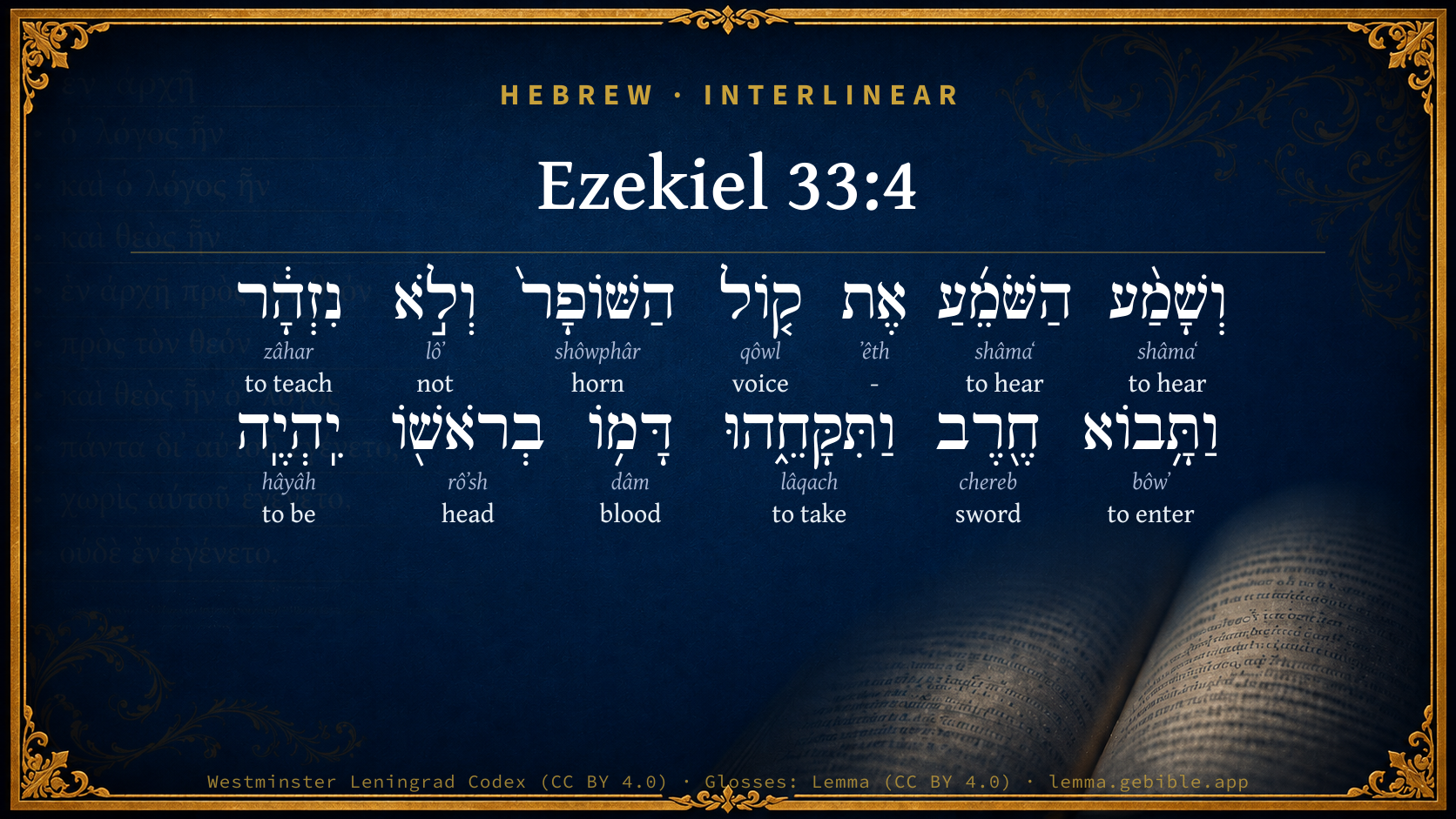
  1. וְשָׁמַ֨ע shâmaʻ H8085 “and · to hear” Conjunction + Verb, Qal, Sequential Perfect, 3rd Person, Masculine, Singular
  2. הַשֹּׁמֵ֜עַ shâmaʻ H8085 “the · hearing” Particle, Definite Article + Verb, Qal, Participle Active, Masculine, Singular, Absolute
  3. אֶת ʼêth H853 “-” Particle, Direct Object
  4. ק֤וֹל qôwl H6963 “voice of” Noun, Common, Masculine, Singular, Construct
  5. הַשּׁוֹפָר֙ shôwphâr H7782 “the · horn” Particle, Definite Article + Noun, Common, Masculine, Singular, Absolute
  6. וְלֹ֣א lôʼ H3808 “and · not” Conjunction + Particle, Negative
  7. וַתָּ֥בוֹא bôwʼ H935 “and · to enter” Conjunction + Verb, Qal, Sequential Imperfect, 3rd Person, Feminine, Singular
  8. חֶ֖רֶב chereb H2719 “sword” Noun, Common, Feminine, Singular, Absolute
  9. וַתִּקָּחֵ֑הוּ lâqach H3947 “and · to take · him” Conjunction + Verb, Qal, Sequential Imperfect, 3rd Person, Feminine, Singular + Suffix, Personal, 3rd Person, Masculine, Singular
  10. דָּמ֥וֹ dâm H1818 “blood · his” Noun, Common, Masculine, Singular, Construct + Suffix, Personal, 3rd Person, Masculine, Singular
  11. בְרֹאשׁ֖וֹ rôʼsh H7218 “in/at · head · his” Preposition + Noun, Common, Masculine, Singular, Construct + Suffix, Personal, 3rd Person, Masculine, Singular
  12. יִֽהְיֶֽה hâyâh H1961 “to be” Verb, Qal, Imperfect, 3rd Person, Masculine, Singular

About this verse

These counts appear in no published source. They are computed here, from the morphology-tagged text and Lemma’s own curated glosses. What Lemma adds →

13
words
12
distinct lemmas
Prophets
section

Notable vocabulary

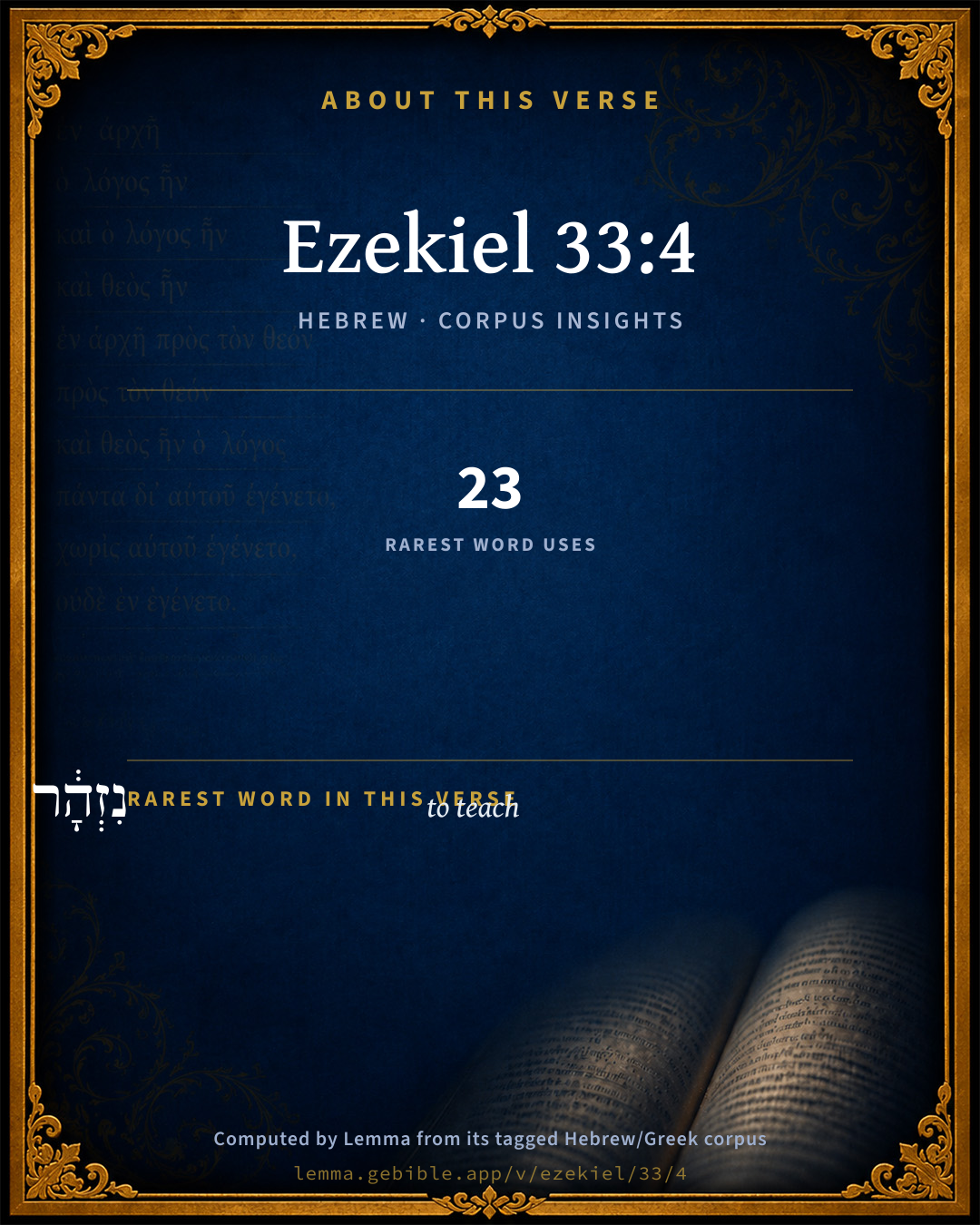
The rarest word here is נִזְהָ֔ר to teach H2094 — appearing just 23 times in the whole Hebrew Bible.

Shared distinctive vocabulary

נִזְהָ֔ר to teach H2094 occurs in 19 verses of the Hebrew Bible. Also found in:

Grammatical profile

  • 6 verbs
  • 5 nouns
  • 2 particles

Verb forms

  • וְשָׁמַ֨ע Qal · Sequential Perfect
  • הַשֹּׁמֵ֜עַ Qal · Participle Active
  • נִזְהָ֔ר Niphal · Perfect
  • וַתָּ֥בוֹא Qal · Sequential Imperfect
  • וַתִּקָּחֵ֑הוּ Qal · Sequential Imperfect
  • יִֽהְיֶֽה Qal · Imperfect

Repetition

A word recurs within this verse — often emphatic in Hebrew:

  • וְשָׁמַ֨ע to hear H8085 ×2

Hebrew & Septuagint length

In English translation the verse runs 28 words from the Hebrew and 35 from the Septuagint (LXX English) — closely comparable.

A rough comparison of the two English renderings, which tokenize alike — not a word-level alignment.

Word counts can differ between the Hebrew and the Greek without any difference in meaning — e.g. the Hebrew direct-object marker אֵת has no separate Greek word, and Greek often adds the article ὁ.

Cross-references

15

Topical passages linked to Ezekiel 33:4 in the Treasury of Scripture Knowledge — connected by theme and wording, ordered by reader-vote popularity; previews shown in the World English Bible.

  • Ezekiel 18:13 has given forth on interest, and has taken increase; shall he then live? he shall not live: he has done all these abominations; he shall surely die; his blood shall be on him.
  • Acts 18:6 When they opposed him and blasphemed, he shook out his clothing and said to them, "Your blood be on your own heads! I am clean. From now on, I will go to the Gentiles!"
  • Jeremiah 6:17 I set watchmen over you, [saying], Listen to the sound of the trumpet; but they said, We will not listen.
  • Ezekiel 33:9 Nevertheless, if you warn the wicked of his way to turn from it, and he doesn't turn from his way; he shall die in his iniquity, but you have delivered your soul.
  • 2 Chronicles 25:16 It happened, as he talked with him, that [the king] said to him, Have we made you of the king's counsel? Stop! Why should you be struck down? Then the prophet stopped, and said, I know that God has determined to destroy you, because you have done this, and have not listened to my counsel.
  • Ezekiel 33:5 He heard the sound of the trumpet, and didn't take warning; his blood shall be on him; whereas if he had taken warning, he would have delivered his soul.
  • Zechariah 1:2–4 "Yahweh was very displeased with your fathers.
  • Leviticus 20:9 "'For everyone who curses his father or his mother shall surely be put to death: he has cursed his father or his mother; his blood shall be upon him.
  • Leviticus 20:11–27 The man who lies with his father's wife has uncovered his father's nakedness: both of them shall surely be put to death; their blood shall be upon them.
  • 2 Samuel 1:16 David said to him, Your blood be on your head; for your mouth has testified against you, saying, I have slain Yahweh's anointed.
  • 1 Kings 2:37 For on the day you go out, and pass over the brook Kidron, know you for certain that you shall surely die: your blood shall be on your own head.
  • Proverbs 29:1 He who is often rebuked and stiffens his neck Will be destroyed suddenly, with no remedy.
  • Jeremiah 42:20–22 For you have dealt deceitfully against your own souls; for you sent me to Yahweh your God, saying, Pray for us to Yahweh our God; and according to all that Yahweh our God shall say, so declare to us, and we will do it:
  • Acts 20:26 Therefore I testify to you this day that I am clean from the blood of all men,
  • James 1:22 But be doers of the word, and not only hearers, deluding your own selves.

Cross-references courtesy of OpenBible.info (CC BY 4.0).

Hebrew and Greek witnesses Masoretic Hebrew ↔ Greek Septuagint

The same verse in the two great witnesses to the Old Testament, shown verse-for-verse.

These are two independent witnesses, not word-aligned to each other, and the Septuagint is shown in lemma (dictionary) form.

Hebrew Ezekiel 33:4 Masoretic · Westminster Leningrad Codex

וְשָׁמַ֨ע הַשֹּׁמֵ֜עַ אֶת ק֤וֹל הַשּׁוֹפָר֙ וְלֹ֣א נִזְהָ֔ר וַתָּ֥בוֹא חֶ֖רֶב וַתִּקָּחֵ֑הוּ דָּמ֥וֹ בְרֹאשׁ֖וֹ יִֽהְיֶֽה

then whoever hears the sound of the trumpet, and doesn't take warning, if the sword come, and take him away, his blood shall be on his own head.

World English Bible · Public Domain

Greek LXX Ezekiel 33:4 Septuagint · lemma form

καί ἀκούω ὁ ἀκούω ὁ φωνή ὁ σάλπιγξ καί μή φυλάσσω καί ἐπιἔρχομαι ὁ ῥομφαία καί καταλαμβάνω αὐτός ὁ αἷμα αὐτός ἐπί ὁ κεφαλή αὐτός εἰμί

and he that hears the sound of the trumpet shall hear indeed, and yet not take heed, and the sword shall come upon him, and overtake him, his blood shall be upon his own head.

LXX2012 (modern English Septuagint) · Public Domain

Hebrew: Westminster Leningrad Codex (CC BY 4.0). Greek: Septuagint (public domain); English from LXX2012 (modern English Septuagint) (Public Domain). How the Septuagint differs from the Hebrew →

Targum (Aramaic paraphrase)

1

The Targum is the ancient Jewish Aramaic paraphrase of the Hebrew Scriptures — an interpretive translation, not the Hebrew text itself. Onkelos (literal) and Pseudo-Jonathan (expansive) render the Torah, and Jonathan the Prophets. Coverage is partial: where no permissively-licensed English translation exists for a verse, only the Aramaic is shown. This is verse-level text, not a word-by-word alignment to the Hebrew.

  1. Targum Jonathan Prophets (Joshua–Malachi)
    וְיִשְׁמַע דִי שְׁמַע יַת קַל שׁוֹפָרָא וְלָא אִזְדְהַר וַאֲתוֹ קָטוֹלֵי חַרְבָּא וְדַבְּרוֹהִי חוֹבַת קְטוֹלֵיהּ בְּרֵישֵׁיהּ יְהֵי:

    (no public-domain English translation for this verse)

    Targum Jonathan — Aramaic: “Mikraot Gedolot” (public domain). English: “Sefaria Community Translation” (CC0 1.0 (public-domain dedication)); “London "Chaldee Paraphrase," 1871” (public domain). Text via Sefaria.

Commentary

Notes on Ezekiel 33:4 from classic Christian and Jewish commentators (each source and its license shown beneath its notes). The classic Christian expositions comment on the surrounding passage and are grouped to its opening verse, so a note may address several verses; the Jewish commentaries on the Tanakh (Rashi and others) are per-verse, so they appear only where the commentator wrote on this verse.

Lemma curates 59 commentaries, every one of them public domain or Creative Commons licensed, each selected and text-cleaned for this edition rather than reprinted as found. About our sources →

Trapp's Complete Commentary

John Trapp

Eze 33:4 Then whosoever heareth the sound of the trumpet, and taketh not warning; if the sword come, and take him away, his blood shall be upon his own head.

Ver. 4. His blood shall be upon his own.] The blame shall rest wholly upon himself. Not to be warned is both a just presage and desert of destruction.

John Trapp, A Commentary or Exposition upon All the Books of the Old and New Testament (1647–1656) — public domain. Text from a community e-Sword module.

The Biblical Illustrator

Joseph S. Exell

Eze_33:4-5

Whosoever heareth the sound of the trumpet.

The trumpet call

I. The analogy between the watchman on the walls of Zion and the preacher of the Gospel of the grace of God.

1. The qualifications needed in a watchman: vigour, courage, intelligence, loyalty, fidelity.

2. The duties: vigilance, to watch; obedience, to warn.

3. The responsibilities: account of the service must be rendered to those who appointed him; safety of the city depended largely upon the faithful discharge of the watchmans duties.

II. The analogy between the sound of the watchmans trumpet and the message of the Gospel preacher. Here we are reminded of the trumpet call of alarm on the approach of danger in time of peril. The call was to be definite, distinct, emphatic, rousing. Warning every man. The Gospel trumpet is to arrest the attention of men, call them to repent, to surrender, lay down their weapons of rebellion; and then, armed with the whole armour of God, go forth manfully to fight His battles. The Gospel message is a trumpet call to advance, and no surrender; it is never the call to retreat, or the proclaimer of defeat. There must be no uncertain sound, for all truth is dogmatic, and ought to be definitely proclaimed.

III. The analogy between the responsibility of those who heard the watchmans trumpet and those who hear the sound of the Gospel. The watchman on the walls of Zion simply sounded the alarm; it was for the people to believe and obey. So the Gospel hearers of today are responsible for the effects produced upon their hearts and minds by the Gospel message. (Homilist.)

He heard the sound of the trumpet, and took not warning; his blood shall be upon him.

The warning neglected

In all worldly things men are always enough awake to understand their own interests There is scarce a merchant who reads the paper who does not read it some way or other with a view to his own personal concerns. In politics, in everything, in fact, that concerns temporal affairs, personal interest usually leads the van. Men will always be looking out for themselves and personal home interests will generally engross the major part of their thoughts. But in religion it is otherwise. In religion men love far rather to believe abstract doctrines, and to talk of general truths, than the searching inquiries which examine their own personal interest in it.

I. The warning was all that could be desired. When in time of war an army is attacked in the night, and cut off and destroyed whilst asleep, if it were possible for them to be aware of the attack, and if they had used all diligence in placing their sentinels, but nevertheless the foe were so wary as to destroy them, we should weep; we should attach no blame to anyone, but should deeply regret, and should give to that host our fullest pity. But if, on the other hand, they had posted their sentinels, and the sentinels were wide awake, and gave to the sleepy soldiers every warning that could be desired, but nevertheless the army were cut off, although we might from common humanity regret the loss thereof, yet at the same time we should be obliged to say, if they were foolish enough to sleep when the sentinels had warned them; if they folded their arms in presumptuous sloth, after they had had sufficient and timely notice of the progress of their bloodthirsty enemy, then in their dying we cannot pity them: their blood must rest upon their own heads. So it is with you.

1. The warnings of the ministry have been to most of you warnings that have been heard--He heard the sound of the trumpet. In far off lands the trumpet sound of warning is not heard.

2. The trumpet was not only heard, but more than that, its warning was understood. If ye be damned, I am innocent of your damnation; for I have told you plainly, that except ye repent ye must perish, and that except ye put your trust in the Lord Jesus Christ there is for you no hope of salvation.

3. Again, this sound was startling. Then, sirs, if ye have heard the cry of fire, if ye are burned in your beds, your charred ashes shall not accuse me.

4. In many of your eases the warning has been very frequent. A hundred times every year you have gone up to the house of God, and far oftener than that, and you have just added a hundred billets to the eternal pile.

5. This warning that you have had so often has come to you in time. You are not warned on a sick bed at the eleventh hour, when there is but a bare possibility of salvation, but you are warned in time, you are warned today, you have been warned for these many years that are now past.

II. Men make excuses why they do not attend to the Gospel warning, but these excuses are all frivolous and wicked.

1. Some say, Well, I did not attend to the warning, because I did not believe there was any necessity for it. There was enough in reason to have taught you that there was an hereafter; the Book of Gods revelation was plain enough to have taught it to you, and if you have rejected Gods Book, and rejected the voice of reason and of conscience, your blood is on your own head.

2. But, cries another, I did not like the trumpet. I did not like the Gospel that was preached. Well, but God made the trumpet, God made the Gospel; and inasmuch as ye did not like what God made, it is an idle excuse. What was that to you what the trumpet was, so long as it warned you?

3. But another says, I did not like the man himself; I did not like the minister; I did not like the man that blew the trumpet; I could hear him preach very well, but I had a personal dislike to him, and so I did not take any notice of what the trumpet said. Verily, God will say to thee at last, Thou fool, what hadst thou to do with that man? to his own master he stands or falls; thy business was with thyself.

4. There are many other people who say, Ah, well, I did none of those things, but I had a notion that the trumpet sound ought to be blown to everybody else, but not to me. Ah! that is a very common notion. All men think all men mortal but themselves, said a good poet; and all men think all men need the Gospel, but not themselves.

5. Well, says another, But I was so busy; I had so much to do that I could not possibly attend to my souls concerns. What will you say of the man who had so much to do that he could not get out of the burning house, but was burnt to ashes.

6. Well, says another, but I thought I had time enough; you do not want me, sir, to be religious in my youth, do you? I am a lad; and may I not have a little frolic, and sow my wild oats as well as anybody else? Well--yes, yes; but at the same time the best place for frolic that I know of is where a Christian lives; the finest happiness in all the world is the happiness of a child of God.

III. Then the last thought is, His blood shall be on his own head. Briefly thus--he shall perish; he shall perish certainly; he shall perish inexcusably.

1. He shall perish. And what does that mean? There is no human mind however capacious, that can ever guess the thought of a soul eternally cast away from God.

2. But again, he that turneth not at the rebuke of the minister shall die, and he shall die certainly. This is not a matter of perhaps or chance.

3. Now, the last thing is, the sinner will perish--he will perish certainly, but last of all, he will perish without excuse,--his blood shall be on his own head. When a man is bankrupt, if he can say, It is not through reckless trading--it has been entirely through the dishonesty of one I trusted that I am what I am; he takes some consolation, and he says, I cannot help it. But oh, if you make bankrupts of your own souls, after you have been warned, then your own eternal bankruptcy shall lie at your own door. (C. H. Spurgeon.)

The Biblical Illustrator, edited by Joseph S. Exell (c. 1880s–1900s) — public domain. Text from a community e-Sword module.

Jamieson, Fausset & Brown

Robert Jamieson, A. R. Fausset & David Brown

blood . . . upon his own head--metaphor from sacrificial victims, on the heads of which they used to lay their hands, praying that their guilt should be upon the victims.

Jamieson, Fausset & Brown — Commentary Critical and Explanatory on the Whole Bible (1871) — public domain (CC PDM 1.0). Text via the HelloAO Bible API.

The Cambridge Bible for Schools and Colleges

gen. ed. J. J. S. Perowne

4, 5. He that heareth the trumpet and taketh not warning, his blood shall be on his own head; he is responsible for his own death, which shall not be laid at the door of the watchman.

The Cambridge Bible for Schools and Colleges (gen. ed. J. J. S. Perowne; Cambridge University Press, 1878–1918) — public domain. Text from a community e-Sword module.

John Gill's Exposition

Then whosoever heareth the sound of the trumpet, and taketh no warning,.... Does not mind the notice given him; is incredulous of the danger he is in, or negligent of providing for his safety; fancies it is an alarm, and nothing else; and imagines there is no real danger, or what is a mere trifle; or, that the enemy is at a great distance, and it is time enough to provide for his defence:

if the sword come and take him away; those that kill with the sword, as the Targum, come suddenly on him, and take away his life, or carry him captive: his blood shall be upon his own head; the guilt of his slaughter, as the Targum; the sin will be his own; it must be brought in wilful murder; no blame can be laid upon any but himself; the watchman will be clear.

John Gill's Exposition of the Whole Bible (1746–1763) — public domain (CC PDM 1.0). Text via the HelloAO Bible API.

Matthew Poole's English Annotations

Whosoever considers not and minds not what he hears, who hears and does not consider, he turns a deaf ear to the meaning, though not to the sound of the trumpet.

Taketh not warning; apprehends not, nor will be made apprehensive of, the danger, to provide for resisting or fleeing the sword.

Take him away; destroy him.

His blood; the guilt and blame of his blood, of his death. Shall be upon his own head; shall never be charged on any but himself.

Matthew Poole's English Annotations on the Holy Bible (1683–1685) — public domain. Text from a community e-Sword/MySword module.

Rashi

Rabbi Shlomo Yitzchaki (Rashi)

his blood will be on his own head The iniquity of causing his death will be required of himself, because he was neglected his life.

Rashi on the Tanakh — English translations: “The Judaica Press complete Tanach with Rashi, translated by A. J. Rosenberg” (CC BY 4.0); “Pentateuch with Rashi's commentary by M. Rosenbaum and A.M. Silbermann, 1929-1934” (public domain); “The Metsudah Tanach series, Lakewood, N.J” (CC BY 4.0); and “The Book of Joshua, Metsudah Publications, 1997” (CC BY 4.0). Text via Sefaria.

Lesson kit

Teaching starters — assembled from the data on this page, not authored interpretation. Every prompt links to the verse data it draws on. Edit before teaching.

Ezekiel, in the Prophets, opens this verse with 13 words (12 distinct Hebrew lemmas). Its most distinctive word is zâhar (“to teach”). A historical commentator’s framing appears above. Read the whole chapter for the surrounding context.

Discussion questions

  1. How does “to teach” (zâhar) shape what this verse is saying?
  2. How does Exodus 18:20, which shares the word «to teach», read alongside this verse?
  3. What does the repetition of “to hear” (2× in this one verse) do in this verse?
  4. These translations render this verse differently. What is at stake in choosing one wording over another?
  5. «וְשָׁמַ֨ע» is a Qal Sequential Perfect verb. How does that grammatical form shape the action described?
  6. Compare how Trapp's Complete Commentary and The Biblical Illustrator read this verse. Where do they agree or differ?

Things to notice

Reading settings

Reading text

Shown beneath each verse's original-language words.

Old Testament
Old Testament edition

Read the OT as the Masoretic Hebrew (MT) or the Greek Septuagint (LXX).

English shown for the Greek Septuagint (in the Hebrew ↔ Greek comparison).

Comparing translations? Open the Compare panel on any verse page to stack up to four side by side.