
Psalms 78:44

Hebrew (Westminster Leningrad Codex) Psalms 78:44 appears in the Hebrew Old Testament. The text above is from the Westminster Leningrad Codex. Each word links to its Strong’s number, a concise gloss, and parsing drawn from the Open Scriptures Hebrew Bible morphology. Click any word for its full Brown-Driver-Briggs (BDB) entry.
Download image
Cite this verse

Psalms 78:44 (World English Bible). Public Domain. Lemma interlinear Bible study tool, https://lemma.gebible.app/v/psalms/78/44.

Show BibTeX & RIS
BibTeX
RIS
English Translation
Turned their rivers into blood, And their streams, so that they could not drink.
World English Bible · Public Domain
Download a study sheet

One document with this verse’s original text, its word-by-word gloss line, the meaning frame, cross-references with their text, attributed commentary, and full source and license credits — printable, and it pastes into notes with its structure intact.

This verse Autodidact and up

Study sheet (.html) Plain text (.txt)

A passage Seminary Student

Up to 50 verses in one chapter. A passage sheet keeps up to 6 commentary sources and 12 cross-references per verse, in the order this page ranks them, and says so on the sheet whenever that leaves anything out. Ask for a single verse and you get the Autodidact verse sheet above.

Everything on this page stays free to read, with no account — the sheet is a download of what is already on screen, not access to it.

Want to remove ads? Support Godless Engineer
Compare translations 3

The same verse in 3 English versions, stacked beneath the original-language interlinear above. Click any original word for its lexicon entry.

Each is an independent rendering of the whole verse — the interlinear is not word-aligned to these translations.

Highlighted words mark where these versions differ — a whole-verse word diff, not a word-by-word alignment.

  • World English Bible Public Domain
    Turned their rivers into blood, And their streams, so that they could not drink.
  • King James Version Public Domain
    And had turned their rivers into blood; and their floods, that they could not drink.
  • unfoldingWord Literal Text CC BY-SA 4.0
    And he turned their rivers to blood and their streams they could not drink.

unfoldingWord Literal Text — © unfoldingWord, licensed CC BY-SA 4.0. Word-aligned USFM3 via Door43 (git.door43.org/unfoldingWord/en_ult).

Versions to compare (up to 4)

3 of 4 selected

Show all 18 translations

Every available English version of this verse, each an independent rendering of the whole verse.

  • World English Bible Public Domain
    Turned their rivers into blood, And their streams, so that they could not drink.
  • Berean Standard Bible Public Domain
    He turned their rivers to blood, and from their streams they could not drink.
  • Majority Standard Bible Public Domain
    He turned their rivers to blood, and from their streams they could not drink.
  • King James Version Public Domain
    And had turned their rivers into blood; and their floods, that they could not drink.
  • American Standard Version (1901) Public Domain
    And turned their rivers into blood, And their streams, so that they could not drink.
  • Revised Version (1885) Public Domain
    And turned their rivers into blood, and their streams, that they could not drink.
  • Geneva Bible (1599) Public Domain
    And turned their riuers into blood, and their floods, that they could not drinke.
  • Douay-Rheims (1899) Public Domain
    And he turned their rivers into blood, and their showers that they might, not drink.
  • Young's Literal Translation Public Domain
    And He turneth to blood their streams, And their floods they drink not.
  • Literal Standard Version CC BY-SA 4.0
    And He turns their streams to blood, || And they do not drink their floods.
  • Unlocked Literal Bible CC BY-SA 4.0
    He turned the Egyptians' rivers to blood so that they could not drink from their streams.
  • unfoldingWord Literal Text CC BY-SA 4.0
    And he turned their rivers to blood and their streams they could not drink.
  • Darby Bible Public Domain
    And turned their rivers into blood, and their streams, that they could not drink;
  • World Messianic Bible Public Domain
    he turned their rivers into blood, and their streams, so that they could not drink.
  • Webster's Bible Public Domain
    And had turned their rivers into blood; and their floods, that they could not drink.
  • Free Bible Version CC BY-SA 4.0
    There he turned their rivers and their streams into blood so that no one could drink from them.
  • Bible in Basic English Public Domain
    So that their rivers were turned to blood, and they were not able to get drink from their streams.
  • JPS Tanakh (1917) Public Domain
    And turned their rivers into blood, so that they could not drink their streams.

Literal Standard Version (2020), Covenant Press — licensed CC BY-SA 4.0. Text via the HelloAO Bible API (eBible.org). Unlocked Literal Bible (unfoldingWord) — licensed CC BY-SA 4.0. Text via the HelloAO Bible API (eBible.org). unfoldingWord Literal Text — © unfoldingWord, licensed CC BY-SA 4.0. Word-aligned USFM3 via Door43 (git.door43.org/unfoldingWord/en_ult). Free Bible Version, Dr. Jonathan Gallagher — licensed CC BY-SA 4.0. Text via the HelloAO Bible API (eBible.org).

Word by word

More ways to search: Search by grammar → Find every occurrence → Compare this word →

Practice this passage: Drill this verse → Learn its vocabulary →

וְ֝נֹזְלֵיהֶ֗ם
nâzal
H5140
“and · flowing · them”
Conjunction + Verb, Qal, Participle Active, Masculine, Plural, Construct + Suffix, Personal, 3rd Person, Masculine, Plural
Part of Speech
Conjunction + Verb
Stem
Qal
Form
Participle Active
Gender
Masculine
Number
Plural
State
Construct
Full BDB Definition

Origin: a primitive root

TWOT: 1337

to flow, distil, flow forth or down, trickle, drop - (Qal) - to flow - streams, floods (participle) - to distil - (Hiphil) to cause to flow
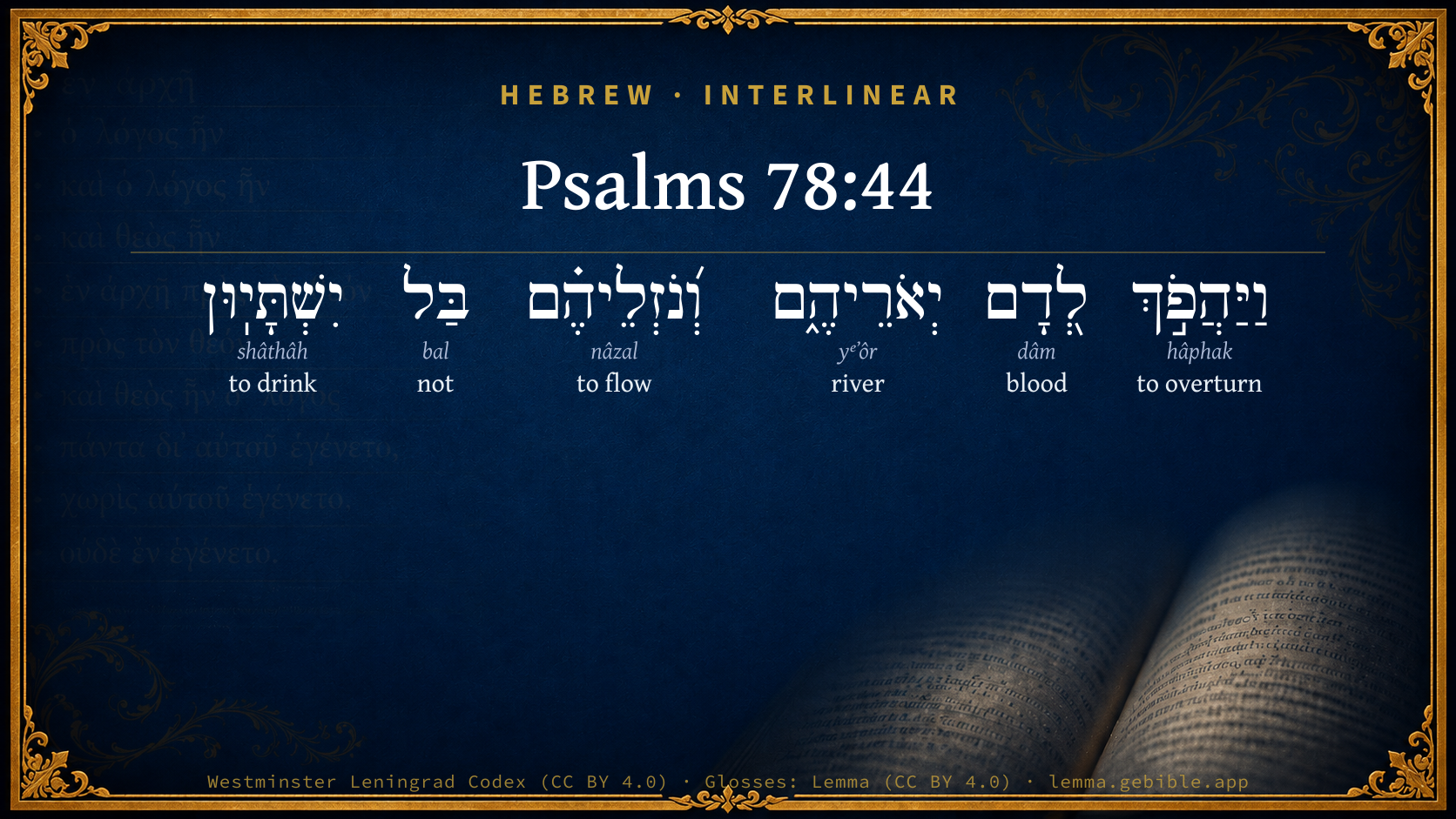
  1. וַיַּהֲפֹ֣ךְ hâphak H2015 “and · to overturn” Conjunction + Verb, Qal, Sequential Imperfect, 3rd Person, Masculine, Singular
  2. לְ֭דָם dâm H1818 “to/for · blood” Preposition + Noun, Common, Masculine, Singular, Absolute
  3. יְאֹרֵיהֶ֑ם yᵉʼôr H2975 “rivers · their” Noun, Common, Masculine, Plural, Construct + Suffix, Personal, 3rd Person, Masculine, Plural
  4. בַּל bal H1077 “not” Particle, Negative
  5. יִשְׁתָּיֽוּן shâthâh H8354 “to drink” Verb, Qal, Imperfect, 3rd Person, Masculine, Plural + Suffix, n

About this verse

These counts appear in no published source. They are computed here, from the morphology-tagged text and Lemma’s own curated glosses. What Lemma adds →

6
words
6
distinct lemmas
Wisdom
section

Notable vocabulary

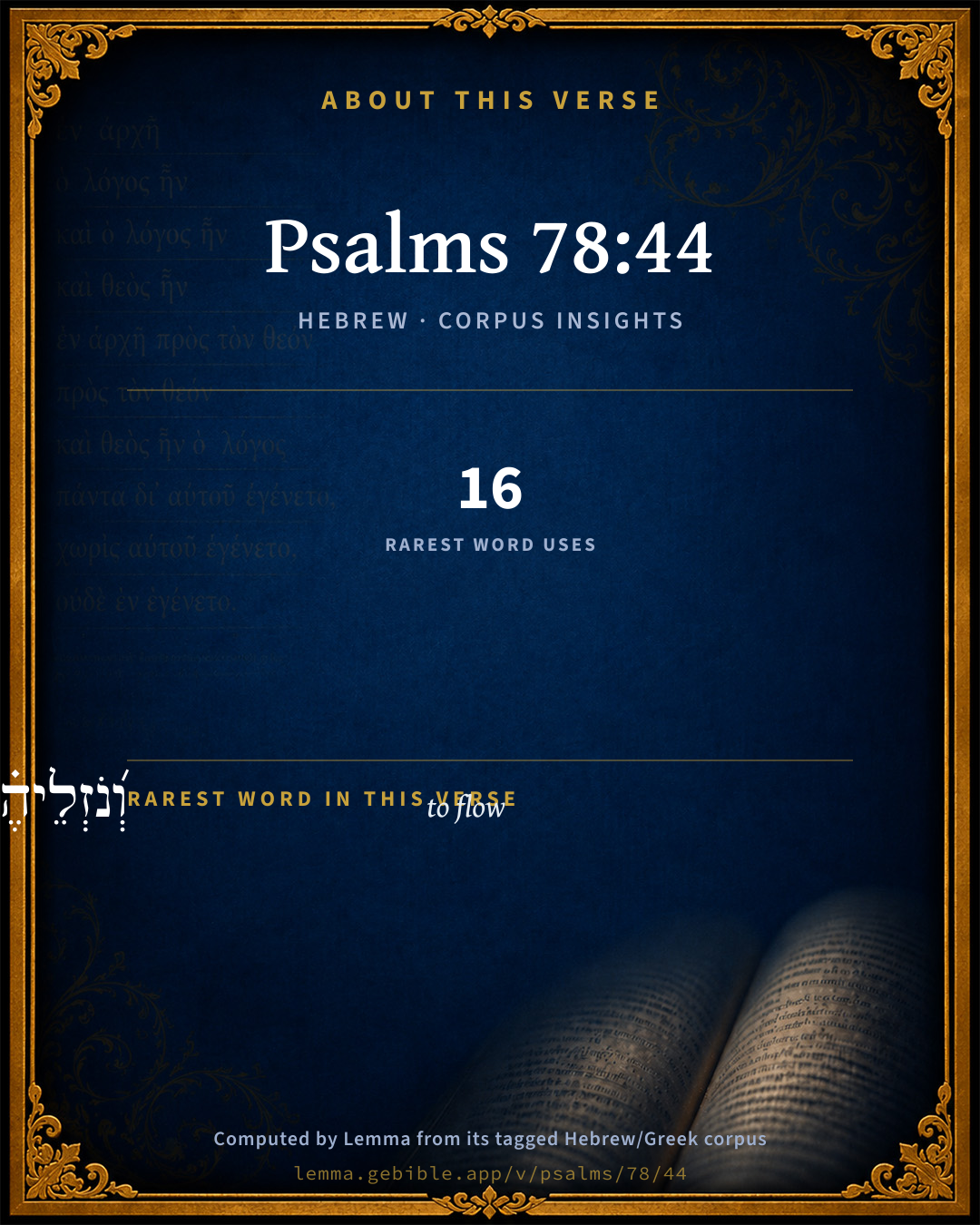
The rarest word here is וְ֝נֹזְלֵיהֶ֗ם to flow H5140 — appearing just 16 times in the whole Hebrew Bible.

Shared distinctive vocabulary

וְ֝נֹזְלֵיהֶ֗ם to flow H5140 occurs in 16 verses of the Hebrew Bible. Also found in:

Grammatical profile

  • 3 verbs
  • 2 nouns
  • 1 particle

Verb forms

  • וַיַּהֲפֹ֣ךְ Qal · Sequential Imperfect
  • וְ֝נֹזְלֵיהֶ֗ם Qal · Participle Active
  • יִשְׁתָּיֽוּן Qal · Imperfect

Hebrew & Septuagint length

In English translation the verse runs 14 words from the Hebrew and 15 from the Septuagint (LXX English) — closely comparable.

A rough comparison of the two English renderings, which tokenize alike — not a word-level alignment.

Word counts can differ between the Hebrew and the Greek without any difference in meaning — e.g. the Hebrew direct-object marker אֵת has no separate Greek word, and Greek often adds the article ὁ.

Cross-references

3

Topical passages linked to Psalms 78:44 in the Treasury of Scripture Knowledge — connected by theme and wording, ordered by reader-vote popularity; previews shown in the World English Bible.

  • Psalms 105:29 He turned their waters into blood, And killed their fish.
  • Revelation 16:3–6 The second angel poured out his bowl into the sea, and it became blood as of a dead man. Every living thing in the sea died.
  • Exodus 7:17–21 Thus says Yahweh, "In this you shall know that I am Yahweh. Behold, I will strike with the rod that is in my hand on the waters which are in the river, and they shall be turned to blood.

Cross-references courtesy of OpenBible.info (CC BY 4.0).

Hebrew and Greek witnesses Masoretic Hebrew ↔ Greek Septuagint

The same verse in the two great witnesses to the Old Testament, shown verse-for-verse.

You’re reading Greek Psalm 77 (Hebrew Psalm 78). The Septuagint counts the superscription, so verse numbers can differ from the Hebrew — chapter-level alignment, not verse-by-verse. Numbering follows Rahlfs.

These are two independent witnesses, not word-aligned to each other, and the Septuagint is shown in lemma (dictionary) form.

Hebrew Psalms 78:44 Masoretic · Westminster Leningrad Codex

וַיַּהֲפֹ֣ךְ לְ֭דָם יְאֹרֵיהֶ֑ם וְ֝נֹזְלֵיהֶ֗ם בַּל יִשְׁתָּיֽוּן

Turned their rivers into blood, And their streams, so that they could not drink.

World English Bible · Public Domain

Greek LXX Greek Psalm 77:44 Septuagint · lemma form

καί μεταστρέφω εἰς αἷμα ὁ ποταμός αὐτός καί ὁ ὄμβρημα αὐτός ὅπως μή πίνω

and had changed their rivers into blood; and their streams, that they should not drink.

LXX2012 (modern English Septuagint) · Public Domain

On this verse, John Gill's Exposition discusses the Septuagint’s reading. Read the note in Commentary ↓

Hebrew: Westminster Leningrad Codex (CC BY 4.0). Greek: Septuagint (public domain); English from LXX2012 (modern English Septuagint) (Public Domain). How the Septuagint differs from the Hebrew →

Commentary

Notes on Psalms 78:44 from classic Christian and Jewish commentators (each source and its license shown beneath its notes). The classic Christian expositions comment on the surrounding passage and are grouped to its opening verse, so a note may address several verses; the Jewish commentaries on the Tanakh (Rashi and others) are per-verse, so they appear only where the commentator wrote on this verse.

Lemma curates 59 commentaries, every one of them public domain or Creative Commons licensed, each selected and text-cleaned for this edition rather than reprinted as found. About our sources →

Trapp's Complete Commentary

John Trapp

Psa 78:44 And had turned their rivers into blood; and their floods, that they could not drink.

Ver. 44. And had turned their rivers into blood, &c.] Seven of those ten plagues of Egypt are here instanced, to aggravate the forgetfulness or perfidy of the Israelites. Good turns aggravate unkindness, and our offences are increased by our obligations.

And their floods, that they could not drink] Usque adeo ut aquae potabiles totam, alioqui stagnantem Aegyptum, deficerent. The Rabbis say (who told them I know not) that out of the same vessel an Egyptian drank blood and an Israelite water (Midras Tilling).

John Trapp, A Commentary or Exposition upon All the Books of the Old and New Testament (1647–1656) — public domain. Text from a community e-Sword module.

J. A. Alexander on Psalms

Joseph Addison Alexander

44. (Psa 78:44) And turned to blood their rivers, and their streams they cannot drink. The general statement of the preceding verse is rendered more specific by the mention of several of the plagues in detail, beginning with the first. See Exo 7:18-20. The word translated rivers is the plural of one commonly applied to the Nile, and supposed to be of Egyptian origin. It may here be understood as denoting either the natural branches of the Nile, or the artificial channels by which its waters are employed in the irrigation of the country. In the last clause, by a very common trope, the writer speaks as he might have spoken at the time of the event.

Joseph Addison Alexander, The Psalms Translated and Explained (1850) — public domain. Text from a community e-Sword module.

Adam Clarke's Commentary

Verse 44. Turned their rivers into blood] See on Ex 7:20.

Adam Clarke's Commentary on the Bible (1810–1826) — public domain. Text from a community e-Sword/MySword module.

John Calvin's Commentaries

44. When he turned their rivers into blood. The Psalmist does not enumerate in their order the miracles by which God gave evidence of his power in the deliverance of his people. He considered it enough to bring to their remembrance the well-known histories of these events, which would be sufficient to lay open the wickedness and ingratitude with which they were chargeable; nor is it necessary for us to stay long on these things, since the narrative of Moses gives a more distinct and fuller account of what is here briefly stated. Only I would have my readers to remember that, although God often punished the sins of the heathen by sending upon them hail and other calamities, yet all the plagues which at that time were inflicted upon the Egyptians were of an extraordinary character, and such as were previously unheard-of. A variety of words is therefore employed to enhance these memorable instances of the vengeance of God, as that he sent upon them the fierceness of his wrath, fury, anger, and affliction This accumulation of words is intended to awaken minds which are asleep to a discovery of so many miracles, of which both the number and the excellence might be perceived even by the blind themselves.

In the last place, it is added that God executed these judgments by angels. Although God has, according as it has pleased him, established certain laws, both in heaven and on earth, and governs the whole order of nature in such a manner as that each creature has assigned to it its own peculiar office; yet whenever it seems good to him he makes use of the ministration of angels for executing his commands, not by ordinary or natural means, but by his secret power, which to us is incomprehensible. Some think that devils are here spoken of, because the epithet evil or hurtful is applied to angel. This opinion I do not reject; but the ground upon which they rest it has little solidity. They say that as God dispenses his benefits to us by the ministry of elect angels, so he also executes his wrath by the agency of reprobate angels, as if they were his executioners. This I admit is partly true; but I deny that this distinction is always observed. Many passages of Scripture can be quoted to the contrary. When the army of the Assyrians laid siege to the holy city Jerusalem, who was it that made such havoc among them as compelled them to raise the siege, but the angel who was appointed at that time for the defense of the Church? (2 Kings 19:35.) In like manner, the angel who slew the first-born in Egypt (Exodus 11:5) was not only a minister and an executor of the wrath of God against the Egyptians, but also the agent employed for preserving the Israelites. On the other hand, although the kings of whom Daniel speaks were avaricious and cruel, or rather robbers, and turned all things upside down, yet the Prophet declares, (chapter 20:13,) that holy angels were appointed to take charge of them. It is probable that the Egyptians were given over and subjected to reprobate angels, as they deserved; but we may simply consider the angels here spoken of as termed evil, on account of the work in which they were employed, — because they inflicted upon the enemies of the people of God terrible plagues to repress their tyranny and cruelty. In this way, both the heavenly and elect angels, and the fallen angels, are justly accounted the ministers or executors of calamity; but they are to be regarded as such in different senses. The former yield a prompt and willing obedience to God; but the latter, as they are always eagerly intent upon doing mischief, and would, if they could, turn the whole world upside down, are fit instruments for inflicting calamities upon men.

John Calvin's Commentaries (1540-1563) — public domain. Text from the Calvin Translation Society English edition (1840s-50s) via the Christian Classics Ethereal Library (ccel.org). Calvin's coverage is partial (roughly two-thirds of the Bible); uncommented books and verses are honest gaps, never fabricated. The 19th-century editor's footnotes and remarks are omitted so the notes are faithfully Calvin's own voice.

The Cambridge Bible for Schools and Colleges

gen. ed. J. J. S. Perowne

44. And turned their rivers into blood,

And their streams, that they could not drink.

See Exo_7:17 ff. The word for ‘rivers’ (y’ôr) is one specially used of the Nile and its canals.

The Cambridge Bible for Schools and Colleges (gen. ed. J. J. S. Perowne; Cambridge University Press, 1878–1918) — public domain. Text from a community e-Sword module.

John Gill's Exposition

He sent divers sorts of flies among them,.... This was the fourth plague; see Exo 8:24, the word signifies a "mixture" (f), and the Targum renders it

"a mixture of wild beasts;''

so Josephus (g) understood this plague of various sorts of beasts of different forms, and such as had never been seen before. Aben Ezra, on Exo 8:24 interprets it of evil beasts mixed together, as lions, wolves, bears, and leopards; and Jarchi, on the same place, of serpents and scorpions: the Syriac and Arabic versions here, following the Septuagint, render the word "dog flies"; so called because they were, as Pliny (h) says, very troublesome to dogs, and so might give the Egyptians greater uneasiness, because they worshipped dogs. God can make use of very mean and contemptible instruments, the least of insects, to plague and distress the most powerful enemies of his people;

which devoured them; corrupted their land, Exo 8:24, perhaps produced a pestilence, which destroyed many of the inhabitants, or consumed the vegetables of the land; as but a few years ago (e), in New England, a sort of insects came out of little holes in the ground, in the form of maggots, and turned to flies, which for the space of two hundred miles poisoned and destroyed all the trees in the country (i):

and frogs, which destroyed them; with their stench; see Exo 8:5, with this plague compare Rev 16:13, this was the second plague.

(e) This was written about 1750. Editor. (f) "mixtionem", Montanus; "miscellam", Vatablus; "a mixed swarm", Ainsworth. (g) Antiqu. l. 2. c. 14. sect. 3. (h) Nat. Hist. l. 11. c. 34. (i) See Philosoph. Transact. vol. 2. p. 766. See also p. 781.

John Gill's Exposition of the Whole Bible (1746–1763) — public domain (CC PDM 1.0). Text via the HelloAO Bible API.

Albert Barnes' Notes on the Bible

And had turned their rivers into blood - Exo 7:20. There was properly but one river in Egypt - the Nile. But there were several branches of that river at the mouth; and there were numerous artificial streams or canals cut from the river, to anyone of which the word river might be also given. Compare the notes at Isa 11:15.

And their floods ... - Their streams; the canals and branches of the Nile, where they usually obtained a supply of water.

Albert Barnes' Notes on the Bible (1834–1885) — public domain. Text from a community e-Sword/MySword module.

Matthew Poole's English Annotations

The several branches and streams of the river Nilus, and those many rivulets which they brought from it.

Matthew Poole's English Annotations on the Holy Bible (1683–1685) — public domain. Text from a community e-Sword/MySword module.

The Treasury of David

Charles H. Spurgeon

Ver. 44. And had turned their rivers into blood. The waters had been made the means of the destruction of Israel's newborn infants, and now they do as it were betray the crimethey blush for it, they avenge it on the murderers. The Nile was the vitality of Egypt, its true life blood, but at God's command it became a flowing curse; every drop of it was a horror, poison to drink, and terror to gaze on. How soon might the Almighty One do this with the Thames or the Seine. Sometimes he has allowed men, who were his rod, to make rivers crimson with gore, and this is a severe judgment; but the event now before us was more mysterious, more general, more complete, and must, therefore, have been a plague of the first magnitude.

And their floods, that they could not drink. Lesser streams partook in the curse, reservoirs and canals felt the evil; God does nothing by halves. All Egypt boasted of the sweet waters of their river, but they were made to loathe it more than they had ever loved it. Our mercies may soon become our miseries if the Lord shall deal with us in wrath.

Ver. 44. Turned their rivers into blood, etc. This displays also the folly of creature worship. Pharaoh adores the life sustaining power of nature, as embodied in the majestic river before him. The God of nature transforms the running water into a river of death before his eyes. It demonstrates, in the way that was most striking to the Hebrew and the Egyptian, that the God of Israel was the true and only God of heaven and earth, and that all other objects of worship were but the creatures of God or the works of men's hands. James G. Murphy.

Ver. 44. Turned their river into blood, etc. They looked upon their river not only as consecrated to a deity; but, if we may believe some authors, as their chief national god; and worshipped it accordingly...They must have felt the utmost astonishment and horror, when they beheld their sacred stream changed and polluted, and the divinity whom they worshipped so shamefully soiled and debased. And these appearances must have had a salutary effect upon the Israelites; as they were hence warned not to accede to this species of idolatry; but to have it ever in contempt, as well as abhorrence. It is to be observed, that God might, if it had been the divine pleasure, have many different ways tainted and polluted the streams of Egypt. But he thought proper to change it to blood. Now the Egyptians, and especially their priests, were particularly nice and delicate in their outward habit and rites; and there was nothing which they abhorred more than blood, they seldom admitted any bloody sacrifices; and with the least stain of gore they would have thought themselves deeply polluted. Their affectation of purity was so great that they could not bear to come within contact with a foreigner, or even to handle his clothes; but to touch a dead body was an abomination, and required to be immediately expiated...On these accounts the priests were continually making ablutions. There were four stated times, twice in the day, and as often in the night, at which they were all obliged to bathe themselves. Many accidents caused them to repeat it much oftener. Hence this evil brought upon them must have been severely felt, as "there was blood throughout all the land of Egypt, " Ex 7:21. Jacob Bryant (1715-1804), in "Observations upon the Plagues inflicted upon the Egyptians."

Ver. 44. And their floods, that they could not drink. A third calamity accompanying this plague was the impossibility of drinking the water of the Nile, a vexation the keener felt by them, because the water of the Nile, after having been purified from the slime by a kind of almond dough is, on the one hand, most agreeable, tasteful and healthy, so that it appears to strangers almost as an artificially prepared drinkwhence the Egyptian proverb originated: "the water of the Nile is as sweet as honey and sugar, "and the adage, "that if Mohammed had drank of it, he would have besought God to be immortal, that he might always enjoy it"; and it is on the other hand, the only drinkable water which the inhabitants can possibly use; for, says Maillet (I. pg 20): "The well and cistern water in Egypt is detestable and unwholesome; fountains are so rare, that they are a kind of prodigy in that country; and, as rain water, that is out of the question, as scarcely any rain falls in Egypt." M. M. Kalisch, in "A Historical and Critical Commentary on the Old Testament." 1867.

None.

Charles H. Spurgeon's The Treasury of David (1869–1885) — public domain. Psalms only. Text from a community e-Sword/MySword module.

The Pulpit Commentary

And had turned their rivers into blood. (see Exo_7:19, Exo_7:20) "Their rivers" are the many branches of the Nile, some natural, some artificial (Herod., 2:17), by which Lower Egypt is traversed. And their floods; or, their streams; i.e. the smaller canals, which diffused the Nile water over the entire land. That they could not drink. (see Exo_7:21)

The Pulpit Commentary (1880–1919), ed. H.D.M. Spence-Jones & Joseph S. Exell — public domain. Text from a community e-Sword module.

unfoldingWord translationNotes

Door43 World Missions Community

General Information:

The writer describes what God did.

swarms of flies

so many flies that it looked like a cloud

that devoured them

The flies made the Egyptians almost as unhappy as they would have if they had eaten the Egyptians. (See: Metaphor and Hyperbole and Generalization)

gave their crops to the grasshopper and their labor to the locust

"allowed the grasshoppers to eat all their crops and allowed the locusts to eat everything they had worked hard to produce"

overran their land

"went everywhere in their land"

grasshopper

a plant-eating insect with long legs used for jumping

He gave their crops to the grasshopper

Asaph speaks of the crops as a gift that God gave to the grasshoppers. AT: "He allowed the grasshopper to eat their crops" (See: Metaphor)

their labor to the locust

"he gave their labor to the locust." Asaph speaks of the people's labor as if it were a gift that God gave to the grasshoppers. The word "labor" is a metonym for the crops that their labor had produced. AT: "he allowed the locusts to eat the crops they had worked so hard to produce" (See: Metaphor and Metonymy)

translationWords

blood

devour

labor

locust

unfoldingWord translationNotes — © Distant Shores Media and the Door43 World Missions Community, licensed CC BY-SA 4.0. Source: git.door43.org/Door43/en_tn.

Lesson kit

Teaching starters — assembled from the data on this page, not authored interpretation. Every prompt links to the verse data it draws on. Edit before teaching.

Psalms, in the Wisdom, opens this verse with 6 words (6 distinct Hebrew lemmas). Its most distinctive word is nâzal (“to flow”). A historical commentator’s framing appears above. Read the whole chapter for the surrounding context.

Discussion questions

  1. The word nâzal carries the sense “to flow.” How does it shape the verse?
  2. How does Exodus 15:8, which shares the word «to flow», read alongside this verse?
  3. These translations render this verse differently. What is at stake in choosing one wording over another?
  4. «וַיַּהֲפֹ֣ךְ» is a Qal Sequential Imperfect verb. How does that grammatical form shape the action described?
  5. Compare how Trapp's Complete Commentary and J. A. Alexander on Psalms read this verse. Where do they agree or differ?

Things to notice

Reading settings

Reading text

Shown beneath each verse's original-language words.

Old Testament
Old Testament edition

Read the OT as the Masoretic Hebrew (MT) or the Greek Septuagint (LXX).

English shown for the Greek Septuagint (in the Hebrew ↔ Greek comparison).

Comparing translations? Open the Compare panel on any verse page to stack up to four side by side.