
Leviticus 16:18

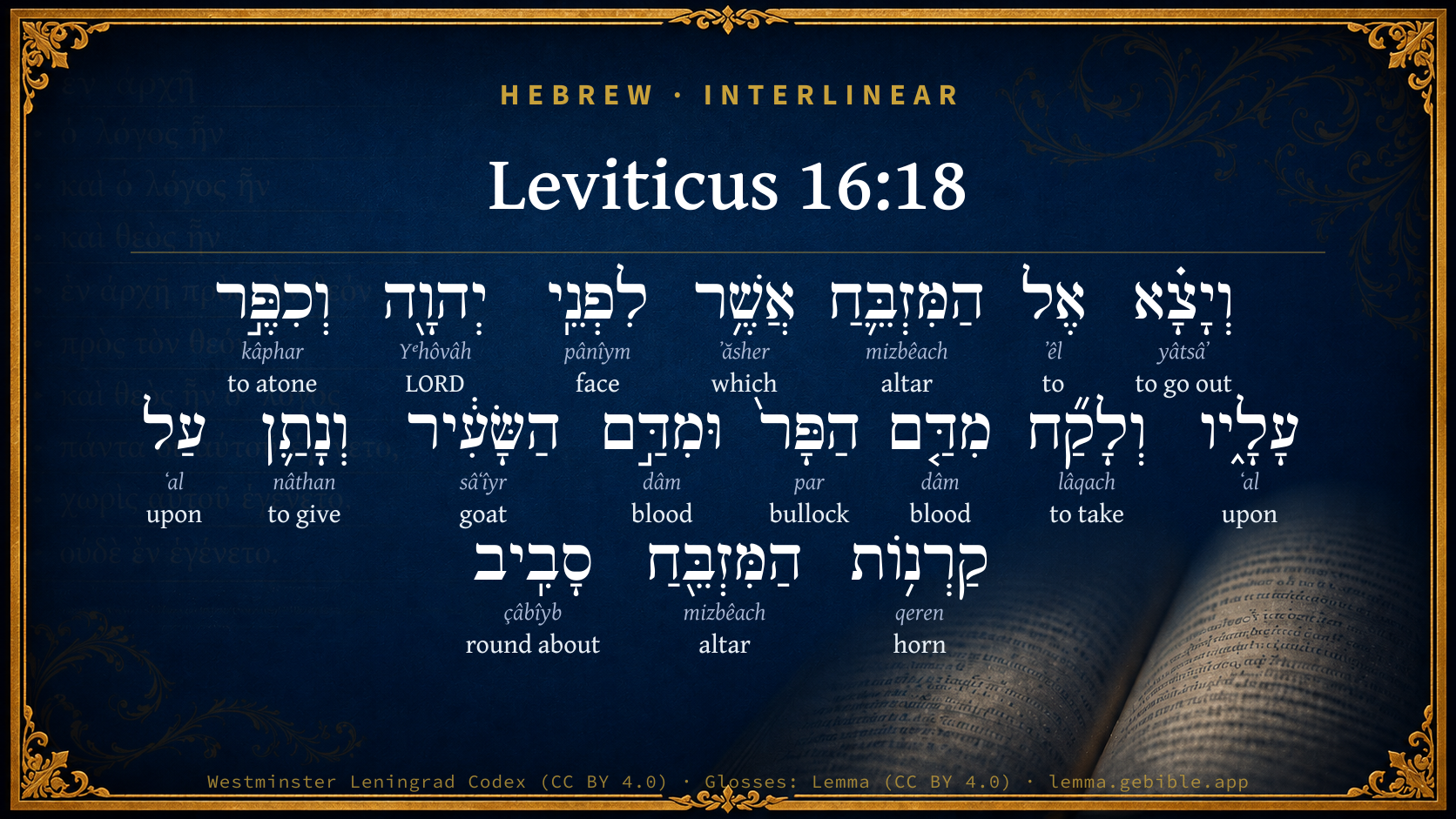
Hebrew (Westminster Leningrad Codex) Leviticus 16:18 appears in the Hebrew Old Testament. The text above is from the Westminster Leningrad Codex. Each word links to its Strong’s number, a concise gloss, and parsing drawn from the Open Scriptures Hebrew Bible morphology. Click any word for its full Brown-Driver-Briggs (BDB) entry.
Download image
Cite this verse

Leviticus 16:18 (World English Bible). Public Domain. Lemma interlinear Bible study tool, https://lemma.gebible.app/v/leviticus/16/18.

Show BibTeX & RIS
BibTeX
RIS
English Translation
"He shall go out to the altar that is before Yahweh and make atonement for it, and shall take some of the bull's blood, and some of the goat's blood, and put it on the horns of the altar round about.
World English Bible · Public Domain
Download a study sheet

One document with this verse’s original text, its word-by-word gloss line, the meaning frame, cross-references with their text, attributed commentary, and full source and license credits — printable, and it pastes into notes with its structure intact.

This verse Autodidact and up

Study sheet (.html) Plain text (.txt)

A passage Seminary Student

Up to 50 verses in one chapter. A passage sheet keeps up to 6 commentary sources and 12 cross-references per verse, in the order this page ranks them, and says so on the sheet whenever that leaves anything out. Ask for a single verse and you get the Autodidact verse sheet above.

Everything on this page stays free to read, with no account — the sheet is a download of what is already on screen, not access to it.

Want to remove ads? Support Godless Engineer
Compare translations 3

The same verse in 3 English versions, stacked beneath the original-language interlinear above. Click any original word for its lexicon entry.

Each is an independent rendering of the whole verse — the interlinear is not word-aligned to these translations.

Highlighted words mark where these versions differ — a whole-verse word diff, not a word-by-word alignment.

  • World English Bible Public Domain
    "He shall go out to the altar that is before Yahweh and make atonement for it, and shall take some of the bull's blood, and some of the goat's blood, and put it on the horns of the altar round about.
  • King James Version Public Domain
    And he shall go out unto the altar that is before the LORD, and make an atonement for it; and shall take of the blood of the bullock, and of the blood of the goat, and put it upon the horns of the altar round about.
  • unfoldingWord Literal Text CC BY-SA 4.0
    And he shall go out to the altar that to the face of Yahweh, and he shall make atonement for it. And he shall take some of the blood of the bull and some of the blood of the goat and put on the horns of the altar all around.

unfoldingWord Literal Text — © unfoldingWord, licensed CC BY-SA 4.0. Word-aligned USFM3 via Door43 (git.door43.org/unfoldingWord/en_ult).

Versions to compare (up to 4)

3 of 4 selected

Show all 18 translations

Every available English version of this verse, each an independent rendering of the whole verse.

  • World English Bible Public Domain
    "He shall go out to the altar that is before Yahweh and make atonement for it, and shall take some of the bull's blood, and some of the goat's blood, and put it on the horns of the altar round about.
  • Berean Standard Bible Public Domain
    Then he shall go out to the altar that is before the LORD and make atonement for it. He is to take some of the bull’s blood and some of the goat’s blood and put it on all the horns of the altar.
  • Majority Standard Bible Public Domain
    Then he shall go out to the altar that is before the LORD and make atonement for it. He is to take some of the bull’s blood and some of the goat’s blood and put it on all the horns of the altar.
  • King James Version Public Domain
    And he shall go out unto the altar that is before the LORD, and make an atonement for it; and shall take of the blood of the bullock, and of the blood of the goat, and put it upon the horns of the altar round about.
  • American Standard Version (1901) Public Domain
    And he shall go out unto the altar that is before Jehovah, and make atonement for it, and shall take of the blood of the bullock, and of the blood of the goat, and put it upon the horns of the altar round about.
  • Revised Version (1885) Public Domain
    And he shall go out unto the altar that is before the LORD, and make atonement for it; and shall take of the blood of the bullock, and of the blood of the goat, and put it upon the horns of the altar round about.
  • Geneva Bible (1599) Public Domain
    After, he shall goe out vnto the altar that is before the Lord and make a reconciliation vpon it, and shall take of the blood of the bullocke, and of the blood of the goate, and put it vpon the hornes of the Altar round about:
  • Douay-Rheims (1899) Public Domain
    And when he is come out to the altar that is before the Lord, let him pray for himself, and taking the blood of the calf, and of the buck goat, let him pour it upon the horns thereof round about:
  • Young's Literal Translation Public Domain
    `And he hath gone out unto the altar which `is' before Jehovah, and hath made atonement for it; and he hath taken of the blood of the bullock, and of the blood of the goat, and hath put on the horns of the altar round about;
  • Literal Standard Version CC BY-SA 4.0
    And he has gone out to the altar which [is] before YHWH, and has made atonement for it; and he has taken of the blood of the bullock and of the blood of the goat, and has put [it] around the horns of the altar;
  • Unlocked Literal Bible CC BY-SA 4.0
    He must go out to the altar that is before Yahweh and make atonement for it, and he must take some of the bull's blood and some of the goat's blood and put it on the horns of the altar all around.
  • unfoldingWord Literal Text CC BY-SA 4.0
    And he shall go out to the altar that to the face of Yahweh, and he shall make atonement for it. And he shall take some of the blood of the bull and some of the blood of the goat and put on the horns of the altar all around.
  • Darby Bible Public Domain
    And he shall go out unto the altar which is before Jehovah, and make atonement for it; and shall take of the blood of the bullock, and of the goat, and put it upon the horns of the altar round about;
  • World Messianic Bible Public Domain
    “He shall go out to the altar that is before the LORD and make atonement for it, and shall take some of the bull’s blood, and some of the goat’s blood, and put it around on the horns of the altar.
  • Webster's Bible Public Domain
    And he shall go out to the altar that is before the LORD, and make an atonement for it; and shall take of the blood of the bullock, and of the blood of the goat, and put it upon the horns of the altar round about.
  • Free Bible Version CC BY-SA 4.0
    Then he shall go to the altar that is before the Lord and purify it. He is to take some of the blood from the bull and the goat and put it on all the horns of the altar.
  • Bible in Basic English Public Domain
    And he is to go out to the altar which is before the Lord and make it free from sin; and he is to take some of the blood of the ox and the blood of the goat and put it on the horns of the altar and round it;
  • JPS Tanakh (1917) Public Domain
    And he shall go out unto the altar that is before the LORD, and make atonement for it; and shall take of the blood of the bullock, and of the blood of the goat, and put it upon the horns of the altar round about.

Literal Standard Version (2020), Covenant Press — licensed CC BY-SA 4.0. Text via the HelloAO Bible API (eBible.org). Unlocked Literal Bible (unfoldingWord) — licensed CC BY-SA 4.0. Text via the HelloAO Bible API (eBible.org). unfoldingWord Literal Text — © unfoldingWord, licensed CC BY-SA 4.0. Word-aligned USFM3 via Door43 (git.door43.org/unfoldingWord/en_ult). Free Bible Version, Dr. Jonathan Gallagher — licensed CC BY-SA 4.0. Text via the HelloAO Bible API (eBible.org).

Word by word

More ways to search: Search by grammar → Find every occurrence → Compare this word →

Practice this passage: Drill this verse → Learn its vocabulary →

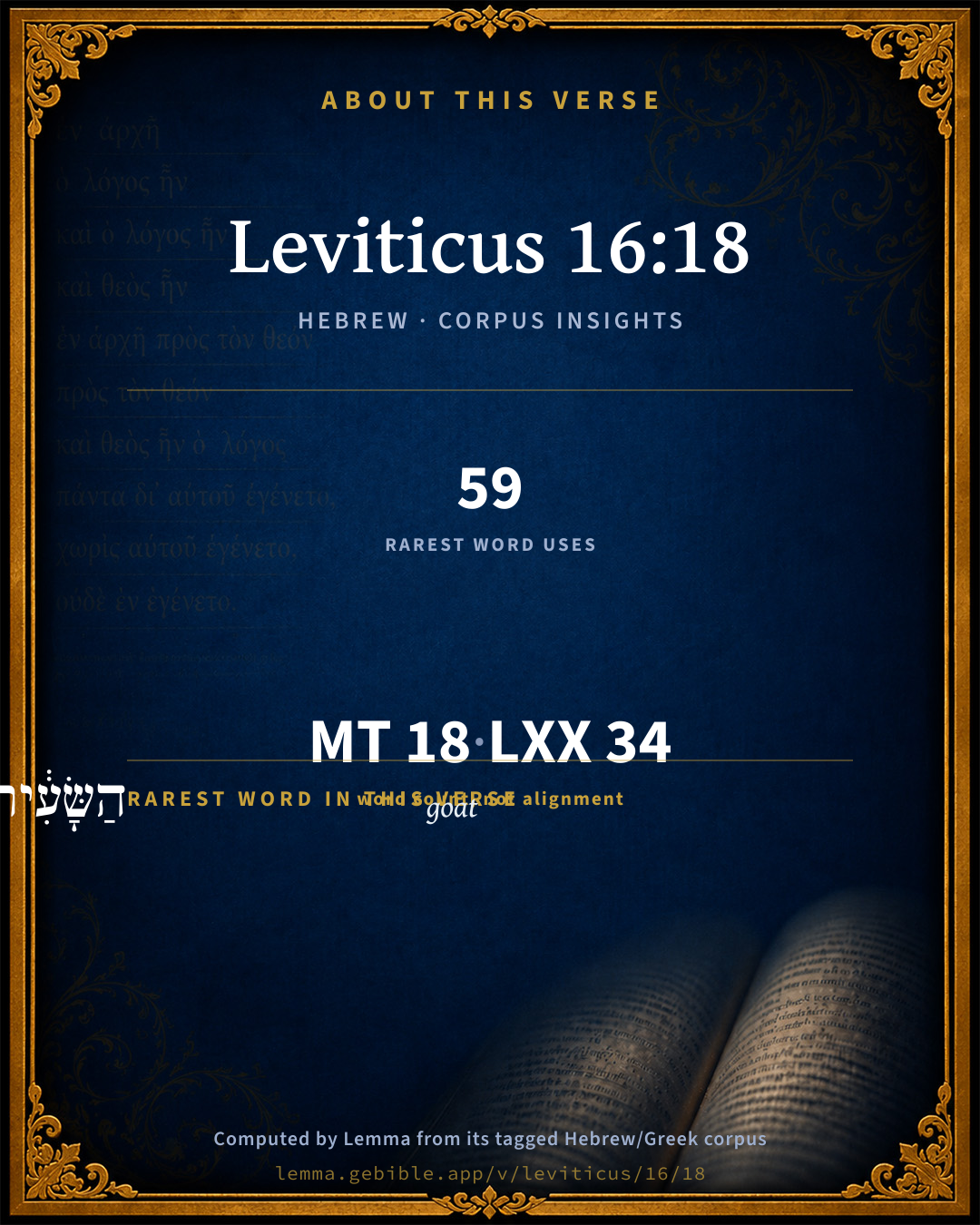
הַשָּׂעִ֔יר
sâʻîyr
H8163
“the · goat”
Particle, Definite Article + Noun, Common, Masculine, Singular, Absolute
Part of Speech
Particle + Noun
Type
Common
Gender
Masculine
Number
Singular
State
Absolute
Full BDB Definition

Origin: from H8175

TWOT: 2274c , 2274e

hairy (adjective) - he-goat, buck (noun masculine) - as sacrificial animal - satyr, may refer to a demon possessed goat like the swine of Gadara ( Mat 8:30-32 )
  1. וְיָצָ֗א yâtsâʼ H3318 “and · to go out” Conjunction + Verb, Qal, Sequential Perfect, 3rd Person, Masculine, Singular
  2. אֶל ʼêl H413 “to” Preposition
  3. הַמִּזְבֵּ֛חַ mizbêach H4196 “the · altar” Particle, Definite Article + Noun, Common, Masculine, Singular, Absolute
  4. אֲשֶׁ֥ר ʼăsher H834 “which” Particle, Relative
  5. לִפְנֵֽי pânîym H6440 “to/for · face(s) of” Preposition + Noun, Common, Both, Plural, Construct
  6. יְהוָ֖ה Yᵉhôvâh H3068 “LORD” Noun, Proper
  7. וְכִפֶּ֣ר kâphar H3722 “and · to atone” Conjunction + Verb, Piel, Sequential Perfect, 3rd Person, Masculine, Singular
  8. עָלָ֑יו ʻal H5921 “upon · him” Preposition + Suffix, Personal, 3rd Person, Masculine, Singular
  9. וְלָקַ֞ח lâqach H3947 “and · to take” Conjunction + Verb, Qal, Sequential Perfect, 3rd Person, Masculine, Singular
  10. מִדַּ֤ם dâm H1818 “from · blood of” Preposition + Noun, Common, Masculine, Singular, Construct
  11. הַפָּר֙ par H6499 “the · bullock” Particle, Definite Article + Noun, Common, Masculine, Singular, Absolute
  12. וּמִדַּ֣ם dâm H1818 “and · from · blood of” Conjunction + Preposition + Noun, Common, Masculine, Singular, Construct
  13. וְנָתַ֛ן nâthan H5414 “and · to give” Conjunction + Verb, Qal, Sequential Perfect, 3rd Person, Masculine, Singular
  14. עַל ʻal H5921 “upon” Preposition
  15. קַרְנ֥וֹת qeren H7161 “horns of” Noun, Common, Both, Plural, Construct
  16. הַמִּזְבֵּ֖חַ mizbêach H4196 “the · altar” Particle, Definite Article + Noun, Common, Masculine, Singular, Absolute
  17. סָבִֽיב çâbîyb H5439 “round about” Noun, Common, Both, Singular, Absolute

About this verse

These counts appear in no published source. They are computed here, from the morphology-tagged text and Lemma’s own curated glosses. What Lemma adds →

18
words
15
distinct lemmas
Pentateuch
section

Shared distinctive vocabulary

הַשָּׂעִ֔יר goat H8163 occurs in 57 verses of the Hebrew Bible. Also found in:

Grammatical profile

  • 4 verbs
  • 10 nouns
  • 3 prepositions
  • 1 particle

Verb forms

  • וְיָצָ֗א Qal · Sequential Perfect
  • וְכִפֶּ֣ר Piel · Sequential Perfect
  • וְלָקַ֞ח Qal · Sequential Perfect
  • וְנָתַ֛ן Qal · Sequential Perfect

Repetition

Words recur within this verse — often emphatic in Hebrew:

  • הַמִּזְבֵּ֛חַ altar H4196 ×2
  • עָלָ֑יו upon H5921 ×2
  • מִדַּ֤ם blood H1818 ×2

Hebrew & Septuagint length

In English translation the verse runs 41 words from the Hebrew and 49 from the Septuagint (LXX English) — closely comparable.

A rough comparison of the two English renderings, which tokenize alike — not a word-level alignment.

Word counts can differ between the Hebrew and the Greek without any difference in meaning — e.g. the Hebrew direct-object marker אֵת has no separate Greek word, and Greek often adds the article ὁ.

In the original languages it is 18 Hebrew tokens and 34 Greek tokens — but the two are counted differently (Hebrew bundles its prefixes and suffixes into one token; the Greek is in lemma form), so that isn’t a like-for-like length.

Cross-references

9

Topical passages linked to Leviticus 16:18 in the Treasury of Scripture Knowledge — connected by theme and wording, ordered by reader-vote popularity; previews shown in the World English Bible.

  • Leviticus 4:7 The priest shall put some of the blood on the horns of the altar of sweet incense before Yahweh, which is in the tent of meeting; and he shall pour out all the blood of the bull out at the base of the altar of burnt offering, which is at the door of the Tent of Meeting.
  • Exodus 30:10 Aaron shall make atonement on its horns once in the year; with the blood of the sin offering of atonement once in the year he shall make atonement for it throughout your generations. It is most holy to Yahweh."
  • Leviticus 4:18 He shall put some of the blood on the horns of the altar which is before Yahweh, that is in the Tent of Meeting; and the rest of the blood he shall pour out at the base of the altar of burnt offering, which is at the door of the Tent of Meeting.
  • Leviticus 16:16 and he shall make atonement for the Holy Place, because of the uncleanness of the children of Israel, and because of their transgressions, even all their sins; and so he shall do for the Tent of Meeting, that dwells with them in the midst of their uncleanness.
  • Hebrews 5:7–8 He, in the days of his flesh, having offered up prayers and petitions with strong crying and tears to him who was able to save him from death, and having been heard for his godly fear,
  • Leviticus 4:25 The priest shall take some of the blood of the sin offering with his finger, and put it on the horns of the altar of burnt offering. He shall pour out the rest of its blood at the base of the altar of burnt offering.
  • John 17:19 For their sakes I sanctify myself, that they themselves also may be sanctified in truth.
  • Hebrews 2:11 For both he who sanctifies and those who are sanctified are all from one, for which cause he is not ashamed to call them brothers,
  • Hebrews 9:22–23 According to the law, nearly everything is cleansed with blood, and apart from shedding of blood there is no remission.

Cross-references courtesy of OpenBible.info (CC BY 4.0).

Hebrew and Greek witnesses Masoretic Hebrew ↔ Greek Septuagint

The same verse in the two great witnesses to the Old Testament, shown verse-for-verse.

These are two independent witnesses, not word-aligned to each other, and the Septuagint is shown in lemma (dictionary) form.

Hebrew Leviticus 16:18 Masoretic · Westminster Leningrad Codex

וְיָצָ֗א אֶל הַמִּזְבֵּ֛חַ אֲשֶׁ֥ר לִפְנֵֽי יְהוָ֖ה וְכִפֶּ֣ר עָלָ֑יו וְלָקַ֞ח מִדַּ֤ם הַפָּר֙ וּמִדַּ֣ם הַשָּׂעִ֔יר וְנָתַ֛ן עַל קַרְנ֥וֹת הַמִּזְבֵּ֖חַ סָבִֽיב

"He shall go out to the altar that is before Yahweh and make atonement for it, and shall take some of the bull's blood, and some of the goat's blood, and put it on the horns of the altar round about.

World English Bible · Public Domain

Greek LXX Leviticus 16:18 Septuagint · lemma form

καί ἐκἔρχομαι ἐπί ὁ θυσιαστήριον ὁ εἰμί ἀπέναντι κύριος καί ἐκἱλάσκομαι ἐπί αὐτός καί λαμβάνω ἀπό ὁ αἷμα ὁ μόσχος καί ἀπό ὁ αἷμα ὁ χίμαρος καί ἐπιτίθημι ἐπί ὁ κέρας ὁ θυσιαστήριον κύκλος

And he shall come forth to the altar that is before the Lord, and he shall make atonement upon it; and he shall take of the blood of the calf, and of the blood of the goat, and shall put it on the horns of the altar round about.

LXX2012 (modern English Septuagint) · Public Domain

Hebrew: Westminster Leningrad Codex (CC BY 4.0). Greek: Septuagint (public domain); English from LXX2012 (modern English Septuagint) (Public Domain). How the Septuagint differs from the Hebrew →

Targum (Aramaic paraphrase)

2

The Targum is the ancient Jewish Aramaic paraphrase of the Hebrew Scriptures — an interpretive translation, not the Hebrew text itself. Onkelos (literal) and Pseudo-Jonathan (expansive) render the Torah, and Jonathan the Prophets. Coverage is partial: where no permissively-licensed English translation exists for a verse, only the Aramaic is shown. This is verse-level text, not a word-by-word alignment to the Hebrew.

  1. Targum Onkelos Torah (Genesis–Deuteronomy)
    וְיִפּוֹק לְמַדְבְּחָא דִי קֳדָם יְיָ וִיכַפֵּר עֲלוֹהִי וְיִסַב מִדְמָא דְתוֹרָא וּמִדְמָא דִצְפִירָא וְיִתֵּן עַל קַרְנַת מַדְבְּחָא סְחוֹר סְחוֹר

    (no public-domain English translation for this verse)

    Targum Onkelos — Aramaic: “Onkelos Genesis” (public domain); “Onkelos Exodus” (public domain); “Onkelos Leviticus” (public domain); “Onkelos Numbers” (public domain); “Onkelos Deuteronomy” (public domain). English: “Sefaria Community Translation” (CC0 1.0 (public-domain dedication)); “J.W. Etheridge. The Targums of Onkelos and Jonathan Ben Uzziel on the Pentateuch. London: Longmans, Green, 1862” (public domain). Text via Sefaria.

  2. Targum Pseudo-Jonathan Torah (Genesis–Deuteronomy)
    וִיצַדֵד וְיִפּוֹק מִן קוּדְשָׁא לְמַדְבְּחָא דִקְדָם יְיָ וִיכַפֵּר עֲלוֹי בְּאִשְׁתְּעוּת מִילַיָא וְיִסַב מֵאַדְמָא דְתוֹרָא וּמֵאַדְמָא דִצְפִירָא כַּד הִינוּן מְעַרְבִין וְיִתֵּן עַל קַרְנַת מַדְבְּחָא חֲזוֹר חֲזוֹר

    And he shall withdraw, and come forth from the holy place, unto the altar which is before the Lord, and make atonement upon it with confession of words, and take of the blood of the bullock and of the blood of the goat, mingled together, and put it upon the horns of the altar round about.

    Targum Pseudo-Jonathan — Aramaic: “Targum Jonathan on Genesis” (public domain); “Targum Jonathan on Exodus” (public domain); “Targum Jonathan on Leviticus” (public domain); “Targum Jonathan on Numbers” (public domain); “Targum Jonathan on Deuteronomy” (public domain). English: “The Targum of Jonathan ben Uzziel, trans. J. W. Etheridge, London, 1862” (public domain). Text via Sefaria.

Commentary

Notes on Leviticus 16:18 from classic Christian and Jewish commentators (each source and its license shown beneath its notes). The classic Christian expositions comment on the surrounding passage and are grouped to its opening verse, so a note may address several verses; the Jewish commentaries on the Tanakh (Rashi and others) are per-verse, so they appear only where the commentator wrote on this verse.

Lemma curates 59 commentaries, every one of them public domain or Creative Commons licensed, each selected and text-cleaned for this edition rather than reprinted as found. About our sources →

Trapp's Complete Commentary

John Trapp

Lev 16:18 And he shall go out unto the altar that [is] before the LORD, and make an atonement for it; and shall take of the blood of the bullock, and of the blood of the goat, and put [it] upon the horns of the altar round about.

Ver. 18. And he shall go out unto the altar.] This signified, saith one, that every church assembly is acceptable to God, only through the blood of Christ, by the remission of all their sins.

John Trapp, A Commentary or Exposition upon All the Books of the Old and New Testament (1647–1656) — public domain. Text from a community e-Sword module.

Joseph Benson's Commentary

Lev 16:18. The altar before the Lord — That is, the altar of incense, where the blood of sacrifices was to be put, particularly the blood of the sin- offerings offered upon this day of atonement, and which is most properly said to be before the Lord; that is, before the place where God in a special manner dwelt. His going out relates to the holy of holies, into which he was said to go in, Lev 16:17.

Joseph Benson's Commentary on the Old and New Testaments (1811–1818) — public domain. Text from a community e-Sword module.

Geneva Bible (1599)

Geneva Bible translators

Whereupon the sweet incense and perfume was offered.

Geneva Bible (1599) marginal notes — public domain. Text via Bolls.life.

Ellicott's Commentary for English Readers

(18) And he shall go out unto the altar.—The authorities during the second Temple took this to denote the golden altar, or the altar of incense which stood in the Holy place over against the Holy of Holies, as this was the altar for which expiation was made once a year on this day (see Exo_30:10); hence it was cleansed next. Beginning at the north-eastern corner, the high priest then went to the north-western, then the south-western, and last round to the south-eastern corner.

A Bible Commentary for English Readers, edited by Charles John Ellicott (1878–1897) — public domain. Text from a community e-Sword module.

The Cambridge Bible for Schools and Colleges

gen. ed. J. J. S. Perowne

18. And he shall go out unto the altar that is before the Lord] The Mishna sees here a reference to the golden altar (Yoma, 58 b), but this must be questioned: throughout this chapter ‘the altar’ is mentioned, and in Lev_16:12, where it undoubtedly means the altar of Burnt-Offering, it is described as ‘the altar before the Lord,’ as in this verse. The words ‘and he shall go out,’ after the purification of the whole tabernacle enjoined in Lev_16:16-17, can hardly have any other meaning than ‘he shall go out of the tabernacle into the court in which was the brasen altar.’ In Exo_30:10 the high priest is commanded to make atonement for the altar of incense once a year with the blood of the Sin-Offering of atonement, but the performance of this rite is not recorded here.

The Cambridge Bible for Schools and Colleges (gen. ed. J. J. S. Perowne; Cambridge University Press, 1878–1918) — public domain. Text from a community e-Sword module.

John Gill's Exposition

And he shall go out unto the altar that is before the Lord,.... The golden altar, the altar of incense, which stood in the holy place without the vail, over against the most holy place, where Jehovah dwelt, and so is said to be before him; of this altar the Misnah (r) understands it, and so do Jarchi and Ben Gersom; and, according to Exo 30:10; once a year Aaron was to make an atonement on the horns of it, with the blood of the sin offering, which plainly refers to this time, the day of atonement; but Aben Ezra is of opinion, that the altar of burnt offering is meant; and Bishop Patrick is inclined to think so too, because he supposes the high priest's going out signifies his coming from the sanctuary, where the golden altar was, and which had been cleansed, Lev 16:16; and because, if the altar of burnt offering is not here meant, no care seems to be taken of its cleansing; but it should be observed, that the holy place, Lev 16:16, means the holy of holies, and not the holy place where the altar of incense stood; and that the altar of burnt offering was atoned for and cleansed, when the tabernacle of the congregation was, in which it stood, and from which, this altar is manifestly distinguished, Lev 16:20; wherefore the reason given for the altar of burnt offering holds good for the altar of incense, since if that is not intended, no care is taken about it; add to this, that the last account of the high priest was, that he was in the most holy place, and not the holy place, Lev 16:17; out of which he now came into the holy place, where the altar of incense was:

and make an atonement for it; where incense was daily offered up, signifying the prayers of the saints, which having many failings and imperfections in them, yea, many sins and transgressions attending them, need atonement by the blood of Christ, of which this was a type:

and shall take of the blood of the bullock, and of the blood of the goat; mixed, as the Targum of Jonathan paraphrases it; and so Jarchi asks, what is the atonement of it? he takes the blood of the bullock, and the blood of the goat, and mixes them together: the account given of this affair in the Misnah (s) is; he poured the blood of the bullock into the blood of the goat, and then put a full basin into an empty one, that it might be well mixed together: and having so done, he did as follows:

and put it upon the horns of the altar round about; upon the four horns which were around it; and it is asked in the Misnah (t), where did he begin? at the northeast horn, and so to the northwest, and then to the southwest, and (ended) at the southeast; at the place where he began with the sin offering on the outward altar, there he finished on the inward altar, and as he went along he put the blood on each horn, which was the atonement for the altar.

(r) Yoma, c. 5. Sect. 5. (s) lbid. Sect. 4. (t) Ut supra. (Misn. Yoma, c.5. sect, 3.)

John Gill's Exposition of the Whole Bible (1746–1763) — public domain (CC PDM 1.0). Text via the HelloAO Bible API.

Haydock's Catholic Bible Commentary

Let him pray for himself. Hebrew, "he shall expiate or purify it," the altar of incense. Josephus says he also sprinkled with blood the great altar of holocausts, ver. 20. (Antiquities iii. 10.)

George Leo Haydock (1774–1849), Haydock's Catholic Family Bible and Commentary, 1859 edition — public domain. Excludes Psalms (Douay-Rheims chapter numbering differs from Protestant) and Deuterocanonical books (Catholic canon only).

Matthew Poole's English Annotations

Unto the altar, to wit, the altar of incense, where the blood of sacrifices was to be put, Lev 4:7; and particularly the blood of the sin-offerings offered upon this day of atonement, Exo 30:10; and which is most truly and properly said to be before the Lord, i.e. before the place where God in special manner dwelt, to wit, the holy of holies. Some understand it of the altar of burnt-offerings, because he is said to go out to it. But that going out relates not to the tabernacle, but to the holy of holies, into which he was said to go in, Lev 16:17. Add to this, that this altar which is atoned by the high priest seems to be in that place where he only might now come, and therefore in the holy place, called here the tabernacle, from which all other priests were for this day excluded, whereas the altar of burnt-offerings was without the holy place or tabernacle, to wit, at the door of it, and in the court of the priests.

Matthew Poole's English Annotations on the Holy Bible (1683–1685) — public domain. Text from a community e-Sword/MySword module.

Whedon's Commentary on the Bible

Daniel D. Whedon

18. Blood… horns of the altar — The horns of the incense-altar symbolized the divine favour and mercy. The annual application of the blood renewed the expression of that favour when forfeited by Israel’s sin. Some suppose that the altar of burnt offerings is referred to, and that the purification of the incense altar is implied in that of the holy place, Lev_16:16. See Lev_4:7, note.

Daniel D. Whedon (gen. ed.), Commentary on the Old and New Testaments (1874–1909) — public domain. Text from a community e-Sword module.

The Pulpit Commentary

Vers. 18, 19. The holy of holies and the outer chamber of the tabernacle having been reconciled, the high priest shall go out unto the altar that is before the Lord that is, the altar of burnt sacrifice in the court, standing in front of the tabernacle, not the altar of incense, as has been supposed by someand shall take of the blood of the bullock, and of the blood of the goat and put it upon the horns of the altar round about. And he shall sprinkle of the blood upon it with his finger seven times. This completes the ceremony of "making an atonement for the holy sanctuary, and making an atonement for the tabernacle of the congregation, and for the altar (verse 33)

The Pulpit Commentary (1880–1919), ed. H.D.M. Spence-Jones & Joseph S. Exell — public domain. Text from a community e-Sword module.

John Wesley's Explanatory Notes

The altar before the Lord - That is, the altar of incense, where the blood of sacrifices was to be put, particularly the blood of the sin-offerings offered upon this day of atonement, and which is most properly said to be before the Lord, that is, before the place where God in a special manner dwelt. His going out relates to the holy of holies, into which he was said to go in, ver. 17.

John Wesley, Explanatory Notes Upon the Whole Bible (1754–1765) — public domain. Text via the GEBible commentary corpus.

Keil & Delitzsch

C. F. Keil & F. Delitzsch

After he had made atonement for the dwelling, Aaron was to expiate the altar in the court, by first of all putting some of the blood of the bullock and he-goat upon the horns of the altar, and then sprinkling it seven times with his finger, and thus cleansing and sanctifying it from the uncleannesses of the children of Israel. The application of blood to the horns of the altar was intended to expiate the sins of the priests as well as those of the nation; just as in the case of ordinary sin-offerings it expiated the sins of individual members of the nation (Lev 4:25, Lev 4:30, Lev 4:34), to which the priests also belonged; and the sevenfold sprinkling effected the purification of the place of sacrifice from the uncleannesses of the congregation.

The meaning of the sprinkling of blood upon the capporeth and the horns of the two altars was the same as in the case of every sin-offering. The peculiar features in the expiatory ritual of the day of atonement were the following. In the first place, the blood of both sacrifices was taken not merely into the holy place, but into the most holy, and sprinkled directly upon the throne of God. This was done to show that the true atonement could only take place before the throne of God Himself, and that the sinner was only then truly reconciled to God, and placed in the full and living fellowship of peace with God, when he could come directly to the throne of God, and not merely to the place where, although the Lord indeed manifested His grace to him, He was still separated from him by a curtain. In this respect, therefore, the bringing of the blood of atonement into the most holy place had a prophetic signification, and was a predictive sign that the curtain, which then separated Israel from its God, would one day be removed, and that with the entrance of the full and eternal atonement free access would be opened to the throne of the Lord. The second peculiarity in this act of atonement was the sprinkling of the blood seven times upon the holy places, the floor of the holy of holies and holy place, and the altar of the court; also the application of blood to the media of atonement in the three divisions of the tabernacle, for the cleansing of the holy places from the uncleanness of the children of Israel. As this uncleanness cannot be regarded as consisting of physical defilement, but simply as the ideal effluence of their sins, which had been transferred to the objects in question; so, on the other hand, the cleansing of the holy places can only be understood as consisting in an ideal transference of the influence of the atoning blood to the inanimate objects which had been defiled by sin. If the way in which the sacrificial blood, regarded as the expiation of souls, produced its cleansing effects was, that by virtue thereof the sin was covered over, whilst the sinner was reconciled to God and received forgiveness of sin and the means of sanctification, we must regard the sin-destroying virtue of the blood as working in the same way also upon the objects defiled by sin, namely, that powers were transferred to them which removed the effects proceeding from sin, and in this way wiped out the uncleanness of the children of Israel that was in them. This communication of purifying powers to the holy things was represented by the sprinkling of the atoning blood upon and against them, and indeed by their being sprinkled seven times, to set forth the communication as raised to an efficiency corresponding to its purpose, and to impress upon it the stamp of a divine act through the number seven, which was sanctified by the work of God in creation.

Keil & Delitzsch — Biblical Commentary on the Old Testament (1861–1891) — public domain (CC PDM 1.0). Text via the HelloAO Bible API. (Old Testament only.)

Scofield Reference Notes

C. I. Scofield

out unto the altar

Dispensationally, for Israel, this is yet future; the High Priest is still in the holiest. When He comes out to His ancient people they will be converted and restored Rom 11:23-27; Zec 12:10; Zec 12:12; Zec 13:1; Rev 1:7 Meantime, believers of this dispensation as priests 1Pe 2:9 enter into the holiest where He is. Heb 10:19-22.

The Scofield Reference Bible (1917 edition), notes by C. I. Scofield — public domain. Text from a community e-Sword module.

Rashi

Rabbi Shlomo Yitzchaki (Rashi)

אל המזבח אשר ‎'לפני ה‎‎‎ [AND HE SHALL GO OUT] UNTO THE ALTAR THAT IS BEFORE THE LORD — i. e. unto the golden altar which is before the Lord viz., in the היכל. But why then (if the golden altar is intended) does Scripture state ויצא, “he shall go out" since he did not then leave the area where he officiated before? But because immediately before he made the sprinklings in front of the Partition Vail (cf. Rashi on the preceding verse) and was standing inwards (i.e. westwards) from the altar when sprinkling, whilst for the purpose of sprinkling the blood upon the horns of the altar Scripture forced him to go outwards from the altar (i. e. to its east-side, the side facing the exit) so that he should begin the sprinklings from the north-east corner, therefore it rightly Uses the term ויצא, he shall go out" i. e. move alongside the altar towards the exit (Sifra, Acharei Mot, Chapter 4 7-8; Yoma 58b).

וכפר עליו AND HE SHALL MAKE EXPIATION FOR IT — wherein does this expiation consist? ולקח מדם הפר ומדם השעיר that HE TAKETH OF THE BLOOD OF THE BULLOCK AND OF THE BLOOD OF THE GOAT mingled one with the other and sprinkles it (Sifra, Acharei Mot, Chapter 4 9; Yoma 57b).

Rashi on the Tanakh — English translations: “The Judaica Press complete Tanach with Rashi, translated by A. J. Rosenberg” (CC BY 4.0); “Pentateuch with Rashi's commentary by M. Rosenbaum and A.M. Silbermann, 1929-1934” (public domain); “The Metsudah Tanach series, Lakewood, N.J” (CC BY 4.0); and “The Book of Joshua, Metsudah Publications, 1997” (CC BY 4.0). Text via Sefaria.

Ramban (Nachmanides)

Rabbi Moshe ben Nachman (Ramban / Nachmanides)

AND HE SHALL GO OUT UNTO THE ALTAR THAT IS BEFORE THE ETERNAL AND MAKE ATONEMENT FOR IT, etc. The sprinklings before the ark-cover [in the Holy of Holies] effected atonement for impurity that befell the innermost part of the Sanctuary and its hallowed things. The sprinklings in front of the Veil in the Tent of Meeting [which divided between the holy place and the most holy], effected atonement for impurity that befell the Sanctuary and its holy things, such as the candelabrum, the table, the showbread, and the Veil itself. The applications of the blood upon [the horns of] the inner altar and the [seven] sprinklings upon its top effected atonement for impurity that befell this altar itself and its holy things, such as the incense [which was burnt on it twice daily]. It is for this reason that Scripture divided them [these three parts of the Service] and mentioned “atonement” in each case. (Verse 16) refers to the Holy of Holies. And there shall be no man in the Tent of Meeting when he goeth in to ‘make atonement’ in the holy place (Verse 17), refers to the atonement in front of the Veil. And he shall go out unto the altar … and ‘make atonement’ for it (Verse 18 before us) is the atonement for the altar. In the Torath Kohanim the Rabbis derived this interpretation from a verse written at the end [of this part of the Service], And when he hath finished making an atonement for the holy place, and the Tent of Meeting, and the altar etc. On this verse the Rabbis commented: 4:1-2. “Making an atonement for the holy place, this refers to the innermost part of the Sanctuary [i.e., the Holy of Holies]. The Tent of Meeting, this is the Sanctuary. The altar, that is the inner altar. This teaches that they are each a separate act of atonement. From this the Sages have deduced that if [the High Priest] made some of the applications of the blood within [the Holy of Holies], and the blood then became spilt, he must bring other blood and start again with the applications [done] within [the Holy of Holies]. But if he finished the applications within [the Holy of Holies], and the blood then became spilt, he must bring other blood and start again with the applications [done] on [the Veil] outside [in the Sanctuary]. If he finished the applications outside [in the Sanctuary] and the blood then became spilt, he must bring other blood and start again with the applications on the altar, etc. [since they are each a separate act of atonement].”

Ramban (Nachmanides) on the Tanakh — English translation: “Commentary on the Torah by Ramban (Nachmanides). Translated and annotated by Charles B. Chavel. New York, Shilo Pub. House, 1971-1976” (CC BY 4.0). Text via Sefaria.

Lesson kit

Teaching starters — assembled from the data on this page, not authored interpretation. Every prompt links to the verse data it draws on. Edit before teaching.

Leviticus, in the Pentateuch, opens this verse with 18 words (15 distinct Hebrew lemmas). Its most distinctive word is sâʻîyr (“goat”). A historical commentator’s framing appears above. Read the whole chapter for the surrounding context.

Discussion questions

  1. What does “goat” (sâʻîyr) contribute to the verse as a whole?
  2. Genesis 27:11 shares the word «goat» with this verse. How do the two illuminate each other?
  3. “altar” occurs 2× in this one verse. What is the effect of the repetition?
  4. The translations on this page render this verse differently — a whole-verse word diff, not a word-by-word alignment. What might account for the different wordings?
  5. The verb «וְיָצָ֗א» is Qal Sequential Perfect. How does its form color the action?
  6. Reading how Trapp's Complete Commentary and Joseph Benson's Commentary read this verse, where do the two commentators agree and where do they part?

Things to notice

Reading settings

Reading text

Shown beneath each verse's original-language words.

Old Testament
Old Testament edition

Read the OT as the Masoretic Hebrew (MT) or the Greek Septuagint (LXX).

English shown for the Greek Septuagint (in the Hebrew ↔ Greek comparison).

Comparing translations? Open the Compare panel on any verse page to stack up to four side by side.