
Psalms 106:38

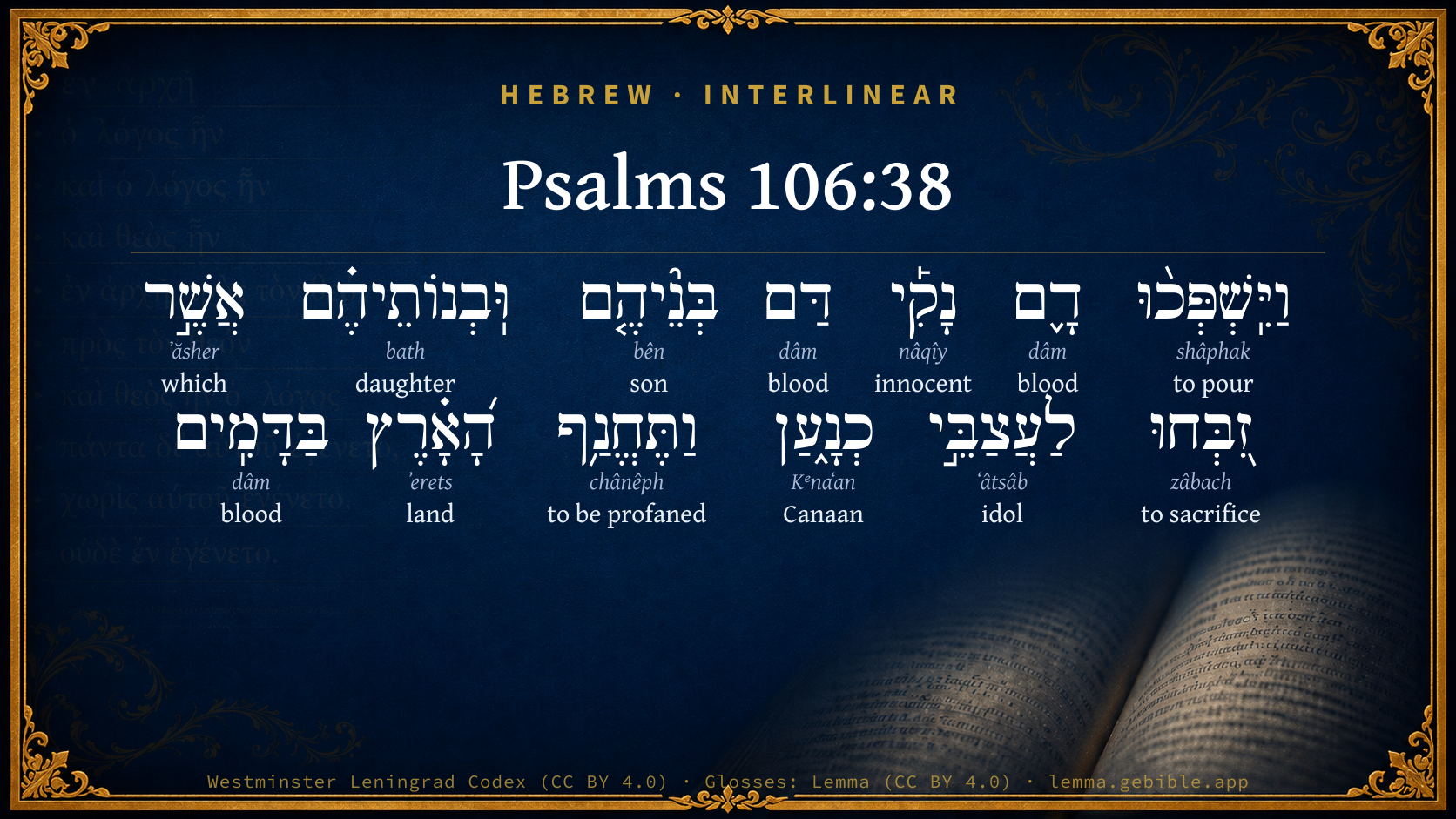
Hebrew (Westminster Leningrad Codex) Psalms 106:38 appears in the Hebrew Old Testament. The text above is from the Westminster Leningrad Codex. Each word links to its Strong’s number, a concise gloss, and parsing drawn from the Open Scriptures Hebrew Bible morphology. Click any word for its full Brown-Driver-Briggs (BDB) entry.
Download image
Cite this verse

Psalms 106:38 (World English Bible). Public Domain. Lemma interlinear Bible study tool, https://lemma.gebible.app/v/psalms/106/38.

Show BibTeX & RIS
BibTeX
RIS
English Translation
They shed innocent blood, Even the blood of their sons and of their daughters, Whom they sacrificed to the idols of Canaan. The land was polluted with blood.
World English Bible · Public Domain
Download a study sheet

One document with this verse’s original text, its word-by-word gloss line, the meaning frame, cross-references with their text, attributed commentary, and full source and license credits — printable, and it pastes into notes with its structure intact.

This verse Autodidact and up

Study sheet (.html) Plain text (.txt)

A passage Seminary Student

Up to 50 verses in one chapter. A passage sheet keeps up to 6 commentary sources and 12 cross-references per verse, in the order this page ranks them, and says so on the sheet whenever that leaves anything out. Ask for a single verse and you get the Autodidact verse sheet above.

Everything on this page stays free to read, with no account — the sheet is a download of what is already on screen, not access to it.

Want to remove ads? Support Godless Engineer
Compare translations 3

The same verse in 3 English versions, stacked beneath the original-language interlinear above. Click any original word for its lexicon entry.

Each is an independent rendering of the whole verse — the interlinear is not word-aligned to these translations.

Highlighted words mark where these versions differ — a whole-verse word diff, not a word-by-word alignment.

  • World English Bible Public Domain
    They shed innocent blood, Even the blood of their sons and of their daughters, Whom they sacrificed to the idols of Canaan. The land was polluted with blood.
  • King James Version Public Domain
    And shed innocent blood, even the blood of their sons and of their daughters, whom they sacrificed unto the idols of Canaan: and the land was polluted with blood.
  • unfoldingWord Literal Text CC BY-SA 4.0
    And they shed innocent blood, the blood of their sons and their daughters, whom they sacrificed to the idols of Canaan, and the land was desecrated by bloodshed.

unfoldingWord Literal Text — © unfoldingWord, licensed CC BY-SA 4.0. Word-aligned USFM3 via Door43 (git.door43.org/unfoldingWord/en_ult).

Versions to compare (up to 4)

3 of 4 selected

Show all 18 translations

Every available English version of this verse, each an independent rendering of the whole verse.

  • World English Bible Public Domain
    They shed innocent blood, Even the blood of their sons and of their daughters, Whom they sacrificed to the idols of Canaan. The land was polluted with blood.
  • Berean Standard Bible Public Domain
    They shed innocent blood—the blood of their sons and daughters, whom they sacrificed to the idols of Canaan, and the land was polluted with blood.
  • Majority Standard Bible Public Domain
    They shed innocent blood—the blood of their sons and daughters, whom they sacrificed to the idols of Canaan, and the land was polluted with blood.
  • King James Version Public Domain
    And shed innocent blood, even the blood of their sons and of their daughters, whom they sacrificed unto the idols of Canaan: and the land was polluted with blood.
  • American Standard Version (1901) Public Domain
    And shed innocent blood, Even the blood of their sons and of their daughters, Whom they sacrificed unto the idols of Canaan; And the land was polluted with blood.
  • Revised Version (1885) Public Domain
    And shed innocent blood, even the blood of their sons and of their daughters, whom they sacrificed unto the idols of Canaan; and the land was polluted with blood.
  • Geneva Bible (1599) Public Domain
    And shed innocent blood, euen the blood of their sonnes, and of their daughters, whome they offred vnto the idoles of Canaan, and the lande was defiled with blood.
  • Douay-Rheims (1899) Public Domain
    And they shed innocent blood: the blood of their sons and of their daughters which they sacrificed to the idols of Chanaan. And the land was polluted with blood,
  • Young's Literal Translation Public Domain
    And they shed innocent blood -- Blood of their sons and of their daughters, Whom they have sacrificed to idols of Canaan, And the land is profaned with blood.
  • Literal Standard Version CC BY-SA 4.0
    And they shed innocent blood—Blood of their sons and of their daughters, || Whom they have sacrificed to idols of Canaan, || And the land is profaned with blood.
  • Unlocked Literal Bible CC BY-SA 4.0
    They shed innocent blood, the blood of their sons and of their daughters, whom they sacrificed to the idols of Canaan, desecrating the land with blood.
  • unfoldingWord Literal Text CC BY-SA 4.0
    And they shed innocent blood, the blood of their sons and their daughters, whom they sacrificed to the idols of Canaan, and the land was desecrated by bloodshed.
  • Darby Bible Public Domain
    And shed innocent blood, the blood of their sons and of their daughters, whom they sacrificed unto the idols of Canaan; and the land was polluted with blood.
  • World Messianic Bible Public Domain
    They shed innocent blood, even the blood of their sons and of their daughters, whom they sacrificed to the idols of Canaan. The land was polluted with blood.
  • Webster's Bible Public Domain
    And shed innocent blood, even the blood of their sons and of their daughters, whom they sacrificed to the idols of Canaan: and the land was polluted with blood.
  • Free Bible Version CC BY-SA 4.0
    They shed the blood of innocent children, their sons and daughters, sacrificing them to the idols of Canaan. By doing so they defiled the land with blood.
  • Bible in Basic English Public Domain
    And gave the blood of their sons and their daughters who had done no wrong, offering them to the images of Canaan; and the land was made unclean with blood.
  • JPS Tanakh (1917) Public Domain
    And shed innocent blood, even the blood of their sons and of their daughters, whom they sacrificed unto the idols of Canaan; and the land was polluted with blood.

Literal Standard Version (2020), Covenant Press — licensed CC BY-SA 4.0. Text via the HelloAO Bible API (eBible.org). Unlocked Literal Bible (unfoldingWord) — licensed CC BY-SA 4.0. Text via the HelloAO Bible API (eBible.org). unfoldingWord Literal Text — © unfoldingWord, licensed CC BY-SA 4.0. Word-aligned USFM3 via Door43 (git.door43.org/unfoldingWord/en_ult). Free Bible Version, Dr. Jonathan Gallagher — licensed CC BY-SA 4.0. Text via the HelloAO Bible API (eBible.org).

Word by word

More ways to search: Search by grammar → Find every occurrence → Compare this word →

Practice this passage: Drill this verse → Learn its vocabulary →

וַתֶּחֱנַ֥ף
chânêph
H2610
“and · to be profaned”
Conjunction + Verb, Qal, Sequential Imperfect, 3rd Person, Feminine, Singular
Part of Speech
Conjunction + Verb
Stem
Qal
Form
Sequential Imperfect
Person
3rd Person
Gender
Feminine
Number
Singular
Full BDB Definition

Origin: a primitive root

TWOT: 696

to be profaned, be defiled, be polluted, be corrupt - (Qal) - to be polluted - to be profane, be godless - (Hiphil) - to pollute - to make profane, make godless, cause to be defiled
  1. וַיִּֽשְׁפְּכ֨וּ shâphak H8210 “and · to pour” Conjunction + Verb, Qal, Sequential Imperfect, 3rd Person, Masculine, Plural
  2. דָ֪ם dâm H1818 “blood” Noun, Common, Masculine, Singular, Absolute
  3. נָקִ֡י nâqîy H5355 “innocent” Adjective, Adjective, Masculine, Singular, Absolute
  4. דַּם dâm H1818 “blood of” Noun, Common, Masculine, Singular, Construct
  5. בְּנֵ֘יהֶ֤ם bên H1121 “sons · their” Noun, Common, Masculine, Plural, Construct + Suffix, Personal, 3rd Person, Masculine, Plural
  6. וּֽבְנוֹתֵיהֶ֗ם bath H1323 “and · daughters · their” Conjunction + Noun, Common, Feminine, Plural, Construct + Suffix, Personal, 3rd Person, Masculine, Plural
  7. אֲשֶׁ֣ר ʼăsher H834 “which” Particle, Relative
  8. זִ֭בְּחוּ zâbach H2076 “to sacrifice” Verb, Piel, Perfect, 3rd Person, Common, Plural
  9. לַעֲצַבֵּ֣י ʻâtsâb H6091 “to/for · idols of” Preposition + Noun, Common, Masculine, Plural, Construct
  10. כְנָ֑עַן Kᵉnaʻan H3667 “Canaan” Noun, Proper
  11. הָ֝אָ֗רֶץ ʼerets H776 “the · land” Particle, Definite Article + Noun, Common, Both, Singular, Absolute
  12. בַּדָּמִֽים dâm H1818 “in/at the · blood” Preposition, Determined + Noun, Common, Masculine, Plural, Absolute

About this verse

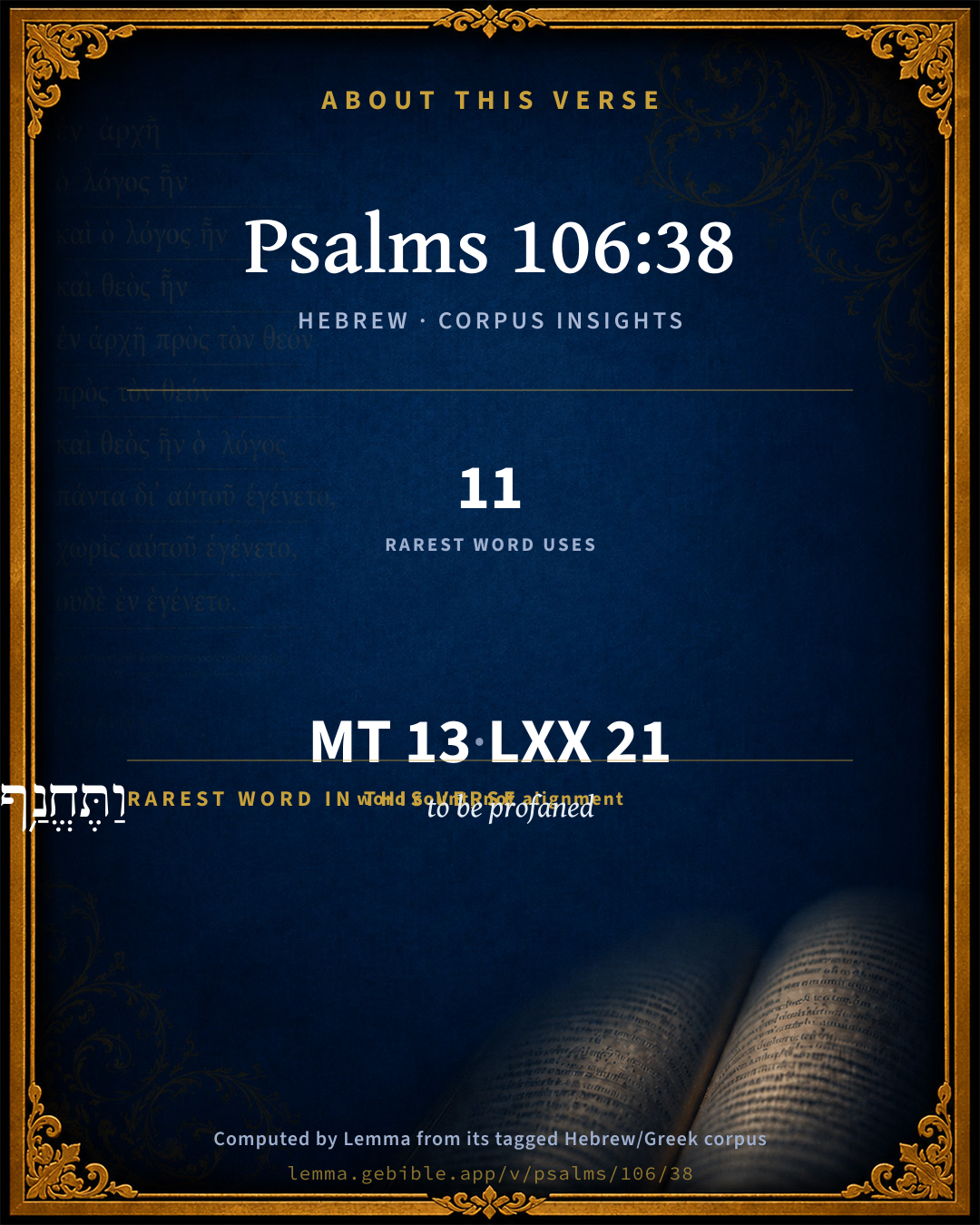
These counts appear in no published source. They are computed here, from the morphology-tagged text and Lemma’s own curated glosses. What Lemma adds →

13
words
11
distinct lemmas
Wisdom
section

Notable vocabulary

The rarest word here is וַתֶּחֱנַ֥ף to be profaned H2610 — appearing just 11 times in the whole Hebrew Bible.

Shared distinctive vocabulary

וַתֶּחֱנַ֥ף to be profaned H2610 occurs in 9 verses of the Hebrew Bible. Also found in:

Grammatical profile

  • 3 verbs
  • 8 nouns
  • 1 adjective
  • 1 particle

Verb forms

  • וַיִּֽשְׁפְּכ֨וּ Qal · Sequential Imperfect
  • זִ֭בְּחוּ Piel · Perfect
  • וַתֶּחֱנַ֥ף Qal · Sequential Imperfect

Repetition

A word recurs within this verse — often emphatic in Hebrew:

  • דָ֪ם blood H1818 ×3

Hebrew & Septuagint length

In English translation the verse runs 28 words from the Hebrew and 26 from the Septuagint (LXX English) — closely comparable.

A rough comparison of the two English renderings, which tokenize alike — not a word-level alignment.

Word counts can differ between the Hebrew and the Greek without any difference in meaning — e.g. the Hebrew direct-object marker אֵת has no separate Greek word, and Greek often adds the article ὁ.

In the original languages it is 13 Hebrew tokens and 21 Greek tokens — but the two are counted differently (Hebrew bundles its prefixes and suffixes into one token; the Greek is in lemma form), so that isn’t a like-for-like length.

Cross-references

10

Topical passages linked to Psalms 106:38 in the Treasury of Scripture Knowledge — connected by theme and wording, ordered by reader-vote popularity; previews shown in the World English Bible.

  • Numbers 35:33 So you shall not pollute the land in which you are: for blood, it pollutes the land; and no expiation can be made for the land for the blood that is shed therein, but by the blood of him who shed it.
  • Deuteronomy 21:9 So shall you put away the innocent blood from the midst of you, when you shall do that which is right in the eyes of Yahweh.
  • 2 Kings 21:16 Moreover Manasseh shed innocent blood very much, until he had filled Jerusalem from one end to another; besides his sin with which he made Judah to sin, in doing that which was evil in the sight of Yahweh.
  • Isaiah 26:21 For, behold, Yahweh comes forth out of his place to punish the inhabitants of the earth for their iniquity: the earth also shall disclose her blood, and shall no more cover her slain.
  • 2 Kings 24:4 and also for the innocent blood that he shed; for he filled Jerusalem with innocent blood: and Yahweh would not pardon.
  • Isaiah 1:15 When you spread forth your hands, I will hide my eyes from you; Yes, when you make many prayers, I will not hear. Your hands are full of blood.
  • Isaiah 24:5 The earth also is polluted under the inhabitants of it; because they have transgressed the laws, violated the statutes, broken the everlasting covenant.
  • Jeremiah 2:34 Also in your skirts is found the blood of the souls of the innocent poor: you did not find them breaking in; but it is because of all these things.
  • Ezekiel 7:23 Make the chain; for the land is full of bloody crimes, and the city is full of violence.
  • Ezekiel 22:3 You shall say, Thus says the Lord Yahweh: A city that sheds blood in the midst of her, that her time may come, and that makes idols against herself to defile her!

Cross-references courtesy of OpenBible.info (CC BY 4.0).

Hebrew and Greek witnesses Masoretic Hebrew ↔ Greek Septuagint

The same verse in the two great witnesses to the Old Testament, shown verse-for-verse.

You’re reading Greek Psalm 105 (Hebrew Psalm 106). The Septuagint counts the superscription, so verse numbers can differ from the Hebrew — chapter-level alignment, not verse-by-verse. Numbering follows Rahlfs.

These are two independent witnesses, not word-aligned to each other, and the Septuagint is shown in lemma (dictionary) form.

Hebrew Psalms 106:38 Masoretic · Westminster Leningrad Codex

וַיִּֽשְׁפְּכ֨וּ דָ֪ם נָקִ֡י דַּם בְּנֵ֘יהֶ֤ם וּֽבְנוֹתֵיהֶ֗ם אֲשֶׁ֣ר זִ֭בְּחוּ לַעֲצַבֵּ֣י כְנָ֑עַן וַתֶּחֱנַ֥ף הָ֝אָ֗רֶץ בַּדָּמִֽים

They shed innocent blood, Even the blood of their sons and of their daughters, Whom they sacrificed to the idols of Canaan. The land was polluted with blood.

World English Bible · Public Domain

Greek LXX Greek Psalm 105:38 Septuagint · lemma form

καί ἐκχέω αἷμα ἀθῷος αἷμα υἱός αὐτός καί θυγάτηρ ὅς θύω ὁ γλυπτός χανάαν καί φονοκτονέω ὁ γῆ ἐν ὁ αἷμα

and shed innocent blood, the blood of their sons and daughters, whom they sacrificed to the idols of Chanaan; and the land was defiled with blood.

LXX2012 (modern English Septuagint) · Public Domain

Hebrew: Westminster Leningrad Codex (CC BY 4.0). Greek: Septuagint (public domain); English from LXX2012 (modern English Septuagint) (Public Domain). How the Septuagint differs from the Hebrew →

Commentary

Notes on Psalms 106:38 from classic Christian and Jewish commentators (each source and its license shown beneath its notes). The classic Christian expositions comment on the surrounding passage and are grouped to its opening verse, so a note may address several verses; the Jewish commentaries on the Tanakh (Rashi and others) are per-verse, so they appear only where the commentator wrote on this verse.

Lemma curates 59 commentaries, every one of them public domain or Creative Commons licensed, each selected and text-cleaned for this edition rather than reprinted as found. About our sources →

Trapp's Complete Commentary

John Trapp

Psa 106:38 And shed innocent blood, [even] the blood of their sons and of their daughters, whom they sacrificed unto the idols of Canaan: and the land was polluted with blood.

Ver. 38. And shed innocent blood, &c.] This was furor Diabolicus; but what may not the devil do with his drudges, when God’s word cannot obtain the smallest things of us?

Whom they sacrificed unto the idols of Canaan] Prompted thereunto by that old manslayer. This was practised by Manasseh, Ahaz, and others not a few, Jer 7:19 Eze 16:1-63 Haec atrocitas frequens apud gentes.

And the land was polluted with blood] Impiata est abominabilis reddita est quasi hypocrita. See Ezr 9:11. As a hypocrite is a fair professor, but a foul sinner, so here.

John Trapp, A Commentary or Exposition upon All the Books of the Old and New Testament (1647–1656) — public domain. Text from a community e-Sword module.

J. A. Alexander on Psalms

Joseph Addison Alexander

38. (Psa 106:38) And they shed innocent blood, the blood of their sons and daughters, which they sacrificed to the idols of Canaan; and defiled was the land with bloods. The first verb means to pour out, and here implies a copious or abundant bloodshed, corresponding to the next verb, which is an intensive form of that used in Psa 106:37. Blood, in the singular, is used in a physical sense; the plural bloods, in a moral one, always implying guilt, and especially the guilt of murder. See above, on Psa 5:6; Psa 26:9; Psa 51:14, Leviticus 24 (23). The first three members of the sentence have respect to the prohibitions in Deu 12:31; Deu 18:10; Deu 19:10. With the last clause compare Num 35:33.

Joseph Addison Alexander, The Psalms Translated and Explained (1850) — public domain. Text from a community e-Sword module.

John Calvin's Commentaries

38. And they shed He inveighs with still greater indignation against that religious phrensy which led them to sacrifice their own children, and thus to pollute the land by the shedding of innocent blood. Should any one object that Abraham is praised, because he did not withhold his only son, the answer is plain, That he did it in obedience to God’s command, so that every vestige of inhumanity was effaced by means of the purity of faith. For if obedience is better than sacrifice, (1 Samuel 15:22) it is the best rule both for morality and religion. It is an awful manifestation of God’s vindictive wrath, when the superstitious heathens, left to their own inventions, become hardened in deeds of horrid cruelty. As often as the martyrs put their life in jeopardy in defense of the truth, the incense of such a sacrifice is pleasing to God. But when the two Romans, by name Decii, in an execrable manner devoted themselves unto death, that was an act of atrocious impiety. It is not without just cause, therefore, that the prophet enhances the guilt of the people by this consideration, that to the perverse mode of worshipping God, they had added excessive cruelty. Nor is there less cause for charging them with having polluted that land out of which God had commanded them to expel the ancient inhabitants, in order that he might render it the peculiar scene where he was to be worshipped. The Israelites then were doubly wicked, who, by not only defiling the land with their idolatry, but also by cruelly butchering their children, robbed God of his due, and in a manner frustrated his designs.

John Calvin's Commentaries (1540-1563) — public domain. Text from the Calvin Translation Society English edition (1840s-50s) via the Christian Classics Ethereal Library (ccel.org). Calvin's coverage is partial (roughly two-thirds of the Bible); uncommented books and verses are honest gaps, never fabricated. The 19th-century editor's footnotes and remarks are omitted so the notes are faithfully Calvin's own voice.

Ellicott's Commentary for English Readers

(38) Innocent blood.—Human sacrifice, and especially that of children, was a Canaanite practice. It seems to have been inherent in Phoenician custom, for Carthage was, two centuries after Christ, notorious for it. (See Sil. Ital., iv. 767.)

A Bible Commentary for English Readers, edited by Charles John Ellicott (1878–1897) — public domain. Text from a community e-Sword module.

The Cambridge Bible for Schools and Colleges

gen. ed. J. J. S. Perowne

38. Human sacrifices, the horror of which was intensified by the tender age of the victims and their relation to the offerers, are mentioned as the climax of the abominations of the Canaanites (Deu_12:31; Deu_18:9-10), and of the Israelites who copied their ways (Eze_16:20-21; Eze_20:31).

the land was polluted with blood] Cp. Num_35:33-34; and for the thought of the defilement of a land by the sins of its inhabitants see Lev_18:24 ff.; Isa_24:5; Jer_3:1-2; Jer_3:9. The Canaanites had been condemned to extermination for their enormities; but Israel failed to take warning from their fate.

The Cambridge Bible for Schools and Colleges (gen. ed. J. J. S. Perowne; Cambridge University Press, 1878–1918) — public domain. Text from a community e-Sword module.

John Gill's Exposition

Thus were they defiled with their own works,.... Not the land only, but they themselves also; or "with their works" (a), with the works of the Heathen they learned, Psa 106:35, or rather with their own works, the works of the flesh, especially their shocking idolatries: sin is of a defiling nature; it has defiled all men, it defiles all of men, all the faculties of their souls, and all the members of their bodies; nor can anything truly and thoroughly cleanse from it but the blood of Christ: even men's works of righteousness are as filthy rags and defiling, and much more their evil works.

And went a whoring with their own inventions; after other gods; idolatry is often in Scripture signified by whoredom; the idolatry of Israel and Judah is represented by two harlots and their lewd practices, in Eze 23:1 and hence the apostate church of Rome is compared to a whore, because of her idolatry, Rev 17:1.

(a) "operibus earum", Muis; so Ainsworth.

John Gill's Exposition of the Whole Bible (1746–1763) — public domain (CC PDM 1.0). Text via the HelloAO Bible API.

Albert Barnes' Notes on the Bible

And shed innocent blood ... - The blood of those who had committed no crime; who did not “deserve” the treatment which they received. That is, they were sacrificed “as” innocent persons, and “because” it was believed that they “were” innocent: the pure for the impure; the holy for the unholy. It was on the general principle that a sacrifice for sin must be itself pure, or it could not be offered in the place of the guilty; that an offering made for one who had violated law must be by one who had “not” violated it. This was the principle on which “lambs” were offered in sacrifice. It is on this principle that the atonement for sin by the Lord Jesus was made; on this depend its efficacy and its value.

And the land was polluted with blood - That is, Either so much blood was thus poured out, that it might be said that the very land was polluted with it; or, the sin itself was so great, that it seemed to defile and pollute the whole land.

Albert Barnes' Notes on the Bible (1834–1885) — public domain. Text from a community e-Sword/MySword module.

Matthew Poole's English Annotations

Innocent blood; the blood of their children, who, though sinners before God, yet were innocent as to them, from any crime deserving such barbarous usage from them.

Matthew Poole's English Annotations on the Holy Bible (1683–1685) — public domain. Text from a community e-Sword/MySword module.

The Pulpit Commentary

And shed innocent blood, even the blood of their sons and of their daughters. Infants, who could have committed no actual sin, were the ordinary victims in the Moloch sacrifices (see Jarchi on Jer_7:31; Diod. Sic., 20:14; Dollinger, "Judenthum und Heidenthum," 1:427, Engl. trans.). Whom they sacrificed unto the idols of Canaan. Bloody offerings of this horrible kind were made, not only to Moloch, but also to Baal, (Jer_19:5) to Chemosh, (2Ki_3:27) and perhaps to other deities. And the land was polluted with blood. Contrary to the commandment given in Num_35:33, "Ye shall not pollute the land wherein ye are." The "innocent blood" shed in the land is often declared to have been the especial cause of God"s anger against Israel, and of his final casting away of his inheritance. (2Ki_24:4 Isa_59:7 Jer_7:6 Jer_22:3, Jer_22:17, etc.)

The Pulpit Commentary (1880–1919), ed. H.D.M. Spence-Jones & Joseph S. Exell — public domain. Text from a community e-Sword module.

Lesson kit

Teaching starters — assembled from the data on this page, not authored interpretation. Every prompt links to the verse data it draws on. Edit before teaching.

Psalms, in the Wisdom, opens this verse with 13 words (11 distinct Hebrew lemmas). Its most distinctive word is chânêph (“to be profaned”). A historical commentator’s framing appears above. Read the whole chapter for the surrounding context.

Discussion questions

  1. What does “to be profaned” (chânêph) contribute to the verse as a whole?
  2. Numbers 35:33 shares the word «to be profaned» with this verse. How do the two illuminate each other?
  3. “blood” occurs 3× in this one verse. What is the effect of the repetition?
  4. These translations render this verse differently. What is at stake in choosing one wording over another?
  5. The verb «וַיִּֽשְׁפְּכ֨וּ» is Qal Sequential Imperfect. How does its form color the action?
  6. Reading how Trapp's Complete Commentary and J. A. Alexander on Psalms read this verse, where do the two commentators agree and where do they part?

Things to notice

Reading settings

Reading text

Shown beneath each verse's original-language words.

Old Testament
Old Testament edition

Read the OT as the Masoretic Hebrew (MT) or the Greek Septuagint (LXX).

English shown for the Greek Septuagint (in the Hebrew ↔ Greek comparison).

Comparing translations? Open the Compare panel on any verse page to stack up to four side by side.