
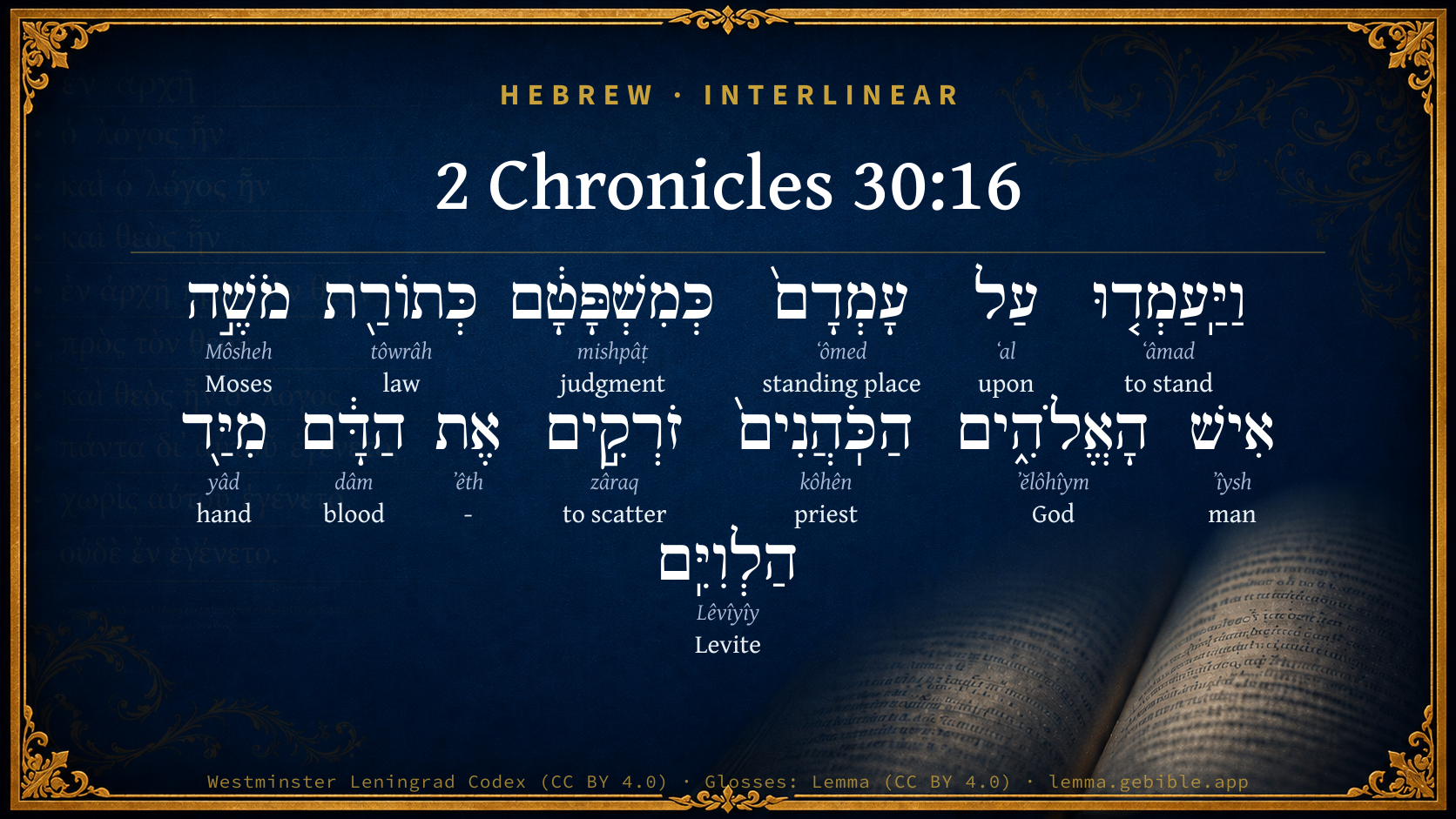
2 Chronicles 30:16

Hebrew (Westminster Leningrad Codex) 2 Chronicles 30:16 appears in the Hebrew Old Testament. The text above is from the Westminster Leningrad Codex. Each word links to its Strong’s number, a concise gloss, and parsing drawn from the Open Scriptures Hebrew Bible morphology. Click any word for its full Brown-Driver-Briggs (BDB) entry.
Download image
Cite this verse

2 Chronicles 30:16 (World English Bible). Public Domain. Lemma interlinear Bible study tool, https://lemma.gebible.app/v/2-chronicles/30/16.

Show BibTeX & RIS
BibTeX
RIS
English Translation
They stood in their place after their order, according to the law of Moses the man of God: the priests sprinkled the blood [which they received] of the hand of the Levites.
World English Bible · Public Domain
Highlights
  • 1 first appearance in the Hebrew Bible
Full analysis ↓
Download a study sheet

One document with this verse’s original text, its word-by-word gloss line, the meaning frame, cross-references with their text, attributed commentary, and full source and license credits — printable, and it pastes into notes with its structure intact.

This verse Autodidact and up

Study sheet (.html) Plain text (.txt)

A passage Seminary Student

Up to 50 verses in one chapter. A passage sheet keeps up to 6 commentary sources and 12 cross-references per verse, in the order this page ranks them, and says so on the sheet whenever that leaves anything out. Ask for a single verse and you get the Autodidact verse sheet above.

Everything on this page stays free to read, with no account — the sheet is a download of what is already on screen, not access to it.

Want to remove ads? Support Godless Engineer
Compare translations 3

The same verse in 3 English versions, stacked beneath the original-language interlinear above. Click any original word for its lexicon entry.

Each is an independent rendering of the whole verse — the interlinear is not word-aligned to these translations.

Highlighted words mark where these versions differ — a whole-verse word diff, not a word-by-word alignment.

  • World English Bible Public Domain
    They stood in their place after their order, according to the law of Moses the man of God: the priests sprinkled the blood [which they received] of the hand of the Levites.
  • King James Version Public Domain
    And they stood in their place after their manner, according to the law of Moses the man of God: the priests sprinkled the blood, which they received of the hand of the Levites.
  • unfoldingWord Literal Text CC BY-SA 4.0
    And they stood at their stations according to their judgment, according to the law of Moses, the man of God. The priests were scattering the blood from the hand of the Levites,

unfoldingWord Literal Text — © unfoldingWord, licensed CC BY-SA 4.0. Word-aligned USFM3 via Door43 (git.door43.org/unfoldingWord/en_ult).

Versions to compare (up to 4)

3 of 4 selected

Show all 18 translations

Every available English version of this verse, each an independent rendering of the whole verse.

  • World English Bible Public Domain
    They stood in their place after their order, according to the law of Moses the man of God: the priests sprinkled the blood [which they received] of the hand of the Levites.
  • Berean Standard Bible Public Domain
    They stood at their prescribed posts, according to the Law of Moses the man of God. The priests sprinkled the blood, which they received from the hand of the Levites.
  • Majority Standard Bible Public Domain
    They stood at their prescribed posts, according to the Law of Moses the man of God. The priests splattered the blood, which they received from the hand of the Levites.
  • King James Version Public Domain
    And they stood in their place after their manner, according to the law of Moses the man of God: the priests sprinkled the blood, which they received of the hand of the Levites.
  • American Standard Version (1901) Public Domain
    And they stood in their place after their order, according to the law of Moses the man of God: the priests sprinkled the blood `which they received' of the hand of the Levites.
  • Revised Version (1885) Public Domain
    And they stood in their place after their order, according to the law of Moses the man of God: the priests sprinkled the blood, which they received of the hand of the Levites.
  • Geneva Bible (1599) Public Domain
    And they stoode in their place after their maner, according to the Lawe of Moses the man of God: and the Priestes sprinkled the blood, receiued of the handes of the Leuites.
  • Douay-Rheims (1899) Public Domain
    And they immolated the phase on the fourteenth day of the second month. And the priests and the Levites being at length sanctified offered holocausts in the house of the Lord.
  • Young's Literal Translation Public Domain
    And they stand on their station according to their ordinance; according to the law of Moses the man of God the priests are sprinkling the blood out of the hand of the Levites,
  • Literal Standard Version CC BY-SA 4.0
    And they stand on their station according to their ordinance, according to the Law of Moses the man of God; the priests are sprinkling the blood out of the hand of the Levites,
  • Unlocked Literal Bible CC BY-SA 4.0
    They stood in their place by their divisions, following the directions given in the law of Moses, the man of God. The priests sprinkled the blood that they received from the hand of the Levites.
  • unfoldingWord Literal Text CC BY-SA 4.0
    And they stood at their stations according to their judgment, according to the law of Moses, the man of God. The priests were scattering the blood from the hand of the Levites,
  • Darby Bible Public Domain
    And they stood in their place after their custom, according to the law of Moses the man of God: the priests sprinkled the blood [receiving it] from the hand of the Levites.
  • World Messianic Bible Public Domain
    They stood in their place after their order, according to the Torah of Moses the man of God. The priests sprinkled the blood which they received of the hand of the Levites.
  • Webster's Bible Public Domain
    And they stood in their place after their manner, according to the law of Moses the man of God: the priests sprinkled the blood, which they received from the hand of the Levites.
  • Free Bible Version CC BY-SA 4.0
    They stood at their assigned positions, according to the law of Moses, the man of God. The priests sprinkled the blood of the sacrifices, which the Levites gave to them.
  • Bible in Basic English Public Domain
    And they took their places in their right order, as it was ordered in the law of Moses, the man of God: the priests draining out on the altar the blood given them by the Levites.
  • JPS Tanakh (1917) Public Domain
    And they stood in their place after their order, according to the law of Moses the man of God; the priests dashed the blood, which they received of the hand of the Levites.

Literal Standard Version (2020), Covenant Press — licensed CC BY-SA 4.0. Text via the HelloAO Bible API (eBible.org). Unlocked Literal Bible (unfoldingWord) — licensed CC BY-SA 4.0. Text via the HelloAO Bible API (eBible.org). unfoldingWord Literal Text — © unfoldingWord, licensed CC BY-SA 4.0. Word-aligned USFM3 via Door43 (git.door43.org/unfoldingWord/en_ult). Free Bible Version, Dr. Jonathan Gallagher — licensed CC BY-SA 4.0. Text via the HelloAO Bible API (eBible.org).

Word by word

More ways to search: Search by grammar → Find every occurrence → Compare this word →

Practice this passage: Drill this verse → Learn its vocabulary →

עָמְדָם֙
ʻômed
H5977
“standing place · their”
Noun, Common, Masculine, Singular, Construct + Suffix, Personal, 3rd Person, Masculine, Plural
Part of Speech
Noun
Type
Common
Gender
Masculine
Number
Singular
State
Construct
Full BDB Definition

Origin: from H5975

TWOT: 1637a

standing place
  1. וַיַּֽעַמְד֤וּ ʻâmad H5975 “and · to stand” Conjunction + Verb, Qal, Sequential Imperfect, 3rd Person, Masculine, Plural
  2. עַל ʻal H5921 “upon” Preposition
  3. כְּמִשְׁפָּטָ֔ם mishpâṭ H4941 “like/as · judgment · their” Preposition + Noun, Common, Masculine, Singular, Construct + Suffix, Personal, 3rd Person, Masculine, Plural
  4. כְּתוֹרַ֖ת tôwrâh H8451 “like/as · law of” Preposition + Noun, Common, Feminine, Singular, Construct
  5. מֹשֶׁ֣ה Môsheh H4872 “Moses” Noun, Proper
  6. אִישׁ ʼîysh H376 “man of” Noun, Common, Masculine, Singular, Construct
  7. הָאֱלֹהִ֑ים ʼĕlôhîym H430 “the · God(s)” Particle, Definite Article + Noun, Common, Masculine, Plural, Absolute
  8. הַכֹּֽהֲנִים֙ kôhên H3548 “the · priests” Particle, Definite Article + Noun, Common, Masculine, Plural, Absolute
  9. זֹרְקִ֣ים zâraq H2236 “scattering” Verb, Qal, Participle Active, Masculine, Plural, Absolute
  10. אֶת ʼêth H853 “-” Particle, Direct Object
  11. הַדָּ֔ם dâm H1818 “the · blood” Particle, Definite Article + Noun, Common, Masculine, Singular, Absolute
  12. מִיַּ֖ד yâd H3027 “from · hand of” Preposition + Noun, Common, Both, Singular, Construct
  13. הַלְוִיִּֽם Lêvîyîy H3881 “the · Levites” Particle, Definite Article + Noun, Gentilic, Masculine, Plural, Absolute

About this verse

These counts appear in no published source. They are computed here, from the morphology-tagged text and Lemma’s own curated glosses. What Lemma adds →

14
words
14
distinct lemmas
Historical
section

Notable vocabulary

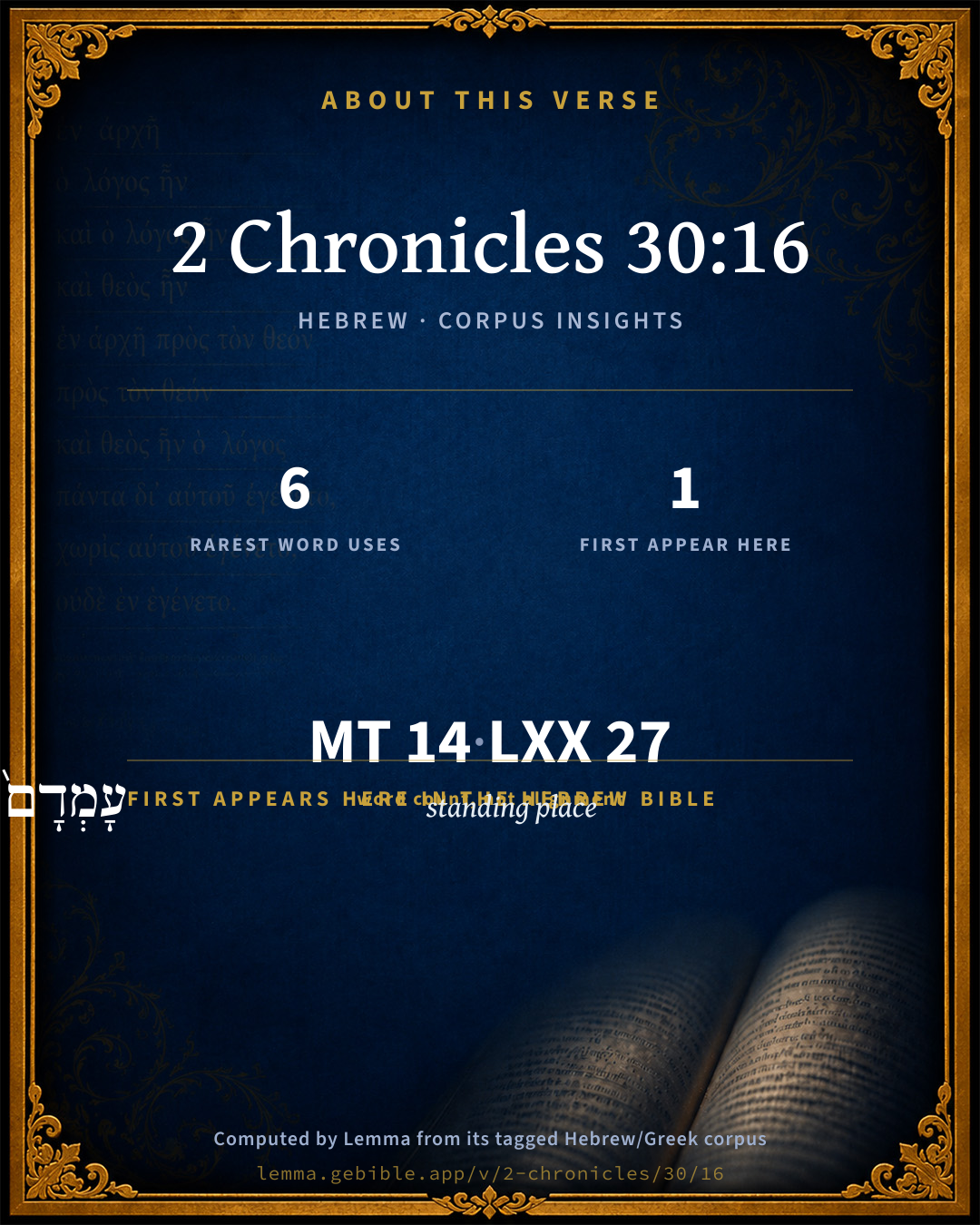
The rarest word here is עָמְדָם֙ standing place H5977 — appearing just 6 times in the whole Hebrew Bible.

First appearance in Scripture

This word makes its first canonical appearance in the Hebrew Bible here:

  • עָמְדָם֙ standing place H5977

Shared distinctive vocabulary

עָמְדָם֙ standing place H5977 occurs in 6 verses of the Hebrew Bible. Also found in:

Grammatical profile

  • 2 verbs
  • 10 nouns
  • 1 preposition
  • 1 particle

Verb forms

  • וַיַּֽעַמְד֤וּ Qal · Sequential Imperfect
  • זֹרְקִ֣ים Qal · Participle Active

Hebrew & Septuagint length

In English translation the verse runs 32 words from the Hebrew and 32 from the Septuagint (LXX English) — the same length.

A rough comparison of the two English renderings, which tokenize alike — not a word-level alignment.

Word counts can differ between the Hebrew and the Greek without any difference in meaning — e.g. the Hebrew direct-object marker אֵת has no separate Greek word, and Greek often adds the article ὁ.

In the original languages it is 14 Hebrew tokens and 27 Greek tokens — but the two are counted differently (Hebrew bundles its prefixes and suffixes into one token; the Greek is in lemma form), so that isn’t a like-for-like length.

Cross-references

6

Topical passages linked to 2 Chronicles 30:16 in the Treasury of Scripture Knowledge — connected by theme and wording, ordered by reader-vote popularity; previews shown in the World English Bible.

  • Deuteronomy 33:1 This is the blessing, with which Moses the man of God blessed the children of Israel before his death.
  • 2 Chronicles 35:15 The singers the sons of Asaph were in their place, according to the commandment of David, and Asaph, and Heman, and Jeduthun the king's seer; and the porters were at every gate: they didn't need to depart from their service; for their brothers the Levites prepared for them.
  • Leviticus 1:5 He shall kill the bull before Yahweh. Aaron's sons, the priests, shall present the blood and sprinkle the blood around on the altar that is at the door of the Tent of Meeting.
  • 2 Kings 11:14 and she looked, and, behold, the king stood by the pillar, as the manner was, and the captains and the trumpets by the king; and all the people of the land rejoiced, and blew trumpets. Then Athaliah tore her clothes, and cried, Treason! treason!
  • 2 Chronicles 35:10–11 So the service was prepared, and the priests stood in their place, and the Levites by their divisions, according to the king's commandment.
  • Hebrews 11:28 By faith, he kept the Passover, and the sprinkling of the blood, that the destroyer of the firstborn should not touch them.

Cross-references courtesy of OpenBible.info (CC BY 4.0).

Hebrew and Greek witnesses Masoretic Hebrew ↔ Greek Septuagint

The same verse in the two great witnesses to the Old Testament, shown verse-for-verse.

These are two independent witnesses, not word-aligned to each other, and the Septuagint is shown in lemma (dictionary) form.

Hebrew 2 Chronicles 30:16 Masoretic · Westminster Leningrad Codex

וַיַּֽעַמְד֤וּ עַל עָמְדָם֙ כְּמִשְׁפָּטָ֔ם כְּתוֹרַ֖ת מֹשֶׁ֣ה אִישׁ הָאֱלֹהִ֑ים הַכֹּֽהֲנִים֙ זֹרְקִ֣ים אֶת הַדָּ֔ם מִיַּ֖ד הַלְוִיִּֽם

They stood in their place after their order, according to the law of Moses the man of God: the priests sprinkled the blood [which they received] of the hand of the Levites.

World English Bible · Public Domain

Greek LXX 2 Chronicles 30:16 Septuagint · lemma form

καί ἵστημι ἐπί ὁ στάσις αὐτός κατά ὁ κρίμα αὐτός κατά ὁ ἐντολή μωυσῆς ἄνθρωπος ὁ θεός καί ὁ ἱερεύς δέχομαι ὁ αἷμα ἐκ χείρ ὁ λευείτης

And they stood at their post, according to their ordinance, according to the commandment of Moses the man of God: and the priests received the blood from the hand of the Levites.

LXX2012 (modern English Septuagint) · Public Domain

Hebrew: Westminster Leningrad Codex (CC BY 4.0). Greek: Septuagint (public domain); English from LXX2012 (modern English Septuagint) (Public Domain). How the Septuagint differs from the Hebrew →

Commentary

Notes on 2 Chronicles 30:16 from classic Christian and Jewish commentators (each source and its license shown beneath its notes). The classic Christian expositions comment on the surrounding passage and are grouped to its opening verse, so a note may address several verses; the Jewish commentaries on the Tanakh (Rashi and others) are per-verse, so they appear only where the commentator wrote on this verse.

Lemma curates 59 commentaries, every one of them public domain or Creative Commons licensed, each selected and text-cleaned for this edition rather than reprinted as found. About our sources →

Trapp's Complete Commentary

John Trapp

2Ch 30:16 And they stood in their place after their manner, according to the law of Moses the man of God: the priests sprinkled the blood, [which they received] of the hand of the Levites.

Ver. 16. The blood which they received of the hands of the Levites.] Part of the blood they sprinkled as a type of that "blood of sprinkling, that speaketh better things" for us; and part to be poured out by the priest upon the earth, to show that the best have deserved to be destroyed, and that God is the Lord of life and of death.

John Trapp, A Commentary or Exposition upon All the Books of the Old and New Testament (1647–1656) — public domain. Text from a community e-Sword module.

Joseph Benson's Commentary

2Ch 30:16-17. The priests sprinkled the blood — Of the sacrifices upon the altar; which they received of the hand of the Levites — Who killed and flayed the sacrifices, which the priests, if they had been sanctified, should have done, as was observed on 2Ch 29:34. For there were many in the congregation that were not sanctified — Abundance of people that came to keep this passover were not clean according to the law, and therefore many more sacrifices were to be offered for their cleansing than would otherwise have been necessary: which was one reason why the Levites were employed in the work, for the priests were not of a number sufficient to perform this duty. The reader must observe that besides the paschal-lamb, the offering of all the sacrifices, which were appointed to accompany it, are included in keeping the passover.

Joseph Benson's Commentary on the Old and New Testaments (1811–1818) — public domain. Text from a community e-Sword module.

Geneva Bible (1599)

Geneva Bible translators

To wit, of the lamb of the Passover.

Geneva Bible (1599) marginal notes — public domain. Text via Bolls.life.

Jamieson, Fausset & Brown

Robert Jamieson, A. R. Fausset & David Brown

the priests sprinkled the blood, which they received of the hand of the Levites--This was a deviation from the established rules and practices in presenting the offerings of the temple. The reason was, that many present on the occasion having not sanctified themselves, the Levites slaughtered the paschal victims (see on Ch2 35:5) for everyone that was unclean. At other times the heads of families killed the lambs themselves, the priests receiving the blood from their hands and presenting it on the altar. Multitudes of the Israelites, especially from certain tribes (Ch2 30:18), were in this unsanctified state, and yet they ate the passover--an exceptional feature and one opposed to the law (Num 9:6); but this exception was allowed in answer to Hezekiah's prayer (Ch2 30:18-20).

Jamieson, Fausset & Brown — Commentary Critical and Explanatory on the Whole Bible (1871) — public domain (CC PDM 1.0). Text via the HelloAO Bible API.

Ellicott's Commentary for English Readers

(16) In their place.—‘Omdâm. This word is used in this sense only in Daniel, Chronicles, Nehemiah. (Comp. 2Ch_34:31; 2Ch_35:10.)

After their manner—i.e., “according to their order” (1Ch_6:31).

According to the law . . . of God.—Another reference to the Pentateuchal legislation. (See 2Ch_23:18; 2Ch_24:6; 2Ch_14:4; 2Ch_17:9.)

Sprinkled . . . Levites.—Rather, sprinkling the blood from the hand of the Levites. On this occasion the Levites, and not the laymen who presented the victims, slew the lambs and handed the blood to the priests to be dashed against the altar. The reason of this breach of the ordinary rule is given in next verse.

A Bible Commentary for English Readers, edited by Charles John Ellicott (1878–1897) — public domain. Text from a community e-Sword module.

The Cambridge Bible for Schools and Colleges

gen. ed. J. J. S. Perowne

16. after their manner] R.V. after their order.

The Cambridge Bible for Schools and Colleges (gen. ed. J. J. S. Perowne; Cambridge University Press, 1878–1918) — public domain. Text from a community e-Sword module.

John Gill's Exposition

For there were many in the congregation that were not sanctified,.... Or purified from uncleanness, contracted either by idolatry, or through such things which, according to the ceremonial law, made them unclean, and from which they had not now time to cleanse themselves according to the law:

therefore the Levites had the charge of the killing of the passovers for everyone that was not clean, to sanctify them unto the Lord; this they did for the masters of families, who were ceremonially unclean, who otherwise might have killed their passover lambs themselves, see Exo 12:6, but now the Levites did it for them, that their passovers might be sanctified and consecrated to the Lord; for, as Philo the Jew says (r), one day in a year the whole sacrificed, everyone acted as a priest, and brought and slew his own sacrifice, meaning at the passover.

(r) De Vita Mosis, l. 3. p. 686. & de Decalogo, p. 766.

John Gill's Exposition of the Whole Bible (1746–1763) — public domain (CC PDM 1.0). Text via the HelloAO Bible API.

Albert Barnes' Notes on the Bible

After their manner - According to the Mishna, the custom was for the priests to stand in two rows extending from the altar to the outer court, where the people were assembled. As each offerer killed his lamb the blood was caught in a basin, which was handed to the nearest priest, who passed it on to his neighbor, and he to the next; the blood was thus conveyed to the altar, at the base of which it was thrown by the last priest in the row. While basins full of blood were thus passed up, empty basins were passed down in a constant succession, so that there was no pause or delay.

Which they received of the hand of the Levites - Ordinarily, the blood was received at the hand of the offerer. But the greater number of the Israelites 2Ch 30:17 who had come to keep the feast were involved in some ceremonial or moral defilement, from which there had not been time for them to purify themselves. On account of this uncleanness, they did not slay their own lambs, but delegated the office to the Levites.

Albert Barnes' Notes on the Bible (1834–1885) — public domain. Text from a community e-Sword/MySword module.

Haydock's Catholic Bible Commentary

Levites, who received the paschal lambs from the unsanctified. M. --- The law does not require the ministry of the tribe of Levi for this purpose, as each one might kill the paschal victim at home. But the people were not sufficiently purified on this occasion. Lyranus --- At other times, laics killed the victims, if they were clean, Ex. xii. 6. After the tabernacle was set up, the priests poured out the blood on the altar; and, in latter ages, they slew the victim according to Grotius. But the texts of Josephus (x. 5., and Jewish Wars vi. 45. Lat. vii. 17.; H.) are inconclusive; and Philo repeatedly assert that, on one day, the law authorizes all the people to sacrifice: and, though he lived at Alexandria, his testimony respecting a fact of public notoriety, is not to be rejected. Only the unclean applied to the Levites on this occasion, and the latter had no more right to sacrifice than the rest. C.

George Leo Haydock (1774–1849), Haydock's Catholic Family Bible and Commentary, 1859 edition — public domain. Excludes Psalms (Douay-Rheims chapter numbering differs from Protestant) and Deuterocanonical books (Catholic canon only).

Matthew Poole's English Annotations

The priests sprinkled the blood of the sacrifices upon the altar, Lev 1:5. Which they received of the hand of the Levites, who flayed and killed the sacrifices which the priests, if they had been sanctified, should have done, as it was observed before, 2Ch 29:34.

Matthew Poole's English Annotations on the Holy Bible (1683–1685) — public domain. Text from a community e-Sword/MySword module.

Whedon's Commentary on the Bible

Daniel D. Whedon

16. They stood in their place after their manner — Priest and Levite occupied each his prescribed place, and performed each his prescribed work according to the law — the priests to sprinkle the blood, (see Lev_1:5; Lev_3:2,) the Levites to assist in any work that might be required. In the present instance the Levites killed the paschal victims. 2Ch_30:17. “According to the Mishna, the custom was for the priests to stand in two rows extending from the altar to the outer court, where the people were assembled. As each offerer slew his lamb the blood was caught in a basin, which was handed to the nearest priest, who passed it on to his neighbour, and he to the next; the blood was thus conveyed to the altar, at the base of which it was thrown by the last priest in the row. While basins full of blood were thus passed up, empty basins were passed down in a constant succession, so that there was no pause or delay.” — Rawlinson.

Daniel D. Whedon (gen. ed.), Commentary on the Old and New Testaments (1874–1909) — public domain. Text from a community e-Sword module.

The Pulpit Commentary

They stood in their place after their manner. (see Lev_1:11-13, and many other references in Leviticus)

The Pulpit Commentary (1880–1919), ed. H.D.M. Spence-Jones & Joseph S. Exell — public domain. Text from a community e-Sword module.

unfoldingWord translationNotes

Door43 World Missions Community

They stood in their place by their divisions

"They stood in their appointed places"

the blood that they received from the hand of the Levites

This refers to the blood of the lambs that the Levites killed. Here "received from the hand of the Levites" is a metonym for the Levites giving the blood to the priests. AT: "the blood that they received from the Levites" or "the lambs' blood that the Levites gave to them" (See: Assumed Knowledge and Implicit Information and Metonymy)

the Passover lambs

"the lambs for the Passover"

translationWords

law

God

blood

receive

Levi

consecrate

slaughter

pure

lamb

unfoldingWord translationNotes — © Distant Shores Media and the Door43 World Missions Community, licensed CC BY-SA 4.0. Source: git.door43.org/Door43/en_tn.

Rashi

Rabbi Shlomo Yitzchaki (Rashi)

the priests sprinkled For [the rituals] from the reception [of the blood] and onwards are the commandments of the priests, and do not wonder why the owners themselves did not slaughter [the sacrifices], as is explained further: for there were many among the congregation who had not consecrated themselves and the Levites presided over the slaughter of their Passover sacrifices.

Rashi on the Tanakh — English translations: “The Judaica Press complete Tanach with Rashi, translated by A. J. Rosenberg” (CC BY 4.0); “Pentateuch with Rashi's commentary by M. Rosenbaum and A.M. Silbermann, 1929-1934” (public domain); “The Metsudah Tanach series, Lakewood, N.J” (CC BY 4.0); and “The Book of Joshua, Metsudah Publications, 1997” (CC BY 4.0). Text via Sefaria.

Lesson kit

Teaching starters — assembled from the data on this page, not authored interpretation. Every prompt links to the verse data it draws on. Edit before teaching.

2 Chronicles, in the Historical, opens this verse with 14 words (14 distinct Hebrew lemmas). Its most distinctive word is ʻômed (“standing place”). A historical commentator’s framing appears above. Read the whole chapter for the surrounding context.

Discussion questions

  1. What does “standing place” (ʻômed) contribute to the verse as a whole?
  2. The word “standing place” first appears here in Scripture. What is being introduced at this debut?
  3. 2 Chronicles 34:31 shares the word «standing place» with this verse. How do the two illuminate each other?
  4. The translations on this page render this verse differently — a whole-verse word diff, not a word-by-word alignment. What might account for the different wordings?
  5. The verb «וַיַּֽעַמְד֤וּ» is Qal Sequential Imperfect. How does its form color the action?
  6. Reading how Trapp's Complete Commentary and Joseph Benson's Commentary read this verse, where do the two commentators agree and where do they part?

Things to notice

Reading settings

Reading text

Shown beneath each verse's original-language words.

Old Testament
Old Testament edition

Read the OT as the Masoretic Hebrew (MT) or the Greek Septuagint (LXX).

English shown for the Greek Septuagint (in the Hebrew ↔ Greek comparison).

Comparing translations? Open the Compare panel on any verse page to stack up to four side by side.