
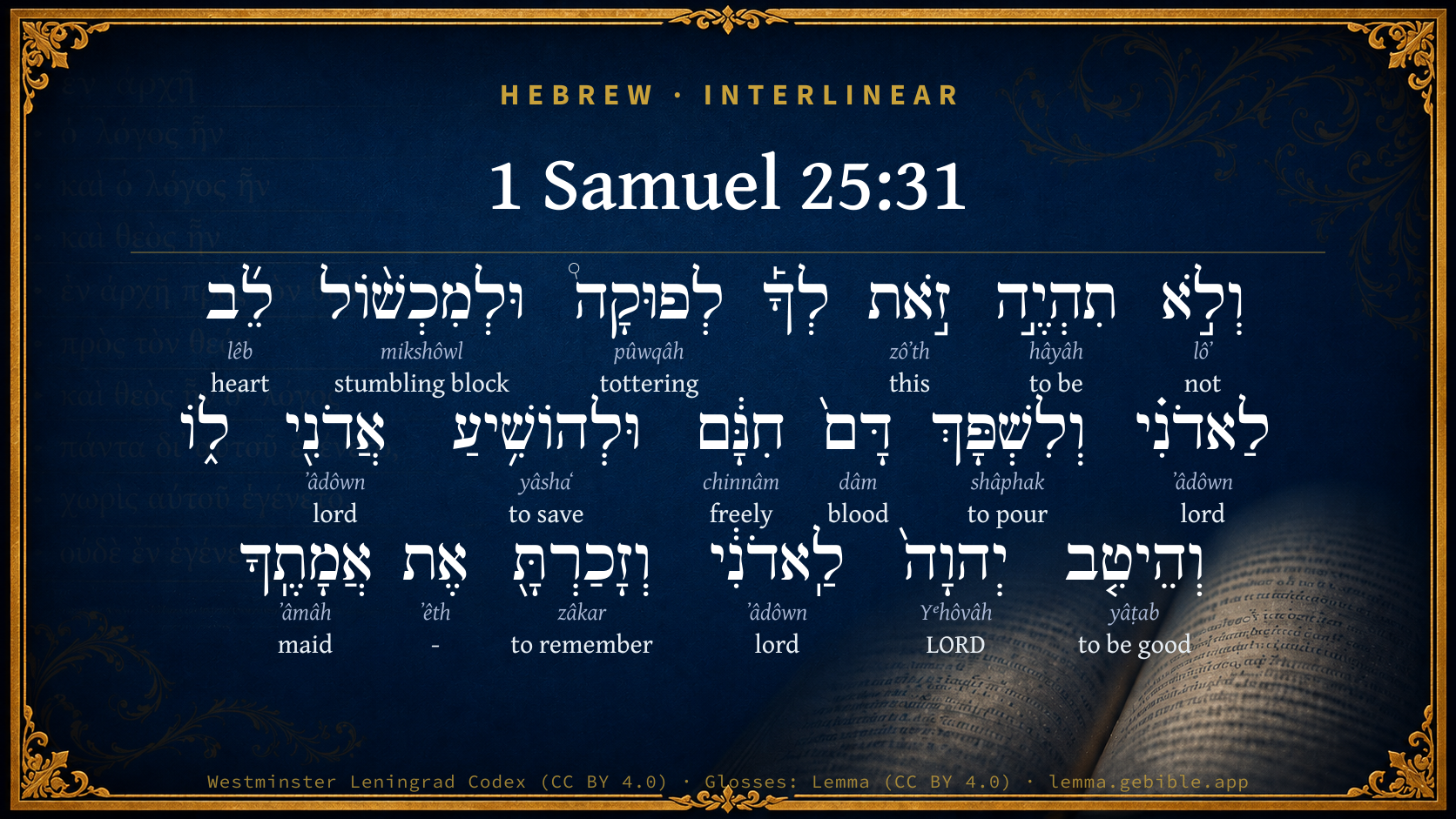
1 Samuel 25:31

Hebrew (Westminster Leningrad Codex) 1 Samuel 25:31 appears in the Hebrew Old Testament. The text above is from the Westminster Leningrad Codex. Each word links to its Strong’s number, a concise gloss, and parsing drawn from the Open Scriptures Hebrew Bible morphology. Click any word for its full Brown-Driver-Briggs (BDB) entry.
Download image
Cite this verse

1 Samuel 25:31 (World English Bible). Public Domain. Lemma interlinear Bible study tool, https://lemma.gebible.app/v/1-samuel/25/31.

Show BibTeX & RIS
BibTeX
RIS
English Translation
that this shall be no grief to you, nor offense of heart to my lord, either that you have shed blood without cause, or that my lord has avenged himself. When Yahweh shall have dealt well with my lord, then remember your handmaid.
World English Bible · Public Domain
Highlights
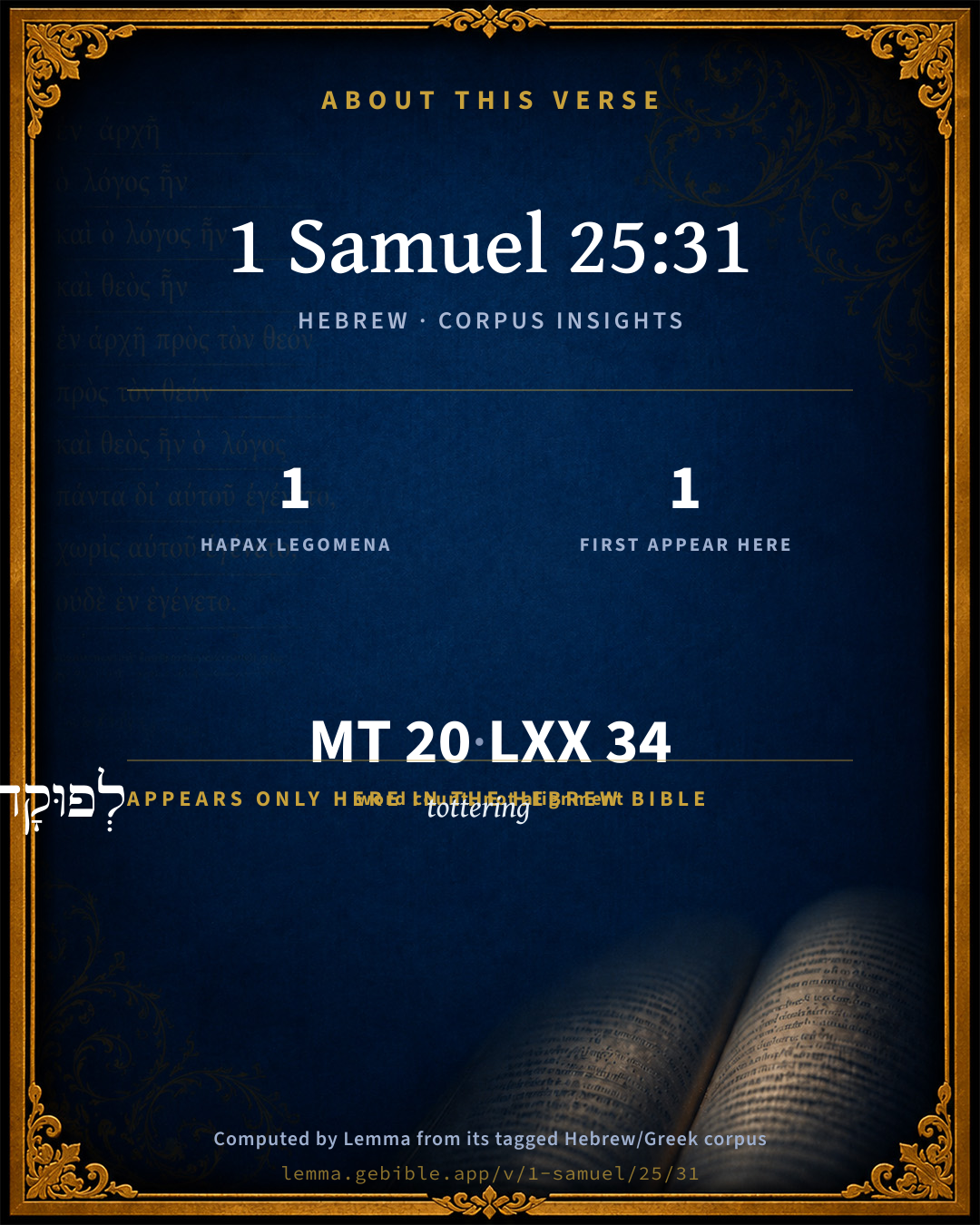
  • 1 hapax legomenon — only here in the Hebrew Bible
  • 1 first appearance in the Hebrew Bible
Full analysis ↓
Download a study sheet

One document with this verse’s original text, its word-by-word gloss line, the meaning frame, cross-references with their text, attributed commentary, and full source and license credits — printable, and it pastes into notes with its structure intact.

This verse Autodidact and up

Study sheet (.html) Plain text (.txt)

A passage Seminary Student

Up to 50 verses in one chapter. A passage sheet keeps up to 6 commentary sources and 12 cross-references per verse, in the order this page ranks them, and says so on the sheet whenever that leaves anything out. Ask for a single verse and you get the Autodidact verse sheet above.

Everything on this page stays free to read, with no account — the sheet is a download of what is already on screen, not access to it.

Want to remove ads? Support Godless Engineer
Compare translations 3

The same verse in 3 English versions, stacked beneath the original-language interlinear above. Click any original word for its lexicon entry.

Each is an independent rendering of the whole verse — the interlinear is not word-aligned to these translations.

Highlighted words mark where these versions differ — a whole-verse word diff, not a word-by-word alignment.

  • World English Bible Public Domain
    that this shall be no grief to you, nor offense of heart to my lord, either that you have shed blood without cause, or that my lord has avenged himself. When Yahweh shall have dealt well with my lord, then remember your handmaid.
  • King James Version Public Domain
    That this shall be no grief unto thee, nor offense of heart unto my lord, either that thou hast shed blood causeless, or that my lord hath avenged himself: but when the LORD shall have dealt well with my lord, then remember thine handmaid.
  • unfoldingWord Literal Text CC BY-SA 4.0
    then this will not be an obstacle for you or a stumbling block of heart for my master, or for the pouring out of blood without cause, or for my master saving himself. And Yahweh will do good for my master, and you will remember your maidservant.”

unfoldingWord Literal Text — © unfoldingWord, licensed CC BY-SA 4.0. Word-aligned USFM3 via Door43 (git.door43.org/unfoldingWord/en_ult).

Versions to compare (up to 4)

3 of 4 selected

Show all 18 translations

Every available English version of this verse, each an independent rendering of the whole verse.

  • World English Bible Public Domain
    that this shall be no grief to you, nor offense of heart to my lord, either that you have shed blood without cause, or that my lord has avenged himself. When Yahweh shall have dealt well with my lord, then remember your handmaid.
  • Berean Standard Bible Public Domain
    then my lord will have no remorse or guilt of conscience over needless bloodshed and revenge. And when the LORD has dealt well with my lord, may you remember your maidservant.”
  • Majority Standard Bible Public Domain
    then my lord will have no remorse or guilt of conscience over needless bloodshed and revenge. And when the LORD has dealt well with my lord, may you remember your servant.”
  • King James Version Public Domain
    That this shall be no grief unto thee, nor offense of heart unto my lord, either that thou hast shed blood causeless, or that my lord hath avenged himself: but when the LORD shall have dealt well with my lord, then remember thine handmaid.
  • American Standard Version (1901) Public Domain
    that this shall be no grief unto thee, nor offence of heart unto my lord, either that thou hast shed blood without cause, or that my lord hath avenged himself. And when Jehovah shall have dealt well with my lord, then remember thy handmaid.
  • Revised Version (1885) Public Domain
    that this shall be no grief unto thee, nor offence of heart unto my lord, either that thou hast shed blood causeless, or that my lord hath avenged himself: and when the LORD shall have dealt well with my lord, then remember thine handmaid.
  • Geneva Bible (1599) Public Domain
    Then shall it be no griefe vnto thee, nor offence of minde vnto my lord, that he hath not shed blood causelesse, nor that my lorde hath not preserued him selfe: and when the Lord shall haue dealt well with my lorde, remember thine handmaide.
  • Douay-Rheims (1899) Public Domain
    This shall not be an occasion of grief to thee, and a scruple of heart to my lord, that thou hast shed innocent blood, or hast revenged thyself: and when the Lord shall have done well by my lord, thou shalt remember thy handmaid.
  • Young's Literal Translation Public Domain
    that this is not to thee for a stumbling-block, and for an offence of heart to my lord -- either to shed blood for nought, or my lord's restraining himself; and Jehovah hath done good to my lord, and thou hast remembered thy handmaid.'
  • Literal Standard Version CC BY-SA 4.0
    that this is not to you for a stumbling-block, and for an offense of heart to my lord—either to shed blood for nothing, or my lord’s restraining himself; and YHWH has done good to my lord, and you have remembered your handmaid.”
  • Unlocked Literal Bible CC BY-SA 4.0
    This will not be a staggering burden for you—that you have poured out innocent blood, or because my master attempted to rescue himself. For when Yahweh will do good for my master, remember your servant.”
  • unfoldingWord Literal Text CC BY-SA 4.0
    then this will not be an obstacle for you or a stumbling block of heart for my master, or for the pouring out of blood without cause, or for my master saving himself. And Yahweh will do good for my master, and you will remember your maidservant.”
  • Darby Bible Public Domain
    that this shall be no stumbling-block to thee, nor offence of heart for my lord, either that thou hast shed blood without cause, or that my lord has avenged himself. And when Jehovah shall deal well with my lord, then remember thy handmaid.
  • World Messianic Bible Public Domain
    that this shall be no grief to you, nor offense of heart to my lord, either that you have shed blood without cause, or that my lord has avenged himself. When the LORD has dealt well with my lord, then remember your servant.”
  • Webster's Bible Public Domain
    That this will be no grief to thee, nor offense of heart to my lord, either that thou hast shed blood without cause, or that my lord hath avenged himself: but when the LORD shall have dealt well with my lord, then remember thy handmaid.
  • Free Bible Version CC BY-SA 4.0
    you won't have feelings of remorse or a guilty conscience over unnecessary bloodshed or of taking your own revenge. And when the Lord has done these good things for you, sir, please remember me, your maidservant.”
  • Bible in Basic English Public Domain
    Then you will have no cause for grief, and my lord's heart will not be troubled because you have taken life without cause and have yourself given punishment for your wrongs: and when the Lord has been good to you, then give a thought to your servant.
  • JPS Tanakh (1917) Public Domain
    that this shall be no stumbling-block unto thee, nor offence of heart unto my lord, either that thou hast shed blood without cause, or that my lord hath found redress for himself. And when the LORD shall have dealt well with my lord, then remember thy handmaid.'

Literal Standard Version (2020), Covenant Press — licensed CC BY-SA 4.0. Text via the HelloAO Bible API (eBible.org). Unlocked Literal Bible (unfoldingWord) — licensed CC BY-SA 4.0. Text via the HelloAO Bible API (eBible.org). unfoldingWord Literal Text — © unfoldingWord, licensed CC BY-SA 4.0. Word-aligned USFM3 via Door43 (git.door43.org/unfoldingWord/en_ult). Free Bible Version, Dr. Jonathan Gallagher — licensed CC BY-SA 4.0. Text via the HelloAO Bible API (eBible.org).

Word by word

More ways to search: Search by grammar → Find every occurrence → Compare this word →

Practice this passage: Drill this verse → Learn its vocabulary →

לְפוּקָה֩
pûwqâh
H6330
“to/for · tottering”
Preposition + Noun, Common, Feminine, Singular, Absolute
Part of Speech
Preposition + Noun
Type
Common
Gender
Feminine
Number
Singular
State
Absolute
Full BDB Definition

Origin: from H6328

TWOT: 1747a

tottering, staggering, stumbling - of qualm of conscience (figuratively)
  1. וְלֹ֣א lôʼ H3808 “and · not” Conjunction + Particle, Negative
  2. תִהְיֶ֣ה hâyâh H1961 “to be” Verb, Qal, Imperfect, 3rd Person, Feminine, Singular
  3. זֹ֣את zôʼth H2063 “this” Pronoun, Demonstrative, Feminine, Singular
  4. וּלְמִכְשׁ֨וֹל mikshôwl H4383 “and · to/for · stumbling block of” Conjunction + Preposition + Noun, Common, Masculine, Singular, Construct
  5. לֵ֜ב lêb H3820 “heart” Noun, Common, Masculine, Singular, Absolute
  6. לַאדֹנִ֗י ʼâdôwn H113 “to/for · lord · my” Preposition + Noun, Common, Masculine, Singular, Construct + Suffix, Personal, 1st Person, Common, Singular
  7. וְלִשְׁפָּךְ shâphak H8210 “and · to pour” Conjunction + Preposition + Verb, Qal, Infinitive Construct
  8. דָּם֙ dâm H1818 “blood” Noun, Common, Masculine, Singular, Absolute
  9. חִנָּ֔ם chinnâm H2600 “freely” Adverb
  10. וּלְהוֹשִׁ֥יעַ yâshaʻ H3467 “and · to save” Conjunction + Preposition + Verb, Hiphil, Infinitive Construct
  11. אֲדֹנִ֖י ʼâdôwn H113 “lord · my” Noun, Common, Masculine, Singular, Construct + Suffix, Personal, 1st Person, Common, Singular
  12. וְהֵיטִ֤ב yâṭab H3190 “and · to be good” Conjunction + Verb, Hiphil, Sequential Perfect, 3rd Person, Masculine, Singular
  13. יְהוָה֙ Yᵉhôvâh H3068 “LORD” Noun, Proper
  14. לַֽאדֹנִ֔י ʼâdôwn H113 “to/for · lord · my” Preposition + Noun, Common, Masculine, Singular, Construct + Suffix, Personal, 1st Person, Common, Singular
  15. וְזָכַרְתָּ֖ zâkar H2142 “and · to remember” Conjunction + Verb, Qal, Sequential Perfect, 2nd Person, Masculine, Singular
  16. אֶת ʼêth H853 “-” Particle, Direct Object
  17. אֲמָתֶֽךָ ʼâmâh H519 “maid · your” Noun, Common, Feminine, Singular, Construct + Suffix, Personal, 2nd Person, Masculine, Singular

About this verse

These counts appear in no published source. They are computed here, from the morphology-tagged text and Lemma’s own curated glosses. What Lemma adds →

20
words
16
distinct lemmas
Historical
section

Notable vocabulary

1 hapax legomenon — a word that appears only here in the entire Hebrew Bible:

  • לְפוּקָה֩ tottering H6330

First appearance in Scripture

This word makes its first canonical appearance in the Hebrew Bible here:

  • לְפוּקָה֩ tottering H6330

Shared distinctive vocabulary

וּלְמִכְשׁ֨וֹל stumbling block H4383 occurs in 14 verses of the Hebrew Bible. Also found in:

Grammatical profile

  • 5 verbs
  • 9 nouns
  • 1 pronoun
  • 2 prepositions
  • 1 adverb
  • 2 particles

Verb forms

  • תִהְיֶ֣ה Qal · Imperfect
  • וְלִשְׁפָּךְ Qal · Infinitive Construct
  • וּלְהוֹשִׁ֥יעַ Hiphil · Infinitive Construct
  • וְהֵיטִ֤ב Hiphil · Sequential Perfect
  • וְזָכַרְתָּ֖ Qal · Sequential Perfect

Repetition

A word recurs within this verse — often emphatic in Hebrew:

  • לַאדֹנִ֗י lord H113 ×3

Hebrew & Septuagint length

In English translation the verse runs 43 words from the Hebrew and 47 from the Septuagint (LXX English) — closely comparable.

A rough comparison of the two English renderings, which tokenize alike — not a word-level alignment.

Word counts can differ between the Hebrew and the Greek without any difference in meaning — e.g. the Hebrew direct-object marker אֵת has no separate Greek word, and Greek often adds the article ὁ.

In the original languages it is 20 Hebrew tokens and 34 Greek tokens — but the two are counted differently (Hebrew bundles its prefixes and suffixes into one token; the Greek is in lemma form), so that isn’t a like-for-like length.

Cross-references

12

Topical passages linked to 1 Samuel 25:31 in the Treasury of Scripture Knowledge — connected by theme and wording, ordered by reader-vote popularity; previews shown in the World English Bible.

  • Genesis 40:14 But remember me when it will be well with you, and show kindness, please, to me, and make mention of me to Pharaoh, and bring me out of this house.
  • 1 Samuel 25:33 and blessed be your discretion, and blessed be you, that have kept me this day from blood guiltiness, and from avenging myself with my own hand.
  • Romans 12:19 Don't seek revenge yourselves, beloved, but give place to God's wrath. For it is written, "Vengeance belongs to me; I will repay, says the Lord."
  • 1 Samuel 24:15 Yahweh therefore be judge, and give sentence between me and you, and see, and plead my cause, and deliver me out of your hand.
  • 1 Samuel 25:40 When the servants of David were come to Abigail to Carmel, they spoke to her, saying, David has sent us to you, to take you to him as wife.
  • 1 Samuel 26:23 Yahweh will render to every man his righteousness and his faithfulness; because Yahweh delivered you into my hand today, and I wouldn't put forth my hand against Yahweh's anointed.
  • 2 Samuel 22:48 Even the God who executes vengeance for me, Who brings down peoples under me,
  • Psalms 94:1 Yahweh, you God to whom vengeance belongs, You God to whom vengeance belongs, shine forth.
  • Proverbs 5:12–13 And say, "How I have hated instruction, And my heart despised reproof;
  • Luke 23:42 He said to Jesus, "Lord, remember me when you come into your Kingdom."
  • Romans 14:21 It is good to not eat meat, drink wine, nor do anything by which your brother stumbles, is offended, or is made weak.
  • 2 Corinthians 1:12 For our boasting is this: the testimony of our conscience, that in holiness and sincerity of God, not in fleshly wisdom but in the grace of God we behaved ourselves in the world, and more abundantly toward you.

Cross-references courtesy of OpenBible.info (CC BY 4.0).

Hebrew and Greek witnesses Masoretic Hebrew ↔ Greek Septuagint

The same verse in the two great witnesses to the Old Testament, shown verse-for-verse.

These are two independent witnesses, not word-aligned to each other, and the Septuagint is shown in lemma (dictionary) form.

Hebrew 1 Samuel 25:31 Masoretic · Westminster Leningrad Codex

וְלֹ֣א תִהְיֶ֣ה זֹ֣את לְךָ֡ לְפוּקָה֩ וּלְמִכְשׁ֨וֹל לֵ֜ב לַאדֹנִ֗י וְלִשְׁפָּךְ דָּם֙ חִנָּ֔ם וּלְהוֹשִׁ֥יעַ אֲדֹנִ֖י ל֑וֹ וְהֵיטִ֤ב יְהוָה֙ לַֽאדֹנִ֔י וְזָכַרְתָּ֖ אֶת אֲמָתֶֽךָ

that this shall be no grief to you, nor offense of heart to my lord, either that you have shed blood without cause, or that my lord has avenged himself. When Yahweh shall have dealt well with my lord, then remember your handmaid.

World English Bible · Public Domain

Greek LXX 1 Samuel 25:31 Septuagint · lemma form

καί οὐ εἰμί σύ οὗτος βδελυγμός καί σκάνδαλον ὁ κύριος ἐγώ ἐκχέω αἷμα ἀθῷος δωρεά καί σώζω χείρ κύριος ἐγώ αὐτός καί ἀγαθόω κύριος ὁ κύριος ἐγώ καί μιμνήσκω ὁ δούλη σύ ἀγαθόω αὐτός

then this shall not be an abomination and offense to my lord, to have shed innocent blood without cause, and for my lord to have avenged himself: and so may the Lord do good to my lord, and you shall remember your handmaid to do her good.

LXX2012 (modern English Septuagint) · Public Domain

Hebrew: Westminster Leningrad Codex (CC BY 4.0). Greek: Septuagint (public domain); English from LXX2012 (modern English Septuagint) (Public Domain). How the Septuagint differs from the Hebrew →

Targum (Aramaic paraphrase)

1

The Targum is the ancient Jewish Aramaic paraphrase of the Hebrew Scriptures — an interpretive translation, not the Hebrew text itself. Onkelos (literal) and Pseudo-Jonathan (expansive) render the Torah, and Jonathan the Prophets. Coverage is partial: where no permissively-licensed English translation exists for a verse, only the Aramaic is shown. This is verse-level text, not a word-by-word alignment to the Hebrew.

  1. Targum Jonathan Prophets (Joshua–Malachi)
    וְלָא תְהֵי דָא לָךְ לְיַצָפָא וּלְתַקְלַת לֵב לְרִבּוֹנִי וּלְמִשְׁפַּךְ דַם זַכַּאי מַגָן וּלְמִפְרַק רִבּוֹנִי לֵיהּ וְכַד יוֹטִיב יְיָ לְרִבּוֹנִי וְתִדְכַּר יַת אַמְתָךְ:

    (no public-domain English translation for this verse)

    Targum Jonathan — Aramaic: “Mikraot Gedolot” (public domain). English: “Sefaria Community Translation” (CC0 1.0 (public-domain dedication)); “London "Chaldee Paraphrase," 1871” (public domain). Text via Sefaria.

Commentary

Notes on 1 Samuel 25:31 from classic Christian and Jewish commentators (each source and its license shown beneath its notes). The classic Christian expositions comment on the surrounding passage and are grouped to its opening verse, so a note may address several verses; the Jewish commentaries on the Tanakh (Rashi and others) are per-verse, so they appear only where the commentator wrote on this verse.

Lemma curates 59 commentaries, every one of them public domain or Creative Commons licensed, each selected and text-cleaned for this edition rather than reprinted as found. About our sources →

Trapp's Complete Commentary

John Trapp

1Sa 25:31 That this shall be no grief unto thee, nor offence of heart unto my lord, either that thou hast shed blood causeless, or that my lord hath avenged himself: but when the LORD shall have dealt well with my lord, then remember thine handmaid.

Ver. 31. That this shall be no grief unto thee.] No terror or torment to thy conscience, for shedding innocent blood, which is a crying sin, and lieth heavy upon the soul. The Hebrew word rendered grief signifieth staggering or stumbling: such is the guilt of sin. The Latin rendereth it singultum, sighing. One drop of it may trouble a whole sea of outward comforts.

Then remember thine handmaid.] For the good counsel I have now given thee; and befriend me accordingly.

John Trapp, A Commentary or Exposition upon All the Books of the Old and New Testament (1647–1656) — public domain. Text from a community e-Sword module.

Joseph Benson's Commentary

1Sa 25:31. This shall be no grief unto thee — Thy mind and conscience will be free from all the torment which such an action would cause in thee. By which, she insinuates what a blemish this would be to his glory, what a disturbance to his peace, if he proceeded to execute his purpose; and withal implies, how comfortable it would be to him to remember that he had, for conscience toward God, restrained his passions. Shed blood causeless — Which, she signifies, would be done if he should go on. For though Nabal had been guilty of abominable rudeness and ingratitude, yet he had done nothing worthy of death by the laws of God or of man. And whatsoever he had done, the rest of his family were innocent. Or that my lord hath avenged himself — Which is directly contrary to God’s law, Lev 19:18; Deu 32:35. Then — When God shall make thee king, let me find grace in thy sight.

Joseph Benson's Commentary on the Old and New Testaments (1811–1818) — public domain. Text from a community e-Sword module.

Geneva Bible (1599)

Geneva Bible translators

That he hath not avenged himself, which things would have tormented his conscience.

Geneva Bible (1599) marginal notes — public domain. Text via Bolls.life.

Ellicott's Commentary for English Readers

(31) Then remember thine handmaid.—With exquisite grace Abigail wound up her earnest simple words to the king of the future with a reference to the period when those happy days, to which she looked forward with such certainty, should have arrived—then David must have no deeds of violence, of furious passion, and of shed blood to look back upon. When that golden time should have come—as come it surely would—he must remember then that Abigail, who was now speaking to him, had saved him from the commission of a wild and sinful act, and, in grateful memory for the good service, must then look kindly on her from his throne.

A Bible Commentary for English Readers, edited by Charles John Ellicott (1878–1897) — public domain. Text from a community e-Sword module.

The Cambridge Bible for Schools and Colleges

gen. ed. J. J. S. Perowne

31. grief] The Heb. word, which occurs nowhere else, probably means stumbling-block. Such a crime as David had meditated would have remained as an obstacle in the way of his enjoying a clear conscience.

The Cambridge Bible for Schools and Colleges (gen. ed. J. J. S. Perowne; Cambridge University Press, 1878–1918) — public domain. Text from a community e-Sword module.

John Gill's Exposition

This shall be no grief unto thee, nor offence of heart unto my lord,.... It would give him no trouble, nor distress of mind, or sit uneasy on his conscience:

either that thou hast shed blood causeless, or that my lord hath avenged himself; which she suggests it might do, if he had shed the blood of Nabal's family, his children and servants, who were no ways concerned with him in his rudeness and ingratitude; or had avenged himself on him for the same, by taking away his life, which such crimes, however great and aggravated, did not deserve; but, on the contrary, it would be a satisfaction and pleasure to him to reflect upon it, that he had passed over such an offence, and shed no blood on account of it:

but when the Lord shall have dealt well with my lord; by delivering him out of the hands of all his enemies, and have raised him to, and settled him on the throne of Israel, of which she made no doubt:

then remember thine handmaid; the advice she gave not to shed blood, and take vengeance, for which he would then be thankful, and gratefully remember: some, as Ben Gersom, think she said this under a spirit of prophecy, that Nabal should die quickly, and she should be David's wife; but rather her meaning is, that when he should be king, and she should apply to him on any account, to have justice done her, and to be assisted and relieved when oppressed, that he would then remember her, and show her favour.

John Gill's Exposition of the Whole Bible (1746–1763) — public domain (CC PDM 1.0). Text via the HelloAO Bible API.

Haydock's Catholic Bible Commentary

Scruple. Hebrew, "scandal," or sin, for David might defend himself, but ought not to attack or take revenge, like a king. (Grotius) --- Innocent. Many of Nabal’s family were such, and even his fault did not deserve death. Hebrew, "shed blood without cause." (Calmet) --- Handmaid, who has suggested this good advice. (Menochius) --- David was so much pleased with her prudence and beauty, that he afterwards married her.

George Leo Haydock (1774–1849), Haydock's Catholic Family Bible and Commentary, 1859 edition — public domain. Excludes Psalms (Douay-Rheims chapter numbering differs from Protestant) and Deuterocanonical books (Catholic canon only).

Matthew Poole's English Annotations

Nor offence of heart unto my lord; thy mind and conscience will be free from all the torment which the guilt and shame of such an action would cause in thee. By which, she cunningly insinuates what a blemish this would be to his glory, what a disturbance to his peace and felicity, if he proceeded to execute his purpose; and withal implies how sweet and comfortable it would be to him to remember, that he had for conscience to God denied himself, and restrained his passions.

That thou hast shed blood causeless; which she signifies would be done if he should go on. For though Nabal had been guilty of abominable rudeness, uncharitableness, and ingratitude; yet he had done nothing worthy of death, by the laws of God or of man. And whatsoever he had done, the rest of his family were innocent.

That my lord hath avenged himself; which is directly contrary to God’s law, Lev 19:18; Deu 32:35, compared with Rom 12:19.

When the Lord shall have dealt well with my lord, then remember thine handmaid; when God shall make thee king, and I shall have occasion to apply myself to time for justice or relief, let me find grace in thy sight, and so let me do at this time. Or, and the Lord will bless my lord, and recompense thee for this mortification of thy passion, and thou wilt remember thine hand-maid, i.e. thou wilt remember my counsel with satisfaction to thyself; and thankfulness to me.

Matthew Poole's English Annotations on the Holy Bible (1683–1685) — public domain. Text from a community e-Sword/MySword module.

Whedon's Commentary on the Bible

Daniel D. Whedon

31. This… no grief unto thee — An act of cruel bloodshed might have been an occasion of anguish to him at a later day, but an act of forgiveness and mercy never.

Daniel D. Whedon (gen. ed.), Commentary on the Old and New Testaments (1874–1909) — public domain. Text from a community e-Sword module.

John Wesley's Explanatory Notes

No grief - The mind and conscience will be free from all the torment which such an action would cause in thee. By which, she intimates, what a blemish this would be to his glory, what a disturbance to his peace, if he proceeded to execute his purpose: and withal implies, how comfortable it would be to him to remember, that he had for conscience to God, restrained his passions. Causeless - Which she signifies would be done if he should go on. For though Nabal had been guilty of abominable rudeness, and ingratitude; yet he had done nothing worthy of death, by the laws of God or of man. And whatsoever he had done, the rest of his family were innocent. Avenged - Which is directly contrary to God's law, Levit xix, 18 Deut. xxxii, 35. Then - When God shall make thee king, let me find grace in thy sight.

John Wesley, Explanatory Notes Upon the Whole Bible (1754–1765) — public domain. Text via the GEBible commentary corpus.

Rashi

Rabbi Shlomo Yitzchaki (Rashi)

That this not be…an obstacle. As a stumbling block, as in, 'and the stumbling [לְפִיק] of the knees'; for had you done this, you would not be able to open your mouth to reprove anyone in future generations, concerning bloodshed.

And that my master has avenged himself. That you avenge yourself.

Rashi on the Tanakh — English translations: “The Judaica Press complete Tanach with Rashi, translated by A. J. Rosenberg” (CC BY 4.0); “Pentateuch with Rashi's commentary by M. Rosenbaum and A.M. Silbermann, 1929-1934” (public domain); “The Metsudah Tanach series, Lakewood, N.J” (CC BY 4.0); and “The Book of Joshua, Metsudah Publications, 1997” (CC BY 4.0). Text via Sefaria.

Lesson kit

Teaching starters — assembled from the data on this page, not authored interpretation. Every prompt links to the verse data it draws on. Edit before teaching.

1 Samuel, in the Historical, opens this verse with 20 words (16 distinct Hebrew lemmas). Its most distinctive word is pûwqâh (“tottering”). A historical commentator’s framing appears above. Read the whole chapter for the surrounding context.

Discussion questions

  1. What does “tottering” (pûwqâh) contribute to the verse as a whole?
  2. 1 word here appears nowhere else in the Hebrew Bible. Why might the author reach for such rare wording?
  3. This is the first place “tottering” appears in Scripture (first appears here). What does its debut here establish?
  4. How does Leviticus 19:14, which shares the word «stumbling block», read alongside this verse?
  5. What does the repetition of “lord” (3× in this one verse) do in this verse?
  6. These translations render this verse differently; the difference is in the English rendering, not the original. What questions does that raise?
  7. «תִהְיֶ֣ה» is a Qal Imperfect verb. How does that grammatical form shape the action described?
  8. Compare how Trapp's Complete Commentary and Joseph Benson's Commentary read this verse. Where do they agree or differ?

Things to notice

  • 1 word in this verse appears nowhere else in the Hebrew Bible.
  • 1 word makes its first canonical appearance in Scripture here.
  • This verse counts 20 Hebrew ↔ 34 Greek words.
  • These translations choose different wording for 29 words in this verse.
  • “lord” occurs 3× in this single verse.

Reading settings

Reading text

Shown beneath each verse's original-language words.

Old Testament
Old Testament edition

Read the OT as the Masoretic Hebrew (MT) or the Greek Septuagint (LXX).

English shown for the Greek Septuagint (in the Hebrew ↔ Greek comparison).

Comparing translations? Open the Compare panel on any verse page to stack up to four side by side.