
Proverbs 1:11

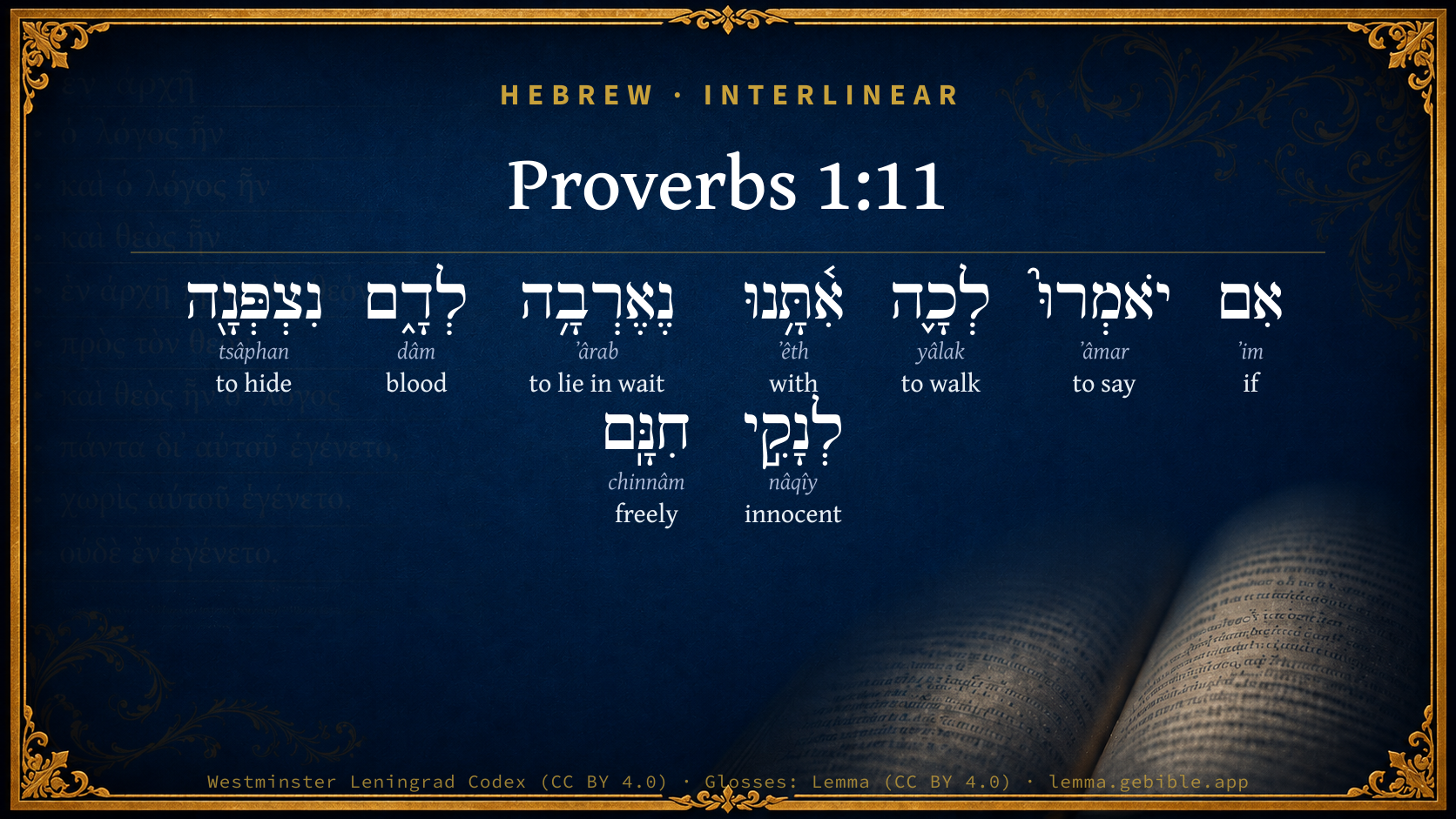
Hebrew (Westminster Leningrad Codex) Proverbs 1:11 appears in the Hebrew Old Testament. The text above is from the Westminster Leningrad Codex. Each word links to its Strong’s number, a concise gloss, and parsing drawn from the Open Scriptures Hebrew Bible morphology. Click any word for its full Brown-Driver-Briggs (BDB) entry.
Download image
Cite this verse

Proverbs 1:11 (World English Bible). Public Domain. Lemma interlinear Bible study tool, https://lemma.gebible.app/v/proverbs/1/11.

Show BibTeX & RIS
BibTeX
RIS
English Translation
If they say, "Come with us, Let's lay in wait for blood; Let's lurk secretly for the innocent without cause;
World English Bible · Public Domain
Download a study sheet

One document with this verse’s original text, its word-by-word gloss line, the meaning frame, cross-references with their text, attributed commentary, and full source and license credits — printable, and it pastes into notes with its structure intact.

This verse Autodidact and up

Study sheet (.html) Plain text (.txt)

A passage Seminary Student

Up to 50 verses in one chapter. A passage sheet keeps up to 6 commentary sources and 12 cross-references per verse, in the order this page ranks them, and says so on the sheet whenever that leaves anything out. Ask for a single verse and you get the Autodidact verse sheet above.

Everything on this page stays free to read, with no account — the sheet is a download of what is already on screen, not access to it.

Want to remove ads? Support Godless Engineer
Compare translations 3

The same verse in 3 English versions, stacked beneath the original-language interlinear above. Click any original word for its lexicon entry.

Each is an independent rendering of the whole verse — the interlinear is not word-aligned to these translations.

Highlighted words mark where these versions differ — a whole-verse word diff, not a word-by-word alignment.

  • World English Bible Public Domain
    If they say, "Come with us, Let's lay in wait for blood; Let's lurk secretly for the innocent without cause;
  • King James Version Public Domain
    If they say, Come with us, let us lay wait for blood, let us lurk privily for the innocent without cause:
  • unfoldingWord Literal Text CC BY-SA 4.0
    If they say, “Come with us! Let us lie in wait for blood. Let us hide to ambush the innocent one without cause.

unfoldingWord Literal Text — © unfoldingWord, licensed CC BY-SA 4.0. Word-aligned USFM3 via Door43 (git.door43.org/unfoldingWord/en_ult).

Versions to compare (up to 4)

3 of 4 selected

Show all 18 translations

Every available English version of this verse, each an independent rendering of the whole verse.

  • World English Bible Public Domain
    If they say, "Come with us, Let's lay in wait for blood; Let's lurk secretly for the innocent without cause;
  • Berean Standard Bible Public Domain
    If they say, “Come along, let us lie in wait for blood, let us ambush the innocent without cause,
  • Majority Standard Bible Public Domain
    If they say, “Come along, let us lie in wait for blood, let us ambush the innocent without cause,
  • King James Version Public Domain
    If they say, Come with us, let us lay wait for blood, let us lurk privily for the innocent without cause:
  • American Standard Version (1901) Public Domain
    If they say, Come with us, Let us lay wait for blood; Let us lurk privily for the innocent without cause;
  • Revised Version (1885) Public Domain
    If they say, Come with us, let us lay wait for blood, let us lurk privily for the innocent without cause;
  • Geneva Bible (1599) Public Domain
    If they say, Come with vs, we will lay waite for blood, and lie priuilie for the innocent without a cause:
  • Douay-Rheims (1899) Public Domain
    If they shall say: Come with us, let us lie in wait for blood, let us hide snares for the innocent without cause:
  • Young's Literal Translation Public Domain
    If they say, `Come with us, we lay wait for blood, We watch secretly for the innocent without cause,
  • Literal Standard Version CC BY-SA 4.0
    If they say, “Come with us, we lay wait for blood, || We watch secretly for the innocent without cause,
  • Unlocked Literal Bible CC BY-SA 4.0
    If they say, “Come with us, let us lie in wait for blood, let us hide and attack innocent people for no reason.
  • unfoldingWord Literal Text CC BY-SA 4.0
    If they say, “Come with us! Let us lie in wait for blood. Let us hide to ambush the innocent one without cause.
  • Darby Bible Public Domain
    If they say, Come with us, let us lay wait for blood, let us lurk secretly for the innocent without cause;
  • World Messianic Bible Public Domain
    If they say, “Come with us. Let’s lie in wait for blood. Let’s lurk secretly for the innocent without cause.
  • Webster's Bible Public Domain
    If they say, Come with us, let us lay wait for blood, let us lurk privily for the innocent without cause:
  • Free Bible Version CC BY-SA 4.0
    They may tell you, “Come with us. Let's go and hide, ready to kill someone. Let's ambush someone for fun!
  • Bible in Basic English Public Domain
    If they say, Come with us; let us make designs against the good, waiting secretly for the upright, without cause;
  • JPS Tanakh (1917) Public Domain
    If they say: 'Come with us, let us lie in wait for blood, let us lurk for the innocent without cause;

Literal Standard Version (2020), Covenant Press — licensed CC BY-SA 4.0. Text via the HelloAO Bible API (eBible.org). Unlocked Literal Bible (unfoldingWord) — licensed CC BY-SA 4.0. Text via the HelloAO Bible API (eBible.org). unfoldingWord Literal Text — © unfoldingWord, licensed CC BY-SA 4.0. Word-aligned USFM3 via Door43 (git.door43.org/unfoldingWord/en_ult). Free Bible Version, Dr. Jonathan Gallagher — licensed CC BY-SA 4.0. Text via the HelloAO Bible API (eBible.org).

Word by word

More ways to search: Search by grammar → Find every occurrence → Compare this word →

Practice this passage: Drill this verse → Learn its vocabulary →

About this verse

These counts appear in no published source. They are computed here, from the morphology-tagged text and Lemma’s own curated glosses. What Lemma adds →

9
words
9
distinct lemmas
Wisdom
section

Shared distinctive vocabulary

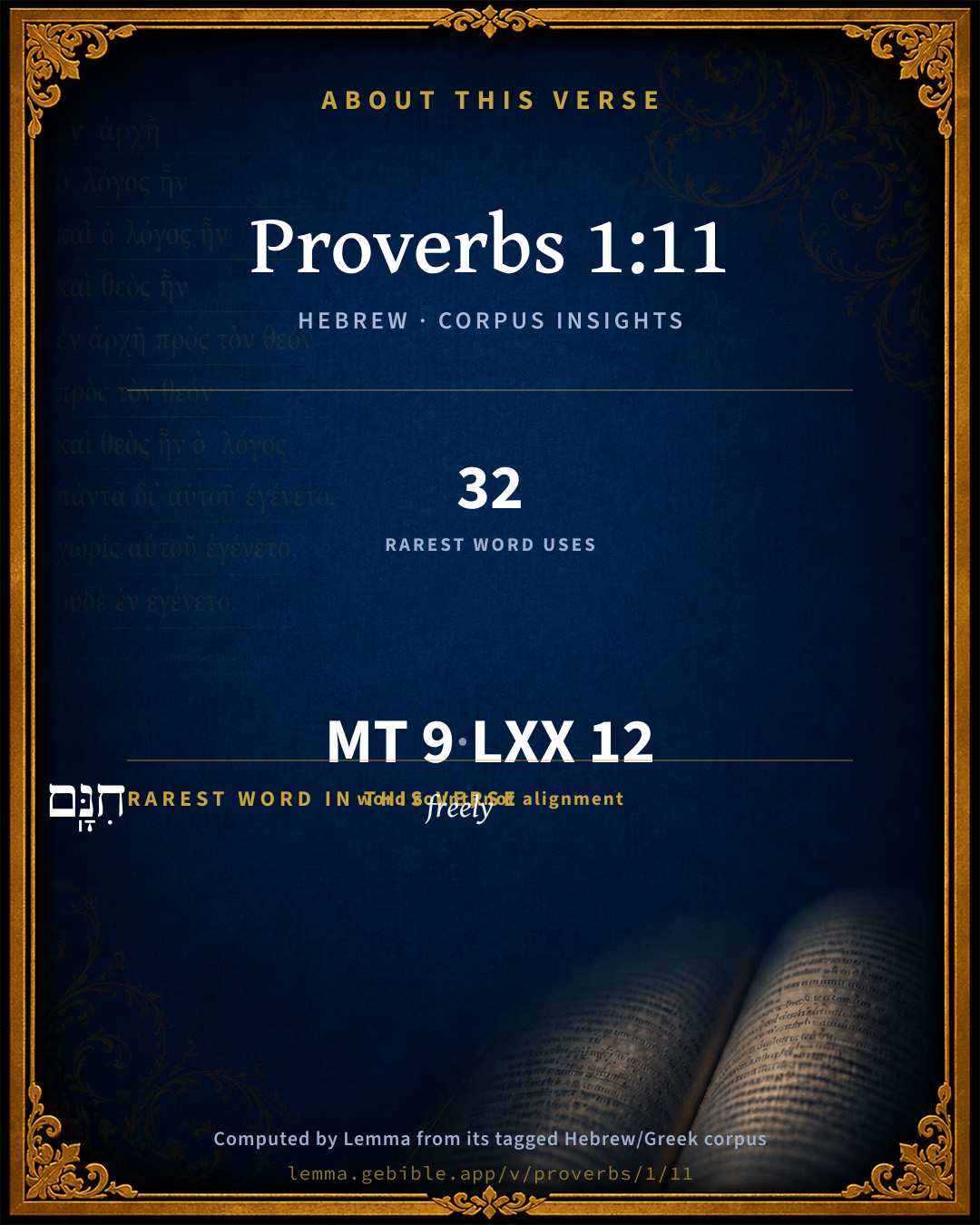
חִנָּֽם freely H2600 occurs in 31 verses of the Hebrew Bible. Also found in:

Grammatical profile

  • 4 verbs
  • 1 noun
  • 1 adjective
  • 1 preposition
  • 1 conjunction
  • 1 adverb

Verb forms

  • יֹאמְרוּ֮ Qal · Imperfect
  • לְכָ֪ה Qal · Imperative
  • נֶאֶרְבָ֥ה Qal · Cohortative
  • נִצְפְּנָ֖ה Qal · Cohortative

Hebrew & Septuagint length

In English translation the verse runs 20 words from the Hebrew and 23 from the Septuagint (LXX English) — closely comparable.

A rough comparison of the two English renderings, which tokenize alike — not a word-level alignment.

Word counts can differ between the Hebrew and the Greek without any difference in meaning — e.g. the Hebrew direct-object marker אֵת has no separate Greek word, and Greek often adds the article ὁ.

In the original languages it is 9 Hebrew tokens and 12 Greek tokens — but the two are counted differently (Hebrew bundles its prefixes and suffixes into one token; the Greek is in lemma form), so that isn’t a like-for-like length.

Cross-references

17

Topical passages linked to Proverbs 1:11 in the Treasury of Scripture Knowledge — connected by theme and wording, ordered by reader-vote popularity; previews shown in the World English Bible.

  • Proverbs 1:18 But these lay wait for their own blood. They lurk secretly for their own lives.
  • Proverbs 12:6 The words of the wicked are about lying in wait for blood, But the speech of the upright rescues them.
  • Jeremiah 5:26 For among my people are found wicked men: they watch, as fowlers lie in wait; they set a trap, they catch men.
  • Jeremiah 18:18–20 Then said they, Come, and let us devise devices against Jeremiah; for the law shall not perish from the priest, nor counsel from the wise, nor the word from the prophet. Come, and let us strike him with the tongue, and let us not give heed to any of his words.
  • Acts 25:3 asking a favor against him, that he would summon him to Jerusalem; plotting to kill him on the way.
  • Psalms 10:8–10 He lies in wait near the villages. From ambushes, he murders the innocent. His eyes are secretly set against the helpless.
  • Psalms 17:12 He is like a lion that is greedy of his prey, As it were a young lion lurking in secret places.
  • Psalms 35:7 For without cause they have hidden their net in a pit for me. Without cause they have dug a pit for my soul.
  • Psalms 56:6 They conspire and lurk, Watching my steps, they are eager to take my life.
  • Psalms 64:5–6 They encourage themselves in evil plans. They talk about laying snares secretly. They say, "Who will see them?"
  • Proverbs 1:16 For their feet run to evil. They hurry to shed blood.
  • Proverbs 30:14 There is a generation whose teeth are like swords, And their jaws like knives, To devour the poor from the earth, and the needy from among men.
  • Jeremiah 11:19 But I was like a gentle lamb that is led to the slaughter; and I didn't know that they had devised devices against me, [saying], Let us destroy the tree with the fruit of it, and let us cut him off from the land of the living, that his name may be no more remembered.
  • Micah 7:2 The godly man has perished out of the earth, And there is no one upright among men. They all lie in wait for blood; Every man hunts his brother with a net.
  • Matthew 26:3–4 Then the chief priests, the scribes, and the elders of the people were gathered together in the court of the high priest, who was called Caiaphas.
  • John 15:25 But this happened so that the word may be fulfilled which was written in their law, 'They hated me without a cause.'
  • Acts 23:15 Now therefore, you with the council inform the commanding officer that he should bring him down to you tomorrow, as though you were going to judge his case more exactly. We are ready to kill him before he comes near."

Cross-references courtesy of OpenBible.info (CC BY 4.0).

Hebrew and Greek witnesses Masoretic Hebrew ↔ Greek Septuagint

The same verse in the two great witnesses to the Old Testament, shown verse-for-verse.

These are two independent witnesses, not word-aligned to each other, and the Septuagint is shown in lemma (dictionary) form.

Hebrew Proverbs 1:11 Masoretic · Westminster Leningrad Codex

אִם יֹאמְרוּ֮ לְכָ֪ה אִ֫תָּ֥נוּ נֶאֶרְבָ֥ה לְדָ֑ם נִצְפְּנָ֖ה לְנָקִ֣י חִנָּֽם

If they say, "Come with us, Let's lay in wait for blood; Let's lurk secretly for the innocent without cause;

World English Bible · Public Domain

Greek LXX Proverbs 1:11 Septuagint · lemma form

ἔρχομαι μετά ἐγώ κοινωνέω αἷμα κρύπτω δέ εἰς γῆ ἀνήρ δίκαιος ἀδίκως

If they should exhort you, saying, Come with us, partake in blood, and let us unjustly hide the just man in the earth:

LXX2012 (modern English Septuagint) · Public Domain

On this verse, Keil & Delitzsch discusses the Septuagint’s reading. Read the note in Commentary ↓

Hebrew: Westminster Leningrad Codex (CC BY 4.0). Greek: Septuagint (public domain); English from LXX2012 (modern English Septuagint) (Public Domain). How the Septuagint differs from the Hebrew →

Commentary

Notes on Proverbs 1:11 from classic Christian and Jewish commentators (each source and its license shown beneath its notes). The classic Christian expositions comment on the surrounding passage and are grouped to its opening verse, so a note may address several verses; the Jewish commentaries on the Tanakh (Rashi and others) are per-verse, so they appear only where the commentator wrote on this verse.

Lemma curates 59 commentaries, every one of them public domain or Creative Commons licensed, each selected and text-cleaned for this edition rather than reprinted as found. About our sources →

Trapp's Complete Commentary

John Trapp

Pro 1:11 If they say, Come with us, let us lay wait for blood, let us lurk privily for the innocent without cause:

Ver. 11. If they say.] The dragon bites the elephant’s ear, and thence sucks his blood; because he knows that to be the only place that he cannot reach with his trunk to defend. So deal the red dragon and his angels: "with good words and fair speeches they deceive the hearts of the simple" {Rom 16:18} "With her much fair speech she caused him to yield, with the flattering of her lips she forced him." {Pro 7:21}

Come with me.] If sinners have their "Come," should not saints much more? "Come, let us go up to the house of the Lord." {Isa 2:3} "Come, let us walk in the light of the Lord." {Isa 2:5} "Let us go speedily to pray before the Lord, and to seek the Lord of hosts; I will go also." {Zec 8:21} Should we not incite, entice, whet, and "provoke {a} one another," {Heb 10:24} "sharpen" and extimulate, {Pro 27:17} rouse and "stir up" {b} each other to love and good works? {2Pe 1:13}

{a} παροξυνειν.

{b} διεγειρειν.

John Trapp, A Commentary or Exposition upon All the Books of the Old and New Testament (1647–1656) — public domain. Text from a community e-Sword module.

Keil & Delitzsch

C. F. Keil & F. Delitzsch

Of the number of wicked men who gain associates to their palliation and strengthening, they are adduced as an example whom covetousness leads to murder.

11 If they say, "Go with us, we will lurk for blood,

Lie in wait for the innocent without cause;

12 Like the pit we will swallow them alive

And in perfect soundness like them that go down to the grave.

13 We find all manner of precious treasure,

Fill our houses with spoil.

14 Thou shalt cast thy lot amongst us,

We all have only one purse."

Pro 1:11

The verb ארב signifies nectere, to bind fast (from רב, close, compact), (see under Isa 25:11), and particularly (but so that it bears in itself its object without ellipse) insidias nectere = insidiari. Regarding לדם Fleischer remarks: "Either elliptically for לשׁפּך־דּם (Jewish interp.), or, as the parallelism and the usage of the language of this book rather recommend, per synecd. for: for a man, with particular reference to his blood to be poured out (cf. our saying 'ein junges Blut,' a young blood = a youth, with the underlying conception of the blood giving colour to the body as shining through it, or giving to it life and strength), as Psa 94:21." As in post-biblical Heb. בּשׂר ודם (or inverted, αἱμα καὶ σάρξ, Heb 2:14), used of men as such, is not so used in the O.T., yet דּם, like נפשׁ, is sometimes used synecdochically for the person, but never with reference to the blood as an essentially constituent part of corporealness, but always with reference to violent putting to death, which separates the blood from the body (cf. my System der bibl. Psychologie, p. 242). Here לדם is explained by לדמים, with which it is interchanged, Mic 7:2 : let us lurk for blood (to be poured out). The verb צפן is never, like טמן (to conceal), connected with חבלים, מוקשׁים ,ח, פּח, רשׁת - thus none of these words is here to be supplied; the idea of gaining over one expressed in the organic root צף (whence צפּה, diducendo obducere) has passed over into that of restraining oneself, watching, lurking, hence צפן (cog. Aram. כּמן) in the sense of speculari, insidiari, interchanges with צפה (to spy), (cf. Psa 10:8; Psa 56:7 with Psa 37:32). The adv. חנּם (an old accus. from חן) properly means in a gracious manner, as a free gift (δωρεάν, gratis = gratiis), and accordingly, without reward, also without cause, which frequently = without guilt; but it never signifies sine effectu qui noceat, i.e., with impunity (Lwenst.). We have thus either to connect together נקי חנּם "innocent in vain" (as איבי חנּם, my enemies without a cause, Lam 3:52): his innocence helps him nothing whom God protects not against us notwithstanding his innocence (Schultens, Bertheau, Elster, and others); or connect חנם with the verb (lie in wait for), for which Hitzig, after the lxx, Syr., Rashi,

(Note: Rashi, i.e., Rabbi Salomo Isaaki, of Troyes, died a.d. 1105. Ralbag, i.e., Rabbi Levi ben Gershon, usually referred to by Christian writers as Master Leo de Bannolis, or Gersonides, a native of Banolas near Gerona, died about 1342.)

Ralbag, Immanuel, rightly decides in view of Sa1 19:5; Sa1 25:31; cf. also Job 9:17, where the succession of the accents is the same (Tarcha transmuted from Mugrash). Frequently there are combined together in his חנם (cf. Isa 28:14.), that which the author thinks, and that which those whom he introduces as speaking think.

Pro 1:12

The first clause of this verse Hitzig translates: "as the pit (swallows) that which lives." This is untenable, because כּ with the force of a substantive (as instar, likeness) is regarded as a preposition, but not a conjunction (see at Psa 38:14.). חיּים (the living) is connected with נבלעם, and is the accus. of the state (hâl, according to the terminology of the Arab. grammarians) in which they will, with impunity, swallow them up like the pit (the insatiable, Pro 27:20; Pro 30:16), namely, while these their sacrifices are in the state of life's freshness,

(Note: Only in this sense is the existing accentuation of this verse (cf. the Targ.) to be justified.)

"the living," - without doubt, like Psa 55:16; Psa 63:10; Psa 124:3, in fact and in expression an allusion to the fate of the company of Korah, Num 16:30, Num 16:33. If this is the meaning of חיים, then תּמימים as the parallel word means integros not in an ethical sense, in which it would be a synonym of נקי of Pro 1:11 (cf. Pro 29:10 with Psa 19:14), but in a physical sense (Graec. Venet. καὶ τελείους; Parchon as Rashi, בריאים ושלמים, vid., Bttcher, De Inferis, 293). This physical sense is claimed for תּם, Job 21:23, for תּם probably, Psa 73:4, and why should not תמים, used in the law regarding sacrifices (e.g., Exo 12:5, "without blemish") of the faultlessness of the victim, also signify such an one אשׁר אין־בּו מתם (Isa 1:6)? In the midst of complete external health they will devour them like those that go down to the grave (cf. Psa 28:1; Psa 88:5, with Isa 14:19), i.e., like those under whose feet the earth is suddenly opened, so that, without leaving any trace behind, they sink into the grave and into Hades. The connection of the finite with the accus. of place, Psa 55:16, lies at the foundation of the genitive connection יורדי בור (with the tone thrown back): those that go down to the grave.

Pro 1:13-14

(Note: Here, in Pro 1:14, גורלך is to be written with Munach (not Metheg) in the second syllable; vid., Torath Emeth, p. 20. Accentuationssystem, vii. 2.)

To their invitation, bearing in itself its own condemnation, they add as a lure the splendid self-enriching treasures which in equal and just fellowship with them they may have the prospect of sharing. הון (from הוּן, levem, then facilem esse, tre ais, son aise) means aisance, convenience, opulence, and concretely that by which life is made agreeable, thus money and possessions (Fleischer in Levy's Chald. Wrterbuch, i. 423f.). With this הון with remarkable frequency in the Mishle יקר (from יקר, Arab. waḳar, grave esse) is connected in direct contrast, according to its primary signification; cf. Pro 12:27; Pro 24:4 : heavy treasures which make life light. Yet it must not be maintained that, as Schultens has remarked, this oxymoron is intended, nor also that it is only consciously present in the language. מצא has here its primitive appropriate signification of attaining, as Isa 10:14 of reaching. שׁלל (from שׁלל, to draw from, draw out, from של, cf. שׁלה, שׁלף, Arab. salab, Comm. on Isa. p. 447) is that which is drawn away from the enemy, exuviae, and then the booty and spoil taken in war generally. נמלּא, to fill with anything, make full, governs a double accusative, as the Kal (to become full of anything) governs only one. In Pro 1:14, the invitation shows how the prospect is to be realized. Interpreters have difficulty in conceiving what is here meant. Do not a share by lot and a common purse exclude one another? Will they truly, in the distribution of the booty by lot, have equal portions at length, equally much in their money-bags? Or is it meant that, apart from the portion of the booty which falls to every one by lot, they have a common purse which, when their business is ebbing, must supply the wants of the company, and on which the new companion can maintain himself beforehand? Or does it mean only that they will be as mutually helpful to one another, according to the principle τὰ τῶν φίλων κοινά (amicorum omnia communia), as if they had only one purse? The meaning is perfectly simple. The oneness of the purse consists in this, that the booty which each of them gets, belongs not wholly or chiefly to him, but to the whole together, and is disposed of by lot; so that, as far as possible, he who participated not at all in the affair in obtaining it, may yet draw the greatest prize. This view harmonizes the relation between 14b and 14a. The common Semitic כּים is even used at the present day in Syria and elsewhere as the name of the Exchange ("Brse") (plur. akjâs); here it is the purse ("Kasse") (χρημάτων δοχεῖον, Procop.), which is made up of the profits of the business. This profit consists not merely in gold, but is here thought of in regard to its worth in gold. The apparent contradiction between distributing by lot and having a common purse disappears when the distribution by lot of the common property is so made, that the retaining of a stock-capital, or reserve fund, is not excluded.

Keil & Delitzsch — Biblical Commentary on the Old Testament (1861–1891) — public domain (CC PDM 1.0). Text via the HelloAO Bible API. (Old Testament only.)

Geneva Bible (1599)

Geneva Bible translators

He speaketh not only of the shedding of blood with hand, but of all crafty practices which tend to the detriment of our neighbor.

Geneva Bible (1599) marginal notes — public domain. Text via Bolls.life.

Jamieson, Fausset & Brown

Robert Jamieson, A. R. Fausset & David Brown

Murder and robbery are given as specific illustrations.

lay wait . . . lurk privily--express an effort and hope for successful concealment.

swallow . . . grave--utterly destroy the victim and traces of the crime (Num 16:33; Psa 55:15). Abundant rewards of villainy are promised as the fruits of this easy and safe course.

Jamieson, Fausset & Brown — Commentary Critical and Explanatory on the Whole Bible (1871) — public domain (CC PDM 1.0). Text via the HelloAO Bible API.

Adam Clarke's Commentary

Verse 11. If they say, Come with us] From all accounts, this is precisely the way in which the workers of iniquity form their partisans, and constitute their marauding societies to the present day.

Let us lay wait for blood] Let us rob and murder.

Let us lurk privily] Let us lie in ambush for our prey.

Adam Clarke's Commentary on the Bible (1810–1826) — public domain. Text from a community e-Sword/MySword module.

Ellicott's Commentary for English Readers

(11) Without cause.—To be taken with “lurk.” Though he has done us no harm.

A Bible Commentary for English Readers, edited by Charles John Ellicott (1878–1897) — public domain. Text from a community e-Sword module.

The Cambridge Bible for Schools and Colleges

gen. ed. J. J. S. Perowne

11. for blood] The shameless form of the proposal shows at once the insecurity and the low moral tone of society. The language is too strong and vivid to admit of a figurative interpretation: Let us rob them violently of their bread which is their life. Compare

“The bread of the needy is the life of the poor:

He that depriveth him thereof is a man of blood.”

Sir_34:21.

without cause] So A.V. and R.V., i.e. though (the reflection being that of the author, not of the speaker) he has done them no harm, given them no cause to injure him. So LXX. ἀδίκως. Others, less probably, take the adverb with the word “innocent”: for them who are innocent in vain (who serve God for nought, Job_1:9, where the Heb. word is the same as here), because, as we will soon shew, his innocency will profit him nothing. “Contra insontem frustra,” Vulg. “Pio nullum pietatis præmium habituro,” Maur.

The Cambridge Bible for Schools and Colleges (gen. ed. J. J. S. Perowne; Cambridge University Press, 1878–1918) — public domain. Text from a community e-Sword module.

John Gill's Exposition

If they say, come with us,.... Leave your father's house, and the business of life in which you are; make one of us, and become a member of our society, and go along with us upon the highway;

let us lay wait for blood; lie in ambush under some hedge or another, waiting till a rich traveller comes up and passes that way, and then rise and shed his blood in order to get his money; and the same word signifies both "blood" and "money", and wait is laid for one for the sake of the other;

let us lurk privily for the innocent without cause; or "let us hide" (q), the Vulgate Latin version adds "snares"; so Vatablus and others, as the fowler does for birds; or "let us hide ourselves" (r); in some private place, waiting "for the innocent", the harmless traveller, who has done no injury to any man's person or property; thinks himself safe, and is not aware of any design upon him; going about his lawful business, and having done nothing to provoke such miscreants to attempt his life or take away his property: and which they do "without cause" as to him; "freely" (s) as to themselves; and "with impunity" (t), as they promise themselves and one another; all which senses the word used will bear.

(q) "abscondamus", Michaelis. (r) "Abscondamus nos", Pagninus, Montanus, Junius & Tremellius, Piscator; "abscondamus nosmetipsos", Baynus. (s) "gratis", Pagninus, Montanus, Michaelis, Schultens. (t) "Impune", Junius & Tremellius, Amama.

John Gill's Exposition of the Whole Bible (1746–1763) — public domain (CC PDM 1.0). Text via the HelloAO Bible API.

Albert Barnes' Notes on the Bible

The temptation against which the teacher seeks to guard his disciple is that of joining a band of highway robbers. The “vain men” who gathered around Jephthah Jdg 11:3, the lawless or discontented who came to David in Adullam 1Sa 22:2, the bands of robbers who infested every part of the country in the period of the New Testament, and against whom every Roman governor had to wage incessant war, show how deeply rooted the evil was in Palestine. Compare the Psa 10:7, note; Psa 10:10 note.

Without cause - Better, in vain; most modern commentators join the words with “innocent,” and interpret them after Job 1:9. The evil-doers deride their victims as being righteous “in vain.” They get nothing by it. It does them no good.

Albert Barnes' Notes on the Bible (1834–1885) — public domain. Text from a community e-Sword/MySword module.

Matthew Poole's English Annotations

Come with us; we are numerous, and strong, and sociable.

Let us lay wait for blood; to shed blood. He expresseth not their words, which would rather affright than inveigle a young novice; but the true nature and consequence of the action, and what lies at the bottom of their specious pretences.

Lurk privily; so we shall neither be prevented before, nor discovered and punished afterward.

The innocent; harmless travellers, who are more careless and secure, and unprovided for opposition, than such villains as themselves.

Without cause; though they have not provoked us, nor deserved this usage from us. This Solomon adds to discover their malignity and baseness, and so deter the young man from association with them.

Matthew Poole's English Annotations on the Holy Bible (1683–1685) — public domain. Text from a community e-Sword/MySword module.

Whedon's Commentary on the Bible

Daniel D. Whedon

11. If they say — The teacher here enlarges upon the subject of evil associations. He seems to have in his mind a marauding party, a band of plunderers and freebooters, who hesitate not to commit murder if needful to obtain booty. We are probably not to understand him as intending to quote the exact language of such cutthroats to a novice, but rather to present vividly to the mind of his pupil what is the real character of their operations, under whatever specious pretext they may be covered, such as patriotism, lawful war, opposition to unjust authority, punishment of public enemies, etc. Palestine has been from time immemorial infested with robbers and raiders — Bedawin Arabs and others imitating their mode of life. His pupil must avoid the seductions which this nefarious kind of guerrilla warfare presented in consequence of the great wealth often suddenly acquired in it.

Without cause — Without reason or justifiable cause, such as is supposed to exist when life is taken or property seized in regular warfare, or by legitimate authority — “Him who in vain is innocent.” — Miller. Compare Jdg_11:3; 1Sa_22:2.

Daniel D. Whedon (gen. ed.), Commentary on the Old and New Testaments (1874–1909) — public domain. Text from a community e-Sword module.

The Pulpit Commentary

If they say, Come with us, let us lay wait for blood. The teacher here puts into the mouth of the sinners, for the sake of vivid representation, the first inducement with which they seek to allure youth from the paths of rectitude, viz. privacy and concealment (Cartwright, Wardlaw). Both the verbs bra (arav) and px, (tzaphan) mean "to lay in wait" (Zockler). The radical meaning of arav, from which hbran (neervah), "let us lay in wait" (Authorized Version) is taken, is "to knot, to weave, to intertwine." Verbs of this class are often applied to snares and craftiness (cf. the Greek dolon udainein , and the Latin insidias nectere, "to weave plots, or lay snares"). Generally, arav is equivalent to "to watch in ambush" (Gesenius); cf. the Vulgate, insidiemur sanguini; i.e. "let us lay wait for blood." The LXX paraphrases the expression, koinwnhson aimatov , i.e. "let us share in blood." On the other hand, px (tzaphan), from which hnpxni (nitz"p"nah), translated in the Authorized Version, "let us lurk privily," is "to hide or conceal," and intrans. "to hide one"s self," or ellipt., "to hide nets, snares" (Gesenius, Holden). This sense agrees with the Vulgate abscondamus tendiculas; i.e. "let us conceal snares." Delitzsch, however, holds that no word is to be understood with this verb, and traces the radical meaning to that of restraining one"s self, watching, lurking. in the sense of speculari, "to watch for," insidiari, "to lay wait for." The two verbs combine what may be termed the apparatus, the arrangement of the plot and their lurking in ambush, by which they will await their victims. For blood ( l"dam). The context (see vers. 12 and 16), bearing as it does upon bloodshed accompanying robbery, requires that the Hebrew (l"dam) should be understood here, as Fleischer remarks, either elliptically, for "the blood of men," as the Jewish interpreters explain, or synedochically, for the person, with especial reference to his blood being shed, as in Psa_94:21. Vatablus, Cornelius a Lapide. and Gesenius support the latter view (cf. Mic_7:2, "They all lie in wait for blood," i.e. for bloodshed, or murder. (dam) may be also taken for life in the sense that "the blood is the life". (Deu_12:23) Let us lurk privily for the innocent without cause. The relation of the phrase. "without cause" ( khinnam), in this sentence is a matter of lnueh dispute. It may be taken either with

(1) the verb (as in the Authorized Version, Wordsworth, Luther, Van Ess, Noyes, Zockler, Delitzsch, Hatzig, LXX, Syriac, Rashi, Ralbac), and then "lurk privily without cause" is equivalent to

(a) without having any reason for revenge and enmity (Zockler), i.e. though they have not provoked us, nor done us any injury, yet let us hurt them, in the sense of absque causa (Munsterus, Paganini Version, Piscatoris Version, Mercerus), adikwv (LXX), inique (Arabic);

(b) with impunity, since none will avenge them in the sense of Job_9:12 (this is the view of Lowestein, but it is rejected by Delitzsch); or

(2) it may be taken with the adjective "innocent," in which case it means him that is innocent in vain; i.e. the man whose innocence will in vain protect (Zockler, Holden), who gets nothing by it (Plumptre), or, innocent in vain, since God does not vindicate hint (Cornelius a Lapide). On the analogy of 1Sa_19:5 1Sa_25:31 Psa_35:19 Psa_69:4 Lam_3:52, it seems preferable to adopt the first connection, and to take the adverb with the verb. In the whole of the passage there is an evident allusion to an evil prevalent in the age of Solomon, viz. the presence of bands of robbers, or banditti, who disturbed the security and internal peace of the country. In the New Testament the same state of things continued, and is alluded to by our Lord in the parable of the man who fell among thieves.

The Pulpit Commentary (1880–1919), ed. H.D.M. Spence-Jones & Joseph S. Exell — public domain. Text from a community e-Sword module.

Rashi

Rabbi Shlomo Yitzchaki (Rashi)

let us lie in wait for blood to shed blood.

let us hide Heb. נצפנה, an expression of ambush.

let us hide for the innocent, without cause Scripture states that their hiding for the innocent is without cause.

Rashi on the Tanakh — English translations: “The Judaica Press complete Tanach with Rashi, translated by A. J. Rosenberg” (CC BY 4.0); “Pentateuch with Rashi's commentary by M. Rosenbaum and A.M. Silbermann, 1929-1934” (public domain); “The Metsudah Tanach series, Lakewood, N.J” (CC BY 4.0); and “The Book of Joshua, Metsudah Publications, 1997” (CC BY 4.0). Text via Sefaria.

Lesson kit

Teaching starters — assembled from the data on this page, not authored interpretation. Every prompt links to the verse data it draws on. Edit before teaching.

Proverbs, in the Wisdom, opens this verse with 9 words (9 distinct Hebrew lemmas). Its most distinctive word is chinnâm (“freely”). A historical commentator’s framing appears above. Read the whole chapter for the surrounding context.

Discussion questions

  1. What does “freely” (chinnâm) contribute to the verse as a whole?
  2. Genesis 29:15 shares the word «freely» with this verse. How do the two illuminate each other?
  3. These translations render this verse differently; the difference is in the English rendering, not the original. What questions does that raise?
  4. The verb «יֹאמְרוּ֮» is Qal Imperfect. How does its form color the action?
  5. Reading how Trapp's Complete Commentary and Keil & Delitzsch read this verse, where do the two commentators agree and where do they part?

Things to notice

Reading settings

Reading text

Shown beneath each verse's original-language words.

Old Testament
Old Testament edition

Read the OT as the Masoretic Hebrew (MT) or the Greek Septuagint (LXX).

English shown for the Greek Septuagint (in the Hebrew ↔ Greek comparison).

Comparing translations? Open the Compare panel on any verse page to stack up to four side by side.