
Exodus 7:20

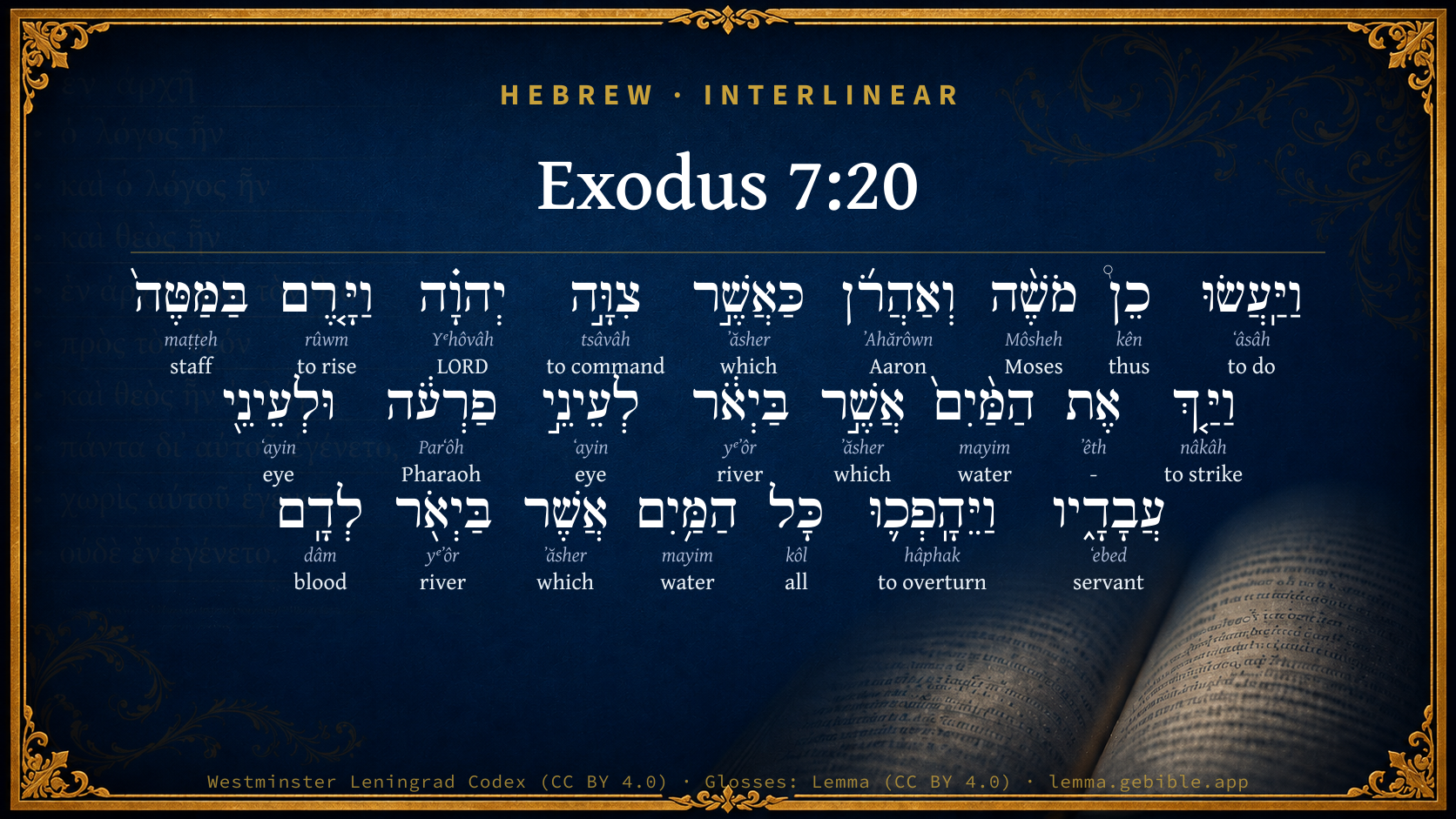
Hebrew (Westminster Leningrad Codex) Exodus 7:20 appears in the Hebrew Old Testament. The text above is from the Westminster Leningrad Codex. Each word links to its Strong’s number, a concise gloss, and parsing drawn from the Open Scriptures Hebrew Bible morphology. Click any word for its full Brown-Driver-Briggs (BDB) entry.
Download image
Cite this verse

Exodus 7:20 (World English Bible). Public Domain. Lemma interlinear Bible study tool, https://lemma.gebible.app/v/exodus/7/20.

Show BibTeX & RIS
BibTeX
RIS
English Translation
Moses and Aaron did so, as Yahweh commanded; and he lifted up the rod, and struck the waters that were in the river, in the sight of Pharaoh, and in the sight of his servants; and all the waters that were in the river were turned to blood.
World English Bible · Public Domain
Download a study sheet

One document with this verse’s original text, its word-by-word gloss line, the meaning frame, cross-references with their text, attributed commentary, and full source and license credits — printable, and it pastes into notes with its structure intact.

This verse Autodidact and up

Study sheet (.html) Plain text (.txt)

A passage Seminary Student

Up to 50 verses in one chapter. A passage sheet keeps up to 6 commentary sources and 12 cross-references per verse, in the order this page ranks them, and says so on the sheet whenever that leaves anything out. Ask for a single verse and you get the Autodidact verse sheet above.

Everything on this page stays free to read, with no account — the sheet is a download of what is already on screen, not access to it.

Want to remove ads? Support Godless Engineer
Compare translations 3

The same verse in 3 English versions, stacked beneath the original-language interlinear above. Click any original word for its lexicon entry.

Each is an independent rendering of the whole verse — the interlinear is not word-aligned to these translations.

Highlighted words mark where these versions differ — a whole-verse word diff, not a word-by-word alignment.

  • World English Bible Public Domain
    Moses and Aaron did so, as Yahweh commanded; and he lifted up the rod, and struck the waters that were in the river, in the sight of Pharaoh, and in the sight of his servants; and all the waters that were in the river were turned to blood.
  • King James Version Public Domain
    And Moses and Aaron did so, as the LORD commanded; and he lifted up the rod, and smote the waters that were in the river, in the sight of Pharaoh, and in the sight of his servants; and all the waters that were in the river were turned to blood.
  • unfoldingWord Literal Text CC BY-SA 4.0
    And Moses and Aaron did so, just as Yahweh commanded. And he raised the staff, and he struck the water that was in the river, in the eyes of Pharaoh and in the eyes of his servants. And all the water that was in the river turned to blood.

unfoldingWord Literal Text — © unfoldingWord, licensed CC BY-SA 4.0. Word-aligned USFM3 via Door43 (git.door43.org/unfoldingWord/en_ult).

Versions to compare (up to 4)

3 of 4 selected

Show all 18 translations

Every available English version of this verse, each an independent rendering of the whole verse.

  • World English Bible Public Domain
    Moses and Aaron did so, as Yahweh commanded; and he lifted up the rod, and struck the waters that were in the river, in the sight of Pharaoh, and in the sight of his servants; and all the waters that were in the river were turned to blood.
  • Berean Standard Bible Public Domain
    Moses and Aaron did just as the LORD had commanded; in the presence of Pharaoh and his officials, Aaron raised the staff and struck the water of the Nile, and all the water was turned to blood.
  • Majority Standard Bible Public Domain
    Moses and Aaron did just as the LORD had commanded; in the presence of Pharaoh and his officials, Aaron raised the staff and struck the water of the Nile, and all the water was turned to blood.
  • King James Version Public Domain
    And Moses and Aaron did so, as the LORD commanded; and he lifted up the rod, and smote the waters that were in the river, in the sight of Pharaoh, and in the sight of his servants; and all the waters that were in the river were turned to blood.
  • American Standard Version (1901) Public Domain
    And Moses and Aaron did so, as Jehovah commanded; and he lifted up the rod, and smote the waters that were in the river, in the sight of Pharaoh, and in the sight of his servants; and all the waters that were in the river were turned to blood.
  • Revised Version (1885) Public Domain
    And Moses and Aaron did so, as the LORD commanded; and he lifted up the rod, and smote the waters that were in the river, in the sight of Pharaoh, and in the sight of his servants; and all the waters that were in the river were turned to blood.
  • Geneva Bible (1599) Public Domain
    So Moses and Aaron did euen as the Lord commanded: and hee lift vp the rodde, and smote the water that was in the riuer in the sight of Pharaoh, and in the sight of his seruants: and all the water that was in the riuer, was turned into blood.
  • Douay-Rheims (1899) Public Domain
    And Moses and Aaron did as the Lord had commanded: and lifting up the rod he struck the water of the river before Pharao and his servants: and it was turned into blood.
  • Young's Literal Translation Public Domain
    And Moses and Aaron do so, as Jehovah hath commanded, and he lifteth up `his hand' with the rod, and smiteth the waters which `are' in the River, before the eyes of Pharaoh, and before the eyes of his servants, and all the waters which `are' in the River are turned to blood,
  • Literal Standard Version CC BY-SA 4.0
    And Moses and Aaron do so, as YHWH has commanded, and he lifts up [his hand] with the rod, and strikes the waters which [are] in the River, before the eyes of Pharaoh and before the eyes of his servants, and all the waters which [are] in the River are turned to blood,
  • Unlocked Literal Bible CC BY-SA 4.0
    Moses and Aaron did as Yahweh commanded. Aaron raised the staff and struck the water in the river, in the sight of Pharaoh and his servants. All the water in the river turned to blood.
  • unfoldingWord Literal Text CC BY-SA 4.0
    And Moses and Aaron did so, just as Yahweh commanded. And he raised the staff, and he struck the water that was in the river, in the eyes of Pharaoh and in the eyes of his servants. And all the water that was in the river turned to blood.
  • Darby Bible Public Domain
    And Moses and Aaron did so, as Jehovah had commanded; and he lifted up the staff, and smote the waters that were in the river before the eyes of Pharaoh, and before the eyes of his bondmen; and all the waters that were in the river were turned into blood.
  • World Messianic Bible Public Domain
    Moses and Aaron did so, as the LORD commanded; and he lifted up the rod, and struck the waters that were in the river, in the sight of Pharaoh, and in the sight of his servants; and all the waters that were in the river were turned to blood.
  • Webster's Bible Public Domain
    And Moses and Aaron did so, as the LORD commanded; and he lifted up the rod and smote the waters that were in the river, in the sight of Pharaoh, and in the sight of his servants; and all the waters that were in the river were turned into blood.
  • Free Bible Version CC BY-SA 4.0
    Moses and Aaron did exactly as the Lord had ordered. While Pharaoh and all his officials watched, Aaron lifted up his walking stick and hit the water of the Nile. Immediately the whole river turned to blood!
  • Bible in Basic English Public Domain
    And Moses and Aaron did as the Lord had said; and when his rod had been lifted up and stretched out over the waters of the Nile before the eyes of Pharaoh and his servants, all the water in the Nile was turned to blood;
  • JPS Tanakh (1917) Public Domain
    And Moses and Aaron did so, as the LORD commanded; and he lifted up the rod, and smote the waters that were in the river, in the sight of Pharaoh, and in the sight of his servants; and all the waters that were in the river were turned to blood.

Literal Standard Version (2020), Covenant Press — licensed CC BY-SA 4.0. Text via the HelloAO Bible API (eBible.org). Unlocked Literal Bible (unfoldingWord) — licensed CC BY-SA 4.0. Text via the HelloAO Bible API (eBible.org). unfoldingWord Literal Text — © unfoldingWord, licensed CC BY-SA 4.0. Word-aligned USFM3 via Door43 (git.door43.org/unfoldingWord/en_ult). Free Bible Version, Dr. Jonathan Gallagher — licensed CC BY-SA 4.0. Text via the HelloAO Bible API (eBible.org).

Word by word

More ways to search: Search by grammar → Find every occurrence → Compare this word →

Practice this passage: Drill this verse → Learn its vocabulary →

בַּיְאֹ֔ר
yᵉʼôr
H2975
“in/at the · river”
Preposition, Determined + Noun, Proper
Part of Speech
Preposition + Noun
Type
Proper
Full BDB Definition

Origin: of Egyptian origin

TWOT: 832

river, stream, canal, Nile, Nile-canal - stream, river (Nile) - Nile-arms, Nile-canals - watercourses - shafts (mining) - river (in general)
  1. וַיַּֽעֲשׂוּ ʻâsâh H6213 “and · to do” Conjunction + Verb, Qal, Sequential Imperfect, 3rd Person, Masculine, Plural
  2. כֵן֩ kên H3651 “thus” Adverb
  3. מֹשֶׁ֨ה Môsheh H4872 “Moses” Noun, Proper
  4. וְאַהֲרֹ֜ן ʼAhărôwn H175 “and · Aaron” Conjunction + Noun, Proper
  5. כַּאֲשֶׁ֣ר ʼăsher H834 “like/as · which” Preposition + Particle, Relative
  6. צִוָּ֣ה tsâvâh H6680 “to command” Verb, Piel, Perfect, 3rd Person, Masculine, Singular
  7. יְהוָ֗ה Yᵉhôvâh H3068 “LORD” Noun, Proper
  8. וַיָּ֤רֶם rûwm H7311 “and · to rise” Conjunction + Verb, Hiphil, Sequential Imperfect, 3rd Person, Masculine, Singular
  9. בַּמַּטֶּה֙ maṭṭeh H4294 “in/at the · staff” Preposition, Determined + Noun, Common, Masculine, Singular, Absolute
  10. וַיַּ֤ךְ nâkâh H5221 “and · to strike” Conjunction + Verb, Hiphil, Sequential Imperfect, 3rd Person, Masculine, Singular
  11. אֶת ʼêth H853 “-” Particle, Direct Object
  12. הַמַּ֨יִם֙ mayim H4325 “the · water(s)” Particle, Definite Article + Noun, Common, Masculine, Plural, Absolute
  13. אֲשֶׁ֣ר ʼăsher H834 “which” Particle, Relative
  14. לְעֵינֵ֣י ʻayin H5869 “to/for · eyes of” Preposition + Noun, Common, Both, Dual, Construct
  15. פַרְעֹ֔ה Parʻôh H6547 “Pharaoh” Noun, Proper
  16. וּלְעֵינֵ֖י ʻayin H5869 “and · to/for · eyes of” Conjunction + Preposition + Noun, Common, Both, Dual, Construct
  17. עֲבָדָ֑יו ʻebed H5650 “servants · his” Noun, Common, Masculine, Plural, Construct + Suffix, Personal, 3rd Person, Masculine, Singular
  18. וַיֵּהָֽפְכ֛וּ hâphak H2015 “and · to overturn” Conjunction + Verb, Niphal, Sequential Imperfect, 3rd Person, Masculine, Plural
  19. כָּל kôl H3605 “all of” Noun, Common, Masculine, Singular, Construct
  20. הַמַּ֥יִם mayim H4325 “the · water(s)” Particle, Definite Article + Noun, Common, Masculine, Plural, Absolute
  21. אֲשֶׁר ʼăsher H834 “which” Particle, Relative
  22. בַּיְאֹ֖ר yᵉʼôr H2975 “in/at the · river” Preposition, Determined + Noun, Proper
  23. לְדָֽם dâm H1818 “to/for · blood” Preposition + Noun, Common, Masculine, Singular, Absolute

About this verse

These counts appear in no published source. They are computed here, from the morphology-tagged text and Lemma’s own curated glosses. What Lemma adds →

24
words
19
distinct lemmas
Pentateuch
section

Grammatical profile

  • 5 verbs
  • 14 nouns
  • 1 adverb
  • 4 particles

Verb forms

  • וַיַּֽעֲשׂוּ Qal · Sequential Imperfect
  • צִוָּ֣ה Piel · Perfect
  • וַיָּ֤רֶם Hiphil · Sequential Imperfect
  • וַיַּ֤ךְ Hiphil · Sequential Imperfect
  • וַיֵּהָֽפְכ֛וּ Niphal · Sequential Imperfect

Repetition

Words recur within this verse — often emphatic in Hebrew:

  • הַמַּ֨יִם֙ water H4325 ×2
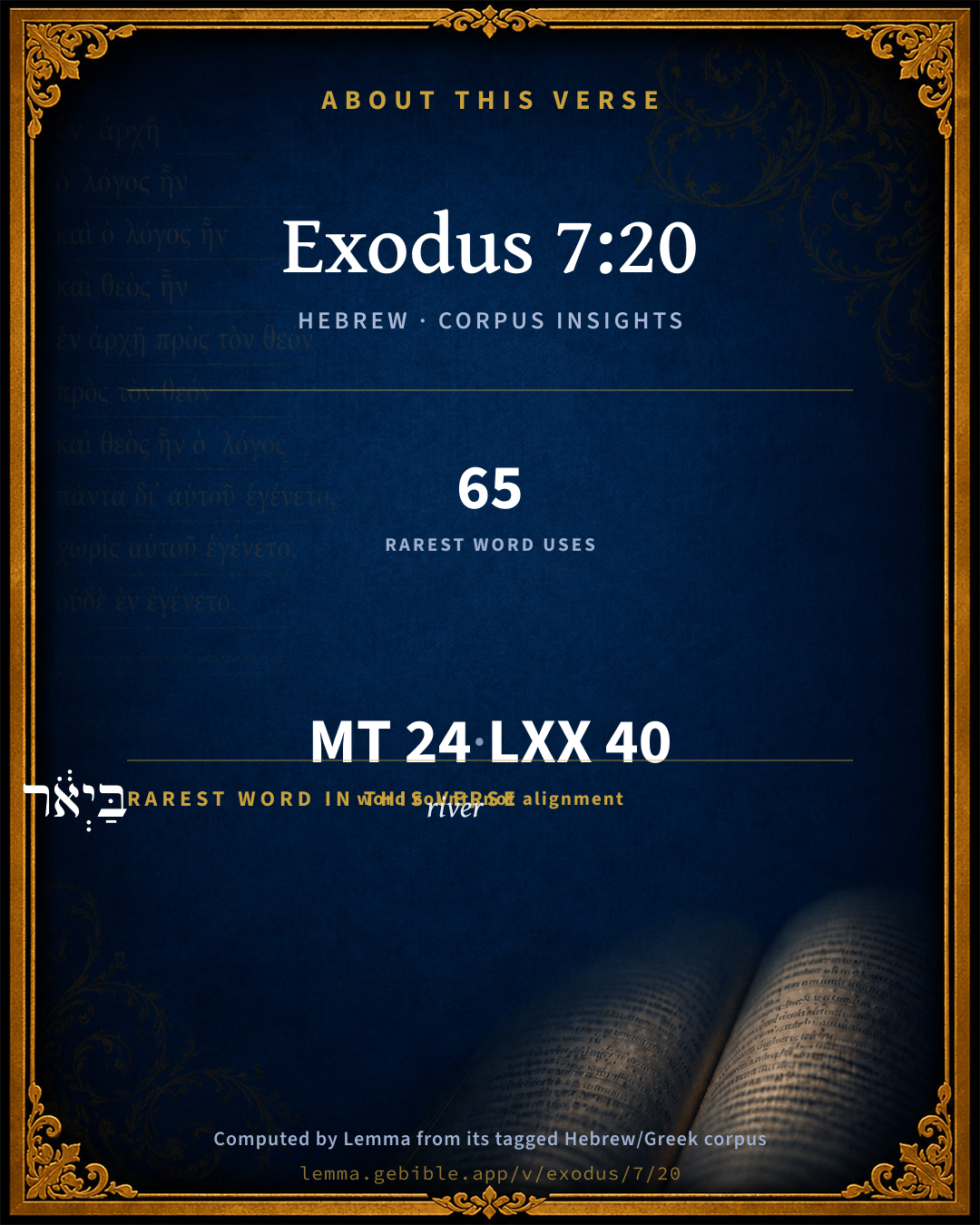
  • בַּיְאֹ֔ר river H2975 ×2
  • לְעֵינֵ֣י eye H5869 ×2
  • כַּאֲשֶׁ֣ר which H834 ×3

Hebrew & Septuagint length

In English translation the verse runs 48 words from the Hebrew and 43 from the Septuagint (LXX English) — closely comparable.

A rough comparison of the two English renderings, which tokenize alike — not a word-level alignment.

Word counts can differ between the Hebrew and the Greek without any difference in meaning — e.g. the Hebrew direct-object marker אֵת has no separate Greek word, and Greek often adds the article ὁ.

In the original languages it is 24 Hebrew tokens and 40 Greek tokens — but the two are counted differently (Hebrew bundles its prefixes and suffixes into one token; the Greek is in lemma form), so that isn’t a like-for-like length.

Cross-references

8

Topical passages linked to Exodus 7:20 in the Treasury of Scripture Knowledge — connected by theme and wording, ordered by reader-vote popularity; previews shown in the World English Bible.

  • Psalms 78:44 Turned their rivers into blood, And their streams, so that they could not drink.
  • Psalms 105:29 He turned their waters into blood, And killed their fish.
  • Exodus 7:17–18 Thus says Yahweh, "In this you shall know that I am Yahweh. Behold, I will strike with the rod that is in my hand on the waters which are in the river, and they shall be turned to blood.
  • Exodus 17:5–6 Yahweh said to Moses, "Walk on before the people, and take the elders of Israel with you, and take the rod in your hand with which you struck the Nile, and go.
  • Exodus 17:9–12 Moses said to Joshua, "Choose men for us, and go out, fight with Amalek. Tomorrow I will stand on the top of the hill with God's rod in my hand."
  • Numbers 20:8–12 Take the rod, and assemble the congregation, you, and Aaron your brother, and speak you to the rock before their eyes, that it give forth its water; and you shall bring forth to them water out of the rock; so you shall give the congregation and their cattle drink.
  • John 2:9–11 When the ruler of the feast tasted the water now become wine, and didn't know where it came from (but the servants who had drawn the water knew), the ruler of the feast called the bridegroom,
  • Revelation 8:8 The second angel sounded, and something like a great burning mountain was thrown into the sea. One third of the sea became blood,

Cross-references courtesy of OpenBible.info (CC BY 4.0).

Hebrew and Greek witnesses Masoretic Hebrew ↔ Greek Septuagint

The same verse in the two great witnesses to the Old Testament, shown verse-for-verse.

These are two independent witnesses, not word-aligned to each other, and the Septuagint is shown in lemma (dictionary) form.

Hebrew Exodus 7:20 Masoretic · Westminster Leningrad Codex

וַיַּֽעֲשׂוּ כֵן֩ מֹשֶׁ֨ה וְאַהֲרֹ֜ן כַּאֲשֶׁ֣ר צִוָּ֣ה יְהוָ֗ה וַיָּ֤רֶם בַּמַּטֶּה֙ וַיַּ֤ךְ אֶת הַמַּ֨יִם֙ אֲשֶׁ֣ר בַּיְאֹ֔ר לְעֵינֵ֣י פַרְעֹ֔ה וּלְעֵינֵ֖י עֲבָדָ֑יו וַיֵּהָֽפְכ֛וּ כָּל הַמַּ֥יִם אֲשֶׁר בַּיְאֹ֖ר לְדָֽם

Moses and Aaron did so, as Yahweh commanded; and he lifted up the rod, and struck the waters that were in the river, in the sight of Pharaoh, and in the sight of his servants; and all the waters that were in the river were turned to blood.

World English Bible · Public Domain

Greek LXX Exodus 7:20 Septuagint · lemma form

καί ποιέω οὕτως μωυσῆς καί ααρων καθάπερ ἐντέλλομαι αὐτός κύριος καί ἐπιαἴρω ὁ ῥάβδος αὐτός πατάσσω ὁ ὕδωρ ὁ ἐν ὁ ποταμός ἐναντίον φαραώ καί ἐναντίον ὁ θεράπων αὐτός καί μεταβάλλω πᾶς ὁ ὕδωρ ὁ ἐν ὁ ποταμός εἰς αἷμα

and Moses and Aaron did so, as the Lord commanded them; and Aaron having lifted up his hand with his rod, struck the water in the river before Pharao, and before his servants, and changed all the water in the river into blood.

LXX2012 (modern English Septuagint) · Public Domain

Hebrew: Westminster Leningrad Codex (CC BY 4.0). Greek: Septuagint (public domain); English from LXX2012 (modern English Septuagint) (Public Domain). How the Septuagint differs from the Hebrew →

Targum (Aramaic paraphrase)

2

The Targum is the ancient Jewish Aramaic paraphrase of the Hebrew Scriptures — an interpretive translation, not the Hebrew text itself. Onkelos (literal) and Pseudo-Jonathan (expansive) render the Torah, and Jonathan the Prophets. Coverage is partial: where no permissively-licensed English translation exists for a verse, only the Aramaic is shown. This is verse-level text, not a word-by-word alignment to the Hebrew.

  1. Targum Onkelos Torah (Genesis–Deuteronomy)
    וַעֲבָדוּ כֵן משֶׁה וְאַהֲרֹן כְּמָא דְפַקֵיד יְיָ וַאֲרֵים בְּחֻטְרָא וּמְחָא יָת מַיָא דִי בְנַהֲרָא לְעֵינֵי פַּרְעֹה וּלְעֵינֵי עַבְדוֹהִי וְאִתְהַפִיכוּ כָּל מַיָא דִי בְנַהֲרָא לִדְמָא:

    (no public-domain English translation for this verse)

    Targum Onkelos — Aramaic: “Onkelos Genesis” (public domain); “Onkelos Exodus” (public domain); “Onkelos Leviticus” (public domain); “Onkelos Numbers” (public domain); “Onkelos Deuteronomy” (public domain). English: “Sefaria Community Translation” (CC0 1.0 (public-domain dedication)); “J.W. Etheridge. The Targums of Onkelos and Jonathan Ben Uzziel on the Pentateuch. London: Longmans, Green, 1862” (public domain). Text via Sefaria.

  2. Targum Pseudo-Jonathan Torah (Genesis–Deuteronomy)
    וַעֲבָדוּ הֵיכְדֵין משֶׁה וְאַהֲרן הֵיכְמָא דְפַּקֵיד יְיָ וַאֲרֵים בְּחוּטְרָא וּמְחָא יַת מוֹי דִבְנַהֲרָא לְמֶחֱמֵי פַרְעה וּלְמֶחֱמֵי עַבְדוֹי וְאִיתְהֲפִּיכוּ כָּל מוֹי דִבְנַהֲרָא לְאַדְמָא

    And Mosheh and Aharon did so, as the Lord commanded; and he lifted up the rod, and smote the waters of the river in the sight of Pharoh, and in the sight of his servants; and all the waters of the river were turned into blood;

    Targum Pseudo-Jonathan — Aramaic: “Targum Jonathan on Genesis” (public domain); “Targum Jonathan on Exodus” (public domain); “Targum Jonathan on Leviticus” (public domain); “Targum Jonathan on Numbers” (public domain); “Targum Jonathan on Deuteronomy” (public domain). English: “The Targum of Jonathan ben Uzziel, trans. J. W. Etheridge, London, 1862” (public domain). Text via Sefaria.

Commentary

Notes on Exodus 7:20 from classic Christian and Jewish commentators (each source and its license shown beneath its notes). The classic Christian expositions comment on the surrounding passage and are grouped to its opening verse, so a note may address several verses; the Jewish commentaries on the Tanakh (Rashi and others) are per-verse, so they appear only where the commentator wrote on this verse.

Lemma curates 59 commentaries, every one of them public domain or Creative Commons licensed, each selected and text-cleaned for this edition rather than reprinted as found. About our sources →

Trapp's Complete Commentary

John Trapp

Exo 7:20 And Moses and Aaron did so, as the LORD commanded; and he lifted up the rod, and smote the waters that [were] in the river, in the sight of Pharaoh, and in the sight of his servants; and all the waters that [were] in the river were turned to blood.

Ver. 20. Were turned into blood.] To show them, as in a mirror, their blood guiltiness. These bloody and deceitful men had "blood to drink, for they were worthy." {Rev 16:6} {See Trapp on "Rev 16:6"}

John Trapp, A Commentary or Exposition upon All the Books of the Old and New Testament (1647–1656) — public domain. Text from a community e-Sword module.

Joseph Benson's Commentary

Exo 7:20. The waters in the river were turned into blood — This was a plague justly inflicted on the Egyptians; for the river of Egypt was their idol; they and their land had so much benefit by that creature, that they served and worshipped it more than their Creator. In ancient times they annually even sacrificed a girl to it, at the opening of the canals, Univ. Hist., vol. 1. p. 413. Also they had stained the river with the blood of the Hebrew children, and now God made that river all bloody; thus he gave them blood to drink, for they were worthy, Rev 16:6. See the power of God! Every creature is that to us which he makes it to be, water or blood. See the mutability of all things under the sun, and what changes we may meet with in them. That which is water to-day may be blood to- morrow; what is always vain may soon become vexatious. And see what mischievous work sin makes! It is sin that turns our waters into blood. All the waters — It seems the word all here, and in the foregoing verse, is either to be understood in a limited sense, as it frequently is in Scripture, meaning not all in the strictest sense, but only a very great part; or else that although Moses’s commission extended to all the waters in Egypt, yet it was only executed upon the river Nile: because we read that the magicians did the same thing; but if Moses had turned all the waters into blood, as some scoffers have, with great raillery and triumph, observed, how could the magicians do the same, there being, on this supposition, no water for them upon which to make the trial.

Joseph Benson's Commentary on the Old and New Testaments (1811–1818) — public domain. Text from a community e-Sword module.

Adam Clarke's Commentary

The FIRST plague. The WATERS turned into BLOOD

Verse 20. All the waters - were turned to blood.] Not merely in appearance, but in reality; for these changed waters became corrupt and insalubrious, so that even the fish that were in the river died; and the smell became highly offensive, so that the waters could not be drank; Ex 7:21.

Adam Clarke's Commentary on the Bible (1810–1826) — public domain. Text from a community e-Sword/MySword module.

Ellicott's Commentary for English Readers

(20) He lifted up the rod.—“He” is, undoubtedly, Aaron. (See Exo_7:19.)

In the sight of Pharaoh, and in the sight of his servants.—If the occasion was one of a Nile festival, Pharaoh would have “gone out to the water” (Exo_7:15) accompanied by all the great officers of the Court, by a large body of the priests, and vast numbers of the people. If it was a mere occasion of bodily ablution, he would have had with him a pretty numerous train of attendants. In either case considerable publicity was given to the miracle, which was certainly not “done in a corner.”

A Bible Commentary for English Readers, edited by Charles John Ellicott (1878–1897) — public domain. Text from a community e-Sword module.

John Gill's Exposition

And Moses and Aaron did so, as the Lord commanded,.... Moses delivered the rod to Aaron, who took it and went to the water side:

and he lift up the rod, and smote the waters that were in the river; or "in that river" (i), the river Nile, on the brink of which Pharaoh then stood:

in the sight of Pharaoh, and in the sight of his servants; his nobles and courtiers who tended him in his walk to the water; for this was done before he returned to his palace:

and all the waters that were in the river were turned into blood; not only the face of the waters looked like blood, but they were really turned into it; and not only the surface of the water, but all the water that was in the river, wherever it flowed, and as far as it flowed in the land of Egypt.

(i) Sept. "in eo rivo", Junius and Tremellius, Piscator.

John Gill's Exposition of the Whole Bible (1746–1763) — public domain (CC PDM 1.0). Text via the HelloAO Bible API.

Whedon's Commentary on the Bible

Daniel D. Whedon

20, 21. And all the waters that were in the river were turned to blood — Also, by implication, (Exo_7:19,) all the waters that had been drawn from the river into the ponds, tanks, etc., underwent the change. The sweet, beneficent Nile water became red and putrid like stagnant blood, so that it poisoned the fishes and became unfit for use. The red moon of the eclipse is said to be turned into blood, Joe_2:3. Only the Nile water was smitten, for water could yet be obtained from the wells and by digging, as we see from Exo_7:24.

Daniel D. Whedon (gen. ed.), Commentary on the Old and New Testaments (1874–1909) — public domain. Text from a community e-Sword module.

The Pulpit Commentary

He lifted up the rod. "He" must be understood to mean "Aaron" (see ver. 19); but the writer is too much engrossed with the general run of his narrative to be careful about minutia. All that he wants to impress upon us is, that the rod was used as an instrument for the working of the miracle. He is not thinking of who it was that used it. In the sight of Pharaoh. See the comment on ver. 15. And of his servants. Either "his courtiers generally," or, at any rate, a large troop of attendants.

The Pulpit Commentary (1880–1919), ed. H.D.M. Spence-Jones & Joseph S. Exell — public domain. Text from a community e-Sword module.

John Wesley's Explanatory Notes

The waters that were in the river were turned into blood - This was a plague justly inflicted upon the Egyptians; for Nilus the river of Egypt was their idol; they and their land had so much benefit by that creature, that they served and worshipped it more than the creator. Also they had stained the river with the blood of the Hebrew children, and now God made that river all bloody; thus he gave them blood to drink, for they were worthy, Rev. xvi, 6. See the power of God. Every creature is that to us which he makes it to be, water or blood. See the mutability of all things under the sun, and what changes we may meet with in them. That which is water to day may be blood to morrow; what is always vain may soon become vexatious. And see what mischievous work sin makes! It is sin that turns our waters into blood.

John Wesley, Explanatory Notes Upon the Whole Bible (1754–1765) — public domain. Text via the GEBible commentary corpus.

unfoldingWord translationNotes

Door43 World Missions Community

Pharaoh's heart was hardened

Here "heart" refers to Pharaoh. His stubborn attitude is spoken of as if his heart was hard. See how you translated this in Exodus 7:13. AT: "Pharaoh became more defiant" (See: Synecdoche and Metaphor)

in the river

The name of the river may be made explicit. AT: "in the Nile River" (See: Assumed Knowledge and Implicit Information)

translationWords

Moses

Aaron

Yahweh

command

raise

servant

magic

Pharaoh

unfoldingWord translationNotes — © Distant Shores Media and the Door43 World Missions Community, licensed CC BY-SA 4.0. Source: git.door43.org/Door43/en_tn.

Ramban (Nachmanides)

Rabbi Moshe ben Nachman (Ramban / Nachmanides)

AND HE LIFTED UP THE ROD, AND SMOTE THE WATERS THAT WERE IN THE RIVER IN THE SIGHT OF PHARAOH. That is to say, Aaron lifted up the rod and stretched out his hand over the land of Egypt in all directions, and afterwards he smote the waters that were in the river, in the sight of Pharaoh. In Pharaoh’s sight, all the waters that were in the river turned to blood, and the blood was furthermore throughout all the land of Egypt. And Rabbi Abraham ibn Ezra said that Scripture mentioned the smiting of the river but found it unnecessary to mention the stretching out of the hand [in all directions] over the entire land of Egypt.

Ramban (Nachmanides) on the Tanakh — English translation: “Commentary on the Torah by Ramban (Nachmanides). Translated and annotated by Charles B. Chavel. New York, Shilo Pub. House, 1971-1976” (CC BY 4.0). Text via Sefaria.

Lesson kit

Teaching starters — assembled from the data on this page, not authored interpretation. Every prompt links to the verse data it draws on. Edit before teaching.

Exodus, in the Pentateuch, opens this verse with 24 words (19 distinct Hebrew lemmas). Its most distinctive word is yᵉʼôr (“river”). A historical commentator’s framing appears above. Read the whole chapter for the surrounding context.

Discussion questions

  1. How does “river” (yᵉʼôr) shape what this verse is saying?
  2. How does Psalms 78:44, which shares this passage’s theme, read alongside this verse?
  3. What does the repetition of “water” (2× in this one verse) do in this verse?
  4. The translations on this page render this verse differently — a whole-verse word diff, not a word-by-word alignment. What might account for the different wordings?
  5. «וַיַּֽעֲשׂוּ» is a Qal Sequential Imperfect verb. How does that grammatical form shape the action described?
  6. Compare how Trapp's Complete Commentary and Joseph Benson's Commentary read this verse. Where do they agree or differ?

Things to notice

Reading settings

Reading text

Shown beneath each verse's original-language words.

Old Testament
Old Testament edition

Read the OT as the Masoretic Hebrew (MT) or the Greek Septuagint (LXX).

English shown for the Greek Septuagint (in the Hebrew ↔ Greek comparison).

Comparing translations? Open the Compare panel on any verse page to stack up to four side by side.