
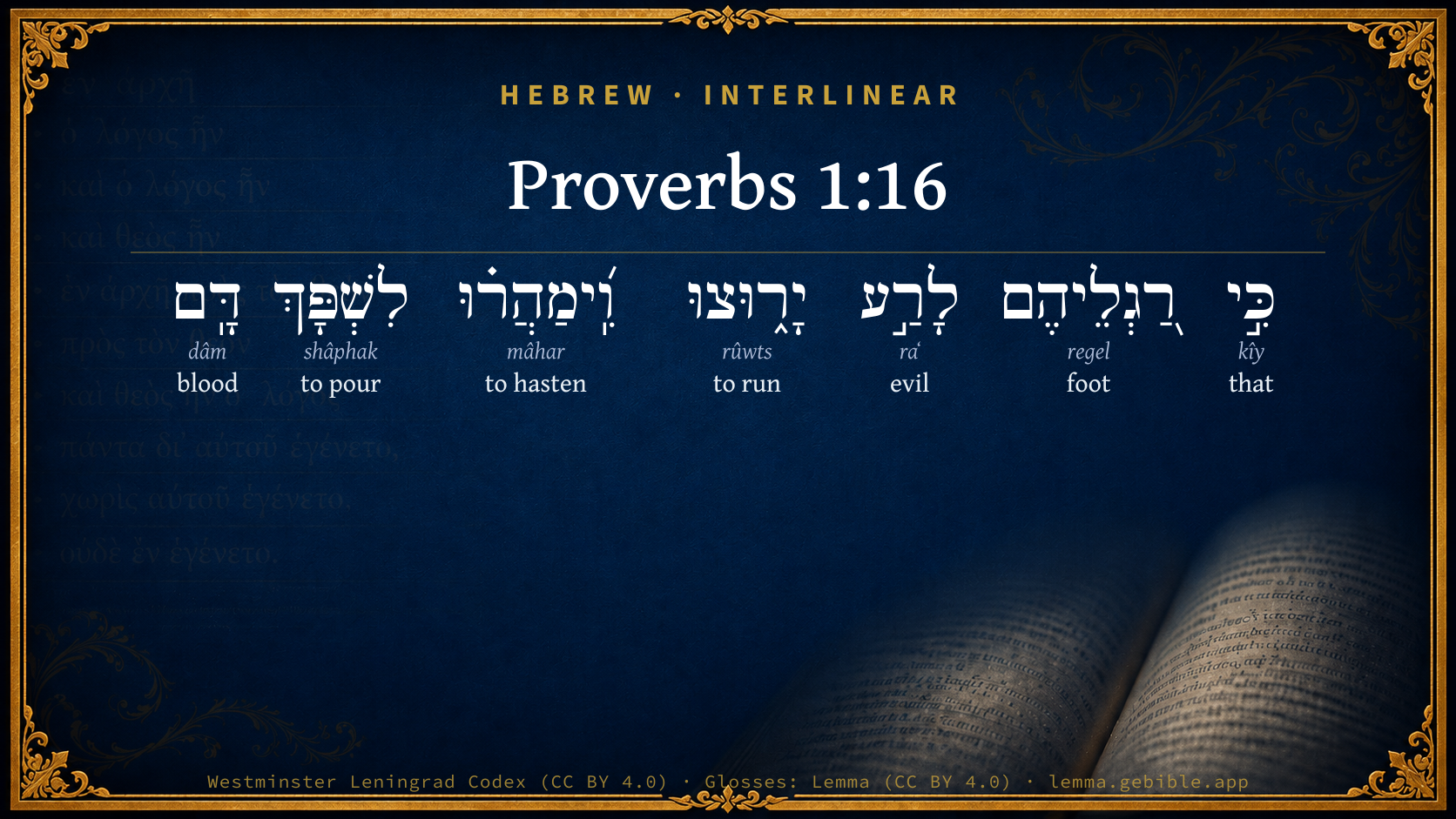
Proverbs 1:16

Hebrew (Westminster Leningrad Codex) Proverbs 1:16 appears in the Hebrew Old Testament. The text above is from the Westminster Leningrad Codex. Each word links to its Strong’s number, a concise gloss, and parsing drawn from the Open Scriptures Hebrew Bible morphology. Click any word for its full Brown-Driver-Briggs (BDB) entry.
Download image
Cite this verse

Proverbs 1:16 (World English Bible). Public Domain. Lemma interlinear Bible study tool, https://lemma.gebible.app/v/proverbs/1/16.

Show BibTeX & RIS
BibTeX
RIS
English Translation
For their feet run to evil. They hurry to shed blood.
World English Bible · Public Domain
Download a study sheet

One document with this verse’s original text, its word-by-word gloss line, the meaning frame, cross-references with their text, attributed commentary, and full source and license credits — printable, and it pastes into notes with its structure intact.

This verse Autodidact and up

Study sheet (.html) Plain text (.txt)

A passage Seminary Student

Up to 50 verses in one chapter. A passage sheet keeps up to 6 commentary sources and 12 cross-references per verse, in the order this page ranks them, and says so on the sheet whenever that leaves anything out. Ask for a single verse and you get the Autodidact verse sheet above.

Everything on this page stays free to read, with no account — the sheet is a download of what is already on screen, not access to it.

Want to remove ads? Support Godless Engineer
Compare translations 3

The same verse in 3 English versions, stacked beneath the original-language interlinear above. Click any original word for its lexicon entry.

Each is an independent rendering of the whole verse — the interlinear is not word-aligned to these translations.

Highlighted words mark where these versions differ — a whole-verse word diff, not a word-by-word alignment.

  • World English Bible Public Domain
    For their feet run to evil. They hurry to shed blood.
  • King James Version Public Domain
    For their feet run to evil, and make haste to shed blood.
  • unfoldingWord Literal Text CC BY-SA 4.0
    for their feet run to evil, and they hurry to pour out blood.

unfoldingWord Literal Text — © unfoldingWord, licensed CC BY-SA 4.0. Word-aligned USFM3 via Door43 (git.door43.org/unfoldingWord/en_ult).

Versions to compare (up to 4)

3 of 4 selected

Show all 18 translations

Every available English version of this verse, each an independent rendering of the whole verse.

  • World English Bible Public Domain
    For their feet run to evil. They hurry to shed blood.
  • Berean Standard Bible Public Domain
    For their feet run to evil, and they are swift to shed blood.
  • Majority Standard Bible Public Domain
    For their feet run to evil, and they are swift to shed blood.
  • King James Version Public Domain
    For their feet run to evil, and make haste to shed blood.
  • American Standard Version (1901) Public Domain
    For their feet run to evil, And they make haste to shed blood.
  • Revised Version (1885) Public Domain
    For their feet run to evil, and they make haste to shed blood.
  • Geneva Bible (1599) Public Domain
    For their feete runne to euill, and make haste to shed blood.
  • Douay-Rheims (1899) Public Domain
    For their feet run to evil, and make haste to shed blood.
  • Young's Literal Translation Public Domain
    For their feet to evil do run, And they haste to shed blood.
  • Literal Standard Version CC BY-SA 4.0
    For their feet run to evil, || And they hurry to shed blood.
  • Unlocked Literal Bible CC BY-SA 4.0
    their feet run to evil and they hurry to shed blood.
  • unfoldingWord Literal Text CC BY-SA 4.0
    for their feet run to evil, and they hurry to pour out blood.
  • Darby Bible Public Domain
    for their feet run to evil, and they make haste to shed blood.
  • World Messianic Bible Public Domain
    for their feet run to evil. They hurry to shed blood.
  • Webster's Bible Public Domain
    For their feet run to evil, and make haste to shed blood.
  • Free Bible Version CC BY-SA 4.0
    For they rush to do evil; they hurry to commit violence and murder.
  • Bible in Basic English Public Domain
    For their feet are running after evil, and they are quick to take a man's life.
  • JPS Tanakh (1917) Public Domain
    For their feet run to evil, and they make haste to shed blood.

Literal Standard Version (2020), Covenant Press — licensed CC BY-SA 4.0. Text via the HelloAO Bible API (eBible.org). Unlocked Literal Bible (unfoldingWord) — licensed CC BY-SA 4.0. Text via the HelloAO Bible API (eBible.org). unfoldingWord Literal Text — © unfoldingWord, licensed CC BY-SA 4.0. Word-aligned USFM3 via Door43 (git.door43.org/unfoldingWord/en_ult). Free Bible Version, Dr. Jonathan Gallagher — licensed CC BY-SA 4.0. Text via the HelloAO Bible API (eBible.org).

Word by word

More ways to search: Search by grammar → Find every occurrence → Compare this word →

Practice this passage: Drill this verse → Learn its vocabulary →

About this verse

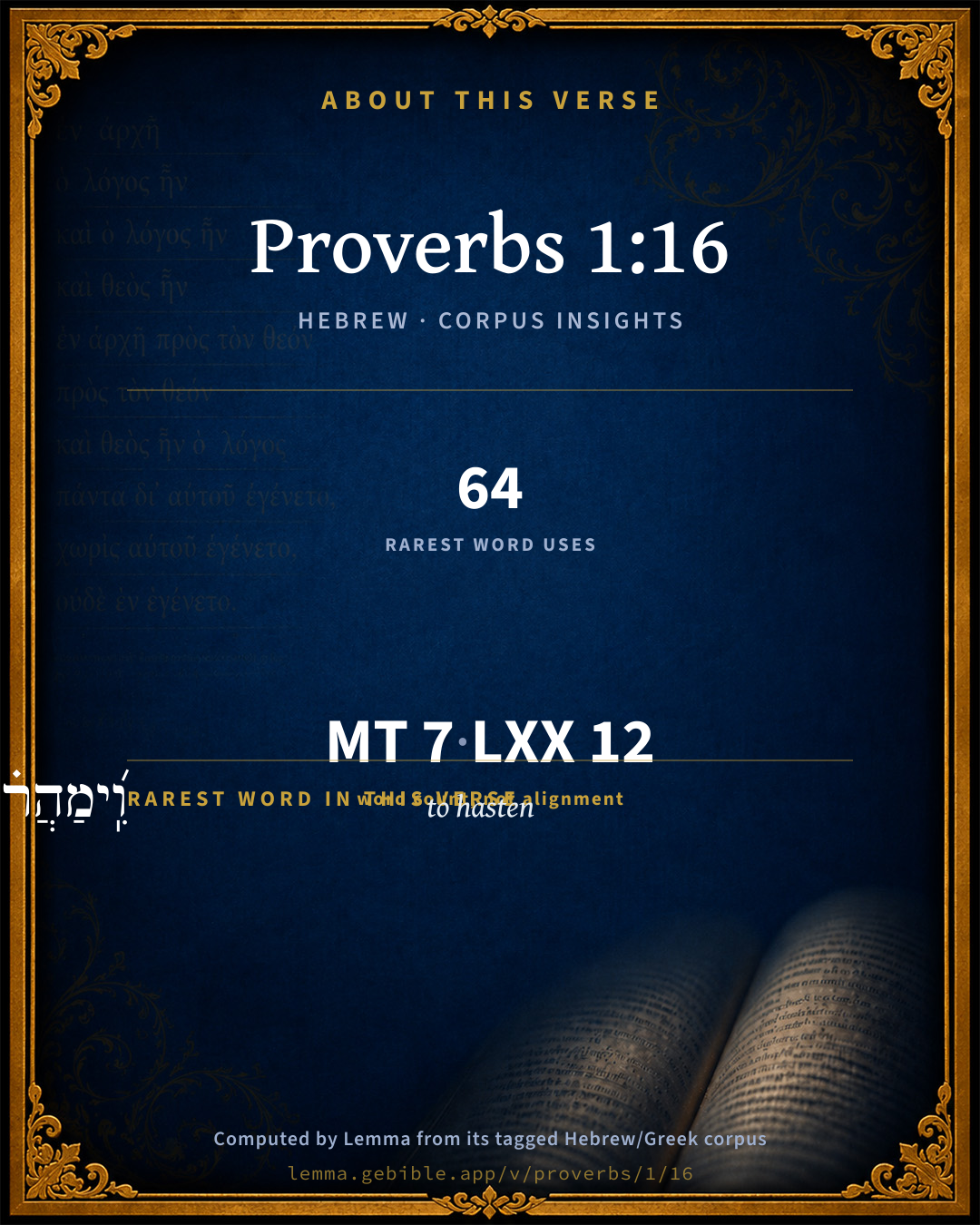
These counts appear in no published source. They are computed here, from the morphology-tagged text and Lemma’s own curated glosses. What Lemma adds →

7
words
7
distinct lemmas
Wisdom
section

Grammatical profile

  • 3 verbs
  • 3 nouns
  • 1 conjunction

Verb forms

  • יָר֑וּצוּ Qal · Imperfect
  • וִֽ֝ימַהֲר֗וּ Piel · Imperfect
  • לִשְׁפָּךְ Qal · Infinitive Construct

Hebrew & Septuagint length

In English translation the verse runs 11 words from the Hebrew and 13 from the Septuagint (LXX English) — closely comparable.

A rough comparison of the two English renderings, which tokenize alike — not a word-level alignment.

Word counts can differ between the Hebrew and the Greek without any difference in meaning — e.g. the Hebrew direct-object marker אֵת has no separate Greek word, and Greek often adds the article ὁ.

In the original languages it is 7 Hebrew tokens and 12 Greek tokens — but the two are counted differently (Hebrew bundles its prefixes and suffixes into one token; the Greek is in lemma form), so that isn’t a like-for-like length.

Cross-references

4

Topical passages linked to Proverbs 1:16 in the Treasury of Scripture Knowledge — connected by theme and wording, ordered by reader-vote popularity; previews shown in the World English Bible.

  • Isaiah 59:7 Their feet run to evil, and they make haste to shed innocent blood: their thoughts are thoughts of iniquity; desolation and destruction are in their paths.
  • Proverbs 6:18 A heart that devises wicked schemes, Feet that are swift in running to mischief,
  • Proverbs 4:16 For they don't sleep, unless they do evil. Their sleep is taken away, unless they make someone fall.
  • Romans 3:5 But if our unrighteousness commends the righteousness of God, what will we say? Is God unrighteous who inflicts wrath? I speak like men do.

Cross-references courtesy of OpenBible.info (CC BY 4.0).

Hebrew and Greek witnesses Masoretic Hebrew ↔ Greek Septuagint

The same verse in the two great witnesses to the Old Testament, shown verse-for-verse.

These are two independent witnesses, not word-aligned to each other, and the Septuagint is shown in lemma (dictionary) form.

Hebrew Proverbs 1:16 Masoretic · Westminster Leningrad Codex

כִּ֣י רַ֭גְלֵיהֶם לָרַ֣ע יָר֑וּצוּ וִֽ֝ימַהֲר֗וּ לִשְׁפָּךְ דָּֽם

For their feet run to evil. They hurry to shed blood.

World English Bible · Public Domain

Greek LXX Proverbs 1:16 Septuagint · lemma form

ὁ γάρ πούς αὐτός εἰς κακία τρέχω καί ταχινός ὁ ἐκχέω αἷμα

For their feet run to do evil, and are swift to shed blood.

LXX2012 (modern English Septuagint) · Public Domain

On this verse, Keil & Delitzsch discusses the Septuagint’s reading. Read the note in Commentary ↓

Hebrew: Westminster Leningrad Codex (CC BY 4.0). Greek: Septuagint (public domain); English from LXX2012 (modern English Septuagint) (Public Domain). How the Septuagint differs from the Hebrew →

Commentary

Notes on Proverbs 1:16 from classic Christian and Jewish commentators (each source and its license shown beneath its notes). The classic Christian expositions comment on the surrounding passage and are grouped to its opening verse, so a note may address several verses; the Jewish commentaries on the Tanakh (Rashi and others) are per-verse, so they appear only where the commentator wrote on this verse.

Lemma curates 59 commentaries, every one of them public domain or Creative Commons licensed, each selected and text-cleaned for this edition rather than reprinted as found. About our sources →

Trapp's Complete Commentary

John Trapp

Pro 1:16 For their feet run to evil, and make haste to shed blood.

Ver. 16. For their feet run to evil.] By the abuse of their locomotive faculty, given them to a better purpose. They "run," as if they should not come time enough; they take long strides toward the burning lake, which is now but a little before them.

John Trapp, A Commentary or Exposition upon All the Books of the Old and New Testament (1647–1656) — public domain. Text from a community e-Sword module.

Keil & Delitzsch

C. F. Keil & F. Delitzsch

The first argument to enforce the warning:

For their feet run to the evil,

And hasten to shed blood.

That this is their object they make no secret (Pro 1:11.); but why is it that such an object as this should furnish no ground of warning against them, especially as on this beginning the stamp of that which is morally blamable is here impressed with לרע? Besides, this circular movement of the thoughts is quite after the manner of this poet; and that Pro 1:16 is his style, Pro 6:18 shows. The want of this distich (Pro 1:16 = Rom 3:15) in lxx B. א. weighs heavier certainly than the presence of it in lxx A. (Procop., Syro-Hezap.), since the translation is not independent, but is transferred from Isa 59:7; but if for the first time, at a later period, it is supplied in the lxx, yet it has the appearance of an addition made to the Hebr. text from Isa 59:7 (Hitzig, Lagarde); cf. Comm. on Isaiah, 40-66. לשׁפּך is always pointed thus; for, as a regular rule, after ל as well as מ sa llew s the aspiration disappears; but in Eze 17:17 בּשׁפּך is also found, and in this case (cf. at Psa 40:15) the punctuation is thus inconsequent.

Keil & Delitzsch — Biblical Commentary on the Old Testament (1861–1891) — public domain (CC PDM 1.0). Text via the HelloAO Bible API. (Old Testament only.)

Adam Clarke's Commentary

Verse 16. For their feet run to evil] The whole of this verse is wanting in the Septuagint, and in the Arabic.

Adam Clarke's Commentary on the Bible (1810–1826) — public domain. Text from a community e-Sword/MySword module.

Ellicott's Commentary for English Readers

(16) For their feet . . .—The first reason against taking part with them: the horrible nature of the crime they are committing.

A Bible Commentary for English Readers, edited by Charles John Ellicott (1878–1897) — public domain. Text from a community e-Sword module.

The Cambridge Bible for Schools and Colleges

gen. ed. J. J. S. Perowne

16. This verse is omitted here by the LXX. It occurs again in Isa_59:7, where, however, the Heb. (but not the LXX.) has “innocent” blood.

The Cambridge Bible for Schools and Colleges (gen. ed. J. J. S. Perowne; Cambridge University Press, 1878–1918) — public domain. Text from a community e-Sword module.

John Gill's Exposition

For their feet run to evil,.... To the evil of sin, to commit robberies and murder, and all manner of iniquity; they are eager upon it, and in haste and swift to do it, Pro 6:18 (x); being carried away with their inordinate affections, which are as feet to the soul; and drawn aside with their lusts, and pushed on by Satan, and, encouraged by one another, and so rush on headlong to the evil of punishment also; and which is a reason why their ways and paths should be abstained from, because they bring upon them swift destruction; it is to their own hurt they run, as Jarchi interprets it; though the first sense seems best to agree with what follows;

and make haste to shed blood; the blood of innocent persons, in order to get their substance, to cover their iniquity and shame, and that no information may be given of them; this is mentioned as having something very horrible in it, in order to deter from joining with them.

(x) "Velox ad facinus", Claudian. in Rufin. l. 1. v. 240.

John Gill's Exposition of the Whole Bible (1746–1763) — public domain (CC PDM 1.0). Text via the HelloAO Bible API.

Matthew Poole's English Annotations

Their feet run; they make haste, as it follows, without considering what they are doing.

To evil; to do evil to others, as was expressed Pro 1:11,12, which also will bring evil upon themselves.

To shed blood; to shed innocent blood; which is an inhuman and dangerous practice.

Matthew Poole's English Annotations on the Holy Bible (1683–1685) — public domain. Text from a community e-Sword/MySword module.

Whedon's Commentary on the Bible

Daniel D. Whedon

16. Their feet run to evil — They are hurrying on to the shedding of blood. Some understand this of their own blood, according to Pro_1:18; but they see it not, and hence the next verse. Compare Rom_10:15.

Daniel D. Whedon (gen. ed.), Commentary on the Old and New Testaments (1874–1909) — public domain. Text from a community e-Sword module.

The Pulpit Commentary

For their feet run to evil, and make haste to shed blood. This is the first dissuasive urged to enforce the warning against evil companionship, as showing the extremes to which entering upon the ways of the wicked lead ultimately. At once the youth who listens will be hurried along impetuously to the two crimes of robbery and murder, which God has expressly forbidden in the eighth and sixth commandments respectively of the moral code. Evil (r, ra) is "wickedness," to kakon , generally, but hero more specifically highway robbery, latrocinism (Cornelius a Lapide), as appears from vers. 11-13, where also murder, the laying in wait for blood, is proposed. The Rabbis Salomon and Salazar understand the evil to refer to the evil or destruction which sinners bring upon themselves, and the shedding of blood to the fact that they lay themselves open to have their own blond shed by judicial process (see also Holden). The former explanation seems preferable to this, as putting a higher law than that of self-preservation before youth. The fear of judges who can condemn to death is nothing comparatively to the fear of him "who is able to destroy both body and soul in hell." This verse is wanting in the Vatican LXX, and Arabic, and hence Hitzig has concluded that it is an interpolation made from Isa_59:7, but upon insufficient evidence, as it is found in the Alexandrian LXX, Chaldea Paraphrase, Vulgate, and Syriac Versions, all which follow the Hebrew text. The latter part of the verse is quoted by St. Paul in Rom_3:15.

The Pulpit Commentary (1880–1919), ed. H.D.M. Spence-Jones & Joseph S. Exell — public domain. Text from a community e-Sword module.

Rashi

Rabbi Shlomo Yitzchaki (Rashi)

run to evil They run to their own harm, and they do not know to pay heed to the matter.

Rashi on the Tanakh — English translations: “The Judaica Press complete Tanach with Rashi, translated by A. J. Rosenberg” (CC BY 4.0); “Pentateuch with Rashi's commentary by M. Rosenbaum and A.M. Silbermann, 1929-1934” (public domain); “The Metsudah Tanach series, Lakewood, N.J” (CC BY 4.0); and “The Book of Joshua, Metsudah Publications, 1997” (CC BY 4.0). Text via Sefaria.

Lesson kit

Teaching starters — assembled from the data on this page, not authored interpretation. Every prompt links to the verse data it draws on. Edit before teaching.

Proverbs, in the Wisdom, opens this verse with 7 words (7 distinct Hebrew lemmas). Its most distinctive word is mâhar (“to hasten”). A historical commentator’s framing appears above. Read the whole chapter for the surrounding context.

Discussion questions

  1. The word mâhar carries the sense “to hasten.” How does it shape the verse?
  2. How does Isaiah 59:7, which shares this passage’s theme, read alongside this verse?
  3. These translations render this verse differently; the difference is in the English rendering, not the original. What questions does that raise?
  4. «יָר֑וּצוּ» is a Qal Imperfect verb. How does that grammatical form shape the action described?
  5. Compare how Trapp's Complete Commentary and Keil & Delitzsch read this verse. Where do they agree or differ?

Things to notice

Reading settings

Reading text

Shown beneath each verse's original-language words.

Old Testament
Old Testament edition

Read the OT as the Masoretic Hebrew (MT) or the Greek Septuagint (LXX).

English shown for the Greek Septuagint (in the Hebrew ↔ Greek comparison).

Comparing translations? Open the Compare panel on any verse page to stack up to four side by side.