
2 Chronicles 29:24

Hebrew (Westminster Leningrad Codex) 2 Chronicles 29:24 appears in the Hebrew Old Testament. The text above is from the Westminster Leningrad Codex. Each word links to its Strong’s number, a concise gloss, and parsing drawn from the Open Scriptures Hebrew Bible morphology. Click any word for its full Brown-Driver-Briggs (BDB) entry.
Download image
Cite this verse

2 Chronicles 29:24 (World English Bible). Public Domain. Lemma interlinear Bible study tool, https://lemma.gebible.app/v/2-chronicles/29/24.

Show BibTeX & RIS
BibTeX
RIS
English Translation
and the priests killed them, and they made a sin-offering with their blood on the altar, to make atonement for all Israel; for the king commanded [that] the burnt offering and the sin-offering [should be made] for all Israel.
World English Bible · Public Domain
Download a study sheet

One document with this verse’s original text, its word-by-word gloss line, the meaning frame, cross-references with their text, attributed commentary, and full source and license credits — printable, and it pastes into notes with its structure intact.

This verse Autodidact and up

Study sheet (.html) Plain text (.txt)

A passage Seminary Student

Up to 50 verses in one chapter. A passage sheet keeps up to 6 commentary sources and 12 cross-references per verse, in the order this page ranks them, and says so on the sheet whenever that leaves anything out. Ask for a single verse and you get the Autodidact verse sheet above.

Everything on this page stays free to read, with no account — the sheet is a download of what is already on screen, not access to it.

Want to remove ads? Support Godless Engineer
Compare translations 3

The same verse in 3 English versions, stacked beneath the original-language interlinear above. Click any original word for its lexicon entry.

Each is an independent rendering of the whole verse — the interlinear is not word-aligned to these translations.

Highlighted words mark where these versions differ — a whole-verse word diff, not a word-by-word alignment.

  • World English Bible Public Domain
    and the priests killed them, and they made a sin-offering with their blood on the altar, to make atonement for all Israel; for the king commanded [that] the burnt offering and the sin-offering [should be made] for all Israel.
  • King James Version Public Domain
    And the priests killed them, and they made reconciliation with their blood upon the altar, to make an atonement for all Israel: for the king commanded that the burnt offering and the sin offering should be made for all Israel.
  • unfoldingWord Literal Text CC BY-SA 4.0
    And the priests slaughtered them, and they made a sin offering with their blood on the altar to atone for all Israel, because “For all Israel,” the king said, “are the burnt offering and the sin offering.”

unfoldingWord Literal Text — © unfoldingWord, licensed CC BY-SA 4.0. Word-aligned USFM3 via Door43 (git.door43.org/unfoldingWord/en_ult).

Versions to compare (up to 4)

3 of 4 selected

Show all 18 translations

Every available English version of this verse, each an independent rendering of the whole verse.

  • World English Bible Public Domain
    and the priests killed them, and they made a sin-offering with their blood on the altar, to make atonement for all Israel; for the king commanded [that] the burnt offering and the sin-offering [should be made] for all Israel.
  • Berean Standard Bible Public Domain
    And the priests slaughtered the goats and put their blood on the altar for a sin offering, to make atonement for all Israel, because the king had ordered the burnt offering and the sin offering for all Israel.
  • Majority Standard Bible Public Domain
    And the priests slaughtered the goats and put their blood on the altar for a sin offering, to make atonement for all Israel, because the king had ordered the burnt offering and the sin offering for all Israel.
  • King James Version Public Domain
    And the priests killed them, and they made reconciliation with their blood upon the altar, to make an atonement for all Israel: for the king commanded that the burnt offering and the sin offering should be made for all Israel.
  • American Standard Version (1901) Public Domain
    and the priests killed them, and they made a sin-offering with their blood upon the altar, to make atonement for all Israel; for the king commanded `that' the burnt-offering and the sin-offering `should be made' for all Israel.
  • Revised Version (1885) Public Domain
    and the priests killed them, and they made a sin offering with their blood upon the altar, to make atonement for all Israel: for the king commanded that the burnt offering and the sin offering should be made for all Israel.
  • Geneva Bible (1599) Public Domain
    And the Priests slewe them, and with the blood of them they clensed the altar to reconcile all Israel: for the King had commanded for all Israel the burnt offring and the sinne offring.
  • Douay-Rheims (1899) Public Domain
    And the priests immolated them, and sprinkled their blood before the altar for an expiation of all Israel: for the king had commanded that the holocaust and the sin offering should be made for all Israel.
  • Young's Literal Translation Public Domain
    and the priests slaughter them, and make a sin-offering with their blood on the altar, to make atonement for all Israel, for `For all Israel,' said the king, ``is' the burnt-offering and the sin-offering.'
  • Literal Standard Version CC BY-SA 4.0
    and the priests slaughter them, and make a sin-offering with their blood on the altar, to make atonement for all Israel, that “For all Israel,” said the king, “[is] the burnt-offering and the sin-offering.”
  • Unlocked Literal Bible CC BY-SA 4.0
    The priests killed them, and they made a sin offering with their blood on the altar to make atonement for all Israel, for the king had commanded that a burnt offering and a sin offering should be made for all Israel.
  • unfoldingWord Literal Text CC BY-SA 4.0
    And the priests slaughtered them, and they made a sin offering with their blood on the altar to atone for all Israel, because “For all Israel,” the king said, “are the burnt offering and the sin offering.”
  • Darby Bible Public Domain
    And the priests slaughtered them, and they made purification for sin with their blood upon the altar, to make an atonement for all Israel; because for all Israel, said the king, is the burnt-offering and the sin-offering.
  • World Messianic Bible Public Domain
    Then the priests killed them, and they made a sin offering with their blood on the altar, to make atonement for all Israel; for the king commanded that the burnt offering and the sin offering should be made for all Israel.
  • Webster's Bible Public Domain
    And the priests killed them, and they made reconciliation with their blood upon the altar, to make an atonement for all Israel: for the king commanded that the burnt-offering and the sin-offering should be made for all Israel.
  • Free Bible Version CC BY-SA 4.0
    Then the priests killed the goats and placed their blood on the altar for a sin offering, to make atonement for the whole of Israel, because the king had ordered that the burnt offering and sin offering were for the whole of Israel.
  • Bible in Basic English Public Domain
    And the priests put them to death, and made a sin-offering with their blood on the altar, to take away the sin of all Israel: for the king gave orders that the burned offering and the sin-offering were for all Israel.
  • JPS Tanakh (1917) Public Domain
    and the priests killed them, and they made a sin-offering with their blood upon the altar, to make atonement for all Israel; for the king commanded that the burnt-offering and the sin-offering should be made for all Israel.

Literal Standard Version (2020), Covenant Press — licensed CC BY-SA 4.0. Text via the HelloAO Bible API (eBible.org). Unlocked Literal Bible (unfoldingWord) — licensed CC BY-SA 4.0. Text via the HelloAO Bible API (eBible.org). unfoldingWord Literal Text — © unfoldingWord, licensed CC BY-SA 4.0. Word-aligned USFM3 via Door43 (git.door43.org/unfoldingWord/en_ult). Free Bible Version, Dr. Jonathan Gallagher — licensed CC BY-SA 4.0. Text via the HelloAO Bible API (eBible.org).

Word by word

More ways to search: Search by grammar → Find every occurrence → Compare this word →

Practice this passage: Drill this verse → Learn its vocabulary →

וַיִּשְׁחָטוּם֙
shâchaṭ
H7819
“and · to slaughter · them”
Conjunction + Verb, Qal, Sequential Imperfect, 3rd Person, Masculine, Plural + Suffix, Personal, 3rd Person, Masculine, Plural
Part of Speech
Conjunction + Verb
Stem
Qal
Form
Sequential Imperfect
Person
3rd Person
Gender
Masculine
Number
Plural
Full BDB Definition

Origin: a primitive root

TWOT: 2362

to kill, slaughter, beat (verb) - (Qal) - to slaughter - beast for food - sacrifice - person in human sacrifice - beaten, hammered (of shekels) - (Niphal) to be slaughtered, be slain (of food or sacrifice) - (BDB) slaughtering (noun feminine) - word doubtful
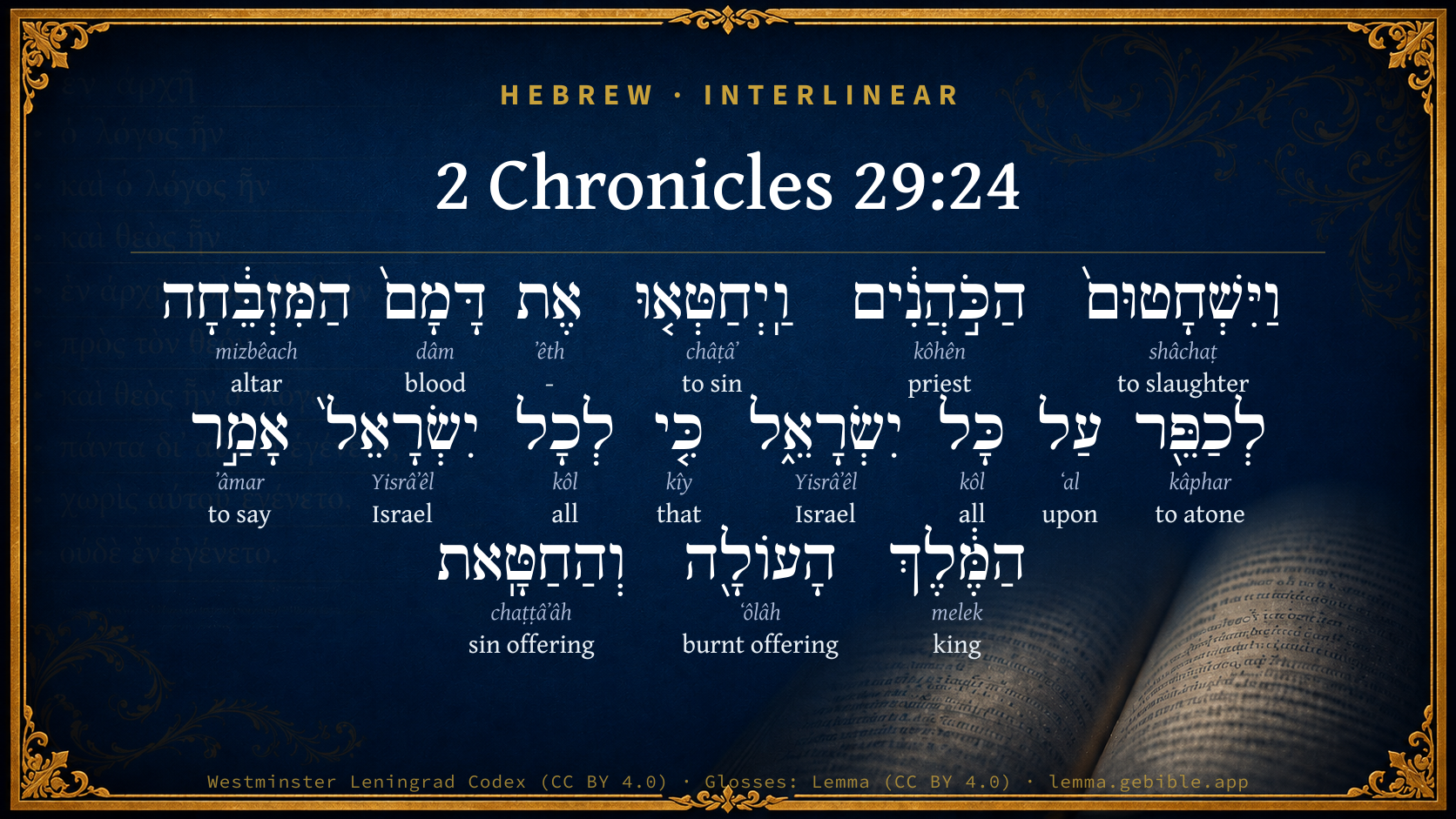
  1. הַכֹּ֣הֲנִ֔ים kôhên H3548 “the · priests” Particle, Definite Article + Noun, Common, Masculine, Plural, Absolute
  2. וַֽיְחַטְּא֤וּ châṭâʼ H2398 “and · to sin” Conjunction + Verb, Piel, Sequential Imperfect, 3rd Person, Masculine, Plural
  3. אֶת ʼêth H853 “-” Particle, Direct Object
  4. דָּמָם֙ dâm H1818 “blood · their” Noun, Common, Masculine, Singular, Construct + Suffix, Personal, 3rd Person, Masculine, Plural
  5. הַמִּזְבֵּ֔חָה mizbêach H4196 “the · altar · toward” Particle, Definite Article + Noun, Common, Masculine, Singular, Absolute + Suffix, Demonstrative
  6. לְכַפֵּ֖ר kâphar H3722 “to atone” Preposition + Verb, Piel, Infinitive Construct
  7. עַל ʻal H5921 “upon” Preposition
  8. כָּל kôl H3605 “all of” Noun, Common, Masculine, Singular, Construct
  9. יִשְׂרָאֵ֑ל Yisrâʼêl H3478 “Israel” Noun, Proper
  10. כִּ֤י kîy H3588 “that” Conjunction
  11. לְכָל kôl H3605 “to/for · all of” Preposition + Noun, Common, Masculine, Singular, Construct
  12. יִשְׂרָאֵל֙ Yisrâʼêl H3478 “Israel” Noun, Proper
  13. אָמַ֣ר ʼâmar H559 “to say” Verb, Qal, Perfect, 3rd Person, Masculine, Singular
  14. הַמֶּ֔לֶךְ melek H4428 “the · king” Particle, Definite Article + Noun, Common, Masculine, Singular, Absolute
  15. הָעוֹלָ֖ה ʻôlâh H5930 “the · burnt offering” Particle, Definite Article + Noun, Common, Feminine, Singular, Absolute
  16. וְהַחַטָּֽאת chaṭṭâʼâh H2403 “and · the · sin offering” Conjunction + Particle, Definite Article + Noun, Common, Feminine, Singular, Absolute

About this verse

These counts appear in no published source. They are computed here, from the morphology-tagged text and Lemma’s own curated glosses. What Lemma adds →

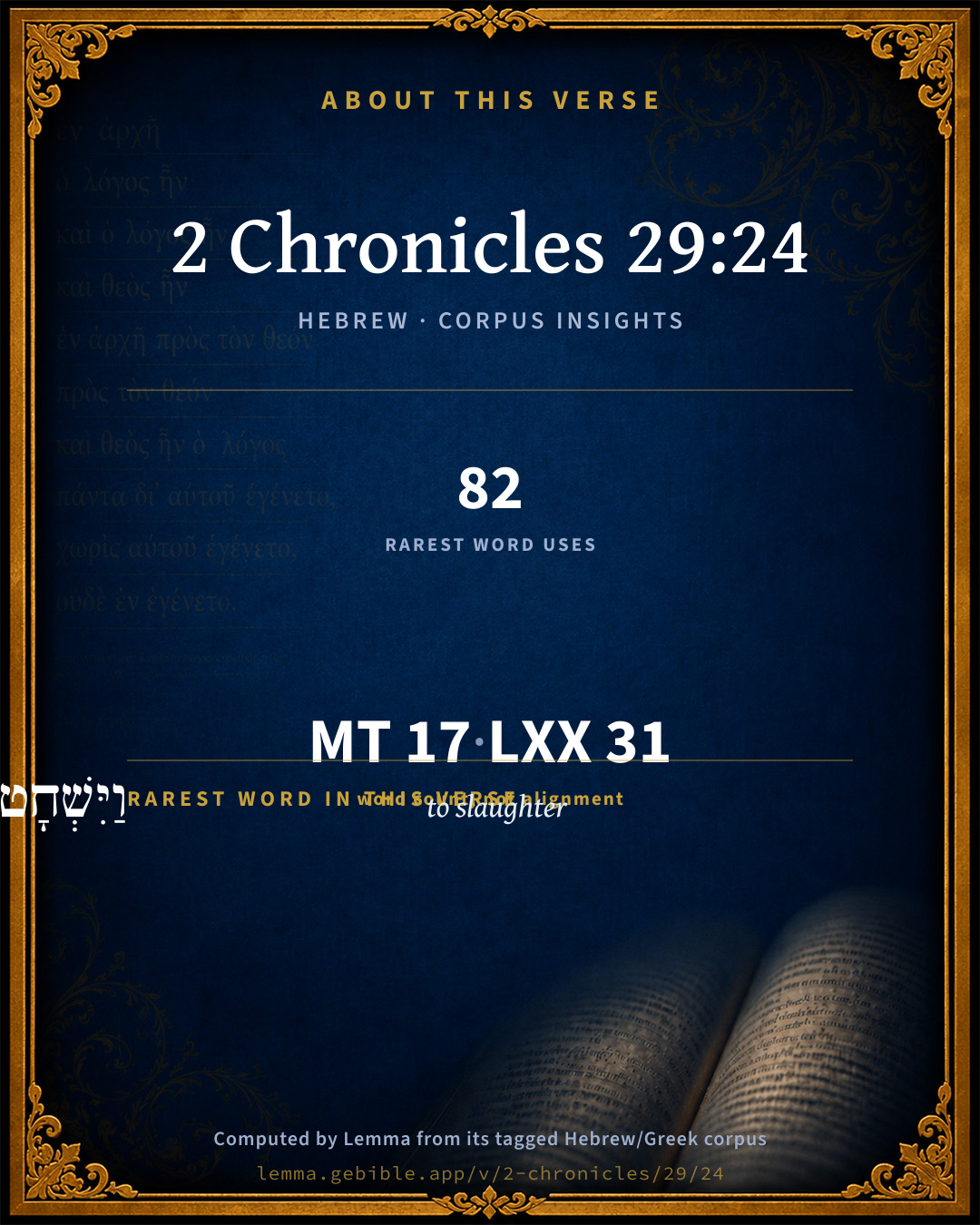
17
words
15
distinct lemmas
Historical
section

Grammatical profile

  • 4 verbs
  • 10 nouns
  • 1 preposition
  • 1 conjunction
  • 1 particle

Verb forms

  • וַיִּשְׁחָטוּם֙ Qal · Sequential Imperfect
  • וַֽיְחַטְּא֤וּ Piel · Sequential Imperfect
  • לְכַפֵּ֖ר Piel · Infinitive Construct
  • אָמַ֣ר Qal · Perfect

Repetition

Words recur within this verse — often emphatic in Hebrew:

  • כָּל all H3605 ×2
  • יִשְׂרָאֵ֑ל Israel H3478 ×2

Hebrew & Septuagint length

In English translation the verse runs 39 words from the Hebrew and 37 from the Septuagint (LXX English) — closely comparable.

A rough comparison of the two English renderings, which tokenize alike — not a word-level alignment.

Word counts can differ between the Hebrew and the Greek without any difference in meaning — e.g. the Hebrew direct-object marker אֵת has no separate Greek word, and Greek often adds the article ὁ.

In the original languages it is 17 Hebrew tokens and 31 Greek tokens — but the two are counted differently (Hebrew bundles its prefixes and suffixes into one token; the Greek is in lemma form), so that isn’t a like-for-like length.

Cross-references

11

Topical passages linked to 2 Chronicles 29:24 in the Treasury of Scripture Knowledge — connected by theme and wording, ordered by reader-vote popularity; previews shown in the World English Bible.

  • Leviticus 4:13–35 "'If the whole congregation of Israel sins, and the thing is hidden from the eyes of the assembly, and they have done any of the things which Yahweh has commanded not to be done, and are guilty;
  • Leviticus 6:30 No sin offering, of which any of the blood is brought into the Tent of Meeting to make atonement in the Holy Place, shall be eaten: it shall be burned with fire.
  • Leviticus 8:15 He killed it; and Moses took the blood, and put it on the horns of the altar round about with his finger, and purified the altar, and poured out the blood at the base of the altar, and sanctified it, to make atonement for it.
  • Leviticus 14:20 and the priest shall offer the burnt offering and the meal offering on the altar. The priest shall make atonement for him, and he shall be clean.
  • Ezekiel 45:15 and one lamb of the flock, out of two hundred, from the well-watered pastures of Israel; -for a meal-offering, and for a burnt offering, and for peace-offerings, to make atonement for them, says the Lord Yahweh.
  • Ezekiel 45:17 It shall be the prince's part to give the burnt offerings, and the meal-offerings, and the drink-offerings, in the feasts, and on the new moons, and on the Sabbaths, in all the appointed feasts of the house of Israel: he shall prepare the sin-offering, and the meal-offering, and the burnt offering, and the peace-offerings, to make atonement for the house of Israel.
  • Daniel 9:24 Seventy weeks are decreed on your people and on your holy city, to finish disobedience, and to make an end of sins, and to make reconciliation for iniquity, and to bring in everlasting righteousness, and to seal up vision and prophecy, and to anoint the most holy.
  • Romans 5:10–11 For if, while we were enemies, we were reconciled to God through the death of his Son, much more, being reconciled, we will be saved by his life.
  • 2 Corinthians 5:18–21 But all things are of God, who reconciled us to himself through Jesus Christ, and gave to us the ministry of reconciliation;
  • Colossians 1:20–21 and through him to reconcile all things to himself, by him, whether things on the earth, or things in the heavens, having made peace through the blood of his cross.
  • Hebrews 2:17 Therefore he was obligated in all things to be made like his brothers, that he might become a merciful and faithful high priest in things pertaining to God, to make atonement for the sins of the people.

Cross-references courtesy of OpenBible.info (CC BY 4.0).

Hebrew and Greek witnesses Masoretic Hebrew ↔ Greek Septuagint

The same verse in the two great witnesses to the Old Testament, shown verse-for-verse.

These are two independent witnesses, not word-aligned to each other, and the Septuagint is shown in lemma (dictionary) form.

Hebrew 2 Chronicles 29:24 Masoretic · Westminster Leningrad Codex

וַיִּשְׁחָטוּם֙ הַכֹּ֣הֲנִ֔ים וַֽיְחַטְּא֤וּ אֶת דָּמָם֙ הַמִּזְבֵּ֔חָה לְכַפֵּ֖ר עַל כָּל יִשְׂרָאֵ֑ל כִּ֤י לְכָל יִשְׂרָאֵל֙ אָמַ֣ר הַמֶּ֔לֶךְ הָעוֹלָ֖ה וְהַחַטָּֽאת

and the priests killed them, and they made a sin-offering with their blood on the altar, to make atonement for all Israel; for the king commanded [that] the burnt offering and the sin-offering [should be made] for all Israel.

World English Bible · Public Domain

Greek LXX 2 Chronicles 29:24 Septuagint · lemma form

καί θύω αὐτός ὁ ἱερεύς καί ἐκἱλάσκομαι ὁ αἷμα αὐτός πρός ὁ θυσιαστήριον καί ἐκἱλάσκομαι περί πᾶς ἰσραήλ ὅτι περί πᾶς ἰσραήλ εἶπον ὁ βασιλεύς ὁ ὁλοκαύτωσις καί ὁ περί ἁμαρτία

And the priests killed them, and offered their blood as a propitiation on the altar; and they made atonement for all Israel: for the king said, The whole burnt offering, and the sin-offering are for all Israel.

LXX2012 (modern English Septuagint) · Public Domain

Hebrew: Westminster Leningrad Codex (CC BY 4.0). Greek: Septuagint (public domain); English from LXX2012 (modern English Septuagint) (Public Domain). How the Septuagint differs from the Hebrew →

Commentary

Notes on 2 Chronicles 29:24 from classic Christian and Jewish commentators (each source and its license shown beneath its notes). The classic Christian expositions comment on the surrounding passage and are grouped to its opening verse, so a note may address several verses; the Jewish commentaries on the Tanakh (Rashi and others) are per-verse, so they appear only where the commentator wrote on this verse.

Lemma curates 59 commentaries, every one of them public domain or Creative Commons licensed, each selected and text-cleaned for this edition rather than reprinted as found. About our sources →

Trapp's Complete Commentary

John Trapp

2Ch 29:24 And the priests killed them, and they made reconciliation with their blood upon the altar, to make an atonement for all Israel: for the king commanded [that] the burnt offering and the sin offering [should be made] for all Israel.

Ver. 24. To make an atonement for all Israel.] For the ten tribes also; for they had need enough. It is but a little fire that casteth but a little heat: a great fire will be felt afar off; so a great measure of charity.

John Trapp, A Commentary or Exposition upon All the Books of the Old and New Testament (1647–1656) — public domain. Text from a community e-Sword module.

Joseph Benson's Commentary

2Ch 29:24. To make an atonement for all Israel — That is, for all the rest of the tribes, whereof a considerable number were now in his dominions, and not for Judah only. Thus is Christ a propitiation, not for the sins of Israel only, but for those of the whole world, 1Jn 1:2.

Joseph Benson's Commentary on the Old and New Testaments (1811–1818) — public domain. Text from a community e-Sword module.

Ellicott's Commentary for English Readers

(24) Made reconciliation with their blood upon the altar.—Literally, made sin offering of their blood. (Comp. Lev_9:15.) The meaning may be seen by reference to Lev_4:30, seq. The priest dipped his finger in the blood of the victim and touched the horns of the altar with it, and then poured the blood at the base of the altar.

For the king commanded . . . Israel.—For for all Israel the king had commanded the burnt offering and the sin offering; or, for “For all Israel,” said the king, “is the burnt offering and the sin offering.” The expression all Israel includes the northern kingdom. (Comp. Hezekiah’s invitation to its people to attend the Passover, 2Ch_30:1.)

A Bible Commentary for English Readers, edited by Charles John Ellicott (1878–1897) — public domain. Text from a community e-Sword module.

The Cambridge Bible for Schools and Colleges

gen. ed. J. J. S. Perowne

24. made reconciliation] R.V. made a sin offering.

The Cambridge Bible for Schools and Colleges (gen. ed. J. J. S. Perowne; Cambridge University Press, 1878–1918) — public domain. Text from a community e-Sword module.

John Gill's Exposition

And the Levites stood with the instruments of David,.... Which were invented, directed, and ordered to be used by him, and are the same as in the preceding verse:

and the priests with the trumpets; which were made by the direction of Moses, according to the order of God, Num 10:2.

John Gill's Exposition of the Whole Bible (1746–1763) — public domain (CC PDM 1.0). Text via the HelloAO Bible API.

Albert Barnes' Notes on the Bible

All lsrael - Hezekiah aimed at reuniting once more the whole people of Israel, if not into a single state, yet, at any rate, into a single religious communion. The northern kingdom was in a condition approaching to anarchy. The end was evidently approaching. Hoshea, the king contemporary with Hezekiah 2Ki 18:1, ruled, not as an independent monarch, but as an Assyrian feudatory 2Ki 17:3. Under these circumstances Hezekiah designed to invite the revolted tribes to return, if not to their old temporal, at least to their old spiritual, allegiance 2Ch 30:5-10. In order, therefore, to prepare the way for this return, he included “all Israel” in the expiatory sacrifice, by which he prefaced his restoration of the old worship.

Albert Barnes' Notes on the Bible (1834–1885) — public domain. Text from a community e-Sword/MySword module.

Matthew Poole's English Annotations

For all Israel, i.e. for Judah and Benjamin, and all the rest of the tribes, whereof a considerable number were now in his dominions.

Matthew Poole's English Annotations on the Holy Bible (1683–1685) — public domain. Text from a community e-Sword/MySword module.

The Pulpit Commentary

They made reconciliation with their blood upon the altar; Revised Version, and they made a sin offering with their blood. etc.; Hebrew, piel future of amj The piel conjugation occurs in all fourteen times seven times rendered "cleanse;" twice, "purify;" twice, "offer for sin;" once, "purge;" once, as here, "make reconciliation;" and once, (Gen_31:39, "I bare the loss of it to "bear loss." This last instance, being the very first occurrence of the word in this conjugation, beautifully harmonizes with the simple and most elementary idea of the doctrine or facts underlying the word. To make atonement; Hebrew, dpekl, piel infinitive. This word, which in the one kal occurrence of it (Gen_6:14) means "to pitch, or cover with pitch," occurs in piel eighty-six times, and is rendered "atone" or "make atonement" sixty-six times, seven times "reconcile" or "make reconciliation," the other renderings being such as "pacify," "purge," "forgive," "cleanse," "be merciful," "put it off," i.e. "expiate" (margin). We are so distinctly twice told that these sacrifices were for all Israel, that it may be taken for granted that the desire of Hezekiah was to include the northern kingdom with which, under Hoshea, in subjection to the Assyrian king, times were now very hard and ominous of the end in the benefits of the expiatory offerings now made (so see vers. 5, 6, 10-12 of next chapter).

The Pulpit Commentary (1880–1919), ed. H.D.M. Spence-Jones & Joseph S. Exell — public domain. Text from a community e-Sword module.

Scofield Reference Notes

C. I. Scofield

reconciliation Or, an offering. (See Scofield "Dan 9:24")

atonement (See Scofield "Exo 29:33").

The Scofield Reference Bible (1917 edition), notes by C. I. Scofield — public domain. Text from a community e-Sword module.

Rashi

Rabbi Shlomo Yitzchaki (Rashi)

to atone for all Israel for they had sinned by [practicing] idolatry. The king said as follows: “Let the burnt offerings and the sin offerings be for all Israel.” In the section שְׁלַח (Num. 16:24) it is written: “the entire congregation shall offer up one bull, etc.,” and it is written: (Lev 4:14): “and the congregation shall bring a young bull for a sin offering,” and here it is written that they brought seven bulls, rams, lambs, and kids! This was a temporary ruling.

Rashi on the Tanakh — English translations: “The Judaica Press complete Tanach with Rashi, translated by A. J. Rosenberg” (CC BY 4.0); “Pentateuch with Rashi's commentary by M. Rosenbaum and A.M. Silbermann, 1929-1934” (public domain); “The Metsudah Tanach series, Lakewood, N.J” (CC BY 4.0); and “The Book of Joshua, Metsudah Publications, 1997” (CC BY 4.0). Text via Sefaria.

Lesson kit

Teaching starters — assembled from the data on this page, not authored interpretation. Every prompt links to the verse data it draws on. Edit before teaching.

2 Chronicles, in the Historical, opens this verse with 17 words (15 distinct Hebrew lemmas). Its most distinctive word is shâchaṭ (“to slaughter”). A historical commentator’s framing appears above. Read the whole chapter for the surrounding context.

Discussion questions

  1. The word shâchaṭ carries the sense “to slaughter.” How does it shape the verse?
  2. How does Leviticus 4:13–35, which shares this passage’s theme, read alongside this verse?
  3. What does the repetition of “all” (2× in this one verse) do in this verse?
  4. These translations render this verse differently. What is at stake in choosing one wording over another?
  5. «וַיִּשְׁחָטוּם֙» is a Qal Sequential Imperfect verb. How does that grammatical form shape the action described?
  6. Compare how Trapp's Complete Commentary and Joseph Benson's Commentary read this verse. Where do they agree or differ?

Things to notice

Reading settings

Reading text

Shown beneath each verse's original-language words.

Old Testament
Old Testament edition

Read the OT as the Masoretic Hebrew (MT) or the Greek Septuagint (LXX).

English shown for the Greek Septuagint (in the Hebrew ↔ Greek comparison).

Comparing translations? Open the Compare panel on any verse page to stack up to four side by side.