
Psalms 5:6

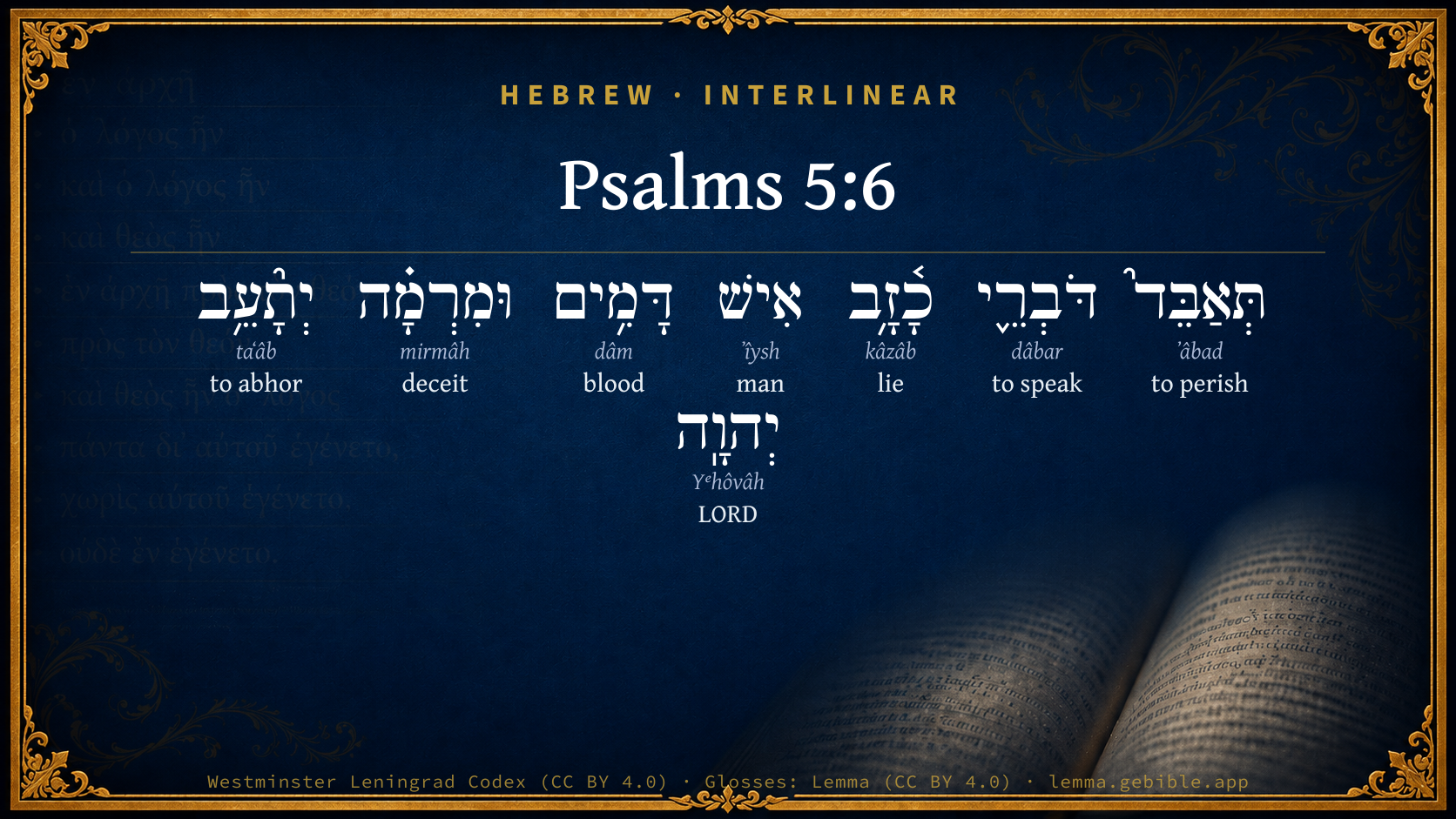
Hebrew (Westminster Leningrad Codex) Psalms 5:6 appears in the Hebrew Old Testament. The text above is from the Westminster Leningrad Codex. Each word links to its Strong’s number, a concise gloss, and parsing drawn from the Open Scriptures Hebrew Bible morphology. Click any word for its full Brown-Driver-Briggs (BDB) entry.
Download image
Cite this verse

Psalms 5:6 (World English Bible). Public Domain. Lemma interlinear Bible study tool, https://lemma.gebible.app/v/psalms/5/6.

Show BibTeX & RIS
BibTeX
RIS
English Translation
You will destroy those who speak lies. Yahweh abhors the blood-thirsty and deceitful man.
World English Bible · Public Domain
Download a study sheet

One document with this verse’s original text, its word-by-word gloss line, the meaning frame, cross-references with their text, attributed commentary, and full source and license credits — printable, and it pastes into notes with its structure intact.

This verse Autodidact and up

Study sheet (.html) Plain text (.txt)

A passage Seminary Student

Up to 50 verses in one chapter. A passage sheet keeps up to 6 commentary sources and 12 cross-references per verse, in the order this page ranks them, and says so on the sheet whenever that leaves anything out. Ask for a single verse and you get the Autodidact verse sheet above.

Everything on this page stays free to read, with no account — the sheet is a download of what is already on screen, not access to it.

Want to remove ads? Support Godless Engineer
Compare translations 3

The same verse in 3 English versions, stacked beneath the original-language interlinear above. Click any original word for its lexicon entry.

Each is an independent rendering of the whole verse — the interlinear is not word-aligned to these translations.

Highlighted words mark where these versions differ — a whole-verse word diff, not a word-by-word alignment.

  • World English Bible Public Domain
    You will destroy those who speak lies. Yahweh abhors the blood-thirsty and deceitful man.
  • King James Version Public Domain
    Thou shalt destroy them that speak leasing: the LORD will abhor the bloody and deceitful man.
  • unfoldingWord Literal Text CC BY-SA 4.0
    You will destroy speakers of falsehood; the man of blood and deceit Yahweh abhors.

unfoldingWord Literal Text — © unfoldingWord, licensed CC BY-SA 4.0. Word-aligned USFM3 via Door43 (git.door43.org/unfoldingWord/en_ult).

Versions to compare (up to 4)

3 of 4 selected

Show all 18 translations

Every available English version of this verse, each an independent rendering of the whole verse.

  • World English Bible Public Domain
    You will destroy those who speak lies. Yahweh abhors the blood-thirsty and deceitful man.
  • Berean Standard Bible Public Domain
    You destroy those who tell lies; the LORD abhors the man of bloodshed and deceit.
  • Majority Standard Bible Public Domain
    You destroy those who tell lies; the LORD abhors the man of bloodshed and deceit.
  • King James Version Public Domain
    Thou shalt destroy them that speak leasing: the LORD will abhor the bloody and deceitful man.
  • American Standard Version (1901) Public Domain
    Thou wilt destroy them that speak lies: Jehovah abhorreth the blood-thirsty and deceitful man.
  • Revised Version (1885) Public Domain
    Thou shalt destroy them that speak lies: the LORD abhorreth the bloodthirsty and deceitful man.
  • Geneva Bible (1599) Public Domain
    Thou shalt destroy them that speake lyes: the Lord will abhorre the bloodie man and deceitfull.
  • Douay-Rheims (1899) Public Domain
    Neither shall the wicked dwell near thee: nor shall the unjust abide before thy eyes.
  • Young's Literal Translation Public Domain
    Thou destroyest those speaking lies, A man of blood and deceit Jehovah doth abominate.
  • Literal Standard Version CC BY-SA 4.0
    You destroy those speaking lies, || YHWH detests a man of blood and deceit.
  • Unlocked Literal Bible CC BY-SA 4.0
    You will destroy liars; Yahweh despises violent and deceitful men.
  • unfoldingWord Literal Text CC BY-SA 4.0
    You will destroy speakers of falsehood; the man of blood and deceit Yahweh abhors.
  • Darby Bible Public Domain
    Thou wilt destroy them that speak lies: Jehovah abhorreth a man of blood and deceit.
  • World Messianic Bible Public Domain
    You will destroy those who speak lies. The LORD abhors the bloodthirsty and deceitful man.
  • Webster's Bible Public Domain
    \\5:5\\The foolish shall not stand in thy sight: thou hatest all workers of iniquity.
  • Free Bible Version CC BY-SA 4.0
    You destroy those who tell lies. The Lord loathes bloodthirsty and deceptive people.
  • Bible in Basic English Public Domain
    You will send destruction on those whose words are false; the cruel man and the man of deceit are hated by the Lord.
  • JPS Tanakh (1917) Public Domain
    (5-7) Thou destroyest them that speak falsehood; the LORD abhorreth the man of blood and of deceit.

Literal Standard Version (2020), Covenant Press — licensed CC BY-SA 4.0. Text via the HelloAO Bible API (eBible.org). Unlocked Literal Bible (unfoldingWord) — licensed CC BY-SA 4.0. Text via the HelloAO Bible API (eBible.org). unfoldingWord Literal Text — © unfoldingWord, licensed CC BY-SA 4.0. Word-aligned USFM3 via Door43 (git.door43.org/unfoldingWord/en_ult). Free Bible Version, Dr. Jonathan Gallagher — licensed CC BY-SA 4.0. Text via the HelloAO Bible API (eBible.org).

Word by word

More ways to search: Search by grammar → Find every occurrence → Compare this word →

Practice this passage: Drill this verse → Learn its vocabulary →

יְתָ֘עֵ֥ב
taʻâb
H8581
“to abhor”
Verb, Piel, Imperfect, 3rd Person, Masculine, Singular
Part of Speech
Verb
Stem
Piel
Form
Imperfect
Person
3rd Person
Gender
Masculine
Number
Singular
Full BDB Definition

Origin: a primitive root

TWOT: 2530

to abhor, be abominable, do abominably - (Niphal) to be abhorred, be detested - in the ritual sense - in the ethical sense - (Piel) - to loathe, abhor, regard as an abomination - in the ritual sense - in the ethical sense - to cause to be an abomination - (Hiphil) to make abominable, do abominably - in the ritual sense - in the ethical sense
  1. תְּאַבֵּד֮ ʼâbad H6 “to perish” Verb, Piel, Imperfect, 2nd Person, Masculine, Singular
  2. דֹּבְרֵ֪י dâbar H1696 “speaking” Verb, Qal, Participle Active, Masculine, Plural, Construct
  3. כָ֫זָ֥ב kâzâb H3577 “lie” Noun, Common, Masculine, Singular, Absolute
  4. אִישׁ ʼîysh H376 “man of” Noun, Common, Masculine, Singular, Construct
  5. דָּמִ֥ים dâm H1818 “blood” Noun, Common, Masculine, Plural, Absolute
  6. וּמִרְמָ֗ה mirmâh H4820 “and · deceit” Conjunction + Noun, Common, Feminine, Singular, Absolute
  7. יְהוָֽה Yᵉhôvâh H3068 “LORD” Noun, Proper

About this verse

These counts appear in no published source. They are computed here, from the morphology-tagged text and Lemma’s own curated glosses. What Lemma adds →

8
words
8
distinct lemmas
Wisdom
section

Notable vocabulary

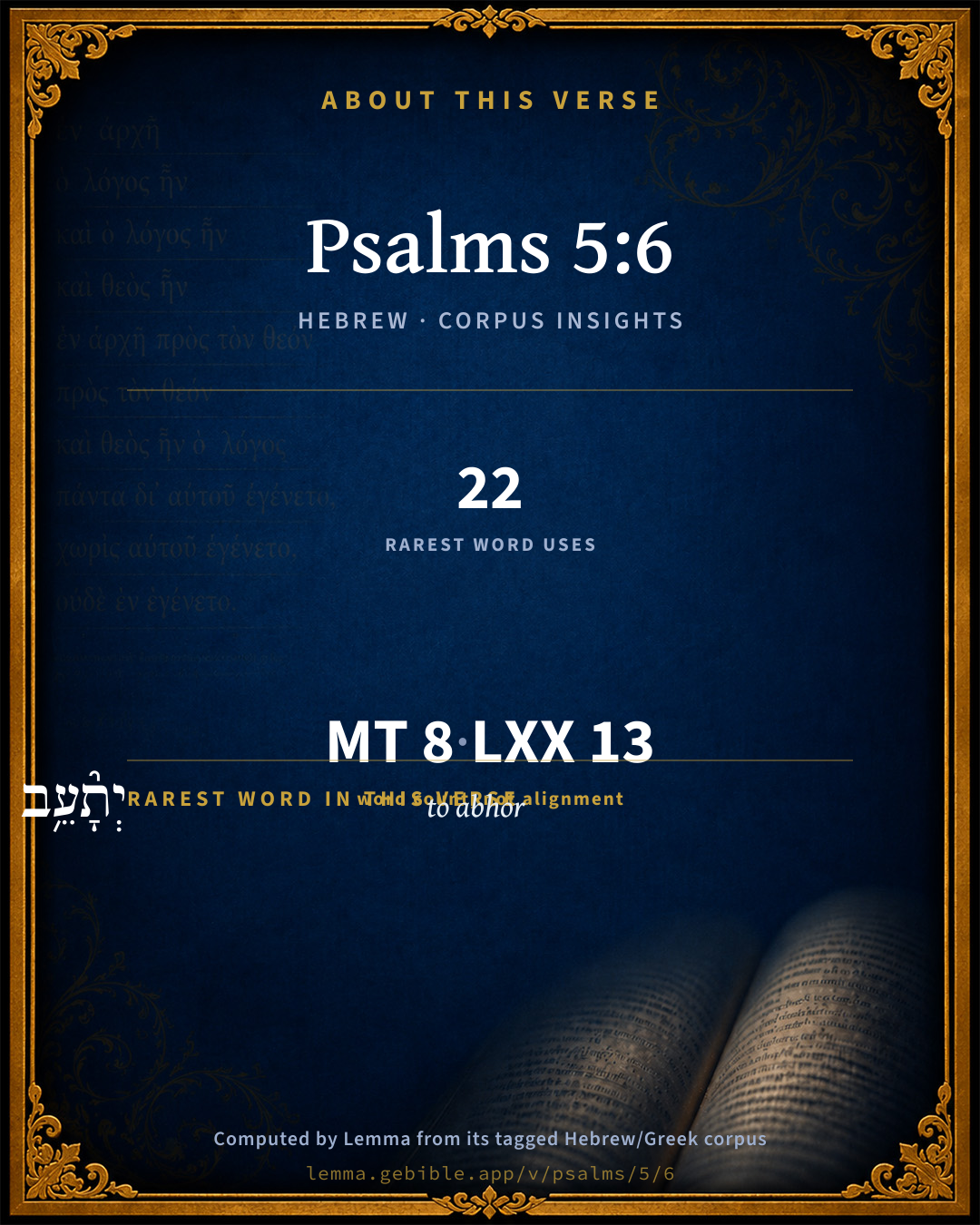
The rarest word here is יְתָ֘עֵ֥ב to abhor H8581 — appearing just 22 times in the whole Hebrew Bible.

Shared distinctive vocabulary

יְתָ֘עֵ֥ב to abhor H8581 occurs in 20 verses of the Hebrew Bible. Also found in:

Grammatical profile

  • 3 verbs
  • 5 nouns

Verb forms

  • תְּאַבֵּד֮ Piel · Imperfect
  • דֹּבְרֵ֪י Qal · Participle Active
  • יְתָ֘עֵ֥ב Piel · Imperfect

Hebrew & Septuagint length

In English translation the verse runs 14 words from the Hebrew and 15 from the Septuagint (LXX English) — closely comparable.

A rough comparison of the two English renderings, which tokenize alike — not a word-level alignment.

Word counts can differ between the Hebrew and the Greek without any difference in meaning — e.g. the Hebrew direct-object marker אֵת has no separate Greek word, and Greek often adds the article ὁ.

In the original languages it is 8 Hebrew tokens and 13 Greek tokens — but the two are counted differently (Hebrew bundles its prefixes and suffixes into one token; the Greek is in lemma form), so that isn’t a like-for-like length.

Cross-references

12

Topical passages linked to Psalms 5:6 in the Treasury of Scripture Knowledge — connected by theme and wording, ordered by reader-vote popularity; previews shown in the World English Bible.

  • Psalms 55:23 But you, God, will bring them down into the pit of destruction. Bloodthirsty and deceitful men shall not live out half their days, But I will trust in you.
  • Revelation 21:8 But for the cowardly, unbelieving, sinners, abominable, murderers, sexually immoral, sorcerers, idolaters, and all liars, their part is in the lake that burns with fire and sulfur, which is the second death."
  • Revelation 22:15 Outside are the dogs, the sorcerers, the sexually immoral, the murderers, the idolaters, and everyone who loves and practices falsehood.
  • Isaiah 26:21 For, behold, Yahweh comes forth out of his place to punish the inhabitants of the earth for their iniquity: the earth also shall disclose her blood, and shall no more cover her slain.
  • Genesis 34:25–26 It happened on the third day, when they were sore, that two of Jacob's sons, Simeon and Levi, Dinah's brothers, each took his sword, came upon the unsuspecting city, and killed all the males.
  • Psalms 4:2 You sons of men, how long shall my glory be turned into dishonor? Will you love vanity, and seek after falsehood? Selah.
  • 2 Samuel 16:8 Yahweh has returned on you all the blood of the house of Saul, in whose place you have reigned; and Yahweh has delivered the kingdom into the hand of Absalom your son; and, behold, you are [taken] in your own mischief, because you are a man of blood.
  • 2 Samuel 20:1 There happened to be there a base fellow, whose name was Sheba, the son of Bichri, a Benjamite: and he blew the trumpet, and said, We have no portion in David, neither have we inheritance in the son of Jesse: every man to his tents, Israel.
  • Psalms 26:8–10 Yahweh, I love the habitation of your house, The place where your glory dwells.
  • Psalms 43:1 Vindicate me, God, and plead my cause against an ungodly nation. Oh, deliver me from deceitful and wicked men.
  • Romans 1:29 being filled with all unrighteousness, sexual immorality, wickedness, covetousness, maliciousness; full of envy, murder, strife, deceit, evil habits, secret slanderers,
  • Genesis 34:14 and said to them, "We can't do this thing, to give our sister to one who is uncircumcised; for that is a reproach to us.

Cross-references courtesy of OpenBible.info (CC BY 4.0).

Hebrew and Greek witnesses Masoretic Hebrew ↔ Greek Septuagint

The same verse in the two great witnesses to the Old Testament, shown verse-for-verse.

You’re reading Greek Psalm 5 (Hebrew Psalm 5). The Septuagint counts the superscription, so verse numbers can differ from the Hebrew — chapter-level alignment, not verse-by-verse. Numbering follows Rahlfs.

These are two independent witnesses, not word-aligned to each other, and the Septuagint is shown in lemma (dictionary) form.

Hebrew Psalms 5:6 Masoretic · Westminster Leningrad Codex

תְּאַבֵּד֮ דֹּבְרֵ֪י כָ֫זָ֥ב אִישׁ דָּמִ֥ים וּמִרְמָ֗ה יְתָ֘עֵ֥ב יְהוָֽה

You will destroy those who speak lies. Yahweh abhors the blood-thirsty and deceitful man.

World English Bible · Public Domain

Greek LXX Greek Psalm 5:6 Septuagint · lemma form

οὐ διαμένω παράνομος κατέναντι ὁ ὀφθαλμός σύ μισέω πᾶς ὁ ἐργάζομαι ὁ ἀνομία

You will destroy all that speak falsehood: the Lord abhors the bloody and deceitful man.

LXX2012 (modern English Septuagint) · Public Domain

On this verse, Ellicott's Commentary for English Readers discusses the Septuagint’s reading. Read the note in Commentary ↓

Hebrew: Westminster Leningrad Codex (CC BY 4.0). Greek: Septuagint (public domain); English from LXX2012 (modern English Septuagint) (Public Domain). How the Septuagint differs from the Hebrew →

Commentary

Notes on Psalms 5:6 from classic Christian and Jewish commentators (each source and its license shown beneath its notes). The classic Christian expositions comment on the surrounding passage and are grouped to its opening verse, so a note may address several verses; the Jewish commentaries on the Tanakh (Rashi and others) are per-verse, so they appear only where the commentator wrote on this verse.

Lemma curates 59 commentaries, every one of them public domain or Creative Commons licensed, each selected and text-cleaned for this edition rather than reprinted as found. About our sources →

Trapp's Complete Commentary

John Trapp

Psa 5:6 Thou shalt destroy them that speak leasing: the LORD will abhor the bloody and deceitful man.

Ver. 6. Thou shalt destroy them that speak leasing] Whether in jest or earnest, those that lie in jest will, without repentance, go to hell in earnest. And for the officious lie some think it no fault; whereas, Gal 1:10, we must not speak truth to please men, much less may we lie. The truth is, all lies are pernicious, all liars will be destroyed, but especially those that have taught their tongues to speak lies, Jer 9:5, that take fast hold of deceit, Jer 8:5, so that they cannot be got off without striving: such a one was Doeg, Saul, &c.

The Lord will abhor the bloody and deceitful man] Heb. the man of blood; for blood hath so many tongues as drops to cry for vengeance, Gen 4:10, and God makes inquisition, Psa 9:12, commanding that murderers should be drawn from the altar to the slaughter, Exo 21:14. This made King James say, that if God did leave him to kill a man he would think God did not love him. And for deceitful persons, the Lord is the avenger of all such, 1Th 4:6.

John Trapp, A Commentary or Exposition upon All the Books of the Old and New Testament (1647–1656) — public domain. Text from a community e-Sword module.

Jamieson, Fausset & Brown

Robert Jamieson, A. R. Fausset & David Brown

leasing--a lie.

the bloody . . . man--literally, "man of blood"--murderer.

Jamieson, Fausset & Brown — Commentary Critical and Explanatory on the Whole Bible (1871) — public domain (CC PDM 1.0). Text via the HelloAO Bible API.

Adam Clarke's Commentary

Verse 6. That speak leasing] Falsity, from the Anglo-Saxon [A.S.] leasunge, a lie, falsity, deceit; from [A.S.] leas, lie, which is from the verb [A.S.] leasian, to lie. See on Ps 4:2.

The Lord will abhor the bloody and deceitful man.] איש דמים ish damim, the man of bloods; for he who has the spirit of a murderer, will rarely end with one bloodshedding. So the Jews, who clamoured for the blood of our Lord, added to that, as far and as long as they could, the blood of his disciples.

Adam Clarke's Commentary on the Bible (1810–1826) — public domain. Text from a community e-Sword/MySword module.

Ellicott's Commentary for English Readers

(6) Leasing.—See Psa_4:2.

Bloody.—Margin, literally, of bloods and deceit. So LXX. and Vulg.

A Bible Commentary for English Readers, edited by Charles John Ellicott (1878–1897) — public domain. Text from a community e-Sword module.

John Gill's Exposition

Thou shall destroy them that speak leasing,.... Or "a lie" (i); whether in matters of religion; as false doctrines, errors, and heresies, are lies; and so all that deny the deity, sonship, and Messiahship of Christ, are liars; and the followers of the man of sin speak lies in hypocrisy: or in common conversation; such are like to Satan, and are abominable in the sight of God; and he will destroy them, either with a temporal destruction, with bodily diseases, as Gehazi was smitten with a leprosy; and with corporeal death, as Ananias and Sapphira; or with eternal destruction, the destruction of body and soul in hell; for all liars have their part in the lake which burns with fire and brimstone;

the Lord will abhor the bloody and deceitful man; or "the man of blood and deceit" (k); that thirsts after blood; who sheds innocent blood, as the Targum paraphrases it. He showed his resentment against Cain, the first of this sort, in a way that was intolerable to him. He very early established a law, requiring that he who shed man's blood, by man should his blood be shed; and he will give the whore of Rome, who has been drunk with the blood of his saints, blood to drink, because she is worthy. And all such who flatter with their tongue, and speak with a double heart, and lie in wait to deceive their neighbour, whether in things temporal or spiritual, are the objects of his abhorrence and indignation; see Psa 55:23. Now David's enemies being such sort of persons, foolish wicked men, proud and haughty, workers of iniquity, liars, bloody and deceitful men, men that God had an abhorrence of, he therefore hoped and was confident that God would hear his prayers against them, and for himself.

(i) "mendacium", V. L. (k) "vir sanguinum et doli, vel fraudis", Montanus, Cocceius, Gejerus; so Ainsworth.

John Gill's Exposition of the Whole Bible (1746–1763) — public domain (CC PDM 1.0). Text via the HelloAO Bible API.

Albert Barnes' Notes on the Bible

Thou shalt destroy - Thou wilt bring to ruin; thou wilt cause to perish; that is, cause to perish as the wicked are caused to perish, by being punished. The idea is that God could not approve their cause; could not favor them; could not give them prosperity, and that they must be overthrown and punished. As in the previous verses, so here, David refers to this as a general characteristic of God, but with an implied reference to his enemies.

Them that speak leasing - Lies; the word “leasing” being the old Saxon word to denote falsehood. See Psa 4:2. It is not found elsewhere in our common version. The allusion here is to his enemies, and the idea is that they were false and treacherous; a description which will well apply to them on the supposition that this refers to the rebellion of Absalom. See the introduction to the psalm.

The Lord will abhor - Will hate; will hold in abomination. That is, he will show his abhorrence by punishing such as are here referred to.

The bloody and deceitful man - The man of blood and fraud; the man who sheds blood, and is guilty of treachery and fraud. Margin, “man of bloods and deceit.” The “man of bloods,” - “the plural form being commonly used where there is reference to blood-guiltiness or murder.” - “Prof. Alexander.” See Gen 4:10; Psa 51:14. The idea seems to be that of shedding “much” blood. The reference here, as before, is to a general characteristic of the Divine Mind, with a special reference to the character of David’s enemies, as being distinguished for fraud and blood-guiltiness. On the supposition (see introduction) that this refers to the rebellion of Absalom, there can be no difficulty in seeing the propriety of the application. It was on these grounds that the psalmist directed his prayer to God. He was confident that his was a righteous cause; he was as sure that his enemies were engaged in a wicked cause; and he felt, therefore, that “he” might go before God and seek his interposition, with the assurance that all his attributes, as a righteous and holy God, would be enlisted in his favor. God has “no” attribute which can take part with a sinner, or on which a sinner can rely; the righteous can appeal to “every” attribute in the divine nature as a ground of confidence and hope.

Albert Barnes' Notes on the Bible (1834–1885) — public domain. Text from a community e-Sword/MySword module.

Matthew Poole's English Annotations

Leasing; or, lies; that make it their business to raise and scatter calumnies and reproaches concerning me; as many did.

The bloody and deceitful man; those who design mischief against me or my friends raider a pretence of kindness; of whom he oft speaks.

Matthew Poole's English Annotations on the Holy Bible (1683–1685) — public domain. Text from a community e-Sword/MySword module.

The Treasury of David

Charles H. Spurgeon

Ver. 6. Thou shalt destroy them that speak leasing, whether in jest or earnest. Those that lie in jest will (without repentance) go to hell in earnest. John Trapp.

Ver. 6. Thou shalt destroy them that speak leasing, etc. In the same field where Absalom raised battle against his father, stood the oak that was his gibbet. The mule whereon he rode was his hangman, for the mule carried him to the tree, and the hair wherein he gloried served for a rope to hang. Little know the wicked how everything which now they have shall be a snare to trap them when God begins to punish them. William Cowper, 1612.

None.

Ver. 7. With this verse the first part of the Psalm ends. The Psalmist has bent his knee in prayer; he has described before God, as an argument for his deliverance, the character and the fate of the wicked; and now he contrasts this with the condition of the righteous.

But as for me, I will come into thy house. I will not stand at a distance, I will come into thy sanctuary, just as a child comes into his father's house. But I will not come there by my own merits; no, I have a multitude of sins, and therefore I will come in the multitude of thy mercy. I will approach thee with confidence because of thy immeasurable grace. God's judgments are all numbered, but his mercies are innumerable; he gives his wrath by weight, but without weight his mercy.

And in thy fear will I worship toward thy holy temple,towards the temple of thy holiness. The temple was not built on earth at that time; it was but a tabernacle; but David was wont to turn his eyes spiritually to that temple of God's holiness where between the wings of the Cherubim Jehovah dwells in light ineffable. Daniel opened his window toward Jerusalem, but we open our hearts toward heaven.

Ver. 7. In thy fear will I worship. As natural fear makes the spirits retire from the outward parts of the body to the heart, so a holy fear of miscarrying in so solemn a duty would be a means to call thy thoughts from all exterior carnal objects, and fix them upon the duty in hand. As the sculpture is on the seal, so will the print on the wax be; if the fear of God be deeply engraven on thy heart, there is no doubt but it will make a suitable impression on the duty thou performest. William Gurnall.

Charles H. Spurgeon's The Treasury of David (1869–1885) — public domain. Psalms only. Text from a community e-Sword/MySword module.

Whedon's Commentary on the Bible

Daniel D. Whedon

6. Leasing—Lying, falsehood. Here applying to speech.

Bloody and deceitful—Deceit here specially applies to treachery, bad faith, treason, as 2Ki_9:23; Psa_55:11; Jer_9:6. Whether the lying and deceit consist in words or acts, such as practice them God will destroy.

Daniel D. Whedon (gen. ed.), Commentary on the Old and New Testaments (1874–1909) — public domain. Text from a community e-Sword module.

The Pulpit Commentary

Thou shalt destroy them that speak leasing. (comp. Psa_4:2) David"s adversaries were cunning, treacherous, and quite regardless of truth. (see 2Sa_3:27 2Sa_13:28 2Sa_15:7-9 2Sa_20:10, etc.) God"s vengeance was sure to fall upon them, either in this world or in the next. The Lord will abhor the bloody and deceitful man. An individual seems to be pointed at, who is probably Ahithophel.

The Pulpit Commentary (1880–1919), ed. H.D.M. Spence-Jones & Joseph S. Exell — public domain. Text from a community e-Sword module.

J. A. Alexander on Psalms

Joseph Addison Alexander

6. What was said in the preceding verse of sin is here, to prevent misapprehension, said of sinners. They shall not stand, the proud, or insolent, here put for wicked men in general and for the Psalmist's enemies in particular, before thine eyes. Thou canst not bear the presence of thy moral opposites. Sin is not only opposed to God's will, but repugnant to his nature. By ceasing to hate it, he would cease to be holy, cease to be perfect, cease to be God. This idea is expressed more directly in the other clause. Thou hast hated, and must still hate, all doers of iniquity. This last word is originally a negative, meaning inanity or nonentity, but like several other negatives in Hebrew, is employed as a strong term to denote moral deficiency and worthlessness.

Joseph Addison Alexander, The Psalms Translated and Explained (1850) — public domain. Text from a community e-Sword module.

Rashi

Rabbi Shlomo Yitzchaki (Rashi)

Confused people who make themselves mad, and in the language of the Mishnah, מערבבין, confused.

Rashi on the Tanakh — English translations: “The Judaica Press complete Tanach with Rashi, translated by A. J. Rosenberg” (CC BY 4.0); “Pentateuch with Rashi's commentary by M. Rosenbaum and A.M. Silbermann, 1929-1934” (public domain); “The Metsudah Tanach series, Lakewood, N.J” (CC BY 4.0); and “The Book of Joshua, Metsudah Publications, 1997” (CC BY 4.0). Text via Sefaria.

Radak

Rabbi David Kimhi (Radak)

(Mad) fools (הוללים) shall not stand before Thine eyes: – The significance of הוללים is sometimes that of folly, as (in the passages) “And he played the fool in their hands” (1 Sam. 21:14); “I said it is foolish” (Eccles. 2:2); and sometimes it is used with the significance of wickedness, as (in the passage) “mischievous madness” (הוללות) (ibid. 10:13), and similar instances. And in this sense (is the clause to be taken here)-(Mad) fools shall not stand before Thine eyes, as he proceeds to say

Thou hatest all workers of iniquity: – nevertheless a single class contains them all, for wickedness is not of the way of knowledge and wisdom. And the interpretation of before Thine eyes (is): like a man who hates another and is unwilling to look him in the face.

Radak on the Tanakh — English translations: “Sefaria Community Translation” (CC0 1.0 (public-domain dedication)); “Eliyahu Munk, HaChut Hameshulash” (CC BY 4.0); “Rabbi Mike Feuer, Jerusalem Anthology” (CC BY 4.0); and “R. David Kimhi on the first book of Psalms, Translated by R.G. Finch, London, 1919” (public domain). Text via Sefaria.

Ibn Ezra

Rabbi Abraham ibn Ezra

Shall not stand (לֹא יִתְיַצְּבוּ - lo yityatzvu): The meaning of stand (yityatzvu) is in the manner of servants (ha-avadim) standing [in attendance] upon their king (nitzavim al malkam).

Ibn Ezra on the Tanakh — English translations: “Sefaria Community Translation” (CC0 1.0 (public-domain dedication)); “Yalkut, Sifsei Chachomim Chumash, Metsudah Publications, 2009” (CC BY 4.0); and “Commentary of Ibn Ezra on Isaiah - trans. by M. Friedlander, 1873” (public domain). Text via Sefaria.

Lesson kit

Teaching starters — assembled from the data on this page, not authored interpretation. Every prompt links to the verse data it draws on. Edit before teaching.

Psalms, in the Wisdom, opens this verse with 8 words (8 distinct Hebrew lemmas). Its most distinctive word is taʻâb (“to abhor”). A historical commentator’s framing appears above. Read the whole chapter for the surrounding context.

Discussion questions

  1. What does “to abhor” (taʻâb) contribute to the verse as a whole?
  2. How does Deuteronomy 7:26, which shares the word «to abhor», read alongside this verse?
  3. These translations render this verse differently; the difference is in the English rendering, not the original. What questions does that raise?
  4. «תְּאַבֵּד֮» is a Piel Imperfect verb. How does that grammatical form shape the action described?
  5. Compare how Trapp's Complete Commentary and Jamieson, Fausset & Brown read this verse. Where do they agree or differ?

Things to notice

Reading settings

Reading text

Shown beneath each verse's original-language words.

Old Testament
Old Testament edition

Read the OT as the Masoretic Hebrew (MT) or the Greek Septuagint (LXX).

English shown for the Greek Septuagint (in the Hebrew ↔ Greek comparison).

Comparing translations? Open the Compare panel on any verse page to stack up to four side by side.