
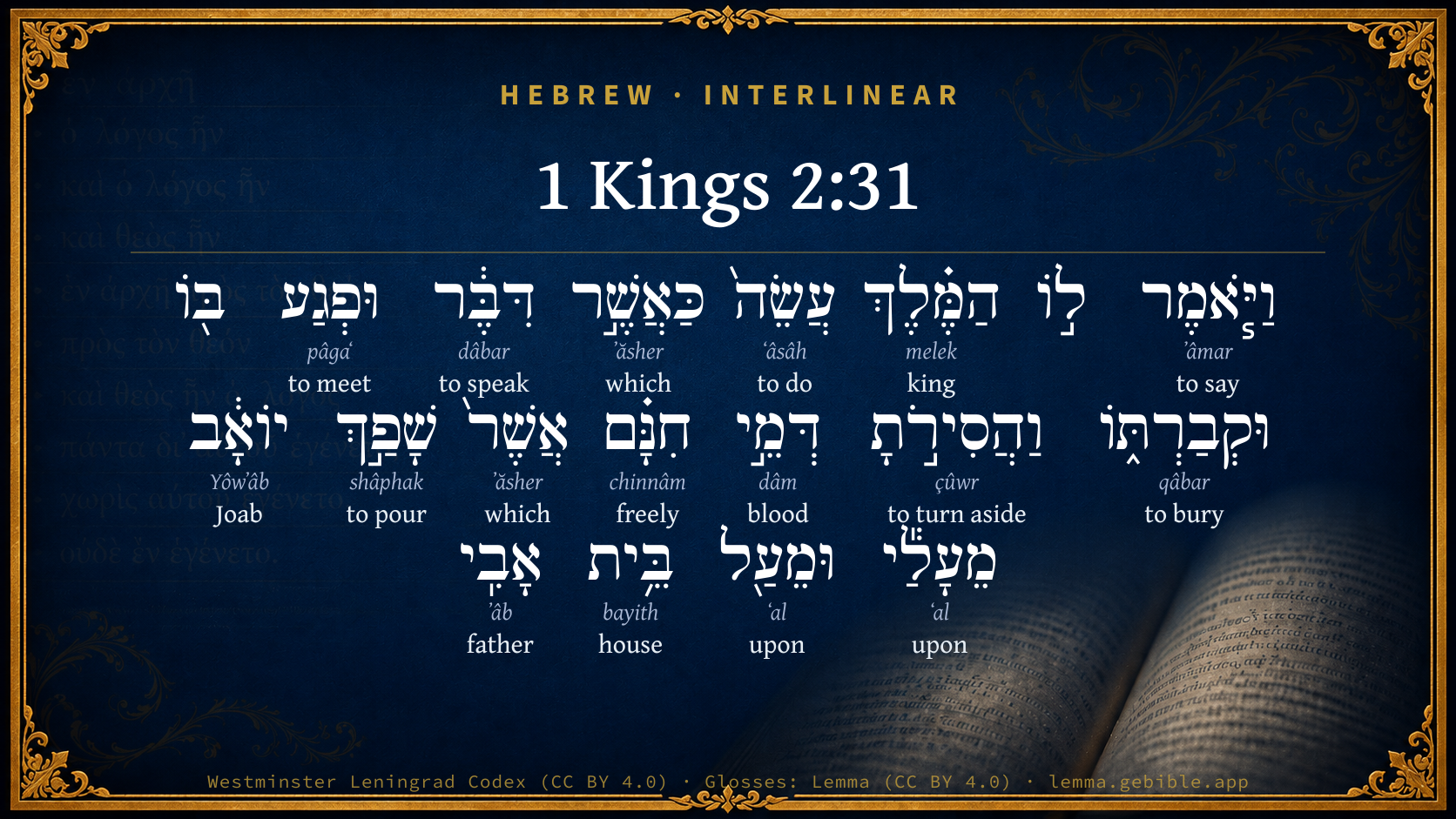
1 Kings 2:31

Hebrew (Westminster Leningrad Codex) 1 Kings 2:31 appears in the Hebrew Old Testament. The text above is from the Westminster Leningrad Codex. Each word links to its Strong’s number, a concise gloss, and parsing drawn from the Open Scriptures Hebrew Bible morphology. Click any word for its full Brown-Driver-Briggs (BDB) entry.
Download image
Cite this verse

1 Kings 2:31 (World English Bible). Public Domain. Lemma interlinear Bible study tool, https://lemma.gebible.app/v/1-kings/2/31.

Show BibTeX & RIS
BibTeX
RIS
English Translation
The king said to him, Do as he has said, and fall on him, and bury him; that you may take away the blood, which Joab shed without cause, from me and from my father's house.
World English Bible · Public Domain
Download a study sheet

One document with this verse’s original text, its word-by-word gloss line, the meaning frame, cross-references with their text, attributed commentary, and full source and license credits — printable, and it pastes into notes with its structure intact.

This verse Autodidact and up

Study sheet (.html) Plain text (.txt)

A passage Seminary Student

Up to 50 verses in one chapter. A passage sheet keeps up to 6 commentary sources and 12 cross-references per verse, in the order this page ranks them, and says so on the sheet whenever that leaves anything out. Ask for a single verse and you get the Autodidact verse sheet above.

Everything on this page stays free to read, with no account — the sheet is a download of what is already on screen, not access to it.

Want to remove ads? Support Godless Engineer
Compare translations 3

The same verse in 3 English versions, stacked beneath the original-language interlinear above. Click any original word for its lexicon entry.

Each is an independent rendering of the whole verse — the interlinear is not word-aligned to these translations.

Highlighted words mark where these versions differ — a whole-verse word diff, not a word-by-word alignment.

  • World English Bible Public Domain
    The king said to him, Do as he has said, and fall on him, and bury him; that you may take away the blood, which Joab shed without cause, from me and from my father's house.
  • King James Version Public Domain
    And the king said unto him, Do as he hath said, and fall upon him, and bury him; that thou mayest take away the innocent blood, which Joab shed, from me, and from the house of my father.
  • unfoldingWord Literal Text CC BY-SA 4.0
    And the king said to him, “Do just as he has spoken and attack him and bury him. And you shall remove the blood that Joab poured out without cause from upon me and from upon the house of my father.

unfoldingWord Literal Text — © unfoldingWord, licensed CC BY-SA 4.0. Word-aligned USFM3 via Door43 (git.door43.org/unfoldingWord/en_ult).

Versions to compare (up to 4)

3 of 4 selected

Show all 18 translations

Every available English version of this verse, each an independent rendering of the whole verse.

  • World English Bible Public Domain
    The king said to him, Do as he has said, and fall on him, and bury him; that you may take away the blood, which Joab shed without cause, from me and from my father's house.
  • Berean Standard Bible Public Domain
    And the king replied, “Do just as he says. Strike him down and bury him, and so remove from me and from the house of my father the innocent blood that Joab shed.
  • Majority Standard Bible Public Domain
    And the king replied, “Do just as he says. Strike him down and bury him, and so remove from me and from the house of my father the innocent blood that Joab shed.
  • King James Version Public Domain
    And the king said unto him, Do as he hath said, and fall upon him, and bury him; that thou mayest take away the innocent blood, which Joab shed, from me, and from the house of my father.
  • American Standard Version (1901) Public Domain
    And the king said unto him, Do as he hath said, and fall upon him, and bury him; that thou mayest take away the blood, which Joab shed without cause, from me and from my father's house.
  • Revised Version (1885) Public Domain
    And the king said unto him, Do as he hath said, and fall upon him, and bury him; that thou mayest take away the blood, which Joab shed without cause, from me and from my father’s house.
  • Geneva Bible (1599) Public Domain
    And the King sayde vnto him, Doe as he hath sayd, and smite him, and bury him, that thou mayest take away the blood, which Ioab shed causelesse, from me and from the house of my father.
  • Douay-Rheims (1899) Public Domain
    And the king said to him: Do as he hath said: and kill him, and bury him, and thou shalt remove the innocent blood which hath been shed by Joab, from me, and from the house of my father.
  • Young's Literal Translation Public Domain
    And the king saith to him, `Do as he hath spoken, and fall upon him, and thou hast buried him, and turned aside the causeless blood which Joab shed, from off me, and from off the house of my father;
  • Literal Standard Version CC BY-SA 4.0
    And the king says to him, “Do as he has spoken, and fall on him, and you have buried him, and turned aside the causeless blood which Joab shed from off me, and from off the house of my father;
  • Unlocked Literal Bible CC BY-SA 4.0
    The king said to him, “Do as he has said. Kill him and bury him so that you may take away from me and from my father's house the blood that Joab shed without cause.
  • unfoldingWord Literal Text CC BY-SA 4.0
    And the king said to him, “Do just as he has spoken and attack him and bury him. And you shall remove the blood that Joab poured out without cause from upon me and from upon the house of my father.
  • Darby Bible Public Domain
    And the king said to him, Do as he has said, and fall upon him, and bury him; and take away the innocent blood, which Joab shed, from me and from the house of my father.
  • World Messianic Bible Public Domain
    The king said to him, “Do as he has said, and fall on him, and bury him, that you may take away the blood, which Joab shed without cause, from me and from my father’s house.
  • Webster's Bible Public Domain
    And the king said to him, Do as he hath said, and fall upon him, and bury him; that thou mayest take away the innocent blood which Joab shed, from me, and from the house of my father.
  • Free Bible Version CC BY-SA 4.0
    “Do as he says,” the king told Benaiah. “Strike him down and bury him. In that way you will remove from me and my family the guilt of the innocent blood that Joab shed.
  • Bible in Basic English Public Domain
    And the king said, Do as he has said and make an attack on him there, and put his body into the earth; so that you may take away from me and from my family the blood of one put to death by Joab without cause.
  • JPS Tanakh (1917) Public Domain
    And the king said unto him: 'Do as he hath said, and fall upon him, and bury him; that thou mayest take away the blood, which Joab shed without cause, from me and from my father's house.

Literal Standard Version (2020), Covenant Press — licensed CC BY-SA 4.0. Text via the HelloAO Bible API (eBible.org). Unlocked Literal Bible (unfoldingWord) — licensed CC BY-SA 4.0. Text via the HelloAO Bible API (eBible.org). unfoldingWord Literal Text — © unfoldingWord, licensed CC BY-SA 4.0. Word-aligned USFM3 via Door43 (git.door43.org/unfoldingWord/en_ult). Free Bible Version, Dr. Jonathan Gallagher — licensed CC BY-SA 4.0. Text via the HelloAO Bible API (eBible.org).

Word by word

More ways to search: Search by grammar → Find every occurrence → Compare this word →

Practice this passage: Drill this verse → Learn its vocabulary →

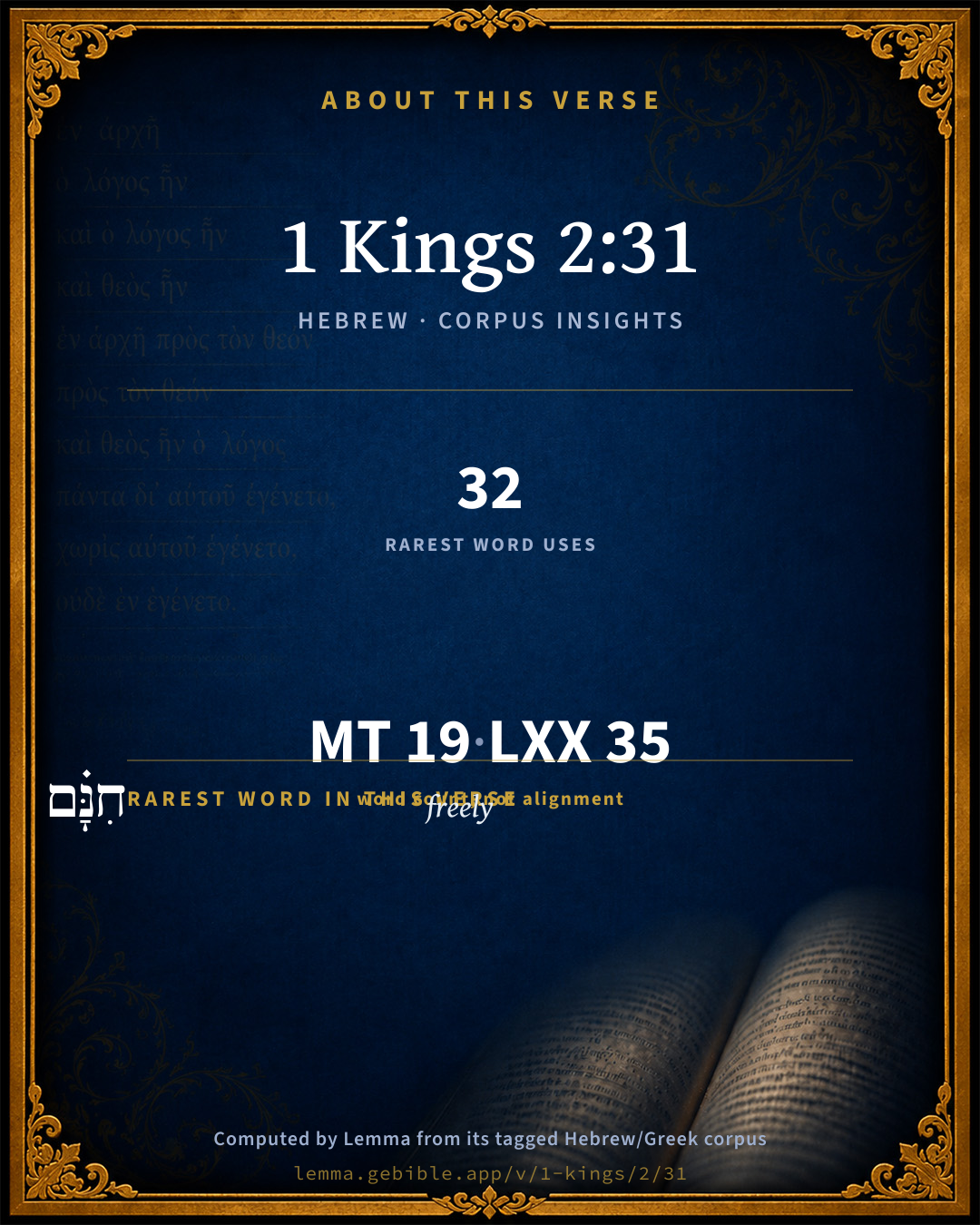
חִנָּ֗ם
chinnâm
H2600
“freely”
Adverb
Part of Speech
Adverb
Full BDB Definition

Origin: from H2580

TWOT: 694b

freely, for nothing, without cause - gratis, gratuitously, for nothing - for no purpose, in vain - gratuitously, without cause, undeservedly
  1. וַיֹּ֧אמֶר ʼâmar H559 “and · to say” Conjunction + Verb, Qal, Sequential Imperfect, 3rd Person, Masculine, Singular
  2. הַמֶּ֗לֶךְ melek H4428 “the · king” Particle, Definite Article + Noun, Common, Masculine, Singular, Absolute
  3. עֲשֵׂה֙ ʻâsâh H6213 “do” Verb, Qal, Imperative, 2nd Person, Masculine, Singular
  4. כַּאֲשֶׁ֣ר ʼăsher H834 “like/as · which” Preposition + Particle, Relative
  5. דִּבֶּ֔ר dâbar H1696 “to speak” Verb, Piel, Perfect, 3rd Person, Masculine, Singular
  6. וּפְגַע pâgaʻ H6293 “and · meet” Conjunction + Verb, Qal, Imperative, 2nd Person, Masculine, Singular
  7. וּקְבַרְתּ֑וֹ qâbar H6912 “and · to bury · him” Conjunction + Verb, Qal, Sequential Perfect, 2nd Person, Masculine, Singular + Suffix, Personal, 3rd Person, Masculine, Singular
  8. וַהֲסִירֹ֣תָ çûwr H5493 “and · to turn aside” Conjunction + Verb, Hiphil, Sequential Perfect, 2nd Person, Masculine, Singular
  9. דְּמֵ֣י dâm H1818 “blood of” Noun, Common, Masculine, Plural, Construct
  10. אֲשֶׁר֙ ʼăsher H834 “which” Particle, Relative
  11. שָׁפַ֣ךְ shâphak H8210 “to pour” Verb, Qal, Perfect, 3rd Person, Masculine, Singular
  12. יוֹאָ֔ב Yôwʼâb H3097 “Joab” Noun, Proper
  13. מֵעָלַ֕י ʻal H5921 “from · upon · me” Preposition + Preposition + Suffix, Personal, 1st Person, Common, Singular
  14. וּמֵעַ֖ל ʻal H5921 “and · from · upon” Conjunction + Preposition + Preposition
  15. בֵּ֥ית bayith H1004 “house of” Noun, Common, Masculine, Singular, Construct
  16. אָבִֽי ʼâb H1 “father · my” Noun, Common, Masculine, Singular, Construct + Suffix, Personal, 1st Person, Common, Singular

About this verse

These counts appear in no published source. They are computed here, from the morphology-tagged text and Lemma’s own curated glosses. What Lemma adds →

19
words
15
distinct lemmas
Historical
section

Shared distinctive vocabulary

חִנָּ֗ם freely H2600 occurs in 31 verses of the Hebrew Bible. Also found in:

Grammatical profile

  • 7 verbs
  • 5 nouns
  • 4 prepositions
  • 1 adverb
  • 2 particles

Verb forms

  • וַיֹּ֧אמֶר Qal · Sequential Imperfect
  • עֲשֵׂה֙ Qal · Imperative
  • דִּבֶּ֔ר Piel · Perfect
  • וּפְגַע Qal · Imperative
  • וּקְבַרְתּ֑וֹ Qal · Sequential Perfect
  • וַהֲסִירֹ֣תָ Hiphil · Sequential Perfect
  • שָׁפַ֣ךְ Qal · Perfect

Repetition

Words recur within this verse — often emphatic in Hebrew:

  • מֵעָלַ֕י upon H5921 ×2
  • כַּאֲשֶׁ֣ר which H834 ×2

Hebrew & Septuagint length

In English translation the verse runs 36 words from the Hebrew and 45 from the Septuagint (LXX English) — closely comparable.

A rough comparison of the two English renderings, which tokenize alike — not a word-level alignment.

Word counts can differ between the Hebrew and the Greek without any difference in meaning — e.g. the Hebrew direct-object marker אֵת has no separate Greek word, and Greek often adds the article ὁ.

In the original languages it is 19 Hebrew tokens and 35 Greek tokens — but the two are counted differently (Hebrew bundles its prefixes and suffixes into one token; the Greek is in lemma form), so that isn’t a like-for-like length.

Cross-references

9

Topical passages linked to 1 Kings 2:31 in the Treasury of Scripture Knowledge — connected by theme and wording, ordered by reader-vote popularity; previews shown in the World English Bible.

  • Numbers 35:33 So you shall not pollute the land in which you are: for blood, it pollutes the land; and no expiation can be made for the land for the blood that is shed therein, but by the blood of him who shed it.
  • Deuteronomy 21:8–9 Forgive, Yahweh, your people Israel, whom you have redeemed, and don't allow innocent blood [to remain] in the midst of your people Israel. The blood shall be forgiven them.
  • Exodus 21:14 If a man schemes and comes presumptuously on his neighbor to kill him, you shall take him from my altar, that he may die.
  • 2 Samuel 3:28 Afterward, when David heard it, he said, I and my kingdom are guiltless before Yahweh forever of the blood of Abner the son of Ner:
  • Proverbs 28:17 A man who is tormented by life blood will be a fugitive until death; No one will support him.
  • Genesis 9:5–6 I will surely require your blood of your lives. At the hand of every animal I will require it. At the hand of man, even at the hand of every man's brother, I will require the life of man.
  • Deuteronomy 19:12–13 then the elders of his city shall send and bring him there, and deliver him into the hand of the avenger of blood, that he may die.
  • 2 Kings 9:26 Surely I have seen yesterday the blood of Naboth, and the blood of his sons, says Yahweh; and I will requite you in this plat, says Yahweh. Now therefore take and cast him into the plat [of ground], according to the word of Yahweh.
  • Acts 28:4 When the natives saw the creature hanging from his hand, they said one to another, "No doubt this man is a murderer, whom, though he has escaped from the sea, yet Justice has not allowed to live."

Cross-references courtesy of OpenBible.info (CC BY 4.0).

Hebrew and Greek witnesses Masoretic Hebrew ↔ Greek Septuagint

The same verse in the two great witnesses to the Old Testament, shown verse-for-verse.

These are two independent witnesses, not word-aligned to each other, and the Septuagint is shown in lemma (dictionary) form.

Hebrew 1 Kings 2:31 Masoretic · Westminster Leningrad Codex

וַיֹּ֧אמֶר ל֣וֹ הַמֶּ֗לֶךְ עֲשֵׂה֙ כַּאֲשֶׁ֣ר דִּבֶּ֔ר וּפְגַע בּ֖וֹ וּקְבַרְתּ֑וֹ וַהֲסִירֹ֣תָ דְּמֵ֣י חִנָּ֗ם אֲשֶׁר֙ שָׁפַ֣ךְ יוֹאָ֔ב מֵעָלַ֕י וּמֵעַ֖ל בֵּ֥ית אָבִֽי

The king said to him, Do as he has said, and fall on him, and bury him; that you may take away the blood, which Joab shed without cause, from me and from my father's house.

World English Bible · Public Domain

Greek LXX 1 Kings 2:31 Septuagint · lemma form

καί εἶπον αὐτός ὁ βασιλεύς πορεύομαι καί ποιέω αὐτός καθώς εἶπον καί ἀνααἱρέω αὐτός καί θάπτω αὐτός καί ἐκαἴρω σήμερον ὁ αἷμα ὅς δωρεά ἐκχέω ιωαβ ἀπό ἐγώ καί ἀπό ὁ οἶκος ὁ πατήρ ἐγώ

And the king said to him, Go, and do to him as he has spoken, and kill him: and you shall bury him, and you shall remove this day the blood which he shed without cause, from me and from the house of my father.

LXX2012 (modern English Septuagint) · Public Domain

On this verse, The Cambridge Bible for Schools and Colleges discusses the Septuagint’s reading. Read the note in Commentary ↓

Hebrew: Westminster Leningrad Codex (CC BY 4.0). Greek: Septuagint (public domain); English from LXX2012 (modern English Septuagint) (Public Domain). How the Septuagint differs from the Hebrew →

Targum (Aramaic paraphrase)

1

The Targum is the ancient Jewish Aramaic paraphrase of the Hebrew Scriptures — an interpretive translation, not the Hebrew text itself. Onkelos (literal) and Pseudo-Jonathan (expansive) render the Torah, and Jonathan the Prophets. Coverage is partial: where no permissively-licensed English translation exists for a verse, only the Aramaic is shown. This is verse-level text, not a word-by-word alignment to the Hebrew.

  1. Targum Jonathan Prophets (Joshua–Malachi)
    וַאֲמַר לֵיהּ מַלְכָּא עֲבֵיד כְּמָא דְמַלֵיל וְתִשְׁלוֹט בֵּיהּ וְתִקְבְּרִינֵיהּ וּתְפַלֵי חוֹבַת דַם זַכַּאי דַאֲשַׁד יוֹאָב מַגָן מִנִי וּמִן בֵּית אַבָּא:

    (no public-domain English translation for this verse)

    Targum Jonathan — Aramaic: “Mikraot Gedolot” (public domain). English: “Sefaria Community Translation” (CC0 1.0 (public-domain dedication)); “London "Chaldee Paraphrase," 1871” (public domain). Text via Sefaria.

Commentary

Notes on 1 Kings 2:31 from classic Christian and Jewish commentators (each source and its license shown beneath its notes). The classic Christian expositions comment on the surrounding passage and are grouped to its opening verse, so a note may address several verses; the Jewish commentaries on the Tanakh (Rashi and others) are per-verse, so they appear only where the commentator wrote on this verse.

Lemma curates 59 commentaries, every one of them public domain or Creative Commons licensed, each selected and text-cleaned for this edition rather than reprinted as found. About our sources →

Trapp's Complete Commentary

John Trapp

1Ki 2:31 And the king said unto him, Do as he hath said, and fall upon him, and bury him; that thou mayest take away the innocent blood, which Joab shed, from me, and from the house of my father.

Ver. 31. Do as he hath said.] Slay him, though it be at the altar. Becket, the traitor, was so served by some that belonged to our Henry II, and thought to gratify him thereby. And although the king constantly protested, se nec mandasse, nec voluisse, nec suo artificio quaesivisse necem Thomae, that he was neither witting nor willing to the taking away of his life in that sort; yet, for a penance, he was, by the command of the Pope’s legate, lashed on the bare [back] with rods, each of the priests and friars there present - and they were not a few - giving him three or four stripes, till the blood followed: besides that he was forced to go three miles on his bare feet, which yielded bloody tokens of his devotion, on the way to Becket’s sepulchre, which he went to visit. {a}

{a} Rev., De Vit. Pontif., 149. Dan., Hist., fol. 101.

John Trapp, A Commentary or Exposition upon All the Books of the Old and New Testament (1647–1656) — public domain. Text from a community e-Sword module.

Joseph Benson's Commentary

1Ki 2:31. Do as he hath said — Kill him, though he be there; take him from that place, and then kill him: for Exo 21:14, doth not command the ruler to kill the murderer there, but to remove him thence; to take him from the altar, that he may die. That thou mayest take away the innocent blood from me — Kings or judges owe that justice to God, whose vicegerents they are, as to inflict those punishments on offenders which the divine laws require them to inflict: or otherwise, the punishment due to the offenders may with justice fall upon their own heads, as, by not executing the punishment, they, in some measure, give their approbation to the crime.

Joseph Benson's Commentary on the Old and New Testaments (1811–1818) — public domain. Text from a community e-Sword module.

Geneva Bible (1599)

Geneva Bible translators

For it was lawful to take the willful murderer from the altar, Exod. 21:14.

Geneva Bible (1599) marginal notes — public domain. Text via Bolls.life.

The Cambridge Bible for Schools and Colleges

gen. ed. J. J. S. Perowne

31. and bury him] The LXX. adds these words to the king’s previous order in 1Ki_2:29. Joab was Solomon’s cousin, and so though it was a political necessity to put him to death, the king would not care to add further dishonour to the dead body.

the innocent blood] i.e. The causeless bloodshed of innocent people of which Joab had been guilty, and which, until it was avenged, would lie at the door of David and his descendants.

The Cambridge Bible for Schools and Colleges (gen. ed. J. J. S. Perowne; Cambridge University Press, 1878–1918) — public domain. Text from a community e-Sword module.

John Gill's Exposition

And the Lord shall return his blood upon his own head,.... By way of retaliation, blood for blood:

who fell upon two men more righteous and better than he; later named; for though they had been in open rebellion against David, yet had submitted, and were reconciled and received into favour; and even their open crimes were not so bad, Solomon judged, as his secret treacherous murders of innocent persons in cool blood; they were men of more honour and integrity than he was, not so cruel and barbarous, though guilty in other respects:

and slew them with the sword, my father not knowing thereof; this is observed to remove all suspicion, and which doubtless had been entertained by some, that David had an hand in their death; and that Joab did what he did with his knowledge and consent, and by his advice and order; they having been both concerned in rebellion against him, the one under Ishbosheth, and the other under Absalom:

to wit, Abner the son of Ner, captain of the host of Israel, and Amasa the son of Jether, captain of the host of Judah: the reason of the two hosts, of which they were captains or generals, being thus distinguished, is, because the tribes of Israel were on the side of Ishbosheth, whose general Abner was, in opposition to Judah, who made David their king; and, on the other hand, they were the men of Judah that were first and chiefly in the rebellion of Absalom, whose general Amasa was; of the murder of these two men by Joab, see Sa2 3:27.

John Gill's Exposition of the Whole Bible (1746–1763) — public domain (CC PDM 1.0). Text via the HelloAO Bible API.

Albert Barnes' Notes on the Bible

It was only a murderer to whom the tabernacle was to be no protection (margin reference). Hence, the reference to the “innocent blood.”

Albert Barnes' Notes on the Bible (1834–1885) — public domain. Text from a community e-Sword/MySword module.

Matthew Poole's English Annotations

Do as he hath said; either,

1. Kill him in that place; and for so doing Solomon might seem to have warrant from God, Exo 21:14, and might further design by this just severity to deter future offenders, by showing that no place nor person should protect them from the stroke of justice. Or rather,

2. Let him die as he is resolved; kill him, though he be there; take him by violence from that place, and then kill him; for Exo 21:14 doth not command the ruler to kill the murderer there, but to remove him thence, to

take him from the altar, that he may die. And seeing this might be done, why should Solomon unnecessarily stain the altar with his blood?

The innocent blood, i. e. both the guilt of it, which would rest upon my father and my family if it went unpunished; and the scandal and reproach of it, that neither this nor following ages may imagine that it was done by David’s secret instigation, or with his consent.

Matthew Poole's English Annotations on the Holy Bible (1683–1685) — public domain. Text from a community e-Sword/MySword module.

The Pulpit Commentary

And the king said unto him do as he hath said, and fall upon him the law decreed (Exo_21:14) that, if a man had slain his neighbour with guile, he should be taken from the altar to die. Possibly the desperate character of Joab made literal compliance with this command well nigh impossible. The attempt to drag him from his place of refuge might have led to a bloody encounter. And the king evidently felt that Joab"s crimes justified exceptional measures, and bury him why this injunction? Possibly because the spirit of; Deu_21:23 seemed to Solomon to require it. Both Bahr and Keil think it was that Joab"s services to the kingdom might be requited with an honourable sepulture. Was it not rather that the corpse might be removed with all possible haste from the sanctuary, which it defiled, and hidden from view, as one accursed of God, in the earth? So Bishop Hall: "He sends Benaiah to take away the offender both from God and men, from the altar and the world" that thou mayest take away LXX "today," shmeron the innocent blood for the construction cf. 1Sa_25:31; Neh_2:12; and Ewald, 287 d. Innocent blood, i.e., blood not shed in war, or forfeited to justice, rested upon the community, or the authorities responsible for its punishment (Num_35:33; Deu_19:10, 13 21:9. Cf. Gen_4:10) until satisfaction was made. See on ver. 5, which Joab shed, from me, and from the house of my father. Heb. "from upon me." Solomon evidently believed that the guilt of blood was upon him and his house so long as Abner"s and Amasa"s blood remained unavenged ("The blood that is not required from the murderer will be required from the magistrate." Henry), and that he and his seed might have to answer for it, as Saul"s seed had done. (2Sa_21:1, 2Sa_21:9) This is one of the many considerations which show that both David and Solomon were actuated not by "cold-blooded vengeance" or "long-cherished resentment" (Stanley), but by a sense of duty. In fact, Jewish law imperatively demanded the death of Joab, and to spare him was to violate all law, and to imperil the throne and the people. "Only a superficial observer," says Ewald, "can here reproach Solomon with needless severity."

The Pulpit Commentary (1880–1919), ed. H.D.M. Spence-Jones & Joseph S. Exell — public domain. Text from a community e-Sword module.

John Wesley's Explanatory Notes

Do, &c. - Kill him, though he be there; take him from that place, and then kill him: for, Exod. xxi, 14, doth not command the ruler to kill the murderer there, but to remove him thence, to take him from the altar, that he may die.

John Wesley, Explanatory Notes Upon the Whole Bible (1754–1765) — public domain. Text via the GEBible commentary corpus.

Rashi

Rabbi Shlomo Yitzchaki (Rashi)

Do as he said. I accept them [i.e., the curses] upon myself. Therefore, all these became attached to Dovid’s offspring. Uziyah became [a] leper, Assa leaned on a staff, Yehoyakim died by the sword, and Tzidkiyahu lacked bread.

Rashi on the Tanakh — English translations: “The Judaica Press complete Tanach with Rashi, translated by A. J. Rosenberg” (CC BY 4.0); “Pentateuch with Rashi's commentary by M. Rosenbaum and A.M. Silbermann, 1929-1934” (public domain); “The Metsudah Tanach series, Lakewood, N.J” (CC BY 4.0); and “The Book of Joshua, Metsudah Publications, 1997” (CC BY 4.0). Text via Sefaria.

Lesson kit

Teaching starters — assembled from the data on this page, not authored interpretation. Every prompt links to the verse data it draws on. Edit before teaching.

1 Kings, in the Historical, opens this verse with 19 words (15 distinct Hebrew lemmas). Its most distinctive word is chinnâm (“freely”). A historical commentator’s framing appears above. Read the whole chapter for the surrounding context.

Discussion questions

  1. What does “freely” (chinnâm) contribute to the verse as a whole?
  2. How does Genesis 29:15, which shares the word «freely», read alongside this verse?
  3. What does the repetition of “upon” (2× in this one verse) do in this verse?
  4. These translations render this verse differently; the difference is in the English rendering, not the original. What questions does that raise?
  5. «וַיֹּ֧אמֶר» is a Qal Sequential Imperfect verb. How does that grammatical form shape the action described?
  6. Compare how Trapp's Complete Commentary and Joseph Benson's Commentary read this verse. Where do they agree or differ?

Things to notice

Reading settings

Reading text

Shown beneath each verse's original-language words.

Old Testament
Old Testament edition

Read the OT as the Masoretic Hebrew (MT) or the Greek Septuagint (LXX).

English shown for the Greek Septuagint (in the Hebrew ↔ Greek comparison).

Comparing translations? Open the Compare panel on any verse page to stack up to four side by side.