2 Kings 24:4

Hebrew (Westminster Leningrad Codex) 2 Kings 24:4 appears in the Hebrew Old Testament. The text above is from the Westminster Leningrad Codex. Each word links to its Strong’s number, a concise gloss, and parsing drawn from the Open Scriptures Hebrew Bible morphology. Click any word for its full Brown-Driver-Briggs (BDB) entry.
Download image
Cite this verse

2 Kings 24:4 (World English Bible). Public Domain. Lemma interlinear Bible study tool, https://lemma.gebible.app/v/2-kings/24/4.

Show BibTeX & RIS
BibTeX
RIS
English Translation
and also for the innocent blood that he shed; for he filled Jerusalem with innocent blood: and Yahweh would not pardon.
World English Bible · Public Domain
Download a study sheet

One document with this verse’s original text, its word-by-word gloss line, the meaning frame, cross-references with their text, attributed commentary, and full source and license credits — printable, and it pastes into notes with its structure intact.

This verse Autodidact and up

Study sheet (.html) Plain text (.txt)

A passage Seminary Student

Up to 50 verses in one chapter. A passage sheet keeps up to 6 commentary sources and 12 cross-references per verse, in the order this page ranks them, and says so on the sheet whenever that leaves anything out. Ask for a single verse and you get the Autodidact verse sheet above.

Everything on this page stays free to read, with no account — the sheet is a download of what is already on screen, not access to it.

Want to remove ads? Support Godless Engineer
Compare translations 3

The same verse in 3 English versions, stacked beneath the original-language interlinear above. Click any original word for its lexicon entry.

Each is an independent rendering of the whole verse — the interlinear is not word-aligned to these translations.

Highlighted words mark where these versions differ — a whole-verse word diff, not a word-by-word alignment.

  • World English Bible Public Domain
    and also for the innocent blood that he shed; for he filled Jerusalem with innocent blood: and Yahweh would not pardon.
  • King James Version Public Domain
    And also for the innocent blood that he shed: for he filled Jerusalem with innocent blood; which the LORD would not pardon.
  • unfoldingWord Literal Text CC BY-SA 4.0
    and also the innocent blood that he poured out, for he had filled Jerusalem innocent blood, and Yahweh was not willing to forgive.

unfoldingWord Literal Text — © unfoldingWord, licensed CC BY-SA 4.0. Word-aligned USFM3 via Door43 (git.door43.org/unfoldingWord/en_ult).

Versions to compare (up to 4)

3 of 4 selected

Show all 18 translations

Every available English version of this verse, each an independent rendering of the whole verse.

  • World English Bible Public Domain
    and also for the innocent blood that he shed; for he filled Jerusalem with innocent blood: and Yahweh would not pardon.
  • Berean Standard Bible Public Domain
    and also for the innocent blood he had shed. For he had filled Jerusalem with innocent blood, and the LORD was unwilling to forgive.
  • Majority Standard Bible Public Domain
    and also for the innocent blood he had shed. For he had filled Jerusalem with innocent blood, and the LORD was unwilling to forgive.
  • King James Version Public Domain
    And also for the innocent blood that he shed: for he filled Jerusalem with innocent blood; which the LORD would not pardon.
  • American Standard Version (1901) Public Domain
    and also for the innocent blood that he shed; for he filled Jerusalem with innocent blood: and Jehovah would not pardon.
  • Revised Version (1885) Public Domain
    and also for the innocent blood that he shed; for he filled Jerusalem with innocent blood: and the LORD would not pardon.
  • Geneva Bible (1599) Public Domain
    And for the innocent blood that he shed, (for he filled Ierusalem with innocent blood) therefore the Lord would not pardon it.
  • Douay-Rheims (1899) Public Domain
    And for the innocent blood that he shed, filling Jerusalem with innocent blood: and therefore the Lord would not be appeased.
  • Young's Literal Translation Public Domain
    and also the innocent blood that he hath shed, and he filleth Jerusalem with innocent blood, and Jehovah was not willing to forgive.
  • Literal Standard Version CC BY-SA 4.0
    and also the innocent blood that he has shed, and he fills Jerusalem with innocent blood, and YHWH was not willing to forgive.
  • Unlocked Literal Bible CC BY-SA 4.0
    and also because of the innocent blood that he shed, for he filled Jerusalem with innocent blood. Yahweh was not willing to pardon that.
  • unfoldingWord Literal Text CC BY-SA 4.0
    and also the innocent blood that he poured out, for he had filled Jerusalem innocent blood, and Yahweh was not willing to forgive.
  • Darby Bible Public Domain
    and also [because of] the innocent blood that he had shed; for he had filled Jerusalem with innocent blood, and Jehovah would not pardon.
  • World Messianic Bible Public Domain
    and also for the innocent blood that he shed; for he filled Jerusalem with innocent blood, and the LORD would not pardon.
  • Webster's Bible Public Domain
    And also for the innocent blood that he shed: for he filled Jerusalem with innocent blood; which the LORD would not pardon.
  • Free Bible Version CC BY-SA 4.0
    filling Jerusalem with their blood. The Lord was not willing to forgive this.
  • Bible in Basic English Public Domain
    And because of the death of those who had done no wrong, for he made Jerusalem full of the blood of the upright; and the Lord had no forgiveness for it.
  • JPS Tanakh (1917) Public Domain
    and also for the innocent blood that he shed; for he filled Jerusalem with innocent blood; and the LORD would not pardon.

Literal Standard Version (2020), Covenant Press — licensed CC BY-SA 4.0. Text via the HelloAO Bible API (eBible.org). Unlocked Literal Bible (unfoldingWord) — licensed CC BY-SA 4.0. Text via the HelloAO Bible API (eBible.org). unfoldingWord Literal Text — © unfoldingWord, licensed CC BY-SA 4.0. Word-aligned USFM3 via Door43 (git.door43.org/unfoldingWord/en_ult). Free Bible Version, Dr. Jonathan Gallagher — licensed CC BY-SA 4.0. Text via the HelloAO Bible API (eBible.org).

Word by word

More ways to search: Search by grammar → Find every occurrence → Compare this word →

Practice this passage: Drill this verse → Learn its vocabulary →

הַנָּקִי֙
nâqîy
H5355
“the · innocent”
Particle, Definite Article + Adjective, Adjective, Masculine, Singular, Absolute
Part of Speech
Particle + Adjective
Type
Adjective
Gender
Masculine
Number
Singular
State
Absolute
Full BDB Definition

Origin: from H5352

TWOT: 1412a , 1412b

clean, free from, exempt, clear, innocent - free from guilt, clean, innocent - free from punishment - free or exempt from obligations - innocent
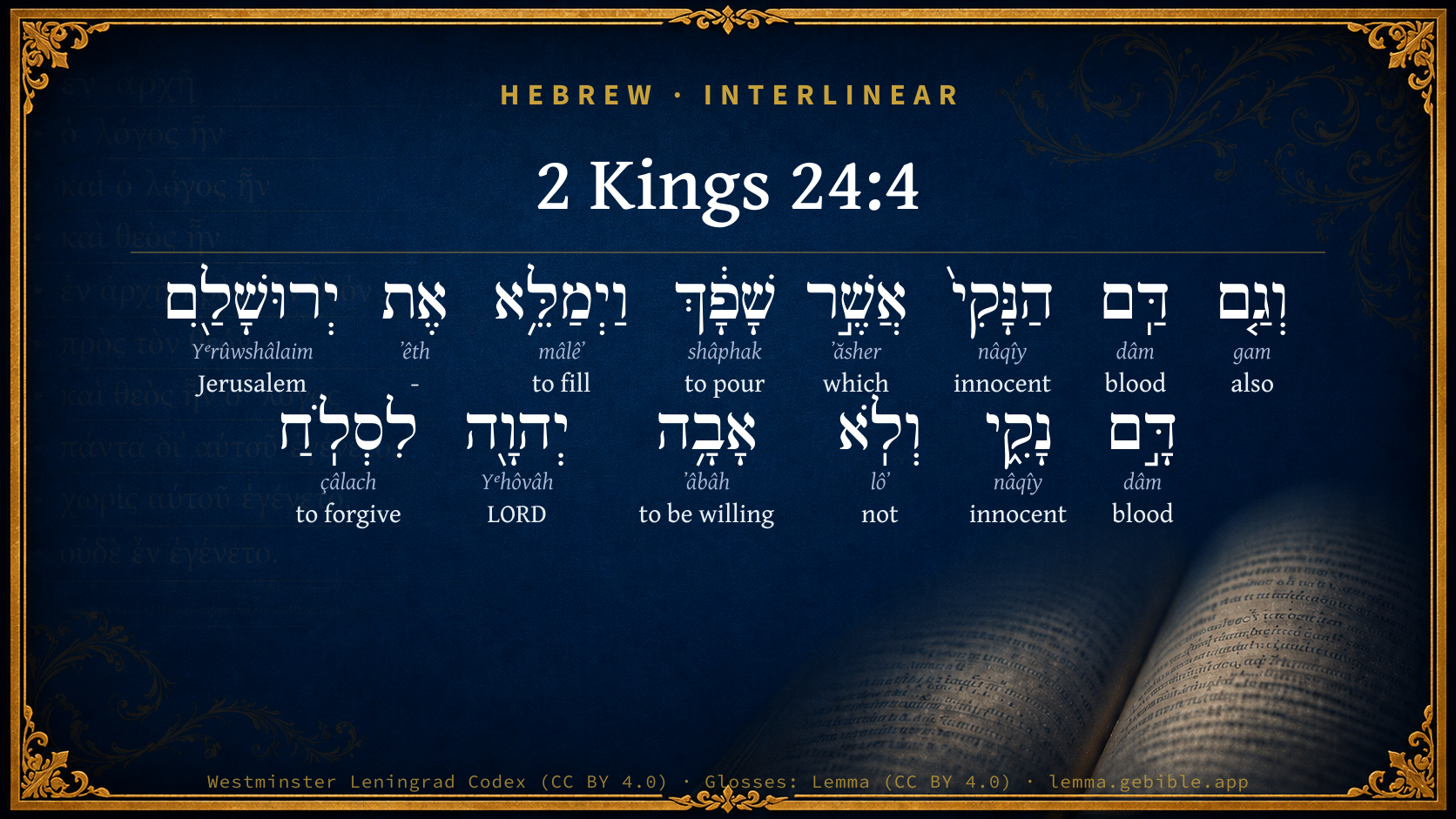
  1. וְגַ֤ם gam H1571 “and · also” Conjunction + Particle, Accusative
  2. דַּֽם dâm H1818 “blood of” Noun, Common, Masculine, Singular, Construct
  3. אֲשֶׁ֣ר ʼăsher H834 “which” Particle, Relative
  4. שָׁפָ֔ךְ shâphak H8210 “to pour” Verb, Qal, Perfect, 3rd Person, Masculine, Singular
  5. וַיְמַלֵּ֥א mâlêʼ H4390 “and · to fill” Conjunction + Verb, Piel, Sequential Imperfect, 3rd Person, Masculine, Singular
  6. אֶת ʼêth H853 “-” Particle, Direct Object
  7. יְרוּשָׁלִַ֖ם Yᵉrûwshâlaim H3389 “Jerusalem” Noun, Proper
  8. דָּ֣ם dâm H1818 “blood” Noun, Common, Masculine, Singular, Absolute
  9. נָקִ֑י nâqîy H5355 “innocent” Adjective, Adjective, Masculine, Singular, Absolute
  10. וְלֹֽא lôʼ H3808 “and · not” Conjunction + Particle, Negative
  11. אָבָ֥ה ʼâbâh H14 “to be willing” Verb, Qal, Perfect, 3rd Person, Masculine, Singular
  12. יְהוָ֖ה Yᵉhôvâh H3068 “LORD” Noun, Proper
  13. לִסְלֹֽחַ çâlach H5545 “to forgive” Preposition + Verb, Qal, Infinitive Construct

About this verse

These counts appear in no published source. They are computed here, from the morphology-tagged text and Lemma’s own curated glosses. What Lemma adds →

14
words
12
distinct lemmas
Historical
section

Shared distinctive vocabulary

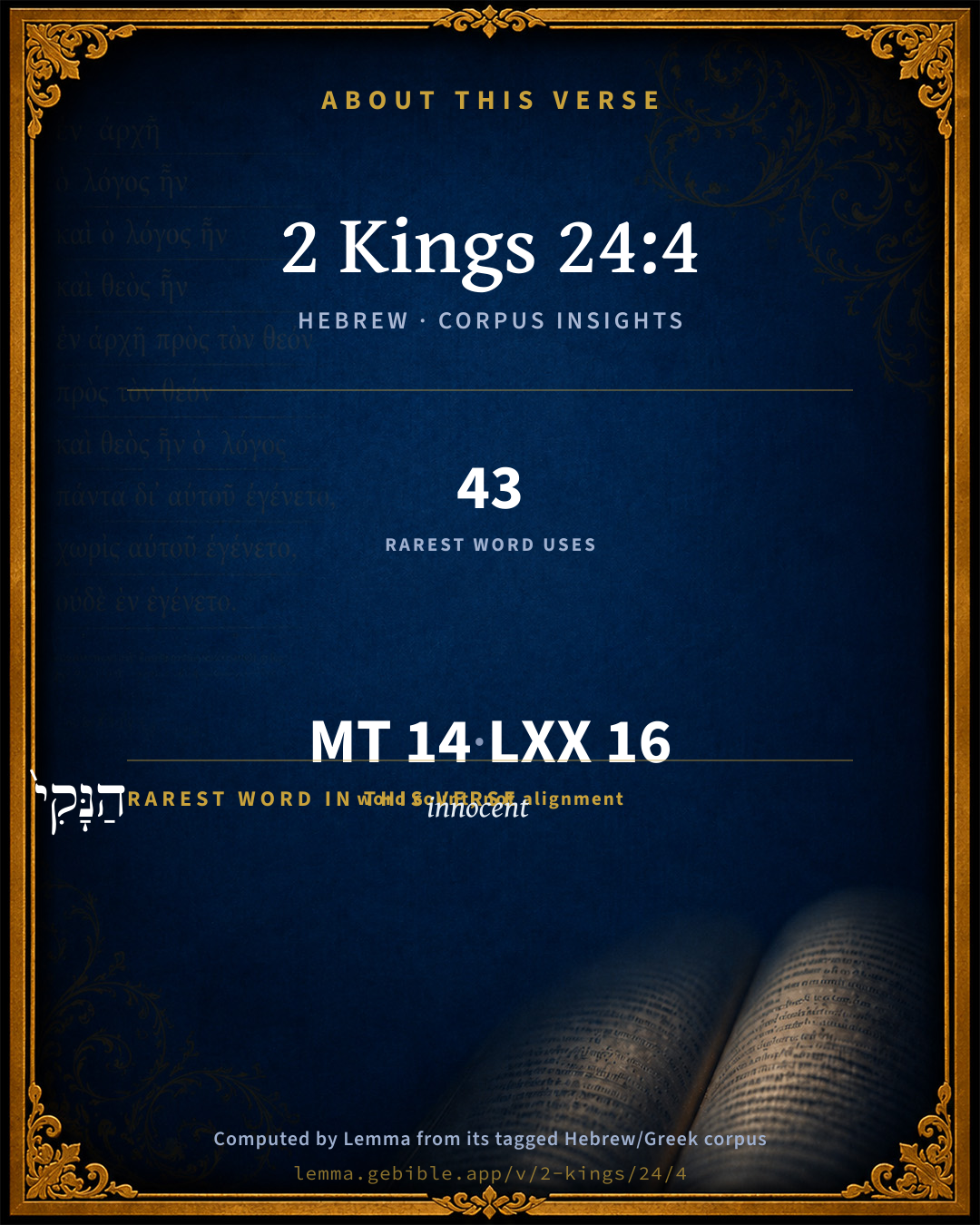
הַנָּקִי֙ innocent H5355 occurs in 42 verses of the Hebrew Bible. Also found in:

Grammatical profile

  • 4 verbs
  • 4 nouns
  • 2 adjectives
  • 4 particles

Verb forms

  • שָׁפָ֔ךְ Qal · Perfect
  • וַיְמַלֵּ֥א Piel · Sequential Imperfect
  • אָבָ֥ה Qal · Perfect
  • לִסְלֹֽחַ Qal · Infinitive Construct

Repetition

Words recur within this verse — often emphatic in Hebrew:

  • דַּֽם blood H1818 ×2
  • הַנָּקִי֙ innocent H5355 ×2

Hebrew & Septuagint length

In English translation the verse runs 21 words from the Hebrew and 18 from the Septuagint (LXX English) — closely comparable.

A rough comparison of the two English renderings, which tokenize alike — not a word-level alignment.

Word counts can differ between the Hebrew and the Greek without any difference in meaning — e.g. the Hebrew direct-object marker אֵת has no separate Greek word, and Greek often adds the article ὁ.

In the original languages it is 14 Hebrew tokens and 16 Greek tokens — but the two are counted differently (Hebrew bundles its prefixes and suffixes into one token; the Greek is in lemma form), so that isn’t a like-for-like length.

Cross-references

7

Topical passages linked to 2 Kings 24:4 in the Treasury of Scripture Knowledge — connected by theme and wording, ordered by reader-vote popularity; previews shown in the World English Bible.

  • 2 Kings 21:16 Moreover Manasseh shed innocent blood very much, until he had filled Jerusalem from one end to another; besides his sin with which he made Judah to sin, in doing that which was evil in the sight of Yahweh.
  • Numbers 35:33 So you shall not pollute the land in which you are: for blood, it pollutes the land; and no expiation can be made for the land for the blood that is shed therein, but by the blood of him who shed it.
  • Deuteronomy 19:10 that innocent blood not be shed in the midst of your land, which Yahweh your God gives you for an inheritance, and so blood be on you.
  • Psalms 106:38 They shed innocent blood, Even the blood of their sons and of their daughters, Whom they sacrificed to the idols of Canaan. The land was polluted with blood.
  • Jeremiah 2:34 Also in your skirts is found the blood of the souls of the innocent poor: you did not find them breaking in; but it is because of all these things.
  • Jeremiah 15:1–2 Then said Yahweh to me, Though Moses and Samuel stood before me, yet my mind would not be toward this people: cast them out of my sight, and let them go forth.
  • Ezekiel 33:25 Therefore tell them, Thus says the Lord Yahweh: You eat with the blood, and lift up your eyes to your idols, and shed blood: and shall you possess the land?

Cross-references courtesy of OpenBible.info (CC BY 4.0).

Hebrew and Greek witnesses Masoretic Hebrew ↔ Greek Septuagint

The same verse in the two great witnesses to the Old Testament, shown verse-for-verse.

These are two independent witnesses, not word-aligned to each other, and the Septuagint is shown in lemma (dictionary) form.

Hebrew 2 Kings 24:4 Masoretic · Westminster Leningrad Codex

וְגַ֤ם דַּֽם הַנָּקִי֙ אֲשֶׁ֣ר שָׁפָ֔ךְ וַיְמַלֵּ֥א אֶת יְרוּשָׁלִַ֖ם דָּ֣ם נָקִ֑י וְלֹֽא אָבָ֥ה יְהוָ֖ה לִסְלֹֽחַ

and also for the innocent blood that he shed; for he filled Jerusalem with innocent blood: and Yahweh would not pardon.

World English Bible · Public Domain

Greek LXX 2 Kings 24:4 Septuagint · lemma form

καί γέ αἷμα ἀθῷος ἐκχέω καί πίμπλημι ὁ ἰερουσαλήμ αἷμα ἀθῷος καί οὐ θέλω κύριος ἱλάσκομαι

Moreover he shed innocent blood, and filled Jerusalem with innocent blood, and the Lord would not pardon it.

LXX2012 (modern English Septuagint) · Public Domain

Hebrew: Westminster Leningrad Codex (CC BY 4.0). Greek: Septuagint (public domain); English from LXX2012 (modern English Septuagint) (Public Domain). How the Septuagint differs from the Hebrew →

Targum (Aramaic paraphrase)

1

The Targum is the ancient Jewish Aramaic paraphrase of the Hebrew Scriptures — an interpretive translation, not the Hebrew text itself. Onkelos (literal) and Pseudo-Jonathan (expansive) render the Torah, and Jonathan the Prophets. Coverage is partial: where no permissively-licensed English translation exists for a verse, only the Aramaic is shown. This is verse-level text, not a word-by-word alignment to the Hebrew.

  1. Targum Jonathan Prophets (Joshua–Malachi)
    וְאַף דַם זַכַּאי דַאֲשַׁד וּמְלֵא יַת יְרוּשְׁלֵם חוֹבַת דַם זַכַּאי הֲוַת רַעֲוָא קֳדָם יְיָ דְלָא לְמִשְׁבַּק:

    (no public-domain English translation for this verse)

    Targum Jonathan — Aramaic: “Mikraot Gedolot” (public domain). English: “Sefaria Community Translation” (CC0 1.0 (public-domain dedication)); “London "Chaldee Paraphrase," 1871” (public domain). Text via Sefaria.

Commentary

Notes on 2 Kings 24:4 from classic Christian and Jewish commentators (each source and its license shown beneath its notes). The classic Christian expositions comment on the surrounding passage and are grouped to its opening verse, so a note may address several verses; the Jewish commentaries on the Tanakh (Rashi and others) are per-verse, so they appear only where the commentator wrote on this verse.

Lemma curates 59 commentaries, every one of them public domain or Creative Commons licensed, each selected and text-cleaned for this edition rather than reprinted as found. About our sources →

Trapp's Complete Commentary

John Trapp

2Ki 24:4 And also for the innocent blood that he shed: for he filled Jerusalem with innocent blood; which the LORD would not pardon.

Ver. 4. And also for the innocent blood.] Of this crying sin Jehoahaz also and Jehoiakim were deeply guilty. {Jer 22:17 Eze 19:1-14}

John Trapp, A Commentary or Exposition upon All the Books of the Old and New Testament (1647–1656) — public domain. Text from a community e-Sword module.

Tyndale Open Study Notes

Tyndale Open Resources

24:4 innocent blood: Tradition holds that Manasseh murdered the prophet Isaiah by sawing him in two (cp. Heb 11:37).

Tyndale Open Study Notes — © Tyndale Open Resources, licensed CC BY-SA 4.0. Text via the HelloAO Bible API.

Jamieson, Fausset & Brown

Robert Jamieson, A. R. Fausset & David Brown

the Lord would not pardon--(see on Kg2 23:26; Jer 15:1).

Jamieson, Fausset & Brown — Commentary Critical and Explanatory on the Whole Bible (1871) — public domain (CC PDM 1.0). Text via the HelloAO Bible API.

Ellicott's Commentary for English Readers

(4) The innocent blood.—Heb., blood of the innocent; an expression like hand of the right, i.e., the right hand; or, day of the sixth, i.e., the sixth day. Thenius thinks the murder of some prominent personage, such as Isaiah, may be intended, and wishes to distinguish between the statement of the first clause of the verse and the second; but 2Ki_21:16, where the two statements are connected more closely, does not favour this view.

Which the Lord would not pardon.—Literally, and Jehovah willed not to pardon. We must not soften the statement of 2Ki_24:3-4, as Bähr does, by asserting the meaning to be that the nation was punished, not for the sins of Manasseh, but for its persistence in the same kind of sins. The sins of Manasseh are regarded as a climax in Judah’s long course of provocation: the cup was full, and judgment ready to fall. It was only suspended for a time, not revoked, in the reign of the good king Josiah. In short, the idea of the writer is that the innocent blood shed by Manasseh cried to heaven for vengeance, and that the ruin of the kingdom was the answer of the All righteous Judge. It is no objection to say, that in that case children suffered for their fathers’ misdeeds; that was precisely the Old Testament doctrine, until Ezekiel proclaimed another (Eze_18:19; comp. Exo_20:5; Deu_5:9). Looking at the catastrophe from a different standpoint, we may remember that national iniquities must be chastised in the present life, if at all; and that the sufferings of the exile were necessary for the purification of Israel from its inveterate tendency to apostatise from Jehovah.

A Bible Commentary for English Readers, edited by Charles John Ellicott (1878–1897) — public domain. Text from a community e-Sword module.

The Cambridge Bible for Schools and Colleges

gen. ed. J. J. S. Perowne

4. which [R.V. and] the Lord would not pardon] The example, set for so long a time, had so penetrated the national character, that Jehovah, who multiplies His pardon (Isa_55:7), could bear with the transgressions no longer. We gather from Chronicles that Jehoiakim did evil like his predecessors. His abominations that he did, and that which was found in him (probably meaning, the evil found in his ways), were written in the book of the kings of Israel and Judah.

The Cambridge Bible for Schools and Colleges (gen. ed. J. J. S. Perowne; Cambridge University Press, 1878–1918) — public domain. Text from a community e-Sword module.

John Gill's Exposition

And also for the innocent blood that he shed, for he filled Jerusalem with innocent blood,.... See Kg2 21:16 which cruel usage of the prophets, and servants of the Lord, was still continued; see Jer 26:21,

which the Lord would not pardon; he pardoned the sins of Manasseh, who repented, but not the sins of those persons who imitated him, but repented not; or though he personally pardoned the sins of Manasseh, so that he was saved everlastingly, yet the temporal punishment of the nation for those sins, in which they were involved with him, was not averted.

John Gill's Exposition of the Whole Bible (1746–1763) — public domain (CC PDM 1.0). Text via the HelloAO Bible API.

Matthew Poole's English Annotations

For the innocent blood, to wit, of those prophets and saints who either reproved or would not comply with his idolatrous worship.

Matthew Poole's English Annotations on the Holy Bible (1683–1685) — public domain. Text from a community e-Sword/MySword module.

The Pulpit Commentary

And also for the innocent blood that he shed. (comp. 2Ki_21:16, and the comment ad loc.) Like the other "sins of Manasseh," the shedding of innocent blood continued, both in the Moloch offerings (Jer_7:31) and in the persecution of the righteous. (Jer_7:6, Jer_7:9, etc.) Urijah was actually put to death by Jehoiakim; (Jer_26:23) Jeremiah narrowly escaped. For he filled Jerusalem with innocent blood; which the Lord would not pardon. Blood "cries to God from the ground" on which it falls, (Gen_4:11) and is "required" at the hands of the bloodshedder (Gen_9:5) unfailingly. Especially is the blood of saints slain for their religion avenged and exacted by the Most High. (see Rev_6:10 Rev_11:18 Rev_16:6 Rev_19:2, etc.)

The Pulpit Commentary (1880–1919), ed. H.D.M. Spence-Jones & Joseph S. Exell — public domain. Text from a community e-Sword module.

Lesson kit

Teaching starters — assembled from the data on this page, not authored interpretation. Every prompt links to the verse data it draws on. Edit before teaching.

2 Kings, in the Historical, opens this verse with 14 words (12 distinct Hebrew lemmas). Its most distinctive word is nâqîy (“innocent”). A historical commentator’s framing appears above. Read the whole chapter for the surrounding context.

Discussion questions

  1. What does “innocent” (nâqîy) contribute to the verse as a whole?
  2. Genesis 24:41 shares the word «innocent» with this verse. How do the two illuminate each other?
  3. “blood” occurs 2× in this one verse. What is the effect of the repetition?
  4. The translations on this page render this verse differently — a whole-verse word diff, not a word-by-word alignment. What might account for the different wordings?
  5. The verb «שָׁפָ֔ךְ» is Qal Perfect. How does its form color the action?
  6. Reading how Trapp's Complete Commentary and Tyndale Open Study Notes read this verse, where do the two commentators agree and where do they part?

Things to notice

Reading settings

Reading text

Shown beneath each verse's original-language words.

Old Testament
Old Testament edition

Read the OT as the Masoretic Hebrew (MT) or the Greek Septuagint (LXX).

English shown for the Greek Septuagint (in the Hebrew ↔ Greek comparison).

Comparing translations? Open the Compare panel on any verse page to stack up to four side by side.