
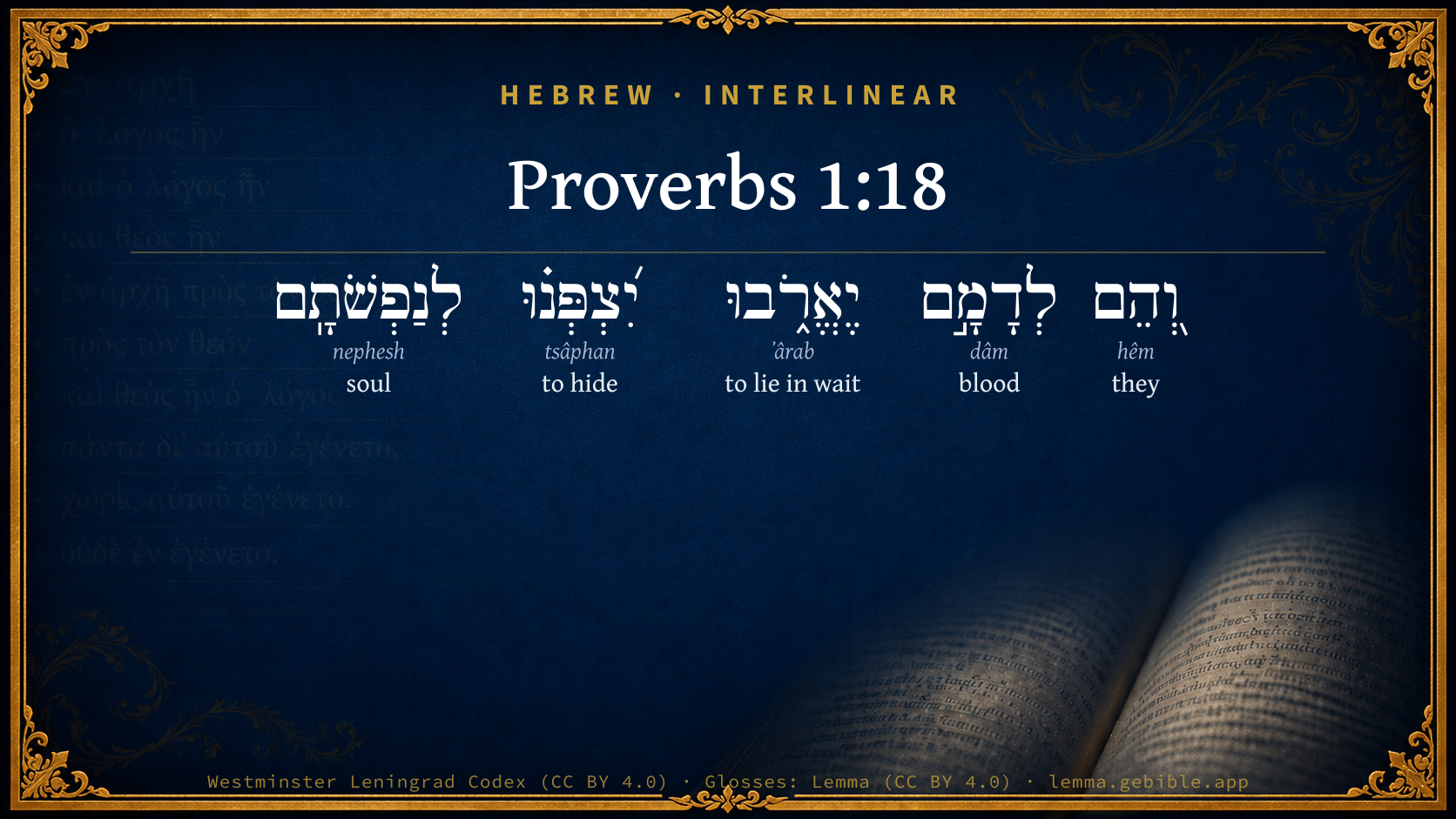
Proverbs 1:18

Hebrew (Westminster Leningrad Codex) Proverbs 1:18 appears in the Hebrew Old Testament. The text above is from the Westminster Leningrad Codex. Each word links to its Strong’s number, a concise gloss, and parsing drawn from the Open Scriptures Hebrew Bible morphology. Click any word for its full Brown-Driver-Briggs (BDB) entry.
Download image
Cite this verse

Proverbs 1:18 (World English Bible). Public Domain. Lemma interlinear Bible study tool, https://lemma.gebible.app/v/proverbs/1/18.

Show BibTeX & RIS
BibTeX
RIS
English Translation
But these lay wait for their own blood. They lurk secretly for their own lives.
World English Bible · Public Domain
Download a study sheet

One document with this verse’s original text, its word-by-word gloss line, the meaning frame, cross-references with their text, attributed commentary, and full source and license credits — printable, and it pastes into notes with its structure intact.

This verse Autodidact and up

Study sheet (.html) Plain text (.txt)

A passage Seminary Student

Up to 50 verses in one chapter. A passage sheet keeps up to 6 commentary sources and 12 cross-references per verse, in the order this page ranks them, and says so on the sheet whenever that leaves anything out. Ask for a single verse and you get the Autodidact verse sheet above.

Everything on this page stays free to read, with no account — the sheet is a download of what is already on screen, not access to it.

Want to remove ads? Support Godless Engineer
Compare translations 3

The same verse in 3 English versions, stacked beneath the original-language interlinear above. Click any original word for its lexicon entry.

Each is an independent rendering of the whole verse — the interlinear is not word-aligned to these translations.

Highlighted words mark where these versions differ — a whole-verse word diff, not a word-by-word alignment.

  • World English Bible Public Domain
    But these lay wait for their own blood. They lurk secretly for their own lives.
  • King James Version Public Domain
    And they lay wait for their own blood; they lurk privily for their own lives.
  • unfoldingWord Literal Text CC BY-SA 4.0
    but they lie in wait for their blood; they hide in ambush for their lives.

unfoldingWord Literal Text — © unfoldingWord, licensed CC BY-SA 4.0. Word-aligned USFM3 via Door43 (git.door43.org/unfoldingWord/en_ult).

Versions to compare (up to 4)

3 of 4 selected

Show all 18 translations

Every available English version of this verse, each an independent rendering of the whole verse.

  • World English Bible Public Domain
    But these lay wait for their own blood. They lurk secretly for their own lives.
  • Berean Standard Bible Public Domain
    But they lie in wait for their own blood; they ambush their own lives.
  • Majority Standard Bible Public Domain
    But they lie in wait for their own blood; they ambush their own lives.
  • King James Version Public Domain
    And they lay wait for their own blood; they lurk privily for their own lives.
  • American Standard Version (1901) Public Domain
    And these lay wait for their own blood; They lurk privily for their own lives.
  • Revised Version (1885) Public Domain
    And these lay wait for their own blood, they lurk privily for their own lives.
  • Geneva Bible (1599) Public Domain
    So they lay waite for blood and lie priuily for their liues.
  • Douay-Rheims (1899) Public Domain
    And they themselves lie in wait for their own blood, and practise deceits against their own souls.
  • Young's Literal Translation Public Domain
    And they for their own blood lay wait, They watch secretly for their own lives.
  • Literal Standard Version CC BY-SA 4.0
    And they lay wait for their own blood, || They watch secretly for their own lives.
  • Unlocked Literal Bible CC BY-SA 4.0
    These men lie in wait for their own blood— they set an ambush for their own lives.
  • unfoldingWord Literal Text CC BY-SA 4.0
    but they lie in wait for their blood; they hide in ambush for their lives.
  • Darby Bible Public Domain
    And these lay wait for their own blood; they lurk secretly for their own lives.
  • World Messianic Bible Public Domain
    but these lay in wait for their own blood. They lurk secretly for their own lives.
  • Webster's Bible Public Domain
    And they lay wait for their own blood; they lurk privily for their own lives.
  • Free Bible Version CC BY-SA 4.0
    However, these evil people hide ready to kill others, but they themselves are the victims. They're only ambushing themselves!
  • Bible in Basic English Public Domain
    And they are secretly waiting for their blood and making ready destruction for themselves.
  • JPS Tanakh (1917) Public Domain
    And these lie in wait for their own blood, they lurk for their own lives.

Literal Standard Version (2020), Covenant Press — licensed CC BY-SA 4.0. Text via the HelloAO Bible API (eBible.org). Unlocked Literal Bible (unfoldingWord) — licensed CC BY-SA 4.0. Text via the HelloAO Bible API (eBible.org). unfoldingWord Literal Text — © unfoldingWord, licensed CC BY-SA 4.0. Word-aligned USFM3 via Door43 (git.door43.org/unfoldingWord/en_ult). Free Bible Version, Dr. Jonathan Gallagher — licensed CC BY-SA 4.0. Text via the HelloAO Bible API (eBible.org).

Word by word

More ways to search: Search by grammar → Find every occurrence → Compare this word →

Practice this passage: Drill this verse → Learn its vocabulary →

About this verse

These counts appear in no published source. They are computed here, from the morphology-tagged text and Lemma’s own curated glosses. What Lemma adds →

5
words
5
distinct lemmas
Wisdom
section

Shared distinctive vocabulary

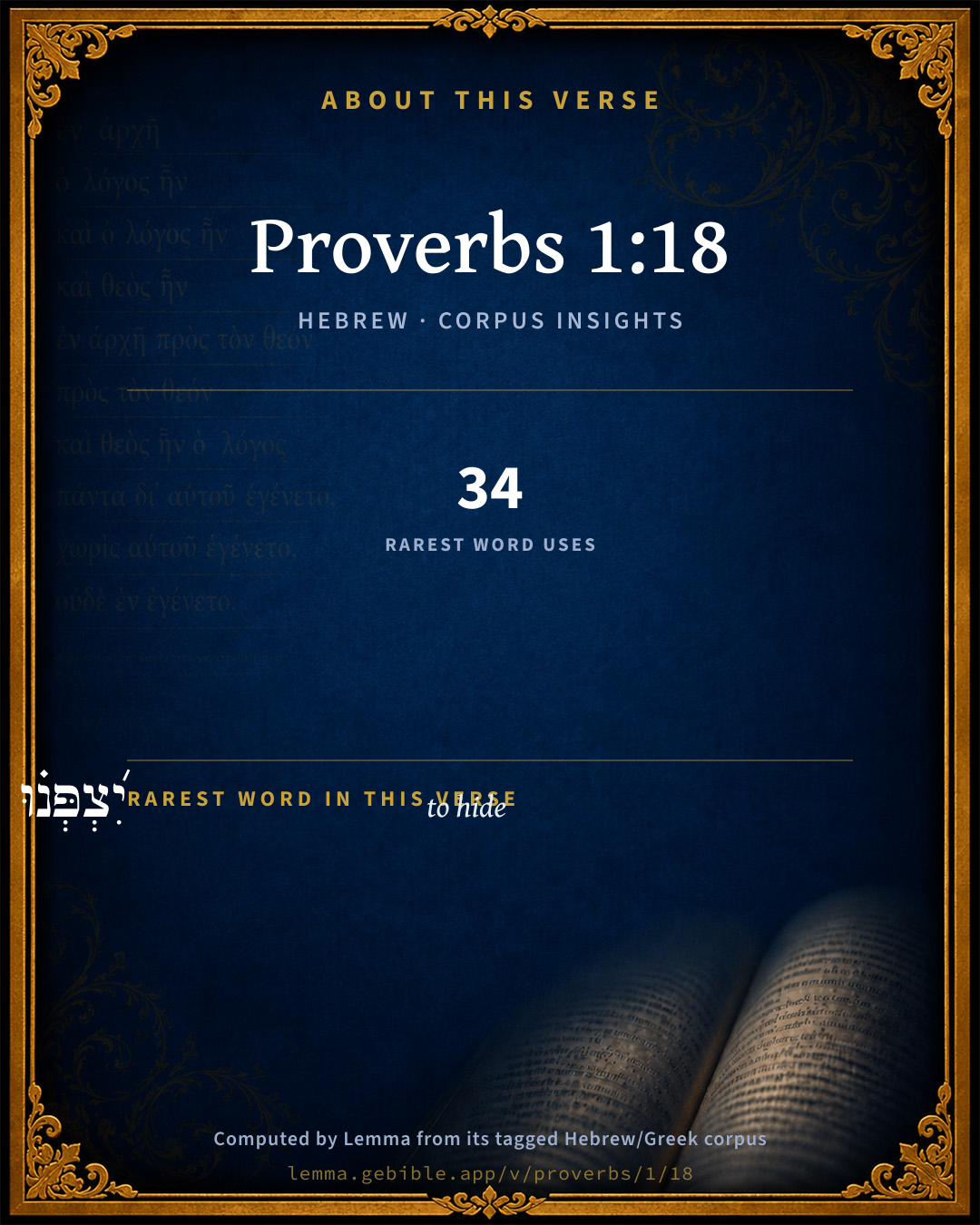
יִ֝צְפְּנ֗וּ to hide H6845 occurs in 31 verses of the Hebrew Bible. Also found in:

Grammatical profile

  • 2 verbs
  • 2 nouns
  • 1 pronoun

Verb forms

  • יֶאֱרֹ֑בוּ Qal · Imperfect
  • יִ֝צְפְּנ֗וּ Qal · Imperfect

Hebrew & Septuagint length

In English translation the verse runs 15 words from the Hebrew and 19 from the Septuagint (LXX English) — closely comparable.

A rough comparison of the two English renderings, which tokenize alike — not a word-level alignment.

Word counts can differ between the Hebrew and the Greek without any difference in meaning — e.g. the Hebrew direct-object marker אֵת has no separate Greek word, and Greek often adds the article ὁ.

Cross-references

8

Topical passages linked to Proverbs 1:18 in the Treasury of Scripture Knowledge — connected by theme and wording, ordered by reader-vote popularity; previews shown in the World English Bible.

  • Psalms 9:16 Yahweh has made himself known. He has executed judgment. The wicked is snared by the work of his own hands. Meditation. Selah.
  • Esther 7:10 So they hanged Haman on the gallows that he had prepared for Mordecai. Then was the king's wrath pacified.
  • Proverbs 5:22–23 The evil deeds of the wicked ensnare him. The cords of his sin hold him firmly.
  • Proverbs 28:17 A man who is tormented by life blood will be a fugitive until death; No one will support him.
  • Psalms 7:14–16 Behold, he travails with iniquity; Yes, he has conceived mischief, And brought forth falsehood.
  • Psalms 55:23 But you, God, will bring them down into the pit of destruction. Bloodthirsty and deceitful men shall not live out half their days, But I will trust in you.
  • Matthew 27:4–5 saying, "I have sinned in that I betrayed innocent blood." But they said, "What is that to us? You see to it."
  • Proverbs 9:17–18 "Stolen water is sweet. Food eaten in secret is pleasant."

Cross-references courtesy of OpenBible.info (CC BY 4.0).

Hebrew and Greek witnesses Masoretic Hebrew ↔ Greek Septuagint

The same verse in the two great witnesses to the Old Testament, shown verse-for-verse.

These are two independent witnesses, not word-aligned to each other, and the Septuagint is shown in lemma (dictionary) form.

Hebrew Proverbs 1:18 Masoretic · Westminster Leningrad Codex

וְ֭הֵם לְדָמָ֣ם יֶאֱרֹ֑בוּ יִ֝צְפְּנ֗וּ לְנַפְשֹׁתָֽם

But these lay wait for their own blood. They lurk secretly for their own lives.

World English Bible · Public Domain

Greek LXX Proverbs 1:18 Septuagint · lemma form

αὐτός γάρ ὁ φόνος μεταἔχω θησαυρίζω ἑαυτοῦ κακός ὁ δέ καταστροφή ἀνήρ παράνομος κακός

For they that are concerned in murder store up evils for themselves; and the overthrow of transgressors is evil.

LXX2012 (modern English Septuagint) · Public Domain

On this verse, The Pulpit Commentary discusses the Septuagint’s reading. Read the note in Commentary ↓

Hebrew: Westminster Leningrad Codex (CC BY 4.0). Greek: Septuagint (public domain); English from LXX2012 (modern English Septuagint) (Public Domain). How the Septuagint differs from the Hebrew →

Commentary

Notes on Proverbs 1:18 from classic Christian and Jewish commentators (each source and its license shown beneath its notes). The classic Christian expositions comment on the surrounding passage and are grouped to its opening verse, so a note may address several verses; the Jewish commentaries on the Tanakh (Rashi and others) are per-verse, so they appear only where the commentator wrote on this verse.

Lemma curates 59 commentaries, every one of them public domain or Creative Commons licensed, each selected and text-cleaned for this edition rather than reprinted as found. About our sources →

Trapp's Complete Commentary

John Trapp

Pro 1:18 And they lay wait for their [own] blood; they lurk privily for their [own] lives.

Ver. 18. And they lay wait.] Their sin will surely find them out. "No doubt this man is a murderer," said those barbarians, {Act 28:4} "whom though he had escaped the sea, yet vengeance suffereth not to live." {a} "Surely I have seen yesterday the blood of Naboth." {2Ki 9:26} Murder ever bleeds fresh in the eye of God; to him many years, yea, that eternity that is past, is but yesterday.

{a} Nemo noquitiam gerit in pectore, qui non idem Nemesin in tergo.

John Trapp, A Commentary or Exposition upon All the Books of the Old and New Testament (1647–1656) — public domain. Text from a community e-Sword module.

Joseph Benson's Commentary

Pro 1:18-19. And they lay wait, &c. — Assure thyself, such men are working their own ruin, and, as it were, lying in wait for themselves, when they lie in wait to take away the lives of others; for, in the end, they shall not escape the hand of justice, but be overtaken and suffer, either by a special vengeance of God, or by human punishment, what they have deserved. Let the young and unexperienced, who are entering into the paths of the world, treasure up this in their memories; let them write it on the table of their hearts; and, whenever they are solicited by any of their companions to do what their own conscience tells them is evil, let them not hesitate to bid such persons adieu that moment, for they spread snares for their destruction. So are the ways — The actions and courses; of every one that is greedy of gain — That seeks gain by unrighteous and wicked practices; which taketh away, &c. — Which greediness, or, rather, which gain, taketh away the life of the owners thereof — Brings sudden and certain destruction upon those who had made themselves masters and possessors of it.

Joseph Benson's Commentary on the Old and New Testaments (1811–1818) — public domain. Text from a community e-Sword module.

Geneva Bible (1599)

Geneva Bible translators

He showeth that there is no cause to move these wicked to spoil the innocent, but their avarice and cruelty.

Geneva Bible (1599) marginal notes — public domain. Text via Bolls.life.

Adam Clarke's Commentary

Verse 18. They lay wait for their own blood] I believe it is the innocent who are spoken of here, for whose blood and lives these lay wait and lurk privily; certainly not their own, by any mode of construction.

Adam Clarke's Commentary on the Bible (1810–1826) — public domain. Text from a community e-Sword/MySword module.

Ellicott's Commentary for English Readers

(18) And they lay wait.—Yet they cannot see that in truth they are laying wait, not for the innocent, but for themselves, as God will deliver him, and bring the mischief they designed for him upon their own head.

A Bible Commentary for English Readers, edited by Charles John Ellicott (1878–1897) — public domain. Text from a community e-Sword module.

John Gill's Exposition

And they lay wait for their own blood,.... While they lie in wait for the blood of others, they lie in wait for their own; and when they shed the blood of innocent persons, it in the issue comes upon their own heads, and is the cause of their own blood being shed; vengeance pursues them, and justice will not suffer them to live;

they lurk privily for their own lives: while they are lurking in secret places to take away, the lives of others, they are laying snares for their own souls; and the consequence of it will be, that they will be brought to a shameful and untimely end here, or, however, to everlasting ruin and destruction hereafter.

John Gill's Exposition of the Whole Bible (1746–1763) — public domain (CC PDM 1.0). Text via the HelloAO Bible API.

Matthew Poole's English Annotations

And, or but, or yet, or so; for all these ways this particle is used; which is more fully expressed in the next verse.

They lay wait for their own blood; the destruction which they design to others falls upon themselves. Their blood answers to their feet, Pro 1:16, and belongs to the same persons.

Matthew Poole's English Annotations on the Holy Bible (1683–1685) — public domain. Text from a community e-Sword/MySword module.

The Pulpit Commentary

And they lay wait for their own blood, etc. The third reason or argument why the teacher"s warning should be followed, drawn from the destruction which overtakes the sinners themselves. "Lay wait," and "lurk privily," as in ver. 11, from which this verse is evidently borrowed. They propose, as they say, to lay wait for the blood of others; but it is, says the teacher, for their own blood. (l"dhammam), contra sanguinem suum; they lurk privily. as they say, for the innocent, but in reality it is for their own lives; (l"naph"shotham); contra animus suas (Vulgate); or, as the LXX puts it, Autoi ganon metecontev yhsaurizousin eautoiv kata , "For they who take part in murder treasure up evils for themselves;" that is, they am bringing a heavier and surer destruction upon themselves than they can ever inflict upon others (Wardlaw). The LXX adds, at the close of the verse, H de katastrofh andrwn paranomwn kakh , "And the overthrowing or destruction of transgressors is wrest, or evil." The Arabic Version has a similar addition.

The Pulpit Commentary (1880–1919), ed. H.D.M. Spence-Jones & Joseph S. Exell — public domain. Text from a community e-Sword module.

John Wesley's Explanatory Notes

Their own blood - The destruction which they design to others, fall upon themselves.

John Wesley, Explanatory Notes Upon the Whole Bible (1754–1765) — public domain. Text via the GEBible commentary corpus.

Keil & Delitzsch

C. F. Keil & F. Delitzsch

The causal conj. כּי (for) in Pro 1:16 and Pro 1:17 are coordinated; and there now follows, introduced by the conj. ו ("and"), a third reason for the warning:

And they lie in wait for their own blood,

They lay snares for their own lives.

The warning of Pro 1:16 is founded on the immorality of the conduct of the enticer; that of Pro 1:17 on the audaciousness of the seduction as such, and now on the self-destruction which the robber and murderer bring upon themselves: they wish to murder others, but, as the result shows, they only murder themselves. The expression is shaped after Pro 1:11, as if it were: They lay snares, as they themselves say, for the blood of others; but it is in reality for their own blood: they certainly lie in wait, as they say; but not, as they add, for the innocent, but for their own lives (Fl.). Instead of לדמם, there might be used לדמיהם, after Mic 7:2; but לנפשׁם would signify ipsis (post-biblical, לעצמם), while לנפשׁתם leaves unobliterated the idea of the life: animis ipsorum; for if the O.T. language seeks to express ipse in any other way than by the personal pronoun spoken emphatically, this is done by the addition of נפשׁ (Isa 53:11). המו was on this account necessary, because Pro 1:17 has another subject (cf. Psa 63:10).

Keil & Delitzsch — Biblical Commentary on the Old Testament (1861–1891) — public domain (CC PDM 1.0). Text via the HelloAO Bible API. (Old Testament only.)

unfoldingWord translationNotes

Door43 World Missions Community

These men lie in wait for their own blood—they set an ambush for their own lives

This finishes the comparison started in Proverbs 1:17. The men destroying themselves by doing sinful things is spoken of as if they set a trap and kill themselves. AT: "But these men are more foolish than the birds. They kill themselves with their own traps" (See: Metaphor)

These men lie in wait for their own blood

To lie in wait is to hide, ready to do something wicked. AT: "It is as if they are looking for an opportunity to kill themselves" or "They themselves will be killed because they try to kill others"

their own blood

Here "blood" is a metonym for a violent death. AT: "to kill themselves violently"

they set an ambush for their own lives

Here "their own lives" is a metonym for themselves. AT: "it is as if they are the ones who are waiting to suddenly attack and kill them"

So are the ways of everyone

A person's fate or destiny is spoken of as if it were a road a person walks on. AT: "This is what happens to everyone" (See: Metaphor)

unjust gain takes away the lives of those who hold on to it

A person destroying themselves by trying to gain wealth through violence, theft, and deceit is spoken of as if the unjust gains will kill those who take it. AT: "it is like the unjust gains will destroy those who hold on to it" (See: Metaphor)

translationWords

snare

just

life

unfoldingWord translationNotes — © Distant Shores Media and the Door43 World Missions Community, licensed CC BY-SA 4.0. Source: git.door43.org/Door43/en_tn.

Rashi

Rabbi Shlomo Yitzchaki (Rashi)

but they lie in wait for their blood But the hunters lie in wait for the blood of the birds.

Rashi on the Tanakh — English translations: “The Judaica Press complete Tanach with Rashi, translated by A. J. Rosenberg” (CC BY 4.0); “Pentateuch with Rashi's commentary by M. Rosenbaum and A.M. Silbermann, 1929-1934” (public domain); “The Metsudah Tanach series, Lakewood, N.J” (CC BY 4.0); and “The Book of Joshua, Metsudah Publications, 1997” (CC BY 4.0). Text via Sefaria.

Lesson kit

Teaching starters — assembled from the data on this page, not authored interpretation. Every prompt links to the verse data it draws on. Edit before teaching.

Proverbs, in the Wisdom, opens this verse with 5 words (5 distinct Hebrew lemmas). Its most distinctive word is tsâphan (“to hide”). A historical commentator’s framing appears above. Read the whole chapter for the surrounding context.

Discussion questions

  1. What does “to hide” (tsâphan) contribute to the verse as a whole?
  2. How does Exodus 2:2, which shares the word «to hide», read alongside this verse?
  3. The translations on this page render this verse differently — a whole-verse word diff, not a word-by-word alignment. What might account for the different wordings?
  4. «יֶאֱרֹ֑בוּ» is a Qal Imperfect verb. How does that grammatical form shape the action described?
  5. Compare how Trapp's Complete Commentary and Joseph Benson's Commentary read this verse. Where do they agree or differ?

Things to notice

Reading settings

Reading text

Shown beneath each verse's original-language words.

Old Testament
Old Testament edition

Read the OT as the Masoretic Hebrew (MT) or the Greek Septuagint (LXX).

English shown for the Greek Septuagint (in the Hebrew ↔ Greek comparison).

Comparing translations? Open the Compare panel on any verse page to stack up to four side by side.