Exodus 34:25

Hebrew (Westminster Leningrad Codex) Exodus 34:25 appears in the Hebrew Old Testament. The text above is from the Westminster Leningrad Codex. Each word links to its Strong’s number, a concise gloss, and parsing drawn from the Open Scriptures Hebrew Bible morphology. Click any word for its full Brown-Driver-Briggs (BDB) entry.
Download image
Cite this verse

Exodus 34:25 (World English Bible). Public Domain. Lemma interlinear Bible study tool, https://lemma.gebible.app/v/exodus/34/25.

Show BibTeX & RIS
BibTeX
RIS
English Translation
"You shall not offer the blood of my sacrifice with leavened bread; neither shall the sacrifice of the feast of the Passover be left to the morning.
World English Bible · Public Domain
Download a study sheet

One document with this verse’s original text, its word-by-word gloss line, the meaning frame, cross-references with their text, attributed commentary, and full source and license credits — printable, and it pastes into notes with its structure intact.

This verse Autodidact and up

Study sheet (.html) Plain text (.txt)

A passage Seminary Student

Up to 50 verses in one chapter. A passage sheet keeps up to 6 commentary sources and 12 cross-references per verse, in the order this page ranks them, and says so on the sheet whenever that leaves anything out. Ask for a single verse and you get the Autodidact verse sheet above.

Everything on this page stays free to read, with no account — the sheet is a download of what is already on screen, not access to it.

Want to remove ads? Support Godless Engineer
Compare translations 3

The same verse in 3 English versions, stacked beneath the original-language interlinear above. Click any original word for its lexicon entry.

Each is an independent rendering of the whole verse — the interlinear is not word-aligned to these translations.

Highlighted words mark where these versions differ — a whole-verse word diff, not a word-by-word alignment.

  • World English Bible Public Domain
    "You shall not offer the blood of my sacrifice with leavened bread; neither shall the sacrifice of the feast of the Passover be left to the morning.
  • King James Version Public Domain
    Thou shalt not offer the blood of my sacrifice with leaven; neither shall the sacrifice of the feast of the passover be left unto the morning.
  • unfoldingWord Literal Text CC BY-SA 4.0
    You shall not slaughter the blood of my sacrifice with leavened bread, and the sacrifice of the Festival of the Passover shall not remain all night to the morning.

unfoldingWord Literal Text — © unfoldingWord, licensed CC BY-SA 4.0. Word-aligned USFM3 via Door43 (git.door43.org/unfoldingWord/en_ult).

Versions to compare (up to 4)

3 of 4 selected

Show all 18 translations

Every available English version of this verse, each an independent rendering of the whole verse.

  • World English Bible Public Domain
    "You shall not offer the blood of my sacrifice with leavened bread; neither shall the sacrifice of the feast of the Passover be left to the morning.
  • Berean Standard Bible Public Domain
    Do not offer the blood of a sacrifice to Me along with anything leavened, and do not let any of the sacrifice from the Passover Feast remain until morning.
  • Majority Standard Bible Public Domain
    Do not offer the blood of a sacrifice to Me along with anything leavened, and do not let any of the sacrifice from the Passover Feast remain until morning.
  • King James Version Public Domain
    Thou shalt not offer the blood of my sacrifice with leaven; neither shall the sacrifice of the feast of the passover be left unto the morning.
  • American Standard Version (1901) Public Domain
    Thou shalt not offer the blood of my sacrifice with leavened bread; neither shall the sacrifice of the feast of the passover be left unto the morning.
  • Revised Version (1885) Public Domain
    Thou shalt not offer the blood of my sacrifice with leavened bread; neither shall the sacrifice of the feast of the passover be left unto the morning.
  • Geneva Bible (1599) Public Domain
    Thou shalt not offer the blood of my sacrifice with leauen, neither shall ought of the sacrifice of the feast of Passeouer be left vnto the morning.
  • Douay-Rheims (1899) Public Domain
    Thou shalt not offer the blood of my sacrifice upon leaven: neither shall there remain in the morning any thing of the victim of the solemnity of the Lord.
  • Young's Literal Translation Public Domain
    `Thou dost not slaughter with a fermented thing the blood of My sacrifice; and the sacrifice of the feast of the passover doth not remain till morning:
  • Literal Standard Version CC BY-SA 4.0
    You do not slaughter the blood of My sacrifice with a fermented thing; and the sacrifice of the Celebration of the Passover does not remain until morning.
  • Unlocked Literal Bible CC BY-SA 4.0
    You must not offer the blood of my sacrifice with any yeast, nor may any meat from the sacrifice at the Festival of the Passover be left over to the morning.
  • unfoldingWord Literal Text CC BY-SA 4.0
    You shall not slaughter the blood of my sacrifice with leavened bread, and the sacrifice of the Festival of the Passover shall not remain all night to the morning.
  • Darby Bible Public Domain
    -- Thou shalt not offer the blood of my sacrifice with leaven; neither shall the sacrifice of the feast of the passover be left over night until the morning.
  • World Messianic Bible Public Domain
    “You shall not offer the blood of my sacrifice with leavened bread. The sacrifice of the feast of the Passover shall not be left to the morning.
  • Webster's Bible Public Domain
    Thou shalt not offer the blood of my sacrifice with leaven, neither shall the sacrifice of the feast of the passover be left until the morning.
  • Free Bible Version CC BY-SA 4.0
    Don't offer bread made with yeast when you present a sacrifice to me, don't keep any sacrifice from the Passover Feast until the morning.
  • Bible in Basic English Public Domain
    No leaven is to be offered with the blood of my offering, and the offering of the Passover feast may not be kept till the morning.
  • JPS Tanakh (1917) Public Domain
    Thou shalt not offer the blood of My sacrifice with leavened bread; neither shall the sacrifice of the feast of the passover be left unto the morning.

Literal Standard Version (2020), Covenant Press — licensed CC BY-SA 4.0. Text via the HelloAO Bible API (eBible.org). Unlocked Literal Bible (unfoldingWord) — licensed CC BY-SA 4.0. Text via the HelloAO Bible API (eBible.org). unfoldingWord Literal Text — © unfoldingWord, licensed CC BY-SA 4.0. Word-aligned USFM3 via Door43 (git.door43.org/unfoldingWord/en_ult). Free Bible Version, Dr. Jonathan Gallagher — licensed CC BY-SA 4.0. Text via the HelloAO Bible API (eBible.org).

Word by word

More ways to search: Search by grammar → Find every occurrence → Compare this word →

Practice this passage: Drill this verse → Learn its vocabulary →

חָמֵ֖ץ
châmêts
H2557
“leaven”
Noun, Common, Masculine, Singular, Absolute
Part of Speech
Noun
Type
Common
Gender
Masculine
Number
Singular
State
Absolute
Full BDB Definition

Origin: from H2556

TWOT: TWOT- 679a

the thing leavened, leaven
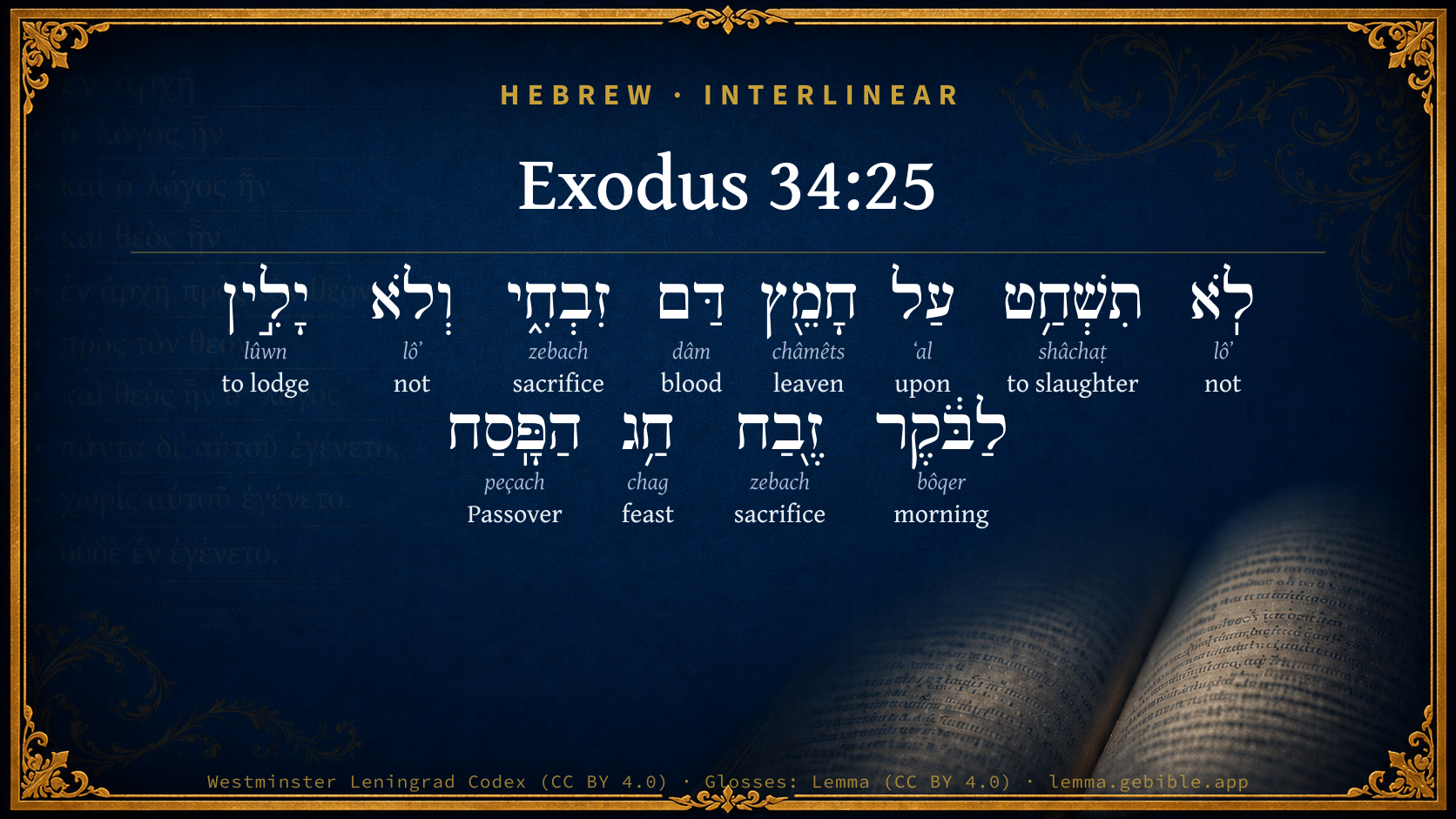
  1. לֹֽא lôʼ H3808 “not” Particle, Negative
  2. תִשְׁחַ֥ט shâchaṭ H7819 “to slaughter” Verb, Qal, Imperfect, 2nd Person, Masculine, Singular
  3. עַל ʻal H5921 “upon” Preposition
  4. דַּם dâm H1818 “blood of” Noun, Common, Masculine, Singular, Construct
  5. זִבְחִ֑י zebach H2077 “sacrifice · my” Noun, Common, Masculine, Singular, Construct + Suffix, Personal, 1st Person, Common, Singular
  6. וְלֹא lôʼ H3808 “and · not” Conjunction + Particle, Negative
  7. יָלִ֣ין lûwn H3885 “to lodge” Verb, Qal, Imperfect, 3rd Person, Masculine, Singular
  8. לַבֹּ֔קֶר bôqer H1242 “to/for the · morning” Preposition, Determined + Noun, Common, Masculine, Singular, Absolute
  9. זֶ֖בַח zebach H2077 “sacrifice of” Noun, Common, Masculine, Singular, Construct
  10. חַ֥ג chag H2282 “feast of” Noun, Common, Masculine, Singular, Construct
  11. הַפָּֽסַח peçach H6453 “the · Passover” Particle, Definite Article + Noun, Common, Masculine, Singular, Absolute

About this verse

These counts appear in no published source. They are computed here, from the morphology-tagged text and Lemma’s own curated glosses. What Lemma adds →

12
words
10
distinct lemmas
Pentateuch
section

Notable vocabulary

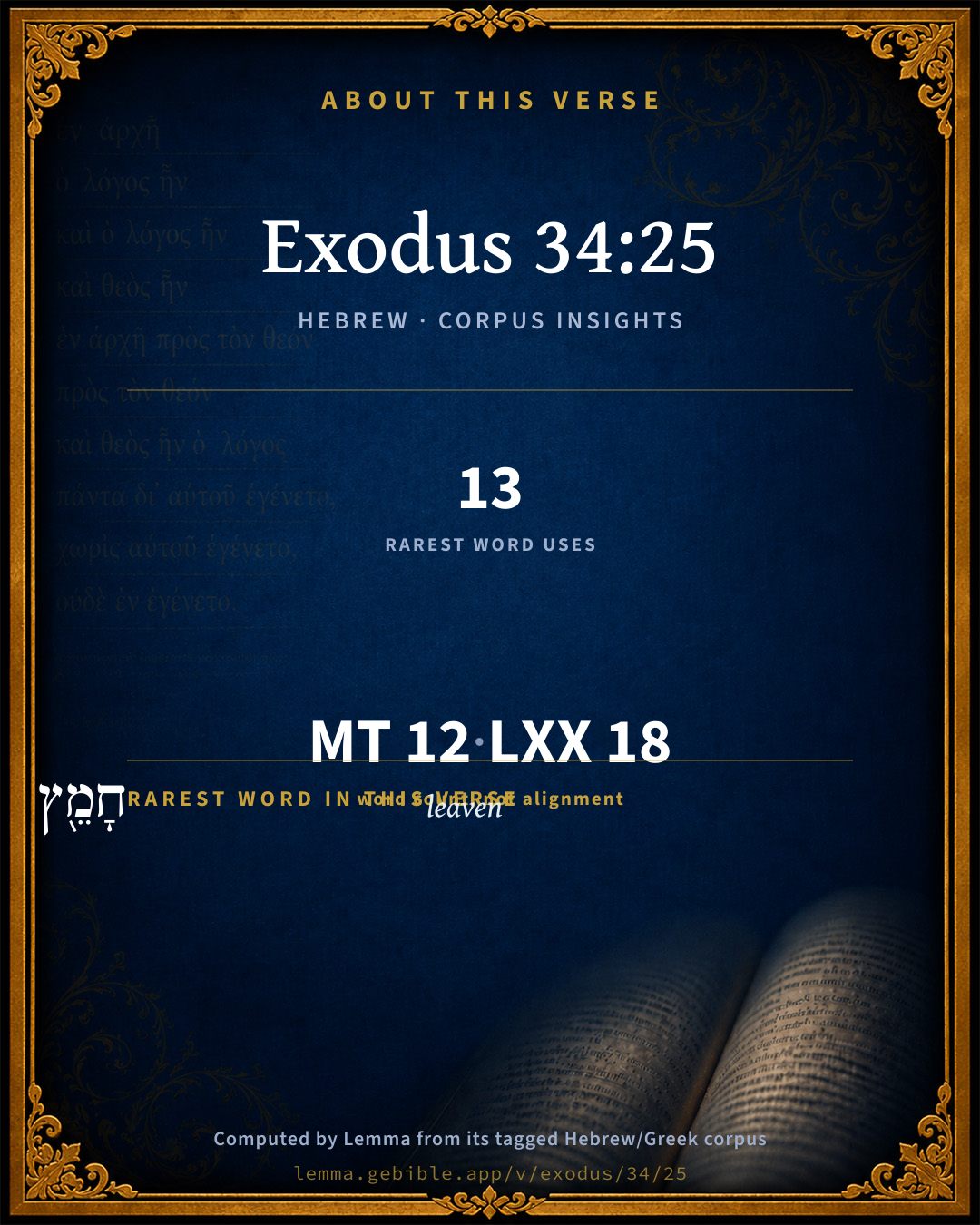
The rarest word here is חָמֵ֖ץ leaven H2557 — appearing just 13 times in the whole Hebrew Bible.

Shared distinctive vocabulary

חָמֵ֖ץ leaven H2557 occurs in 13 verses of the Hebrew Bible. Also found in:

Grammatical profile

  • 2 verbs
  • 7 nouns
  • 1 preposition
  • 2 particles

Verb forms

  • תִשְׁחַ֥ט Qal · Imperfect
  • יָלִ֣ין Qal · Imperfect

Repetition

Words recur within this verse — often emphatic in Hebrew:

  • זִבְחִ֑י sacrifice H2077 ×2
  • לֹֽא not H3808 ×2

Hebrew & Septuagint length

In English translation the verse runs 27 words from the Hebrew and 25 from the Septuagint (LXX English) — closely comparable.

A rough comparison of the two English renderings, which tokenize alike — not a word-level alignment.

Word counts can differ between the Hebrew and the Greek without any difference in meaning — e.g. the Hebrew direct-object marker אֵת has no separate Greek word, and Greek often adds the article ὁ.

In the original languages it is 12 Hebrew tokens and 18 Greek tokens — but the two are counted differently (Hebrew bundles its prefixes and suffixes into one token; the Greek is in lemma form), so that isn’t a like-for-like length.

Cross-references

9

Topical passages linked to Exodus 34:25 in the Treasury of Scripture Knowledge — connected by theme and wording, ordered by reader-vote popularity; previews shown in the World English Bible.

  • Exodus 23:18 "You shall not offer the blood of my sacrifice with leavened bread, neither shall the fat of my feast remain all night until the morning.
  • Exodus 12:10 You shall let nothing of it remain until the morning; but that which remains of it until the morning you shall burn with fire.
  • Exodus 12:8 They shall eat the flesh in that night, roasted with fire, and unleavened bread. They shall eat it with bitter herbs.
  • Exodus 12:20 You shall eat nothing leavened. In all your habitations you shall eat unleavened bread.'"
  • Numbers 9:12 They shall leave none of it until the morning, nor break a bone of it. According to all the statute of the Passover they shall keep it.
  • Deuteronomy 16:3 You shall eat no leavened bread with it; seven days shall you eat unleavened bread therewith, even the bread of affliction; for you came forth out of the land of Egypt in haste: that you may remember the day when you came forth out of the land of Egypt all the days of your life.
  • 1 Corinthians 5:7–8 Purge out the old yeast, that you may be a new lump, even as you are unleavened. For indeed Christ, our Passover, has been sacrificed in our place.
  • Exodus 29:34 If anything of the flesh of the consecration, or of the bread, remains to the morning, then you shall burn the remainder with fire: it shall not be eaten, because it is holy.
  • Leviticus 7:15 The flesh of the sacrifice of his peace offerings for thanksgiving shall be eaten on the day of his offering. He shall not leave any of it until the morning.

Cross-references courtesy of OpenBible.info (CC BY 4.0).

Hebrew and Greek witnesses Masoretic Hebrew ↔ Greek Septuagint

The same verse in the two great witnesses to the Old Testament, shown verse-for-verse.

These are two independent witnesses, not word-aligned to each other, and the Septuagint is shown in lemma (dictionary) form.

Hebrew Exodus 34:25 Masoretic · Westminster Leningrad Codex

לֹֽא תִשְׁחַ֥ט עַל חָמֵ֖ץ דַּם זִבְחִ֑י וְלֹא יָלִ֣ין לַבֹּ֔קֶר זֶ֖בַח חַ֥ג הַפָּֽסַח

"You shall not offer the blood of my sacrifice with leavened bread; neither shall the sacrifice of the feast of the Passover be left to the morning.

World English Bible · Public Domain

Greek LXX Exodus 34:25 Septuagint · lemma form

οὐ σφάζω ἐπί ζυμή αἷμα θυμίαμα ἐγώ καί οὐ κοιμάω εἰς ὁ πρωΐ θῦμα ὁ ἑορτή ὁ πασχα

You shall not offer the blood of my sacrifices with leaven, neither shall the sacrifices of the feast of the passover remain till the morning.

LXX2012 (modern English Septuagint) · Public Domain

Hebrew: Westminster Leningrad Codex (CC BY 4.0). Greek: Septuagint (public domain); English from LXX2012 (modern English Septuagint) (Public Domain). How the Septuagint differs from the Hebrew →

Targum (Aramaic paraphrase)

2

The Targum is the ancient Jewish Aramaic paraphrase of the Hebrew Scriptures — an interpretive translation, not the Hebrew text itself. Onkelos (literal) and Pseudo-Jonathan (expansive) render the Torah, and Jonathan the Prophets. Coverage is partial: where no permissively-licensed English translation exists for a verse, only the Aramaic is shown. This is verse-level text, not a word-by-word alignment to the Hebrew.

  1. Targum Onkelos Torah (Genesis–Deuteronomy)
    לָא תִכּוֹס עַל חֲמִיעַ דַם פִּסְחִי וְלָא יְבִיתוּן לְצַפְרָא בַּר מִמַדְבְּחָא תַּרְבֵּי נִכְסַת חַגָא דְפִסְחָא:

    (no public-domain English translation for this verse)

    Targum Onkelos — Aramaic: “Onkelos Genesis” (public domain); “Onkelos Exodus” (public domain); “Onkelos Leviticus” (public domain); “Onkelos Numbers” (public domain); “Onkelos Deuteronomy” (public domain). English: “Sefaria Community Translation” (CC0 1.0 (public-domain dedication)); “J.W. Etheridge. The Targums of Onkelos and Jonathan Ben Uzziel on the Pentateuch. London: Longmans, Green, 1862” (public domain). Text via Sefaria.

  2. Targum Pseudo-Jonathan Torah (Genesis–Deuteronomy)
    לָא תִכְסוּן קֳדָם עַד לָא תְבַטְלִין חֲמִיעַ נִכְסַת פִּסְחִי וְלָא יְבִיתוּן לְצַפְרָא בַּר מִמַּדְבְּחָא תַּרְבֵּי נִכְסַת פִּיסְחָא

    You shall not sacrifice the victim of My passover before you have done away with leaven; nor suffer the fat of the paschal sacrifice to remain about the altar till the morning.

    Targum Pseudo-Jonathan — Aramaic: “Targum Jonathan on Genesis” (public domain); “Targum Jonathan on Exodus” (public domain); “Targum Jonathan on Leviticus” (public domain); “Targum Jonathan on Numbers” (public domain); “Targum Jonathan on Deuteronomy” (public domain). English: “The Targum of Jonathan ben Uzziel, trans. J. W. Etheridge, London, 1862” (public domain). Text via Sefaria.

Commentary

Notes on Exodus 34:25 from classic Christian and Jewish commentators (each source and its license shown beneath its notes). The classic Christian expositions comment on the surrounding passage and are grouped to its opening verse, so a note may address several verses; the Jewish commentaries on the Tanakh (Rashi and others) are per-verse, so they appear only where the commentator wrote on this verse.

Lemma curates 59 commentaries, every one of them public domain or Creative Commons licensed, each selected and text-cleaned for this edition rather than reprinted as found. About our sources →

Trapp's Complete Commentary

John Trapp

Exo 34:25 Thou shalt not offer the blood of my sacrifice with leaven; neither shall the sacrifice of the feast of the passover be left unto the morning.

Ver. 25. Thou shalt not offer.] See Exo 23:18-19,

John Trapp, A Commentary or Exposition upon All the Books of the Old and New Testament (1647–1656) — public domain. Text from a community e-Sword module.

Adam Clarke's Commentary

Verse 25. The blood of my sacrifice] That is, the paschal lamb. See Clarke on Ex 23:18.

Adam Clarke's Commentary on the Bible (1810–1826) — public domain. Text from a community e-Sword/MySword module.

Ellicott's Commentary for English Readers

(25) Thou shalt not offer the blood of my sacrifice with leaven.—Comp. Exo_23:18, and the Notes ad loc.

A Bible Commentary for English Readers, edited by Charles John Ellicott (1878–1897) — public domain. Text from a community e-Sword module.

The Cambridge Bible for Schools and Colleges

gen. ed. J. J. S. Perowne

25. See on Exo_23:18. In cl. bwhat in Exo_23:18 is prescribed apparently for all festal sacrifices is here referred specifically to the passover,—‘fat,’ which is not elsewhere mentioned in connexion with the passover, being changed into ‘sacrifice,’ which would refer naturally to the flesh of the lamb eaten at the passover.

be left] remain all night (yâlîn), exactly as Exo_23:18.

The Cambridge Bible for Schools and Colleges (gen. ed. J. J. S. Perowne; Cambridge University Press, 1878–1918) — public domain. Text from a community e-Sword module.

John Gill's Exposition

And he was there with the Lord forty days and forty nights,.... These were other forty days and nights, besides those he had been with the Lord, when he came down and broke the two tables in his hand, on sight of the idolatry of the people; yea, not only the Jewish writers think that he was on the mount three times forty days and forty nights, but also several learned Christian writers, as Dr. Lightfoot (p) and others; and it seems plain that he went up to the mountain three times, Exo 24:15 and it is not improbable that he was each time so long there; about the first and third times there can be no doubt, see Exo 24:18 and the text before us; and at the second time, when he went up to make reconciliation for the people, Exo 32:30 he says, that he fell down before the Lord, as at the first forty days and forty nights, Deu 9:18 and from the seventh day of the month Sivan, the day after the giving of the law, to the tenth of Tisri, on which day he now descended, are just so many days:

he did neither eat bread nor drink water: and it is very likely slept not, he being supported without either of these by the power of God; and having such nearness of communion with God, and his mind taken up with what he heard and saw, he had no thoughts of, nor desires and cravings after such things, as well as he stood in no need of them; all which must be ascribed to the miraculous interposition of God in the support of him; see Gill on Exo 24:18.

and he wrote on the tables the words of the covenant, the ten commandments; not Moses, for these were tables of stone, which he could not write or engrave upon without proper instruments, which it does not appear he had with him on the mount; but it was God that wrote them, who, in Exo 34:1 says he would write them, and from Deu 10:2 we are assured he did.

(p) Works, vol. 1. p. 715, 716.

John Gill's Exposition of the Whole Bible (1746–1763) — public domain (CC PDM 1.0). Text via the HelloAO Bible API.

Haydock's Catholic Bible Commentary

Sacrifice of the paschal lamb, to which the Chaldean properly restrains this verse. (Calmet)

George Leo Haydock (1774–1849), Haydock's Catholic Family Bible and Commentary, 1859 edition — public domain. Excludes Psalms (Douay-Rheims chapter numbering differs from Protestant) and Deuterocanonical books (Catholic canon only).

The Pulpit Commentary

Repeated from Exo_23:18.

The Pulpit Commentary (1880–1919), ed. H.D.M. Spence-Jones & Joseph S. Exell — public domain. Text from a community e-Sword module.

unfoldingWord translationNotes

Door43 World Missions Community

General Information:

Yahweh continues to tell Moses what the people must do.

the blood of my sacrifice

The fact that the blood is from an animal can be stated clearly. AT: "the blood of an animal that you sacrifice to me" (See: Assumed Knowledge and Implicit Information)

with any yeast

The fact that any yeast would be in bread can be stated clearly. AT: "with bread that has yeast in it" (See: Assumed Knowledge and Implicit Information)

translationWords

blood

sacrifice

yeast

Passover

firstfruits

house of God

goat

unfoldingWord translationNotes — © Distant Shores Media and the Door43 World Missions Community, licensed CC BY-SA 4.0. Source: git.door43.org/Door43/en_tn.

Rashi

Rabbi Shlomo Yitzchaki (Rashi)

לא תשחט וגו׳ THOU SHALT NOT OFFER [THE BLOOD OF MY SACRIFICE TOGETHER WITH LEAVEN] — i. e. thou shalt not kill the Passover lamb whilst leaven is still existent in your possession. This is an admonition addressed to him who slaughters the Passover lamb, as well as to him who sprinkles its blood or to one of the members of the party formed to eat that lamb in company (Pesachim 63a).

ולא ילין NEITHER SHALL [THE SACRIFICE OF THE FESTIVAL OF PASSOVER] REMAIN OVER NIGHT — Understand this as the Targum renders it: ולא יביתון... בר ממדבחא … ‎“There shall not remain overnight away from the altar till the morning the fat of the sacrifice” — this law of leaving the fat away from the altar overnight does not serve to invaliditate the sacrifice if it has been placed on the top of the altar some time during the night, even if it be not entirely burnt by morning, nor is the law about leaving the fat overnight infringed except if it has not been placed on the altar by the dawn of the morning (but any time during the night one may lift it up from the pavement on to the altar (Zevachim 87a; cf. Rashi on Exodus 23:18).

זבח חג הפסח means the pieces of its fat (which had to be burnt on the altar). From here you may derive the law concerning all cases of burning the pieces of fat and the limbs of sacrifices (i. e. you may derive the general rule regarding all sacrifices).

Rashi on the Tanakh — English translations: “The Judaica Press complete Tanach with Rashi, translated by A. J. Rosenberg” (CC BY 4.0); “Pentateuch with Rashi's commentary by M. Rosenbaum and A.M. Silbermann, 1929-1934” (public domain); “The Metsudah Tanach series, Lakewood, N.J” (CC BY 4.0); and “The Book of Joshua, Metsudah Publications, 1997” (CC BY 4.0). Text via Sefaria.

Ramban (Nachmanides)

Rabbi Moshe ben Nachman (Ramban / Nachmanides)

NEITHER SHALL THE SACRIFICE OF THE FEAST OF THE PASSOVER BE LEFT UNTO THE MORNING. In line with the plain meaning of Scripture this admonition applies to the whole [Passover-] offering, [the sacrificial portions burnt on the altar, and the flesh eaten by the Passover celebrants]: that one should not leave over of the flesh unto the morning, for that which remains of it until the morning shall be burnt with fire, and also the fat of it should be burnt on the altar only until the morning. Onkelos, however, translated the verse as applying [only] to the fat which had to be taken up to be burnt on the altar, for this “feast” [mentioned there] is explained there, neither shall the fat of My feast remain all night until the morning, since all these commandments [mentioned here] are based upon those cited there.Now Rashi wrote: “Neither shall [the sacrifice of the feast of the Passover] be left unto the morning. This is to be understood as the Targum renders it [namely, that it refers to the fat, as explained above]. An offering left overnight is not invalidated if it was placed on top of the altar [during the night, even though it was not burnt at night; and it may be burnt on the altar the following day], neither is it invalidated until the dawn of morning [i.e., if at that time it is not on top of the altar, it is deemed to have been ‘left-over’]. The sacrifice of the feast of the Passover. This refers to the sacrificial portions. From here you derive the law concerning the burning of all fats and limbs of sacrifices [which were burnt on the altar].” In the section of Tzav I will explain this with the help of G-d. And with regard to what Rashi wrote about an offering left overnight if it was placed on top of the altar [during the night it is not invalidated] — there is a difference of opinion on this matter in the Gemara, and in the opinion of Raba it does become invalidated even if on top of the altar; thus if limbs of a sacrifice were left there [on top of the altar] overnight, and then by accident they were taken down [from the altar to the pavement], they may no longer be taken up. On the other hand, if they were not taken down, then even those limbs that had been left over on the pavement of the Court for many days, and by accident were taken up, do not need to come down [and are burnt upon the altar], as is found in the Chapter “The Altar.”

Ramban (Nachmanides) on the Tanakh — English translation: “Commentary on the Torah by Ramban (Nachmanides). Translated and annotated by Charles B. Chavel. New York, Shilo Pub. House, 1971-1976” (CC BY 4.0). Text via Sefaria.

Lesson kit

Teaching starters — assembled from the data on this page, not authored interpretation. Every prompt links to the verse data it draws on. Edit before teaching.

Exodus, in the Pentateuch, opens this verse with 12 words (10 distinct Hebrew lemmas). Its most distinctive word is châmêts (“leaven”). A historical commentator’s framing appears above. Read the whole chapter for the surrounding context.

Discussion questions

  1. What does “leaven” (châmêts) contribute to the verse as a whole?
  2. Exodus 12:15 shares the word «leaven» with this verse. How do the two illuminate each other?
  3. “sacrifice” occurs 2× in this one verse. What is the effect of the repetition?
  4. These translations render this verse differently; the difference is in the English rendering, not the original. What questions does that raise?
  5. The verb «תִשְׁחַ֥ט» is Qal Imperfect. How does its form color the action?
  6. Reading how Trapp's Complete Commentary and Adam Clarke's Commentary read this verse, where do the two commentators agree and where do they part?

Things to notice

Reading settings

Reading text

Shown beneath each verse's original-language words.

Old Testament
Old Testament edition

Read the OT as the Masoretic Hebrew (MT) or the Greek Septuagint (LXX).

English shown for the Greek Septuagint (in the Hebrew ↔ Greek comparison).

Comparing translations? Open the Compare panel on any verse page to stack up to four side by side.