
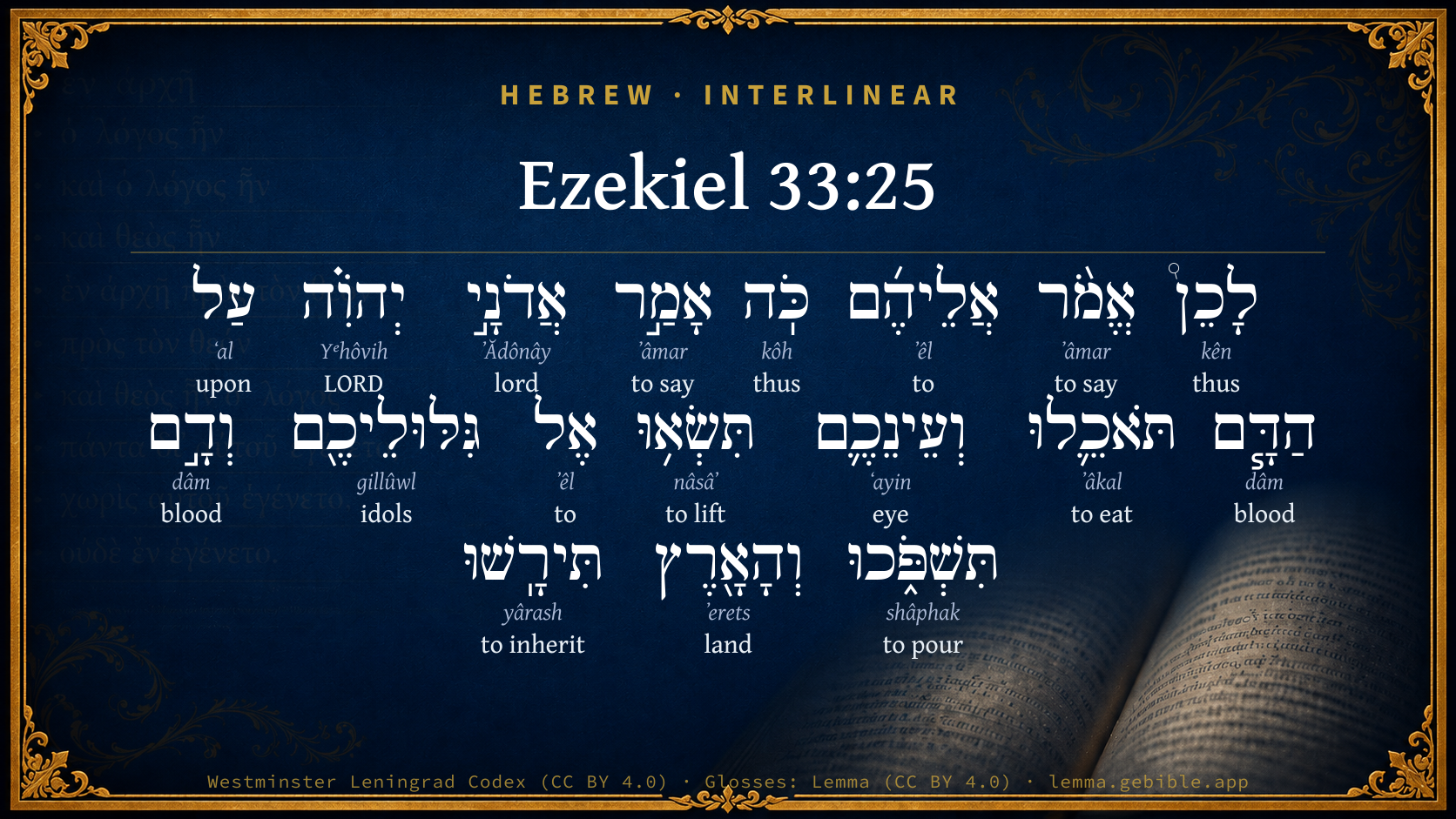
Ezekiel 33:25

Hebrew (Westminster Leningrad Codex) Ezekiel 33:25 appears in the Hebrew Old Testament. The text above is from the Westminster Leningrad Codex. Each word links to its Strong’s number, a concise gloss, and parsing drawn from the Open Scriptures Hebrew Bible morphology. Click any word for its full Brown-Driver-Briggs (BDB) entry.
Download image
Cite this verse

Ezekiel 33:25 (World English Bible). Public Domain. Lemma interlinear Bible study tool, https://lemma.gebible.app/v/ezekiel/33/25.

Show BibTeX & RIS
BibTeX
RIS
English Translation
Therefore tell them, Thus says the Lord Yahweh: You eat with the blood, and lift up your eyes to your idols, and shed blood: and shall you possess the land?
World English Bible · Public Domain
Download a study sheet

One document with this verse’s original text, its word-by-word gloss line, the meaning frame, cross-references with their text, attributed commentary, and full source and license credits — printable, and it pastes into notes with its structure intact.

This verse Autodidact and up

Study sheet (.html) Plain text (.txt)

A passage Seminary Student

Up to 50 verses in one chapter. A passage sheet keeps up to 6 commentary sources and 12 cross-references per verse, in the order this page ranks them, and says so on the sheet whenever that leaves anything out. Ask for a single verse and you get the Autodidact verse sheet above.

Everything on this page stays free to read, with no account — the sheet is a download of what is already on screen, not access to it.

Want to remove ads? Support Godless Engineer
Compare translations 3

The same verse in 3 English versions, stacked beneath the original-language interlinear above. Click any original word for its lexicon entry.

Each is an independent rendering of the whole verse — the interlinear is not word-aligned to these translations.

Highlighted words mark where these versions differ — a whole-verse word diff, not a word-by-word alignment.

  • World English Bible Public Domain
    Therefore tell them, Thus says the Lord Yahweh: You eat with the blood, and lift up your eyes to your idols, and shed blood: and shall you possess the land?
  • King James Version Public Domain
    Wherefore say unto them, Thus saith the Lord GOD; Ye eat with the blood, and lift up your eyes toward your idols, and shed blood: and shall ye possess the land?
  • unfoldingWord Literal Text CC BY-SA 4.0
    Therefore say to them, ‘The Lord Yahweh says this: You eat blood, and you lift up your eyes towards your idols, then you pour out people’s blood. Should you really possess the land?

unfoldingWord Literal Text — © unfoldingWord, licensed CC BY-SA 4.0. Word-aligned USFM3 via Door43 (git.door43.org/unfoldingWord/en_ult).

Versions to compare (up to 4)

3 of 4 selected

Show all 18 translations

Every available English version of this verse, each an independent rendering of the whole verse.

  • World English Bible Public Domain
    Therefore tell them, Thus says the Lord Yahweh: You eat with the blood, and lift up your eyes to your idols, and shed blood: and shall you possess the land?
  • Berean Standard Bible Public Domain
    Therefore tell them that this is what the Lord GOD says: ‘You eat meat with the blood in it, lift up your eyes to your idols, and shed blood. Should you then possess the land?
  • Majority Standard Bible Public Domain
    Therefore tell them that this is what the Lord GOD says: ‘You eat meat with the blood in it, lift up your eyes to your idols, and shed blood. Should you then possess the land?
  • King James Version Public Domain
    Wherefore say unto them, Thus saith the Lord GOD; Ye eat with the blood, and lift up your eyes toward your idols, and shed blood: and shall ye possess the land?
  • American Standard Version (1901) Public Domain
    Wherefore say unto them, Thus saith the Lord Jehovah: Ye eat with the blood, and lift up your eyes unto your idols, and shed blood: and shall ye possess the land?
  • Revised Version (1885) Public Domain
    Wherefore say unto them, Thus saith the Lord GOD: Ye eat with the blood, and lift up your eyes unto your idols, and shed blood: and shall ye possess the land?
  • Geneva Bible (1599) Public Domain
    Wherefore say vnto them, Thus saieth the Lord God, Ye eate with the blood, and lift vp your eyes towarde your idoles, and sheade blood: should ye then possesse the land?
  • Douay-Rheims (1899) Public Domain
    Therefore say to them: Thus saith the Lord God, You that eat with the blood and lift up your eyes to your uncleannesses, and that shed blood: shall you possess the land by inheritance?
  • Young's Literal Translation Public Domain
    Therefore say unto them: Thus said the Lord Jehovah: With the blood ye do eat, And your eyes ye lift up unto your idols, And blood ye shed, and the land ye inherit!
  • Literal Standard Version CC BY-SA 4.0
    Therefore say to them, Thus said Lord YHWH: You eat with the blood, || And you lift up your eyes to your idols, || And you shed blood, || Should you then inherit the land?
  • Unlocked Literal Bible CC BY-SA 4.0
    Therefore say to them, 'The Lord Yahweh says this: You eat blood, and you lift up your eyes towards your idols, then you pour out people's blood. Should you really possess the land?
  • unfoldingWord Literal Text CC BY-SA 4.0
    Therefore say to them, ‘The Lord Yahweh says this: You eat blood, and you lift up your eyes towards your idols, then you pour out people’s blood. Should you really possess the land?
  • Darby Bible Public Domain
    Therefore say unto them, Thus saith the Lord Jehovah: Ye eat with the blood, and lift up your eyes toward your idols, and shed blood; and shall ye possess the land?
  • World Messianic Bible Public Domain
    Therefore tell them, ‘The Lord GOD says: “You eat with the blood, and lift up your eyes to your idols, and shed blood. So should you possess the land?
  • Webster's Bible Public Domain
    Wherefore say to them, Thus saith the Lord GOD; Ye eat with the blood, and lift up your eyes towards your idols, and shed blood: and shall ye possess the land?
  • Free Bible Version CC BY-SA 4.0
    So tell them that this is what the Lord God says: You eat meat with the blood still in it. You go and worship your idols. You commit murder. Do you really think the country should belong to you?
  • Bible in Basic English Public Domain
    For this cause say to them, This is what the Lord has said: You take your meat with the blood, your eyes are lifted up to your images, and you are takers of life: are you to have the land for your heritage?
  • JPS Tanakh (1917) Public Domain
    Wherefore say unto them: Thus saith the Lord GOD. Ye eat with the blood, and lift up your eyes unto your idols, and shed blood; and shall ye possess the land?

Literal Standard Version (2020), Covenant Press — licensed CC BY-SA 4.0. Text via the HelloAO Bible API (eBible.org). Unlocked Literal Bible (unfoldingWord) — licensed CC BY-SA 4.0. Text via the HelloAO Bible API (eBible.org). unfoldingWord Literal Text — © unfoldingWord, licensed CC BY-SA 4.0. Word-aligned USFM3 via Door43 (git.door43.org/unfoldingWord/en_ult). Free Bible Version, Dr. Jonathan Gallagher — licensed CC BY-SA 4.0. Text via the HelloAO Bible API (eBible.org).

Word by word

More ways to search: Search by grammar → Find every occurrence → Compare this word →

Practice this passage: Drill this verse → Learn its vocabulary →

גִּלּוּלֵיכֶ֖ם
gillûwl
H1544
“idols · your”
Noun, Common, Masculine, Plural, Construct + Suffix, Personal, 2nd Person, Masculine, Plural
Part of Speech
Noun
Type
Common
Gender
Masculine
Number
Plural
State
Construct
Full BDB Definition

Origin: from H1556

TWOT: 353h

idols
  1. לָכֵן֩ kên H3651 “to/for · thus” Preposition + Adverb
  2. אֱמֹ֨ר ʼâmar H559 “say” Verb, Qal, Imperative, 2nd Person, Masculine, Singular
  3. אֲלֵיהֶ֜ם ʼêl H413 “to · them” Preposition + Suffix, Personal, 3rd Person, Masculine, Plural
  4. כֹּֽה kôh H3541 “thus” Adverb
  5. אָמַ֣ר ʼâmar H559 “to say” Verb, Qal, Perfect, 3rd Person, Masculine, Singular
  6. אֲדֹנָ֣י ʼĂdônây H136 “Lord · my” Noun, Common, Masculine, Plural, Construct + Suffix, Personal, 1st Person, Common, Singular
  7. יְהֹוִ֗ה Yᵉhôvih H3069 “LORD” Noun, Proper
  8. עַל ʻal H5921 “upon” Preposition
  9. הַדָּ֧ם dâm H1818 “the · blood” Particle, Definite Article + Noun, Common, Masculine, Singular, Absolute
  10. תֹּאכֵ֛לוּ ʼâkal H398 “to eat” Verb, Qal, Imperfect, 2nd Person, Masculine, Plural
  11. וְעֵינֵכֶ֛ם ʻayin H5869 “and · eyes · your” Conjunction + Noun, Common, Both, Dual, Construct + Suffix, Personal, 2nd Person, Masculine, Plural
  12. תִּשְׂא֥וּ nâsâʼ H5375 “to lift” Verb, Qal, Imperfect, 2nd Person, Masculine, Plural
  13. אֶל ʼêl H413 “to” Preposition
  14. וְדָ֣ם dâm H1818 “and · blood” Conjunction + Noun, Common, Masculine, Singular, Absolute
  15. תִּשְׁפֹּ֑כוּ shâphak H8210 “to pour” Verb, Qal, Imperfect, 2nd Person, Masculine, Plural
  16. וְהָאָ֖רֶץ ʼerets H776 “and · the · land” Conjunction + Particle, Definite Article + Noun, Common, Both, Singular, Absolute
  17. תִּירָֽשׁוּ yârash H3423 “to inherit” Verb, Qal, Imperfect, 2nd Person, Masculine, Plural

About this verse

These counts appear in no published source. They are computed here, from the morphology-tagged text and Lemma’s own curated glosses. What Lemma adds →

18
words
15
distinct lemmas
Prophets
section

Shared distinctive vocabulary

גִּלּוּלֵיכֶ֖ם idols H1544 occurs in 45 verses of the Hebrew Bible. Also found in:

Grammatical profile

  • 6 verbs
  • 7 nouns
  • 3 prepositions
  • 2 adverbs

Verb forms

  • אֱמֹ֨ר Qal · Imperative
  • אָמַ֣ר Qal · Perfect
  • תֹּאכֵ֛לוּ Qal · Imperfect
  • תִּשְׂא֥וּ Qal · Imperfect
  • תִּשְׁפֹּ֑כוּ Qal · Imperfect
  • תִּירָֽשׁוּ Qal · Imperfect

Repetition

Words recur within this verse — often emphatic in Hebrew:

  • אֱמֹ֨ר to say H559 ×2
  • הַדָּ֧ם blood H1818 ×2
  • אֲלֵיהֶ֜ם to H413 ×2

Cross-references

21

Topical passages linked to Ezekiel 33:25 in the Treasury of Scripture Knowledge — connected by theme and wording, ordered by reader-vote popularity; previews shown in the World English Bible.

  • Genesis 9:4 But flesh with the life of it, the blood of it, you shall not eat.
  • Deuteronomy 12:16 Only you shall not eat the blood; you shall pour it out on the earth as water.
  • Jeremiah 7:9–10 Will you steal, murder, and commit adultery, and swear falsely, and burn incense to Baal, and walk after other gods that you have not known,
  • Leviticus 3:17 "'It shall be a perpetual statute throughout your generations in all your dwellings, that you shall eat neither fat nor blood.'"
  • Ezekiel 18:6 and has not eaten on the mountains, neither has lifted up his eyes to the idols of the house of Israel, neither has defiled his neighbor's wife, neither has come near to a woman in her impurity,
  • Ezekiel 22:6 Behold, the princes of Israel, everyone according to his power, have been in you to shed blood.
  • Ezekiel 22:27 Her princes in the midst of it are like wolves ravening the prey, to shed blood, [and] to destroy souls, that they may get dishonest gain.
  • Leviticus 7:26–27 You shall not eat any blood, whether it is of bird or of animal, in any of your dwellings.
  • Leviticus 17:10–14 "'Any man of the house of Israel, or of the strangers who live as foreigners among them, who eats any kind of blood, I will set my face against that soul who eats blood, and will cut him off from among his people.
  • Leviticus 19:26 "'You shall not eat any meat with the blood still in it; neither shall you use enchantments, nor practice sorcery.
  • Deuteronomy 4:19 and lest you lift up your eyes to the sky, and when you see the sun and the moon and the stars, even all the host of the sky, you are drawn away and worship them, and serve them, which Yahweh your God has allotted to all the peoples under the whole sky.
  • 1 Samuel 14:32–34 and the people flew on the spoil, and took sheep, and oxen, and calves, and killed them on the ground; and the people ate them with the blood.
  • Psalms 24:4 He who has clean hands and a pure heart; Who has not lifted up his soul to falsehood, And has not sworn deceitfully.
  • Jeremiah 44:15–19 Then all the men who knew that their wives burned incense to other gods, and all the women who stood by, a great assembly, even all the people who lived in the land of Egypt, in Pathros, answered Jeremiah, saying,
  • Ezekiel 9:9 Then said he to me, The iniquity of the house of Israel and Judah is exceeding great, and the land is full of blood, and the city full of wrestling [of judgment]: for they say, Yahweh has forsaken the land, and Yahweh doesn't see.
  • Ezekiel 18:12 has wronged the poor and needy, has taken by robbery, has not restored the pledge, and has lifted up his eyes to the idols, has committed abomination,
  • Ezekiel 18:15 who has not eaten on the mountains, neither has lifted up his eyes to the idols of the house of Israel, has not defiled his neighbor's wife,
  • Ezekiel 22:9 Slanderous men have been in you to shed blood; and in you they have eaten on the mountains: in the midst of you they have committed lewdness.
  • Acts 15:20–21 but that we write to them that they abstain from the pollution of idols, from sexual immorality, from what is strangled, and from blood.
  • Acts 15:29 that you abstain from things sacrificed to idols, from blood, from things strangled, and from sexual immorality, from which if you keep yourselves, it will be well with you. Farewell."
  • Acts 21:25 But concerning the Gentiles who believe, we have written our decision that they should observe no such thing, except that they should keep themselves from food offered to idols, from blood, from strangled things, and from sexual immorality."

Cross-references courtesy of OpenBible.info (CC BY 4.0).

Hebrew and Greek witnesses Masoretic Hebrew ↔ Greek Septuagint

The same verse in the two great witnesses to the Old Testament, shown verse-for-verse.

These are two independent witnesses, not word-aligned to each other, and the Septuagint is shown in lemma (dictionary) form.

Hebrew Ezekiel 33:25 Masoretic · Westminster Leningrad Codex

לָכֵן֩ אֱמֹ֨ר אֲלֵיהֶ֜ם כֹּֽה אָמַ֣ר אֲדֹנָ֣י יְהֹוִ֗ה עַל הַדָּ֧ם תֹּאכֵ֛לוּ וְעֵינֵכֶ֛ם תִּשְׂא֥וּ אֶל גִּלּוּלֵיכֶ֖ם וְדָ֣ם תִּשְׁפֹּ֑כוּ וְהָאָ֖רֶץ תִּירָֽשׁוּ

Therefore tell them, Thus says the Lord Yahweh: You eat with the blood, and lift up your eyes to your idols, and shed blood: and shall you possess the land?

World English Bible · Public Domain

Greek LXX Ezekiel 33:25 Septuagint · lemma form

διά οὗτος εἶπον αὐτός ὅδε λέγω κύριος κύριος

No English rendering of this Greek verse — the small residue in the structurally divergent books.

On this verse, Haydock's Catholic Bible Commentary discusses the Septuagint’s reading. Read the note in Commentary ↓

Hebrew: Westminster Leningrad Codex (CC BY 4.0). Greek: Septuagint (public domain); English from a public-domain English Septuagint. How the Septuagint differs from the Hebrew →

Targum (Aramaic paraphrase)

1

The Targum is the ancient Jewish Aramaic paraphrase of the Hebrew Scriptures — an interpretive translation, not the Hebrew text itself. Onkelos (literal) and Pseudo-Jonathan (expansive) render the Torah, and Jonathan the Prophets. Coverage is partial: where no permissively-licensed English translation exists for a verse, only the Aramaic is shown. This is verse-level text, not a word-by-word alignment to the Hebrew.

  1. Targum Jonathan Prophets (Joshua–Malachi)
    בְּכֵן אֲמַר לְהוֹן כִּדְנַן אֲמַר יְיָ אֱלֹהִים עַל דַם זַכַּאי אַתּוּן אָכְלִין וְעֵינֵיכוֹן אַתּוּן זָקְפִין לְפוּלְחַן טַעֲוַתְכוֹן וְדַם זַכַּאי אַתּוּן אֶשְׁדִין וְאַרְעָא אַתּוּן מְדַמָן לְמֵירְתָהּ:

    (no public-domain English translation for this verse)

    Targum Jonathan — Aramaic: “Mikraot Gedolot” (public domain). English: “Sefaria Community Translation” (CC0 1.0 (public-domain dedication)); “London "Chaldee Paraphrase," 1871” (public domain). Text via Sefaria.

Commentary

Notes on Ezekiel 33:25 from classic Christian and Jewish commentators (each source and its license shown beneath its notes). The classic Christian expositions comment on the surrounding passage and are grouped to its opening verse, so a note may address several verses; the Jewish commentaries on the Tanakh (Rashi and others) are per-verse, so they appear only where the commentator wrote on this verse.

Lemma curates 59 commentaries, every one of them public domain or Creative Commons licensed, each selected and text-cleaned for this edition rather than reprinted as found. About our sources →

Ellicott's Commentary for English Readers

(25) Ye eat with the blood.—The people who remained in the land went on as before in their course of sin. The crimes here charged upon them (Eze_33:25-26) are the same as those all along alleged against them, and Jeremiah gives a sad picture of their open rebellion against the express commands of God (Jeremiah 42, 43). This particular sin of eating flesh with the blood had been repeatedly forbidden, first to Noah (Gen_9:4), and again under the Law (Lev_3:17; Lev_7:26; Lev_17:10-14; Deu_12:16).

A Bible Commentary for English Readers, edited by Charles John Ellicott (1878–1897) — public domain. Text from a community e-Sword module.

Trapp's Complete Commentary

John Trapp

Eze 33:25 Wherefore say unto them, Thus saith the Lord GOD; Ye eat with the blood, and lift up your eyes toward your idols, and shed blood: and shall ye possess the land?

Ver. 25. Ye eat with the blood.] Which wicked Saul would not do, {1Sa 14:32-34} much less would righteous Abraham have done it, since it was against the light and letter of the law. {Gen 9:4 Lev 7:26 Deu 12:16} Nay, ye do worse things; and are you Abraham’s children, and heirs of the promised land, together with that faithful patriarch? I think not. See a like manner of reasoning, Mic 2:7 Joh 8:39. So the learned Linaker, having read our Saviour’s sermon in the mount, and considering how little it is lived among us, broke out into these words, Certainly either this is not gospel, or we are not right gospellers.

John Trapp, A Commentary or Exposition upon All the Books of the Old and New Testament (1647–1656) — public domain. Text from a community e-Sword module.

Joseph Benson's Commentary

Eze 33:25-26. Say unto them, Thus saith the Lord — Remove from them this destructive carnal confidence, and show them what they do, and how far they are from being Abraham’s genuine seed. Ye eat with the blood — Which was expressly forbidden in the Jewish law, as appears from Lev 7:26, as well as that more ancient law ordained to all mankind, Gen 9:4; and lift up your eyes toward your idols — Offer up your prayers unto your fictitious gods; and shed blood — That is, commit murders; and shall ye possess the land? — When you do not perform the conditions on which the land was given, namely, that of being a holy people, can you think that you shall continue to enjoy it? Ye stand upon your sword — You make your strength the law of justice, and, confiding in that, you do whatsoever your inclinations lead you to, whether right or wrong; according to the character given of ungodly men, Wis 2:11, who say, “Let our strength be the law of justice, for that which is feeble is found to be nothing worthy” &c. Houbigant translates the clause, You stand in your high way, or the corners of your streets, and commit your abominations, considering the words as referring to their public and open profession of idolatry. Dr. Spencer (De Legib. Hebrew, lib. 2. cap. 11) thinks that the expression alludes to a custom of the heathen, “who put the blood of their sacrifices into a vessel, or pit, in order to call up and consult evil spirits, and then stood with their swords drawn, to keep the demons off from doing them any harm.” Ye defile every one his neighbour’s wife — Ye universally commit adultery; and shall ye possess the land? — The question implies a peremptory denial. Thus the prophet shows how vain and ill-grounded their expectations were of being continued in the possession of Judea, since they did those things which were contrary to the divine law, and which consequently excluded them from any right to the land.

Joseph Benson's Commentary on the Old and New Testaments (1811–1818) — public domain. Text from a community e-Sword module.

Geneva Bible (1599)

Geneva Bible translators

Contrary to the Law, Lev. 17:14.

Geneva Bible (1599) marginal notes — public domain. Text via Bolls.life.

Jamieson, Fausset & Brown

Robert Jamieson, A. R. Fausset & David Brown

eat with the blood--in opposition to the law (Lev 19:26; compare Gen 9:4). They did so as an idolatrous rite.

Jamieson, Fausset & Brown — Commentary Critical and Explanatory on the Whole Bible (1871) — public domain (CC PDM 1.0). Text via the HelloAO Bible API.

Adam Clarke's Commentary

Verse 25. Ye eat with the blood] Abraham was righteous, ye are unrighteous. Eating of blood, in any way dressed, or of flesh from which the blood had not been extracted, was and is in the sight of God abominable. All such practices he has absolutely and for ever forbidden. Let the vile blood-eaters hear and tremble. See Clarke on Ac 15:20, and the passages in the margin.

Adam Clarke's Commentary on the Bible (1810–1826) — public domain. Text from a community e-Sword/MySword module.

The Cambridge Bible for Schools and Colleges

gen. ed. J. J. S. Perowne

25. The claim of the remnant is repudiated by Ezek. with indignation. They persist in the sins for which their country fell, and the same judgment shall overtake them.

ye eat with the blood] i.e. eat flesh slaughtered in such a way that the blood remains in it. According to the law animals had to be slaughtered in such a way as to drain away the blood, which was poured into the ground, where not dashed upon the altar. An example of a prohibited way of slaughtering was breaking the neck, Isa_66:3. Cf. Lev_17:10; Lev_19:26; Deu_12:16; 1Sa_14:32. See on Eze_18:6; Eze_18:11; Eze_18:15, Eze_22:9.

lift up your eyes] See Eze_18:6. On “shed blood” Eze_22:6; Eze_22:9.

The Cambridge Bible for Schools and Colleges (gen. ed. J. J. S. Perowne; Cambridge University Press, 1878–1918) — public domain. Text from a community e-Sword module.

John Gill's Exposition

Say thou thus unto them, thus saith the Lord God,.... Send or write unto them in the name of the Lord, after this manner,

as I live, which is the form of an oath; the Lord swears by himself his life, because he could swear by no greater, and for the confirmation of what follows:

surely they that are in the wastes shall fall by the sword; by their own sword, falling out one with another; or by the sword of Ishmael Jer 41:2 or by the sword of the Chaldeans, who revenged the death of Gedaliah and others; even such who dwelt amidst the ruins of the city of Jerusalem, and other places, that were become desolate through the ravages of the enemy:

and him that is in the open field will I give to the beasts to be devoured; of which it may be supposed there were the greater numbers, since the land was so depopulated: and they that be in the forts, and in the caves, shall die of the pestilence; such as were in fortified cities, or in caverns of the earth, dug in rocks and mountains, where, in neither of them, men and beasts could easily come at them; here the Lord would send his arrow, the plague, that flies by day, and reach them, and destroy them; none can escape his hands; these are three of the Lord's sore judgments, the sword, pestilence, and noisome beasts.

John Gill's Exposition of the Whole Bible (1746–1763) — public domain (CC PDM 1.0). Text via the HelloAO Bible API.

Haydock's Catholic Bible Commentary

To them. Grabe marks to ver. 27., Thus saith, &c., as wanting in the Septuagint, though not in the Alexandrian copy. St. Jerome reckons eight verses or lines omitted. (Haydock) --- The Complutensian and Theodoret read them with some variations. --- The blood. It must be carefully extracted, Genesis ix. 4., and Leviticus vii. 26. --- Uncleannesses; idols, in which you trust.

George Leo Haydock (1774–1849), Haydock's Catholic Family Bible and Commentary, 1859 edition — public domain. Excludes Psalms (Douay-Rheims chapter numbering differs from Protestant) and Deuterocanonical books (Catholic canon only).

Matthew Poole's English Annotations

Say unto them; remove them from this dangerous carnal confidence, and show them what they do, and by that what they are, how far from Abraham’s seed, his genuine seed.

Ye eat with the blood: whatever might be the reason why, it is most certain this was forbidden, Gen 9:4; Lev 17:14; 19:26; they sinned by violating this law.

Lift up your eyes; honouring, praying, depending on, and committing yourselves to the protection and guidance of those dumb idols: see Eze 18:6. Shed blood, innocent blood, ye are murderers.

Shall ye possess the land, polluted with such and many other heinous sins? and what colour of hope can you have, that you shall possess the land? The question includes a peremptory denial.

Matthew Poole's English Annotations on the Holy Bible (1683–1685) — public domain. Text from a community e-Sword/MySword module.

The Pulpit Commentary

Ye eat with the blood. It is characteristic of Ezekiel that the first offence which he names with horror should be a sin against a positive commandment. He felt, as it were, a sense of loathing at what seemed to him a descent into the worst form of pollution, forbidden, not to the Jews (Lev_17:10 Lev_19:26; Deu_12:16) but to mankind; (Gen_9:4) compare the scene in 1Sa_14:32. The same feeling shows itself in Zec_9:7 and Act_15:20, Act_15:29. The prohibition of blood took its place, in later Judaism, as among the precepts of Noah, which were binding even on the proselytes of the gate, upon whom, as distinct from the proselytes of righteousness, the rite of circumcision was not enforced; and as such were accepted by the council at Jerusalem, as binding also among Christian converts. Not for such as these was the inheritance of Israel, and the prophet asks indignantly, after naming yet. more hateful offenses, Shall ye possess the land?

The Pulpit Commentary (1880–1919), ed. H.D.M. Spence-Jones & Joseph S. Exell — public domain. Text from a community e-Sword module.

unfoldingWord translationNotes

Door43 World Missions Community

General Information:

Yahweh continues speaking to Ezekiel about the people who were living in the ruins of Israel.

You eat blood

It is implied that they eat blood by eating meat that still has blood in it. Yahweh had commanded them to drain out the blood. AT: "You eat meat with blood in it" (See: Assumed Knowledge and Implicit Information)

you lift up your eyes towards your idols

"you look to your idols" This is an idiom. AT: "you worship your idols" (See: Idiom)

you pour out people's blood

Here "blood" represents a person's life. To pour out blood is an idiom that means to murder. AT: "you murder people" (See: Metonymy and Idiom)

Should you really possess the land?

Yahweh used this question to rebuke the people. AT: "You should not possess this land!" or "You do not deserve this land!" (See: Rhetorical Question)

You have depended on your swords

Here "swords" represent doing violent things. AT: "You have committed violent acts with your swords to get what you want" (See: Metonymy)

done disgusting things

"done things that I hate very much"

each man defiles his neighbor's wife

It is implied that they defile their neighbor's wives by sleeping with them. AT: "each man sleeps with his neighbor's wife" (See: Assumed Knowledge and Implicit Information)

translationWords

Lord Yahweh

blood

false god

sword

defile

neighbor

unfoldingWord translationNotes — © Distant Shores Media and the Door43 World Missions Community, licensed CC BY-SA 4.0. Source: git.door43.org/Door43/en_tn.

Rashi

Rabbi Shlomo Yitzchaki (Rashi)

You eat on the blood, etc., and you should inherit the land This is a rhetorical question. If you were commanded [many commandments], you do not keep [them]. You eat on the blood: you eat delicacies through murder, for you slay those who have money and take away their money.

Rashi on the Tanakh — English translations: “The Judaica Press complete Tanach with Rashi, translated by A. J. Rosenberg” (CC BY 4.0); “Pentateuch with Rashi's commentary by M. Rosenbaum and A.M. Silbermann, 1929-1934” (public domain); “The Metsudah Tanach series, Lakewood, N.J” (CC BY 4.0); and “The Book of Joshua, Metsudah Publications, 1997” (CC BY 4.0). Text via Sefaria.

Lesson kit

Teaching starters — assembled from the data on this page, not authored interpretation. Every prompt links to the verse data it draws on. Edit before teaching.

Ezekiel, in the Prophets, opens this verse with 18 words (15 distinct Hebrew lemmas). Its most distinctive word is gillûwl (“idols”). A historical commentator’s framing appears above. Read the whole chapter for the surrounding context.

Discussion questions

  1. How does “idols” (gillûwl) shape what this verse is saying?
  2. Leviticus 26:30 shares the word «idols» with this verse. How do the two illuminate each other?
  3. “to say” occurs 2× in this one verse. What is the effect of the repetition?
  4. These translations render this verse differently; the difference is in the English rendering, not the original. What questions does that raise?
  5. The verb «אֱמֹ֨ר» is Qal Imperative. How does its form color the action?
  6. Reading how Ellicott's Commentary for English Readers and Trapp's Complete Commentary read this verse, where do the two commentators agree and where do they part?

Things to notice

Reading settings

Reading text

Shown beneath each verse's original-language words.

Old Testament
Old Testament edition

Read the OT as the Masoretic Hebrew (MT) or the Greek Septuagint (LXX).

English shown for the Greek Septuagint (in the Hebrew ↔ Greek comparison).

Comparing translations? Open the Compare panel on any verse page to stack up to four side by side.