
Leviticus 8:15

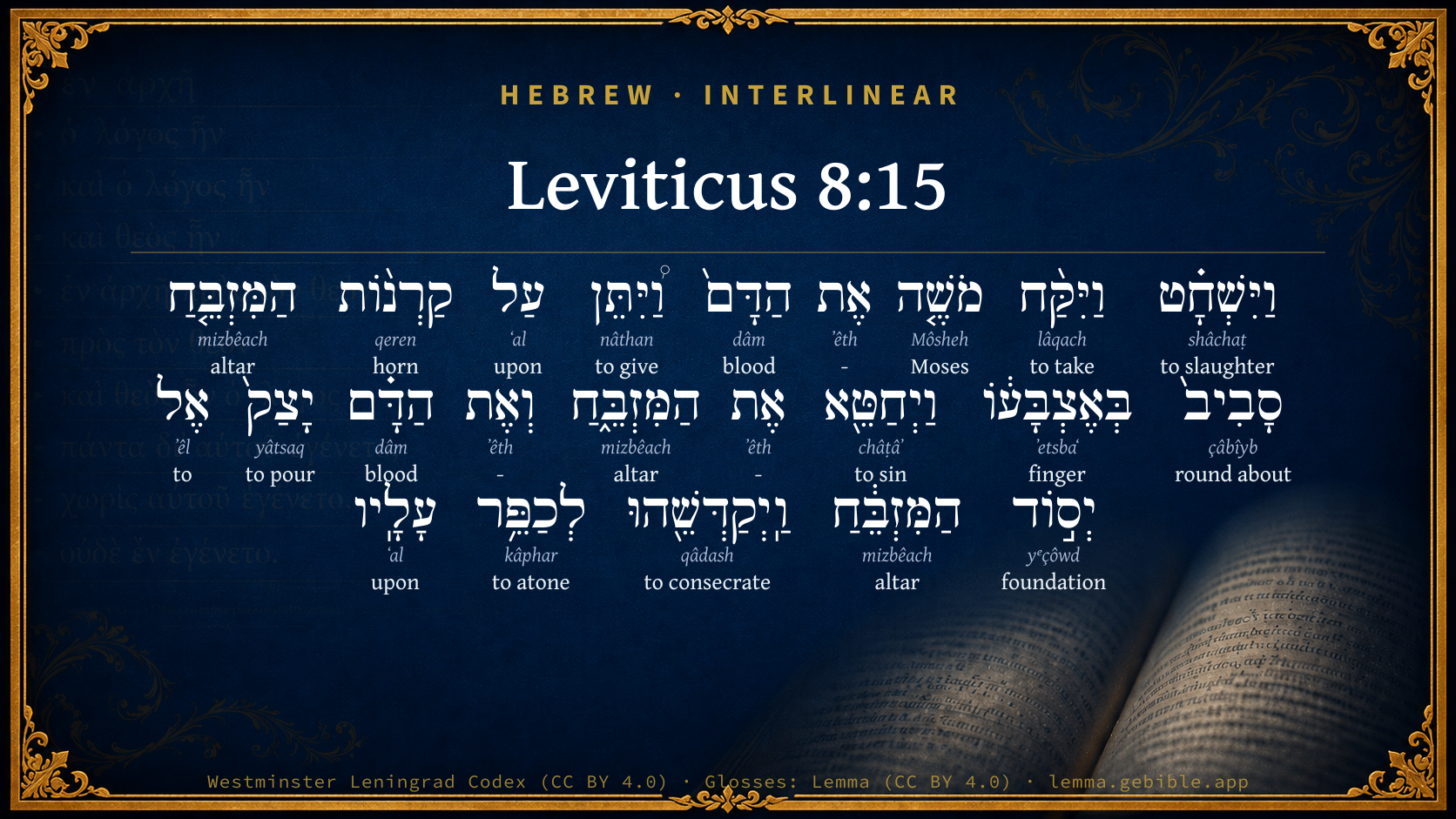
Hebrew (Westminster Leningrad Codex) Leviticus 8:15 appears in the Hebrew Old Testament. The text above is from the Westminster Leningrad Codex. Each word links to its Strong’s number, a concise gloss, and parsing drawn from the Open Scriptures Hebrew Bible morphology. Click any word for its full Brown-Driver-Briggs (BDB) entry.
Download image
Cite this verse

Leviticus 8:15 (World English Bible). Public Domain. Lemma interlinear Bible study tool, https://lemma.gebible.app/v/leviticus/8/15.

Show BibTeX & RIS
BibTeX
RIS
English Translation
He killed it; and Moses took the blood, and put it on the horns of the altar round about with his finger, and purified the altar, and poured out the blood at the base of the altar, and sanctified it, to make atonement for it.
World English Bible · Public Domain
Download a study sheet

One document with this verse’s original text, its word-by-word gloss line, the meaning frame, cross-references with their text, attributed commentary, and full source and license credits — printable, and it pastes into notes with its structure intact.

This verse Autodidact and up

Study sheet (.html) Plain text (.txt)

A passage Seminary Student

Up to 50 verses in one chapter. A passage sheet keeps up to 6 commentary sources and 12 cross-references per verse, in the order this page ranks them, and says so on the sheet whenever that leaves anything out. Ask for a single verse and you get the Autodidact verse sheet above.

Everything on this page stays free to read, with no account — the sheet is a download of what is already on screen, not access to it.

Want to remove ads? Support Godless Engineer
Compare translations 3

The same verse in 3 English versions, stacked beneath the original-language interlinear above. Click any original word for its lexicon entry.

Each is an independent rendering of the whole verse — the interlinear is not word-aligned to these translations.

Highlighted words mark where these versions differ — a whole-verse word diff, not a word-by-word alignment.

  • World English Bible Public Domain
    He killed it; and Moses took the blood, and put it on the horns of the altar round about with his finger, and purified the altar, and poured out the blood at the base of the altar, and sanctified it, to make atonement for it.
  • King James Version Public Domain
    And he slew it; and Moses took the blood, and put it upon the horns of the altar round about with his finger, and purified the altar, and poured the blood at the bottom of the altar, and sanctified it, to make reconciliation upon it.
  • unfoldingWord Literal Text CC BY-SA 4.0
    And he slaughtered, and Moses took the blood, and he put on the horns of the altar all around with his finger. And he purified the altar, and he poured out the blood at the base of the altar. And he made it holy to make atonement on it.

unfoldingWord Literal Text — © unfoldingWord, licensed CC BY-SA 4.0. Word-aligned USFM3 via Door43 (git.door43.org/unfoldingWord/en_ult).

Versions to compare (up to 4)

3 of 4 selected

Show all 18 translations

Every available English version of this verse, each an independent rendering of the whole verse.

  • World English Bible Public Domain
    He killed it; and Moses took the blood, and put it on the horns of the altar round about with his finger, and purified the altar, and poured out the blood at the base of the altar, and sanctified it, to make atonement for it.
  • Berean Standard Bible Public Domain
    Moses slaughtered the bull, took some of the blood, and applied it with his finger to all four horns of the altar, purifying the altar. He poured out the rest of the blood at the base of the altar and consecrated it so that atonement could be made on it.
  • Majority Standard Bible Public Domain
    Moses slaughtered the bull, took some of the blood, and applied it with his finger to all four horns of the altar, purifying the altar. He poured out the rest of the blood at the base of the altar and consecrated it so that atonement could be made on it.
  • King James Version Public Domain
    And he slew it; and Moses took the blood, and put it upon the horns of the altar round about with his finger, and purified the altar, and poured the blood at the bottom of the altar, and sanctified it, to make reconciliation upon it.
  • American Standard Version (1901) Public Domain
    And he slew it; and Moses took the blood, and put it upon the horns of the altar round about with his finger, and purified the altar, and poured out the blood at the base of the altar, and sanctified it, to make atonement for it.
  • Revised Version (1885) Public Domain
    And he slew it; and Moses took the blood, and put it upon the horns of the altar round about with his finger, and purified the altar, and poured out the blood at the base of the altar, and sanctified it, to make atonement for it.
  • Geneva Bible (1599) Public Domain
    And Moses slew him, and tooke the blood, which he put vpon the hornes of the Altar roud about with his finger, and purified the altar, and powred the rest of the blood at the foote of ye altar: so he sanctified it, to make reconciliation vpon it.
  • Douay-Rheims (1899) Public Domain
    He immolated it: and took the blood, and dipping his finger in it, he touched the horns of the altar round about. Which being expiated, and sanctified, he poured the rest of the blood at the bottom thereof.
  • Young's Literal Translation Public Domain
    and `one' slaughtereth, and Moses taketh the blood, and putteth on the horns of the altar round about with his finger, and cleanseth the altar, and the blood he hath poured out at the foundation of the altar, and sanctifieth it, to make atonement upon it.
  • Literal Standard Version CC BY-SA 4.0
    and [one] slaughters, and Moses takes the blood, and puts [it] around the horns of the altar with his finger, and cleanses the altar, and he has poured out the blood at the foundation of the altar, and sanctifies it, to make atonement on it.
  • Unlocked Literal Bible CC BY-SA 4.0
    He killed it, and he took the blood and put it on the horns of the altar with his finger, purified the altar, poured out the blood at the base of the altar, and set it apart for God in order to make atonement for it.
  • unfoldingWord Literal Text CC BY-SA 4.0
    And he slaughtered, and Moses took the blood, and he put on the horns of the altar all around with his finger. And he purified the altar, and he poured out the blood at the base of the altar. And he made it holy to make atonement on it.
  • Darby Bible Public Domain
    and he slaughtered [it], and Moses took the blood, and put [it] on the horns of the altar round about with his finger, and cleansed the altar from sin, and the blood he poured at the bottom of the altar, and hallowed it, making atonement for it.
  • World Messianic Bible Public Domain
    He killed it; and Moses took the blood, and put it around on the horns of the altar with his finger, and purified the altar, and poured out the blood at the base of the altar, and sanctified it, to make atonement for it.
  • Webster's Bible Public Domain
    And he slew it; and Moses took the blood, and put it upon the horns of the altar round about with his finger, and purified the altar, and poured the blood at the bottom of the altar, and sanctified it, to make reconciliation upon it.
  • Free Bible Version CC BY-SA 4.0
    Moses killed the bull and took some of the blood. He used his finger to put the blood on all four horns of the altar to dedicate it and purify it. He poured out the rest of the blood at the bottom of the altar, and consecrated the altar so that it could be used to make people right.
  • Bible in Basic English Public Domain
    And he put it to death; and Moses took the blood and put it on the horns of the altar and round it with his finger, and made the altar clean, draining out the blood at the base of the altar; so he made it holy, taking away what was unclean.
  • JPS Tanakh (1917) Public Domain
    And when it was slain, Moses took the blood, and put it upon the horns of the altar round about with his finger, and purified the altar, and poured out the remaining blood at the base of the altar, and sanctified it, to make atonement for it.

Literal Standard Version (2020), Covenant Press — licensed CC BY-SA 4.0. Text via the HelloAO Bible API (eBible.org). Unlocked Literal Bible (unfoldingWord) — licensed CC BY-SA 4.0. Text via the HelloAO Bible API (eBible.org). unfoldingWord Literal Text — © unfoldingWord, licensed CC BY-SA 4.0. Word-aligned USFM3 via Door43 (git.door43.org/unfoldingWord/en_ult). Free Bible Version, Dr. Jonathan Gallagher — licensed CC BY-SA 4.0. Text via the HelloAO Bible API (eBible.org).

Word by word

More ways to search: Search by grammar → Find every occurrence → Compare this word →

Practice this passage: Drill this verse → Learn its vocabulary →

יְס֣וֹד
yᵉçôwd
H3247
“foundation of”
Noun, Common, Masculine, Singular, Construct
Part of Speech
Noun
Type
Common
Gender
Masculine
Number
Singular
State
Construct
Full BDB Definition

Origin: from H3245

TWOT: 875b

foundation, base - foundation - base, bottom
  1. וַיִּשְׁחָ֗ט shâchaṭ H7819 “and · to slaughter” Conjunction + Verb, Qal, Sequential Imperfect, 3rd Person, Masculine, Singular
  2. וַיִּקַּ֨ח lâqach H3947 “and · to take” Conjunction + Verb, Qal, Sequential Imperfect, 3rd Person, Masculine, Singular
  3. מֹשֶׁ֤ה Môsheh H4872 “Moses” Noun, Proper
  4. אֶת ʼêth H853 “-” Particle, Direct Object
  5. הַדָּם֙ dâm H1818 “the · blood” Particle, Definite Article + Noun, Common, Masculine, Singular, Absolute
  6. וַ֠יִּתֵּן nâthan H5414 “and · to give” Conjunction + Verb, Qal, Sequential Imperfect, 3rd Person, Masculine, Singular
  7. עַל ʻal H5921 “upon” Preposition
  8. קַרְנ֨וֹת qeren H7161 “horns of” Noun, Common, Both, Plural, Construct
  9. הַמִּזְבֵּ֤חַ mizbêach H4196 “the · altar” Particle, Definite Article + Noun, Common, Masculine, Singular, Absolute
  10. סָבִיב֙ çâbîyb H5439 “round about” Noun, Common, Both, Singular, Absolute
  11. בְּאֶצְבָּע֔וֹ ʼetsbaʻ H676 “in/at · finger · his” Preposition + Noun, Common, Feminine, Singular, Construct + Suffix, Personal, 3rd Person, Masculine, Singular
  12. וַיְחַטֵּ֖א châṭâʼ H2398 “and · to sin” Conjunction + Verb, Piel, Sequential Imperfect, 3rd Person, Masculine, Singular
  13. אֶת ʼêth H853 “-” Particle, Direct Object
  14. הַמִּזְבֵּ֑חַ mizbêach H4196 “the · altar” Particle, Definite Article + Noun, Common, Masculine, Singular, Absolute
  15. וְאֶת ʼêth H853 “and · -” Conjunction + Particle, Direct Object
  16. הַדָּ֗ם dâm H1818 “the · blood” Particle, Definite Article + Noun, Common, Masculine, Singular, Absolute
  17. יָצַק֙ yâtsaq H3332 “to pour” Verb, Qal, Perfect, 3rd Person, Masculine, Singular
  18. אֶל ʼêl H413 “to” Preposition
  19. הַמִּזְבֵּ֔חַ mizbêach H4196 “the · altar” Particle, Definite Article + Noun, Common, Masculine, Singular, Absolute
  20. וַֽיְקַדְּשֵׁ֖הוּ qâdash H6942 “and · to consecrate · him” Conjunction + Verb, Piel, Sequential Imperfect, 3rd Person, Masculine, Singular + Suffix, Personal, 3rd Person, Masculine, Singular
  21. לְכַפֵּ֥ר kâphar H3722 “to atone” Preposition + Verb, Piel, Infinitive Construct
  22. עָלָֽיו ʻal H5921 “upon · him” Preposition + Suffix, Personal, 3rd Person, Masculine, Singular

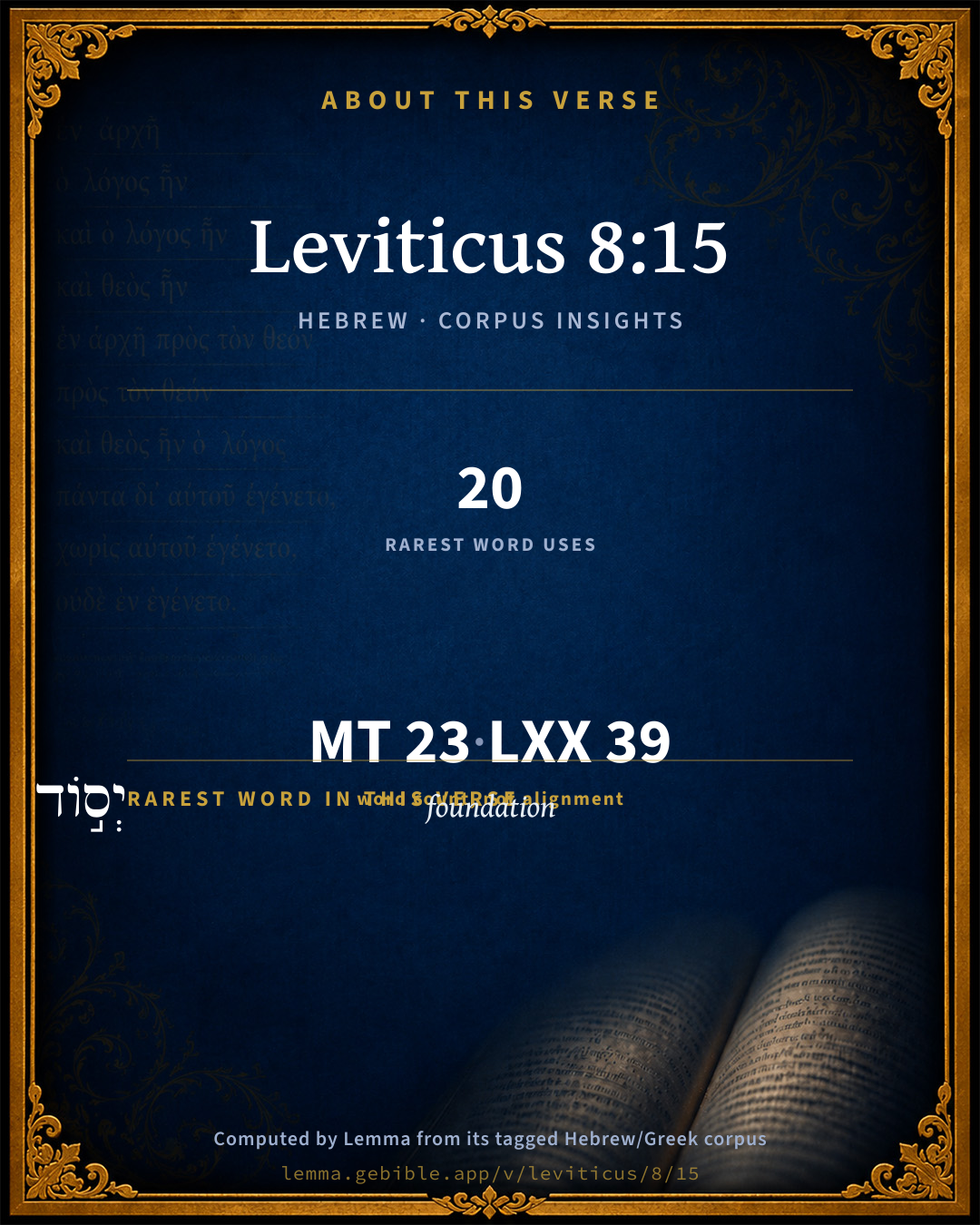
About this verse

These counts appear in no published source. They are computed here, from the morphology-tagged text and Lemma’s own curated glosses. What Lemma adds →

23
words
17
distinct lemmas
Pentateuch
section

Notable vocabulary

The rarest word here is יְס֣וֹד foundation H3247 — appearing just 20 times in the whole Hebrew Bible.

Shared distinctive vocabulary

יְס֣וֹד foundation H3247 occurs in 20 verses of the Hebrew Bible. Also found in:

Grammatical profile

  • 7 verbs
  • 10 nouns
  • 3 prepositions
  • 3 particles

Verb forms

  • וַיִּשְׁחָ֗ט Qal · Sequential Imperfect
  • וַיִּקַּ֨ח Qal · Sequential Imperfect
  • וַ֠יִּתֵּן Qal · Sequential Imperfect
  • וַיְחַטֵּ֖א Piel · Sequential Imperfect
  • יָצַק֙ Qal · Perfect
  • וַֽיְקַדְּשֵׁ֖הוּ Piel · Sequential Imperfect
  • לְכַפֵּ֥ר Piel · Infinitive Construct

Repetition

Words recur within this verse — often emphatic in Hebrew:

  • הַמִּזְבֵּ֤חַ altar H4196 ×3
  • הַדָּם֙ blood H1818 ×2
  • עַל upon H5921 ×2

Hebrew & Septuagint length

In English translation the verse runs 45 words from the Hebrew and 48 from the Septuagint (LXX English) — closely comparable.

A rough comparison of the two English renderings, which tokenize alike — not a word-level alignment.

Word counts can differ between the Hebrew and the Greek without any difference in meaning — e.g. the Hebrew direct-object marker אֵת has no separate Greek word, and Greek often adds the article ὁ.

In the original languages it is 23 Hebrew tokens and 39 Greek tokens — but the two are counted differently (Hebrew bundles its prefixes and suffixes into one token; the Greek is in lemma form), so that isn’t a like-for-like length.

Cross-references

21

Topical passages linked to Leviticus 8:15 in the Treasury of Scripture Knowledge — connected by theme and wording, ordered by reader-vote popularity; previews shown in the World English Bible.

  • Leviticus 4:7 The priest shall put some of the blood on the horns of the altar of sweet incense before Yahweh, which is in the tent of meeting; and he shall pour out all the blood of the bull out at the base of the altar of burnt offering, which is at the door of the Tent of Meeting.
  • Exodus 29:10–12 "You shall bring the bull before the tent of meeting: and Aaron and his sons shall lay their hands on the head of the bull.
  • Exodus 29:36–37 Every day shall you offer the bull of sin-offering for atonement: and you shall cleanse the altar, when you make atonement for it; and you shall anoint it, to sanctify it.
  • Leviticus 1:5 He shall kill the bull before Yahweh. Aaron's sons, the priests, shall present the blood and sprinkle the blood around on the altar that is at the door of the Tent of Meeting.
  • Leviticus 1:11 He shall kill it on the north side of the altar before Yahweh. Aaron's sons, the priests, shall sprinkle its blood around on the altar.
  • Leviticus 3:2 He shall lay his hand on the head of his offering, and kill it at the door of the tent of meeting: and Aaron's sons the priests shall sprinkle the blood on the altar round about.
  • Leviticus 3:8 and he shall lay his hand on the head of his offering, and kill it before the tent of meeting: and Aaron's sons shall sprinkle its blood on the altar round about.
  • Leviticus 4:17–18 and the priest shall dip his finger in the blood, and sprinkle it seven times before Yahweh, before the veil.
  • Leviticus 4:30 The priest shall take some of its blood with his finger, and put it on the horns of the altar of burnt offering; and the rest of its blood he shall pour out at the base of the altar.
  • Leviticus 6:30 No sin offering, of which any of the blood is brought into the Tent of Meeting to make atonement in the Holy Place, shall be eaten: it shall be burned with fire.
  • Leviticus 16:20 "When he has made an end of atoning for the Holy Place, the Tent of Meeting, and the altar, he shall present the live goat.
  • 2 Chronicles 29:24 and the priests killed them, and they made a sin-offering with their blood on the altar, to make atonement for all Israel; for the king commanded [that] the burnt offering and the sin-offering [should be made] for all Israel.
  • Ezekiel 43:19–27 You shall give to the priests the Levites who are of the seed of Zadok, who are near to me, to minister to me, says the Lord Yahweh, a young bull for a sin-offering.
  • Ezekiel 45:20 So you shall do on the seventh [day] of the month for everyone who errs, and for him who is simple: so shall you make atonement for the house.
  • Daniel 9:24 Seventy weeks are decreed on your people and on your holy city, to finish disobedience, and to make an end of sins, and to make reconciliation for iniquity, and to bring in everlasting righteousness, and to seal up vision and prophecy, and to anoint the most holy.
  • Romans 5:10 For if, while we were enemies, we were reconciled to God through the death of his Son, much more, being reconciled, we will be saved by his life.
  • 2 Corinthians 5:18–21 But all things are of God, who reconciled us to himself through Jesus Christ, and gave to us the ministry of reconciliation;
  • Ephesians 2:16 and might reconcile them both in one body to God through the cross, having killed the hostility thereby.
  • Colossians 1:21–22 You, being in past times alienated and enemies in your mind in your evil works,
  • Hebrews 2:17 Therefore he was obligated in all things to be made like his brothers, that he might become a merciful and faithful high priest in things pertaining to God, to make atonement for the sins of the people.
  • Hebrews 9:18–23 Therefore even the first covenant has not been dedicated without blood.

Cross-references courtesy of OpenBible.info (CC BY 4.0).

Hebrew and Greek witnesses Masoretic Hebrew ↔ Greek Septuagint

The same verse in the two great witnesses to the Old Testament, shown verse-for-verse.

These are two independent witnesses, not word-aligned to each other, and the Septuagint is shown in lemma (dictionary) form.

Hebrew Leviticus 8:15 Masoretic · Westminster Leningrad Codex

וַיִּשְׁחָ֗ט וַיִּקַּ֨ח מֹשֶׁ֤ה אֶת הַדָּם֙ וַ֠יִּתֵּן עַל קַרְנ֨וֹת הַמִּזְבֵּ֤חַ סָבִיב֙ בְּאֶצְבָּע֔וֹ וַיְחַטֵּ֖א אֶת הַמִּזְבֵּ֑חַ וְאֶת הַדָּ֗ם יָצַק֙ אֶל יְס֣וֹד הַמִּזְבֵּ֔חַ וַֽיְקַדְּשֵׁ֖הוּ לְכַפֵּ֥ר עָלָֽיו

He killed it; and Moses took the blood, and put it on the horns of the altar round about with his finger, and purified the altar, and poured out the blood at the base of the altar, and sanctified it, to make atonement for it.

World English Bible · Public Domain

Greek LXX Leviticus 8:15 Septuagint · lemma form

καί σφάζω αὐτός καί λαμβάνω μωυσῆς ἀπό ὁ αἷμα καί ἐπιτίθημι ἐπί ὁ κέρας ὁ θυσιαστήριον κύκλος ὁ δάκτυλος καί καθαρίζω ὁ θυσιαστήριον καί ὁ αἷμα ἐκχέω ἐπί ὁ βάσις ὁ θυσιαστήριον καί ἁγιάζω αὐτός ὁ ἐκἱλάσκομαι ἐπί αὐτός

And he killed it; and Moses took of the blood, and put it on the horns of the altar round about with his finger; and he purified the altar, and poured out the blood at the bottom of the altar, and sanctified it, to make atonement upon it.

LXX2012 (modern English Septuagint) · Public Domain

Hebrew: Westminster Leningrad Codex (CC BY 4.0). Greek: Septuagint (public domain); English from LXX2012 (modern English Septuagint) (Public Domain). How the Septuagint differs from the Hebrew →

Targum (Aramaic paraphrase)

2

The Targum is the ancient Jewish Aramaic paraphrase of the Hebrew Scriptures — an interpretive translation, not the Hebrew text itself. Onkelos (literal) and Pseudo-Jonathan (expansive) render the Torah, and Jonathan the Prophets. Coverage is partial: where no permissively-licensed English translation exists for a verse, only the Aramaic is shown. This is verse-level text, not a word-by-word alignment to the Hebrew.

  1. Targum Onkelos Torah (Genesis–Deuteronomy)
    וּנְכֵס וּנְסִיב מֹשֶׁה יָת דְמָא וִיהַב עַל קַרְנַת מַדְבְּחָא סְחוֹר סְחוֹר בְּאֶצְבְּעֵהּ וְדַכִּי יָת מַדְבְּחָא וְיָת דְמָא אֲרִיק לִיסוֹדָא דְמַדְבְּחָא וְקַדְשֵׁהּ לְכַפָּרָא עֲלוֹהִי

    (no public-domain English translation for this verse)

    Targum Onkelos — Aramaic: “Onkelos Genesis” (public domain); “Onkelos Exodus” (public domain); “Onkelos Leviticus” (public domain); “Onkelos Numbers” (public domain); “Onkelos Deuteronomy” (public domain). English: “Sefaria Community Translation” (CC0 1.0 (public-domain dedication)); “J.W. Etheridge. The Targums of Onkelos and Jonathan Ben Uzziel on the Pentateuch. London: Longmans, Green, 1862” (public domain). Text via Sefaria.

  2. Targum Pseudo-Jonathan Torah (Genesis–Deuteronomy)
    וּנְכַס משֶׁה יַת תּוֹרָא וּנְסֵיב משֶׁה יַת אַדְמָא וִיהַב עַל קַרְנַת מַדְבְּחָא חֲזוֹר חֲזוֹר בְּאֶצְבְּעֵיהּ וְרַבֵּי יַת מַדְבְּחָא מִן כָּל סְפַק אָנוֹס וְחָטוּפִין מְטוֹל דְחָשִׁיב בִּלְבָבֵיהּ דִלְמָא נְסִיבָא סַרְכַיָא דִבְנֵי יִשְרָאֵל אַפְרָשׁוּתָא מִן אָחֵיהוֹן בְּאוֹנְסָא וּקְרִיבוּ לַעֲבִידַת מַשְׁכְּנָא אוֹ דִילְמָא הִישְׁתְּכַּח בִּבְנֵי יִשְרָאֵל דְלָא הֲוָה בְּלִבֵּיהּ לְמֵיתַיָא לַעֲבִידְתָּא וְשָׁמַע קַל כְּרוּזָא וְאִיסְתְּפֵי וְאַיְיתִי בְּלָא צְבוֹ מְטוֹל כֵּן דְכֵי יָתֵיהּ בַּאֲדַם תּוֹרָא וְיַת מוֹתַר אַדְמָא אָרִיק לִיסוֹדָא דְמַדְבְּחָא וְקַדְשֵׁיהּ לְכַפָּרָא עֲלוֹי

    And Mosheh killed the bullock: and Mosheh took the blood and put it upon the horns of the altar round about with his finger, and anointed the altar (to expiate it) from all double-mindedness, constraint, and force, from the thoughts of his heart, should any one of the princes of the sons of Israel have taken his separation from his brethren by violence, and brought it for the work of the tabernacle, or lest any one was found among the children of Israel who had it not in his heart to bring for the work, but heard the voice of the crier, and was constrained, and brought without willingness; therefore cleansed he it with the blood of the bullock, and poured the rest of the blood at the foot of the altar, and sanctified it to make atonement thereon.

    Targum Pseudo-Jonathan — Aramaic: “Targum Jonathan on Genesis” (public domain); “Targum Jonathan on Exodus” (public domain); “Targum Jonathan on Leviticus” (public domain); “Targum Jonathan on Numbers” (public domain); “Targum Jonathan on Deuteronomy” (public domain). English: “The Targum of Jonathan ben Uzziel, trans. J. W. Etheridge, London, 1862” (public domain). Text via Sefaria.

Commentary

Notes on Leviticus 8:15 from classic Christian and Jewish commentators (each source and its license shown beneath its notes). The classic Christian expositions comment on the surrounding passage and are grouped to its opening verse, so a note may address several verses; the Jewish commentaries on the Tanakh (Rashi and others) are per-verse, so they appear only where the commentator wrote on this verse.

Lemma curates 59 commentaries, every one of them public domain or Creative Commons licensed, each selected and text-cleaned for this edition rather than reprinted as found. About our sources →

Joseph Benson's Commentary

Lev 8:15. Moses took the blood, &c., and purified the altar — This ceremony of touching the altar with blood emphatically signified that all the services which they offered to God partook of their impurity, and that the very altar which consecrated their oblations was defiled by their unhallowed touch. But the sprinkling it with the blood of the victim, which, by divine appointment, was substituted and accepted instead of the forfeited life of the sinner, made room for repentance, the removal of guilt, and purification; on which account the altar is said to be purified and sanctified by this action.

Joseph Benson's Commentary on the Old and New Testaments (1811–1818) — public domain. Text from a community e-Sword module.

Tyndale Open Study Notes

Tyndale Open Resources

8:15 Normally, the high priest performed these priestly duties. However, it would not be proper for the priests to ordain themselves, so Moses, acting as God’s representative, instituted the priesthood.

Tyndale Open Study Notes — © Tyndale Open Resources, licensed CC BY-SA 4.0. Text via the HelloAO Bible API.

Geneva Bible (1599)

Geneva Bible translators

Of the burnt offering.

To offer for the sins of the people.

Geneva Bible (1599) marginal notes — public domain. Text via Bolls.life.

Ellicott's Commentary for English Readers

(15) And he slew it.—Better, and he killed it, as it is rendered in the Authorised Version, in Lev_8:19. In ordinary cases the offerer himself slaughtered the victim (see Lev_1:5), but in the case before us Moses performed this act in accordance with the command in Exo_29:11.

And Moses took the blood.—That is, having caught the blood in the bowl, he threw it upon the four corners of the altar, as described in Lev_1:5—not, however, on the horns of the altar of incense, or in the tabernacle, as in the case of the sin offering for the high priest and for the nation. (See Lev_4:7; Lev_4:16-18.)

And purified the altar . . . and sanctified it.—Like the priest, the altar was consecrated to the service of God by the anointing oil (see Lev_8:11), and hence, like the priest, the altar is also purified by the expiatory sacrifice from its defilements.

A Bible Commentary for English Readers, edited by Charles John Ellicott (1878–1897) — public domain. Text from a community e-Sword module.

The Cambridge Bible for Schools and Colleges

gen. ed. J. J. S. Perowne

14–30. (d) the sacrificial part of the rite, consisting of:

(i) The Sin-Offering (Lev_8:14-17, cp. Exo_29:10-14)

A bullock, the most costly animal, appointed for ‘the anointed priest,’ or for ‘the whole congregation’ (Lev_4:3; Lev_4:14), on which Aaron and his sons laid their hands (see on Lev_1:4). It appears that the selection of the animal indicates the sacred office to which Aaron and his sons are to be admitted, but until they are consecrated, the ritual of the offering is the same as that prescribed in the case of private individuals (cp. Lev_4:30; Lev_4:34). Some of the blood is put on the horns of the altar, and the rest is poured out at the base of the altar.

15. And he slew it] Comparison with Exo_29:11 shews that Moses slew it, but the text here might be interpreted, and he (Aaron) slew it, especially as it is followed by ‘and Moses took.…’ The same remark applies to Lev_8:19 and Lev_8:23; cp. Exo_29:16; Exo_29:20. In all the verses here cited, the Heb. verb is the same, but is rendered by both ‘kill’ and ‘slay.’

at the base of the altar] see on Lev_4:7.

and purified the altar … and sanctified it by making atonement for it] These clauses are not found in Exo_29:12, but occur in Exo_29:36-37 of that ch. The altar had already been anointed (Lev_8:11); it is now further sanctified by the blood of the Sin-Offering.

The words ‘purify’ here, and ‘cleanse’ (purge R.V. mg.) in Exo_29:36 are translations of the same Heb. verb. As in English ‘to stone plums’ means to remove the stones, so in Heb. a verb corresponding to a noun is sometimes used in the same way. Here the Heb. verb corresponds to the noun ‘sin,’ and means to ‘remove sin’; it occurs also in Lev_14:49; Lev_14:52 (of a leprous house), and Eze_43:20-23 with reference to the altar (see note on Exo_29:36). The rendering ‘by making atonement’ is like R.V. mg. of the passage in Exo_29:36.

The Cambridge Bible for Schools and Colleges (gen. ed. J. J. S. Perowne; Cambridge University Press, 1878–1918) — public domain. Text from a community e-Sword module.

John Gill's Exposition

And he slew it,.... Not Aaron, nor any of his sons, who as yet were not fully consecrated and installed into their office, but Moses, as follows:

and Moses took the blood; which was received into a basin when the bullock was slain:

and put it upon the horns of the altar round about with his finger; upon the four horns of the altar, which were at the four corners of it, and dipping his finger into the blood, he besmeared the horns with it, and drew it about with his finger here and there; and so is said to be done round about the altar, as these horns were:

and purified the altar; or cleansed it; not from moral guilt and pollution, which it was incapable of, but from all ceremonial pollution it might be supposed to have:

and poured the blood at the bottom of the altar; the rest of the blood he did not use about the horns:

and sanctified it; separated it from common to sacred use:

to make reconciliation upon it; that it might be fit to have sacrifices offered on it to make atonement and reconciliation for sins; for which reason it was necessary it should itself be pure and holy, in such sense it was capable of being so.

John Gill's Exposition of the Whole Bible (1746–1763) — public domain (CC PDM 1.0). Text via the HelloAO Bible API.

Whedon's Commentary on the Bible

Daniel D. Whedon

15. Blood… horns — Lev_4:7, note.

Purified the altar — The altar, the work of the hands of sinful men, is viewed as sinful. In Lev_8:11 it is sanctified, and now it is expiated with blood. A holy life cannot be maintained on the earth without the blood of atonement being constantly sprinkled upon it. 1Jn_1:7, note.

Sanctified — The sanctification by oil is a setting apart, the blood sanctification is a thorough purgation of the very nature.

To make reconciliation upon it — The Hebrew is capable of this construction. But precisely the same words in Lev_1:4, are rendered to make atonement for him. The personified altar needs an atonement as much as its imperfect minister.

Daniel D. Whedon (gen. ed.), Commentary on the Old and New Testaments (1874–1909) — public domain. Text from a community e-Sword module.

The Pulpit Commentary

Vers. 15-17. And Moses took the blood. Moses continues still to act as priest, and the new sacrifice is once offered by him. He performs the priestly act of presenting the blood; but on this occasion, which is special, the blood is not dealt with in the manner prescribed for the high priest"s offerings. (Lev_4:6) The reason of this is that Aaron was not yet high priest, and also that the offering was made not only for Aaron, but also for his sons; and further, the blood as well as the anointing oil was required to purify the altar, and sanctify it. (see Heb_9:21) Although the blood was not "brought into the tabernacle," yet the bullock was burnt with fire without the camp, not eaten according to the rule of Lev_7:26, Lev_7:30. This was necessary, as there were as yet no priests to eat it.

The Pulpit Commentary (1880–1919), ed. H.D.M. Spence-Jones & Joseph S. Exell — public domain. Text from a community e-Sword module.

Scofield Reference Notes

C. I. Scofield

reconciliation Heb. "kaphar," to cover.

(See Scofield "Dan 9:24").

The Scofield Reference Bible (1917 edition), notes by C. I. Scofield — public domain. Text from a community e-Sword module.

Rashi

Rabbi Shlomo Yitzchaki (Rashi)

ויחטא את המזבח AND HE PURIFIED THE ALTAR — He cleansed and purified it from anything “strange” (alien to the sacred purpose for which the altar was intended) that may have happened to it, so that it might enter into a state of holiness (cf. Rashi on Exodus 19:36).

ויקדשהו AND HE SANCTIFIED IT by this rite.

לכפר עליו THAT ONE MIGHT MAKE EXPIATION UPON IT from that time onward with all atonement sacrifices (i. e. that all atonement sacrifices might henceforth be offered upon it; the meaning is not that he sanctified it so that he might now offer an atonement offering for it or upon it).

Rashi on the Tanakh — English translations: “The Judaica Press complete Tanach with Rashi, translated by A. J. Rosenberg” (CC BY 4.0); “Pentateuch with Rashi's commentary by M. Rosenbaum and A.M. Silbermann, 1929-1934” (public domain); “The Metsudah Tanach series, Lakewood, N.J” (CC BY 4.0); and “The Book of Joshua, Metsudah Publications, 1997” (CC BY 4.0). Text via Sefaria.

Ramban (Nachmanides)

Rabbi Moshe ben Nachman (Ramban / Nachmanides)

AND HE PURIFIED THE ALTAR. “He cleansed it and purified it from anything ‘strange’ [not holy], so that it might enter into a state of holiness. AND HE SANCTIFIED IT by this rite. TO MAKE ATONEMENT UPON IT — from that time onward for all atonements of sin.” This is the language of Rashi.If this is so, then Scripture is saying that by these means the altar was hallowed and made fit to effect atonement upon from that time onward. This is similar to that which is said in the Book of Ezekiel, Seven days shall they make atonement for the altar and cleanse it; so shall they consecrate it. And when they have accomplished the days, it shall be that upon the eighth day, and forward, the priests shall make your burnt-offerings upon the altar, and your peace-offerings, and I will accept you, saith the Eternal G-d. Here He teaches that this consecration is done with blood, but the burning of the fats is no hindrance to the consecration of the altar, for in succeeding generations too it is no hindrance to the atonement [if the fats of the offering were not burnt on the altar].But in the Tosephta of the section of consecration 15. I have seen [the following text]: “I know not what is this atonement for the altar. [I must say that] from here (from here) is the preferred text. Our books of the Torath Kohanim have the word minayin (from whence). you learn that this atonement was only necessary because Moses said: ‘When the call was issued to bring freewill donations for the Sanctuary, the people pressured each other, both men and women, and some donated without their complete will; let this be an atonement so that they should not donate to the Sanctuary anything which had been taken by force.’ And so it also says, For I the Eternal love justice, I hate robbery in a burnt-offering.” Rashi has also mentioned this already in the section of V’atah Tetzaveh.

Ramban (Nachmanides) on the Tanakh — English translation: “Commentary on the Torah by Ramban (Nachmanides). Translated and annotated by Charles B. Chavel. New York, Shilo Pub. House, 1971-1976” (CC BY 4.0). Text via Sefaria.

Lesson kit

Teaching starters — assembled from the data on this page, not authored interpretation. Every prompt links to the verse data it draws on. Edit before teaching.

Leviticus, in the Pentateuch, opens this verse with 23 words (17 distinct Hebrew lemmas). Its most distinctive word is yᵉçôwd (“foundation”). A historical commentator’s framing appears above. Read the whole chapter for the surrounding context.

Discussion questions

  1. What does “foundation” (yᵉçôwd) contribute to the verse as a whole?
  2. Exodus 29:12 shares the word «foundation» with this verse. How do the two illuminate each other?
  3. “altar” occurs 3× in this one verse. What is the effect of the repetition?
  4. The translations on this page render this verse differently — a whole-verse word diff, not a word-by-word alignment. What might account for the different wordings?
  5. The verb «וַיִּשְׁחָ֗ט» is Qal Sequential Imperfect. How does its form color the action?
  6. Reading how Joseph Benson's Commentary and Tyndale Open Study Notes read this verse, where do the two commentators agree and where do they part?

Things to notice

Reading settings

Reading text

Shown beneath each verse's original-language words.

Old Testament
Old Testament edition

Read the OT as the Masoretic Hebrew (MT) or the Greek Septuagint (LXX).

English shown for the Greek Septuagint (in the Hebrew ↔ Greek comparison).

Comparing translations? Open the Compare panel on any verse page to stack up to four side by side.