Numbers 19:5

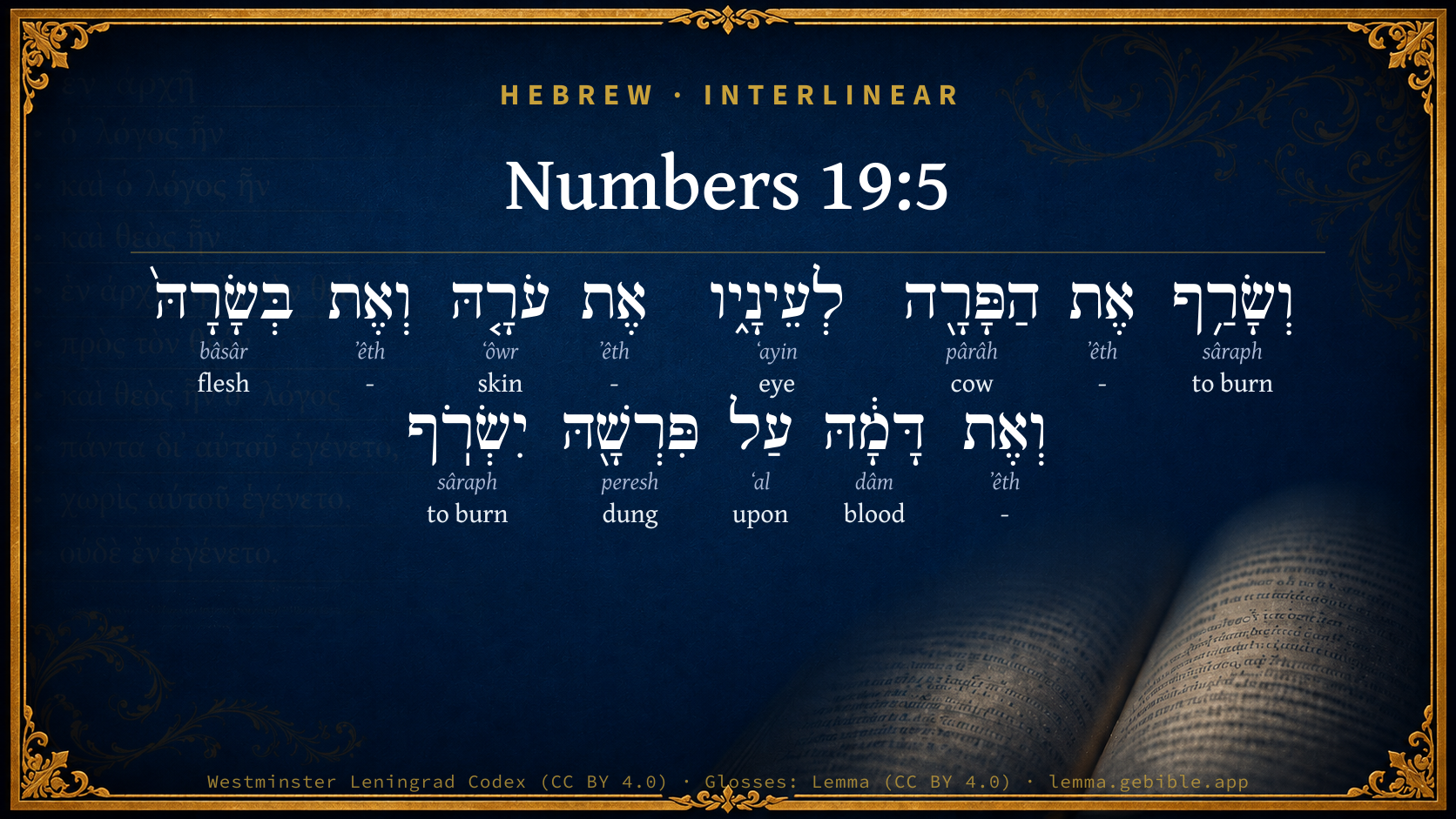
Hebrew (Westminster Leningrad Codex) Numbers 19:5 appears in the Hebrew Old Testament. The text above is from the Westminster Leningrad Codex. Each word links to its Strong’s number, a concise gloss, and parsing drawn from the Open Scriptures Hebrew Bible morphology. Click any word for its full Brown-Driver-Briggs (BDB) entry.
Download image
Cite this verse

Numbers 19:5 (World English Bible). Public Domain. Lemma interlinear Bible study tool, https://lemma.gebible.app/v/numbers/19/5.

Show BibTeX & RIS
BibTeX
RIS
English Translation
One shall burn the heifer in his sight; her skin, and her flesh, and her blood, with her dung, shall he burn:
World English Bible · Public Domain
Download a study sheet

One document with this verse’s original text, its word-by-word gloss line, the meaning frame, cross-references with their text, attributed commentary, and full source and license credits — printable, and it pastes into notes with its structure intact.

This verse Autodidact and up

Study sheet (.html) Plain text (.txt)

A passage Seminary Student

Up to 50 verses in one chapter. A passage sheet keeps up to 6 commentary sources and 12 cross-references per verse, in the order this page ranks them, and says so on the sheet whenever that leaves anything out. Ask for a single verse and you get the Autodidact verse sheet above.

Everything on this page stays free to read, with no account — the sheet is a download of what is already on screen, not access to it.

Want to remove ads? Support Godless Engineer
Compare translations 3

The same verse in 3 English versions, stacked beneath the original-language interlinear above. Click any original word for its lexicon entry.

Each is an independent rendering of the whole verse — the interlinear is not word-aligned to these translations.

Highlighted words mark where these versions differ — a whole-verse word diff, not a word-by-word alignment.

  • World English Bible Public Domain
    One shall burn the heifer in his sight; her skin, and her flesh, and her blood, with her dung, shall he burn:
  • King James Version Public Domain
    And one shall burn the heifer in his sight; her skin, and her flesh, and her blood, with her dung, shall he burn:
  • unfoldingWord Literal Text CC BY-SA 4.0
    And he shall burn the cow to his eyes; its skin and its flesh and its blood, with its dung, he shall burn.

unfoldingWord Literal Text — © unfoldingWord, licensed CC BY-SA 4.0. Word-aligned USFM3 via Door43 (git.door43.org/unfoldingWord/en_ult).

Versions to compare (up to 4)

3 of 4 selected

Show all 18 translations

Every available English version of this verse, each an independent rendering of the whole verse.

  • World English Bible Public Domain
    One shall burn the heifer in his sight; her skin, and her flesh, and her blood, with her dung, shall he burn:
  • Berean Standard Bible Public Domain
    Then the heifer must be burned in his sight. Its hide, its flesh, and its blood are to be burned, along with its dung.
  • Majority Standard Bible Public Domain
    Then the heifer must be burned in his sight. Its hide, its flesh, and its blood are to be burned, along with its dung.
  • King James Version Public Domain
    And one shall burn the heifer in his sight; her skin, and her flesh, and her blood, with her dung, shall he burn:
  • American Standard Version (1901) Public Domain
    And one shall burn the heifer in his sight; her skin, and her flesh, and her blood, with her dung, shall he burn:
  • Revised Version (1885) Public Domain
    and one shall burn the heifer in his sight; her skin, and her flesh, and her blood, with her dung, shall he burn:
  • Geneva Bible (1599) Public Domain
    And cause the kow to be burnt in his sight: with her skinne, and her flesh, and her blood, and her doung shall he burne her.
  • Douay-Rheims (1899) Public Domain
    And shall burn her in the sight of all, delivering up to the fire her skin, and her flesh, and her blood, and her dung.
  • Young's Literal Translation Public Domain
    and `one' hath burnt the cow before his eyes; her skin, and her flesh, and her blood, besides her dung, he doth burn;
  • Literal Standard Version CC BY-SA 4.0
    and [one] has burned the cow before his eyes; her skin, and her flesh, and her blood, besides her dung, he burns;
  • Unlocked Literal Bible CC BY-SA 4.0
    Another priest must burn the heifer in his sight. He must burn its hide, flesh, and its blood with its dung.
  • unfoldingWord Literal Text CC BY-SA 4.0
    And he shall burn the cow to his eyes; its skin and its flesh and its blood, with its dung, he shall burn.
  • Darby Bible Public Domain
    And one shall burn the heifer before his eyes; its skin and its flesh, and its blood, with its dung, shall he burn.
  • World Messianic Bible Public Domain
    One shall burn the heifer in his sight; her skin, and her meat, and her blood, with her dung, shall he burn.
  • Webster's Bible Public Domain
    And one shall burn the heifer in his sight; her skin, and her flesh, and her blood, with her dung, shall he burn:
  • Free Bible Version CC BY-SA 4.0
    Then the cow must be burned as he watches. All of it is to be burned—its skin, meat, and blood, as well as its excrement.
  • Bible in Basic English Public Domain
    And the cow is to be burned before him, her skin and her flesh and her blood and her waste are to be burned:
  • JPS Tanakh (1917) Public Domain
    And the heifer shall be burnt in his sight; her skin, and her flesh, and her blood, with her dung, shall be burnt.

Literal Standard Version (2020), Covenant Press — licensed CC BY-SA 4.0. Text via the HelloAO Bible API (eBible.org). Unlocked Literal Bible (unfoldingWord) — licensed CC BY-SA 4.0. Text via the HelloAO Bible API (eBible.org). unfoldingWord Literal Text — © unfoldingWord, licensed CC BY-SA 4.0. Word-aligned USFM3 via Door43 (git.door43.org/unfoldingWord/en_ult). Free Bible Version, Dr. Jonathan Gallagher — licensed CC BY-SA 4.0. Text via the HelloAO Bible API (eBible.org).

Word by word

More ways to search: Search by grammar → Find every occurrence → Compare this word →

Practice this passage: Drill this verse → Learn its vocabulary →

פִּרְשָׁ֖הּ
peresh
H6569
“dung · her”
Noun, Common, Masculine, Singular, Construct + Suffix, Personal, 3rd Person, Feminine, Singular
Part of Speech
Noun
Type
Common
Gender
Masculine
Number
Singular
State
Construct
Full BDB Definition

Origin: from H6567

TWOT: 1835a

faecal matter, dung, offal
  1. וְשָׂרַ֥ף sâraph H8313 “and · to burn” Conjunction + Verb, Qal, Sequential Perfect, 3rd Person, Masculine, Singular
  2. אֶת ʼêth H853 “-” Particle, Direct Object
  3. הַפָּרָ֖ה pârâh H6510 “the · cow” Particle, Definite Article + Noun, Common, Feminine, Singular, Absolute
  4. לְעֵינָ֑יו ʻayin H5869 “to/for · eyes · his” Preposition + Noun, Common, Both, Dual, Construct + Suffix, Personal, 3rd Person, Masculine, Singular
  5. אֶת ʼêth H853 “-” Particle, Direct Object
  6. עֹרָ֤הּ ʻôwr H5785 “skin · her” Noun, Common, Masculine, Singular, Construct + Suffix, Personal, 3rd Person, Feminine, Singular
  7. וְאֶת ʼêth H853 “and · -” Conjunction + Particle, Direct Object
  8. בְּשָׂרָהּ֙ bâsâr H1320 “flesh · her” Noun, Common, Masculine, Singular, Construct + Suffix, Personal, 3rd Person, Feminine, Singular
  9. וְאֶת ʼêth H853 “and · -” Conjunction + Particle, Direct Object
  10. דָּמָ֔הּ dâm H1818 “blood · her” Noun, Common, Masculine, Singular, Construct + Suffix, Personal, 3rd Person, Feminine, Singular
  11. עַל ʻal H5921 “upon” Preposition
  12. יִשְׂרֹֽף sâraph H8313 “to burn” Verb, Qal, Imperfect, 3rd Person, Masculine, Singular

About this verse

These counts appear in no published source. They are computed here, from the morphology-tagged text and Lemma’s own curated glosses. What Lemma adds →

13
words
9
distinct lemmas
Pentateuch
section

Notable vocabulary

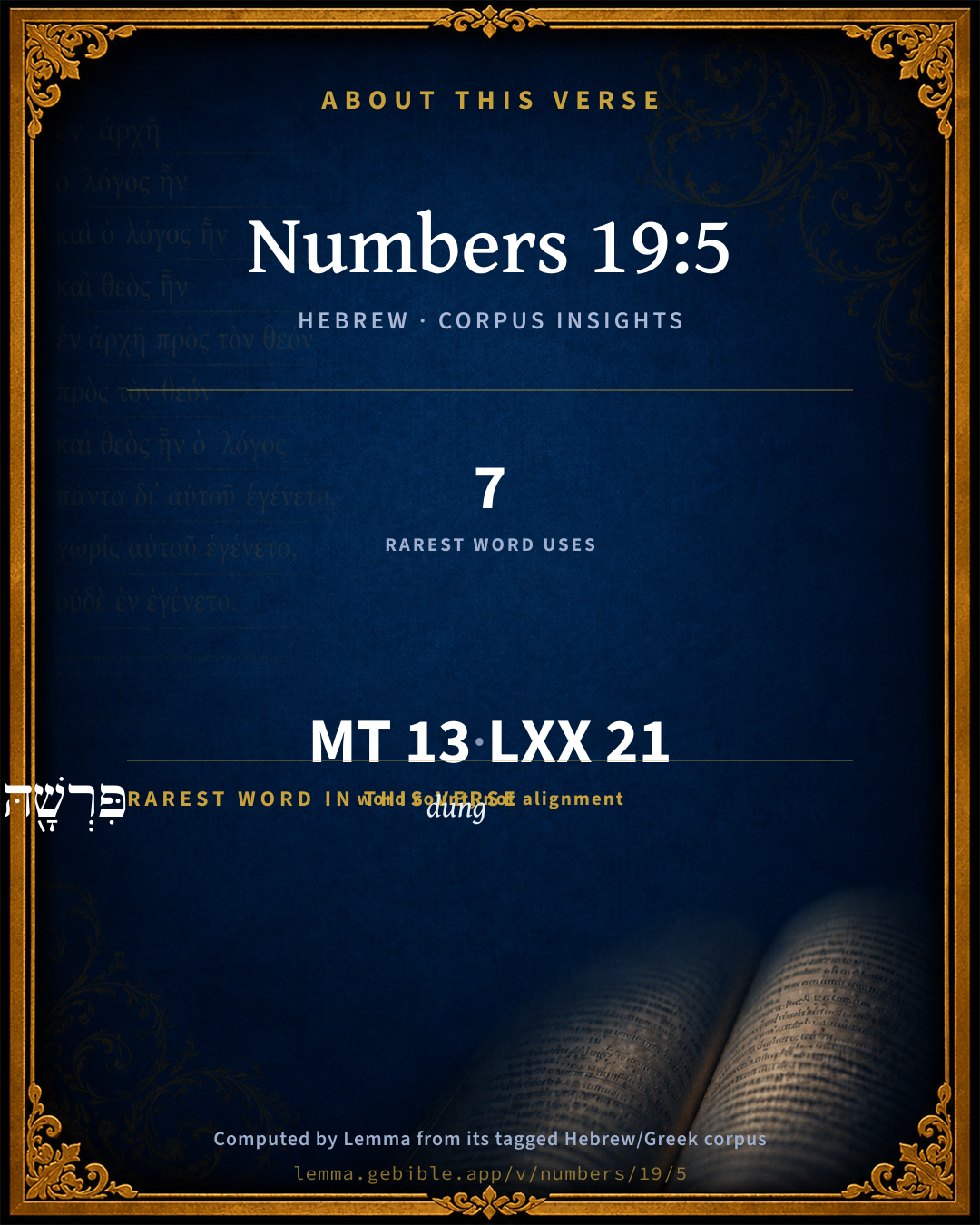
The rarest word here is פִּרְשָׁ֖הּ dung H6569 — appearing just 7 times in the whole Hebrew Bible.

Shared distinctive vocabulary

פִּרְשָׁ֖הּ dung H6569 occurs in 6 verses of the Hebrew Bible. Also found in:

Grammatical profile

  • 2 verbs
  • 6 nouns
  • 1 preposition
  • 4 particles

Verb forms

  • וְשָׂרַ֥ף Qal · Sequential Perfect
  • יִשְׂרֹֽף Qal · Imperfect

Repetition

A word recurs within this verse — often emphatic in Hebrew:

  • וְשָׂרַ֥ף to burn H8313 ×2

Hebrew & Septuagint length

In English translation the verse runs 22 words from the Hebrew and 24 from the Septuagint (LXX English) — closely comparable.

A rough comparison of the two English renderings, which tokenize alike — not a word-level alignment.

Word counts can differ between the Hebrew and the Greek without any difference in meaning — e.g. the Hebrew direct-object marker אֵת has no separate Greek word, and Greek often adds the article ὁ.

In the original languages it is 13 Hebrew tokens and 21 Greek tokens — but the two are counted differently (Hebrew bundles its prefixes and suffixes into one token; the Greek is in lemma form), so that isn’t a like-for-like length.

Cross-references

5

Topical passages linked to Numbers 19:5 in the Treasury of Scripture Knowledge — connected by theme and wording, ordered by reader-vote popularity; previews shown in the World English Bible.

  • Exodus 29:14 But the flesh of the bull, and its skin, and its dung, you shall burn with fire outside of the camp: it is a sin-offering.
  • Leviticus 4:11–12 The bull's skin, all its flesh, with its head, and with its legs, its innards, and its dung,
  • Leviticus 4:21 He shall carry forth the bull outside the camp, and burn it as he burned the first bull. It is the sin offering for the assembly.
  • Psalms 22:14 I am poured out like water. All my bones are out of joint. My heart is like wax; It is melted within me.
  • Isaiah 53:10 Yet it pleased Yahweh to bruise him; he has put him to grief: when you shall make his soul an offering for sin, he shall see [his] seed, he shall prolong his days, and the pleasure of Yahweh shall prosper in his hand.

Cross-references courtesy of OpenBible.info (CC BY 4.0).

Hebrew and Greek witnesses Masoretic Hebrew ↔ Greek Septuagint

The same verse in the two great witnesses to the Old Testament, shown verse-for-verse.

These are two independent witnesses, not word-aligned to each other, and the Septuagint is shown in lemma (dictionary) form.

Hebrew Numbers 19:5 Masoretic · Westminster Leningrad Codex

וְשָׂרַ֥ף אֶת הַפָּרָ֖ה לְעֵינָ֑יו אֶת עֹרָ֤הּ וְאֶת בְּשָׂרָהּ֙ וְאֶת דָּמָ֔הּ עַל פִּרְשָׁ֖הּ יִשְׂרֹֽף

One shall burn the heifer in his sight; her skin, and her flesh, and her blood, with her dung, shall he burn:

World English Bible · Public Domain

Greek LXX Numbers 19:5 Septuagint · lemma form

καί κατακαίω αὐτός ἐναντίον αὐτός καί ὁ δέρμα καί ὁ κρέας αὐτός καί ὁ αἷμα αὐτός σύν ὁ κόπρος αὐτός κατακαίω

And they shall burn her to ashes before him; and her skin and her flesh and her blood, with her dung, shall be consumed.

LXX2012 (modern English Septuagint) · Public Domain

Hebrew: Westminster Leningrad Codex (CC BY 4.0). Greek: Septuagint (public domain); English from LXX2012 (modern English Septuagint) (Public Domain). How the Septuagint differs from the Hebrew →

Targum (Aramaic paraphrase)

2

The Targum is the ancient Jewish Aramaic paraphrase of the Hebrew Scriptures — an interpretive translation, not the Hebrew text itself. Onkelos (literal) and Pseudo-Jonathan (expansive) render the Torah, and Jonathan the Prophets. Coverage is partial: where no permissively-licensed English translation exists for a verse, only the Aramaic is shown. This is verse-level text, not a word-by-word alignment to the Hebrew.

  1. Targum Onkelos Torah (Genesis–Deuteronomy)
    וְיוֹקֵד יָת תּוֹרְתָא לְעֵינוֹהִי יָת מַשְׁכַּהּ וְיָת בִּשְׂרַהּ וְיָת דְמַהּ עַל אָכְלַהּ יוֹקֵיד

    (no public-domain English translation for this verse)

    Targum Onkelos — Aramaic: “Onkelos Genesis” (public domain); “Onkelos Exodus” (public domain); “Onkelos Leviticus” (public domain); “Onkelos Numbers” (public domain); “Onkelos Deuteronomy” (public domain). English: “Sefaria Community Translation” (CC0 1.0 (public-domain dedication)); “J.W. Etheridge. The Targums of Onkelos and Jonathan Ben Uzziel on the Pentateuch. London: Longmans, Green, 1862” (public domain). Text via Sefaria.

  2. Targum Pseudo-Jonathan Torah (Genesis–Deuteronomy)
    וְיִפְקוּן מִגוֹ סְדוּרָא וְיוֹקֵד כּהֵן אוֹחֲרַן יַת תּוֹרָתָא כַּד חָמֵי אֶלְעָזָר יַת מוֹשְׁכָהּ וְיַת בִּשְרָהּ וְיַת אַדְמָהּ עַל רֵיעַיָיהּ יוֹקֵד

    And they shall bring her out from the midst of the railing and another priest, while Elazar looketh on, shall burn the heifer, her skin, flesh, and blood, with her dung shall he burn.

    Targum Pseudo-Jonathan — Aramaic: “Targum Jonathan on Genesis” (public domain); “Targum Jonathan on Exodus” (public domain); “Targum Jonathan on Leviticus” (public domain); “Targum Jonathan on Numbers” (public domain); “Targum Jonathan on Deuteronomy” (public domain). English: “The Targum of Jonathan ben Uzziel, trans. J. W. Etheridge, London, 1862” (public domain). Text via Sefaria.

Commentary

Notes on Numbers 19:5 from classic Christian and Jewish commentators (each source and its license shown beneath its notes). The classic Christian expositions comment on the surrounding passage and are grouped to its opening verse, so a note may address several verses; the Jewish commentaries on the Tanakh (Rashi and others) are per-verse, so they appear only where the commentator wrote on this verse.

Lemma curates 59 commentaries, every one of them public domain or Creative Commons licensed, each selected and text-cleaned for this edition rather than reprinted as found. About our sources →

Trapp's Complete Commentary

John Trapp

Num 19:5 And [one] shall burn the heifer in his sight; her skin, and her flesh, and her blood, with her dung, shall he burn:

Ver. 5. Shall he burn.] To set forth Christ’s ardent love and bitter sufferings. Love itself is a passion, and delights to express itself by suffering for the party beloved.

John Trapp, A Commentary or Exposition upon All the Books of the Old and New Testament (1647–1656) — public domain. Text from a community e-Sword module.

Joseph Benson's Commentary

Num 19:5-6. One shall burn the heifer in his sight — This typified the extreme sufferings of our Lord, both in soul and body, as a sacrifice made by fire. Cedar-wood, hyssop, and scarlet — These were used in the cleansing of lepers, (Lev 14:6-7,) and were all here burned, and, as it were, offered to God, that they might be sanctified to this holy use in future.

Joseph Benson's Commentary on the Old and New Testaments (1811–1818) — public domain. Text from a community e-Sword module.

John Gill's Exposition

And one shall burn the heifer in his sight,.... Another priest, as the Targum of Jonathan, Eleazar looking on, as that expresses it; the Jews say (g), that when the priest came to the mount of Olives, accompanied by the elders of Israel, before he burnt the cow, he dipped himself in a dipping place there; and the wood being laid there in order, wood of cedar, ash, fir, and fig trees, made in the form of a tower, with holes opened in it (to put in the fire, and that it might burn the quicker), and its aspect being to the west, he bound the cow, and laid her upon the pile, with her head to the south, and her face to the west; and then having slain it, and sprinkled its blood, as before related, he set fire to it by the help of some small wood: the burning of it may signify the dolorous sufferings of Christ, when the wrath of God was poured forth like fire upon him; the same was signified by roasting the passover lamb:

her skin, and her flesh, and her blood, with her dung, shall he burn; which may denote the extent of Christ's sufferings, reaching to all parts of his body, skin, flesh, and blood, and the shame and reproach that attended them, signified by dung; as well as how impure and accursed he was accounted when he was made sin for his people, bore their sins and suffered for them, even not in body only, but in his soul also; for his soul as well as his body were made an offering for sin.

(g) Misn. Parah, c. 3. sect. 7, 8, 9.

John Gill's Exposition of the Whole Bible (1746–1763) — public domain (CC PDM 1.0). Text via the HelloAO Bible API.

Matthew Poole's English Annotations

To signify the sharp and grievous sufferings of Christ for our sins.

Her blood; all of it but what was spent in sprinkling.

Matthew Poole's English Annotations on the Holy Bible (1683–1685) — public domain. Text from a community e-Sword/MySword module.

Whedon's Commentary on the Bible

Daniel D. Whedon

5. Shall burn the heifer — The burning was not the means adopted to dispose of the victim in a fitting manner; it must have had a svmbolical significance looking toward expiation.

And her blood — This, instead of being poured at the foot of the altar, was to be burned, in order to strengthen the ashes with its incombustible ingredients. Lev_4:12.

Daniel D. Whedon (gen. ed.), Commentary on the Old and New Testaments (1874–1909) — public domain. Text from a community e-Sword module.

The Pulpit Commentary

One shall burn the heifer. See on Exo_29:14. And her blood. In all other cases the blood was poured away beside the altar, because in the blood was the life, and the life was given to God in exchange for the life of the offerer. This great truth, which underlay all animal sacrifices, was represented in this case by the sprinkling towards the sanctuary. The rest of the blood was burnt with the carcass, either because outside the holy precincts there was no consecrated earth to receive the blood, or in order that the virtue of the blood might in a figure pass into the ashes and add to their efficacy.

The Pulpit Commentary (1880–1919), ed. H.D.M. Spence-Jones & Joseph S. Exell — public domain. Text from a community e-Sword module.

John Wesley's Explanatory Notes

Burn the heifer - To signify the sharp and grievous sufferings of Christ for our sins. Her blood - All of it, but what was spent in sprinkling.

John Wesley, Explanatory Notes Upon the Whole Bible (1754–1765) — public domain. Text via the GEBible commentary corpus.

Lesson kit

Teaching starters — assembled from the data on this page, not authored interpretation. Every prompt links to the verse data it draws on. Edit before teaching.

Numbers, in the Pentateuch, opens this verse with 13 words (9 distinct Hebrew lemmas). Its most distinctive word is peresh (“dung”). A historical commentator’s framing appears above. Read the whole chapter for the surrounding context.

Discussion questions

  1. The word peresh carries the sense “dung.” How does it shape the verse?
  2. How does Exodus 29:14, which shares the word «dung», read alongside this verse?
  3. What does the repetition of “to burn” (2× in this one verse) do in this verse?
  4. The translations on this page render this verse differently — a whole-verse word diff, not a word-by-word alignment. What might account for the different wordings?
  5. «וְשָׂרַ֥ף» is a Qal Sequential Perfect verb. How does that grammatical form shape the action described?
  6. Compare how Trapp's Complete Commentary and Joseph Benson's Commentary read this verse. Where do they agree or differ?

Things to notice

Reading settings

Reading text

Shown beneath each verse's original-language words.

Old Testament
Old Testament edition

Read the OT as the Masoretic Hebrew (MT) or the Greek Septuagint (LXX).

English shown for the Greek Septuagint (in the Hebrew ↔ Greek comparison).

Comparing translations? Open the Compare panel on any verse page to stack up to four side by side.