
Leviticus 12:4

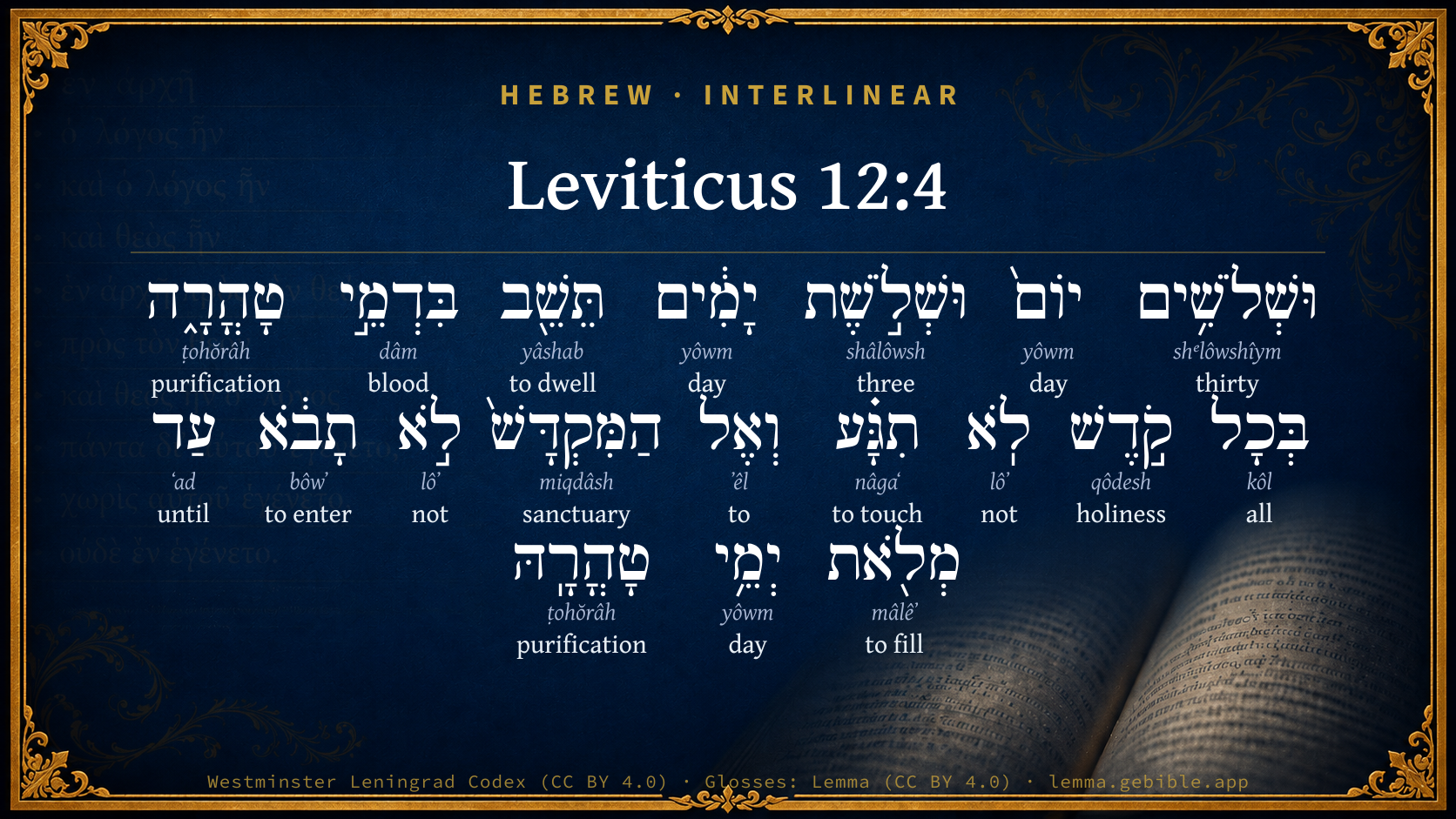
Hebrew (Westminster Leningrad Codex) Leviticus 12:4 appears in the Hebrew Old Testament. The text above is from the Westminster Leningrad Codex. Each word links to its Strong’s number, a concise gloss, and parsing drawn from the Open Scriptures Hebrew Bible morphology. Click any word for its full Brown-Driver-Briggs (BDB) entry.
Download image
Cite this verse

Leviticus 12:4 (World English Bible). Public Domain. Lemma interlinear Bible study tool, https://lemma.gebible.app/v/leviticus/12/4.

Show BibTeX & RIS
BibTeX
RIS
English Translation
She shall continue in the blood of purification thirty-three days. She shall not touch any holy thing, nor come into the sanctuary, until the days of her purifying are completed.
World English Bible · Public Domain
Highlights
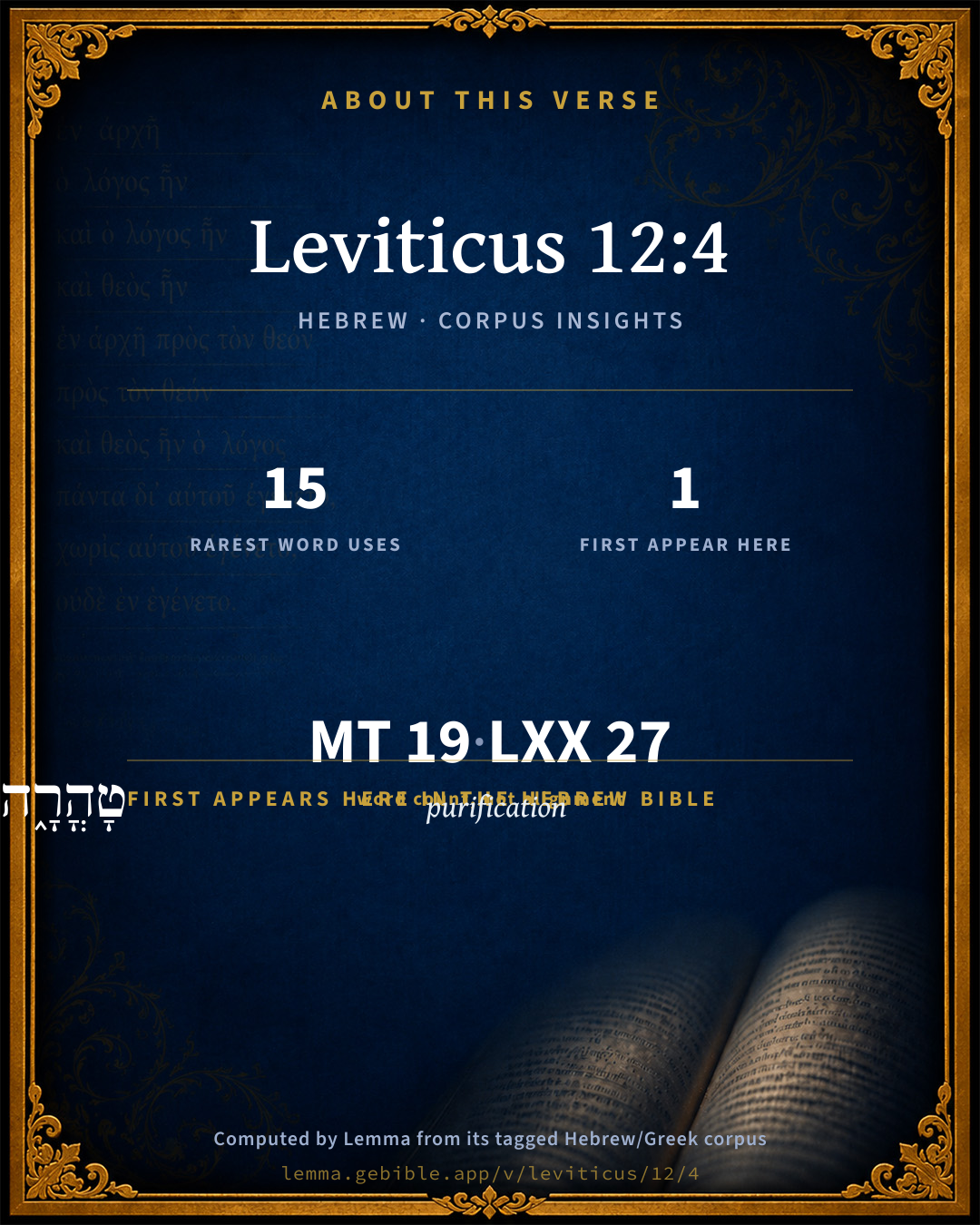
  • 1 first appearance in the Hebrew Bible
Full analysis ↓
Download a study sheet

One document with this verse’s original text, its word-by-word gloss line, the meaning frame, cross-references with their text, attributed commentary, and full source and license credits — printable, and it pastes into notes with its structure intact.

This verse Autodidact and up

Study sheet (.html) Plain text (.txt)

A passage Seminary Student

Up to 50 verses in one chapter. A passage sheet keeps up to 6 commentary sources and 12 cross-references per verse, in the order this page ranks them, and says so on the sheet whenever that leaves anything out. Ask for a single verse and you get the Autodidact verse sheet above.

Everything on this page stays free to read, with no account — the sheet is a download of what is already on screen, not access to it.

Want to remove ads? Support Godless Engineer
Compare translations 3

The same verse in 3 English versions, stacked beneath the original-language interlinear above. Click any original word for its lexicon entry.

Each is an independent rendering of the whole verse — the interlinear is not word-aligned to these translations.

Highlighted words mark where these versions differ — a whole-verse word diff, not a word-by-word alignment.

  • World English Bible Public Domain
    She shall continue in the blood of purification thirty-three days. She shall not touch any holy thing, nor come into the sanctuary, until the days of her purifying are completed.
  • King James Version Public Domain
    And she shall then continue in the blood of her purifying three and thirty days; she shall touch no hallowed thing, nor come into the sanctuary, until the days of her purifying be fulfilled.
  • unfoldingWord Literal Text CC BY-SA 4.0
    And thirty days and three days she shall stay in the blood of her purification. Any holy thing she shall not touch, and into the holy place she shall not go until the days of her purification are full.

unfoldingWord Literal Text — © unfoldingWord, licensed CC BY-SA 4.0. Word-aligned USFM3 via Door43 (git.door43.org/unfoldingWord/en_ult).

Versions to compare (up to 4)

3 of 4 selected

Show all 18 translations

Every available English version of this verse, each an independent rendering of the whole verse.

  • World English Bible Public Domain
    She shall continue in the blood of purification thirty-three days. She shall not touch any holy thing, nor come into the sanctuary, until the days of her purifying are completed.
  • Berean Standard Bible Public Domain
    The woman shall continue in purification from her bleeding for thirty-three days. She must not touch anything sacred or go into the sanctuary until the days of her purification are complete.
  • Majority Standard Bible Public Domain
    The woman shall continue in purification from her bleeding for thirty-three days. She must not touch anything sacred or go into the sanctuary until the days of her purification are complete.
  • King James Version Public Domain
    And she shall then continue in the blood of her purifying three and thirty days; she shall touch no hallowed thing, nor come into the sanctuary, until the days of her purifying be fulfilled.
  • American Standard Version (1901) Public Domain
    And she shall continue in the blood of `her' purifying three and thirty days; she shall touch no hallowed thing, nor come into the sanctuary, until the days of her purifying be fulfilled.
  • Revised Version (1885) Public Domain
    And she shall continue in the blood of her purifying three and thirty days; she shall touch no hallowed thing, nor come into the sanctuary, until the days of her purifying be fulfilled.
  • Geneva Bible (1599) Public Domain
    And she shall continue in the blood of her purifying three and thirtie dayes: she shall touch no halowed thing, nor come into the Sanctuarie, vntil the time of her purifying be out.
  • Douay-Rheims (1899) Public Domain
    But she shall remain three and thirty days in the blood of her purification. She shall touch no holy thing, neither shall she enter into the sanctuary, until the days of her purification be fulfilled.
  • Young's Literal Translation Public Domain
    and thirty and three days she doth abide in the blood of her cleansing; against any holy thing she doth not come, and unto the sanctuary she doth not go in, till the fulness of the days of her cleansing.
  • Literal Standard Version CC BY-SA 4.0
    and she abides in the blood of her cleansing [for] thirty-three days; she does not come against any holy thing, and she does not go into the sanctuary, until the fullness of the days of her cleansing.
  • Unlocked Literal Bible CC BY-SA 4.0
    Then the mother's purification from her bleeding will continue for thirty-three days. She must not touch any holy thing or come into the tabernacle area until the days of her purification are finished.
  • unfoldingWord Literal Text CC BY-SA 4.0
    And thirty days and three days she shall stay in the blood of her purification. Any holy thing she shall not touch, and into the holy place she shall not go until the days of her purification are full.
  • Darby Bible Public Domain
    And she shall continue thirty-three days in the blood of her cleansing; no holy thing shall she touch, nor come into the sanctuary, until the days of her cleansing are fulfilled.
  • World Messianic Bible Public Domain
    She shall continue in the blood of purification thirty-three days. She shall not touch any holy thing, nor come into the sanctuary, until the days of her purifying are completed.
  • Webster's Bible Public Domain
    And she shall then continue in the blood of her purifying three and thirty days: she shall touch no hallowed thing, nor come into the sanctuary, until the days of her purifying be fulfilled.
  • Free Bible Version CC BY-SA 4.0
    The woman must wait a further thirty-three days for the purification of her bleeding. She is not allowed to touch anything holy, and she is not allowed to enter the sanctuary until her time of purification is finished.
  • Bible in Basic English Public Domain
    And she will be unclean for thirty-three days till the flow of her blood is stopped; no holy thing may be touched by her, and she may not come into the holy place, till the days for making her clean are ended.
  • JPS Tanakh (1917) Public Domain
    And she shall continue in the blood of purification three and thirty days; she shall touch no hallowed thing, nor come into the sanctuary, until the days of her purification be fulfilled.

Literal Standard Version (2020), Covenant Press — licensed CC BY-SA 4.0. Text via the HelloAO Bible API (eBible.org). Unlocked Literal Bible (unfoldingWord) — licensed CC BY-SA 4.0. Text via the HelloAO Bible API (eBible.org). unfoldingWord Literal Text — © unfoldingWord, licensed CC BY-SA 4.0. Word-aligned USFM3 via Door43 (git.door43.org/unfoldingWord/en_ult). Free Bible Version, Dr. Jonathan Gallagher — licensed CC BY-SA 4.0. Text via the HelloAO Bible API (eBible.org).

Word by word

More ways to search: Search by grammar → Find every occurrence → Compare this word →

Practice this passage: Drill this verse → Learn its vocabulary →

טָהֳרָ֑ה
ṭohŏrâh
H2893
“purification”
Noun, Common, Both, Singular, Absolute
Part of Speech
Noun
Type
Common
Gender
Both
Number
Singular
State
Absolute
Full BDB Definition

Origin: from H2892

TWOT: 792c

purifying, cleansing, purification, purity, cleanness - purifying, menstruation - cleansing, purification
  1. וּשְׁלֹשִׁ֥ים shᵉlôwshîym H7970 “and · thirty” Conjunction + Adjective, Cardinal number, Both, Plural, Absolute
  2. יוֹם֙ yôwm H3117 “day” Noun, Common, Masculine, Singular, Absolute
  3. וּשְׁלֹ֣שֶׁת shâlôwsh H7969 “and · three” Conjunction + Adjective, Cardinal number, Masculine, Singular, Construct
  4. יָמִ֔ים yôwm H3117 “days” Noun, Common, Masculine, Plural, Absolute
  5. תֵּשֵׁ֖ב yâshab H3427 “to dwell” Verb, Qal, Imperfect, 3rd Person, Feminine, Singular
  6. בִּדְמֵ֣י dâm H1818 “in/at · blood of” Preposition + Noun, Common, Masculine, Plural, Construct
  7. בְּכָל kôl H3605 “in/at · all of” Preposition + Noun, Common, Masculine, Singular, Construct
  8. קֹ֣דֶשׁ qôdesh H6944 “holiness” Noun, Common, Masculine, Singular, Absolute
  9. לֹֽא lôʼ H3808 “not” Particle, Negative
  10. תִגָּ֗ע nâgaʻ H5060 “to touch” Verb, Qal, Imperfect, 3rd Person, Feminine, Singular
  11. וְאֶל ʼêl H413 “and · to” Conjunction + Preposition
  12. הַמִּקְדָּשׁ֙ miqdâsh H4720 “the · sanctuary” Particle, Definite Article + Noun, Common, Masculine, Singular, Absolute
  13. לֹ֣א lôʼ H3808 “not” Particle, Negative
  14. תָבֹ֔א bôwʼ H935 “to enter” Verb, Qal, Imperfect, 3rd Person, Feminine, Singular
  15. עַד ʻad H5704 “until” Preposition
  16. מְלֹ֖את mâlêʼ H4390 “to fill” Verb, Qal, Infinitive Construct
  17. יְמֵ֥י yôwm H3117 “days of” Noun, Common, Masculine, Plural, Construct
  18. טָהֳרָֽהּ ṭohŏrâh H2893 “purification · her” Noun, Common, Both, Singular, Construct + Suffix, Personal, 3rd Person, Feminine, Singular

About this verse

These counts appear in no published source. They are computed here, from the morphology-tagged text and Lemma’s own curated glosses. What Lemma adds →

19
words
15
distinct lemmas
Pentateuch
section

Notable vocabulary

The rarest word here is טָהֳרָ֑ה purification H2893 — appearing just 15 times in the whole Hebrew Bible.

First appearance in Scripture

This word makes its first canonical appearance in the Hebrew Bible here:

  • טָהֳרָ֑ה purification H2893

Shared distinctive vocabulary

טָהֳרָ֑ה purification H2893 occurs in 14 verses of the Hebrew Bible. Also found in:

Grammatical profile

  • 4 verbs
  • 9 nouns
  • 2 adjectives
  • 2 prepositions
  • 2 particles

Verb forms

  • תֵּשֵׁ֖ב Qal · Imperfect
  • תִגָּ֗ע Qal · Imperfect
  • תָבֹ֔א Qal · Imperfect
  • מְלֹ֖את Qal · Infinitive Construct

Repetition

Words recur within this verse — often emphatic in Hebrew:

  • יוֹם֙ day H3117 ×3
  • טָהֳרָ֑ה purification H2893 ×2
  • לֹֽא not H3808 ×2

Hebrew & Septuagint length

In English translation the verse runs 30 words from the Hebrew and 30 from the Septuagint (LXX English) — the same length.

A rough comparison of the two English renderings, which tokenize alike — not a word-level alignment.

Word counts can differ between the Hebrew and the Greek without any difference in meaning — e.g. the Hebrew direct-object marker אֵת has no separate Greek word, and Greek often adds the article ὁ.

In the original languages it is 19 Hebrew tokens and 27 Greek tokens — but the two are counted differently (Hebrew bundles its prefixes and suffixes into one token; the Greek is in lemma form), so that isn’t a like-for-like length.

Cross-references

3

Topical passages linked to Leviticus 12:4 in the Treasury of Scripture Knowledge — connected by theme and wording, ordered by reader-vote popularity; previews shown in the World English Bible.

  • Leviticus 15:25–28 "'If a woman has a discharge of her blood many days not in the time of her period, or if she has a discharge beyond the time of her period; all the days of the discharge of her uncleanness shall be as in the days of her period: she is unclean.
  • Haggai 2:13 Then Haggai said, "If one who is unclean by reason of a dead body touch any of these, will it be unclean?" The priests answered, "It will be unclean."
  • Luke 2:22–23 When the days of their purification according to the law of Moses were fulfilled, they brought him up to Jerusalem, to present him to the Lord

Cross-references courtesy of OpenBible.info (CC BY 4.0).

Hebrew and Greek witnesses Masoretic Hebrew ↔ Greek Septuagint

The same verse in the two great witnesses to the Old Testament, shown verse-for-verse.

These are two independent witnesses, not word-aligned to each other, and the Septuagint is shown in lemma (dictionary) form.

Hebrew Leviticus 12:4 Masoretic · Westminster Leningrad Codex

וּשְׁלֹשִׁ֥ים יוֹם֙ וּשְׁלֹ֣שֶׁת יָמִ֔ים תֵּשֵׁ֖ב בִּדְמֵ֣י טָהֳרָ֑ה בְּכָל קֹ֣דֶשׁ לֹֽא תִגָּ֗ע וְאֶל הַמִּקְדָּשׁ֙ לֹ֣א תָבֹ֔א עַד מְלֹ֖את יְמֵ֥י טָהֳרָֽהּ

She shall continue in the blood of purification thirty-three days. She shall not touch any holy thing, nor come into the sanctuary, until the days of her purifying are completed.

World English Bible · Public Domain

Greek LXX Leviticus 12:4 Septuagint · lemma form

καί τριάκοντα ἡμέρα καί τρεῖς καταἧμαι ἐν αἷμα ἀκάθαρτος αὐτός πᾶς ἅγιος οὐ ἅπτομαι καί εἰς ὁ ἁγιαστήριον οὐ εἰςἔρχομαι ἕως ἄν πληρόω ὁ ἡμέρα κάθαρσις αὐτός

And for thirty-three days she shall continue in her unclean blood; she shall touch nothing holy, and shall not enter the sanctuary, until the days of her purification be fulfilled.

LXX2012 (modern English Septuagint) · Public Domain

Hebrew: Westminster Leningrad Codex (CC BY 4.0). Greek: Septuagint (public domain); English from LXX2012 (modern English Septuagint) (Public Domain). How the Septuagint differs from the Hebrew →

Targum (Aramaic paraphrase)

2

The Targum is the ancient Jewish Aramaic paraphrase of the Hebrew Scriptures — an interpretive translation, not the Hebrew text itself. Onkelos (literal) and Pseudo-Jonathan (expansive) render the Torah, and Jonathan the Prophets. Coverage is partial: where no permissively-licensed English translation exists for a verse, only the Aramaic is shown. This is verse-level text, not a word-by-word alignment to the Hebrew.

  1. Targum Onkelos Torah (Genesis–Deuteronomy)
    וּתְלָתִין וּתְלָתָא יוֹמִין תֵּיתֵב בְּדַם דְכוּ בְּכָל קוּדְשָׁא לָא תִקְרַב וּלְמִקְדְשָׁא לָא תֵעוֹל עַד מִשְׁלַם יוֹמֵי דָכוּתַהּ

    (no public-domain English translation for this verse)

    Targum Onkelos — Aramaic: “Onkelos Genesis” (public domain); “Onkelos Exodus” (public domain); “Onkelos Leviticus” (public domain); “Onkelos Numbers” (public domain); “Onkelos Deuteronomy” (public domain). English: “Sefaria Community Translation” (CC0 1.0 (public-domain dedication)); “J.W. Etheridge. The Targums of Onkelos and Jonathan Ben Uzziel on the Pentateuch. London: Longmans, Green, 1862” (public domain). Text via Sefaria.

  2. Targum Pseudo-Jonathan Torah (Genesis–Deuteronomy)
    וּתְלָתִין וּתְלָתָא יוֹמִין רְצִיפִין תְּהֵא כָּל דְמָהָא דַכְיָין בְּרַם בְּכָל קוּדְשַׁיָא לָא תִקְרַב וּלְבֵי מַקְדְשָׁא לָא תֵיעוֹל עַד זְמַן מִישְׁלַם יוֹמֵי דְכוּתָהּ

    And thirty and three continuous days she shall have for the purification of the whole blood; but she must not touch things sacred, nor come into the sanctuary until the time when the days of her purification be completed.

    Targum Pseudo-Jonathan — Aramaic: “Targum Jonathan on Genesis” (public domain); “Targum Jonathan on Exodus” (public domain); “Targum Jonathan on Leviticus” (public domain); “Targum Jonathan on Numbers” (public domain); “Targum Jonathan on Deuteronomy” (public domain). English: “The Targum of Jonathan ben Uzziel, trans. J. W. Etheridge, London, 1862” (public domain). Text via Sefaria.

Commentary

Notes on Leviticus 12:4 from classic Christian and Jewish commentators (each source and its license shown beneath its notes). The classic Christian expositions comment on the surrounding passage and are grouped to its opening verse, so a note may address several verses; the Jewish commentaries on the Tanakh (Rashi and others) are per-verse, so they appear only where the commentator wrote on this verse.

Lemma curates 59 commentaries, every one of them public domain or Creative Commons licensed, each selected and text-cleaned for this edition rather than reprinted as found. About our sources →

Trapp's Complete Commentary

John Trapp

Lev 12:4 And she shall then continue in the blood of her purifying three and thirty days; she shall touch no hallowed thing, nor come into the sanctuary, until the days of her purifying be fulfilled.

Ver. 4. She shall touch no hallowed thing.] Preparation must go before participation of holy ordinances. {Hag 2:13}

John Trapp, A Commentary or Exposition upon All the Books of the Old and New Testament (1647–1656) — public domain. Text from a community e-Sword module.

Joseph Benson's Commentary

Lev 12:4. In the blood of her purifying — In her polluted and separated estate; for the word blood, or bloods, signifies both guilt and uncleanness, as here and elsewhere. And it is called the blood of her purifying, because by the expulsion or purgation of that blood, which is done by degrees, she is purified. No hallowed thing — She shall not eat any part of the peace- offerings which she or her husband offered, which otherwise she might have done; and, if she be a priest’s wife, she shall not eat any of the tithes or first-fruits, or part of the hallowed meats, which at other times she, together with her husband, might eat.

Joseph Benson's Commentary on the Old and New Testaments (1811–1818) — public domain. Text from a community e-Sword module.

The Expositor's Bible

PURIFICATION AFTER CHILD BIRTH

Lev_12:4-8

"And she shall continue in the blood of her purifying three and thirty days; she shall touch no hallowed thing, nor come into the sanctuary, until the days of her purifying be fulfilled. But if she bear a maid child, then she shall be unclean two weeks, as in her impurity: and she shall continue in the blood of her purifying threescore and six days. And when the days of her purifying are fulfilled, for a son, or for a daughter, she shall bring a lamb of the first year for a burnt offering, and a young pigeon, or a turtledove, for a sin offering, unto the door of the tent of meeting, unto the priest: and he shall offer it before the Lord, and make atonement for her; and she shall be cleansed from the fountain of her blood. This is the law for her that beareth, whether a male or a female. And if her means suffice not for a lamb, then she shall take two turtledoves, or two young pigeons; the one for a burnt offering, and the other for a sin offering: and the priest shall make atonement for her, and she shall be clean."

Until the circumcision of the newborn child, on the eighth day, he was regarded by the law as ceremonially still in a state of nature, and therefore as symbolically unclean. For this reason, again, the mother who had brought him into the world, and whose life was so intimately connected with his. life, was regarded as unclean also. Unclean, under analogous circumstances, according to the law of Lev_15:19, she was reckoned doubly unclean in this case, -unclean because of her issue, and unclean because of her connection with this child, uncircumcised and unclean. But when the symbolic cleansing of the child took place by the ordinance of circumcision, then her uncleanness, so far as occasioned by her immediate relation to him, came to an end. She was not indeed completely restored; for, according to the law, in her still continuing condition, it was impossible that she should be allowed to come into the tabernacle of the Lord, or touch any hallowed thing; but the ordinance which admitted her child, admitted her also again to the fellowship of the covenant people.

The longer period of forty-or, in the case of the birth of a female child, of twice forty-days must also be explained upon Symbolical grounds. Some have indeed attempted to account for these periods, as also for the difference in their length in the two cases, by a reference to beliefs of the ancients with regard to the physical condition of the mother during these periods; but such notions of the ancients are not justified by facts; nor, especially, would they by any means account for the greatly prolonged period of eighty days in the case of the female child. It is possible that in the forty, and twice forty, we may have a reference to the forty weeks during which the life of the unborn child had been identified with that of the mother, -a child which, it must be remembered, according to the uniform Biblical view, was not innocent, but conceived in sin; for each week of which connection of life, the mother suffered a judicial exclusion of one, or, in the case of the birth of a daughter, of two days; the time being doubled in the latter case with allusion to the double curse which, according to Genesis, rested upon the woman, as "first in the transgression." But, apart from this, however difficult it may be to give a satisfactory explanation of the fact, it is certain that throughout Scripture the number forty appears to have a symbolic meaning; and one can usually trace in its application a reference, more or less distinct, to the conception of trial or testing. Thus for forty days was Moses in the mount, -a time of testing for Israel, as for him: forty days, the spies explored the promised land; forty years, Israel was tried in the wilderness; forty days, abode Elijah in the wilderness; forty days, also, was our Lord fasting in the wilderness; and forty days, again, He abode in resurrection life upon the earth.

The forty (or eighty) days ended, the mother was now formally reinstated in the fulness of her privileges as a daughter of Israel. The ceremonial, as in the law of issues, consisted in the presentation of a burnt offering and a sin offering, with the only variation that, wherever possible, the burnt offering must be a young lamb, instead of a dove or pigeon; the reason for which variation is to be found either in the fact that the burnt offering was to represent not herself alone, but also her child, or, possibly, as some have suggested, it was because she had been so much longer excluded from the tabernacle service than in the other case.

The teaching of this law, then, is twofold: it concerns, first, the woman; and, secondly, the child which she bears. As regards the woman, it emphasises the fact that, because "first in the transgression," she is under special pains and penalties in virtue of her sex. The capacity of motherhood, which is her crown and her glory, though still a precious privilege, has yet been made, because of sin, an inevitable instrument of pain, and that because of her relation to the first sin. We are thus reminded that the specific curse denounced against the woman, as recorded in the book of Genesis, is no dead letter, but a fact. No doubt, the conception is one which raises difficulties which in themselves are great, and to modern thought are greater than ever. Nevertheless, the fact abides unaltered, that even to this day woman is under special pains and disabilities, inseparably connected with her power of motherhood. Modern theorists, men and women with nineteenth-century notions concerning politics and education, may persist in ignoring this; but the fact abides, and cannot be got rid of by passing resolutions in a mass meeting, or even by Act of Parliament or Congress.

And so, as it is useless to object to facts, it is only left to object to the Mosaic view of the facts, which connects them with sin, and, in particular, with the first sin. Why should all the daughters of Eve suffer because of her sin? Where is the justice in such an ordinance? A question this is to which we cannot yet give any satisfactory answer. But it does not follow that because in any proposition there are difficulties which at present we are unable to solve, therefore the proposition is false. And, further, it is important to observe that this law, under which womanhood abides, is after all only a special case under that Jaw of the Divine government which is announced in the second commandment, by which the iniquities of the fathers are visited upon the children. It is most certainly a law which, to our apprehension, suggests great moral difficulties, even to the most reverent spirits; but it is no less certainly a law which represents a conspicuous and tremendous fact, which is illustrated, for instance, in the family of every drunkard in the world. And it is well worth observing, that while the ceremonial law, which was specially intended to keep this fact before the mind and the conscience, is abrogated, the fact that woman is still under certain Divinely imposed disabilities because of that first sin, is reaffirmed in the New Testament, and is by apostolic authority applied in the administration of Church government. For Paul wrote to Timothy: {1Ti_2:12-13} "I permit not a woman to teach, nor to have dominion over a man For Adam was not beguiled, but the woman being beguiled hath fallen into transgression." Modern theorists, and so-called "reformers" in Church, State, and society, busy with their social, governmental, and ecclesiastical. novelties, would do well to heed this apostolic reminder.

All the more beautiful, as against this dark background of mystery, is the word of the Apostle which follows, wherein he reminds us that, through the grace of God, even by means of those very powers of motherhood on which the curse has so heavily fallen, has come the redemption of the woman; so that "she shall be saved through the childbearing, if they continue in faith and love and sanctification with sobriety"; {1Ti_2:15, R.V} seeing that "in Christ Jesus," in respect of the completeness and freeness of salvation, "there can be no male and female". {Gal_3:28, R.V}

But, in the second place, we may also derive abiding instruction from this law, concerning the child which is of man begotten and of woman born. It teaches us that not only has the curse thus fallen on the woman, but that, because she is herself a sinful creature, she can only bring forth another sinful creature like herself; and if a daughter, then a daughter inheriting all her own peculiar infirmities and disabilities. The law, as regards both mother and child, expresses in the language of symbolism those words of David in his penitential confession: {Psa_51:5} "Behold, I was shapen in iniquity; and in sin did my mother conceive me." Men may contemptuously call this "theology," or even rail at it as "Calvinism"; but it is more than theology, more than Calvinism; it is a fact, to which until this present time history has seen but one exception, even that mysterious Son of the Virgin, who claimed, however, to be no mere man, but the Christ, the Son of the Blessed!

And yet many, who surely can think but superficially upon the solemn facts of life, still object to this most strenuously, that even the newborn child should be regarded as in nature sinful and unclean. Difficulty here we must all admit, -difficulty so great that it is hard to overstate it-regarding the bearing of this fact on the character of the holy and merciful God, who in the beginning made man. And yet surely, deeper thought must confess that herein the Mosaic view of infant nature-a view which is assumed and taught throughout Holy Scripture-however humbling to our natural pride, is only in strictest accord with what the admitted principles of the whenever, in any case, we find all creatures of the same class doing, under all circumstances, any one thing, we conclude that the reason for this can only lie in the nature of such creatures, antecedent to any influence of a tendency to imitation. If, for instance, the ox everywhere and always eats the green thing of the earth, and not flesh, the reason, we say, is found simply in the nature of the ox as he comes into being. So when we see all men, everywhere, under all circumstances, as soon as ever they come to the time of free moral choice, always choosing and committing sin, what can we conclude-regarding this, not as a theological, but merely as a scientific question-but that man, as he comes into the world, must have a sinful nature? And this being so, then why must not the law of heredity apply, according to which, by a law which knows of no exceptions, like ever produces its like?

Least of all, then, should those object to the view of child nature which is represented in this law of Leviticus, who accept these commonplaces of modern science as representing facts. Wiser it were to turn attention to the other teaching of the law, that, notwithstanding these sad and humiliating facts, there is provision made by God, through the cleansing by grace of the very nature in which we are born, and atonement for the sin which without our fault we inherit, for a complete redemption from all the inherited corruption and guilt.

And, last of all, especially should Christian parents with joy and thankfulness receive the manifest teaching of this law, -teaching reaffirmed by our blessed Lord in the New Testament, -that God our Father offers to parental faith Himself to take in hand our children, even from the earliest beginning of their infant days, and, purifying the fountain of their life through "a circumcision made without hands," receive the little ones into covenant relation with Himself, to their eternal salvation. And thus is the word of the Apostle fulfilled. "Where sin abounded, grace did abound more exceedingly: that, as sin reigned in death, even so might grace reign through righteousness unto eternal life through Jesus Christ our Lord."

William Robertson Nicoll, ed., The Expositor's Bible (London: Hodder & Stoughton, 1887–1910) — public domain. 65 of 66 books (1 Corinthians is not separately keyed, as that volume carries no machine-parseable verse references); section-level commentary keyed to the opening verse. Introductory and overview sections not keyed to a specific passage are excluded.

Tyndale Open Study Notes

Tyndale Open Resources

12:4 These thirty-three days are added to the seven previous days (12:2, 3) to yield a total of forty days to complete the mother’s period of purification.

Tyndale Open Study Notes — © Tyndale Open Resources, licensed CC BY-SA 4.0. Text via the HelloAO Bible API.

Geneva Bible (1599)

Geneva Bible translators

Besides the first seven days.

As sacrifice, or such like.

That is, into the court gate, till after forty days.

Geneva Bible (1599) marginal notes — public domain. Text via Bolls.life.

Adam Clarke's Commentary

Verse 4. The blood of her purifying] A few words will make this subject sufficiently plain.

1. God designs that the human female should bring forth children.

2. That children should derive, under his providence, their being, all their solids and all their fluids, in a word, the whole mass of their bodies, from the substance of the mother.

3. For this purpose he has given to the body of the female an extra quantity of blood and nutritious juices.

4. Before pregnancy this superabundance is evacuated at periodical times.

5. In pregnancy, that which was formerly evacuated is retained for the formation and growth of the fetus, or the general strengthening of the system during the time of pregnancy.

6. After the birth of the child, for seven or fourteen days, more or less according to certain circumstances, that superabundance, no longer necessary for the growth of the child as before, continues to be evacuated: this was called the time of the female's purification among the Jews.

7. When the lacerated vessels are rejoined, this superfluity of blood is returned into the general circulation, and, by a wise law of the Creator, becomes principally useful to the breasts, and helps in the production of milk for the nourishment of the new-born infant.

8. And thus it continues till the weaning of the child, or renewed pregnancy takes place. Here is a series of mercies and wise providential regulations which cannot be known without being admired, and which should be known that the great Creator and Preserver may have that praise from his creatures which his wonderful working demands.

The term purifying here does not imply that there is any thing impure in the blood at this or the other times referred to above; on the contrary, the blood is pure, perfectly so, as to its quality, but is excessive in quantity for the reasons above assigned. The idle tales found in certain works relative to the infectious nature of this fluid, and of the female in such times are as impious as they are irrational and absurd.

Adam Clarke's Commentary on the Bible (1810–1826) — public domain. Text from a community e-Sword/MySword module.

Ellicott's Commentary for English Readers

(4) Continue in the blood of her purifying.—Better, continue in the blood of purification, that is, pure blood. Though the discharge consequent upon the birth ceases after two or three weeks, the period in this case, as in the former instance, is nearly doubled, to include exceptional cases. During these thirty-three days, which constituted the second stage, the mother was only debarred from touching holy things, such as first tithes, the flesh of thank- and peace-offerings, &c, and from entering the sanctuary. Having bathed at the end of the seven days which constituted the first and defiling period, she could now partake of the second tithes, and resume conjugal intercourse, since any blood that might now appear was regarded as pure blood, in contradistinction to the (dam nidah) blood of monthly courses. Her proximity, therefore, no longer defiled. The Sadducees and the Samaritans during the second Temple, and their followers, the Karaite Jews, interpreted this law more rigidly. Though admitting that there is a difference of degree in the two periods, they maintained that the woman was too unclean for conjugal intercourse even during the second period. They therefore pointed the text differently so as to yield the rendering “blood of her purifying.” The Authorised Version, which, in this instance, follows the opinion of the Sadducees, departs from the received text.

A Bible Commentary for English Readers, edited by Charles John Ellicott (1878–1897) — public domain. Text from a community e-Sword module.

The Cambridge Bible for Schools and Colleges

gen. ed. J. J. S. Perowne

4, 5. The time of purification after the birth of a female was twice as long as that after a male. The belief that the birth of a girl was more dangerous for the mother than the birth of a boy prevailed among ancient nations, who considered that hostile supernatural beings were more to be feared in these cases. The practice, at here, survived the belief on which it was founded. Observe that the mother is regarded as unclean but not the child.

The Cambridge Bible for Schools and Colleges (gen. ed. J. J. S. Perowne; Cambridge University Press, 1878–1918) — public domain. Text from a community e-Sword module.

John Gill's Exposition

But if she bear a maid child,.... A daughter, whether born alive or dead, if she goes with it her full time:

then she shall be unclean two weeks; or fourteen days running; and on the fifteenth day be free or loosed, as the Targum of Jonathan, just as long again as for a man child:

as in her separation; on account of her monthly courses; the sense is, that she should be fourteen days, to all intents and purposes, as unclean as when these are upon her:

and she shall continue in the blood of her purifying sixty and six days; which being added to the fourteen make eighty days, just as many more as in the case of a male child; the reason of which, as given by some Jewish writers, is, because of the greater flow of humours, and the corruption of the blood through the birth of a female than of a male: but perhaps the truer reason may be, what a learned man (p) suggests, that a male infant circumcised on the eighth day, by the profusion of its own blood, bears part of the purgation; wherefore the mother, for the birth of a female, must suffer twice the time of separation; the separation is finished within two weeks, but the purgation continues sixty six days; a male child satisfies the law together, and at once, by circumcision; but an adult female bears both the purgation and separation every month. According to Hippocrates (q), the purgation of a new mother, after the birth of a female, is forty two days, and after the birth of a male thirty days; so that it should seem there is something in nature which requires a longer time for purifying after the one than after the other, and which may in part be regarded by this law; but it chiefly depends upon the sovereign will of the lawgiver. The Jews do not now strictly observe this. Buxtorf (r) says, the custom prevails now with them, that whether a woman bears a male or a female, at the end of forty days she leaves her bed, and returns to her husband; but Leo of Modena relates (s), that if she bears a male child, her husband may not touch her for the space of seven weeks; and if a female, the space of three months; though he allows, in some places, they continue separated a less while, according as the custom of the place is.

(p) Scheuchzer. Physic. Sacr. vol. 2. p. 314, 315. (q) Apud Grotium in loc. (r) Synagog. Jud. c. 5. p. 120. (s) History of Rites, Customs, &c. of the Jews, par. 4. c. 5. sect. 3.

John Gill's Exposition of the Whole Bible (1746–1763) — public domain (CC PDM 1.0). Text via the HelloAO Bible API.

Albert Barnes' Notes on the Bible

The Levitical law ascribed impurity exclusively to the mother, in no degree to the Child.

Albert Barnes' Notes on the Bible (1834–1885) — public domain. Text from a community e-Sword/MySword module.

Haydock's Catholic Bible Commentary

Sanctuary, or court of the tabernacle, where the women had probably a place apart. (Calmet)

George Leo Haydock (1774–1849), Haydock's Catholic Family Bible and Commentary, 1859 edition — public domain. Excludes Psalms (Douay-Rheims chapter numbering differs from Protestant) and Deuterocanonical books (Catholic canon only).

Matthew Poole's English Annotations

She shall then continue, Heb. sit, i.e. abide, as that word is oft used, as Gen 22:5; 34:10, or tarry at home, nor go into the sanctuary.

In the blood of her purifying; in her polluted and separated estate; for the word blood or bloods signifies both guilt, as Gen 4:10, and uncleanness, as here and elsewhere. See Eze 16:6. And it is called the blood of her purifying, because by the expulsion or purgation of that blood, which is done by degrees, she is purified.

She shall touch no hallowed thing; she shall not eat any part of the peace-offerings which she or her husband offered, which otherwise she might have done; and if she be a priest’s wife, she shall not eat any of the tithes or first-fruits, or part of the hallowed meats, which at other times she together with her husband might eat.

Matthew Poole's English Annotations on the Holy Bible (1683–1685) — public domain. Text from a community e-Sword/MySword module.

Whedon's Commentary on the Bible

Daniel D. Whedon

4. Thirty-three days — At the end of seven days she ceased to be unclean, in the sense of ceremonially defiling by her contact, but she is for more than a month longer forbidden to touch any hallowed thing and to come into the sanctuary — court of tabernacle or temple. She was competent to perform secular but not religious duties. Obstetrical science suggests that the seclusion of seven days relates to the lochia rubra, the red discharge, and that of thirty-three days to the lochia alba, the white issue. Mosaism makes no discrimination against the sex in respect to public worship. The Hindoos, Parsees, and Arabs require the mother to be secluded forty days, and then to be purified by bathing. The ancient Greeks had a similar usage. They suffered neither childbirth nor death to pollute consecrated places.

Daniel D. Whedon (gen. ed.), Commentary on the Old and New Testaments (1874–1909) — public domain. Text from a community e-Sword module.

John Wesley's Explanatory Notes

In the blood of her purifying - In her polluted and separated estate; for the word blood or bloods signifies both guilt, and uncleanness, as here and elsewhere. And it is called the blood of her purifying, because by the expulsion or purgation of that blood, which is done by degrees, she is purified. No hallowed thing - She shall not eat any part of the peace-offerings which she or her husband offered, which otherwise she might have done; and, if she be a priest's wife, she shall not eat any of the tythes or first fruits, or part of the hallowed meats, which at other times she together with her husband might eat.

John Wesley, Explanatory Notes Upon the Whole Bible (1754–1765) — public domain. Text via the GEBible commentary corpus.

unfoldingWord translationNotes

Door43 World Missions Community

the mother's purification from her bleeding will continue for thirty-three days

This means that the mother will remain impure for thirty-three days.

thirty-three days

"33 days" (See: Numbers)

she will be unclean for two weeks

A woman whom other people must not touch because she is bleeding from her womb is spoken of as if she were physically unclean. (See: Metaphor)

for two weeks

"for 14 days"

during her period

This refers to the time of the month when a woman bleeds from her womb. See how you translated this in Leviticus 12:2. (See: Euphemism)

sixty-six days

"66 days"

translationWords

pure

holy

tabernacle

children

clean

unfoldingWord translationNotes — © Distant Shores Media and the Door43 World Missions Community, licensed CC BY-SA 4.0. Source: git.door43.org/Door43/en_tn.

Rashi

Rabbi Shlomo Yitzchaki (Rashi)

תשב — The word תשב signifies here “remaining”, just as in (Deuteronomy 1:46) “And ye stayed (ותשבו) at Kadesh”, and (Genesis 13:18) “and he stayed (‎‎‎וישב) in the Plain of Mamre”

בדמי טהרה IN THE BLOOD OF PURIFICATION — Even though she see an issue of blood she is nevertheless clean (Sifra, Tazria Parashat Yoledet, Chapter 1 7).

בדמי טהרה — There is no Mappik in the last 'ה‎ of טהרה (as there is in the last word of this verse): it (the word) is an uninflected noun similar in meaning to טֹהַר (being a feminine form of it).

ימי טהרה — the 'ה here has a Mappik and the meaning is: the days of her טֹהַר, her purification.

בכל קדש [SHE SHALL NOT TOUCH] ANYTHING THAT IS HOLY — not anything: this serves to include the heave-offering (Makkot 14b; Yevamot 75a). The Torah prescribes this because such a woman must be regarded as one who has taken the immersion on a very long day (טבולת יום ארוך), because she immersed herself at the end of the first seven days whilst her sun does not set to bring about her purification until sunset of the fortieth day since it is only on the morrow that she has to bring the atonement offering in connection with her purification, as it is stated in v. 6.

לא תגע SHE SHALL NOT TOUCH — This is a prohibition addressed to anyone who would eat holy things in a state of uncleanness, as it is stated in a Baraitha in Yevamot 75a.

Rashi on the Tanakh — English translations: “The Judaica Press complete Tanach with Rashi, translated by A. J. Rosenberg” (CC BY 4.0); “Pentateuch with Rashi's commentary by M. Rosenbaum and A.M. Silbermann, 1929-1934” (public domain); “The Metsudah Tanach series, Lakewood, N.J” (CC BY 4.0); and “The Book of Joshua, Metsudah Publications, 1997” (CC BY 4.0). Text via Sefaria.

Ramban (Nachmanides)

Rabbi Moshe ben Nachman (Ramban / Nachmanides)

AND SHE SHALL THEN ‘TEISHEIV’ (REMAIN) IN THE BLOOD OF PURIFICATION THREE AND THIRTY DAYS. “The term yeshivah [literally: sitting] signifies here ‘remaining,’ just like in the verses: ‘vateishvu’ (and ye stayed) in Kadesh; ‘vayeishev’ (and he dwelled) by the terebinths of Mamre.” This is Rashi’s language. But if so, the verse is stating: “for another thirty-three days she should still wait, touching no hallowed thing nor coming into the Sanctuary, even though they are days of purity as far as [physical relationship with] her husband,” law which explains the verses and the text of Ramban before us. For the practical law to be observed today, see further, Note 23. this being the sense of the expression in the blood of purification. Scripture uses this expression [‘remain’ in the blood of purification, instead of saying “and she shall then be … “] in order to inform us that even though she sees no issue of blood during these [thirty-three days for a male child, or sixty-six for a female], she must still wait this entire period on account of the childbirth [before she may eat of the hallowed food or enter the Sanctuary]. It is possible that the expression teisheiv here is like in the verse, Many days ‘teishvi’ (thou shalt sit solitary) for me; thou shalt not play the harlot, and then thou shalt not be any man’s wife, for a woman who has intercourse with her husband is called yosheveth lo (sitting for him). Now since He said in regard to the seven days [after the birth of the male child], she shall be unclean seven days; as in the days of the impurity of the sickness shall she be unclean, meaning that she be impure to her husband and for hallowed food during all these seven days, He now said that after the seven days she may sit for her husband [i.e., she may have intercourse with him] for thirty-three days in the blood of purification, but still she may not touch hallowed things nor come into the Sanctuary, even if she sees [no issue of blood], and she may be with her husband even if she sees [an issue]. days, she is permitted to her husband. But if she again saw even a drop of blood as tiny as a grain of mustard, she is unclean. For although by Scriptural law it is clean blood, yet the custom has already been accepted in all Israel that no coition is permitted if there is clean blood, the law applicable thereto being in every respect like that of other [unclean] blood” (Yoreh Deah 194:1, Rama).The correct interpretation appears to me to be that a woman in the days of her menstruation is called niddah (shunned) because she was avoided by and kept distant from all people. Men and women would not approach her, and she would sit alone and not speak with them, for even her speech was considered by them impure, and they regarded the dust upon which she stepped to be impure as the dust of the decomposed bones of the dead. Our Rabbis have mentioned this. Even her gaze was considered harmful, and I have already mentioned this in Seder Vayeitzei Ya’akov., pp. 387-388, and Note 224 there. Thus it was the custom of menstruants to sit in a special tent, this being the intent of Rachel’s words to her father [Laban], Let not my lord be angry that I cannot rise up before thee; for the manner of women is upon me, since it was their custom that a woman in that condition should not walk, nor let the sole of her foot step upon the ground. That is why the Torah was more stringent in regard to what the menstruant sits upon or lies upon [in that both the person who touches them and his garments are rendered impure] than with respect to touching [the menstruant herself, in which case the person himself is rendered impure, but not his garments]., Verse 19. Similarly Scripture said in regard to the leper: he shall dwell [literally: “sit”] alone; without the camp shall his dwelling be, 13:46. and it did not say as it did in the case of the other impure persons, and he shall go out of the camp, he shall not come within the camp. Rather, it mentioned the term “sitting,” meaning that he is to avoid walking, since his odor and breath are harmful. It is for this reason that Scripture says here that for another thirty-three days she shall ‘sit’ in the blood of purification, in the same place where she sat in the [seven] days of impurity on account of the childbirth, and further prohibited by means of a negative commandment from touching hallowed things or coming into the Sanctuary during that time. The [Rabbinical] interpretation thereof is as follows: 1:7. “She shall continue [in the blood of purification for three and thirty days]. This comes to include a woman in hard labor during the eleven days, concepts in order to understand the text before us: (a) Commencing with the day on which a woman first sees a menstrual issue, she is to count seven days of impurity. During these days she remains impure, and forbidden to her husband, whether or not she sees another issue in the course of them. The issue, however, having ceased before the sun has set on the seventh day, she is to immerse herself that night in a ritual pool and may enter into conjugal relations. [However, for the Rabbinic ordinance as observed today, see Note 35.] (b) After these seven days of impurity effecting the menstruant, commences “the eleven-day period” (here referred to in the text) during which she becomes subject to the law affecting the zavah (a woman suffering a flux outside her regular period). That is to say, if during this period she sees one or two issues on the same day or on two consecutive days, she only has to immerse herself in a ritual pool on the following day, and returns to her purity with the setting of the sun. A woman suffering a flux of this kind is often referred to as “a minor zavah.” If, however, during the eleven-day period she sees one or more issues on three consecutive days, she becomes “a major zavah,” being under the obligation to count seven “clean days” after the complete cessation of the flux. And if in the course of these seven “clean days,” she sees another issue, she is to commence counting seven “clean days” anew. With the completion of the counting of seven completely “clean days,” the major zavah is to immerse herself in a ritual pool, bringing on the following day the prescribed offering (further, 15:29-30). Thus it is clear that by ordinance of the Torah, the law of the menstruant is far different from that of the zavah, to which she is subject during “the eleven-day” period, or the intervening time between her regular periods. See additionally, Note 35 as to the Rabbinic ordinance. that she be pure from zivah (the law of ‘flux’). days of this “eleven-day period” [during which ordinarily the laws of zivah would have applied], and she saw issues on these three consecutive days, is yet not subject to this law. But, as the text continues, if she was in hard labor during her seven days of menstruation and she saw an issue, she is impure as a menstruant. I might think that she should also be regarded as pure from [the impurity conveyed through] menstruation; Scripture therefore says [as in the days of the impurity of her sickness] shall she be unclean.”, is under obligation to count seven completely “clean days” after the cessation of the issue last seen — irrespective of whether she has seen the last issue within the seven-day period, or at any time thereafter. She must then immerse herself in a ritual pool, whereupon she is considered purified, and may enter into conjugal relations — the conditions attaching to the eating of hallowed food no longer of course being in force in our days because of the destruction of the Sanctuary and the absence of certain other means of ritual purification.

IN THE BLOOD OF ‘TAHORAH’ (PURIFICATION). According to Rashi this means that even though she sees [an issue of blood during this period of thirty-three days for a male child, and sixty-six for a female], she is nevertheless pure by law of the Torah. days, she is permitted to her husband. But if she again saw even a drop of blood as tiny as a grain of mustard, she is unclean. For although by Scriptural law it is clean blood, yet the custom has already been accepted in all Israel that no coition is permitted if there is clean blood, the law applicable thereto being in every respect like that of other [unclean] blood” (Yoreh Deah 194:1, Rama). And so did Rabbi Abraham ibn Ezra write, that the meaning of the above expression is that “it constitutes pure blood in contrast to the blood of the menstruant, and therefore does not convey impurity, G-d having decreed in the case of a male child [a forty-days period for the after-effects of the childbirth upon the mother — seven impure days and thirty-three pure days], corresponding to the number of days necessary for the form of the male child to be completed in the womb, while that of the female child is double [fourteen impure days and sixty-six pure days, corresponding to the eighty days it takes for the female child to be formed in the mother’s womb]. This is clear and tested.”But in my opinion the meaning of the word tahorah is cleanness [in a physical sense], similar in meaning to ‘zahav tahor’ (pure gold), which means smelted and refined. A similar expression is found in the verse, And he shall sit as a refiner and purifier of silver, and he shall purify the sons of Levi, and purge them as gold and silver. Thus the meaning of the expression here is as follows. Having commanded that a woman who gives birth to a male child be impure for seven days as in the days of her impurity, because then she usually sees issues of blood from the interior of the womb [from which the menses are discharged], He further commanded that she should wait for another thirty-three days, staying in her house in order to cleanse her body; for during all these days she will emit the remnants of blood and the turbid, ill-smelling secretions which come from these bloods, and then she will become cleansed from the childbirth, pregnancy and conception, and she may come to the House of G-d. Now our Rabbis have received the tradition that during these [thirty-three days for a male child and sixty-six for a female], she is pure for her husband, because with reference to the seven impure days it says that they are as in the days of the impurity of her sickness, but in connection with these [thirty-three days etc.] He said that she is impure as regards [eating or touching] hallowed things and entering the Sanctuary, but not for non-holy things nor for her husband, just as the Rabbis have said, “Her husband is not a holy object.”The reason that the time is doubled in the case of the birth of a female child [i.e., fourteen impure days and sixty-six pure days], is perhaps as Rabbi Abraham ibn Ezra said [as mentioned above] in accordance with the opinion of Rabbi Yishmael, that the formation of a male child is completed on the forty-first day, and that of a female child on the eighty-first day. But according to the opinion of the Sages who say that both male and female are completed on the forty-first day, we must say that the reason [why the time is doubled in the case of a female child] is that the nature of the female is cold and moist, and the white [fluid] in the mother’s womb is then exceedingly abundant and cold, this being the reason why she gave birth to a female child. Hence she needs a longer time to become clean [in a physical sense], on account of the abundant moisture in her which contains the ill-smelling blood, and on account of the coldness [of her body], as is well-known that sick people who suffer from cold need a longer period to restore their vigor than those who are hot.

Ramban (Nachmanides) on the Tanakh — English translation: “Commentary on the Torah by Ramban (Nachmanides). Translated and annotated by Charles B. Chavel. New York, Shilo Pub. House, 1971-1976” (CC BY 4.0). Text via Sefaria.

Lesson kit

Teaching starters — assembled from the data on this page, not authored interpretation. Every prompt links to the verse data it draws on. Edit before teaching.

Leviticus, in the Pentateuch, opens this verse with 19 words (15 distinct Hebrew lemmas). Its most distinctive word is ṭohŏrâh (“purification”). A historical commentator’s framing appears above. Read the whole chapter for the surrounding context.

Discussion questions

  1. What does “purification” (ṭohŏrâh) contribute to the verse as a whole?
  2. This is the first place “purification” appears in Scripture (first appears here). What does its debut here establish?
  3. How does Leviticus 12:5, which shares the word «purification», read alongside this verse?
  4. What does the repetition of “day” (3× in this one verse) do in this verse?
  5. These translations render this verse differently; the difference is in the English rendering, not the original. What questions does that raise?
  6. «תֵּשֵׁ֖ב» is a Qal Imperfect verb. How does that grammatical form shape the action described?
  7. Compare how Trapp's Complete Commentary and Joseph Benson's Commentary read this verse. Where do they agree or differ?

Things to notice

Reading settings

Reading text

Shown beneath each verse's original-language words.

Old Testament
Old Testament edition

Read the OT as the Masoretic Hebrew (MT) or the Greek Septuagint (LXX).

English shown for the Greek Septuagint (in the Hebrew ↔ Greek comparison).

Comparing translations? Open the Compare panel on any verse page to stack up to four side by side.