Leviticus 1:15

Hebrew (Westminster Leningrad Codex) Leviticus 1:15 appears in the Hebrew Old Testament. The text above is from the Westminster Leningrad Codex. Each word links to its Strong’s number, a concise gloss, and parsing drawn from the Open Scriptures Hebrew Bible morphology. Click any word for its full Brown-Driver-Briggs (BDB) entry.
Download image
Cite this verse

Leviticus 1:15 (World English Bible). Public Domain. Lemma interlinear Bible study tool, https://lemma.gebible.app/v/leviticus/1/15.

Show BibTeX & RIS
BibTeX
RIS
English Translation
The priest shall bring it to the altar, and wring off its head, and burn it on the altar; and its blood shall be drained out on the side of the altar;
World English Bible · Public Domain
Highlights
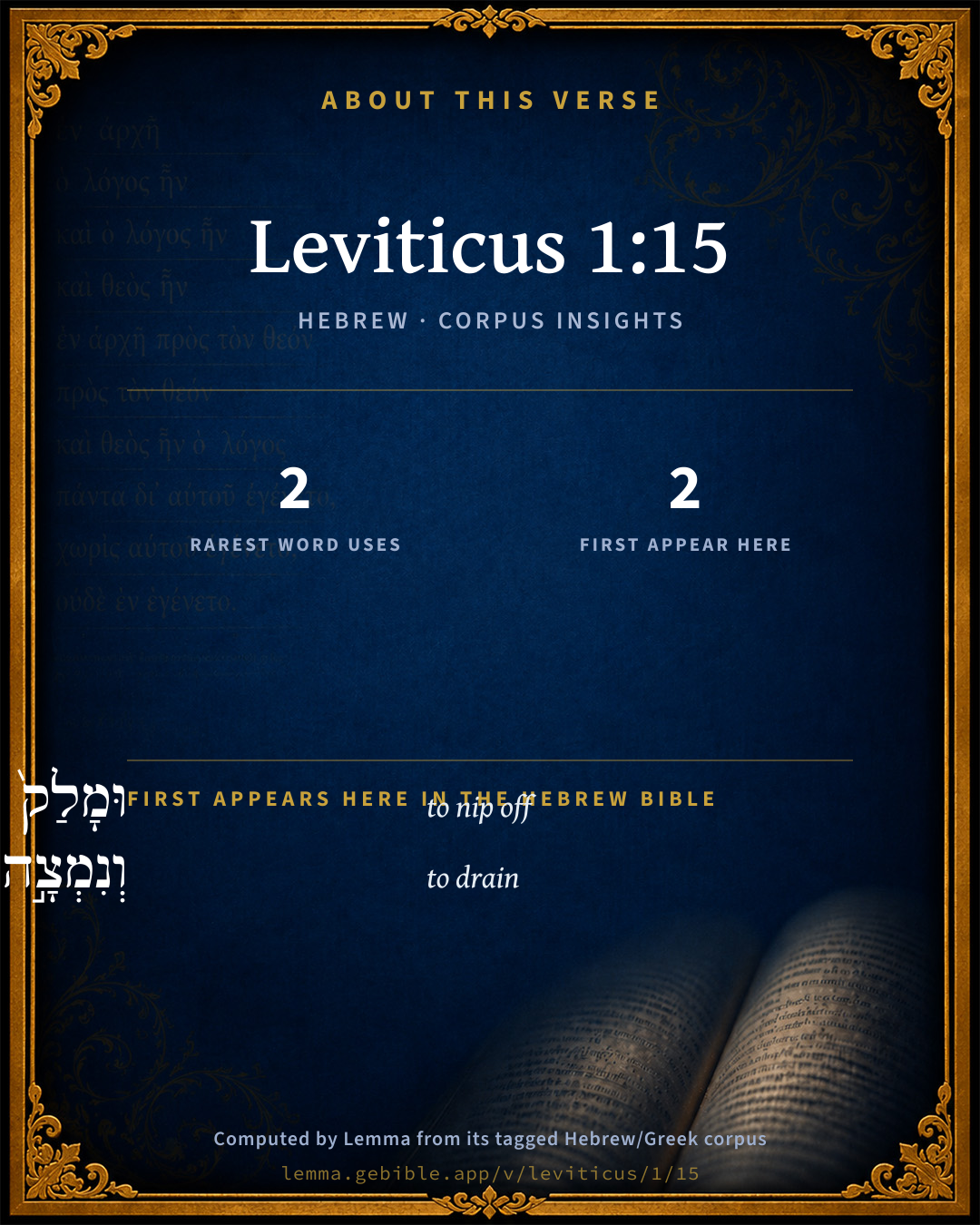
  • 2 first appearances in the Hebrew Bible
Full analysis ↓
Download a study sheet

One document with this verse’s original text, its word-by-word gloss line, the meaning frame, cross-references with their text, attributed commentary, and full source and license credits — printable, and it pastes into notes with its structure intact.

This verse Autodidact and up

Study sheet (.html) Plain text (.txt)

A passage Seminary Student

Up to 50 verses in one chapter. A passage sheet keeps up to 6 commentary sources and 12 cross-references per verse, in the order this page ranks them, and says so on the sheet whenever that leaves anything out. Ask for a single verse and you get the Autodidact verse sheet above.

Everything on this page stays free to read, with no account — the sheet is a download of what is already on screen, not access to it.

Want to remove ads? Support Godless Engineer
Compare translations 3

The same verse in 3 English versions, stacked beneath the original-language interlinear above. Click any original word for its lexicon entry.

Each is an independent rendering of the whole verse — the interlinear is not word-aligned to these translations.

Highlighted words mark where these versions differ — a whole-verse word diff, not a word-by-word alignment.

  • World English Bible Public Domain
    The priest shall bring it to the altar, and wring off its head, and burn it on the altar; and its blood shall be drained out on the side of the altar;
  • King James Version Public Domain
    And the priest shall bring it unto the altar, and wring off his head, and burn it on the altar; and the blood thereof shall be wrung out at the side of the altar:
  • unfoldingWord Literal Text CC BY-SA 4.0
    And the priest shall present it at the altar, and he shall twist off its head and he shall cause to become smoke on the altar. And its blood shall be drained on the side of the altar.

unfoldingWord Literal Text — © unfoldingWord, licensed CC BY-SA 4.0. Word-aligned USFM3 via Door43 (git.door43.org/unfoldingWord/en_ult).

Versions to compare (up to 4)

3 of 4 selected

Show all 18 translations

Every available English version of this verse, each an independent rendering of the whole verse.

  • World English Bible Public Domain
    The priest shall bring it to the altar, and wring off its head, and burn it on the altar; and its blood shall be drained out on the side of the altar;
  • Berean Standard Bible Public Domain
    Then the priest shall bring it to the altar, twist off its head, and burn it on the altar; its blood should be drained out on the side of the altar.
  • Majority Standard Bible Public Domain
    Then the priest shall bring it to the altar, twist off its head, and burn it on the altar; its blood should be drained out on the side of the altar.
  • King James Version Public Domain
    And the priest shall bring it unto the altar, and wring off his head, and burn it on the altar; and the blood thereof shall be wrung out at the side of the altar:
  • American Standard Version (1901) Public Domain
    And the priest shall bring it unto the altar, and wring off its head, and burn it on the altar; and the blood thereof shall be drained out on the side of the altar;
  • Revised Version (1885) Public Domain
    And the priest shall bring it unto the altar, and wring off its head, and burn it on the altar; and the blood thereof shall be drained out on the side of the altar:
  • Geneva Bible (1599) Public Domain
    And the Priest shall bring it vnto the altar, and wring the necke of it asunder, and burne it on the altar: and the blood thereof shall bee shed vpon the side of the altar.
  • Douay-Rheims (1899) Public Domain
    The priest shall offer it at the altar: and twisting back the neck, and breaking the place of the wound, he shall make the blood run down upon the brim of the altar.
  • Young's Literal Translation Public Domain
    and the priest hath brought it near unto the altar, and hath wrung off its head, and hath made perfume on the altar, and its blood hath been wrung out by the side of the altar;
  • Literal Standard Version CC BY-SA 4.0
    and the priest has brought it near to the altar, and has wrung off its head, and has made incense on the altar, and its blood has been wrung out by the side of the altar;
  • Unlocked Literal Bible CC BY-SA 4.0
    The priest must bring it to the altar, wring off its head, and burn it on the altar. Then its blood must be drained out on the side of the altar.
  • unfoldingWord Literal Text CC BY-SA 4.0
    And the priest shall present it at the altar, and he shall twist off its head and he shall cause to become smoke on the altar. And its blood shall be drained on the side of the altar.
  • Darby Bible Public Domain
    And the priest shall bring it near to the altar and pinch off its head and burn it on the altar; and its blood shall be pressed out at the side of the altar.
  • World Messianic Bible Public Domain
    The priest shall bring it to the altar, and wring off its head, and burn it on the altar; and its blood shall be drained out on the side of the altar;
  • Webster's Bible Public Domain
    And the priest shall bring it to the altar, and wring off its head, and burn it on the altar: and its blood shall be wrung out at the side of the altar:
  • Free Bible Version CC BY-SA 4.0
    The priest shall take it to the altar, twist off its head, and burn it on the altar. Its blood shall be drained out on the side of the altar.
  • Bible in Basic English Public Domain
    And the priest is to take it to the altar, and after its head has been twisted off, it is to be burned on the altar, and its blood drained out on the side of the altar:
  • JPS Tanakh (1917) Public Domain
    And the priest shall bring it unto the altar, and pinch off its head, and make it smoke on the altar; and the blood thereof shall be drained out on the side of the altar.

Literal Standard Version (2020), Covenant Press — licensed CC BY-SA 4.0. Text via the HelloAO Bible API (eBible.org). Unlocked Literal Bible (unfoldingWord) — licensed CC BY-SA 4.0. Text via the HelloAO Bible API (eBible.org). unfoldingWord Literal Text — © unfoldingWord, licensed CC BY-SA 4.0. Word-aligned USFM3 via Door43 (git.door43.org/unfoldingWord/en_ult). Free Bible Version, Dr. Jonathan Gallagher — licensed CC BY-SA 4.0. Text via the HelloAO Bible API (eBible.org).

Word by word

More ways to search: Search by grammar → Find every occurrence → Compare this word →

Practice this passage: Drill this verse → Learn its vocabulary →

וּמָלַק֙
mâlaq
H4454
“and · to nip off”
Conjunction + Verb, Qal, Sequential Perfect, 3rd Person, Masculine, Singular
Part of Speech
Conjunction + Verb
Stem
Qal
Form
Sequential Perfect
Person
3rd Person
Gender
Masculine
Number
Singular
Full BDB Definition

Origin: a primitive root

TWOT: 1207

(Qal) to nip, nip off (head of a bird)
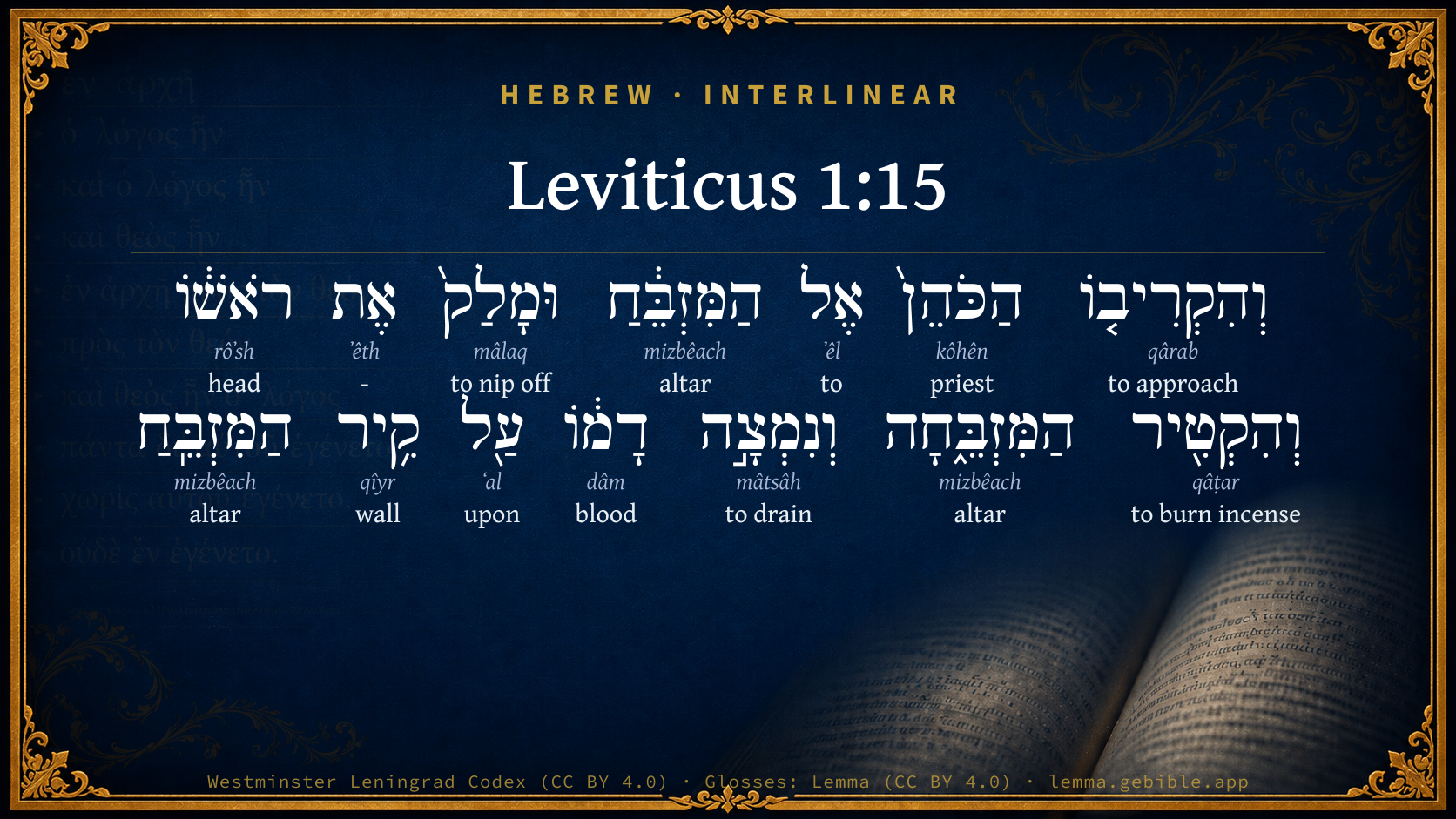
  1. וְהִקְרִיב֤וֹ qârab H7126 “and · to approach · him” Conjunction + Verb, Hiphil, Sequential Perfect, 3rd Person, Masculine, Singular + Suffix, Personal, 3rd Person, Masculine, Singular
  2. הַכֹּהֵן֙ kôhên H3548 “the · priest” Particle, Definite Article + Noun, Common, Masculine, Singular, Absolute
  3. אֶל ʼêl H413 “to” Preposition
  4. הַמִּזְבֵּ֔חַ mizbêach H4196 “the · altar” Particle, Definite Article + Noun, Common, Masculine, Singular, Absolute
  5. אֶת ʼêth H853 “-” Particle, Direct Object
  6. רֹאשׁ֔וֹ rôʼsh H7218 “head · his” Noun, Common, Masculine, Singular, Construct + Suffix, Personal, 3rd Person, Masculine, Singular
  7. וְהִקְטִ֖יר qâṭar H6999 “and · to burn incense” Conjunction + Verb, Hiphil, Sequential Perfect, 3rd Person, Masculine, Singular
  8. הַמִּזְבֵּ֑חָה mizbêach H4196 “the · altar · toward” Particle, Definite Article + Noun, Common, Masculine, Singular, Absolute + Suffix, Demonstrative
  9. וְנִמְצָ֣ה mâtsâh H4680 “and · to drain” Conjunction + Verb, Niphal, Sequential Perfect, 3rd Person, Masculine, Singular
  10. דָמ֔וֹ dâm H1818 “blood · his” Noun, Common, Masculine, Singular, Construct + Suffix, Personal, 3rd Person, Masculine, Singular
  11. עַ֖ל ʻal H5921 “upon” Preposition
  12. קִ֥יר qîyr H7023 “wall of” Noun, Common, Masculine, Singular, Construct
  13. הַמִּזְבֵּֽחַ mizbêach H4196 “the · altar” Particle, Definite Article + Noun, Common, Masculine, Singular, Absolute

About this verse

These counts appear in no published source. They are computed here, from the morphology-tagged text and Lemma’s own curated glosses. What Lemma adds →

14
words
12
distinct lemmas
Pentateuch
section

Notable vocabulary

The rarest word here is וּמָלַק֙ to nip off H4454 — appearing just 2 times in the whole Hebrew Bible.

First appearance in Scripture

These words make their first canonical appearance in the Hebrew Bible here:

  • וּמָלַק֙ to nip off H4454
  • וְנִמְצָ֣ה to drain H4680

Shared distinctive vocabulary

וּמָלַק֙ to nip off H4454 occurs in 2 verses of the Hebrew Bible. Also found in:

Grammatical profile

  • 4 verbs
  • 7 nouns
  • 2 prepositions
  • 1 particle

Verb forms

  • וְהִקְרִיב֤וֹ Hiphil · Sequential Perfect
  • וּמָלַק֙ Qal · Sequential Perfect
  • וְהִקְטִ֖יר Hiphil · Sequential Perfect
  • וְנִמְצָ֣ה Niphal · Sequential Perfect

Repetition

A word recurs within this verse — often emphatic in Hebrew:

  • הַמִּזְבֵּ֔חַ altar H4196 ×3

Hebrew & Septuagint length

In English translation the verse runs 32 words from the Hebrew and 36 from the Septuagint (LXX English) — closely comparable.

A rough comparison of the two English renderings, which tokenize alike — not a word-level alignment.

Word counts can differ between the Hebrew and the Greek without any difference in meaning — e.g. the Hebrew direct-object marker אֵת has no separate Greek word, and Greek often adds the article ὁ.

Cross-references

8

Topical passages linked to Leviticus 1:15 in the Treasury of Scripture Knowledge — connected by theme and wording, ordered by reader-vote popularity; previews shown in the World English Bible.

  • Leviticus 5:8–9 He shall bring them to the priest, who shall first offer the one which is for the sin offering, and wring off its head from its neck, but shall not sever it completely.
  • Psalms 22:1 My God, my God, why have you forsaken me? Why are you so far from helping me, and from the words of my groaning?
  • Psalms 22:21 Save me from the lion's mouth; Yes, from the horns of the wild oxen you have answered me.
  • Psalms 69:1–21 Save me, God, For the waters have come up to my neck!
  • Isaiah 53:4–5 Surely he has borne our sickness, and carried our suffering; yet we considered him plagued, struck by God, and afflicted.
  • Isaiah 53:10 Yet it pleased Yahweh to bruise him; he has put him to grief: when you shall make his soul an offering for sin, he shall see [his] seed, he shall prolong his days, and the pleasure of Yahweh shall prosper in his hand.
  • Matthew 26:1–27 It happened, when Jesus had finished all these words, that he said to his disciples,
  • 1 John 2:27 As for you, the anointing which you received from him remains in you, and you don't need for anyone to teach you. But as his anointing teaches you concerning all things, and is true, and is no lie, and even as it taught you, you will remain in him.

Cross-references courtesy of OpenBible.info (CC BY 4.0).

Hebrew and Greek witnesses Masoretic Hebrew ↔ Greek Septuagint

The same verse in the two great witnesses to the Old Testament, shown verse-for-verse.

These are two independent witnesses, not word-aligned to each other, and the Septuagint is shown in lemma (dictionary) form.

Hebrew Leviticus 1:15 Masoretic · Westminster Leningrad Codex

וְהִקְרִיב֤וֹ הַכֹּהֵן֙ אֶל הַמִּזְבֵּ֔חַ וּמָלַק֙ אֶת רֹאשׁ֔וֹ וְהִקְטִ֖יר הַמִּזְבֵּ֑חָה וְנִמְצָ֣ה דָמ֔וֹ עַ֖ל קִ֥יר הַמִּזְבֵּֽחַ

The priest shall bring it to the altar, and wring off its head, and burn it on the altar; and its blood shall be drained out on the side of the altar;

World English Bible · Public Domain

Greek LXX Leviticus 1:15 Septuagint · lemma form

καί προςφέρω αὐτός ὁ ἱερεύς πρός ὁ θυσιαστήριον καί ἀποκνίζω ὁ κεφαλή καί ἐπιτίθημι ὁ ἱερεύς ἐπί ὁ θυσιαστήριον καί στραγγίζω ὁ αἷμα πρός ὁ βάσις ὁ θυσιαστήριον

And the priest shall bring it to the altar, and shall wring off its head; and the priest shall put it on the altar, and shall wring out the blood at the bottom of the altar.

LXX2012 (modern English Septuagint) · Public Domain

Hebrew: Westminster Leningrad Codex (CC BY 4.0). Greek: Septuagint (public domain); English from LXX2012 (modern English Septuagint) (Public Domain). How the Septuagint differs from the Hebrew →

Targum (Aramaic paraphrase)

2

The Targum is the ancient Jewish Aramaic paraphrase of the Hebrew Scriptures — an interpretive translation, not the Hebrew text itself. Onkelos (literal) and Pseudo-Jonathan (expansive) render the Torah, and Jonathan the Prophets. Coverage is partial: where no permissively-licensed English translation exists for a verse, only the Aramaic is shown. This is verse-level text, not a word-by-word alignment to the Hebrew. Some Onkelos verses here show an unreviewed machine translation (clearly flagged), not a published edition.

  1. Targum Onkelos Torah (Genesis–Deuteronomy)
    וִיקָרְבִינֵהּ כַּהֲנָא לְמַדְבְּחָא וְיִמְלוֹק יָת רֵישֵׁהּ וְיַסֵק לְמַדְבְּחָא וְיִתְמְצֵי דְמֵיהּ עַל כּוֹתֶל מַדְבְּחָא

    Unreviewed machine translation (Claude Sonnet 5) — not public domain confidence: high

    And the priest shall bring it near to the altar, and shall nip off its head, and shall burn it on the altar; and its blood shall be drained out against the wall of the altar.

    Generated by an AI translate-then-audit pipeline and checked against an independent public-domain English translation of the underlying Hebrew for drift only. Not a published edition; pending human review.

    Aramaic base: public-domain Targum Onkelos (via Sefaria). The English above is the unreviewed machine translation, not public domain.

  2. Targum Pseudo-Jonathan Torah (Genesis–Deuteronomy)
    וִיקַרְבִינֵיהּ כַּהֲנָא לְמַדְבְּחָא וְיַחֲזוֹם יַת רֵישֵׁיהּ וְיַסֵיק לְמַדְבְּחָא וְיִתְמְצֵי אַדְמֵיהּ עַל כּוֹתֶל מַדְבְּחָא

    And the priest shall offer it upon the altar, and shall wring off its head, and burn upon the altar, and press out its blood at the side of the altar.

    Targum Pseudo-Jonathan — Aramaic: “Targum Jonathan on Genesis” (public domain); “Targum Jonathan on Exodus” (public domain); “Targum Jonathan on Leviticus” (public domain); “Targum Jonathan on Numbers” (public domain); “Targum Jonathan on Deuteronomy” (public domain). English: “The Targum of Jonathan ben Uzziel, trans. J. W. Etheridge, London, 1862” (public domain). Text via Sefaria.

Commentary

Notes on Leviticus 1:15 from classic Christian and Jewish commentators (each source and its license shown beneath its notes). The classic Christian expositions comment on the surrounding passage and are grouped to its opening verse, so a note may address several verses; the Jewish commentaries on the Tanakh (Rashi and others) are per-verse, so they appear only where the commentator wrote on this verse.

Lemma curates 59 commentaries, every one of them public domain or Creative Commons licensed, each selected and text-cleaned for this edition rather than reprinted as found. About our sources →

Trapp's Complete Commentary

John Trapp

Lev 1:15 And the priest shall bring it unto the altar, and wring off his head, and burn [it] on the altar; and the blood thereof shall be wrung out at the side of the altar:

Ver. 15. Wring off his head.] Or, Pinch it with his nail, that the blood might go out, without separating it from the rest of the body. This prefigured the death of Christ without either breaking a bone or dividing the Godhead from the manhood; as also the skill that should be in ministers, to cut or divide aright the word of truth.

John Trapp, A Commentary or Exposition upon All the Books of the Old and New Testament (1647–1656) — public domain. Text from a community e-Sword module.

Joseph Benson's Commentary

Lev 1:15. His head — From the rest of the body; as sufficiently appears, because this was to be burned by itself, and the body afterward, Lev 1:17. And whereas it is said, (Lev 5:8,) He shall — wring his head from his neck, but shall not divide it asunder, that is spoken not of the burnt- offering as here, but of the sin-offering.

Joseph Benson's Commentary on the Old and New Testaments (1811–1818) — public domain. Text from a community e-Sword module.

Geneva Bible (1599)

Geneva Bible translators

Or, strained or pressed.

The Hebrew word signifieth to pinch off with the nail.

Geneva Bible (1599) marginal notes — public domain. Text via Bolls.life.

Ellicott's Commentary for English Readers

(15) And the priest.—It was probably out of consideration for the feelings of the poor offerer, and to increase the importance of the otherwise small offering, that the priest himself brought the victim to the altar and slew it instead of the worshipper performing these acts, as in the case of quadrupeds. The imposition of hands upon the victim was dispensed with, both because the bird was too small for this ceremony, and because the offerer brought it in his hands to the place of sacrifice, thus conveying by this act the idea involved in the imposition of hands.

And wring off his head.—When the bird is handed to him, the priest is not to use any knife, but is to nip off its head with his nails, throw the severed head on the altar fire, and thus cause it to ascend in the sweet smelling savour. As the small quantity of blood could not be caught in a bowl, and would not suffice for throwing it or pouring it on the four walls, as was the case in the offering of quadrupeds, he pressed it out from the headless body, and let it run on the walls.

A Bible Commentary for English Readers, edited by Charles John Ellicott (1878–1897) — public domain. Text from a community e-Sword module.

The Cambridge Bible for Schools and Colleges

gen. ed. J. J. S. Perowne

15. wring off] Or, pinch off the head with the nail, as A.V. mg., a word used here and Lev_5:8 only. The head is burnt after being removed, and the remainder of the bird is burnt afterwards. This burning of the parts separately is in marked contrast with the burning of the whole together in the two preceding sections (Lev_1:9 and Lev_1:13).

drained out on the side of the altar] The blood is too small in quantity to be treated as in the previous cases.

The Cambridge Bible for Schools and Colleges (gen. ed. J. J. S. Perowne; Cambridge University Press, 1878–1918) — public domain. Text from a community e-Sword module.

John Gill's Exposition

And the priest shall bring it unto the altar,.... The southeast horn of it; near which was the place of the ashes, into which the crop and its feathers were cast (n):

and wring off his head; by twisting it back as it should seem; the word used is only to be found here, and in Lev 5:8 the Jews say, it signifies to cut with the nail, and that the priest did this, not with a knife or any other instrument, but with his nail; so Jarchi and Gersom on the place observe: some think he only let out the blood this way, but did not separate the head from the body, which seems to be favoured by Lev 5:8 though Maimonides and Bartenora (o) conclude the reverse from the same place; and that the meaning is, that he should cut off the head and divide it asunder at the time he cuts with the nail: the manner of cutting with the nail was this (p), the priest held both the feet of the bird with his two fingers of his left hand, and the wings between two other fingers, and the bird upon the back of his hand, that it might not be within the palm of it; then he stretches out its neck upon the thumb about two fingers' breadth, and cuts it over against the neck with his nail, and this is one of the hardest services in the sanctuary:

and burn it on the altar; that is, the head, after squeezing out the blood, and rubbing it with salt:

and the blood thereof shall be wrung out at the side of the altar: or "the wall" of it: this, though mentioned last, must be done before, and immediately upon the wringing of the head, and between that and the burning it on the altar: this wringing off the head, and wringing out the blood, denote violence, and show that Christ's death, which this was a type of, was a violent one; the Jews laid violent hands upon him, and pursued his life in a violent manner, were very pressing to have it taken away, and his life was taken away in such a manner by men, though not without his Father's secret will, and his own consent.

(n) Misn. Zebachim, c. 6. sect. 5. & Bartenora in ib. (o) In Misn. ib. (p) Maimon. in Misn. ib. sect. 4. & Bartenora. in ib.

John Gill's Exposition of the Whole Bible (1746–1763) — public domain (CC PDM 1.0). Text via the HelloAO Bible API.

Haydock's Catholic Bible Commentary

The neck. Some say, without pulling the head off (Grotius); which the Rabbins deny. (Calmet)

George Leo Haydock (1774–1849), Haydock's Catholic Family Bible and Commentary, 1859 edition — public domain. Excludes Psalms (Douay-Rheims chapter numbering differs from Protestant) and Deuterocanonical books (Catholic canon only).

Matthew Poole's English Annotations

Wring off his head, to wit, from the rest of the body; as sufficiently appears, because this was to be burnt by itself, as it here follows, and the body afterwards, Lev 1:17. And whereas it is said, Lev 5:8, he shall wring off his head from his neck, but shall not divide it asunder, that is spoken not of the burnt-offering, as here, but of the sin-offering, in which there might be a differing rite.

Matthew Poole's English Annotations on the Holy Bible (1683–1685) — public domain. Text from a community e-Sword/MySword module.

Whedon's Commentary on the Bible

Daniel D. Whedon

15. Wring off his head — Rather, pinch it off and lay it on the altar. The blood was then to be pressed out at the side of the altar.

Daniel D. Whedon (gen. ed.), Commentary on the Old and New Testaments (1874–1909) — public domain. Text from a community e-Sword module.

The Pulpit Commentary

The priest shall bring it unto the altar. The difference in the ritual for the burnt sacrifice of fowls is:

1. That the offerer is not commanded to lay his hand on the bird.

2. That the altar is the place of emaciation, instead of the space on the north side of the altar.

3. That the priest slays it instead of the offerer.

4. That the blood (owing to its smaller quantity) is pressed out against the side of the altar instead of being caught in a vessel and thrown on it. There is no essential variation here; the analogy of the sacrifice of the animal is followed so far as circumstances permit. It is not certain that the word malak, translated wring off his head, means more than "make an incision with the nail;" but in all probability the head was to be severed and laid on the fire separately, after the manner of the other sacrifices.

The Pulpit Commentary (1880–1919), ed. H.D.M. Spence-Jones & Joseph S. Exell — public domain. Text from a community e-Sword module.

Rashi

Rabbi Shlomo Yitzchaki (Rashi)

והקריבו [AND THE PRIEST] SHALL OFFER IT — It — even a single bird he may offer (not necessarily more than one, as might be assumed from the plural תורים and בני יונה) (Sifra, Vayikra Dibbura d'Nedavah, Section 7 1; Zevachim 65a).

הכהן … ומלק THE PRIEST SHALL … NIP OFF [ITS HEAD] — The nipping of the bird’s head must not be done with an instrument but by the priest’s very self:) he nips with his finger-nail close by the nape, cuts right through the neck-bone until he comes to the “organs” (the wind pipe and the gullet) and cuts them through too (Sifra, Vayikra Dibbura d'Nedavah, Section 7 3; Zevachim 65a).

ונמצה דמו AND THE BLOOD THEREOF SHALL BE WRUNG OUT — The word ונמצה is connected in meaning with (Proverbs 30:33) “the pressing out (מיץ) of wrath”; (Isaiah 16:4) “for extortion (המץ) is at an end). — He presses the place where the neck has been cut (בית השחיטה) against the wall and the blood thus drains itself out) and runs down the wall (cf. Sifra, Vayikra Dibbura d'Nedavah, Section 7 7; Zevachim 64b).

ומלק … והקטיר …ונמצה AND HE SHALL NIP OFF … AND CAUSE IT TO ASCEND IN FUMES … AND [THE BLOOD] SHALL BE WRUNG OUT — Is it possible to say so? Since he has burnt it can he squeeze the blood out?! But the wording is intended to suggest the following: How is it with the burning of the sacrifice? The head is separate and the body is separate (since it states here ומלק את ראשו והקטיר, and in v. 17 it is enjoined והקטיר אתו i. e. the body; vv. 16—17 speaking of the rites performed on the body)! So, too, the nipping has to be thus (i. e. has to have the effect of severing the head from the body so that it may be burnt apart from the body; the מליקה accordingly denotes here complete severance, whilst in 5:8 this is forbidden. The translation therefore is: and he shall nip off the head so that he may burn it on the altar) (Sifra, Vayikra Dibbura d'Nedavah, Section 7 5; Zevachim 65a). According to the literal sense of the verse, however, the wording is inverted: he shall nip off [the head] and burn it, and before the burning the blood shall have been pressed out already (ונמצה has therefore a future-perfect meaning: “and its blood shall have been pressed out”).

Rashi on the Tanakh — English translations: “The Judaica Press complete Tanach with Rashi, translated by A. J. Rosenberg” (CC BY 4.0); “Pentateuch with Rashi's commentary by M. Rosenbaum and A.M. Silbermann, 1929-1934” (public domain); “The Metsudah Tanach series, Lakewood, N.J” (CC BY 4.0); and “The Book of Joshua, Metsudah Publications, 1997” (CC BY 4.0). Text via Sefaria.

Ramban (Nachmanides)

Rabbi Moshe ben Nachman (Ramban / Nachmanides)

AND THE PRIEST SHALL BRING IT UNTO THE ALTAR. This “bringing” means bringing it up onto the altar, signifying that the priest is to bring up the bird onto the altar and nip off its head there, as the nipping off may only be done on top of the altar. It is for this reason that the Rabbis interpreted: “And the priest shall bring it … Could you possibly think that a non-priest could come near the altar? If so, why does it say the priest … shall nip off? It is to teach us that the nipping off be done [not with an instrument but] only by the priest himself.” “And he shall nip off … and cause it to ascend in fumes … and the blood thereof shall be wrung out. Is it possible to say that after he has burnt it, he should squeeze the blood out? But [the order of the wording] is to teach us that just as the burning of the head is to be done separately [as is indicated here in the verse, and he shall nip off its head, and cause it to ascend in fumes], and that of the body is to be done separately [as is stated further on in Verse 17: and he shall cleave it … and cause it to ascend in fumes], so also the nipping off has to be done in this way, the head separately and the body separately. The plain meaning of the verse, however, is that the wording is to be inverted: and he shall nip off and cause it to ascend in fumes, and before the burning its blood shall have been wrung out.” This is Rashi’s language.Now it is impossible to say [that the order of the verse can be explained to mean] that he should nip off its head and burn it, and afterwards wring the blood of the body on the wall of the altar and then burn the body, since no limbs of any offering may ever be burnt [on the altar] before the sprinkling of the blood, the principle for it is the blood that maketh atonement by reason of the life, and the wringing of the blood can nonetheless be done subsequently because it refers to the body’s blood. Rashi, however, was compelled to invert the word-order because this suggested explanation is impossible, as explained by Ramban. applying to all offerings. Therefore the Rabbis interpreted the verse [to mean] that Scripture intended only to liken the nipping off to the burning, so that in both cases the head should be treated by itself and the body by itself. The plain sense of the verse, however, is that “he should nip off its head in order to burn it on the altar,” thus teaching that the nipping off should be done in order to burn the head [separately, and not dispose of it otherwise], just as he will burn the body, concerning which He said, and the priest shall cause it to ascend in fumes, for such is Scriptures’ way of speaking about all offerings, as I have explained in connection with the severance into pieces of the burnt-offering. However, Scripture states here, and the priest shall cause it to ascend in fumes, and did not say “and he shall cause all to ascend” [as it said above in Verse 9, in the case of the burnt-offering of the herd], because [here in the case of the burnt-offering of the fowl] the burning thereof was done in two separate stages: first he burnt the head, and then he removed the crop [from the body], and cleft it by the wings, and then he burnt the body, as we have been taught in Tractate Zebachim.

Ramban (Nachmanides) on the Tanakh — English translation: “Commentary on the Torah by Ramban (Nachmanides). Translated and annotated by Charles B. Chavel. New York, Shilo Pub. House, 1971-1976” (CC BY 4.0). Text via Sefaria.

Lesson kit

Teaching starters — assembled from the data on this page, not authored interpretation. Every prompt links to the verse data it draws on. Edit before teaching.

Leviticus, in the Pentateuch, opens this verse with 14 words (12 distinct Hebrew lemmas). Its most distinctive word is mâlaq (“to nip off”). A historical commentator’s framing appears above. Read the whole chapter for the surrounding context.

Discussion questions

  1. How does “to nip off” (mâlaq) shape what this verse is saying?
  2. 2 words make their first appearance in Scripture here. What does this debut establish?
  3. How does Leviticus 5:8, which shares the word «to nip off», read alongside this verse?
  4. What does the repetition of “altar” (3× in this one verse) do in this verse?
  5. These translations render this verse differently. What is at stake in choosing one wording over another?
  6. «וְהִקְרִיב֤וֹ» is a Hiphil Sequential Perfect verb. How does that grammatical form shape the action described?
  7. Compare how Trapp's Complete Commentary and Joseph Benson's Commentary read this verse. Where do they agree or differ?

Things to notice

  • 2 words make their first canonical appearance in Scripture here.
  • These translations choose different wording for 12 words in this verse.
  • “altar” occurs 3× in this single verse.
  • 12 distinct Hebrew lemmas span 14 words in this verse.

Reading settings

Reading text

Shown beneath each verse's original-language words.

Old Testament
Old Testament edition

Read the OT as the Masoretic Hebrew (MT) or the Greek Septuagint (LXX).

English shown for the Greek Septuagint (in the Hebrew ↔ Greek comparison).

Comparing translations? Open the Compare panel on any verse page to stack up to four side by side.