
Leviticus 14:28

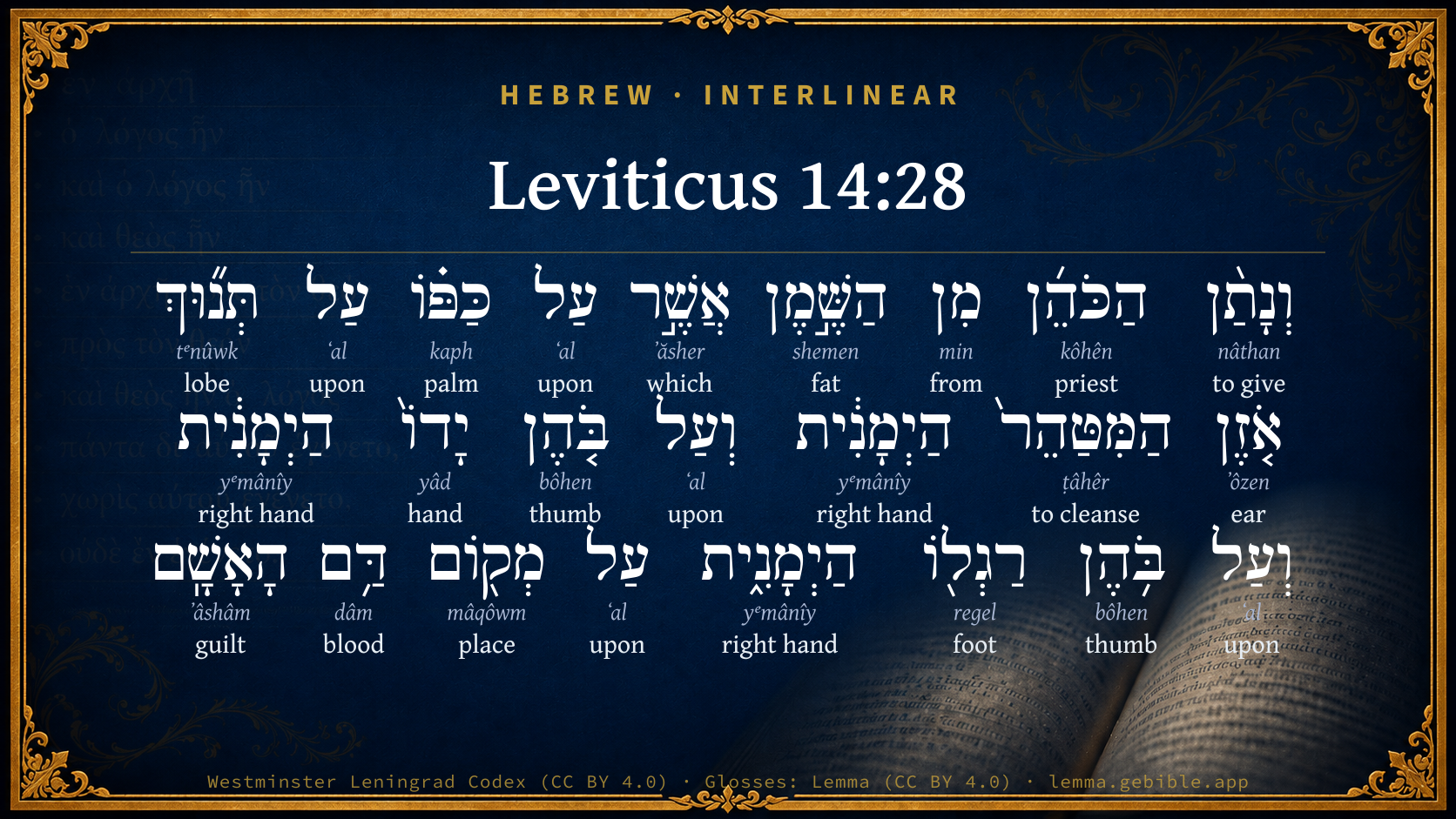
Hebrew (Westminster Leningrad Codex) Leviticus 14:28 appears in the Hebrew Old Testament. The text above is from the Westminster Leningrad Codex. Each word links to its Strong’s number, a concise gloss, and parsing drawn from the Open Scriptures Hebrew Bible morphology. Click any word for its full Brown-Driver-Briggs (BDB) entry.
Download image
Cite this verse

Leviticus 14:28 (World English Bible). Public Domain. Lemma interlinear Bible study tool, https://lemma.gebible.app/v/leviticus/14/28.

Show BibTeX & RIS
BibTeX
RIS
English Translation
Then the priest shall put some of the oil that is in his hand on the tip of the right ear of him who is to be cleansed, and on the thumb of his right hand, and on the big toe of his right foot, on the place of the blood of the trespass offering.
World English Bible · Public Domain
Download a study sheet

One document with this verse’s original text, its word-by-word gloss line, the meaning frame, cross-references with their text, attributed commentary, and full source and license credits — printable, and it pastes into notes with its structure intact.

This verse Autodidact and up

Study sheet (.html) Plain text (.txt)

A passage Seminary Student

Up to 50 verses in one chapter. A passage sheet keeps up to 6 commentary sources and 12 cross-references per verse, in the order this page ranks them, and says so on the sheet whenever that leaves anything out. Ask for a single verse and you get the Autodidact verse sheet above.

Everything on this page stays free to read, with no account — the sheet is a download of what is already on screen, not access to it.

Want to remove ads? Support Godless Engineer
Compare translations 3

The same verse in 3 English versions, stacked beneath the original-language interlinear above. Click any original word for its lexicon entry.

Each is an independent rendering of the whole verse — the interlinear is not word-aligned to these translations.

Highlighted words mark where these versions differ — a whole-verse word diff, not a word-by-word alignment.

  • World English Bible Public Domain
    Then the priest shall put some of the oil that is in his hand on the tip of the right ear of him who is to be cleansed, and on the thumb of his right hand, and on the big toe of his right foot, on the place of the blood of the trespass offering.
  • King James Version Public Domain
    And the priest shall put of the oil that is in his hand upon the tip of the right ear of him that is to be cleansed, and upon the thumb of his right hand, and upon the great toe of his right foot, upon the place of the blood of the trespass offering:
  • unfoldingWord Literal Text CC BY-SA 4.0
    And the priest shall put some of the oil that on his palm on the lobe of the right ear of the person being cleansed and on the thumb of his right hand and on the big toe of his right foot, on the place of the blood of the guilt offering.

unfoldingWord Literal Text — © unfoldingWord, licensed CC BY-SA 4.0. Word-aligned USFM3 via Door43 (git.door43.org/unfoldingWord/en_ult).

Versions to compare (up to 4)

3 of 4 selected

Show all 18 translations

Every available English version of this verse, each an independent rendering of the whole verse.

  • World English Bible Public Domain
    Then the priest shall put some of the oil that is in his hand on the tip of the right ear of him who is to be cleansed, and on the thumb of his right hand, and on the big toe of his right foot, on the place of the blood of the trespass offering.
  • Berean Standard Bible Public Domain
    The priest shall also put some of the oil in his palm on the right earlobe of the one to be cleansed, on the thumb of his right hand, and on the big toe of his right foot—on the same places as the blood of the guilt offering.
  • Majority Standard Bible Public Domain
    The priest shall also put some of the oil in his palm on the right earlobe of the one to be cleansed, on the thumb of his right hand, and on the big toe of his right foot—on the same places as the blood of the guilt offering.
  • King James Version Public Domain
    And the priest shall put of the oil that is in his hand upon the tip of the right ear of him that is to be cleansed, and upon the thumb of his right hand, and upon the great toe of his right foot, upon the place of the blood of the trespass offering:
  • American Standard Version (1901) Public Domain
    and the priest shall put of the oil that is in his hand upon the tip of the right ear of him that is to be cleansed, and upon the thumb of his right hand, and upon the great toe of his right foot, upon the place of the blood of the trespass-offering:
  • Revised Version (1885) Public Domain
    and the priest shall put of the oil that is in his hand upon the tip of the right ear of him that is to be cleansed, and upon the thumb of his right hand, and upon the great toe of his right foot, upon the place of the blood of the guilt offering:
  • Geneva Bible (1599) Public Domain
    Then the Priest shall put of the oyle that is in his hande, vpon the lap of the right eare of him that is to bee clensed, and vpon the thumbe of his right hande, and vpon the great toe of his right foote: vpon the place of the blood of the trespasse offring.
  • Douay-Rheims (1899) Public Domain
    And he shall touch the tip of the right ear of him that is cleansed, and the thumb of his right hand and the great toe of his right foot, in the place of the blood that was shed for trespass.
  • Young's Literal Translation Public Domain
    `And the priest hath put of the oil which `is' on his palm, on the tip of the right ear of him who is to be cleansed, and on the thumb of his right hand, and on the great toe of his right foot, on the place of the blood of the guilt-offering;
  • Literal Standard Version CC BY-SA 4.0
    And the priest has put of the oil which [is] on his palm, on the tip of the right ear of him who is to be cleansed, and on the thumb of his right hand, and on the great toe of his right foot, on the place of the blood of the guilt-offering;
  • Unlocked Literal Bible CC BY-SA 4.0
    The priest will then put some of the oil that is in his hand on the tip of the right ear of the one who is to be cleansed, on the thumb of his right hand, and on the big toe of his right foot, the same places where he put the blood of the guilt offering.
  • unfoldingWord Literal Text CC BY-SA 4.0
    And the priest shall put some of the oil that on his palm on the lobe of the right ear of the person being cleansed and on the thumb of his right hand and on the big toe of his right foot, on the place of the blood of the guilt offering.
  • Darby Bible Public Domain
    And the priest shall put of the oil that is in his hand upon the tip of the right ear of him that is to be cleansed, and upon the thumb of his right hand, and on the great toe of his right foot, upon the place of the blood of the trespass-offering.
  • World Messianic Bible Public Domain
    Then the priest shall put some of the oil that is in his hand on the tip of the right ear of him who is to be cleansed, and on the thumb of his right hand, and on the big toe of his right foot, on the place of the blood of the trespass offering.
  • Webster's Bible Public Domain
    And the priest shall put of the oil that is in his hand upon the tip of the right ear of him that is to be cleansed, and upon the thumb of his right hand, and upon the great toe of his right foot, upon the place of the blood of the trespass-offering.
  • Free Bible Version CC BY-SA 4.0
    The priest shall also put some of the olive oil in his palm on the right earlobe of the person being made clean, on their right thumb, and on the big toe of their right foot, in the same places as the blood of the guilt offering.
  • Bible in Basic English Public Domain
    And the priest will put some of the oil which is in his hand on the point of the ear of the man who is to be made clean and on the thumb of his right hand and on the great toe of his right foot, on the place where the blood of the offering for wrongdoing was put;
  • JPS Tanakh (1917) Public Domain
    And the priest shall put of the oil that is in his hand upon the tip of the right ear of him that is to be cleansed, and upon the thumb of his right hand, and upon the great toe of his right foot, upon the place of the blood of the guilt-offering.

Literal Standard Version (2020), Covenant Press — licensed CC BY-SA 4.0. Text via the HelloAO Bible API (eBible.org). Unlocked Literal Bible (unfoldingWord) — licensed CC BY-SA 4.0. Text via the HelloAO Bible API (eBible.org). unfoldingWord Literal Text — © unfoldingWord, licensed CC BY-SA 4.0. Word-aligned USFM3 via Door43 (git.door43.org/unfoldingWord/en_ult). Free Bible Version, Dr. Jonathan Gallagher — licensed CC BY-SA 4.0. Text via the HelloAO Bible API (eBible.org).

Word by word

More ways to search: Search by grammar → Find every occurrence → Compare this word →

Practice this passage: Drill this verse → Learn its vocabulary →

תְּנ֞וּךְ
tᵉnûwk
H8571
“lobe of”
Noun, Common, Masculine, Singular, Construct
Part of Speech
Noun
Type
Common
Gender
Masculine
Number
Singular
State
Construct
Full BDB Definition

Origin: perhaps from the same as H594 through the idea of protraction

TWOT: 2527a

tip, lobe (of ear)
  1. וְנָתַ֨ן nâthan H5414 “and · to give” Conjunction + Verb, Qal, Sequential Perfect, 3rd Person, Masculine, Singular
  2. הַכֹּהֵ֜ן kôhên H3548 “the · priest” Particle, Definite Article + Noun, Common, Masculine, Singular, Absolute
  3. מִן min H4480 “from” Preposition
  4. הַשֶּׁ֣מֶן shemen H8081 “the · fat” Particle, Definite Article + Noun, Common, Masculine, Singular, Absolute
  5. אֲשֶׁ֣ר ʼăsher H834 “which” Particle, Relative
  6. עַל ʻal H5921 “upon” Preposition
  7. כַּפּ֗וֹ kaph H3709 “palm · his” Noun, Common, Feminine, Singular, Construct + Suffix, Personal, 3rd Person, Masculine, Singular
  8. עַל ʻal H5921 “upon” Preposition
  9. אֹ֤זֶן ʼôzen H241 “ear of” Noun, Common, Feminine, Singular, Construct
  10. הַמִּטַּהֵר֙ ṭâhêr H2891 “the · cleansing” Particle, Definite Article + Verb, Hithpael, Participle Active, Masculine, Singular, Absolute
  11. הַיְמָנִ֔ית yᵉmânîy H3233 “the · right hand” Particle, Definite Article + Adjective, Adjective, Feminine, Singular, Absolute
  12. וְעַל ʻal H5921 “and · upon” Conjunction + Preposition
  13. בֹּ֤הֶן bôhen H931 “thumb of” Noun, Common, Feminine, Singular, Construct
  14. יָדוֹ֙ yâd H3027 “hand · his” Noun, Common, Both, Singular, Construct + Suffix, Personal, 3rd Person, Masculine, Singular
  15. הַיְמָנִ֔ית yᵉmânîy H3233 “the · right hand” Particle, Definite Article + Adjective, Adjective, Feminine, Singular, Absolute
  16. וְעַל ʻal H5921 “and · upon” Conjunction + Preposition
  17. בֹּ֥הֶן bôhen H931 “thumb of” Noun, Common, Feminine, Singular, Construct
  18. רַגְל֖וֹ regel H7272 “foot · his” Noun, Common, Feminine, Singular, Construct + Suffix, Personal, 3rd Person, Masculine, Singular
  19. הַיְמָנִ֑ית yᵉmânîy H3233 “the · right hand” Particle, Definite Article + Adjective, Adjective, Feminine, Singular, Absolute
  20. עַל ʻal H5921 “upon” Preposition
  21. מְק֖וֹם mâqôwm H4725 “place of” Noun, Common, Masculine, Singular, Construct
  22. דַּ֥ם dâm H1818 “blood of” Noun, Common, Masculine, Singular, Construct
  23. הָאָשָֽׁם ʼâshâm H817 “the · guilt” Particle, Definite Article + Noun, Common, Masculine, Singular, Absolute

About this verse

These counts appear in no published source. They are computed here, from the morphology-tagged text and Lemma’s own curated glosses. What Lemma adds →

24
words
17
distinct lemmas
Pentateuch
section

Notable vocabulary

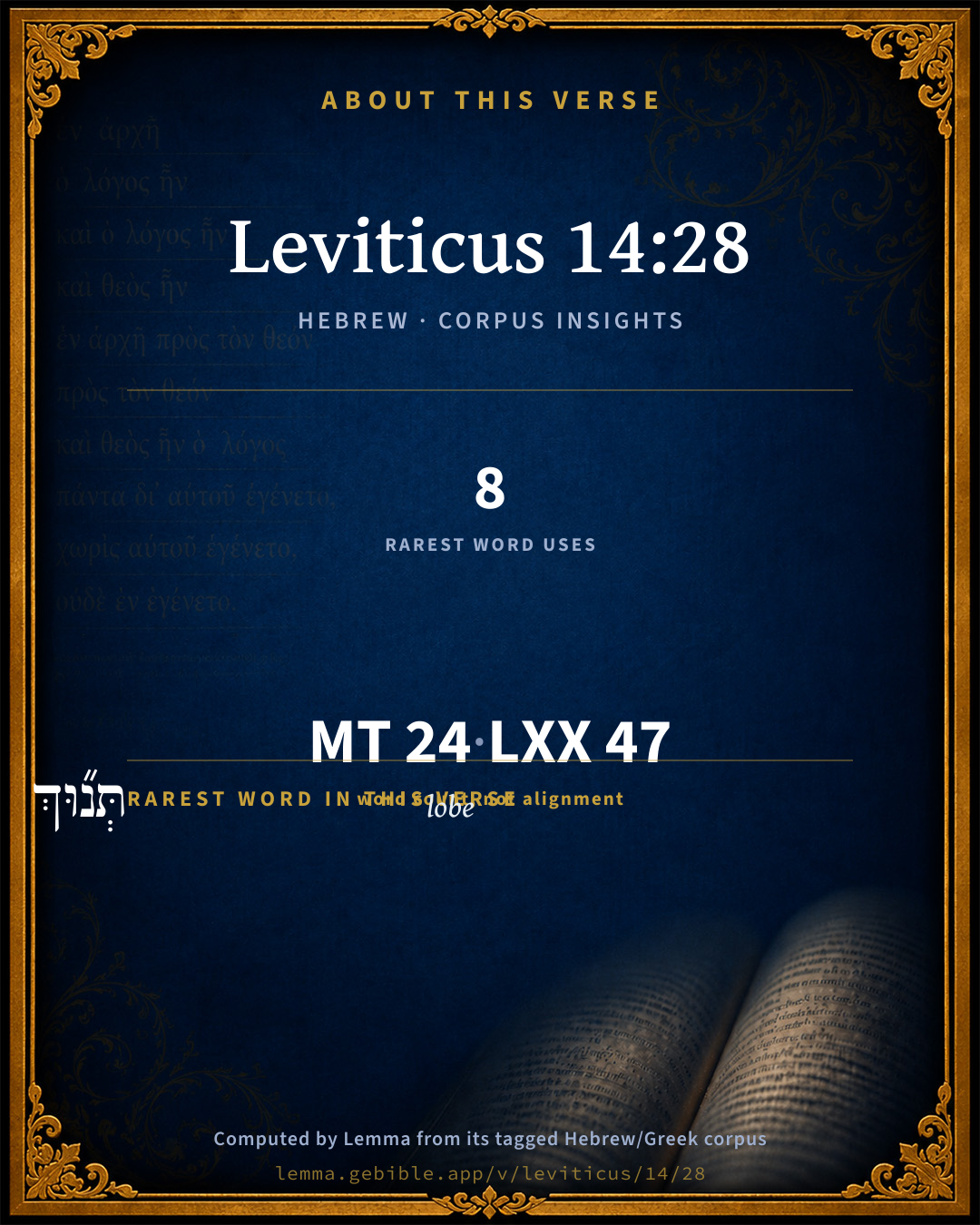
The rarest word here is תְּנ֞וּךְ lobe H8571 — appearing just 8 times in the whole Hebrew Bible.

Shared distinctive vocabulary

תְּנ֞וּךְ lobe H8571 occurs in 7 verses of the Hebrew Bible. Also found in:

Grammatical profile

  • 2 verbs
  • 12 nouns
  • 3 adjectives
  • 6 prepositions
  • 1 particle

Verb forms

  • וְנָתַ֨ן Qal · Sequential Perfect
  • הַמִּטַּהֵר֙ Hithpael · Participle Active

Repetition

Words recur within this verse — often emphatic in Hebrew:

  • עַל upon H5921 ×5
  • הַיְמָנִ֔ית right hand H3233 ×3
  • בֹּ֤הֶן thumb H931 ×2

Hebrew & Septuagint length

In English translation the verse runs 55 words from the Hebrew and 52 from the Septuagint (LXX English) — closely comparable.

A rough comparison of the two English renderings, which tokenize alike — not a word-level alignment.

Word counts can differ between the Hebrew and the Greek without any difference in meaning — e.g. the Hebrew direct-object marker אֵת has no separate Greek word, and Greek often adds the article ὁ.

In the original languages it is 24 Hebrew tokens and 47 Greek tokens — but the two are counted differently (Hebrew bundles its prefixes and suffixes into one token; the Greek is in lemma form), so that isn’t a like-for-like length.

Hebrew and Greek witnesses Masoretic Hebrew ↔ Greek Septuagint

The same verse in the two great witnesses to the Old Testament, shown verse-for-verse.

These are two independent witnesses, not word-aligned to each other, and the Septuagint is shown in lemma (dictionary) form.

Hebrew Leviticus 14:28 Masoretic · Westminster Leningrad Codex

וְנָתַ֨ן הַכֹּהֵ֜ן מִן הַשֶּׁ֣מֶן אֲשֶׁ֣ר עַל כַּפּ֗וֹ עַל תְּנ֞וּךְ אֹ֤זֶן הַמִּטַּהֵר֙ הַיְמָנִ֔ית וְעַל בֹּ֤הֶן יָדוֹ֙ הַיְמָנִ֔ית וְעַל בֹּ֥הֶן רַגְל֖וֹ הַיְמָנִ֑ית עַל מְק֖וֹם דַּ֥ם הָאָשָֽׁם

Then the priest shall put some of the oil that is in his hand on the tip of the right ear of him who is to be cleansed, and on the thumb of his right hand, and on the big toe of his right foot, on the place of the blood of the trespass offering.

World English Bible · Public Domain

Greek LXX Leviticus 14:28 Septuagint · lemma form

καί ἐπιτίθημι ὁ ἱερεύς ἀπό ὁ ἔλαιον ὁ ἐπί ὁ χείρ αὐτός ἐπί ὁ λοβός ὁ οὖς ὁ καθαρίζω ὁ δεξιός καί ἐπί ὁ ἄκρος ὁ χείρ αὐτός ὁ δεξιός καί ἐπί ὁ ἄκρος ὁ πούς αὐτός ὁ δεξιός ἐπί ὁ τόπος ὁ αἷμα ὁ ὁ πλημμέλεια

And the priest shall put of the oil that is on his hand on the tip of the right ear of him that is under purification, and on the thumb of his right hand, and on the great toe of his right foot, on the place of the blood of the trespass-offering.

LXX2012 (modern English Septuagint) · Public Domain

Hebrew: Westminster Leningrad Codex (CC BY 4.0). Greek: Septuagint (public domain); English from LXX2012 (modern English Septuagint) (Public Domain). How the Septuagint differs from the Hebrew →

Targum (Aramaic paraphrase)

2

The Targum is the ancient Jewish Aramaic paraphrase of the Hebrew Scriptures — an interpretive translation, not the Hebrew text itself. Onkelos (literal) and Pseudo-Jonathan (expansive) render the Torah, and Jonathan the Prophets. Coverage is partial: where no permissively-licensed English translation exists for a verse, only the Aramaic is shown. This is verse-level text, not a word-by-word alignment to the Hebrew.

  1. Targum Onkelos Torah (Genesis–Deuteronomy)
    וְיִתֵּן כַּהֲנָא מִן מִשְׁחָא דִי עַל יְדֵהּ עַל רוּם אוּדְנָא דְמִדַכֵּי דְיַמִינָא וְעַל אִלְיוֹן יְדֵהּ דְיַמִינָא וְעַל אִלְיוֹן רַגְלֵהּ דְיַמִינָא עַל אֲתַר דְמָא דַאֲשָׁמָא

    (no public-domain English translation for this verse)

    Targum Onkelos — Aramaic: “Onkelos Genesis” (public domain); “Onkelos Exodus” (public domain); “Onkelos Leviticus” (public domain); “Onkelos Numbers” (public domain); “Onkelos Deuteronomy” (public domain). English: “Sefaria Community Translation” (CC0 1.0 (public-domain dedication)); “J.W. Etheridge. The Targums of Onkelos and Jonathan Ben Uzziel on the Pentateuch. London: Longmans, Green, 1862” (public domain). Text via Sefaria.

  2. Targum Pseudo-Jonathan Torah (Genesis–Deuteronomy)
    וְיִתֵּן כַּהֲנָא מִמִישְׁחָא דְעַל יְדֵיהּ עַל גְדֵירָא מִיצְעָא דְאוּדְנָא דְמִידְכֵּי יַמִינָא וְעַל פּוּרְקָא מִיצְעָא דְיָדֵיהּ יַמִינָא וְעַל פּוּרְקָא מִיצְעָא דְרִיגְלֵיהּ יַמִינָא עַל אַתְרֵי דִיהַב מִן שֵׁירוּיָא אֲדַם קָרְבַּן אֲשָׁמָא

    And the priest shall put of the oil that is in his hand on the middle cartilage of the right ear of him who is to be cleansed, and on the middle joint of his right hand, and on the middle joint of his right foot, upon the spot whereon he first put the blood of the trespass offering.

    Targum Pseudo-Jonathan — Aramaic: “Targum Jonathan on Genesis” (public domain); “Targum Jonathan on Exodus” (public domain); “Targum Jonathan on Leviticus” (public domain); “Targum Jonathan on Numbers” (public domain); “Targum Jonathan on Deuteronomy” (public domain). English: “The Targum of Jonathan ben Uzziel, trans. J. W. Etheridge, London, 1862” (public domain). Text via Sefaria.

Commentary

Notes on Leviticus 14:28 from classic Christian and Jewish commentators (each source and its license shown beneath its notes). The classic Christian expositions comment on the surrounding passage and are grouped to its opening verse, so a note may address several verses; the Jewish commentaries on the Tanakh (Rashi and others) are per-verse, so they appear only where the commentator wrote on this verse.

Lemma curates 59 commentaries, every one of them public domain or Creative Commons licensed, each selected and text-cleaned for this edition rather than reprinted as found. About our sources →

Geneva Bible (1599)

Geneva Bible translators

Or, where the blood of the trespass offering was put, as verse 17.

Geneva Bible (1599) marginal notes — public domain. Text via Bolls.life.

John Gill's Exposition

This is the law of him in whom is the plague of leprosy,.... The former part of the chapter contains an account of the laws, rites, and ceremonies of a leper who was able to bear the expenses them: this latter part respects such laws, rites, and ceremonies, that belonged to him:

whose hand is not able to get that which pertaineth to his cleansing; as the three lambs and three tenth deals of fine flour, and therefore one lamb, and one tenth deal of fine flour, and two turtles or two young pigeons, were admitted of in the room of them, in consideration of his poverty. The Jewish canons respecting the cases of a poor and rich leper are these (c): if a poor leper offers the sacrifice of a rich man, it is very well; but if a rich leper offers the sacrifice of a poor one, it is not sufficient; if a poor leper offers his sacrifice and he becomes rich, or if when rich, and he afterwards becomes poor, all goes after the sin offering; that is, as they (d) explain it, if a man when he offers his sin offering is poor, and so his offering is of a turtle or pigeon, though he should become rich he must finish the offering of the poor, by bringing for a burnt offering one of the fowls; and so if he was rich, and offered the sin offering out of the lambs, though he should become poor, he must offer the burnt offering of the same; but the trespass offering is generally pitched upon as the rule in which the poor and the rich were equal: and Maimonides (e) says, all goes after the trespass offering; as if at the time of slaying the trespass offering he is rich, he must finish the offering of a rich man, but if poor he must finish the offering of a poor man: it may be observed that a great deal of notice is taken of a leper, and strict inquiry made into the nature of leprosy, and the various signs of it given; and a great deal to do about the cleansing and expiation of him; all which shows what notice God takes of leprous sinners, and what a diligent scrutiny should be made into the evil nature of sin, and what a provision God has made for the cleansing and atonement of sinners by the blood and sacrifice of his Son; which is here typified by all sorts of offerings, the sin offering, the trespass offering, the burnt offering, and the meat offering.

(c) Misn. Negaim, c. 14. sect. 11, 12. (d) Maimon. & Bartenora in ib. (e) Hilchot Mechosre Capharah, c. 5. sect. 9.

John Gill's Exposition of the Whole Bible (1746–1763) — public domain (CC PDM 1.0). Text via the HelloAO Bible API.

unfoldingWord translationNotes

Door43 World Missions Community

the one who is to be cleansed

This can be translated in active form. AT: "the one he is cleansing" (See: Active or Passive)

translationWords

priest

oil

clean

blood

guilt offering

atonement

Yahweh

unfoldingWord translationNotes — © Distant Shores Media and the Door43 World Missions Community, licensed CC BY-SA 4.0. Source: git.door43.org/Door43/en_tn.

Rashi

Rabbi Shlomo Yitzchaki (Rashi)

על מקום דם האשם UPON THE PLACE OF THE BLOOD OF THE GUILT-OFFERING — even though the blood has been wiped off; this teaches that it is not the presence of the blood that brings about the validity of this rite but it is the place (the fact that the oil has been placed on the proper spot) that brings it about (Sifra, Metzora, Chapter 3 10; Menachot 10a).

Rashi on the Tanakh — English translations: “The Judaica Press complete Tanach with Rashi, translated by A. J. Rosenberg” (CC BY 4.0); “Pentateuch with Rashi's commentary by M. Rosenbaum and A.M. Silbermann, 1929-1934” (public domain); “The Metsudah Tanach series, Lakewood, N.J” (CC BY 4.0); and “The Book of Joshua, Metsudah Publications, 1997” (CC BY 4.0). Text via Sefaria.

Lesson kit

Teaching starters — assembled from the data on this page, not authored interpretation. Every prompt links to the verse data it draws on. Edit before teaching.

Leviticus, in the Pentateuch, opens this verse with 24 words (17 distinct Hebrew lemmas). Its most distinctive word is tᵉnûwk (“lobe”). A historical commentator’s framing appears above. Read the whole chapter for the surrounding context.

Discussion questions

  1. What does “lobe” (tᵉnûwk) contribute to the verse as a whole?
  2. How does Exodus 29:20, which shares the word «lobe», read alongside this verse?
  3. What does the repetition of “upon” (5× in this one verse) do in this verse?
  4. These translations render this verse differently; the difference is in the English rendering, not the original. What questions does that raise?
  5. «וְנָתַ֨ן» is a Qal Sequential Perfect verb. How does that grammatical form shape the action described?
  6. Compare how Geneva Bible (1599) and John Gill's Exposition read this verse. Where do they agree or differ?

Things to notice

Reading settings

Reading text

Shown beneath each verse's original-language words.

Old Testament
Old Testament edition

Read the OT as the Masoretic Hebrew (MT) or the Greek Septuagint (LXX).

English shown for the Greek Septuagint (in the Hebrew ↔ Greek comparison).

Comparing translations? Open the Compare panel on any verse page to stack up to four side by side.