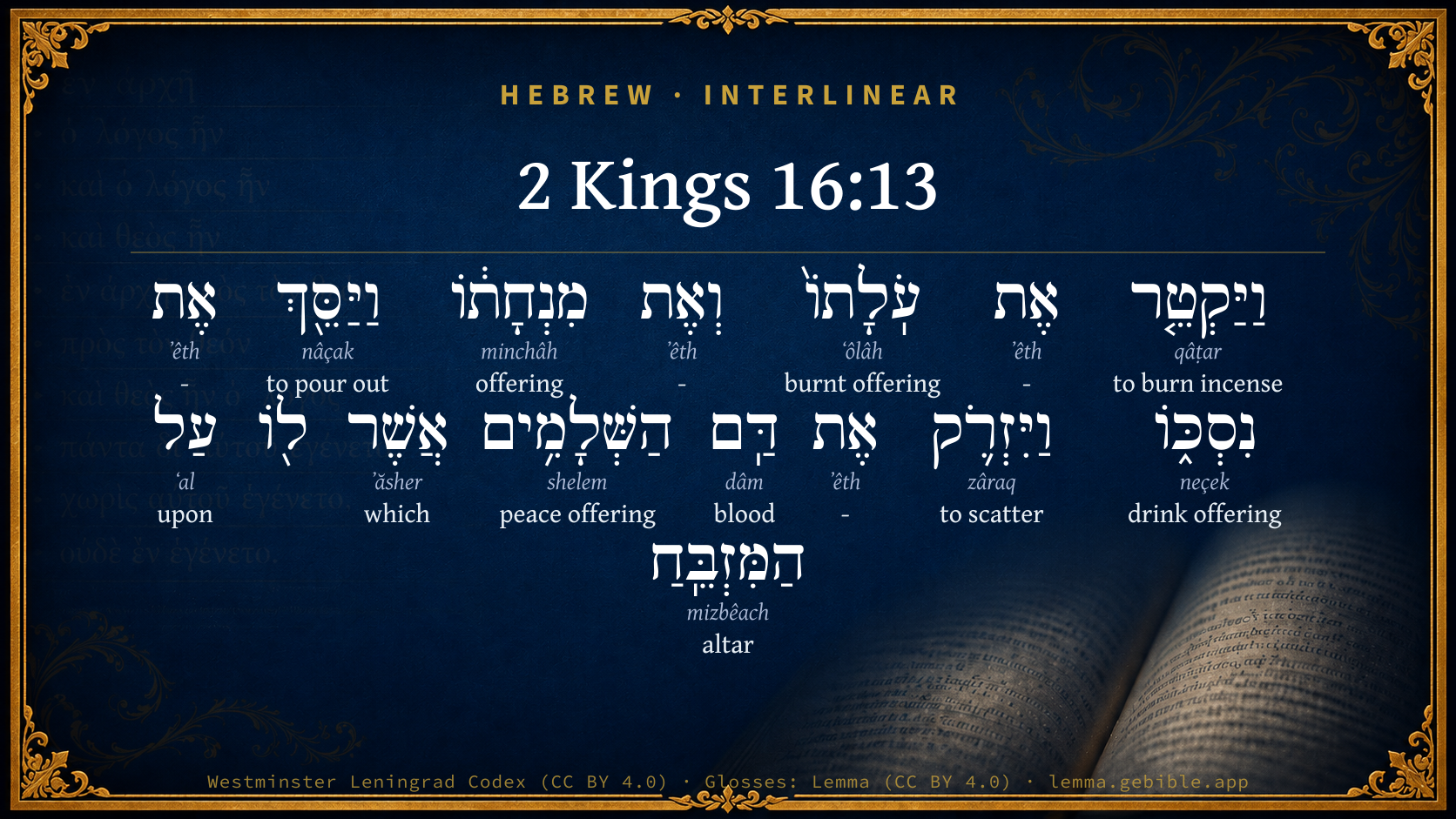
2 Kings 16:13

Hebrew (Westminster Leningrad Codex) 2 Kings 16:13 appears in the Hebrew Old Testament. The text above is from the Westminster Leningrad Codex. Each word links to its Strong’s number, a concise gloss, and parsing drawn from the Open Scriptures Hebrew Bible morphology. Click any word for its full Brown-Driver-Briggs (BDB) entry.
Download image
Cite this verse

2 Kings 16:13 (World English Bible). Public Domain. Lemma interlinear Bible study tool, https://lemma.gebible.app/v/2-kings/16/13.

Show BibTeX & RIS
BibTeX
RIS
English Translation
He burnt his burnt offering and his meal-offering, and poured his drink-offering, and sprinkled the blood of his peace-offerings, on the altar.
World English Bible · Public Domain
Download a study sheet

One document with this verse’s original text, its word-by-word gloss line, the meaning frame, cross-references with their text, attributed commentary, and full source and license credits — printable, and it pastes into notes with its structure intact.

This verse Autodidact and up

Study sheet (.html) Plain text (.txt)

A passage Seminary Student

Up to 50 verses in one chapter. A passage sheet keeps up to 6 commentary sources and 12 cross-references per verse, in the order this page ranks them, and says so on the sheet whenever that leaves anything out. Ask for a single verse and you get the Autodidact verse sheet above.

Everything on this page stays free to read, with no account — the sheet is a download of what is already on screen, not access to it.

Want to remove ads? Support Godless Engineer
Compare translations 3

The same verse in 3 English versions, stacked beneath the original-language interlinear above. Click any original word for its lexicon entry.

Each is an independent rendering of the whole verse — the interlinear is not word-aligned to these translations.

Highlighted words mark where these versions differ — a whole-verse word diff, not a word-by-word alignment.

  • World English Bible Public Domain
    He burnt his burnt offering and his meal-offering, and poured his drink-offering, and sprinkled the blood of his peace-offerings, on the altar.
  • King James Version Public Domain
    And he burnt his burnt offering and his meat offering, and poured his drink offering, and sprinkled the blood of his peace offerings, upon the altar.
  • unfoldingWord Literal Text CC BY-SA 4.0
    And he burned his burnt offering and his grain offering and poured out his drink offering and sprinkled the blood of the peace offerings that to him on the altar.

unfoldingWord Literal Text — © unfoldingWord, licensed CC BY-SA 4.0. Word-aligned USFM3 via Door43 (git.door43.org/unfoldingWord/en_ult).

Versions to compare (up to 4)

3 of 4 selected

Show all 18 translations

Every available English version of this verse, each an independent rendering of the whole verse.

  • World English Bible Public Domain
    He burnt his burnt offering and his meal-offering, and poured his drink-offering, and sprinkled the blood of his peace-offerings, on the altar.
  • Berean Standard Bible Public Domain
    He offered his burnt offering and his grain offering, poured out his drink offering, and sprinkled the blood of his peace offerings on the altar.
  • Majority Standard Bible Public Domain
    He offered his burnt offering and his grain offering, poured out his drink offering, and splattered the blood of his peace offerings on the altar.
  • King James Version Public Domain
    And he burnt his burnt offering and his meat offering, and poured his drink offering, and sprinkled the blood of his peace offerings, upon the altar.
  • American Standard Version (1901) Public Domain
    And he burnt his burnt-offering and his meal-offering, and poured his drink-offering, and sprinkled the blood of his peace-offerings, upon the altar.
  • Revised Version (1885) Public Domain
    And he burnt his burnt offering and his meal offering, and poured his drink offering, and sprinkled the blood of his peace offerings, upon the altar.
  • Geneva Bible (1599) Public Domain
    And hee burnt his burnt offering, and his meate offring, and powred his drinke offring, and sprinkled the blood of his peace offrings besides the altar,
  • Douay-Rheims (1899) Public Domain
    And offered libations and poured the blood of the peace offerings, which he had offered upon the altar.
  • Young's Literal Translation Public Domain
    and perfumeth his burnt-offering, and his present, and poureth out his libation, and sprinkleth the blood of the peace-offerings that he hath, on the altar.
  • Literal Standard Version CC BY-SA 4.0
    and burns his burnt-offering and his present as incense, and pours out his drink-offering, and sprinkles the blood of the peace-offerings that he has, on the altar.
  • Unlocked Literal Bible CC BY-SA 4.0
    He made his burnt offering and his grain offering, poured out his drink offering, and sprinkled the blood of his fellowship offerings on the altar.
  • unfoldingWord Literal Text CC BY-SA 4.0
    And he burned his burnt offering and his grain offering and poured out his drink offering and sprinkled the blood of the peace offerings that to him on the altar.
  • Darby Bible Public Domain
    And he burned his burnt-offering and his oblation, and poured out his drink-offering, and sprinkled the blood of his peace-offering upon the altar.
  • World Messianic Bible Public Domain
    He burned his burnt offering and his meal offering, poured his drink offering, and sprinkled the blood of his peace offerings on the altar.
  • Webster's Bible Public Domain
    And he burnt his burnt-offering and his meat-offering, and poured his drink-offering, and sprinkled the blood of his peace-offerings upon the altar.
  • Free Bible Version CC BY-SA 4.0
    He presented his burnt offering and his grain offering, he poured out his drink offering, and sprinkled the blood of his friendship offerings on it.
  • Bible in Basic English Public Domain
    He made his burned offering and his meal offering and his drink offering there, draining out the blood of his peace-offerings on the altar.
  • JPS Tanakh (1917) Public Domain
    And he offered his burnt-offering and his meal-offering, and poured his drink-offering, and dashed the blood of his peace-offerings against the altar.

Literal Standard Version (2020), Covenant Press — licensed CC BY-SA 4.0. Text via the HelloAO Bible API (eBible.org). Unlocked Literal Bible (unfoldingWord) — licensed CC BY-SA 4.0. Text via the HelloAO Bible API (eBible.org). unfoldingWord Literal Text — © unfoldingWord, licensed CC BY-SA 4.0. Word-aligned USFM3 via Door43 (git.door43.org/unfoldingWord/en_ult). Free Bible Version, Dr. Jonathan Gallagher — licensed CC BY-SA 4.0. Text via the HelloAO Bible API (eBible.org).

Word by word

More ways to search: Search by grammar → Find every occurrence → Compare this word →

Practice this passage: Drill this verse → Learn its vocabulary →

וַיַּסֵּ֖ךְ
nâçak
H5258
“and · to pour out”
Conjunction + Verb, Hiphil, Sequential Imperfect, 3rd Person, Masculine, Singular
Part of Speech
Conjunction + Verb
Stem
Hiphil
Form
Sequential Imperfect
Person
3rd Person
Gender
Masculine
Number
Singular
Full BDB Definition

Origin: a primitive root

TWOT: 1375 , 1377

to pour out, pour, offer, cast - (Qal) - to pour out - to cast metal images - to anoint (a king) - (Niphal) to be anointed - (Piel) to pour out (as a libation) - (Hiphil) to pour out libations - (Hophal) to be poured out - to set, install - (Qal) to install - (Niphal) to be installed
  1. וַיַּקְטֵ֤ר qâṭar H6999 “and · to burn incense” Conjunction + Verb, Hiphil, Sequential Imperfect, 3rd Person, Masculine, Singular
  2. אֶת ʼêth H853 “-” Particle, Direct Object
  3. עֹֽלָתוֹ֙ ʻôlâh H5930 “burnt offering · his” Noun, Common, Feminine, Singular, Construct + Suffix, Personal, 3rd Person, Masculine, Singular
  4. וְאֶת ʼêth H853 “and · -” Conjunction + Particle, Direct Object
  5. מִנְחָת֔וֹ minchâh H4503 “offering · his” Noun, Common, Feminine, Singular, Construct + Suffix, Personal, 3rd Person, Masculine, Singular
  6. אֶת ʼêth H853 “-” Particle, Direct Object
  7. נִסְכּ֑וֹ neçek H5262 “drink offering · his” Noun, Common, Masculine, Singular, Construct + Suffix, Personal, 3rd Person, Masculine, Singular
  8. וַיִּזְרֹ֛ק zâraq H2236 “and · to scatter” Conjunction + Verb, Qal, Sequential Imperfect, 3rd Person, Masculine, Singular
  9. אֶת ʼêth H853 “-” Particle, Direct Object
  10. דַּֽם dâm H1818 “blood of” Noun, Common, Masculine, Singular, Construct
  11. הַשְּׁלָמִ֥ים shelem H8002 “the · peace offerings” Particle, Definite Article + Noun, Common, Masculine, Plural, Absolute
  12. אֲשֶׁר ʼăsher H834 “which” Particle, Relative
  13. עַל ʻal H5921 “upon” Preposition
  14. הַמִּזְבֵּֽחַ mizbêach H4196 “the · altar” Particle, Definite Article + Noun, Common, Masculine, Singular, Absolute

About this verse

These counts appear in no published source. They are computed here, from the morphology-tagged text and Lemma’s own curated glosses. What Lemma adds →

16
words
12
distinct lemmas
Historical
section

Notable vocabulary

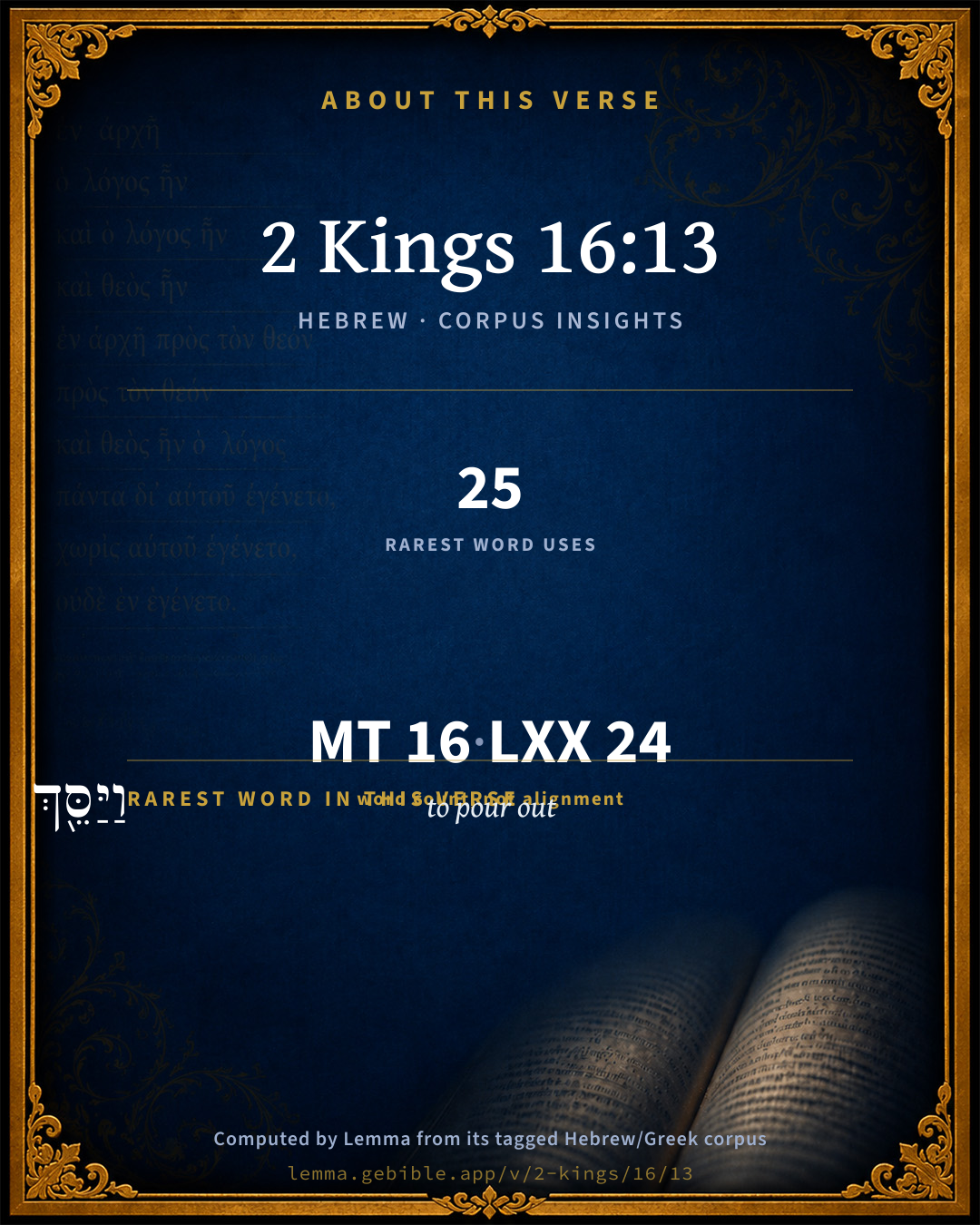
The rarest word here is וַיַּסֵּ֖ךְ to pour out H5258 — appearing just 25 times in the whole Hebrew Bible.

Shared distinctive vocabulary

וַיַּסֵּ֖ךְ to pour out H5258 occurs in 24 verses of the Hebrew Bible. Also found in:

Grammatical profile

  • 3 verbs
  • 6 nouns
  • 2 prepositions
  • 5 particles

Verb forms

  • וַיַּקְטֵ֤ר Hiphil · Sequential Imperfect
  • וַיַּסֵּ֖ךְ Hiphil · Sequential Imperfect
  • וַיִּזְרֹ֛ק Qal · Sequential Imperfect

Hebrew & Septuagint length

In English translation the verse runs 22 words from the Hebrew and 29 from the Septuagint (LXX English) — closely comparable.

A rough comparison of the two English renderings, which tokenize alike — not a word-level alignment.

Word counts can differ between the Hebrew and the Greek without any difference in meaning — e.g. the Hebrew direct-object marker אֵת has no separate Greek word, and Greek often adds the article ὁ.

In the original languages it is 16 Hebrew tokens and 24 Greek tokens — but the two are counted differently (Hebrew bundles its prefixes and suffixes into one token; the Greek is in lemma form), so that isn’t a like-for-like length.

Cross-references

1

Topical passages linked to 2 Kings 16:13 in the Treasury of Scripture Knowledge — connected by theme and wording, ordered by reader-vote popularity; previews shown in the World English Bible.

  • Leviticus 1:1–3 Yahweh called to Moses, and spoke to him out of the Tent of Meeting, saying,

Cross-references courtesy of OpenBible.info (CC BY 4.0).

Hebrew and Greek witnesses Masoretic Hebrew ↔ Greek Septuagint

The same verse in the two great witnesses to the Old Testament, shown verse-for-verse.

These are two independent witnesses, not word-aligned to each other, and the Septuagint is shown in lemma (dictionary) form.

Hebrew 2 Kings 16:13 Masoretic · Westminster Leningrad Codex

וַיַּקְטֵ֤ר אֶת עֹֽלָתוֹ֙ וְאֶת מִנְחָת֔וֹ וַיַּסֵּ֖ךְ אֶת נִסְכּ֑וֹ וַיִּזְרֹ֛ק אֶת דַּֽם הַשְּׁלָמִ֥ים אֲשֶׁר ל֖וֹ עַל הַמִּזְבֵּֽחַ

He burnt his burnt offering and his meal-offering, and poured his drink-offering, and sprinkled the blood of his peace-offerings, on the altar.

World English Bible · Public Domain

Greek LXX 2 Kings 16:13 Septuagint · lemma form

καί θυμιάζω ὁ ὁλοκαύτωσις αὐτός καί ὁ θυσία αὐτός καί ὁ σπονδή αὐτός καί προςχέω ὁ αἷμα ὁ εἰρηνικός ὁ αὐτός ἐπί ὁ θυσιαστήριον

and offered his whole burnt offering, and his meat-offering, and his drink-offering, and poured out the blood of his peace-offerings on the brazen altar that was before the Lord.

LXX2012 (modern English Septuagint) · Public Domain

Hebrew: Westminster Leningrad Codex (CC BY 4.0). Greek: Septuagint (public domain); English from LXX2012 (modern English Septuagint) (Public Domain). How the Septuagint differs from the Hebrew →

Targum (Aramaic paraphrase)

1

The Targum is the ancient Jewish Aramaic paraphrase of the Hebrew Scriptures — an interpretive translation, not the Hebrew text itself. Onkelos (literal) and Pseudo-Jonathan (expansive) render the Torah, and Jonathan the Prophets. Coverage is partial: where no permissively-licensed English translation exists for a verse, only the Aramaic is shown. This is verse-level text, not a word-by-word alignment to the Hebrew.

  1. Targum Jonathan Prophets (Joshua–Malachi)
    וְאַסֵיק יַת עֲלָתֵיהּ וְיַת מִנְחָתֵיהּ וְנַסֵיךְ יַת נִסְכֵּיהּ וּזְרַק יַת דַם נִכְסַת קוּדְשַׁיָא דִי לֵיהּ עַל מַדְבְּחָא:

    (no public-domain English translation for this verse)

    Targum Jonathan — Aramaic: “Mikraot Gedolot” (public domain). English: “Sefaria Community Translation” (CC0 1.0 (public-domain dedication)); “London "Chaldee Paraphrase," 1871” (public domain). Text via Sefaria.

Commentary

Notes on 2 Kings 16:13 from classic Christian and Jewish commentators (each source and its license shown beneath its notes). The classic Christian expositions comment on the surrounding passage and are grouped to its opening verse, so a note may address several verses; the Jewish commentaries on the Tanakh (Rashi and others) are per-verse, so they appear only where the commentator wrote on this verse.

Lemma curates 59 commentaries, every one of them public domain or Creative Commons licensed, each selected and text-cleaned for this edition rather than reprinted as found. About our sources →

Trapp's Complete Commentary

John Trapp

2Ki 16:13 And he burnt his burnt offering and his meat offering, and poured his drink offering, and sprinkled the blood of his peace offerings, upon the altar.

Ver. 13. And he burnt his burnt offering.] Uzziah for so doing was smitten with leprosy; but Ahaz of a far worse disease, an incurable hardness of heart. So was Gardiner, Bonner, Pool, Stokesley, &c.

John Trapp, A Commentary or Exposition upon All the Books of the Old and New Testament (1647–1656) — public domain. Text from a community e-Sword module.

Joseph Benson's Commentary

2Ki 16:13-14. And he burned his burnt-offering, &c. — For the heathen, and Ahaz, in imitation of them, offered the same sorts of offerings to their false gods which the Israelites did to the true. He brought also the brazen altar — Namely, the altar of burnt-offerings made by Solomon, and placed there by God’s appointment; from before the Lord — That is, from before the Lord’s house, Lev 1:3. From between the altar, &c. — Urijah had placed Ahaz’s altar behind that of the Lord, namely, between it and the east gate of the court of the priests: but when Ahaz came, taking this for a disparagement to his altar, he impiously and audaciously removed the altar of the Lord to the north side of the court, and set his own in the place of it. A bolder stroke this, than the very worst of the kings had hitherto given to religion.

Joseph Benson's Commentary on the Old and New Testaments (1811–1818) — public domain. Text from a community e-Sword module.

Ellicott's Commentary for English Readers

(13) And he burnt his burnt offering . . .—The verse describes the thank-offering of Ahaz for his late deliverance from deadly peril. From the present narrative it does not appear but that he offered it to Jehovah. The account in 2Ch_28:23 must be understood to refer to other sacrifices instituted by Ahaz, who, like most of his contemporaries, thought the traditional worship of Jehovah not incompatible with the cultus of foreign deities. (Comp. 2Ki_16:3-4.)

A Bible Commentary for English Readers, edited by Charles John Ellicott (1878–1897) — public domain. Text from a community e-Sword module.

The Cambridge Bible for Schools and Colleges

gen. ed. J. J. S. Perowne

13. his meat offering] R.V. meal-offering. See above 2Ki_3:20 note. The same change is to be made three times over in verse 15 below. The king’s wish and order was that not only all his own sacrifices, but all those of the people, should be offered upon the new altar. He did not propose to put down the worship of Jehovah and to substitute any other, but that instead of the altar made according to a divine pattern there should be used one of a fashion which pleased himself, and which would shew to the Assyrians that he was not unfavourable to their divinities.

The Cambridge Bible for Schools and Colleges (gen. ed. J. J. S. Perowne; Cambridge University Press, 1878–1918) — public domain. Text from a community e-Sword module.

John Gill's Exposition

And he brought also the brasen altar which was before the Lord,.... That which Solomon made, Ch2 4:1, which stood in the court by the door of the tabernacle of the congregation before the Lord, Lev 1:5 from the forefront of the house; the frontispiece of the temple, which was at the eastern gate of it:

from between the altar and the house of the Lord for it seems Urijah had placed the new altar behind the old one, more out of sight; the brasen altar standing between that and the eastern gate, or entrance into the temple; wherefore he removed the brasen altar, and put his new one in the room of it:

and put it; that is, the brasen altar of Solomon:

on the north side of the altar; of the new altar, at the right hand as they went into the temple; where it was as in a corner, in greater obscurity, and the new altar more in view as they came into the temple.

John Gill's Exposition of the Whole Bible (1746–1763) — public domain (CC PDM 1.0). Text via the HelloAO Bible API.

Matthew Poole's English Annotations

For the heathens, and Ahaz, in imitation of them, offered the same sorts of offerings to their false gods which the Israelites did to the true, the devil being noted to be God’s ape in his worship.

Matthew Poole's English Annotations on the Holy Bible (1683–1685) — public domain. Text from a community e-Sword/MySword module.

The Pulpit Commentary

And he burnt his burnt offering and his meat offering, and poured his drink offering, and sprinkled the blood of his peace offerings, upon the altar. (On the different kinds of offerings, see Leviticus 1-7.)

The Pulpit Commentary (1880–1919), ed. H.D.M. Spence-Jones & Joseph S. Exell — public domain. Text from a community e-Sword module.

John Wesley's Explanatory Notes

Peace-offerings - For the Heathens; and Ahaz, in imitation of them, offered the same sorts of offerings to their false gods, which the Israelites did to the true.

John Wesley, Explanatory Notes Upon the Whole Bible (1754–1765) — public domain. Text via the GEBible commentary corpus.

unfoldingWord translationNotes

Door43 World Missions Community

General Information:

This is what King Ahaz did after he returned from Damascus and visited the new altar which Uriah the priest had built for him.

He made his burnt offering

"King Ahaz made his burnt offering"

on the altar

This refers to the altar that King Ahaz told Uriah to build.

The bronze altar that was before Yahweh

This was the altar that the people of Israel had made long ago according to God's instructions.

The bronze altar that was before Yahweh

The phrase "before Yahweh" is a metonym that refers to the place where Yahweh had shown his glory in the past. AT: "The bronze altar that was in front of the temple" (See: Metonymy)

from the front of the temple ... from between his altar and the temple of Yahweh

Both of these phrases tell where the bronze altar was. They refer to the same place.

translationWords

burnt offering

grain offering

drink offering

blood

fellowship offering

bronze

Yahweh

temple

unfoldingWord translationNotes — © Distant Shores Media and the Door43 World Missions Community, licensed CC BY-SA 4.0. Source: git.door43.org/Door43/en_tn.

Lesson kit

Teaching starters — assembled from the data on this page, not authored interpretation. Every prompt links to the verse data it draws on. Edit before teaching.

2 Kings, in the Historical, opens this verse with 16 words (12 distinct Hebrew lemmas). Its most distinctive word is nâçak (“to pour out”). A historical commentator’s framing appears above. Read the whole chapter for the surrounding context.

Discussion questions

  1. What does “to pour out” (nâçak) contribute to the verse as a whole?
  2. How does Genesis 35:14, which shares the word «to pour out», read alongside this verse?
  3. The translations on this page render this verse differently — a whole-verse word diff, not a word-by-word alignment. What might account for the different wordings?
  4. «וַיַּקְטֵ֤ר» is a Hiphil Sequential Imperfect verb. How does that grammatical form shape the action described?
  5. Compare how Trapp's Complete Commentary and Joseph Benson's Commentary read this verse. Where do they agree or differ?

Things to notice

Reading settings

Reading text

Shown beneath each verse's original-language words.

Old Testament
Old Testament edition

Read the OT as the Masoretic Hebrew (MT) or the Greek Septuagint (LXX).

English shown for the Greek Septuagint (in the Hebrew ↔ Greek comparison).

Comparing translations? Open the Compare panel on any verse page to stack up to four side by side.