Lamentations 4:14

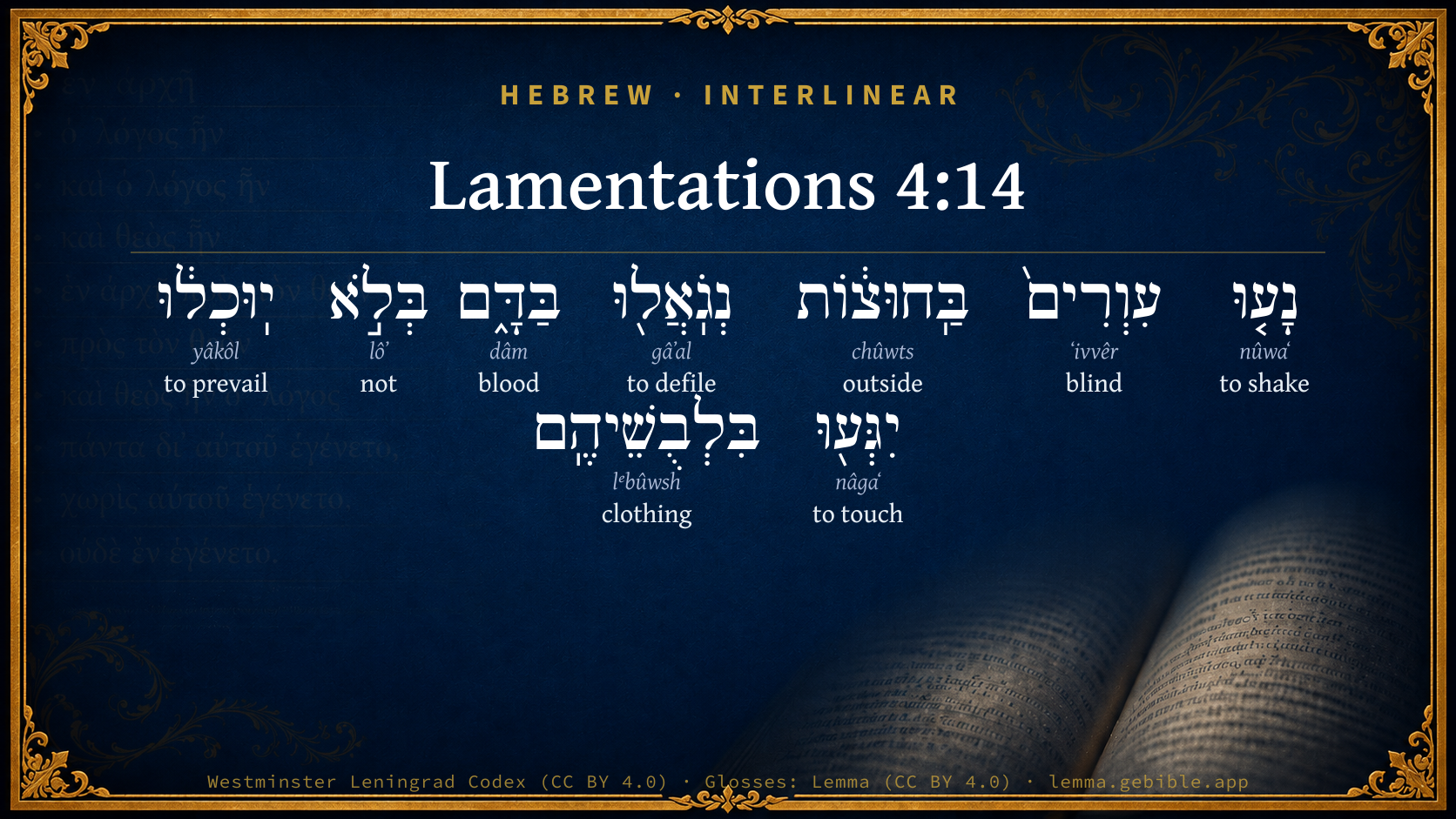
Hebrew (Westminster Leningrad Codex) Lamentations 4:14 appears in the Hebrew Old Testament. The text above is from the Westminster Leningrad Codex. Each word links to its Strong’s number, a concise gloss, and parsing drawn from the Open Scriptures Hebrew Bible morphology. Click any word for its full Brown-Driver-Briggs (BDB) entry.
Download image
Cite this verse

Lamentations 4:14 (World English Bible). Public Domain. Lemma interlinear Bible study tool, https://lemma.gebible.app/v/lamentations/4/14.

Show BibTeX & RIS
BibTeX
RIS
English Translation
They wander as blind men in the streets, they are polluted with blood, So that men can't touch their garments.
World English Bible · Public Domain
Download a study sheet

One document with this verse’s original text, its word-by-word gloss line, the meaning frame, cross-references with their text, attributed commentary, and full source and license credits — printable, and it pastes into notes with its structure intact.

This verse Autodidact and up

Study sheet (.html) Plain text (.txt)

A passage Seminary Student

Up to 50 verses in one chapter. A passage sheet keeps up to 6 commentary sources and 12 cross-references per verse, in the order this page ranks them, and says so on the sheet whenever that leaves anything out. Ask for a single verse and you get the Autodidact verse sheet above.

Everything on this page stays free to read, with no account — the sheet is a download of what is already on screen, not access to it.

Want to remove ads? Support Godless Engineer
Compare translations 3

The same verse in 3 English versions, stacked beneath the original-language interlinear above. Click any original word for its lexicon entry.

Each is an independent rendering of the whole verse — the interlinear is not word-aligned to these translations.

Highlighted words mark where these versions differ — a whole-verse word diff, not a word-by-word alignment.

  • World English Bible Public Domain
    They wander as blind men in the streets, they are polluted with blood, So that men can't touch their garments.
  • King James Version Public Domain
    They have wandered as blind men in the streets, they have polluted themselves with blood, so that men could not touch their garments.
  • unfoldingWord Literal Text CC BY-SA 4.0
    They wandered blind in the streets; they were defiled with blood, so that none were able to touch their garments. SAMEKH

unfoldingWord Literal Text — © unfoldingWord, licensed CC BY-SA 4.0. Word-aligned USFM3 via Door43 (git.door43.org/unfoldingWord/en_ult).

Versions to compare (up to 4)

3 of 4 selected

Show all 18 translations

Every available English version of this verse, each an independent rendering of the whole verse.

  • World English Bible Public Domain
    They wander as blind men in the streets, they are polluted with blood, So that men can't touch their garments.
  • Berean Standard Bible Public Domain
    They wandered blind in the streets, defiled by this blood, so that no one dared to touch their garments.
  • Majority Standard Bible Public Domain
    They wandered blind in the streets, defiled by this blood, so that no one dared to touch their garments.
  • King James Version Public Domain
    They have wandered as blind men in the streets, they have polluted themselves with blood, so that men could not touch their garments.
  • American Standard Version (1901) Public Domain
    They wander as blind men in the streets, they are polluted with blood, So that men cannot touch their garments.
  • Revised Version (1885) Public Domain
    They wander as blind men in the streets, that are polluted with blood, so that men cannot touch their garments.
  • Geneva Bible (1599) Public Domain
    They haue wandred as blinde men in the streetes, and they were polluted with blood, so that they would not touch their garments.
  • Douay-Rheims (1899) Public Domain
    Nun. They have wandered as blind men in the streets, they were defiled with blood: and when they could not help walking in it, they held up their skirts.
  • Young's Literal Translation Public Domain
    They have wandered naked in out-places, They have been polluted with blood, Without `any' being able to touch their clothing,
  • Literal Standard Version CC BY-SA 4.0
    They have wandered naked in out-places, || They have been defiled with blood, || Without [any] being able to touch their clothing,
  • Unlocked Literal Bible CC BY-SA 4.0
    They wandered, blind, through the streets. They were so defiled by that blood that no one was allowed to touch their clothes.
  • unfoldingWord Literal Text CC BY-SA 4.0
    They wandered blind in the streets; they were defiled with blood, so that none were able to touch their garments. SAMEKH
  • Darby Bible Public Domain
    They wandered about blind in the streets; they were polluted with blood, so that men could not touch their garments.
  • World Messianic Bible Public Domain
    They wander as blind men in the streets. They are polluted with blood, So that men can’t touch their garments.
  • Webster's Bible Public Domain
    They have wandered as blind men in the streets, they have polluted themselves with blood, so that men could not touch their garments.
  • Free Bible Version CC BY-SA 4.0
    They wandered like blind men through the streets, made unclean by this blood, so no one would touch their clothes.
  • Bible in Basic English Public Domain
    They are wandering like blind men in the streets, they are made unclean with blood, so that their robes may not be touched by men.
  • JPS Tanakh (1917) Public Domain
    They wander as blind men in the streets, they are polluted with blood, so that men cannot touch their garments.

Literal Standard Version (2020), Covenant Press — licensed CC BY-SA 4.0. Text via the HelloAO Bible API (eBible.org). Unlocked Literal Bible (unfoldingWord) — licensed CC BY-SA 4.0. Text via the HelloAO Bible API (eBible.org). unfoldingWord Literal Text — © unfoldingWord, licensed CC BY-SA 4.0. Word-aligned USFM3 via Door43 (git.door43.org/unfoldingWord/en_ult). Free Bible Version, Dr. Jonathan Gallagher — licensed CC BY-SA 4.0. Text via the HelloAO Bible API (eBible.org).

Word by word

More ways to search: Search by grammar → Find every occurrence → Compare this word →

Practice this passage: Drill this verse → Learn its vocabulary →

נְגֹֽאֲל֖וּ
gâʼal
H1351
“to defile”
Verb, Niphal, Perfect, 3rd Person, Common, Plural
Part of Speech
Verb
Stem
Niphal
Form
Perfect
Person
3rd Person
Gender
Common
Number
Plural
Full BDB Definition

Origin: a primitive root

TWOT: 301

to defile, pollute, desecrate - (Niphal) to be defiled, be polluted - (Piel) to pollute, desecrate - (Pual) to be desecrated (of removal from priesthood) - (Hiphil) to pollute, stain - (Hithpael) to defile oneself
  1. נָע֤וּ nûwaʻ H5128 “to shake” Verb, Qal, Perfect, 3rd Person, Common, Plural
  2. עִוְרִים֙ ʻivvêr H5787 “blind” Adjective, Adjective, Masculine, Plural, Absolute
  3. בַּֽחוּצ֔וֹת chûwts H2351 “in/at the · streets” Preposition, Determined + Noun, Common, Masculine, Plural, Absolute
  4. בַּדָּ֑ם dâm H1818 “in/at the · blood” Preposition, Determined + Noun, Common, Masculine, Singular, Absolute
  5. בְּלֹ֣א lôʼ H3808 “in/at · not” Preposition + Particle, Negative
  6. יֽוּכְל֔וּ yâkôl H3201 “to prevail” Verb, Qal, Imperfect, 3rd Person, Masculine, Plural
  7. יִגְּע֖וּ nâgaʻ H5060 “to touch” Verb, Qal, Imperfect, 3rd Person, Masculine, Plural
  8. בִּלְבֻשֵׁיהֶֽם lᵉbûwsh H3830 “in/at · garments · their” Preposition + Noun, Common, Masculine, Plural, Construct + Suffix, Personal, 3rd Person, Masculine, Plural

About this verse

These counts appear in no published source. They are computed here, from the morphology-tagged text and Lemma’s own curated glosses. What Lemma adds →

9
words
9
distinct lemmas
Prophets
section

Notable vocabulary

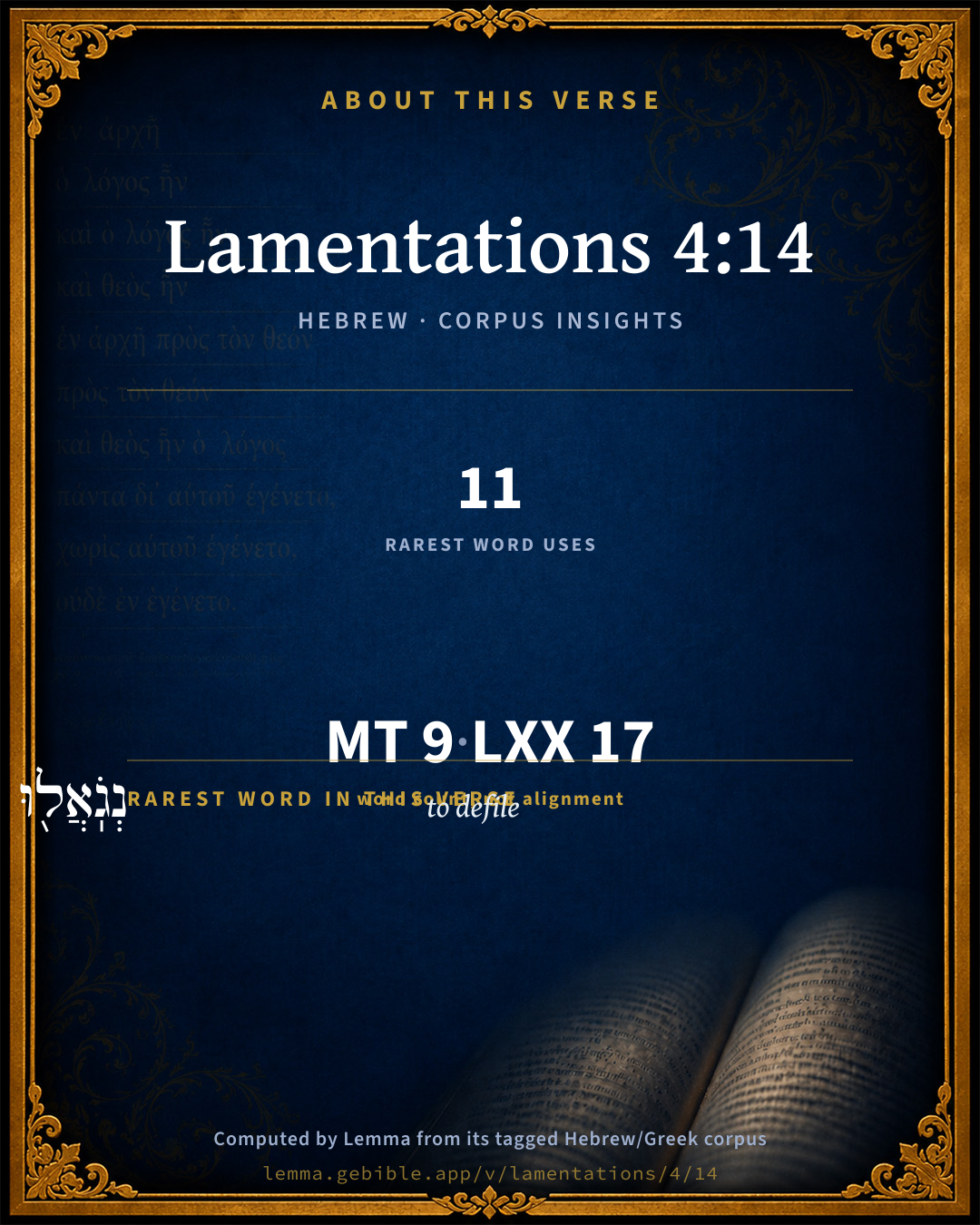
The rarest word here is נְגֹֽאֲל֖וּ to defile H1351 — appearing just 11 times in the whole Hebrew Bible.

Shared distinctive vocabulary

נְגֹֽאֲל֖וּ to defile H1351 occurs in 9 verses of the Hebrew Bible. Also found in:

Grammatical profile

  • 4 verbs
  • 3 nouns
  • 1 adjective
  • 1 particle

Verb forms

  • נָע֤וּ Qal · Perfect
  • נְגֹֽאֲל֖וּ Niphal · Perfect
  • יֽוּכְל֔וּ Qal · Imperfect
  • יִגְּע֖וּ Qal · Imperfect

Hebrew & Septuagint length

In English translation the verse runs 20 words from the Hebrew and 21 from the Septuagint (LXX English) — closely comparable.

A rough comparison of the two English renderings, which tokenize alike — not a word-level alignment.

Word counts can differ between the Hebrew and the Greek without any difference in meaning — e.g. the Hebrew direct-object marker אֵת has no separate Greek word, and Greek often adds the article ὁ.

In the original languages it is 9 Hebrew tokens and 17 Greek tokens — but the two are counted differently (Hebrew bundles its prefixes and suffixes into one token; the Greek is in lemma form), so that isn’t a like-for-like length.

Cross-references

12

Topical passages linked to Lamentations 4:14 in the Treasury of Scripture Knowledge — connected by theme and wording, ordered by reader-vote popularity; previews shown in the World English Bible.

  • Isaiah 1:15 When you spread forth your hands, I will hide my eyes from you; Yes, when you make many prayers, I will not hear. Your hands are full of blood.
  • Jeremiah 2:34 Also in your skirts is found the blood of the souls of the innocent poor: you did not find them breaking in; but it is because of all these things.
  • Numbers 19:16 Whoever in the open field touches one who is slain with a sword, or a dead body, or a bone of a man, or a grave, shall be unclean seven days.
  • Deuteronomy 28:28–29 Yahweh will strike you with madness, and with blindness, and with astonishment of heart;
  • Isaiah 56:10 His watchmen are blind, they are all without knowledge; they are all mute dogs, they can't bark; dreaming, lying down, loving to slumber.
  • Numbers 35:33 So you shall not pollute the land in which you are: for blood, it pollutes the land; and no expiation can be made for the land for the blood that is shed therein, but by the blood of him who shed it.
  • Isaiah 29:10–12 For Yahweh has poured out on you the spirit of deep sleep, and has closed your eyes, the prophets; and your heads, the seers, has he covered.
  • Isaiah 59:9–11 Therefore is justice far from us, neither does righteousness overtake us: we look for light, but, behold, darkness; for brightness, but we walk in obscurity.
  • Hosea 4:2 There is cursing, lying, murder, stealing, and committing adultery; They break boundaries, and bloodshed causes bloodshed.
  • Micah 3:6–7 "Therefore night is over you, with no vision, And it is dark to you, that you may not divine; And the sun will go down on the prophets, And the day will be black over them.
  • Matthew 15:14 Leave them alone. They are blind guides of the blind. If the blind guide the blind, both will fall into a pit."
  • Ephesians 4:18 being darkened in their understanding, alienated from the life of God, because of the ignorance that is in them, because of the hardening of their hearts;

Cross-references courtesy of OpenBible.info (CC BY 4.0).

Hebrew and Greek witnesses Masoretic Hebrew ↔ Greek Septuagint

The same verse in the two great witnesses to the Old Testament, shown verse-for-verse.

These are two independent witnesses, not word-aligned to each other, and the Septuagint is shown in lemma (dictionary) form.

Hebrew Lamentations 4:14 Masoretic · Westminster Leningrad Codex

נָע֤וּ עִוְרִים֙ בַּֽחוּצ֔וֹת נְגֹֽאֲל֖וּ בַּדָּ֑ם בְּלֹ֣א יֽוּכְל֔וּ יִגְּע֖וּ בִּלְבֻשֵׁיהֶֽם

They wander as blind men in the streets, they are polluted with blood, So that men can't touch their garments.

World English Bible · Public Domain

Greek LXX Lamentations 4:14 Septuagint · lemma form

σαλεύω ἐγείρω αὐτός ἐν ὁ ἔξοδος μολύνω ἐν αἷμα ἐν ὁ μή δύναμαι αὐτός ἅπτομαι ἔνδυμα αὐτός

NUN. her watchmen staggered in the streets, they were defiled with blood in their weakness, they touched their raiment with it.

LXX2012 (modern English Septuagint) · Public Domain

On this verse, Haydock's Catholic Bible Commentary discusses the Septuagint’s reading. Read the note in Commentary ↓

Hebrew: Westminster Leningrad Codex (CC BY 4.0). Greek: Septuagint (public domain); English from LXX2012 (modern English Septuagint) (Public Domain). How the Septuagint differs from the Hebrew →

Commentary

Notes on Lamentations 4:14 from classic Christian and Jewish commentators (each source and its license shown beneath its notes). The classic Christian expositions comment on the surrounding passage and are grouped to its opening verse, so a note may address several verses; the Jewish commentaries on the Tanakh (Rashi and others) are per-verse, so they appear only where the commentator wrote on this verse.

Lemma curates 59 commentaries, every one of them public domain or Creative Commons licensed, each selected and text-cleaned for this edition rather than reprinted as found. About our sources →

Trapp's Complete Commentary

John Trapp

Lam 4:14 They have wandered [as] blind [men] in the streets, they have polluted themselves with blood, so that men could not touch their garments.

Ver. 14. They have wandered as blind men in the streets.] Well might a certain expositor say, Hic versus cure sequentibus varie exponitur. The sense, in short, is this, saith one, that the Jews, misled by their prophets and priests, were so blind in knowledge that every example of sin led to evil, which, for want of grace, they could not refrain from.

John Trapp, A Commentary or Exposition upon All the Books of the Old and New Testament (1647–1656) — public domain. Text from a community e-Sword module.

Joseph Benson's Commentary

Lam 4:14-16. They have wandered as blind men in the streets — They strayed from the paths of righteousness, and were blind to every thing that was good, but to do evil they were quick-sighted; they have polluted themselves with blood — The blood of the saints and servants of the Lord; so that men could not touch their garments — But they would be legally polluted; and there were so many of them, that a man could not walk in the streets but he must touch some of them. They cried unto them, Depart ye: it is unclean — Or, ye polluted, depart, &c. “When they fled to save their lives, they could find no safe retreat, but every body shunned and avoided them as polluted; and used the same words to express their abhorrence of this defilement of such persons, whose office it was to cleanse and purify others, as the lepers were by the law obliged to pronounce upon themselves, and cry, Unclean, unclean: see Lev 13:45. The bloody garments of the priests called to remembrance the innocent blood which had been shed by their means, (Lam 4:13,) when people saw their sin thus retaliated upon them.” — Lowth. They said among the heathen, They shall no more sojourn there — Even the heathen themselves looked upon them as polluted persons, unworthy of living in Judea, or attending on the worship of God in his temple. And they concluded that such impious wretches would never be restored to their native country, but would continue always vagabonds. The anger of the Lord hath divided them — “God, in his just displeasure, hath scattered and dispersed them into foreign countries, where no respect will be given to their characters.” This seems to be the language of their enemies, triumphing over them, as discerning that their God was provoked with them, and would have no more regard to them. And therefore these heathen no more respected the persons of their priests or elders, but considered them as peculiarly guilty, and deserving of their abhorrence and execration.

Joseph Benson's Commentary on the Old and New Testaments (1811–1818) — public domain. Text from a community e-Sword module.

Geneva Bible (1599)

Geneva Bible translators

Meaning, the heathen which came to destroy them, could not abide them.

Some refer this to the blind men, which as they went, stumbled on the blood, whereof the city was full.

Geneva Bible (1599) marginal notes — public domain. Text via Bolls.life.

Jamieson, Fausset & Brown

Robert Jamieson, A. R. Fausset & David Brown

blind--with mental aberration.

polluted . . . with blood--both with blood of one another mutually shed (for example, Jer 2:34), and with their blood shed by the enemy [GLASSIUS].

not touch . . . garments--as being defiled with blood (Num 19:16).

Jamieson, Fausset & Brown — Commentary Critical and Explanatory on the Whole Bible (1871) — public domain (CC PDM 1.0). Text via the HelloAO Bible API.

Adam Clarke's Commentary

Verse 14. They have wandered as blind men in the streets] Rather, "They ran frantic through the streets, they were stained with blood." This was in their pretended zeal for their cause. Bishop Bonner, who was at the head of those sanguinary executions in England, was accustomed to buffet the poor Protestants, when on their examinations they were too powerful for him in argument: -

"He proved his doctrine orthodox,

By apostolic blows and knocks."

Just as his elder brethren, the false priests and prophets of Jerusalem.

Adam Clarke's Commentary on the Bible (1810–1826) — public domain. Text from a community e-Sword/MySword module.

John Calvin's Commentaries

They who simply read, that the blind had wandered, deduce this meaning, that the blind were polluted in the streets, even because there was filth everywhere. They, indeed, come near to the meaning of the Prophet, but they do not clearly explain what he intended. I regard it therefore beyond dispute, that the people are here compared to the blind, but it does not yet appear for what purpose. But my opinion is this, that the whole city was so full of defilement’s, that they could not avoid uncleanness; for a blind man would touch a carcass, he would touch an unclean beast, he would touch a man infected with some disease; how so? because he could not see to distinguish between a dead and a living man, between the clean and unclean. Our Prophet now compares the people to the blind, and why? because wherever they went, uncleanness met them, so that their eyes were in a manner dazzled by thick darkness. For when pestilence does not spread everywhere, we can avoid an unclean place; but when there is no corner where there is not a dead corpse or some sickness, we must pass on anyhow, having no choice to make, — and why? because uncleanness surrounds us everywhere. So, then, the Prophet says that the citizens of Jerusalem were everywhere polluted, as though they were blind.

Now follows the reason, which has not been understood by interpreters, They were polluted, he says, with blood, because they could not but touch their garments. They all give this version, “They could not touch their garments,” and as there is much obscurity and almost absurdity in this rendering, they say that the meaning is that they were to avoid to touch their garments, because the law forbade them to touch the unclean. But the Prophet meant another thing. The words are literally thus, “They could not, they will touch their garments, that is, they will inevitably touch their garments. But the particle which I have mentioned is to be understood, and the passage will read thus, They could not but touch their garments; and we know that the language will bear this. And as this is consistent with the subject which the Prophet handles, every one, judging rightly, will readily receive what I have stated. The meaning then is, that they wandered as the blind, and were polluted in all the streets of the city, because they could not escape uncleanness, which met them everywhere; that is, because the city, as I have said, was full of so many pollutions, that they could not turn either here or there and avoid uncleanness.

As to the words, polluted with blood, they refer to the ceremonial law. There were indeed various kinds of pollutions, but this was the chief. He accommodates his expressions to his own age, and follows what was prescribed by the law. He, however, alludes to the sins designated by blood. We, in short, see that the whole of Jerusalem was so polluted with defilements, that no one could go forth without falling on some uncleanness. A confirmation follows, which also interpreters have not understood, —

John Calvin's Commentaries (1540-1563) — public domain. Text from the Calvin Translation Society English edition (1840s-50s) via the Christian Classics Ethereal Library (ccel.org). Calvin's coverage is partial (roughly two-thirds of the Bible); uncommented books and verses are honest gaps, never fabricated. The 19th-century editor's footnotes and remarks are omitted so the notes are faithfully Calvin's own voice.

Ellicott's Commentary for English Readers

(14) They have wandered . . .—Literally, reeled. The blindness, i.e., either that of the insatiable lust of blood, or of hopeless despair, or both. (Comp. Deu_28:28; Jer_23:12; Isa_29:10.) The horror of the picture is heightened by the fact that the very garments of the priests were so dripping with blood that men shrank from touching them.

A Bible Commentary for English Readers, edited by Charles John Ellicott (1878–1897) — public domain. Text from a community e-Sword module.

The Cambridge Bible for Schools and Colleges

gen. ed. J. J. S. Perowne

14. They] these prophets and priests.

wander, etc.] in perplexity and helplessness, stamped with the mark of Cain.

The Cambridge Bible for Schools and Colleges (gen. ed. J. J. S. Perowne; Cambridge University Press, 1878–1918) — public domain. Text from a community e-Sword module.

John Gill's Exposition

They have wandered as blind men in the streets,.... That is, the false prophets and wicked priests; and may be understood either literally, that when the city was taken, and they fled, they were like blind men, and knew not which way to go to make their escape, but wandered from place to place, and could find no way out; or spiritually, though they pretended to great light and knowledge, yet were as blind men, surrounded with the darkness of ignorance and error, and were blind leaders of the blind:

they have polluted themselves with blood, so that men could not touch their garments; or, "could not but touch it with their garments" (c); or, "might not" (d); it was not lawful for them to do it: the sense is either, that, which way soever these men took to make their escape, they found so many dead carcasses in the streets, and such a profusion of blood by them, that they could not but touch it with their garments; or being besmeared with it, were so defiled, that others might not touch them, even their garments; or these men had defiled themselves with the shedding of the blood of righteous persons; so that they were odious to men, and they shunned them as they would do anything that by the law rendered them in a ceremonious sense unclean, and therefore said as follows:

(c) "quem non possunt, quin tangent vestimentis suis", "Junius & Tremellius. (d) "Tangebant eum (nempe sanguinem) vestibus eorum quem non potuerunt", i.e. "jure", Gataker.

John Gill's Exposition of the Whole Bible (1746–1763) — public domain (CC PDM 1.0). Text via the HelloAO Bible API.

Albert Barnes' Notes on the Bible

They have wandered - God’s ministers, consecrated to His service, wandered through the city blinded by the insatiable lust of slaughter. It was a pollution to touch their garments.

Albert Barnes' Notes on the Bible (1834–1885) — public domain. Text from a community e-Sword/MySword module.

Haydock's Catholic Bible Commentary

They. Septuagint, "Her guards have tottered in," &c. --- When. Protestants, "so that men could not touch their garments," as they were defiled. (Haydock) --- These hypocrites were afraid of touching blood, as they observed external ceremonies, while they disregarded the spirit of religion.

George Leo Haydock (1774–1849), Haydock's Catholic Family Bible and Commentary, 1859 edition — public domain. Excludes Psalms (Douay-Rheims chapter numbering differs from Protestant) and Deuterocanonical books (Catholic canon only).

Matthew Poole's English Annotations

A variety of interpreters hath made this text much more difficult than it is. Certainly nothing can appear more reasonable than to interpret the pronoun in the front of the verse relatively, and to fetch the antecedent from the former verse. They, that is, the prophets and the priests, wandered up and down the streets like blind men, being spiritually blind, polluting themselves with blood, either the blood of the children which they slew, or the just men mentioned Lam 4:13, the slaughter of whom they either encouraged, or at least did not discourage; so as one could not touch a prophet or a priest but he must be legally polluted, and there were so many of them, that men could not walk in the streets but that he must touch some of them. Some thinking the discourse of the priests done with interpret they of the blind men in the city who could not walk up and down the streets without touching the bodies of some that were slain. Others interpret the words of the common people, who, during the siege, could no more avoid touching bodies slain, and so polluting themselves with blood, than blind men could; so as they abhorred to touch their own garments. The first sense to me seemeth most natural and easy.

Matthew Poole's English Annotations on the Holy Bible (1683–1685) — public domain. Text from a community e-Sword/MySword module.

Whedon's Commentary on the Bible

Daniel D. Whedon

14. They have wandered, etc — Namely, those same prophets and priests. Some understand by this that they wandered or staggered as if in phrensy, “intoxicated with blood that had been shed.” Others, with better reason, find here the judgment of God by which they are made to reel in helplessness as blind men. This accords better with the concluding sentence, which represents them to be objects of general abhorrence. Defiled with blood, so that men could not touch their garments.

Daniel D. Whedon (gen. ed.), Commentary on the Old and New Testaments (1874–1909) — public domain. Text from a community e-Sword module.

The Pulpit Commentary

They; i.e. the prophets and priests. Wandered as blind men. The leaders of the people are blinded by ignorance, for they know not the only true way of averting calamity, and by passion, for they have not that "eye" of the soul (Mat_6:22, Mat_6:23) which alone enables a man to see the good and the right course for himself individually, The" wandering," or, rather, "staggering", (comp. Psa_107:27, Authorized Version) however, may also refer to the panic stricken condition of those self. deceived deceivers when overtaken by God"s punishment; comp. "wine of reeling" (Authorized Version, "astonishment"), Psa_60:3; also the prophecies in Deu_28:28, 29 Jer_23:12. The doubt is whether "have wandered" refers to some period before the final catastrophe, or to the consternation produced by that awful surprise. The latter view seems the more probable. They have polluted themselves, etc. Their acts of violence have been continued to the very end of their term of power. Their garments are still stained with blood when the summons to depart into exile reaches them.

Blindness.

The prophets and priests are so dismayed that they wander through the streets of Jerusalem like blind men; No doubt the confused movement of these men as they run to and fro, not knowing whither to turn, is the chief idea in the mind of the poet. But the image of blindness by which he illustrates it is suggestive of the secret of their confusion. They were, indeed, as blind men because spiritual blindness had seized on them.

I THE MEN WHO WERE BLINDED. Priests and prophets.

1. Blindness would be least excusable in these men. They were not like the illiterate, nor even like the mass of the laity. Priests were trained in traditional lore, and prophets had access to new fountains of truth.

2. Blindness would be most dangerous in these men. They assumed the position of "men of light and leading." The world was made to believe that whoever else might be in darkness these teachers were fully illuminated. Their blindness was most fatal because they were "blind leaders of the blind

II THE CHARACTER OF THEIR BLINDNESS. It was spiritual. These teachers had all their senses and faculties. They could see the standards and chariots and hosts of the invader, They could measure his forces and calculate his movements. They had intellectual as well as physical eyesight. But they could not see the hand of God in the whole transaction. They failed to discern that moral condition of the nation which had called the judgment of Heaven down upon its head. They were quite at sea as to the future. They did not understand the Divine purpose of the chastisement; and they were helpless when called upon to guide their followers in the great emergency. When the wolf broke into the fold the shepherds were hopelessly confounded. So must it be with all unworthy guides. The moment of need will discover their worthlessness.

III THE CAUSE OF THIS BLINDNESS. Sin (see ver. 13). Priests and prophets had shed the blood of the just. Gross abuse of power and tyrannous violence were iniquities enough to blunt the spiritual vision of the most gifted. This is one of the most terrible fruits of sin. It always tends to deaden conscience and darken the eye of the soul. We must do right if we would see truth. It is not only sensuality, passion, and gross worldliness that debase the soul beyond the power of perceiving higher things, but more spiritual sins pride, bigotry, self-will, etc. also blind it. Purity of heart is essential to clearness of vision.

IV THE EFFECT OF THIS BLINDNESS. "They wandered as blind men in the streets." Darkness of vision leads to confusion in action. We must see clearly that we may walk straightly. A confused conscience will make an uncertain will. Practical truth is not merely a subject for discussion in the seclusion of the study. It is a necessary chart to guide our course by. When the seeing and teaching of this is at fault all life is thrown into helpless disorder.

V THE CUBE FOR THIS BLINDNESS. This is not suggested here. It is not the function of Lamentations to console and heal. But there is a remedy. For Christ came to "open the blind eyes". (Isa_42:7) He is "the Light of the world," and all who follow him shall not walk m darkness, but shall have the light of life". (Joh_8:12)

The Pulpit Commentary (1880–1919), ed. H.D.M. Spence-Jones & Joseph S. Exell — public domain. Text from a community e-Sword module.

John Wesley's Explanatory Notes

They - The prophets and priests wandered up and down the streets polluting themselves with blood, either the blood of the children which they slew, or the just men, mentioned ver. 13, the slaughter of whom they either encouraged, or at least did not discourage; so that one could not touch a prophet or priest, but he must be legally polluted, and there were so many of them, that men could not walk in the streets, but he must touch some of them.

John Wesley, Explanatory Notes Upon the Whole Bible (1754–1765) — public domain. Text via the GEBible commentary corpus.

unfoldingWord translationNotes

Door43 World Missions Community

They wandered, blind, through the streets

The priests and prophets are spoken of as if they were blind because they wandered through the streets, not knowing where to go. AT: "They wandered through the streets like blind men" (See: Metaphor)

They were so defiled by that blood

Here "defiled" represents being unacceptable to God. Because the priests and prophets murdered people, they were ritually unclean, unable to worship God or be with ordinary people. (See: Metaphor)

defiled by that blood

"defiled by the blood that they shed." Possible meanings are 1) the blood was on their clothes or 2) "blood" is a metonym for murder. (See: Metonymy)

Away! Unclean

"Go away! You are unclean"

Away! Away! Do not touch

"Go away! Go away! Do not touch us"

translationWords

defile

blood

clean

Gentile

alien

unfoldingWord translationNotes — © Distant Shores Media and the Door43 World Missions Community, licensed CC BY-SA 4.0. Source: git.door43.org/Door43/en_tn.

Rashi

Rabbi Shlomo Yitzchaki (Rashi)

The blind stagger through the streets When the blind would walk in the street, they staggered, and their feet slipped on the blood of the slain, whom the wicked were slaying in their midst.

they are defiled with blood They were so sullied with blood that those near them could not touch their clothes, and would therefore call out to them.

Rashi on the Tanakh — English translations: “The Judaica Press complete Tanach with Rashi, translated by A. J. Rosenberg” (CC BY 4.0); “Pentateuch with Rashi's commentary by M. Rosenbaum and A.M. Silbermann, 1929-1934” (public domain); “The Metsudah Tanach series, Lakewood, N.J” (CC BY 4.0); and “The Book of Joshua, Metsudah Publications, 1997” (CC BY 4.0). Text via Sefaria.

Lesson kit

Teaching starters — assembled from the data on this page, not authored interpretation. Every prompt links to the verse data it draws on. Edit before teaching.

Lamentations, in the Prophets, opens this verse with 9 words (9 distinct Hebrew lemmas). Its most distinctive word is gâʼal (“to defile”). A historical commentator’s framing appears above. Read the whole chapter for the surrounding context.

Discussion questions

  1. What does “to defile” (gâʼal) contribute to the verse as a whole?
  2. Ezra 2:62 shares the word «to defile» with this verse. How do the two illuminate each other?
  3. The translations on this page render this verse differently — a whole-verse word diff, not a word-by-word alignment. What might account for the different wordings?
  4. The verb «נָע֤וּ» is Qal Perfect. How does its form color the action?
  5. Reading how Trapp's Complete Commentary and Joseph Benson's Commentary read this verse, where do the two commentators agree and where do they part?

Things to notice

Reading settings

Reading text

Shown beneath each verse's original-language words.

Old Testament
Old Testament edition

Read the OT as the Masoretic Hebrew (MT) or the Greek Septuagint (LXX).

English shown for the Greek Septuagint (in the Hebrew ↔ Greek comparison).

Comparing translations? Open the Compare panel on any verse page to stack up to four side by side.