
Leviticus 16:15

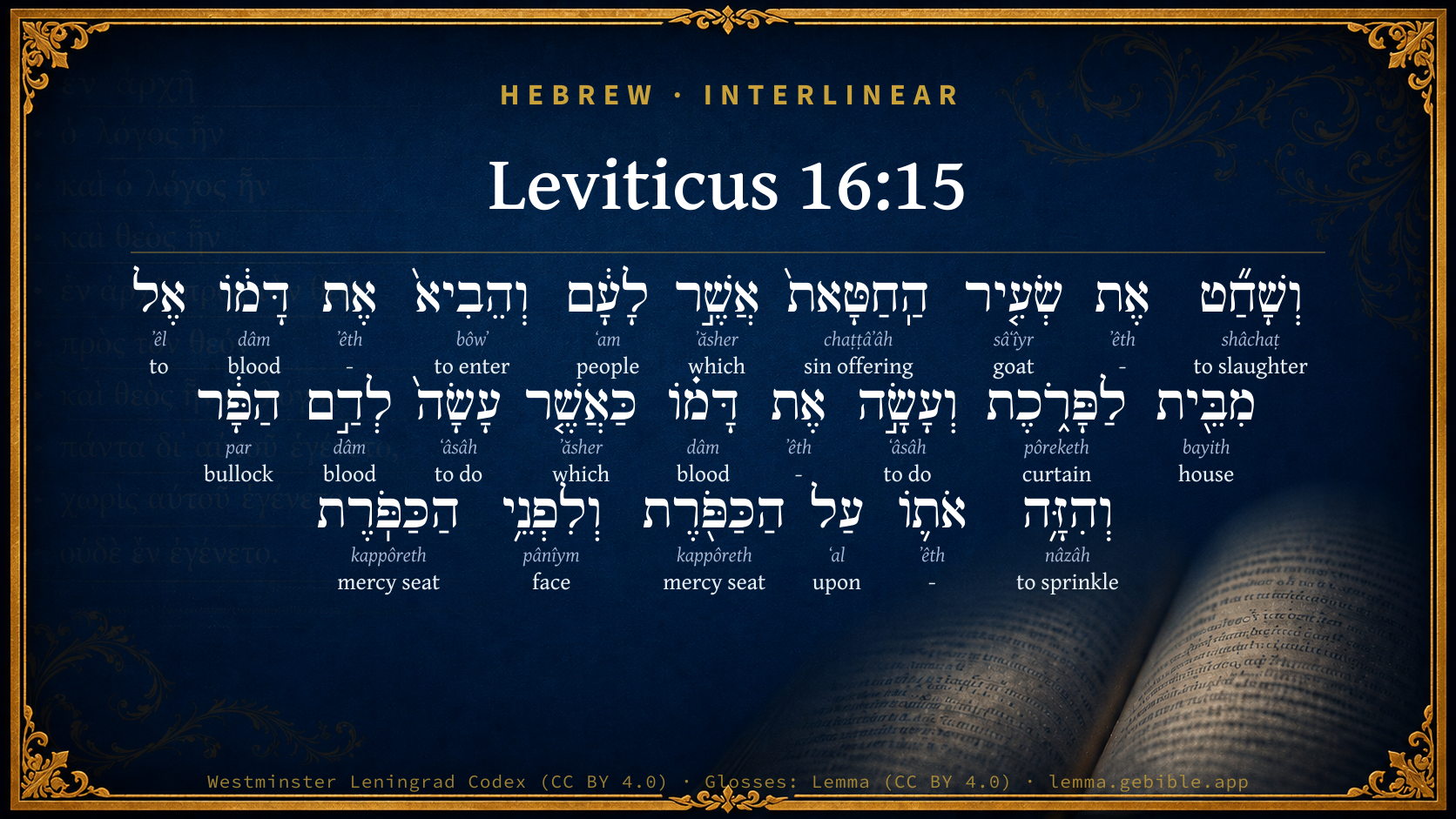
Hebrew (Westminster Leningrad Codex) Leviticus 16:15 appears in the Hebrew Old Testament. The text above is from the Westminster Leningrad Codex. Each word links to its Strong’s number, a concise gloss, and parsing drawn from the Open Scriptures Hebrew Bible morphology. Click any word for its full Brown-Driver-Briggs (BDB) entry.
Download image
Cite this verse

Leviticus 16:15 (World English Bible). Public Domain. Lemma interlinear Bible study tool, https://lemma.gebible.app/v/leviticus/16/15.

Show BibTeX & RIS
BibTeX
RIS
English Translation
"Then he shall kill the goat of the sin offering, that is for the people, and bring his blood within the veil, and do with his blood as he did with the blood of the bull, and sprinkle it on the mercy seat, and before the mercy seat:
World English Bible · Public Domain
Download a study sheet

One document with this verse’s original text, its word-by-word gloss line, the meaning frame, cross-references with their text, attributed commentary, and full source and license credits — printable, and it pastes into notes with its structure intact.

This verse Autodidact and up

Study sheet (.html) Plain text (.txt)

A passage Seminary Student

Up to 50 verses in one chapter. A passage sheet keeps up to 6 commentary sources and 12 cross-references per verse, in the order this page ranks them, and says so on the sheet whenever that leaves anything out. Ask for a single verse and you get the Autodidact verse sheet above.

Everything on this page stays free to read, with no account — the sheet is a download of what is already on screen, not access to it.

Want to remove ads? Support Godless Engineer
Compare translations 3

The same verse in 3 English versions, stacked beneath the original-language interlinear above. Click any original word for its lexicon entry.

Each is an independent rendering of the whole verse — the interlinear is not word-aligned to these translations.

Highlighted words mark where these versions differ — a whole-verse word diff, not a word-by-word alignment.

  • World English Bible Public Domain
    "Then he shall kill the goat of the sin offering, that is for the people, and bring his blood within the veil, and do with his blood as he did with the blood of the bull, and sprinkle it on the mercy seat, and before the mercy seat:
  • King James Version Public Domain
    Then shall he kill the goat of the sin offering, that is for the people, and bring his blood within the vail, and do with that blood as he did with the blood of the bullock, and sprinkle it upon the mercy seat, and before the mercy seat:
  • unfoldingWord Literal Text CC BY-SA 4.0
    And he shall slaughter the goat of the sin offering that for the people, and he shall bring its blood to inside of the curtain. And he shall make its blood just as he did to the blood of the bull. And he shall sprinkle it on the atonement lid and to the face of the atonement lid.

unfoldingWord Literal Text — © unfoldingWord, licensed CC BY-SA 4.0. Word-aligned USFM3 via Door43 (git.door43.org/unfoldingWord/en_ult).

Versions to compare (up to 4)

3 of 4 selected

Show all 18 translations

Every available English version of this verse, each an independent rendering of the whole verse.

  • World English Bible Public Domain
    "Then he shall kill the goat of the sin offering, that is for the people, and bring his blood within the veil, and do with his blood as he did with the blood of the bull, and sprinkle it on the mercy seat, and before the mercy seat:
  • Berean Standard Bible Public Domain
    Aaron shall then slaughter the goat for the sin offering for the people and bring its blood behind the veil, and with its blood he must do as he did with the bull’s blood: He is to sprinkle it against the mercy seat and in front of it.
  • Majority Standard Bible Public Domain
    Aaron shall then slaughter the goat for the sin offering for the people and bring its blood behind the veil, and with its blood he must do as he did with the bull’s blood: He is to sprinkle it against the mercy seat and in front of it.
  • King James Version Public Domain
    Then shall he kill the goat of the sin offering, that is for the people, and bring his blood within the vail, and do with that blood as he did with the blood of the bullock, and sprinkle it upon the mercy seat, and before the mercy seat:
  • American Standard Version (1901) Public Domain
    Then shall he kill the goat of the sin-offering, that is for the people, and bring his blood within the veil, and do with his blood as he did with the blood of the bullock, and sprinkle it upon the mercy-seat, and before the mercy-seat:
  • Revised Version (1885) Public Domain
    Then shall he kill the goat of the sin offering, that is for the people, and bring his blood within the veil, and do with his blood as he did with the blood of the bullock, and sprinkle it upon the mercy-seat, and before the mercy-seat:
  • Geneva Bible (1599) Public Domain
    Then shall he kill the goate that is the peoples sinne offring, and bring his blood within the vaile, and doe with that blood, as he did with the blood of the bullocke, and sprinckle it vpon the Merciseate, and before the Merciseate.
  • Douay-Rheims (1899) Public Domain
    And when he hath killed the buck goat for the sin of the people, he shall carry in the blood thereof within the veil, as he was commanded to do with the blood of the calf, that he may sprinkle it over against the oracle,
  • Young's Literal Translation Public Domain
    `And he hath slaughtered the goat of the sin-offering which `is' the people's, and hath brought in its blood unto the inside of the vail, and hath done with its blood as he hath done with the blood of the bullock, and hath sprinkled it on the mercy-seat, and at the front of the mercy-seat,
  • Literal Standard Version CC BY-SA 4.0
    And he has slaughtered the goat of the sin-offering which [is] the people’s, and has brought in its blood to the inside of the veil, and has done with its blood as he has done with the blood of the bullock, and has sprinkled it on the propitiatory covering, and at the front of the propitiatory covering,
  • Unlocked Literal Bible CC BY-SA 4.0
    Then he must kill the goat for the sin offering that is for the people and bring its blood inside the curtain. There he must do with the blood as he did with the blood of the bull: He must sprinkle it on the atonement lid and then before the atonement lid.
  • unfoldingWord Literal Text CC BY-SA 4.0
    And he shall slaughter the goat of the sin offering that for the people, and he shall bring its blood to inside of the curtain. And he shall make its blood just as he did to the blood of the bull. And he shall sprinkle it on the atonement lid and to the face of the atonement lid.
  • Darby Bible Public Domain
    And he shall slaughter the goat of the sin-offering, which is for the people, and bring its blood inside the veil, and do with its blood as he did with the blood of the bullock, and sprinkle it upon the mercy-seat, and before the mercy-seat;
  • World Messianic Bible Public Domain
    “Then he shall kill the goat of the sin offering that is for the people, and bring his blood within the veil, and do with his blood as he did with the blood of the bull, and sprinkle it on the mercy seat and before the mercy seat.
  • Webster's Bible Public Domain
    Then shall he kill the goat of the sin-offering that is for the people, and bring his blood within the vail, and do with that blood as he did with the blood of the bullock, and sprinkle it upon the mercy-seat, and before the mercy-seat:
  • Free Bible Version CC BY-SA 4.0
    Then Aaron will slaughter the goat for the sin offering for the people and bring its blood behind the veil, and with its blood he must do as he did with the bull's blood. He is to sprinkle it against the atonement cover and in front of it.
  • Bible in Basic English Public Domain
    Then let him put to death the goat of the sin-offering for the people, and take its blood inside the veil and do with it as he did with the blood of the ox, shaking drops of it on and before the cover of the ark.
  • JPS Tanakh (1917) Public Domain
    Then shall he kill the goat of the sin-offering, that is for the people, and bring his blood within the veil, and do with his blood as he did with the blood of the bullock, and sprinkle it upon the ark-cover, and before the ark-cover.

Literal Standard Version (2020), Covenant Press — licensed CC BY-SA 4.0. Text via the HelloAO Bible API (eBible.org). Unlocked Literal Bible (unfoldingWord) — licensed CC BY-SA 4.0. Text via the HelloAO Bible API (eBible.org). unfoldingWord Literal Text — © unfoldingWord, licensed CC BY-SA 4.0. Word-aligned USFM3 via Door43 (git.door43.org/unfoldingWord/en_ult). Free Bible Version, Dr. Jonathan Gallagher — licensed CC BY-SA 4.0. Text via the HelloAO Bible API (eBible.org).

Word by word

More ways to search: Search by grammar → Find every occurrence → Compare this word →

Practice this passage: Drill this verse → Learn its vocabulary →

וְהִזָּ֥ה
nâzâh
H5137
“and · to sprinkle”
Conjunction + Verb, Hiphil, Sequential Perfect, 3rd Person, Masculine, Singular
Part of Speech
Conjunction + Verb
Stem
Hiphil
Form
Sequential Perfect
Person
3rd Person
Gender
Masculine
Number
Singular
Full BDB Definition

Origin: a primitive root

TWOT: 1335 , 1336

to spurt, spatter, sprinkle - (Qal) to spurt, spatter - (Hiphil) to cause to spurt, sprinkle upon - to spring, leap - (Hiphil) to cause to leap, startle
  1. וְשָׁחַ֞ט shâchaṭ H7819 “and · to slaughter” Conjunction + Verb, Qal, Sequential Perfect, 3rd Person, Masculine, Singular
  2. אֶת ʼêth H853 “-” Particle, Direct Object
  3. שְׂעִ֤יר sâʻîyr H8163 “goat of” Noun, Common, Masculine, Singular, Construct
  4. הַֽחַטָּאת֙ chaṭṭâʼâh H2403 “the · sin offering” Particle, Definite Article + Noun, Common, Feminine, Singular, Absolute
  5. אֲשֶׁ֣ר ʼăsher H834 “which” Particle, Relative
  6. לָעָ֔ם ʻam H5971 “to/for the · people” Preposition, Determined + Noun, Common, Masculine, Singular, Absolute
  7. וְהֵבִיא֙ bôwʼ H935 “and · to enter” Conjunction + Verb, Hiphil, Sequential Perfect, 3rd Person, Masculine, Singular
  8. אֶת ʼêth H853 “-” Particle, Direct Object
  9. דָּמ֔וֹ dâm H1818 “blood · his” Noun, Common, Masculine, Singular, Construct + Suffix, Personal, 3rd Person, Masculine, Singular
  10. אֶל ʼêl H413 “to” Preposition
  11. מִבֵּ֖ית bayith H1004 “from · house of” Preposition + Noun, Common, Masculine, Singular, Construct
  12. לַפָּרֹ֑כֶת pôreketh H6532 “to/for the · curtain” Preposition, Determined + Noun, Common, Feminine, Singular, Absolute
  13. וְעָשָׂ֣ה ʻâsâh H6213 “and · to do” Conjunction + Verb, Qal, Sequential Perfect, 3rd Person, Masculine, Singular
  14. אֶת ʼêth H853 “-” Particle, Direct Object
  15. דָּמ֗וֹ dâm H1818 “blood · his” Noun, Common, Masculine, Singular, Construct + Suffix, Personal, 3rd Person, Masculine, Singular
  16. כַּאֲשֶׁ֤ר ʼăsher H834 “like/as · which” Preposition + Particle, Relative
  17. עָשָׂה֙ ʻâsâh H6213 “to do” Verb, Qal, Perfect, 3rd Person, Masculine, Singular
  18. לְדַ֣ם dâm H1818 “to/for · blood of” Preposition + Noun, Common, Masculine, Singular, Construct
  19. הַפָּ֔ר par H6499 “the · bullock” Particle, Definite Article + Noun, Common, Masculine, Singular, Absolute
  20. אֹת֛וֹ ʼêth H853 “- · him” Particle, Direct Object + Suffix, Personal, 3rd Person, Masculine, Singular
  21. עַל ʻal H5921 “upon” Preposition
  22. הַכַּפֹּ֖רֶת kappôreth H3727 “the · mercy seat” Particle, Definite Article + Noun, Common, Feminine, Singular, Absolute
  23. וְלִפְנֵ֥י pânîym H6440 “and · to/for · face(s) of” Conjunction + Preposition + Noun, Common, Both, Plural, Construct
  24. הַכַּפֹּֽרֶת kappôreth H3727 “the · mercy seat” Particle, Definite Article + Noun, Common, Feminine, Singular, Absolute

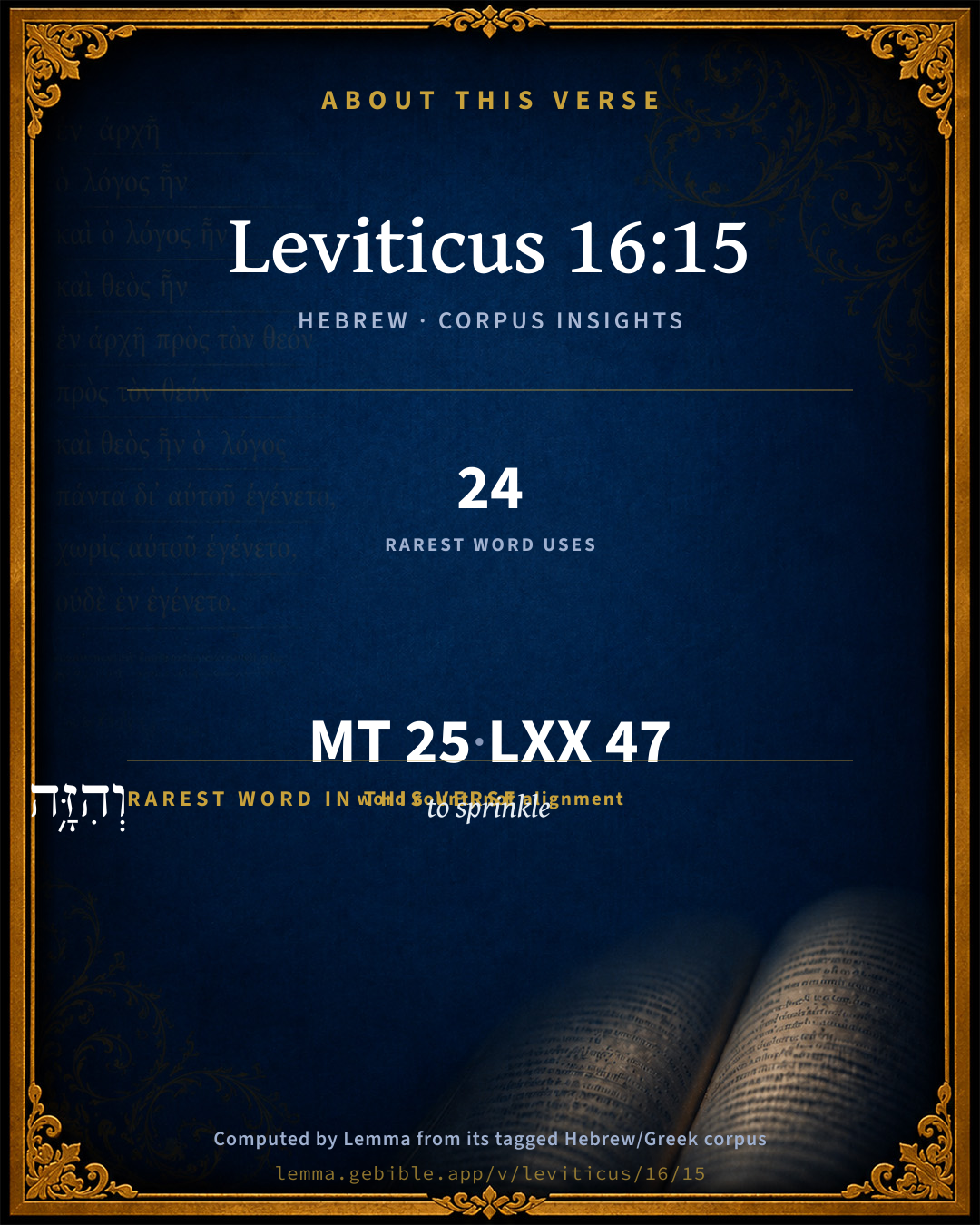
About this verse

These counts appear in no published source. They are computed here, from the morphology-tagged text and Lemma’s own curated glosses. What Lemma adds →

25
words
17
distinct lemmas
Pentateuch
section

Notable vocabulary

The rarest word here is וְהִזָּ֥ה to sprinkle H5137 — appearing just 24 times in the whole Hebrew Bible.

Shared distinctive vocabulary

וְהִזָּ֥ה to sprinkle H5137 occurs in 22 verses of the Hebrew Bible. Also found in:

Grammatical profile

  • 5 verbs
  • 12 nouns
  • 2 prepositions
  • 6 particles

Verb forms

  • וְשָׁחַ֞ט Qal · Sequential Perfect
  • וְהֵבִיא֙ Hiphil · Sequential Perfect
  • וְעָשָׂ֣ה Qal · Sequential Perfect
  • עָשָׂה֙ Qal · Perfect
  • וְהִזָּ֥ה Hiphil · Sequential Perfect

Repetition

Words recur within this verse — often emphatic in Hebrew:

  • דָּמ֔וֹ blood H1818 ×3
  • וְעָשָׂ֣ה to do H6213 ×2
  • הַכַּפֹּ֖רֶת mercy seat H3727 ×2
  • אֲשֶׁ֣ר which H834 ×2

Hebrew & Septuagint length

In English translation the verse runs 48 words from the Hebrew and 56 from the Septuagint (LXX English) — closely comparable.

A rough comparison of the two English renderings, which tokenize alike — not a word-level alignment.

Word counts can differ between the Hebrew and the Greek without any difference in meaning — e.g. the Hebrew direct-object marker אֵת has no separate Greek word, and Greek often adds the article ὁ.

In the original languages it is 25 Hebrew tokens and 47 Greek tokens — but the two are counted differently (Hebrew bundles its prefixes and suffixes into one token; the Greek is in lemma form), so that isn’t a like-for-like length.

Cross-references

9

Topical passages linked to Leviticus 16:15 in the Treasury of Scripture Knowledge — connected by theme and wording, ordered by reader-vote popularity; previews shown in the World English Bible.

  • Hebrews 9:7 but into the second the high priest alone, once in the year, not without blood, which he offers for himself, and for the errors of the people.
  • Hebrews 2:17 Therefore he was obligated in all things to be made like his brothers, that he might become a merciful and faithful high priest in things pertaining to God, to make atonement for the sins of the people.
  • Hebrews 9:3 After the second veil was the tabernacle which is called the Holy of Holies,
  • Hebrews 9:12 nor yet through the blood of goats and calves, but through his own blood, entered in once for all into the Holy Place, having obtained eternal redemption.
  • Leviticus 16:2 and Yahweh said to Moses, "Tell Aaron your brother, not to come at all times into the Most Holy Place within the veil, before the mercy seat which is on the ark; lest he die: for I will appear in the cloud on the mercy seat.
  • Hebrews 5:3 Because of this, he must offer sacrifices for sins for the people, as well as for himself.
  • Hebrews 6:19 This hope we have as an anchor of the soul, a hope both sure and steadfast and entering into that which is within the veil;
  • Leviticus 16:5–9 He shall take from the congregation of the children of Israel two male goats for a sin offering, and one ram for a burnt offering
  • Hebrews 9:25–26 nor yet that he should offer himself often, as the high priest enters into the holy place year by year with blood not his own,

Cross-references courtesy of OpenBible.info (CC BY 4.0).

Hebrew and Greek witnesses Masoretic Hebrew ↔ Greek Septuagint

The same verse in the two great witnesses to the Old Testament, shown verse-for-verse.

These are two independent witnesses, not word-aligned to each other, and the Septuagint is shown in lemma (dictionary) form.

Hebrew Leviticus 16:15 Masoretic · Westminster Leningrad Codex

וְשָׁחַ֞ט אֶת שְׂעִ֤יר הַֽחַטָּאת֙ אֲשֶׁ֣ר לָעָ֔ם וְהֵבִיא֙ אֶת דָּמ֔וֹ אֶל מִבֵּ֖ית לַפָּרֹ֑כֶת וְעָשָׂ֣ה אֶת דָּמ֗וֹ כַּאֲשֶׁ֤ר עָשָׂה֙ לְדַ֣ם הַפָּ֔ר וְהִזָּ֥ה אֹת֛וֹ עַל הַכַּפֹּ֖רֶת וְלִפְנֵ֥י הַכַּפֹּֽרֶת

"Then he shall kill the goat of the sin offering, that is for the people, and bring his blood within the veil, and do with his blood as he did with the blood of the bull, and sprinkle it on the mercy seat, and before the mercy seat:

World English Bible · Public Domain

Greek LXX Leviticus 16:15 Septuagint · lemma form

καί σφάζω ὁ χίμαρος ὁ περί ὁ ἁμαρτία ὁ περί ὁ λαός ἔναντι κύριος καί εἰςφέρω ἀπό ὁ αἷμα αὐτός ἔσω ὁ καταπέτασμα καί ποιέω ὁ αἷμα αὐτός ὅς τρόπος ποιέω ὁ αἷμα ὁ μόσχος καί ῥαίνω ὁ αἷμα αὐτός ἐπί ὁ ἱλαστήριον κατά πρόσωπον ὁ ἱλαστήριον

And he shall kill the goat for the sin-offering that is for the people, before the Lord; and he shall bring in of its blood within the veil, and shall do with its blood as he did with the blood of the calf, and shall sprinkle its blood on the mercy-seat, in front of the mercy-seat.

LXX2012 (modern English Septuagint) · Public Domain

Hebrew: Westminster Leningrad Codex (CC BY 4.0). Greek: Septuagint (public domain); English from LXX2012 (modern English Septuagint) (Public Domain). How the Septuagint differs from the Hebrew →

Targum (Aramaic paraphrase)

2

The Targum is the ancient Jewish Aramaic paraphrase of the Hebrew Scriptures — an interpretive translation, not the Hebrew text itself. Onkelos (literal) and Pseudo-Jonathan (expansive) render the Torah, and Jonathan the Prophets. Coverage is partial: where no permissively-licensed English translation exists for a verse, only the Aramaic is shown. This is verse-level text, not a word-by-word alignment to the Hebrew.

  1. Targum Onkelos Torah (Genesis–Deuteronomy)
    וְיִכּוֹס יָת צְפִירָא דְחַטָאתָא דִי לְעַמָא וְיָעֵל יָת דְמֵהּ לְמִגָיו לְפָרֻכְתָּא וְיַעְבֵּד לִדְמֵהּ כְּמָא דִי עֲבַּד לִדְמָא דְתוֹרָא וְיַדִי יָתֵהּ עַל כַּפֻּרְתָּא וְלָקֳדָם כַּפֻּרְתָּא

    (no public-domain English translation for this verse)

    Targum Onkelos — Aramaic: “Onkelos Genesis” (public domain); “Onkelos Exodus” (public domain); “Onkelos Leviticus” (public domain); “Onkelos Numbers” (public domain); “Onkelos Deuteronomy” (public domain). English: “Sefaria Community Translation” (CC0 1.0 (public-domain dedication)); “J.W. Etheridge. The Targums of Onkelos and Jonathan Ben Uzziel on the Pentateuch. London: Longmans, Green, 1862” (public domain). Text via Sefaria.

  2. Targum Pseudo-Jonathan Torah (Genesis–Deuteronomy)
    וְיִכּוֹס יַת צְפִירָא דְחַטָאתָא דְמִן מָמוֹנָא דְעַמָא וְיָעֵיל יַת אַדְמָא דִצְפִירָא מִלְגֵיו לְפַרְגוֹדָא וְיַעֲבֵיד לְאַדְמֵיהּ הֵי כְמָא דְעָבַד לְאַדְמָא דְתוֹרָא וְיַדֵי יָתֵיהּ עַל כַּפּוּרְתָּא וְלִקְדָם כַּפּוּרְתָּא

    Then shall he kill the goat of the sin offering which is (purchased with) the money of the people, and carry in of the blood of the goat within the veil, and do with the blood of the goat as he did with the blood of the bullock, and sprinkle it upon the mercy-seat, and before the mercy-seat.

    Targum Pseudo-Jonathan — Aramaic: “Targum Jonathan on Genesis” (public domain); “Targum Jonathan on Exodus” (public domain); “Targum Jonathan on Leviticus” (public domain); “Targum Jonathan on Numbers” (public domain); “Targum Jonathan on Deuteronomy” (public domain). English: “The Targum of Jonathan ben Uzziel, trans. J. W. Etheridge, London, 1862” (public domain). Text via Sefaria.

Commentary

Notes on Leviticus 16:15 from classic Christian and Jewish commentators (each source and its license shown beneath its notes). The classic Christian expositions comment on the surrounding passage and are grouped to its opening verse, so a note may address several verses; the Jewish commentaries on the Tanakh (Rashi and others) are per-verse, so they appear only where the commentator wrote on this verse.

Lemma curates 59 commentaries, every one of them public domain or Creative Commons licensed, each selected and text-cleaned for this edition rather than reprinted as found. About our sources →

Matthew Henry's Commentary

When the priest had come out from the sprinkling the blood of the bullock before the mercy-seat, 1. He must next kill the goat which was the sin-offering for the people (Lev 16:15) and go the third time into the holy of holies, to sprinkle the blood of the goat, as he had done that of the bullock; and thus he was to make atonement for the holy place (Lev 16:16); that is, whereas the people by their sins had provoked God to take away those tokens of his favourable presence with them, and rendered even that holy place unfit to be the habitation of the holy God, atonement was hereby made for sin, that God, being reconciled to them, might continue with them. 2. He must then do the same for the outward part of the tabernacle that he had done for the inner room, by sprinkling the blood of the bullock first, and then that of the goat, without the veil, where the table and incense-altar stood, eight times each as before. The reason intimated is because the tabernacle remained among them in the midst of their uncleanness, Lev 16:16. God would hereby show them how much their hearts needed to be purified, when even the tabernacle, only by standing in the midst of such an impure and sinful people, needed this expiation; and also that even their devotions and religious performances had much amiss in them, for which it was necessary that atonement should be made. During this solemnity, none of the inferior priests must come into the tabernacle (Lev 16:17), but, by standing without, must own themselves unworthy and unfit to minister there, because their follies, and defects, and manifold impurities in their ministry, had made this expiation of the tabernacle necessary. 3. He must then put some of the blood, both of the bullock and of the goat mixed together, upon the horns of the altar that is before the Lord, Lev 16:18, Lev 16:19. It is certain that the altar of incense had this blood put upon it, for so it is expressly ordered (Exo 30:10); but some think that this directs the high priest to the altar of burnt-offerings, for that also is here called the altar before the Lord (Lev 16:12), because he is said to go out to it, and because it may be presumed that that also had need of an expiation; for to that the gifts and offerings of the children of Israel were all brought, from whose uncleanness the altar is here said to be hallowed.

Matthew Henry's Commentary on the Whole Bible (1708–1710) — public domain (CC PDM 1.0). Text via the HelloAO Bible API.

Joseph Benson's Commentary

Lev 16:15. Then shall he kill the goat — He went out of the holy of holies and killed it, and then returned thither again with its blood. And whereas the high-priest is said to be allowed to enter into that place but once in a year, that is to be understood of one day in a year, but there was occasion of going in and coming out more than once upon that day.

Joseph Benson's Commentary on the Old and New Testaments (1811–1818) — public domain. Text from a community e-Sword module.

Ellicott's Commentary for English Readers

(15) Then shall he kill the goat.—As the act of expiation for himself and for the priesthood was thus completed by the sprinkling of the blood, the high priest again left the Holy of Holies in the same manner as before, put the vessel on a golden stand in the Temple, expressly prepared for this purpose, and returned to the court, to the altar of burnt offering. On the north side of the altar he slew the goat which the lot had destined for God, and which was the sin offering for the people. As in the case of the bullock, which was his own sin offering, he caught the blood in the bowl, and went within the Holy of Holies a third time. He placed himself in the same position as before, sprinkled and counted the sprinklings in the same manner, and, on his returning to the Holy place, put the vessel on another stand.

A Bible Commentary for English Readers, edited by Charles John Ellicott (1878–1897) — public domain. Text from a community e-Sword module.

John Gill's Exposition

Then shall he kill the goat of the sin offering that is for the people,.... That upon which the lot came for the Lord, Lev 16:9; the high priest having sprinkled the blood of the bullock, came out of the most holy place, and went into the court of the tabernacle to the altar of burnt offering, and on the north side of that slew the goat for the sin offering, the place where all such were killed; see Lev 1:11. This was a type of Christ, of his being slain, and made an offering for the sins of his people:

and bring his blood within the vail: it being received into a basin, as before the blood of the bullock was, he took it, and with it went in a third time into the most holy place:

and do with that blood as he did with the blood of the bullock, and sprinkle it upon the mercy seat, and before the mercy seat; it should be rendered "toward the mercy seat" it is by Noldius (q); See Gill on Lev 16:14.

(q) Concord. Ebr. partic. p. 704. No. 2013.

John Gill's Exposition of the Whole Bible (1746–1763) — public domain (CC PDM 1.0). Text via the HelloAO Bible API.

Haydock's Catholic Bible Commentary

Oracle. He probably took this blood at the same time with that of the calf, Hebrews ix. 7. (Menochius) --- Though some Rabbins assert, the high priest entered the holy of holies four times on that day. (Drusius) Pausanias tells us, that the temples of Dindymenes and Orcus were opened only once a year. (Calmet)

George Leo Haydock (1774–1849), Haydock's Catholic Family Bible and Commentary, 1859 edition — public domain. Excludes Psalms (Douay-Rheims chapter numbering differs from Protestant) and Deuterocanonical books (Catholic canon only).

Matthew Poole's English Annotations

Either he killed the goat before he entered into the holy of holies, though it be mentioned after, such transplacings of passages being not unusual; or rather he went out of the holy of holies and killed it, and then returned thither again with its blood, and this agrees best with the text, nor are transpositions to be allowed without necessity. And whereas the high priest is said to be allowed to enter into that place but once in a year, that is to be understood but one day in a year, though there seems to have been occasion of going in and coming out more than once upon that day.

Matthew Poole's English Annotations on the Holy Bible (1683–1685) — public domain. Text from a community e-Sword/MySword module.

The Pulpit Commentary

The third entry was made as soon as he had killed the goat which formed a moiety of the sin offering of the congregation, when he brought his blood likewise within the vail, and did with that blood as he did with the blood of the bullock, sprinkling it the same number of times as before. "By the entrance of the high priest into the holy of holies is set forth that atonement could only be effected before the throne of Jehovah" (Clark).

The Pulpit Commentary (1880–1919), ed. H.D.M. Spence-Jones & Joseph S. Exell — public domain. Text from a community e-Sword module.

John Wesley's Explanatory Notes

Then shall he kill the goat - He went out of the holy of holies, and killed it, and then returned thither again with its blood. And whereas the high-priest is said to be allowed to enter into that place but once in a year, that is to be understood, but one day in a year, though there was occasion of going in and coming out more than once upon that day.

John Wesley, Explanatory Notes Upon the Whole Bible (1754–1765) — public domain. Text via the GEBible commentary corpus.

Keil & Delitzsch

C. F. Keil & F. Delitzsch

After this he was to slay the he-goat as a sin-offering for the nation, for which purpose, of course, he must necessarily come back to the court again, and then take the blood of the goat into the most holy place, and do just the same with it as he had already done with that of the ox. A double sprinkling took place in both cases, first upon or against the capporeth, and then seven times in front of the capporeth. The first sprinkling, which was performed once only, was for the expiation of the sins, first of the high priest and his house, and then of the congregation of Israel (Lev 4:7, and Lev 4:18); the second, which was repeated seven times, was for the expiation of the sanctuary from the sins of the people. This is implied in the words of Lev 16:16, "and so shall he make expiation for the most holy place, on account of the uncleanness of the children of Israel, and on account of their transgressions with regard to all their sins," which refer to both the sacrifices; since Aaron first of all expiated the sins of the priesthood, and the uncleanness with which the priesthood had stained the sanctuary through their sin, by the blood of the bullock of the sin-offering; and then the sins of the nation, and the uncleannesses with which it had defiled the sanctuary, by the he-goat, which was also slain as a sin-offering.

(Note: V. Hoffmann's objection to this rests upon the erroneous supposition that a double act of expiation was required for the congregation, and only a single one for the priesthood, whereas, according to the distinct words of the text, a double sprinkling was performed with the blood of both the sin-offerings, and therefore a double expiation effected.)

Lev 16:16-17

"And so shall he do to the tabernacle of the congregation that dwelleth among them." (i.e., has its place among them, Jos 22:19) "in the midst of their uncleanness." The holy things were rendered unclean, not only by the sins of those who touched them, but by the uncleanness, i.e., the bodily manifestations of the sin of the nation; so that they also required a yearly expiation and cleansing through the expiatory blood of sacrifice. By ohel moed, "the tabernacle of the congregation," in Lev 16:16 and Lev 16:17, as well as Lev 16:20 and Lev 16:33, we are to understand the holy place of the tabernacle, to which the name of the whole is applied on account of its occupying the principal space in the dwelling, and in distinction from kodesh (the holy), which is used in this chapter to designate the most holy place, or the space at the back of the dwelling. It follows still further from this, that by the altar in Lev 16:18, and also in Lev 16:20 and Lev 16:33, which is mentioned here as the third portion of the entire sanctuary, we are to understand the altar of burnt-offering in the court, and not the altar of incense, as the Rabbins and most of the commentators assume. This rabbinical view cannot be sustained, either from Exo 30:10 or from the context. Exo 30:10 simply prescribes a yearly expiation of the altar of incense on the day of atonement; and this is implied in the words "so shall he do," in Lev 16:16. For these words can only mean, that in the same way in which he had expiated the most holy place he was also to expiate the holy place of the tabernacle, in which the altar of incense took the place of the ark of the covenant of the most holy place; so that the expiation was performed by his putting blood, in the first place, upon the horns of the altar, and then sprinkling it seven times upon the ground in front of it. The expression "go out" in Lev 16:18 refers, not to his going out of the most holy into the holy place, but to his going out of the ohel moed (or holy place) into the court.

Keil & Delitzsch — Biblical Commentary on the Old Testament (1861–1891) — public domain (CC PDM 1.0). Text via the HelloAO Bible API. (Old Testament only.)

Kretzmann's Popular Commentary

Paul E. Kretzmann

The offerings for the People

v. 15. Then shall he kill the goat of the sin-offering that is for the people, the slaying taking place, of course, outside in the court, and bring his blood within the veil, into the Most Holy Place, and do with that blood as he did with the blood of the bullock, and sprinkle it upon the mercy-seat and before the mercy-seat;

v. 16. and he shall make an atonement for the Holy Place, the Sanctuary itself being in need of cleansing, because of the uncleanness of the children of Israel, and because of their transgressions in all their sins, for it was exposed to defilement in the midst of a sinful people; and so shall ha do for the Tabernacle of the Congregation, that remaineth among them in the midst of their uncleanness. Thus both the sins of the priests, with which they had contaminated the Sanctuary, and the transgressions of the people, which also defiled the habitation of God in their midst, had to be expiated on the great Day of Atonement.

v. 17. And there shall be no man in the Tabernacle of the Congregation when he goeth in to make an atonement in the Holy Place, until he come out, and have made an atonement for himself, and for his household, for the entire priesthood, and for all the congregation of Israel. Everything and every person that was defiled had to be kept away from the Most Holy Place during this most solemn part of the ceremony, and the entire responsibility rested upon the high priest alone. While all the members of the congregation were, on this day, to feel the damnable nature of sin, the high priest was to be particularly conscious of this fact, since he acted in the name of all the children of Israel.

v. 18. And he shall go out unto the altar that is before the Lord, to the altar of incense, and make an atonement for it; and shall take of the blood of the bullock, and of the blood of the goat, and put it upon the horns of the altar round about. So the blood of both kinds of sin-offering was mingled in the expiatory rite, the faults of both the priests and the people being atoned for in the sight of God by this third stage of the day’s sacrificial ceremonies. Note that even the altar, as an instrument used for purposes of purification and atonement, had to be cleansed of the defilement clinging to it by reason of the worship of sinners.

v. 19. And he shall sprinkle of the blood upon it with his finger seven times, and cleanse it, and hallow it from the uncleanness of the children of Israel. The ceremonies of the great Day of Atonement were largely Messianic types. Christ is the true High Priest, holy, blameless, undefiled, separate from sinners, and made higher than the heavens, Heb 7:26. By His own blood He entered in once into the Holy Place, having obtained eternal redemption for us, Heb 9:12.

v. 20. And when he hath made an end of reconciling the Holy Place and the Tabernacle of the Congregation and the altar, he shall bring the live goat, the second animal of the sin- offering.

v. 21. And Aaron shall lay both his hands upon the head of the live goat, not only one, as in the ordinary sacrifices, and confess over him all the iniquities of the children of Israel, individually and collectively, and all their transgressions in all their sins, all the misdeeds and trespasses which brought upon them the wrath of Jehovah, putting them upon the head of the goat, the "remover of sins," and shall send him away by the hand of a fit man in to the wilderness, one who stood ready to go upon the instant, without loss of time;

v. 22. and the go at shall bear upon him all their iniquities unto a land not inhabited, into a desert and desolate place, for complete removal; and he shall let go the goat in the wilderness. Thus the fourth part of the special ceremonies of the day was brought to a close.

v. 23. And Aaron shall come in to the Tabernacle of the Congregation, and shall put off the linen garments which he put on when he went in to the Holy Place, and shall leave them there, since they were used only in the rite of atonement on this one day in the year;

v. 24. and he shall wash his flesh with water in the Holy Place, where the ablutions of the priests were ordinarily performed, at the laver near the entrance of the Tabernacle, and put on his garments, the ordinary vestments of his office made of the fine variegated cloth, and come forth, and offer his burnt offering and the burnt offering of the people, in either case a ram, and make an atonement for himself and for the people.

v. 25. And the fat of the sin-offering shall he burn upon the altar. All this could be done only after the defilement of sin had been entirely removed.

v. 26. And he that let go the goat for the scapegoat, for the complete removal of the sin placed upon his head, shall wash his clothes, and bathe his flesh in water, and afterward come into the camp, thus also cleansing himself of the impurity of contact with the sin-offering.

v. 27. And the bullock for the sin-offering, and the goat for the sin-offering, whose blood was brought in to make atonement in the Holy Place, shall one carry forth without the camp; and they shall burn in the fire their skins and their flesh and their dung.

v. 28. And he that burneth them shall wash his clothes, and bathe his flesh in water, and afterward he shall come into the camp. He also had to be cleansed from the contamination which came to him by touching the sin-offering. The second goat is also a type of Christ, who is the true "Remover of Sin. " The Lord laid on Him the iniquity of us all, Isa 53:6, and He not only bore them, but He took them away, Joh 1:29, removed them so completely that their guilt no longer rests upon us. Thus Christ has earned an eternal redemption for us.

Paul E. Kretzmann, Popular Commentary of the Bible (1921–1924) — public domain. Text from a community e-Sword module.

unfoldingWord translationNotes

Door43 World Missions Community

General Information:

Yahweh continues telling Moses what Aaron must do on the Day of Atonement.

He must sprinkle it on the atonement lid and then before the atonement lid

Aaron sprinkled the blood in the same manner that he did with the bull's blood. See how you translated the previous instructions in Leviticus 16:14.

He must make atonement for the holy place because of the unclean actions of the people of Israel

The sins of the people of Israel made the holy place unclean.

unclean actions ... rebellion ... sins

These words mean basically the same thing. They emphasize that the people have committed all kinds of sins.

unclean actions

Sinful actions which make people unacceptable to Yahweh are spoken of as if they were physically unclean actions. (See: Metaphor)

in the presence of their unclean actions

The phrase "their unclean actions" represents the people who commit sinful actions. AT: "in the presence of people who commit sinful actions" (See: Metonymy)

translationWords

curtain

clean

rebel

sin

unfoldingWord translationNotes — © Distant Shores Media and the Door43 World Missions Community, licensed CC BY-SA 4.0. Source: git.door43.org/Door43/en_tn.

Rashi

Rabbi Shlomo Yitzchaki (Rashi)

אשר לעם [THE GOAT OF THE SIN-OFFERING] THAT IS FOR THE PEOPLE — Only for that which the bullock effects atonement for the priests (i. e. for ומאת מקדש וקדשיו‎ט) the goat effects atonement for the Israelites. It (the goat spoken of here) is that goat upon which the lot “for the Lord" fell (Yoma 61a; Shevuot 2b).

כאשר עשה לדם הפר AS HE DID WITH THE BLOOD OF THE BULLOCK, viz., sprinkling once upwards and seven times downwards (Yoma 53b).

Rashi on the Tanakh — English translations: “The Judaica Press complete Tanach with Rashi, translated by A. J. Rosenberg” (CC BY 4.0); “Pentateuch with Rashi's commentary by M. Rosenbaum and A.M. Silbermann, 1929-1934” (public domain); “The Metsudah Tanach series, Lakewood, N.J” (CC BY 4.0); and “The Book of Joshua, Metsudah Publications, 1997” (CC BY 4.0). Text via Sefaria.

Lesson kit

Teaching starters — assembled from the data on this page, not authored interpretation. Every prompt links to the verse data it draws on. Edit before teaching.

Leviticus, in the Pentateuch, opens this verse with 25 words (17 distinct Hebrew lemmas). Its most distinctive word is nâzâh (“to sprinkle”). A historical commentator’s framing appears above. Read the whole chapter for the surrounding context.

Discussion questions

  1. The word nâzâh carries the sense “to sprinkle.” How does it shape the verse?
  2. How does Exodus 29:21, which shares the word «to sprinkle», read alongside this verse?
  3. What does the repetition of “blood” (3× in this one verse) do in this verse?
  4. These translations render this verse differently; the difference is in the English rendering, not the original. What questions does that raise?
  5. «וְשָׁחַ֞ט» is a Qal Sequential Perfect verb. How does that grammatical form shape the action described?
  6. Compare how Matthew Henry's Commentary and Joseph Benson's Commentary read this verse. Where do they agree or differ?

Things to notice

Reading settings

Reading text

Shown beneath each verse's original-language words.

Old Testament
Old Testament edition

Read the OT as the Masoretic Hebrew (MT) or the Greek Septuagint (LXX).

English shown for the Greek Septuagint (in the Hebrew ↔ Greek comparison).

Comparing translations? Open the Compare panel on any verse page to stack up to four side by side.