
Leviticus 1:5

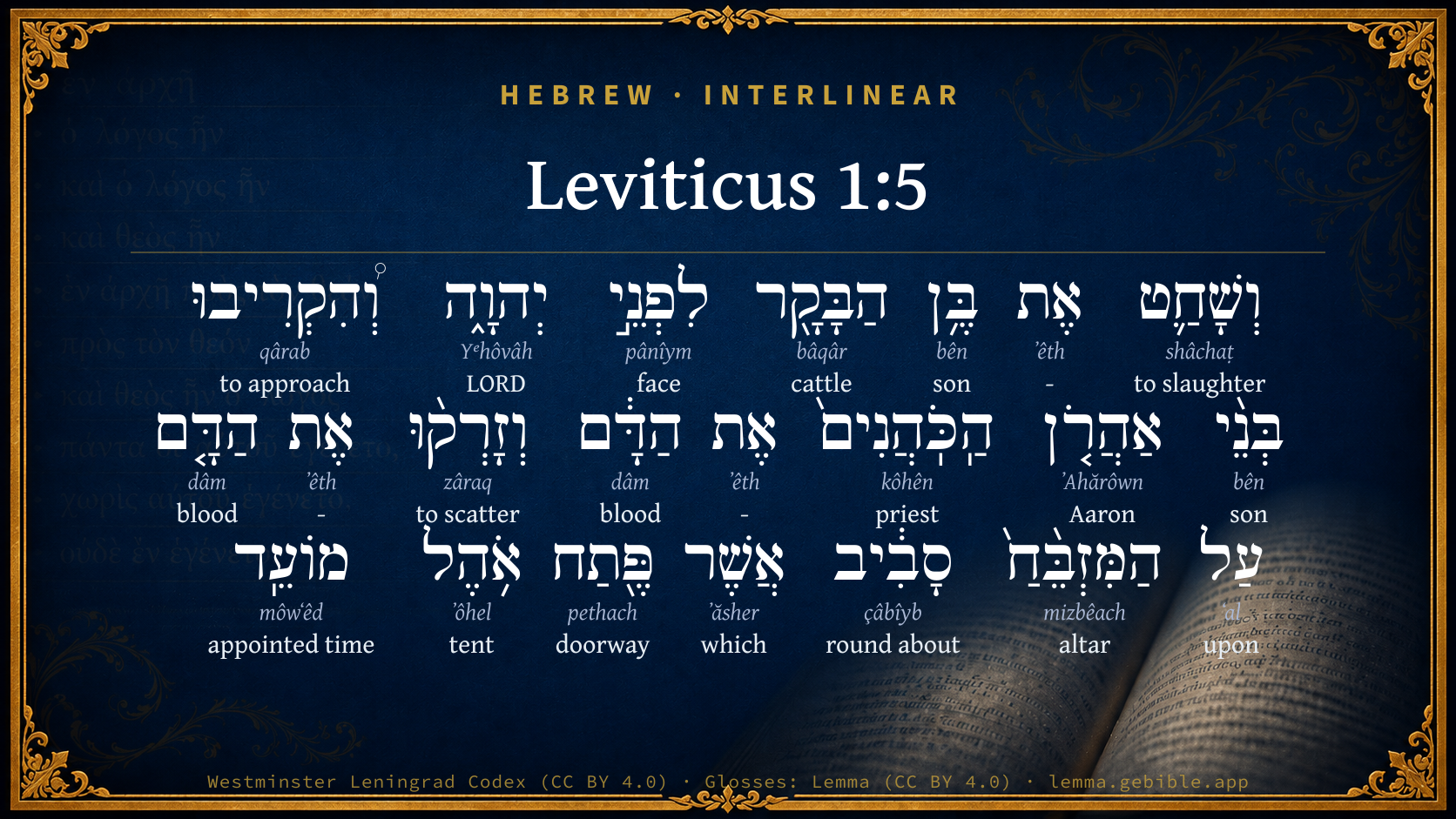
Hebrew (Westminster Leningrad Codex) Leviticus 1:5 appears in the Hebrew Old Testament. The text above is from the Westminster Leningrad Codex. Each word links to its Strong’s number, a concise gloss, and parsing drawn from the Open Scriptures Hebrew Bible morphology. Click any word for its full Brown-Driver-Briggs (BDB) entry.
Download image
Cite this verse

Leviticus 1:5 (World English Bible). Public Domain. Lemma interlinear Bible study tool, https://lemma.gebible.app/v/leviticus/1/5.

Show BibTeX & RIS
BibTeX
RIS
English Translation
He shall kill the bull before Yahweh. Aaron's sons, the priests, shall present the blood and sprinkle the blood around on the altar that is at the door of the Tent of Meeting.
World English Bible · Public Domain
Download a study sheet

One document with this verse’s original text, its word-by-word gloss line, the meaning frame, cross-references with their text, attributed commentary, and full source and license credits — printable, and it pastes into notes with its structure intact.

This verse Autodidact and up

Study sheet (.html) Plain text (.txt)

A passage Seminary Student

Up to 50 verses in one chapter. A passage sheet keeps up to 6 commentary sources and 12 cross-references per verse, in the order this page ranks them, and says so on the sheet whenever that leaves anything out. Ask for a single verse and you get the Autodidact verse sheet above.

Everything on this page stays free to read, with no account — the sheet is a download of what is already on screen, not access to it.

Want to remove ads? Support Godless Engineer
Compare translations 3

The same verse in 3 English versions, stacked beneath the original-language interlinear above. Click any original word for its lexicon entry.

Each is an independent rendering of the whole verse — the interlinear is not word-aligned to these translations.

Highlighted words mark where these versions differ — a whole-verse word diff, not a word-by-word alignment.

  • World English Bible Public Domain
    He shall kill the bull before Yahweh. Aaron's sons, the priests, shall present the blood and sprinkle the blood around on the altar that is at the door of the Tent of Meeting.
  • King James Version Public Domain
    And he shall kill the bullock before the LORD: and the priests, Aaron's sons, shall bring the blood, and sprinkle the blood round about upon the altar that is by the door of the tabernacle of the congregation.
  • unfoldingWord Literal Text CC BY-SA 4.0
    And he shall slaughter the son of the cattle to the face of Yahweh. And the sons of Aaron, the priests, shall present the blood, and they shall splash the blood all around on the altar that the entrance of the tent of meeting.

unfoldingWord Literal Text — © unfoldingWord, licensed CC BY-SA 4.0. Word-aligned USFM3 via Door43 (git.door43.org/unfoldingWord/en_ult).

Versions to compare (up to 4)

3 of 4 selected

Show all 18 translations

Every available English version of this verse, each an independent rendering of the whole verse.

  • World English Bible Public Domain
    He shall kill the bull before Yahweh. Aaron's sons, the priests, shall present the blood and sprinkle the blood around on the altar that is at the door of the Tent of Meeting.
  • Berean Standard Bible Public Domain
    And he shall slaughter the young bull before the LORD, and Aaron’s sons the priests are to present the blood and sprinkle it on all sides of the altar at the entrance to the Tent of Meeting.
  • Majority Standard Bible Public Domain
    And he shall slaughter the young bull before the LORD, and Aaron’s sons the priests are to present the blood and splatter it on all sides of the altar at the entrance to the Tent of Meeting.
  • King James Version Public Domain
    And he shall kill the bullock before the LORD: and the priests, Aaron's sons, shall bring the blood, and sprinkle the blood round about upon the altar that is by the door of the tabernacle of the congregation.
  • American Standard Version (1901) Public Domain
    And he shall kill the bullock before Jehovah: and Aaron's sons, the priests, shall present the blood, and sprinkle the blood round about upon the altar that is at the door of the tent of meeting.
  • Revised Version (1885) Public Domain
    And he shall kill the bullock before the LORD: and Aaron’s sons, the priests, shall present the blood, and sprinkle the blood round about upon the altar that is at the door of the tent of meeting.
  • Geneva Bible (1599) Public Domain
    And he shall kill the bullocke before the Lord, and the Priestes Aarons sonnes shall offer the blood, and shall sprinckle it round about vpon the altar, that is by the doore of the Tabernacle of the Congregation.
  • Douay-Rheims (1899) Public Domain
    And he shall immolate the calf before the Lord, and the priests the sons of Aaron shall offer the blood thereof, pouring it round about the altar, which is before the door of the tabernacle.
  • Young's Literal Translation Public Domain
    and he hath slaughtered the son of the herd before Jehovah; and sons of Aaron, the priests, have brought the blood near, and sprinkled the blood on the altar round about, which `is' at the opening of the tent of meeting.
  • Literal Standard Version CC BY-SA 4.0
    and he has slaughtered the son of the herd before YHWH; and sons of Aaron, the priests, have brought the blood near, and sprinkled the blood around the altar, which [is] at the opening of the Tent of Meeting.
  • Unlocked Literal Bible CC BY-SA 4.0
    Then he must kill the bull before Yahweh. Aaron's sons, the priests, will present the blood and sprinkle it on the altar that is at the entrance of the tent of meeting.
  • unfoldingWord Literal Text CC BY-SA 4.0
    And he shall slaughter the son of the cattle to the face of Yahweh. And the sons of Aaron, the priests, shall present the blood, and they shall splash the blood all around on the altar that the entrance of the tent of meeting.
  • Darby Bible Public Domain
    And he shall slaughter the bullock before Jehovah; and Aaron's sons, the priests, shall present the blood and sprinkle the blood round about on the altar that is at the entrance of the tent of meeting.
  • World Messianic Bible Public Domain
    He shall kill the bull before the LORD. Aaron’s sons, the priests, shall present the blood and sprinkle the blood around on the altar that is at the door of the Tent of Meeting.
  • Webster's Bible Public Domain
    And he shall kill the bullock before the LORD: and the priests, Aaron's sons, shall bring the blood, and sprinkle the blood around upon the altar that is by the door of the tabernacle of the congregation.
  • Free Bible Version CC BY-SA 4.0
    You are to kill the bull in the Lord's presence, and Aaron's sons, the priests, are to take the blood and sprinkle it on all sides of the altar at the entrance to the Tent of Meeting.
  • Bible in Basic English Public Domain
    And the ox is to be put to death before the Lord: then Aaron's sons, the priests, are to take the blood and put some of it on and round the altar which is at the door of the Tent of meeting.
  • JPS Tanakh (1917) Public Domain
    And he shall kill the bullock before the LORD; and Aaron's sons, the priests, shall present the blood, and dash the blood round about against the altar that is at the door of the tent of meeting.

Literal Standard Version (2020), Covenant Press — licensed CC BY-SA 4.0. Text via the HelloAO Bible API (eBible.org). Unlocked Literal Bible (unfoldingWord) — licensed CC BY-SA 4.0. Text via the HelloAO Bible API (eBible.org). unfoldingWord Literal Text — © unfoldingWord, licensed CC BY-SA 4.0. Word-aligned USFM3 via Door43 (git.door43.org/unfoldingWord/en_ult). Free Bible Version, Dr. Jonathan Gallagher — licensed CC BY-SA 4.0. Text via the HelloAO Bible API (eBible.org).

Word by word

More ways to search: Search by grammar → Find every occurrence → Compare this word →

Practice this passage: Drill this verse → Learn its vocabulary →

וְזָרְק֨וּ
zâraq
H2236
“and · to scatter”
Conjunction + Verb, Qal, Sequential Perfect, 3rd Person, Common, Plural
Part of Speech
Conjunction + Verb
Stem
Qal
Form
Sequential Perfect
Person
3rd Person
Gender
Common
Number
Plural
Full BDB Definition

Origin: a primitive root

TWOT: 585

to scatter, sprinkle, toss, throw, scatter abundantly, strew - (Qal) to scatter, sprinkle, toss - (Pual) to be sprinkled
  1. וְשָׁחַ֛ט shâchaṭ H7819 “and · to slaughter” Conjunction + Verb, Qal, Sequential Perfect, 3rd Person, Masculine, Singular
  2. אֶת ʼêth H853 “-” Particle, Direct Object
  3. בֶּ֥ן bên H1121 “son of” Noun, Common, Masculine, Singular, Construct
  4. הַבָּקָ֖ר bâqâr H1241 “the · cattle” Particle, Definite Article + Noun, Common, Both, Singular, Absolute
  5. לִפְנֵ֣י pânîym H6440 “to/for · face(s) of” Preposition + Noun, Common, Both, Plural, Construct
  6. יְהוָ֑ה Yᵉhôvâh H3068 “LORD” Noun, Proper
  7. וְ֠הִקְרִיבוּ qârab H7126 “and · to approach” Conjunction + Verb, Hiphil, Sequential Perfect, 3rd Person, Common, Plural
  8. בְּנֵ֨י bên H1121 “sons of” Noun, Common, Masculine, Plural, Construct
  9. אַהֲרֹ֤ן ʼAhărôwn H175 “Aaron” Noun, Proper
  10. הַֽכֹּֽהֲנִים֙ kôhên H3548 “the · priests” Particle, Definite Article + Noun, Common, Masculine, Plural, Absolute
  11. אֶת ʼêth H853 “-” Particle, Direct Object
  12. הַדָּ֔ם dâm H1818 “the · blood” Particle, Definite Article + Noun, Common, Masculine, Singular, Absolute
  13. אֶת ʼêth H853 “-” Particle, Direct Object
  14. הַדָּ֤ם dâm H1818 “the · blood” Particle, Definite Article + Noun, Common, Masculine, Singular, Absolute
  15. עַל ʻal H5921 “upon” Preposition
  16. הַמִּזְבֵּ֨חַ֙ mizbêach H4196 “the · altar” Particle, Definite Article + Noun, Common, Masculine, Singular, Absolute
  17. סָבִ֔יב çâbîyb H5439 “round about” Noun, Common, Both, Singular, Absolute
  18. אֲשֶׁר ʼăsher H834 “which” Particle, Relative
  19. פֶּ֖תַח pethach H6607 “doorway of” Noun, Common, Masculine, Singular, Construct
  20. אֹ֥הֶל ʼôhel H168 “tent of” Noun, Common, Masculine, Singular, Construct
  21. מוֹעֵֽד môwʻêd H4150 “appointed time” Noun, Common, Masculine, Singular, Absolute

About this verse

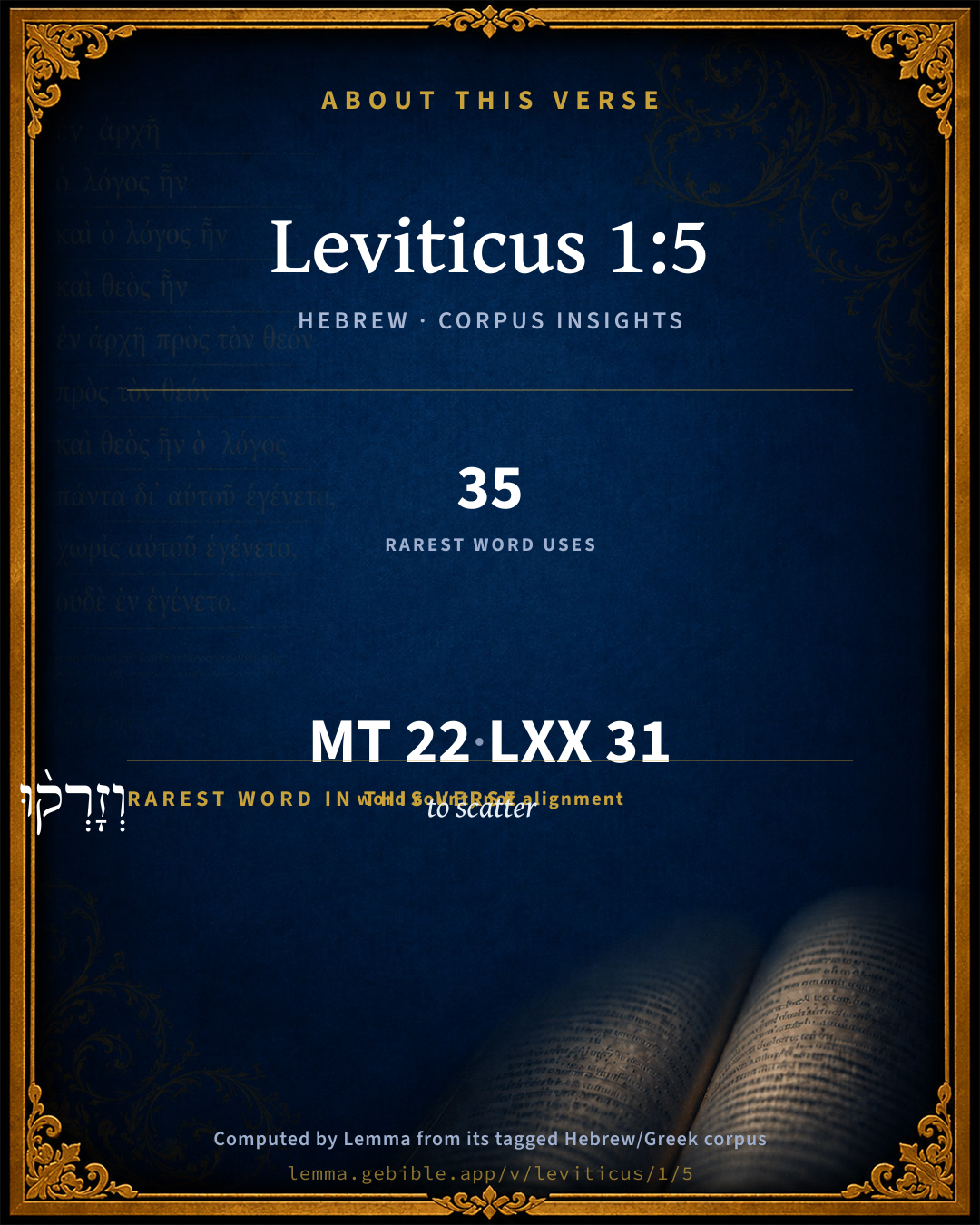
These counts appear in no published source. They are computed here, from the morphology-tagged text and Lemma’s own curated glosses. What Lemma adds →

22
words
18
distinct lemmas
Pentateuch
section

Shared distinctive vocabulary

וְזָרְק֨וּ to scatter H2236 occurs in 33 verses of the Hebrew Bible. Also found in:

Grammatical profile

  • 3 verbs
  • 14 nouns
  • 1 preposition
  • 4 particles

Verb forms

  • וְשָׁחַ֛ט Qal · Sequential Perfect
  • וְ֠הִקְרִיבוּ Hiphil · Sequential Perfect
  • וְזָרְק֨וּ Qal · Sequential Perfect

Repetition

Words recur within this verse — often emphatic in Hebrew:

  • בֶּ֥ן son H1121 ×2
  • הַדָּ֔ם blood H1818 ×2

Hebrew & Septuagint length

In English translation the verse runs 33 words from the Hebrew and 41 from the Septuagint (LXX English) — closely comparable.

A rough comparison of the two English renderings, which tokenize alike — not a word-level alignment.

Word counts can differ between the Hebrew and the Greek without any difference in meaning — e.g. the Hebrew direct-object marker אֵת has no separate Greek word, and Greek often adds the article ὁ.

In the original languages it is 22 Hebrew tokens and 31 Greek tokens — but the two are counted differently (Hebrew bundles its prefixes and suffixes into one token; the Greek is in lemma form), so that isn’t a like-for-like length.

Cross-references

17

Topical passages linked to Leviticus 1:5 in the Treasury of Scripture Knowledge — connected by theme and wording, ordered by reader-vote popularity; previews shown in the World English Bible.

  • Leviticus 1:11 He shall kill it on the north side of the altar before Yahweh. Aaron's sons, the priests, shall sprinkle its blood around on the altar.
  • Leviticus 3:8 and he shall lay his hand on the head of his offering, and kill it before the tent of meeting: and Aaron's sons shall sprinkle its blood on the altar round about.
  • Leviticus 3:2 He shall lay his hand on the head of his offering, and kill it at the door of the tent of meeting: and Aaron's sons the priests shall sprinkle the blood on the altar round about.
  • Leviticus 3:13 and he shall lay his hand on its head, and kill it before the tent of meeting; and the sons of Aaron shall sprinkle its blood on the altar round about.
  • 2 Chronicles 35:11 They killed the Passover, and the priests sprinkled [the blood which they received] of their hand, and the Levites flayed them.
  • Hebrews 12:24 to Jesus, the mediator of a new covenant, and to the blood of sprinkling that speaks better than that of Abel.
  • 1 Peter 1:2 according to the foreknowledge of God the Father, in sanctification of the Spirit, that you may obey Jesus Christ and be sprinkled in his blood: Grace to you and peace be multiplied.
  • Exodus 29:16 You shall kill the ram, and you shall take its blood, and sprinkle it around on the altar.
  • Exodus 24:6–8 Moses took half of the blood and put it in basins, and half of the blood he sprinkled on the altar.
  • Leviticus 1:15 The priest shall bring it to the altar, and wring off its head, and burn it on the altar; and its blood shall be drained out on the side of the altar;
  • Leviticus 16:15 "Then he shall kill the goat of the sin offering, that is for the people, and bring his blood within the veil, and do with his blood as he did with the blood of the bull, and sprinkle it on the mercy seat, and before the mercy seat:
  • Numbers 18:17 But the firstborn of a cow, or the firstborn of a sheep, or the firstborn of a goat, you shall not redeem; they are holy: you shall sprinkle their blood on the altar, and shall burn their fat for an offering made by fire, for a sweet savor to Yahweh.
  • 2 Chronicles 29:22–24 So they killed the bulls, and the priests received the blood, and sprinkled it on the altar: and they killed the rams, and sprinkled the blood on the altar: they killed also the lambs, and sprinkled the blood on the altar.
  • Isaiah 52:15 so shall he sprinkle many nations; kings shall shut their mouths at him: for that which had not been told them shall they see; and that which they had not heard shall they understand.
  • Ezekiel 36:25 I will sprinkle clean water on you, and you shall be clean: from all your filthiness, and from all your idols, will I cleanse you.
  • Micah 6:6 How shall I come before Yahweh, And bow myself before the exalted God? Shall I come before him with burnt offerings, With calves a year old?
  • Hebrews 10:11 Every priest indeed stands day by day ministering and often offering the same sacrifices, which can never take away sins,

Cross-references courtesy of OpenBible.info (CC BY 4.0).

Hebrew and Greek witnesses Masoretic Hebrew ↔ Greek Septuagint

The same verse in the two great witnesses to the Old Testament, shown verse-for-verse.

These are two independent witnesses, not word-aligned to each other, and the Septuagint is shown in lemma (dictionary) form.

Hebrew Leviticus 1:5 Masoretic · Westminster Leningrad Codex

וְשָׁחַ֛ט אֶת בֶּ֥ן הַבָּקָ֖ר לִפְנֵ֣י יְהוָ֑ה וְ֠הִקְרִיבוּ בְּנֵ֨י אַהֲרֹ֤ן הַֽכֹּֽהֲנִים֙ אֶת הַדָּ֔ם וְזָרְק֨וּ אֶת הַדָּ֤ם עַל הַמִּזְבֵּ֨חַ֙ סָבִ֔יב אֲשֶׁר פֶּ֖תַח אֹ֥הֶל מוֹעֵֽד

He shall kill the bull before Yahweh. Aaron's sons, the priests, shall present the blood and sprinkle the blood around on the altar that is at the door of the Tent of Meeting.

World English Bible · Public Domain

Greek LXX Leviticus 1:5 Septuagint · lemma form

καί σφάζω ὁ μόσχος ἔναντι κύριος καί προςφέρω ὁ υἱός ἀαρών ὁ ἱερεύς ὁ αἷμα καί προςχέω ὁ αἷμα ἐπί ὁ θυσιαστήριον κύκλος ὁ ἐπί ὁ θύρα ὁ σκηνή ὁ μαρτύριον

And they shall kill the calf before the Lord; and the sons of Aaron the priests shall bring the blood, and they shall pour the blood round about on the altar, which is at the doors of the tabernacle of witness.

LXX2012 (modern English Septuagint) · Public Domain

On this verse, The Cambridge Bible for Schools and Colleges discusses the Septuagint’s reading. Read the note in Commentary ↓

Hebrew: Westminster Leningrad Codex (CC BY 4.0). Greek: Septuagint (public domain); English from LXX2012 (modern English Septuagint) (Public Domain). How the Septuagint differs from the Hebrew →

Targum (Aramaic paraphrase)

2

The Targum is the ancient Jewish Aramaic paraphrase of the Hebrew Scriptures — an interpretive translation, not the Hebrew text itself. Onkelos (literal) and Pseudo-Jonathan (expansive) render the Torah, and Jonathan the Prophets. Coverage is partial: where no permissively-licensed English translation exists for a verse, only the Aramaic is shown. This is verse-level text, not a word-by-word alignment to the Hebrew. Some Onkelos verses here show an unreviewed machine translation (clearly flagged), not a published edition.

  1. Targum Onkelos Torah (Genesis–Deuteronomy)
    וְיִכּוֹס יָת בַּר תּוֹרֵי קֳדָם יְיָ וִיקָרְבוּן בְּנֵי אַהֲרֹן כָּהֲנַיָא יָת דְמָא וְיִזְרְקוּן יָת דְמָא עַל מַדְבְּחָא סְחוֹר סְחוֹר דִי בִתְרַע מַשְׁכַּן זִמְנָא

    Unreviewed machine translation (Claude Sonnet 5) — not public domain confidence: high

    And he shall slaughter the young bull before the Lord, and the sons of Aaron the priests shall bring near the blood, and they shall sprinkle the blood upon the altar round about, which is at the door of the tent of meeting.

    Generated by an AI translate-then-audit pipeline and checked against an independent public-domain English translation of the underlying Hebrew for drift only. Not a published edition; pending human review.

    Aramaic base: public-domain Targum Onkelos (via Sefaria). The English above is the unreviewed machine translation, not public domain.

  2. Targum Pseudo-Jonathan Torah (Genesis–Deuteronomy)
    וְיִכּוֹס טַבְּחָא בְּבֵית מַטְבְּחַיָא יַת בַּר תּוֹרֵי קֳדָם יְיָ וְיִקְרְבוּן בְּנֵי אַהֲרן כַּהֲנָא יַת אַדְמָא בְּמָנַיָא וְיִדְרְקוּן יַת אַדְמָא בְּמִזְרְקַיָא עַל מַדְבְּחָא חֲזוֹר חֲזוֹר דְבִתְרַע מַשְׁכַּן זִמְנָא

    And the slayer shall kill the ox at the place of slaughter before the Lord, and the sons of Aharon the priest shall bring the blood in vessels, and sprinkle the blood which is in the basins round about the altar that is at the door of the tabernacle of ordinance.

    Targum Pseudo-Jonathan — Aramaic: “Targum Jonathan on Genesis” (public domain); “Targum Jonathan on Exodus” (public domain); “Targum Jonathan on Leviticus” (public domain); “Targum Jonathan on Numbers” (public domain); “Targum Jonathan on Deuteronomy” (public domain). English: “The Targum of Jonathan ben Uzziel, trans. J. W. Etheridge, London, 1862” (public domain). Text via Sefaria.

Commentary

Notes on Leviticus 1:5 from classic Christian and Jewish commentators (each source and its license shown beneath its notes). The classic Christian expositions comment on the surrounding passage and are grouped to its opening verse, so a note may address several verses; the Jewish commentaries on the Tanakh (Rashi and others) are per-verse, so they appear only where the commentator wrote on this verse.

Lemma curates 59 commentaries, every one of them public domain or Creative Commons licensed, each selected and text-cleaned for this edition rather than reprinted as found. About our sources →

Ellicott's Commentary for English Readers

(5) And he shall kill the bullock.—The sacrificer himself slaughtered the victim on the north side of the altar, by cutting its throat, while a priest or an assistant held a bowl under the neck to receive the blood.

Before the Lord.—That is, before the door of the tent of meeting (comp. Lev_1:11). The two phrases constantly interchange in the directions about the sacrifices. (Comp. Lev_3:2; Lev_3:8; Lev_3:12; Lev_4:4; Lev_4:15; Lev_4:24; Lev_6:18, &c.)

The priests, Aaron’s sons.—Better, the sons of Aaron, the priests, as the Authorised Version renders this phrase in Num_10:8. Besides the passage in Jos_21:19, this phrase only occurs six times, once in Numbers, where it is properly rendered, and five times in this book, where it is translated three times “the priests Aaron’s sons” (Lev_1:5; Lev_1:8; Lev_1:11), and twice “Aaron’s sons the priests” (Lev_2:2; Lev_3:2). (See Lev_21:1.)

And sprinkle.—Better, throw the blood. The priestly functions, which began with the catching of the blood in the bowl, are now to continue also in this instance. The priest threw the blood upon the walls of the altar in two portions. He first stepped to the north-eastern corner, and from that corner diffused the blood on the northern and eastern walls; he then placed himself at the south-western corner, whence he diffused the second portion of the blood on the south and western walls. The rest of the blood he poured out at the Southern side of the altar, which was furnished with two holes; these holes communicated with a drain which conducted the blood into the Kedron.

By the door of the tabernacle.—Better, at the entrance of the tent of meeting. (See Lev_1:3.)

A Bible Commentary for English Readers, edited by Charles John Ellicott (1878–1897) — public domain. Text from a community e-Sword module.

Trapp's Complete Commentary

John Trapp

Lev 1:5 And he shall kill the bullock before the LORD: and the priests, Aaron’s sons, shall bring the blood, and sprinkle the blood round about upon the altar that [is by] the door of the tabernacle of the congregation.

Ver. 5. And he shall kill the bullock.] The priest shall kill it: for it was death for any man to offer his own sacrifice. So it is still for any to come to God, otherwise than in and by Christ.

John Trapp, A Commentary or Exposition upon All the Books of the Old and New Testament (1647–1656) — public domain. Text from a community e-Sword module.

The Biblical Illustrator

Joseph S. Exell

Lev_1:5

He shall kill the bullock

Slaying the sacrifice

I.

Concerning the killing and slaying of the offering, our first point is that it was absolutely essential.

1. The pouring out of the blood of the victim was of the very essence of the type. The death of Christ by blood-shedding was absolutely necessary to make Him an acceptable sacrifice for sin. It behoved Christ to suffer. He could only enter into the presence of God with His own blood. He could not be the grain of wheat which bringeth forth much fruit unless He should die. The blood of Jesus Christ His Son cleanseth us from all sin. Observe, not the life, not the incarnation, not the resurrection, not the second coming of the Lord Jesus, but His blood, His death, the giving up of His life, is that which cleanseth us from all sin. This is that purging with hyssop whereof David speaks when he laments his sin, and yet looks to be made whiter than snow by the free pardon of his God. This truth is the subject of all true gospel preaching. Do you not know how Paul puts it--The preaching of the Cross is to them that perish foolishness; but unto us which are saved it is the power of God; for, he says, the Jews require a sign, and the Greeks seek after wisdom: but we preach Christ crucified. It is not Christ in any other position, but Christ as crucified, Christ as made a curse for us up n the tree, that is the first and most prominent fact that we are called to preach among the sons of men.

2. Here let us further consider that death is the result and penalty of sin--The soul that sinneth it shall die. Sin, when it is finished, bringeth forth death. The wages of sin is death. It was meet that the Substitute should bear a similar chastisement to that which should have fullen upon the sinner.

3. This death of Christ was absolutely necessary also for the clearing of the troubled conscience. An awakened conscience will never be quieted with anything less than the blood of the Lamb: it rests at the sight of the great Sacrifice, but nowhere else.

II. Secondly, we will with great delight meditate upon the fact that the death of Christ is effectually prevalent. Other offerings, though duly slain, did nothing thoroughly, did nothing lastingly, did nothing really, by way of expiation; for the Scripture saith, It is not possible that the blood of bulls and of goats should take away sins the true purification is alone found in the death of the Son of God. Why was there such cleansing power in the Redeemers blood? I answer, for several reasons.

1. First, because of the glory of His person. Only think who He was I He was none other than the Light of light, very God of very God.

2. Next, consider the perfection of our Lords character. In Him was no sin, nor tendency to sin. He was holy, harmless, undefiled, and separate from sinners. In His character we see every virtue at its best; He is incomparable. If lie therefore died, the just for the unjust, what must be the merit of such a death?

3. Think next of the nature of the death of Christ, and you will be helped to see how effectual it must be. It was not a death by disease or old age, but a death of violence, well symbolised by the killing of the victim at the altar.

4. And then think of the Spirit in which our Lord and Saviour bore all this. Martyrs who have died for the faith have only paid the debt of nature a little before its time, for they must have died sooner or later; but our Lord needed not to have died at all he said of His life, No man taketh it from Me, but I lay it down of Myself. O glorious Christ, there must be infinite merit in such a death as Thine, endured in such a style!

5. And then I bid you to remember once more the covenant character which Christ sustained: for when He was crucified we thus judge that one died for all, and in Him all died. He was not slain as a private individual, but He was put to death as a representative man.

III. That the fact of the necessity for the death of the Lord Jesus is intensely instructive.

1. Must the victims die? must Jesus bleed? then let us see what is claimed by our righteous God. He claims our life: He claimed of the offering its blood, which is the life thereof: He justly requires of each of us our whole life. Nor is the demand unjust. Did He not make us, and does He not preserve us? Should He not receive homage from the creatures of His hand?

2. Next, must the sacrifice die? then see the evil of sin. It is not such a trifle as certain men imagine. It is a deadly evil, a killing poison. It is a horrible and a grievous thing, and God saith to you, Oh, do not this abominable thing which I hate. God help you to flee from all iniquity.

3. Next learn the love of God. Behold how He loved you and me I He must punish sin, but He must save us, and so He gives His Son to die in our stead. I shall not go too far if I say that in giving His Son the Lord God gave Himself, for Jesus is one with the Father. Next learn how Christ has made an end of sin. His one offering has perfected for ever the set-apart ones. These are but a few of the great lessons which we may learn from the necessity that the Sacrifice should be slain.

IV. And so I shall close by saying that this blessed subject is not only full of instruction, but it is energetically inspiring.

1. First, this inspires us with the spirit of consecration. When I think that I could not be saved except by the death of Jesus, then I feel that I am not my own, but bought with a price.

2. Next, this truth should create in us a longing after the greatest holiness, for we should say, Did sin kill my Saviour? Then I will kill sin!

3. Does not this inspire you with great love for the Lord Jesus? Can you look at His dear wounds, and not be wounded with love for Him? Are not His wounds as mouths which plead with you to yield Him all your hearts?

4. Lastly, do you not think that this solemn truth should inspire us with great zeal for the salvation of others? (C. H. Spurgeon.)

The Biblical Illustrator, edited by Joseph S. Exell (c. 1880s–1900s) — public domain. Text from a community e-Sword module.

Joseph Benson's Commentary

Lev 1:5-6. And he — Either, 1st, The offerer, who is said to do it, namely, by the priest; for men are commonly said to do what they cause others to do, as Joh 4:1-2. Or, 2d, The priest, as it follows, or the Levite, whose office this was. Shall sprinkle the blood — Which was done in a considerable quantity, and whereby was signified, 1st, That the offerer deserved to have his blood spilt in that manner. 2d, That the blood of Christ should be poured forth for sinners, and that this was the only means of their reconciliation to God, and acceptance with him. Pieces — Namely, the head, and fat, and inwards, and legs, Lev 1:8-9.

Joseph Benson's Commentary on the Old and New Testaments (1811–1818) — public domain. Text from a community e-Sword module.

The Expositor's Bible

THE BURNT OFFERING (CONCLUDED)

Lev_1:5-17; Lev_6:8-13

AFTER the laying on of the hand, the next sacrificial act was-

THE KILLING OF THE VICTIM

"And he shall kill the bullock before the Lord." (Lev_1:5)

In the light of what has been already said, the significance of this killing, in a typical way, will be quite clear. For with the first sin, and again and again thereafter, God had denounced death as the penalty of sin. But here is a sinner who, in accord with a Divine command, brings before God a sacrificial victim, on whose head he lays his hand, on which he thus rests as he confesses his sins, and gives over the innocent victim to die instead of himself. Thus each of these sacrificial deaths, whether in the burnt offering, the peace offering, or the sin offering, brings ever before us the death in the sinners stead of that one Holy Victim who suffered for us, "the just for the unjust," and thus laid down His life, in accord with His own previously declared intention, "as a ransom for many."

In the sacrifices made by and for individuals, the victim was killed, except in the case of the turtledove or pigeon, by the offerer himself; but, very naturally, in the case of the national and public offerings, it was killed by the priest. As, in this latter case, it was impossible that all individual Israelites should unite in killing the victim, it is plain that the priest herein acted as the representative of the nation. Hence we may properly say that the fundamental thought of the ritual was this, that the victim should be killed by the offerer himself.

And by this ordinance we may well be reminded, first, how Israel, -for whose sake as a nation the antitypical Sacrifice was offered, -Israel itself became the executioner of the Victim; and, beyond that, how, in a deeper sense, every sinner must regard himself as truly causal of the Saviours death, in that, as is often truly said, our sins nailed Christ to His cross. But whether such a reference were intended in this law of the offering or not, the great, significant, outstanding fact remains, that as soon as the offerer, by his laying on of the hand, signified the transfer of the personal obligation to die for sin from himself to the sacrificial victim, then came at once upon that victim the penalty denounced against sin.

And the added words, "before the Lord," cast further light upon this, in that they remind us that the killing of the victim had reference to Jehovah, whose holy law the offerer, failing of that perfect consecration which the burnt offering symbolised, had failed to glorify and honour.

THE SPRINKLING OF BLOOD

"And Aarons sons, the priests, shall present the blood, and sprinkle the blood round about upon the altar that is at the door of the tent of meeting." (Lev_1:5)

And now follows the fourth act in the ceremonial, the Sprinkling of the Blood. The offerers part is now done, and herewith the work of the priest begins. Even so must we, having laid the hand of faith upon the head of the substituted Lamb of God, now leave it to the heavenly Priest to act in our behalf with God.

The directions to the priest as to the use of the blood vary in the different offerings, according as the design is to give greater or less prominence to the idea of expiation. In the sin offering this has the foremost place. But in the burnt offering, as also in the peace offering, although the conception of atonement by blood was not absent, it was not the dominant conception of the sacrifice. Hence, while the sprinkling of blood by the priest could in no wise be omitted, it took in this case a subordinate place in the ritual. It was to be sprinkled only on the sides of the altar of burnt offering which stood in the outer court. We read (Lev_1:5): "Aarons sons, the priests, shall present the blood, and sprinkle the blood round about upon the altar that is at the door of the tent of meeting."

It was in this sprinkling of the blood that the atoning work was completed. The altar had been appointed as a place of Jehovahs special presence; it had been designated as a place where God would come unto man to bless him. Thus, to present and sprinkle the blood upon the altar was symbolically to present the blood unto God. And the blood represented life, -the life of an innocent victim atoning for the sinner, because rendered upin the stead of his life. And the priests were to sprinkle the blood. So, while to bring and present the sacrifice of Christ, to lay the hand of faith upon His head, is our part, with this our duty ends. To sprinkle the blood, to use the blood God-ward for the remission of sin, this is the work alone of our heavenly Priest. We are then to leave that with Him.

Reserving a fuller exposition of the meaning of this sprinkling of blood for the exposition of the sin offering, in which it was the central act of the ritual, we pass on now to the burning of the sacrifice, which in this offering marked the culmination of its special symbolism.

William Robertson Nicoll, ed., The Expositor's Bible (London: Hodder & Stoughton, 1887–1910) — public domain. 65 of 66 books (1 Corinthians is not separately keyed, as that volume carries no machine-parseable verse references); section-level commentary keyed to the opening verse. Introductory and overview sections not keyed to a specific passage are excluded.

Tyndale Open Study Notes

Tyndale Open Resources

1:5 Aaron’s sons: The descendants of Levi, Moses’ own tribe, were divided into two categories: (1) priests, who were descendants of Aaron, the first high priest; and (2) Levites, who served in subordinate roles (Exod 28:1-4; Num 18:1-7). The instructions given here applied to later generations as well. • The blood was a symbol of life, not of death. The Israelite system of sacrifice was based on the principle of substitution, and the shedding of sacrificial blood was essential for atonement. It represented sacrificing the life of the animal as a substitute for the life of the worshiper (Lev 17:10-14; Heb 9:22). The blood of Jesus Christ was shed as the ultimate sacrifice for sin (Heb 9:11-14). • The altar of burnt offering was located in the east end of the courtyard, outside the Tabernacle but inside the entrance to the courtyard (Exod 40:6, 29).

Tyndale Open Study Notes — © Tyndale Open Resources, licensed CC BY-SA 4.0. Text via the HelloAO Bible API.

Geneva Bible (1599)

Geneva Bible translators

The Priest or Levite.

Of the burnt offering, Exod. 27:1.

Geneva Bible (1599) marginal notes — public domain. Text via Bolls.life.

Jamieson, Fausset & Brown

Robert Jamieson, A. R. Fausset & David Brown

he shall kill the bullock--The animal should be killed by the offerer, not by the priest, for it was not his duty in case of voluntary sacrifices; in later times, however, the office was generally performed by Levites.

before the Lord--on the spot where the hands had been laid upon the animal's head, on the north side of the altar.

sprinkle the blood--This was to be done by the priests. The blood being considered the life, the effusion of it was the essential part of the sacrifice; and the sprinkling of it--the application of the atonement--made the person and services of the offerer acceptable to God. The skin having been stripped off, and the carcass cut up, the various pieces were disposed on the altar in the manner best calculated to facilitate their being consumed by the fire.

Jamieson, Fausset & Brown — Commentary Critical and Explanatory on the Whole Bible (1871) — public domain (CC PDM 1.0). Text via the HelloAO Bible API.

The Cambridge Bible for Schools and Colleges

gen. ed. J. J. S. Perowne

5, 6. And he shall kill … flay … and cut it into its pieces] Many would not be able to flay and divide an animal without assistance; it seems probable that these parts of the ritual were performed by some one else. The plural verbs in LXX. and some other versions (they shall kill … flay …) may refer to existing practice, and it appears from 2Ch_29:24; 2Ch_29:34; 2Ch_35:9-11 that priests and Levites performed these duties.

Aaron’s sons, the priests, shall present] bring A.V., the same Heb. word as that translated ‘offer’ in Lev_1:3. The priestly action commences here.

and sprinkle] Better, throw or scatter; the blood was caught in a bowl, and thrown against the sides of the altar twice, in such a manner that the blood touched all the four sides. The priest went to the N.E. corner, and threw the blood against the N. and E. sides, and then to the S.W. corner, where he threw the blood against the S. and W. sides. This is described in Mishna Zebâḥîm 53 b as ‘two applications of the blood which are four’ and quoted by Rashi in his commentary on this verse. For ‘sprinkling’ with the finger (Lev_4:6) another Heb. word is used.

door] entrance. There were no doors to the tent of meeting, but curtains.

The Cambridge Bible for Schools and Colleges (gen. ed. J. J. S. Perowne; Cambridge University Press, 1878–1918) — public domain. Text from a community e-Sword module.

John Gill's Exposition

And he shall kill the bullock before the Lord,.... That is, the man that brings the burnt offering, for no other is yet spoken of; and according to the traditions of the elders (h), killing of the sacrifice was right when done by strangers, by women, and by servants, and by unclean persons, even in the most holy things so be it that the unclean did not touch the flesh; and it is observed (i), that the service of the priest begins in the next clause, killing being lawful by him that was not a priest, according to the Targum of Jonathan, the butcher; but Aben Ezra interprets it of the priests, and certain it is, that the burnt offerings of the fowls were killed by the priests, Lev 1:15 and the Septuagint version renders it, "and they shall kill": but be this as it will, the burnt offering was to be killed in the court before the Lord; and this was typical of the death of Christ, who, according to these types, as well as to other prophecies, was to die for the sins of men, and accordingly did; and if this was the proprietor and not the priest that killed the sacrifice, it may denote that the sins of God's people, for whom Christ's sacrifice was offered up, were the cause of his death:

and the priests, Aaron's sons, shall bring the blood: in vessels or basins, as the Targum of Jonathan adds, into which they received it when slain:

and sprinkle the blood round about upon the altar that is by the door of the tabernacle of the congregation; which was the altar of burnt offering, and not the altar of incense, as appears by the situation of it, see Exo 40:5 and the blood was sprinkled all around the altar with two sprinklings: the rule in the Misnah is (k); the slaying of the burnt offering is in the north, and the reception of its blood into the ministering vessels is in the north, and its blood ought to have two sprinklings, which answer to four; which Maimonides (l) explains thus; because it is said "round about", it must needs be that the sprinklings should comprehend the four sides of the altar; and this is done when the two sprinklings are upon the two horns, which are diametrically opposite; and this is what is meant, "which are four"; the sense is, that those two should include the four sides, and the two opposite horns were the northeast and the southwest, as he and other Jewish writers observe (m), and which he expresses more clearly elsewhere (n): when the priest took the blood in the basin, he sprinkled out of it in the basin, two sprinklings upon the two corners of the altar opposite from it; and he ordered it so to sprinkle the blood upon the horn, that the blood might surround the corners in the form of the Greek letter "gamma" (o); so that the blood of the two sprinklings might be found upon the four sides of the altar; because it is said of the burnt offerings, and of the peace offerings "round about"; and this is the law for the trespass offering, and the rest of the blood was poured out at the bottom southward: now this was always done by a priest, for though the bullock might be killed by a stranger, as Gersom on the place observes, yet its blood must be sprinkled by a priest; and it is the note of Aben Ezra, that this might be done by many, and therefore it is said, the "priests, Aaron's sons", when the slaying of it was only by one. The "altar" on which the blood was sprinkled typified the divinity of Christ, which gave virtue to his blood, whereby it made atonement for sin; and in allusion to this rite Christ's blood is called "the blood of sprinkling", Pe1 1:2 Heb 12:24 which being sprinkled on the heart by the Spirit of God clears it from an evil conscience, and purges the conscience from dead works, and speaks peace and pardon there, Heb 10:22.

(h) Misn. Zebachim, c. 3. sect. 1. & Maimon. in ib. T. Bab. Yoma, fol. 27. 1. & Zebachim, fol. 32. 1. & Menachot, fol. 19. 1. (i) Bartenora in Misn. Zebachim, ib. (k) Misn. Zebachim, c. 5. sect. 4. (l) Perush in ib. (m) Jarchi, Bartenora, & Yom Tob, in ib. (n) Hilchot Korbanot, c. 5. sect. 6. (o) Vid. T. Bab. Zebachim, fol. 53. 2.

John Gill's Exposition of the Whole Bible (1746–1763) — public domain (CC PDM 1.0). Text via the HelloAO Bible API.

Albert Barnes' Notes on the Bible

And he shall kill the bullock - Tradition states that before the laying on of the hand, the victim was bound by a cord to a ring on the north side of the altar; as the words of the prayer were ended, the throat was cut and the blood received into a bowl held by an assistant.

Sprinkle the blood - Rather, throw the blood, so as to make the liquid cover a considerable surface. (The Christian significance of this typical action is referred to in Heb 12:24; 1Pe 1:2.)

By the door of the tabernacle - At the entrance of the tent.

Albert Barnes' Notes on the Bible (1834–1885) — public domain. Text from a community e-Sword/MySword module.

Haydock's Catholic Bible Commentary

He, by the hands of the priests, (chap. x. 1,) as the Septuagint express it, "they shall immolate;" (Menochius) though we might infer from this text, that the person who offered the victim, had to slay it; (Calmet) while the priests alone could pour the blood upon and around the altar. Without the effusion of blood remission is not made, Hebrews ix. 22. (Haydock)

George Leo Haydock (1774–1849), Haydock's Catholic Family Bible and Commentary, 1859 edition — public domain. Excludes Psalms (Douay-Rheims chapter numbering differs from Protestant) and Deuterocanonical books (Catholic canon only).

Matthew Poole's English Annotations

He shall kill; either,

1. The offerer, who is said to do it, to wit, by the priest; for men are commonly said to do what they cause others to do, as Joh 4:1,2. Or,

2. The priest, as it follows, or the Levite, whose office this was. See Exo 29:11; Lev 8:15; Num 8:19; 1Ch 23:28,31; 2Ch 20:16; 35:11.

Sprinkle the blood round about upon the altar; which was done in a considerable, quantity, as may be gathered from Zec 9:15; and whereby was signified,

1. That the offerer deserved to have his blood spilt in that manner.

2. That the blood of Christ should be poured forth for sinners, and that that was the only mean of their reconciliation to God, and acceptance with him.

Matthew Poole's English Annotations on the Holy Bible (1683–1685) — public domain. Text from a community e-Sword/MySword module.

Whedon's Commentary on the Bible

Daniel D. Whedon

5. Shall kill — After the most searching scrutiny by the priest, if the animal was pronounced perfect, the offerer killed it, except when it was presented in behalf of the whole congregation; then it was killed by the high priest. Chap. Lev_16:15.

The bullock — Literally, the son of a bull. The term ox is often used in a broad sense as describing sacrificial victims of the bovine genus, but in the narrow sense of modern parlance it is an improper term, since the ox is not a perfect male. See note on Lev_1:3.

Before the Lord — Since Jehovah had deigned to take up his abode between the cherubim above the mercy seat in the holy of holies, the whole tabernacle, recently illumined with his glory, was filled with his special presence. Hence before the open door of the holy place, the court of the priests, was before the Lord.

The priests, Aaron’s sons — They had been designated (Exodus xxix) but not yet consecrated. Chap. 8.

Sprinkle the blood — Brought from the door of the tabernacle to the altar, it is to be copiously spilled upon the ground round about, upon the altar’s walls, and probably upon its top. The verb sprinkle here used is different from that employed to express the scattering of drops with the finger or hyssop. As no instrument for sprinkling is here specified, and as the same verb is used when all the blood of an ox, as here, and all the blood of a sheep, Lev_1:11, are to be thus treated, we infer that the manner was by waving the basin and spilling the blood. For the ceremonial office of the blood see Introduction, (6.)

Daniel D. Whedon (gen. ed.), Commentary on the Old and New Testaments (1874–1909) — public domain. Text from a community e-Sword module.

The Pulpit Commentary

And he shall kill the bullock. After having made the presentation, the offerer proceeds to the second part of the sacrifice, the immolation or slaying, which was to be performed before the Lord, that is, in front of the tabernacle, on the north side of the brazen altar. Then follows the third part of the sacrifice: the priests, Aaron"s sons, shall bring the blood, and sprinkle the blood round about upon the altar.

The priests caught the blood, (sometimes the Levites were allowed to do this 2Ch_30:16) and sprinkled or rather threw it round about on the altar, that is, so as to touch all the inner sides of the altar. "A red line all round the middle of the altar marked that above it the blood of sacrifices intended to be eaten, below it that of sacrifices wholly consumed, was to be sprinkled" (Edersheim, "The Temple"). This was in some respects the most essential part of the ceremony, the blood representing the life, (Lev_17:11) which was symbolically received at the hands of the offerer, and presented by the priests to God. In the antitype our Lord exercised the function of the sacrificing priest when he presented his own life to the Father, as he hung upon the altar of the cross.

Vers. 5-9. Medication.

The sacrificial act cannot be completed, though it can be begun, by the offerer alone. The intervention of God"s priest is requisite, and it is his hand which performs the most solemn portion of the rite. Thus there is taught the need of mediation and of a mediator when a work of atonement is to be accomplished. "The expiation was always made or completed by the priest, as the sanctified mediator between Jehovah and the people, or, previous to the institution of the Aaronic priesthood, by Moses, the chosen mediator of the covenant.... It is not Jehovah who makes the expiation, but this is invariably the office or work of a mediator, who intervenes between the holy God and sinful man, and by means of expiation averts the wrath of God from the sinner, and brings the grace of God to bear upon him" (Keil). Hence, the great work of atonement, of which all other atonements are but shadows, was performed by the One Mediator between God and man, the man Jesus Christ.

Vers. 5-9. The killing, flaying, and consuming of the victim.

Full, throughout, of the idea of atonement. The three main elements are

I The blood.

II the fire.

III The sweet savour unto the Lord.

Consider

I THE SPRINKLED BLOOD. The offerer killed the victim. The priests received the blood and sprinkled it upon the altar. The two chief elements of atonement were thus trotted the human and the Divine. Atonement is reconciliation on the ground of a restored covenant through sacrifice. The blood shed represented the fact of life for life offered by faith. The blood sprinkled by priests, represented the Divine offer of mercy through an appointed mediation, at the place and time prescribed by God"s gracious will. His will is our sanctification. The sacrifice of Christ is an outcome of Divine love received on behalf of the sinner as being offered by him in believing surrender to God and renewal of the covenant.

II THE FIRE. The offering flayed and cut in pieces. Fire and wood placed by the priests on the altar, etc. All these details belong to the one fact that the offering is not only presented, but consumed, and consumed in pieces. The idea is that of the mingling together of the will of Jehovah with the offered obedience of his creature. A representation of the promised sanctifying grace which renews the whole man, gradually, but with comprehensive application of the Spirit of God to every part of the being and character. The ablution would convey the idea of the washing of regeneration. All which is specially significant of life and activity, "the inwards and the legs," is washed in water before placed on the altar. The whole is then termed, "a burnt sacrifice, an offering made by fire." The fire represented at the same time purification and destruction. As applied in the name of God, it promised his bestowment of the supernatural power which should at once destroy the evil and renew the good. Hence the gift of the Holy Spirit was symbolized by fire. We must be wholly offered, we must be penetrated and pervaded by the Spirit. The application of the fire is not only in a first baptism of the Spirit, but in the sanctifying work of life, in which oftentimes consuming dispensations are required, which, while they burn up, do also renew and recreate. Are we yielding up all to this gracious process on God"s altar?

III THE SWEET SAVOUR UNTO THE LORD. Fragrant ascent of man"s offering. Nothing is said of the addition of incense, therefore the mere smoke and steam of the offering itself is described as "sweet savour." The obedience of faith is acceptable to the Lord. Nothing can more decidedly set forth the freeness and fulness of pardon and reconciliation. The Divine will is entirely reunited with the human will. Thus every sacrifice pointed to the end of sacrifices. When it is offered, when the fire has done its work, there is peace with God. So the Lord Jesus, anticipating the conclusion of his sufferings and his return to heaven, exclaimed, "The hour is come, glorify thy Son." "I have glorified thee on the earth. I have finished the work which thou gavest me to do." Resting on that finished sacrifice, we can rejoice in our obedience as a sweet savour to the Lord, notwithstanding that in itself it is necessarily consumed by the perfect righteousness of the Divine Law. The blood and fire of the cross of Calvary are already upon the altar. We are able in the resurrection and ascension to behold the manifest tokens of acceptance. The fragrance of the Saviour"s risen glory and eternal righteousness are not only before God, well pleasing to him, but are also ours by faith, mingling with the imperfection of a fallen humanity, and lifting it up to angelic life and spotless purity and joy in the presence of God. R.

The Pulpit Commentary (1880–1919), ed. H.D.M. Spence-Jones & Joseph S. Exell — public domain. Text from a community e-Sword module.

unfoldingWord translationNotes

Door43 World Missions Community

General Information:

Yahweh continues telling Moses what the people must do.

Then he must kill the bull

Here "he" refers to the one making the offering. It can be stated in second person. AT: "Then you must kill the bull" (See: First, Second, or Third Person)

before Yahweh

"in the presence of Yahweh"

will present the blood

It is implied that the priests would catch the blood in a bowl as it drained out of the animal. Then they would bring the bowl with the blood in it and present it to Yahweh at the altar. (See: Assumed Knowledge and Implicit Information)

Then he must skin the burnt offering and cut it to pieces

As indicated in Lev 1:9, the person must also wash the inner parts and the legs of the animal with water. The person would do this before giving the pieces to the priests so they could place them on the altar. As in the UDB, you can state here the instructions to wash the inner parts and legs. (See: Order of Events)

Then he must skin

Here "he" refers to the one making the offering.

translationWords

cow

Yahweh

Aaron

priest

blood

altar

tent of meeting

burnt offering

unfoldingWord translationNotes — © Distant Shores Media and the Door43 World Missions Community, licensed CC BY-SA 4.0. Source: git.door43.org/Door43/en_tn.

Rashi

Rabbi Shlomo Yitzchaki (Rashi)

הכהנים …‎ושחט …והקריבו AND HE SHALL SLAUGHTER … AND THE PRIESTS SHALL OFFER [THE BLOOD] — All the rites from “receiving the blood in a vessel” (which is implied in והקריבו) and onwards are the duty of the priesthood. This teaches about the slaughtering that it is valid even if performed by a layman (Sifra, Vayikra Dibbura d'Nedavah, Section 4 2; Zevachim 32a).

'‎לפני ה‎‎‎ means in the forecourt.

והקריבו AND [THE PRIESTS] SHALL OFFER [THE BLOOD] — This must refer to “receiving the blood in a vessel”, since this is the first rite mentioned after the slaughtering of the animal, but really it implies the bringing of the blood to the altar; we thus learn that both of them (receiving of the blood and bringing it to the altar) as well as all the succeeding rites are priestly duties (cf. Zevachim 4a):

בני אהרן — One might think that these duties may be performed also by חללים (priests who have lost their priestly status for reasons connected with their birth or marriage)! Scripture, however, adds הכהנים, the priests (i.e. they must not only be descendants of Aaron but also “priests” — fit for priesthood, and חללים are excluded from priestly functions) (Sifra, Vayikra Dibbura d'Nedavah, Section 4 6).

את הדם …וזרקו את הדם [AND THE PRIESTS … SHALL OFFER] THE BLOOD AND SHALL SPRINKLE THE BLOOD — Why does Scripture use the word דם twice (instead of saying והקריבו את הדם וזרקוהו)? In order to include in the command of sprinkling also the blood of an עולה which has been commingled with blood of the same kind of sacrifice (i. e. with the blood of another burnt offering) or with that of a different kind (that of a peace — offering or a guilt — offering). One might think that this law applies also if it has been commingled with that of sacrifices unfit for sacrifice or with that of sin — offerings whose blood has to be sprinkled in the “Interior’ (the Holy Place) or with that of sin — offerings whose blood has to be sprinkled outside (in the court), although these (i. e., the blood of the (חטאות פנימיות וחיצוניות) has to be sprinkled above the red line (that marks the division between the upper and the lower halves of the altar) and it (the blood of the עולה) below! Scripture, however, states of an עולה in another place (v. 11) ‘‘[and he shall sprinkle] its blood (דמו)” (cf. Sifra, Vayikra Dibbura d'Nedavah, Section 4 7-8; Zevachim 81).

וזרקו AND [THE PRIESTS] … SHALL DASH [THE BLOOD ROUND ABOUT] — He (the priest) stands below and dashes the blood from the vessel upon the altar wall below the red line over against the two diagonally opposite corners (the north — east and the south — west corners so that there is blood on the four sides). That is what Scripture means when it says, סביב, “round about” — that the blood shall be put upon all the four sides of the altar. Or I might think that it means he (the priest) shall place it (the blood) right round the altar as a line! Scripture, however, states, וזרקו, “and they shall dash [the blood]” (i. e. fling it; cf. Exodus 9:8; thus implying that he must be standing some distance away), and it is impossible to put it right round the altar by flinging it against it. — The explanation given above as to how it was actually done is arrived at by the following argument: If we go only by the meaning of the word וזרקו alone, one might have thought that it would suffice with one “flinging” only (that we need merely fling the blood against one side of the altar)! Scripture, however, adds סביב, “round about”! How then can this be done? He makes two flingings but in such a manner that they virtually constitute four, as stated above). (Sifra, Vayikra Dibbura d'Nedavah, Section 4 9)

אשר פתח אוהל מועד {AND THEY SHALL SPRINKLE THE BLOOD ROUND ABOUT THE ALTAR} THAT IS BY THE ENTRANCE OF THE APPOINTED TENT — but not at times when it (the appointed tent) had already been dismantled, even though the altar itself were still in position, for then it is not by the entrance of the appointed tent (Sifra, Vayikra Dibbura d'Nedavah, Section 4 14).

Rashi on the Tanakh — English translations: “The Judaica Press complete Tanach with Rashi, translated by A. J. Rosenberg” (CC BY 4.0); “Pentateuch with Rashi's commentary by M. Rosenbaum and A.M. Silbermann, 1929-1934” (public domain); “The Metsudah Tanach series, Lakewood, N.J” (CC BY 4.0); and “The Book of Joshua, Metsudah Publications, 1997” (CC BY 4.0). Text via Sefaria.

Ramban (Nachmanides)

Rabbi Moshe ben Nachman (Ramban / Nachmanides)

AND HE SHALL SLAUGHTER THE BULL BEFORE THE ETERNAL. AND THE PRIESTS, AARON’S SONS, SHALL OFFER THE BLOOD. “All acts from receiving [the blood in a vessel] onwards are the duty of the priests. This teaches that the slaughtering [of the offering] is valid if performed by a zar (non-priest). ‘V’hikrivu’ (and they shall offer …) — this refers to ‘receiving’ [the blood], and the sense thereof is the bringing [of the blood to the altar]. Thus we learn that both of them [receiving the blood and bringing it to the altar], are to be done by Aaron’s sons.” This is Rashi’s language.But it is not correct. has a primary meaning of “receiving” the blood in a vessel, which is the first process after the “slaughtering” mentioned immediately before in the verse, and a subsidiary meaning [from the root ‘karav’, to bring near] of “bringing” it to the altar. To this Ramban objects that ‘v’hikrivu’ is not derived from the root ‘karav’, implying bringing near, and hence cannot sustain the interpretation of “bringing it near” the altar even as a subsidiary meaning. Rather, it is associated with the word ‘korban’ (offering), and has only one meaning, that of “receiving” the blood, which is the first stage in offering. If so, whence do we know that bringing it near the altar may also be done only by priests [and is invalid if done by a non-priest]? To this Ramban replies that it is a logical deduction [“if receiving the blood may only be done by priests, it follows ‘all the more’ that bringing it to the altar, which is a later stage in its offering, has this requirement”]. A careful reading of Rashi and Ramban clearly indicates this interpretation. Instead, the Midrash of our Rabbis states: 4:4. “V’hikrivu — this is the receiving of the blood.” For the term v’hikrivu does not mean the bringing of the blood near to the altar, namely the holachah (carrying of it). Instead, v’hikrivu is an expression similar to the word korban (offering) and it signifies receiving [of the blood in a vessel] and sprinkling it upon the altar. Thus He mentioned bringing it [to the door of the Tent of Meeting], laying hands on it, and slaughtering it with reference to the owner of the offering, and after the slaughtering He immediately mentioned the sons of Aaron. It accordingly follows that receiving the blood is in itself a duty to be performed by the priests, and may only be done by a qualified priest and with vessels dedicated to the Temple Service; and [it follows] all the more that bringing it to the altar and sprinkling it [can be done only by a qualified priest]. Moreover, even carrying of the limbs to the ramp [leading to the altar] is invalid if done by a non-priest, for so the Rabbis interpreted: “And the priest shall offer it all, and cause it to ascend in fumes upon the altar — this refers to carrying of the limbs to the ramp.” If so, carrying the blood to the altar also may be done only by a priest with all the conditions of priesthood.

Ramban (Nachmanides) on the Tanakh — English translation: “Commentary on the Torah by Ramban (Nachmanides). Translated and annotated by Charles B. Chavel. New York, Shilo Pub. House, 1971-1976” (CC BY 4.0). Text via Sefaria.

Lesson kit

Teaching starters — assembled from the data on this page, not authored interpretation. Every prompt links to the verse data it draws on. Edit before teaching.

Leviticus, in the Pentateuch, opens this verse with 22 words (18 distinct Hebrew lemmas). Its most distinctive word is zâraq (“to scatter”). A historical commentator’s framing appears above. Read the whole chapter for the surrounding context.

Discussion questions

  1. What does “to scatter” (zâraq) contribute to the verse as a whole?
  2. Exodus 9:8 shares the word «to scatter» with this verse. How do the two illuminate each other?
  3. “son” occurs 2× in this one verse. What is the effect of the repetition?
  4. These translations render this verse differently; the difference is in the English rendering, not the original. What questions does that raise?
  5. The verb «וְשָׁחַ֛ט» is Qal Sequential Perfect. How does its form color the action?
  6. Reading how Ellicott's Commentary for English Readers and Trapp's Complete Commentary read this verse, where do the two commentators agree and where do they part?

Things to notice

Reading settings

Reading text

Shown beneath each verse's original-language words.

Old Testament
Old Testament edition

Read the OT as the Masoretic Hebrew (MT) or the Greek Septuagint (LXX).

English shown for the Greek Septuagint (in the Hebrew ↔ Greek comparison).

Comparing translations? Open the Compare panel on any verse page to stack up to four side by side.