Leviticus 12:5

Hebrew (Westminster Leningrad Codex) Leviticus 12:5 appears in the Hebrew Old Testament. The text above is from the Westminster Leningrad Codex. Each word links to its Strong’s number, a concise gloss, and parsing drawn from the Open Scriptures Hebrew Bible morphology. Click any word for its full Brown-Driver-Briggs (BDB) entry.
Download image
Cite this verse

Leviticus 12:5 (World English Bible). Public Domain. Lemma interlinear Bible study tool, https://lemma.gebible.app/v/leviticus/12/5.

Show BibTeX & RIS
BibTeX
RIS
English Translation
But if she bears a female child, then she shall be unclean two weeks, as in her period; and she shall continue in the blood of purification sixty-six days.
World English Bible · Public Domain
Download a study sheet

One document with this verse’s original text, its word-by-word gloss line, the meaning frame, cross-references with their text, attributed commentary, and full source and license credits — printable, and it pastes into notes with its structure intact.

This verse Autodidact and up

Study sheet (.html) Plain text (.txt)

A passage Seminary Student

Up to 50 verses in one chapter. A passage sheet keeps up to 6 commentary sources and 12 cross-references per verse, in the order this page ranks them, and says so on the sheet whenever that leaves anything out. Ask for a single verse and you get the Autodidact verse sheet above.

Everything on this page stays free to read, with no account — the sheet is a download of what is already on screen, not access to it.

Want to remove ads? Support Godless Engineer
Compare translations 3

The same verse in 3 English versions, stacked beneath the original-language interlinear above. Click any original word for its lexicon entry.

Each is an independent rendering of the whole verse — the interlinear is not word-aligned to these translations.

Highlighted words mark where these versions differ — a whole-verse word diff, not a word-by-word alignment.

  • World English Bible Public Domain
    But if she bears a female child, then she shall be unclean two weeks, as in her period; and she shall continue in the blood of purification sixty-six days.
  • King James Version Public Domain
    But if she bear a maid child, then she shall be unclean two weeks, as in her separation: and she shall continue in the blood of her purifying threescore and six days.
  • unfoldingWord Literal Text CC BY-SA 4.0
    But if she bears a female, then she will be unclean two sets of seven, like her menstruation. And sixty days and six days she shall stay in the blood of her purification.

unfoldingWord Literal Text — © unfoldingWord, licensed CC BY-SA 4.0. Word-aligned USFM3 via Door43 (git.door43.org/unfoldingWord/en_ult).

Versions to compare (up to 4)

3 of 4 selected

Show all 18 translations

Every available English version of this verse, each an independent rendering of the whole verse.

  • World English Bible Public Domain
    But if she bears a female child, then she shall be unclean two weeks, as in her period; and she shall continue in the blood of purification sixty-six days.
  • Berean Standard Bible Public Domain
    If, however, she gives birth to a daughter, the woman will be unclean for two weeks as she is during her menstruation. Then she must continue in purification from her bleeding for sixty-six days.
  • Majority Standard Bible Public Domain
    If, however, she gives birth to a daughter, the woman will be unclean for two weeks as she is during her menstruation. Then she must continue in purification from her bleeding for sixty-six days.
  • King James Version Public Domain
    But if she bear a maid child, then she shall be unclean two weeks, as in her separation: and she shall continue in the blood of her purifying threescore and six days.
  • American Standard Version (1901) Public Domain
    But if she bear a maid-child, then she shall be unclean two weeks, as in her impurity; and she shall continue in the blood of `her' purifying threescore and six days.
  • Revised Version (1885) Public Domain
    But if she bear a maid child, then she shall be unclean two weeks, as in her impurity: and she shall continue in the blood of her purifying threescore and six days.
  • Geneva Bible (1599) Public Domain
    But if she beare a mayde childe, then shee shalbe vncleane two weekes, as when shee hath her disease: and she shall continue in the blood of her purifying three score and sixe dayes.
  • Douay-Rheims (1899) Public Domain
    But if she shall bear a maid child, she shall be unclean two weeks, according to the custom of her monthly courses, and she shall remain in the blood of her purification sixty-six days.
  • Young's Literal Translation Public Domain
    `And if a female she bear, then she hath been unclean two weeks, as in her separation; and sixty and six days she doth abide for the blood of her cleansing.
  • Literal Standard Version CC BY-SA 4.0
    And if she bears a female, then she has been unclean [for] two weeks, as in her separation; and she abides by the blood of her cleansing [for] sixty-six days.
  • Unlocked Literal Bible CC BY-SA 4.0
    But if she gives birth to a female child, then she will be unclean for two weeks, as she is during her period. Then the mother's purification will continue for sixty-six days.
  • unfoldingWord Literal Text CC BY-SA 4.0
    But if she bears a female, then she will be unclean two sets of seven, like her menstruation. And sixty days and six days she shall stay in the blood of her purification.
  • Darby Bible Public Domain
    And if she bear a female, then she shall be unclean two weeks, as in her separation; and she shall continue sixty-six days in the blood of her cleansing.
  • World Messianic Bible Public Domain
    But if she bears a female child, then she shall be unclean two weeks, as in her period; and she shall continue in the blood of purification sixty-six days.
  • Webster's Bible Public Domain
    But if she shall bear a female-child, then she shall be unclean two weeks, as in her separation: and she shall continue in the blood of her purifying sixty six days.
  • Free Bible Version CC BY-SA 4.0
    If a woman has a daughter, she will be unclean for two weeks, in the same way that she is unclean during her menstrual period. The woman must wait a further sixty-six days for the purification of her blood.
  • Bible in Basic English Public Domain
    But if she gives birth to a female child, then she will be unclean for two weeks, as when she is unwell; and she will not be completely clean for sixty-six days.
  • JPS Tanakh (1917) Public Domain
    But if she bear a maid-child, then she shall be unclean two weeks, as in her impurity; and she shall continue in the blood of purification threescore and six days.

Literal Standard Version (2020), Covenant Press — licensed CC BY-SA 4.0. Text via the HelloAO Bible API (eBible.org). Unlocked Literal Bible (unfoldingWord) — licensed CC BY-SA 4.0. Text via the HelloAO Bible API (eBible.org). unfoldingWord Literal Text — © unfoldingWord, licensed CC BY-SA 4.0. Word-aligned USFM3 via Door43 (git.door43.org/unfoldingWord/en_ult). Free Bible Version, Dr. Jonathan Gallagher — licensed CC BY-SA 4.0. Text via the HelloAO Bible API (eBible.org).

Word by word

More ways to search: Search by grammar → Find every occurrence → Compare this word →

Practice this passage: Drill this verse → Learn its vocabulary →

טָהֳרָֽה
ṭohŏrâh
H2893
“purification”
Noun, Common, Both, Singular, Absolute
Part of Speech
Noun
Type
Common
Gender
Both
Number
Singular
State
Absolute
Full BDB Definition

Origin: from H2892

TWOT: 792c

purifying, cleansing, purification, purity, cleanness - purifying, menstruation - cleansing, purification
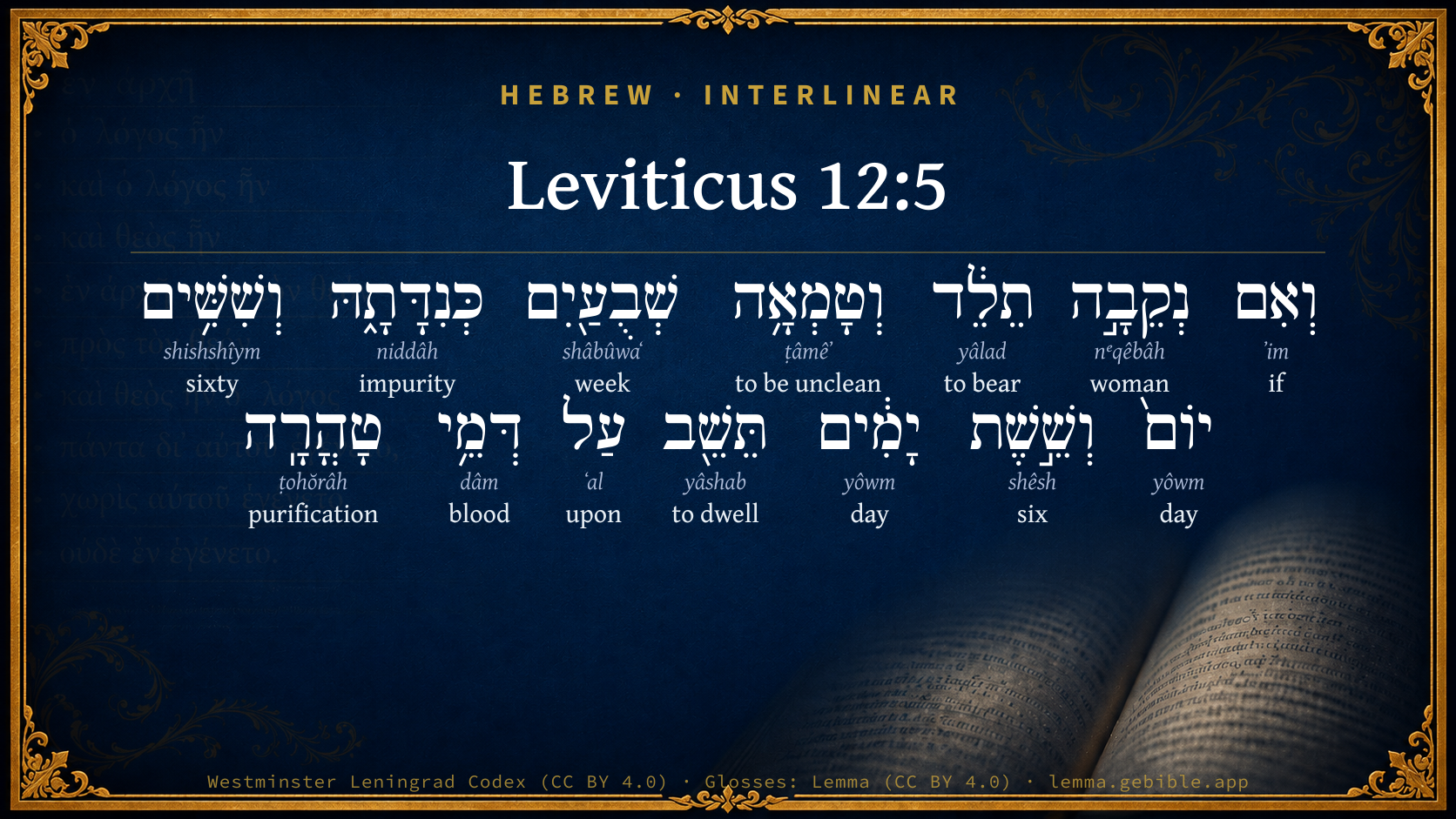
  1. וְאִם ʼim H518 “and · if” Conjunction + Conjunction
  2. נְקֵבָ֣ה nᵉqêbâh H5347 “woman” Noun, Common, Feminine, Singular, Absolute
  3. תֵלֵ֔ד yâlad H3205 “to bear” Verb, Qal, Imperfect, 3rd Person, Feminine, Singular
  4. וְטָמְאָ֥ה ṭâmêʼ H2930 “and · to be unclean” Conjunction + Verb, Qal, Sequential Perfect, 3rd Person, Feminine, Singular
  5. שְׁבֻעַ֖יִם shâbûwaʻ H7620 “weeks” Noun, Common, Masculine, Dual, Absolute
  6. כְּנִדָּתָ֑הּ niddâh H5079 “like/as · impurity · her” Preposition + Noun, Common, Feminine, Singular, Construct + Suffix, Personal, 3rd Person, Feminine, Singular
  7. וְשִׁשִּׁ֥ים shishshîym H8346 “and · sixty” Conjunction + Adjective, Cardinal number, Both, Plural, Absolute
  8. יוֹם֙ yôwm H3117 “day” Noun, Common, Masculine, Singular, Absolute
  9. וְשֵׁ֣שֶׁת shêsh H8337 “and · six” Conjunction + Adjective, Cardinal number, Masculine, Singular, Construct
  10. יָמִ֔ים yôwm H3117 “days” Noun, Common, Masculine, Plural, Absolute
  11. תֵּשֵׁ֖ב yâshab H3427 “to dwell” Verb, Qal, Imperfect, 3rd Person, Feminine, Singular
  12. עַל ʻal H5921 “upon” Preposition
  13. דְּמֵ֥י dâm H1818 “blood of” Noun, Common, Masculine, Plural, Construct

About this verse

These counts appear in no published source. They are computed here, from the morphology-tagged text and Lemma’s own curated glosses. What Lemma adds →

14
words
13
distinct lemmas
Pentateuch
section

Notable vocabulary

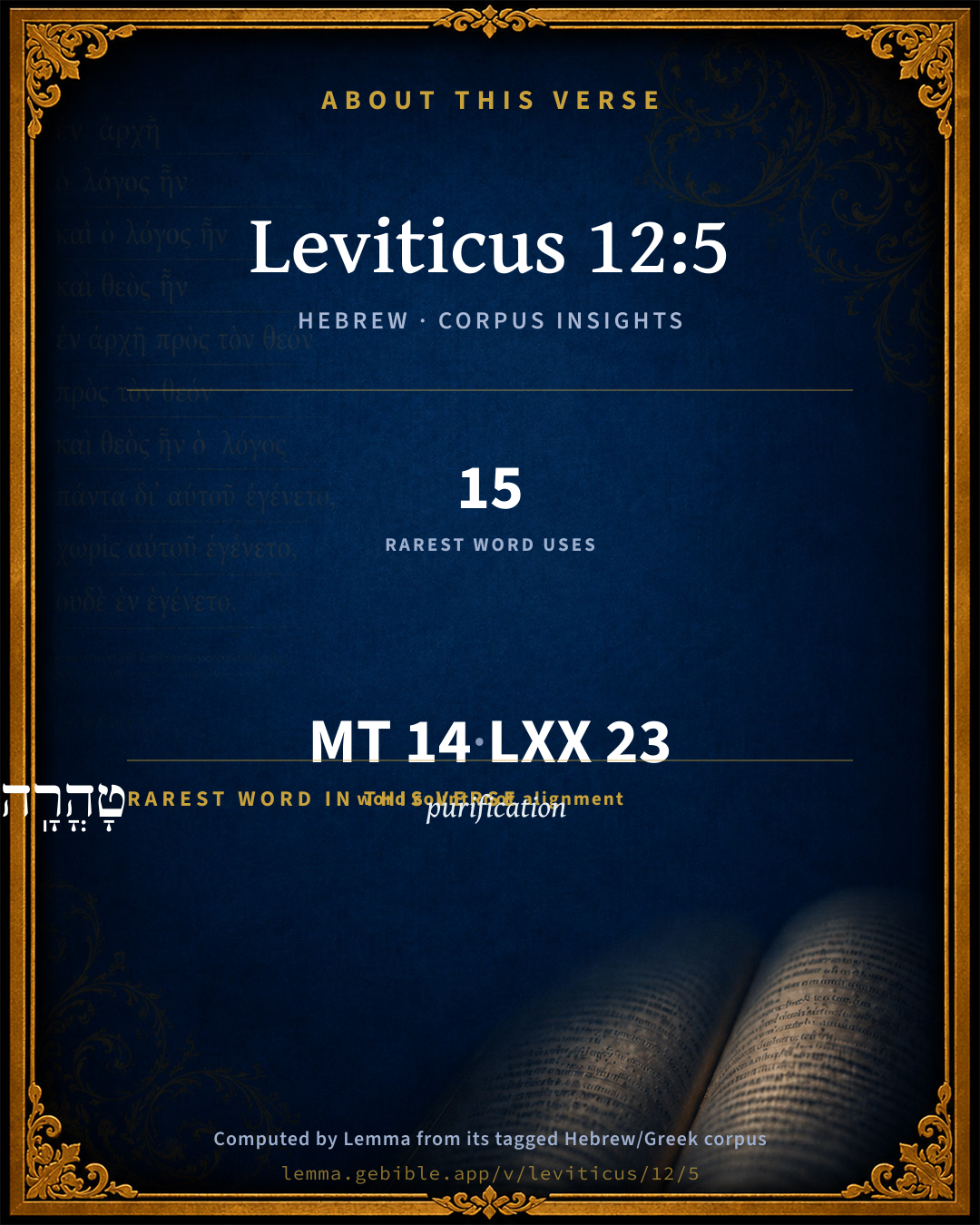
The rarest word here is טָהֳרָֽה purification H2893 — appearing just 15 times in the whole Hebrew Bible.

Shared distinctive vocabulary

טָהֳרָֽה purification H2893 occurs in 14 verses of the Hebrew Bible. Also found in:

Grammatical profile

  • 3 verbs
  • 7 nouns
  • 2 adjectives
  • 1 preposition
  • 1 conjunction

Verb forms

  • תֵלֵ֔ד Qal · Imperfect
  • וְטָמְאָ֥ה Qal · Sequential Perfect
  • תֵּשֵׁ֖ב Qal · Imperfect

Repetition

A word recurs within this verse — often emphatic in Hebrew:

  • יוֹם֙ day H3117 ×2

Hebrew & Septuagint length

In English translation the verse runs 29 words from the Hebrew and 36 from the Septuagint (LXX English) — closely comparable.

A rough comparison of the two English renderings, which tokenize alike — not a word-level alignment.

Word counts can differ between the Hebrew and the Greek without any difference in meaning — e.g. the Hebrew direct-object marker אֵת has no separate Greek word, and Greek often adds the article ὁ.

In the original languages it is 14 Hebrew tokens and 23 Greek tokens — but the two are counted differently (Hebrew bundles its prefixes and suffixes into one token; the Greek is in lemma form), so that isn’t a like-for-like length.

Cross-references

4

Topical passages linked to Leviticus 12:5 in the Treasury of Scripture Knowledge — connected by theme and wording, ordered by reader-vote popularity; previews shown in the World English Bible.

  • Genesis 3:13 Yahweh God said to the woman, "What is this you have done?" The woman said, "The serpent deceived me, and I ate."
  • Leviticus 12:2 "Speak to the children of Israel, saying, 'If a woman conceives, and bears a male child, then she shall be unclean seven days; as in the days of her monthly period she shall be unclean.
  • Leviticus 12:4 She shall continue in the blood of purification thirty-three days. She shall not touch any holy thing, nor come into the sanctuary, until the days of her purifying are completed.
  • 1 Timothy 2:14–15 Adam wasn't deceived, but the woman, being deceived, has fallen into disobedience;

Cross-references courtesy of OpenBible.info (CC BY 4.0).

Hebrew and Greek witnesses Masoretic Hebrew ↔ Greek Septuagint

The same verse in the two great witnesses to the Old Testament, shown verse-for-verse.

These are two independent witnesses, not word-aligned to each other, and the Septuagint is shown in lemma (dictionary) form.

Hebrew Leviticus 12:5 Masoretic · Westminster Leningrad Codex

וְאִם נְקֵבָ֣ה תֵלֵ֔ד וְטָמְאָ֥ה שְׁבֻעַ֖יִם כְּנִדָּתָ֑הּ וְשִׁשִּׁ֥ים יוֹם֙ וְשֵׁ֣שֶׁת יָמִ֔ים תֵּשֵׁ֖ב עַל דְּמֵ֥י טָהֳרָֽה

But if she bears a female child, then she shall be unclean two weeks, as in her period; and she shall continue in the blood of purification sixty-six days.

World English Bible · Public Domain

Greek LXX Leviticus 12:5 Septuagint · lemma form

ἐάν δέ θῆλυς τίκτω καί ἀκάθαρτος εἰμί δίς ἑπτά ἡμέρα κατά ὁ ἄφεδρος καί ἑξήκοντα ἡμέρα καί ἕξ καταἕζομαι ἐν αἷμα ἀκάθαρτος αὐτός

But if she should have born a female child, then she shall be unclean twice seven days, according to the time of her monthly courses; and for sixty-six days shall she remain in her unclean blood.

LXX2012 (modern English Septuagint) · Public Domain

On this verse, John Gill's Exposition discusses the Septuagint’s reading. Read the note in Commentary ↓

Hebrew: Westminster Leningrad Codex (CC BY 4.0). Greek: Septuagint (public domain); English from LXX2012 (modern English Septuagint) (Public Domain). How the Septuagint differs from the Hebrew →

Targum (Aramaic paraphrase)

2

The Targum is the ancient Jewish Aramaic paraphrase of the Hebrew Scriptures — an interpretive translation, not the Hebrew text itself. Onkelos (literal) and Pseudo-Jonathan (expansive) render the Torah, and Jonathan the Prophets. Coverage is partial: where no permissively-licensed English translation exists for a verse, only the Aramaic is shown. This is verse-level text, not a word-by-word alignment to the Hebrew.

  1. Targum Onkelos Torah (Genesis–Deuteronomy)
    וְאִם נְקוּבְתָא תְלִיד וּתְהֵי מְסָאָבָא אַרְבְּעָה עֲסַר כְּרִחוּקַהּ וְשִׁתִּין וְשִׁתָּא יוֹמִין תֵּיתֵב עַל דַם דְכוּ

    (no public-domain English translation for this verse)

    Targum Onkelos — Aramaic: “Onkelos Genesis” (public domain); “Onkelos Exodus” (public domain); “Onkelos Leviticus” (public domain); “Onkelos Numbers” (public domain); “Onkelos Deuteronomy” (public domain). English: “Sefaria Community Translation” (CC0 1.0 (public-domain dedication)); “J.W. Etheridge. The Targums of Onkelos and Jonathan Ben Uzziel on the Pentateuch. London: Longmans, Green, 1862” (public domain). Text via Sefaria.

  2. Targum Pseudo-Jonathan Torah (Genesis–Deuteronomy)
    וְאִין בְּרַת נוּקְבָא תְלִיד וּתְהֵי מְסָאֲבָא אַרְבֵּסְרֵי יוֹמִין רְצִיפִין הֵי כְּרִיחוּקָהּ וּבַחֲמֵיסַר תִּישְׁתְּרֵי וְשִׁיתִּין וְשִׁיתָּא יוֹמִין רְצִיפִין תְהֵי עַל דְמָהָא דַכְיָין

    And if she hath borne a daughter, she shall be unclean fourteen continuous days according to (the law of) her separation; and on the fifteenth she shall be released; but sixty and six continuous days shall she have for the (full) purification of the blood.

    Targum Pseudo-Jonathan — Aramaic: “Targum Jonathan on Genesis” (public domain); “Targum Jonathan on Exodus” (public domain); “Targum Jonathan on Leviticus” (public domain); “Targum Jonathan on Numbers” (public domain); “Targum Jonathan on Deuteronomy” (public domain). English: “The Targum of Jonathan ben Uzziel, trans. J. W. Etheridge, London, 1862” (public domain). Text via Sefaria.

Commentary

Notes on Leviticus 12:5 from classic Christian and Jewish commentators (each source and its license shown beneath its notes). The classic Christian expositions comment on the surrounding passage and are grouped to its opening verse, so a note may address several verses; the Jewish commentaries on the Tanakh (Rashi and others) are per-verse, so they appear only where the commentator wrote on this verse.

Lemma curates 59 commentaries, every one of them public domain or Creative Commons licensed, each selected and text-cleaned for this edition rather than reprinted as found. About our sources →

Trapp's Complete Commentary

John Trapp

Lev 12:5 But if she bear a maid child, then she shall be unclean two weeks, as in her separation: and she shall continue in the blood of her purifying threescore and six days.

Ver. 5. But if she bear a maid child.] To intimate, it may be, the woman’s being first in the transgression. {1Ti 2:14}

John Trapp, A Commentary or Exposition upon All the Books of the Old and New Testament (1647–1656) — public domain. Text from a community e-Sword module.

Joseph Benson's Commentary

Lev 12:5. Threescore and six days — The time in both particulars is double to the former; the law, as some think, being adapted to a received opinion that women are sooner purified after the birth of males than of females; an opinion which, however questioned, Grotius shows to be supported by no less authority than that of Aristotle and Hippocrates. Others, however, suppose that this difference was made to put an honour on the ordinance of circumcision, which, being administered to the males, put an end to that pollution sooner than otherwise would have been the case.

Joseph Benson's Commentary on the Old and New Testaments (1811–1818) — public domain. Text from a community e-Sword module.

Tyndale Open Study Notes

Tyndale Open Resources

12:5 two weeks . . . sixty-six days: The total is eighty days, double the time required for the birth of a son (see also 27:2-7).

Tyndale Open Study Notes — © Tyndale Open Resources, licensed CC BY-SA 4.0. Text via the HelloAO Bible API.

Geneva Bible (1599)

Geneva Bible translators

Twice so long as if she bare a man-child.

Geneva Bible (1599) marginal notes — public domain. Text via Bolls.life.

Ellicott's Commentary for English Readers

(5) But if she bear a maid child.—Better, but if she giveth birth to a female child. (See Lev_12:2.)

As in her separation.—Better, as in the time of her monthly courses. (See Lev_12:2.) In the case of a daughter the days of purification in both stages is exactly double that prescribed at the birth of a son. The reason for this difference is probably owing to the fact that the ancients believed that the physical derangement of the system is far greater at the birth of a girl than at the birth of a boy, and that it requires a longer time for the effects to pass away. Similar laws obtained among other nations of antiquity, and exist to this day among many Eastern tribes. The Greeks held that the man who had been near a woman in childbirth defiled the altar if he approached it. One of the means adopted during the Peloponnesian war for purifying the island of Delos was to proscribe women keeping their confinement on the island. The Hindoos go so far as to regard all the relations of a new-born child as impure; the father has to undergo lustrations, and the mother remains unclean till the tenth day, when the child receives its name. Among the Arabs the mother continues unclean for forty days.

In the blood of her purifying.—Better, in the blood of purification, that is, pure blood. (See Lev_12:4.) It will be seen that the law here only legislates for ordinary cases, and that it passes over in silence cases of twins. The administrators of the law during the second Temple had therefore, in this instance, as in many other points, to supplement the Mosaic legislation. They therefore enacted that when a mother had twins, and if they were a boy and a girl, the two stages of her uncleanness were those for a girl. If one of the twins was a boy and the other sexless, or bi-sexual, she continued unclean for both male and female. If, on the contrary, one was a female and the other of neither sex, or bi-sexual, her separation was only for a female.

A Bible Commentary for English Readers, edited by Charles John Ellicott (1878–1897) — public domain. Text from a community e-Sword module.

John Gill's Exposition

And when the days of her purifying are fulfilled, for a son, or for a daughter,.... For a son forty days, and for a daughter eighty; but the ancient Jews formerly, that they might not break it, ordered, that the offering enjoined as follows should not be brought until the next day after the time was up: their canon runs thus (t),"a new mother does not bring her offering on the fortieth day for a male, nor on the eightieth day for a female, but after her sun is set; and she brings her offering on the morrow, which is the forty first for a male, and the eighty first for a female; and this is the day of which it is said, "when the days", &c. Lev 12:6."

She shall bring a lamb of the first year; the Septuagint adds, without blemish, as all sacrifices should be, if not expressed; "or the son of his year" (u); some distinguish between "the son of a year", as the phrase sometimes is, and "the son of his year", as here; the latter denoting a lamb in its first year, though something wanting of it, the former a full year old, neither more nor less:

for a burnt offering; in gratitude, and by way of thanksgiving for the mercies she had received in childbearing:

and a young pigeon, or a turtledove, for a sin offering; either the one or the other. With the Persians (w), it is incumbent on a new mother, in Abam (the twelfth month), to bring twelve oblations for the sin which proceedeth from childbirth, that so she might be purified from her sins. It is an observation of the Misnic doctors (x), that turtles precede pigeons in all places; upon which they ask this question, is it because they are choicer or more excellent than they? observe what is said, Lev 12:6 from whence may be learned, that they are both alike, or of equal value. But why a sin offering for childbearing? is it sinful to bear and bring forth children in lawful marriage, where the bed is undefiled? The Jews commonly refer this to some sin or another, that the childbearing woman has been guilty of in relation to childbirth, or while in her labour; and it is not unlikely that she may sometimes be guilty of sin in some way or other, either through an immoderate desire after children, or through impatience and breaking out into rash expressions in the midst of her pains; so Aben Ezra suggests, perhaps some thought rose up in her mind in the hour of childbirth because of pain, or perhaps spoke with her mouth; meaning what was unbecoming, rash, and sinful. Some take the sin to be a rash and false oath: but there seems to be something more than all this, because though one or other of these might be the case of some women, yet not all; whereas this law is general, and reached every new mother, and has respect not so much to any particular sin of her's, as of her first parent Eve, who was first in the transgression; and on account of which transgression pains are endured by every childbearing woman; and who also conceives in sin, and is the instrument of propagating the corruption of nature to her offspring; and therefore was to bring a sin offering typical of the sin offering Christ is made to take away that, and all other sin; whereby she shall be saved, even in childbearing, and that by the birth of a child, the child Jesus, if she continues in faith, and charity, and holiness, with sobriety, Ti1 2:15 these offerings were to be brought

unto the door of the tabernacle of the congregation, unto the priest; to offer them up for her. When the temple was built, these were brought to the eastern gate, the gate Nicanor, where the lepers were cleansed, and new mothers purified (y).

(t) Maimon. Mechosre Capparah, c. 1. sect. 5. (u) "filium sui anni", Montanus, Piscator, Drusius. (w) Lib. Shad-der, port. 73. apud Hyde, ut supra, (Hist. Relig. Vet. Pers.) p. 473. (x) Misn. Ceritot. c. 6. sect. 9. (y) Misn. Sotah, c. 1. sect. 5.

John Gill's Exposition of the Whole Bible (1746–1763) — public domain (CC PDM 1.0). Text via the HelloAO Bible API.

Albert Barnes' Notes on the Bible

Some have thought that this doubling of each of the two periods was intended to remind the people of the fact that woman represents the lower side of human nature, and was the first to fall into temptation. 1Ti 2:13-15; 1Pe 3:7. The ancients had a notion that the mother suffers for a longer time after the birth of a girl than after the birth of a boy. The period required for the restoration of her health in the one case was thirty days, and in the other, it was 40 or 42 days. This notion may have been connected with a general custom of observing the distinction as early as the time of Moses.

Albert Barnes' Notes on the Bible (1834–1885) — public domain. Text from a community e-Sword/MySword module.

Haydock's Catholic Bible Commentary

Days. In all 80, double the time required for a male child, as they infirmities of women continue so much longer when they bear a female. (Vales. sac. Philos. c. xviii.) Hippocrates allows forty-two days for the one, and thirty for the other. --- Purification. Some copies of the Septuagint read, in her pure, others, in her impure blood; which Origen attempts to reconcile by observing, that she is deemed less impure during the last thirty-three or sixty-six days, than in the preceding ones. (Calmet) --- During these, she was treated almost like those who were under the greatest legal uncleanness. (Chap. xv.; Numbers v.) Those who were under the less, might enter the court of the Gentiles, and did not infect others by their touch. (Josephus, contra Apion 2.) (Tirinus)

George Leo Haydock (1774–1849), Haydock's Catholic Family Bible and Commentary, 1859 edition — public domain. Excludes Psalms (Douay-Rheims chapter numbering differs from Protestant) and Deuterocanonical books (Catholic canon only).

Matthew Poole's English Annotations

The time in both particulars is double to the former, not so much from natural causes, because the purifications in female births are longer and slower, which if it were true, yet doth not extend to any such time as here is mentioned, as for moral reasons; either to be as a blot upon that sex for being the first in man’s transgression, 1Ti 2:14, or to put an honour upon the sacrament of circumcision, which being administered to the males, did put an end to that pollution sooner than otherwise had been; or to show the privilege of the man above the woman, and that the women were to be purified, sanctified, and saved by one of the other sex, even by the man Christ Jesus, without whom they should have still continued in their impurity.

Matthew Poole's English Annotations on the Holy Bible (1683–1685) — public domain. Text from a community e-Sword/MySword module.

Whedon's Commentary on the Bible

Daniel D. Whedon

5. Maid child… threescore and six days — It has not pleased God to disclose the ground of this different legislation for the sexes by doubling the period of purification after the birth of a female child. The sexes are equally honoured in the decalogue. Though woman was first in transgression, sin is not thereby more deeply ingrained in her nature, for St. Paul implies that Eve’s sin was less heinous than Adam’s, inasmuch as she was deceived, while he transgressed with his eyes wide open to the character and consequences of his act. 1Ti_2:14. We are not satisfied with Keil’s theory, that the ancients supposed that the impure discharges continued longer after the birth of a girl. Since this is an attested physiological fact, the all-wise God did not inflict a needless disability of forty additional days. It may also have been that both mother and daughter required double time for purification as all equivalent to the circumcision of the male child.

Daniel D. Whedon (gen. ed.), Commentary on the Old and New Testaments (1874–1909) — public domain. Text from a community e-Sword module.

The Pulpit Commentary

If she bear a maid child, then she shall be unclean two weeks; ... and she shall continue in the blood of her purifying threescore and six days. The reason why the duration of the mother"s uncleanness is twice as long at a girl"s birth as at a boy"s, would appear to be that the uncleanness attached to the child as well as to the mother, but as the boy was placed in a state of ceremonial purity at once by the act of circumcision, which took place on the eighth day, he thereupon ceased to be unclean, anti the mother"s uncleanness alone remained; whereas in the case of a girl, both mother and child were unclean during the period that the former was "in the blood of her purifying," and therefore that period had to be doubly long. See Luk_2:20, where the right reading is, "When the days of their purification, according to the Law of Moses, were accomplished." For eight days the infant Saviour submitted to legal uncleanness in "fulfilling all righteousness", (Mat_3:15) and therefore the whole forty days were spoken of as "the days of their purification."

The Pulpit Commentary (1880–1919), ed. H.D.M. Spence-Jones & Joseph S. Exell — public domain. Text from a community e-Sword module.

John Wesley's Explanatory Notes

Threescore and six days - The time in both particulars is double to the former, not so much from natural causes, as to put an honour upon the sacrament of circumcision, which being administered to the males, did put an end to that pollution sooner than otherwise had been.

John Wesley, Explanatory Notes Upon the Whole Bible (1754–1765) — public domain. Text via the GEBible commentary corpus.

Keil & Delitzsch

C. F. Keil & F. Delitzsch

But if she had given birth to a girl, she was to be unclean two weeks (14 days), as in her menstruation, and then after that to remain at home 66 days. The distinction between the seven (or fourteen) days of the "separation for her infirmity," and the thirty-three (or sixty-six) days of the "blood of her purifying," had a natural ground in the bodily secretions connected with child-birth, which are stronger and have more blood in them in the first week (lochia rubra) than the more watery discharge of the lochia alba, which may last as much as five weeks, so that the normal state may not be restored till about six weeks after the birth of the child. The prolongation of the period, in connection with the birth of a girl, was also founded upon the notion, which was very common in antiquity, that the bleeding and watery discharge continued longer after the birth of a girl than after that of a boy (Hippocr. Opp. ed. Khn. i. p. 393; Aristot. h. an. 6, 22; 7, 3, cf. Burdach, Physiologie iii. p. 34). But the extension of the period to 40 and 80 days can only be accounted for from the significance of the numbers, which we meet with repeatedly, more especially the number forty (see at Exo 24:18).

Keil & Delitzsch — Biblical Commentary on the Old Testament (1861–1891) — public domain (CC PDM 1.0). Text via the HelloAO Bible API. (Old Testament only.)

Lesson kit

Teaching starters — assembled from the data on this page, not authored interpretation. Every prompt links to the verse data it draws on. Edit before teaching.

Leviticus, in the Pentateuch, opens this verse with 14 words (13 distinct Hebrew lemmas). Its most distinctive word is ṭohŏrâh (“purification”). A historical commentator’s framing appears above. Read the whole chapter for the surrounding context.

Discussion questions

  1. What does “purification” (ṭohŏrâh) contribute to the verse as a whole?
  2. Leviticus 12:4 shares the word «purification» with this verse. How do the two illuminate each other?
  3. “day” occurs 2× in this one verse. What is the effect of the repetition?
  4. These translations render this verse differently; the difference is in the English rendering, not the original. What questions does that raise?
  5. The verb «תֵלֵ֔ד» is Qal Imperfect. How does its form color the action?
  6. Reading how Trapp's Complete Commentary and Joseph Benson's Commentary read this verse, where do the two commentators agree and where do they part?

Things to notice

Reading settings

Reading text

Shown beneath each verse's original-language words.

Old Testament
Old Testament edition

Read the OT as the Masoretic Hebrew (MT) or the Greek Septuagint (LXX).

English shown for the Greek Septuagint (in the Hebrew ↔ Greek comparison).

Comparing translations? Open the Compare panel on any verse page to stack up to four side by side.