
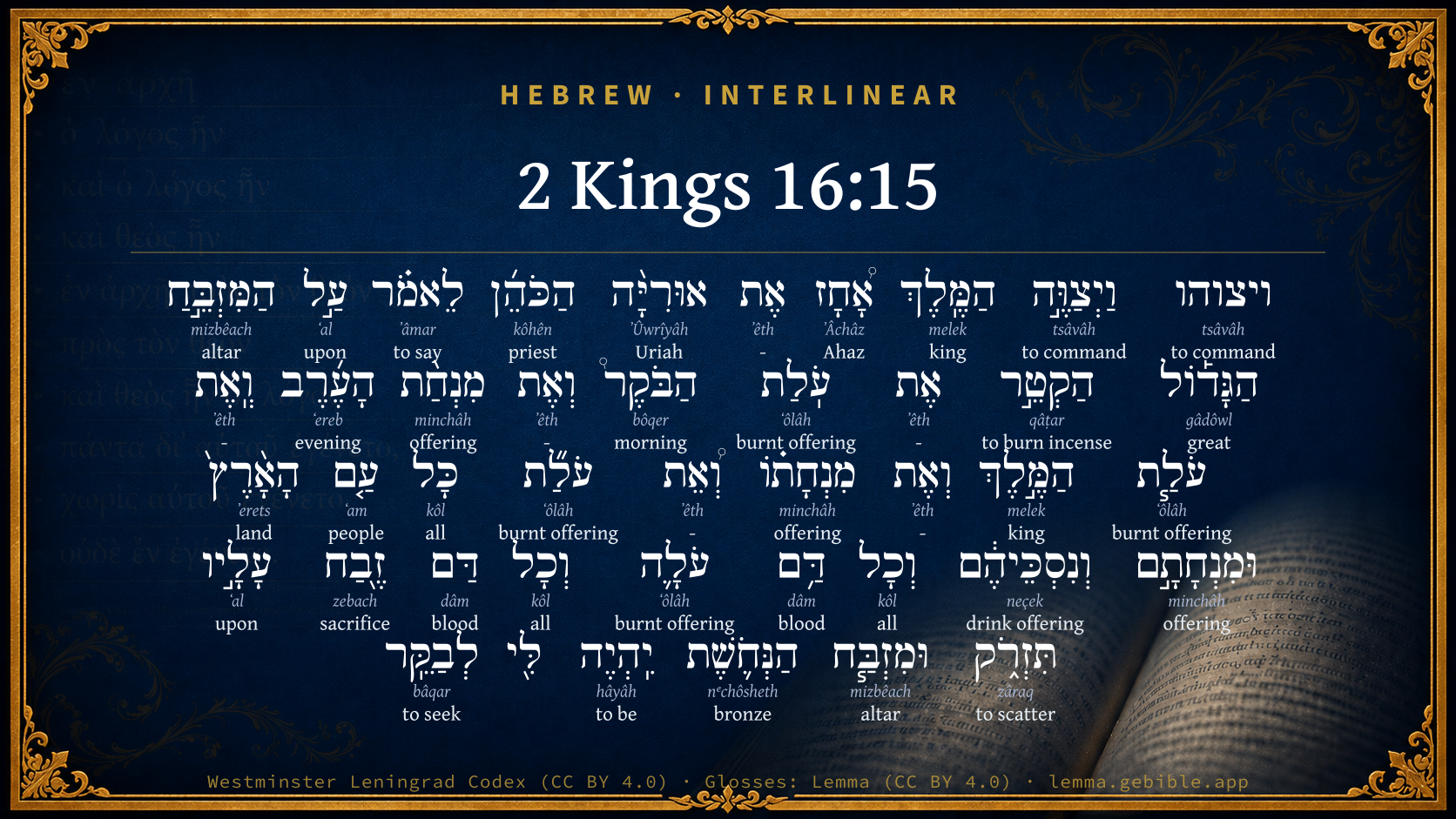
2 Kings 16:15

Hebrew (Westminster Leningrad Codex) 2 Kings 16:15 appears in the Hebrew Old Testament. The text above is from the Westminster Leningrad Codex. Each word links to its Strong’s number, a concise gloss, and parsing drawn from the Open Scriptures Hebrew Bible morphology. Click any word for its full Brown-Driver-Briggs (BDB) entry.
Download image
Cite this verse

2 Kings 16:15 (World English Bible). Public Domain. Lemma interlinear Bible study tool, https://lemma.gebible.app/v/2-kings/16/15.

Show BibTeX & RIS
BibTeX
RIS
English Translation
King Ahaz commanded Urijah the priest, saying, On the great altar burn the morning burnt offering, and the evening meal-offering, and the king's burnt offering, and his meal-offering, with the burnt offering of all the people of the land, and their meal-offering, and their drink-offerings; and sprinkle on it all the blood of the burnt offering, and all the blood of the sacrifice: but the brazen altar shall be for me to inquire by.
World English Bible · Public Domain
Download a study sheet

One document with this verse’s original text, its word-by-word gloss line, the meaning frame, cross-references with their text, attributed commentary, and full source and license credits — printable, and it pastes into notes with its structure intact.

This verse Autodidact and up

Study sheet (.html) Plain text (.txt)

A passage Seminary Student

Up to 50 verses in one chapter. A passage sheet keeps up to 6 commentary sources and 12 cross-references per verse, in the order this page ranks them, and says so on the sheet whenever that leaves anything out. Ask for a single verse and you get the Autodidact verse sheet above.

Everything on this page stays free to read, with no account — the sheet is a download of what is already on screen, not access to it.

Want to remove ads? Support Godless Engineer
Compare translations 3

The same verse in 3 English versions, stacked beneath the original-language interlinear above. Click any original word for its lexicon entry.

Each is an independent rendering of the whole verse — the interlinear is not word-aligned to these translations.

Highlighted words mark where these versions differ — a whole-verse word diff, not a word-by-word alignment.

  • World English Bible Public Domain
    King Ahaz commanded Urijah the priest, saying, On the great altar burn the morning burnt offering, and the evening meal-offering, and the king's burnt offering, and his meal-offering, with the burnt offering of all the people of the land, and their meal-offering, and their drink-offerings; and sprinkle on it all the blood of the burnt offering, and all the blood of the sacrifice: but the brazen altar shall be for me to inquire by.
  • King James Version Public Domain
    And king Ahaz commanded Urijah the priest, saying, Upon the great altar burn the morning burnt offering, and the evening meat offering, and the king's burnt sacrifice, and his meat offering, with the burnt offering of all the people of the land, and their meat offering, and their drink offerings; and sprinkle upon it all the blood of the burnt offering, and all the blood of the sacrifice: and the brazen altar shall be for me to enquire by.
  • unfoldingWord Literal Text CC BY-SA 4.0
    And King Ahaz commanded Uriah the priest, saying, “On the large altar burn the burnt offering of the morning and the grain offering of the evening and the burnt offering of the king and his grain offering and the burnt offering of all of the people of the land and their grain offering and their drink offerings. And you shall sprinkle on it all of the blood of the burnt offering and all of the blood of the sacrifice. But the altar of bronze will be for me to seek.”

unfoldingWord Literal Text — © unfoldingWord, licensed CC BY-SA 4.0. Word-aligned USFM3 via Door43 (git.door43.org/unfoldingWord/en_ult).

Versions to compare (up to 4)

3 of 4 selected

Show all 18 translations

Every available English version of this verse, each an independent rendering of the whole verse.

  • World English Bible Public Domain
    King Ahaz commanded Urijah the priest, saying, On the great altar burn the morning burnt offering, and the evening meal-offering, and the king's burnt offering, and his meal-offering, with the burnt offering of all the people of the land, and their meal-offering, and their drink-offerings; and sprinkle on it all the blood of the burnt offering, and all the blood of the sacrifice: but the brazen altar shall be for me to inquire by.
  • Berean Standard Bible Public Domain
    Then King Ahaz commanded Uriah the priest, “Offer on the great altar the morning burnt offering, the evening grain offering, and the king’s burnt offering and grain offering, as well as the burnt offerings, grain offerings, and drink offerings of all the people of the land. Sprinkle on the altar all the blood of the burnt offerings and sacrifices. But I will use the bronze altar to seek guidance.”
  • Majority Standard Bible Public Domain
    Then King Ahaz commanded Uriah the priest, “Offer on the great altar the morning burnt offering, the evening grain offering, and the king’s burnt offering and grain offering, as well as the burnt offerings, grain offerings, and drink offerings of all the people of the land. Splatter on the altar all the blood of the burnt offerings and sacrifices. But I will use the bronze altar to seek guidance.”
  • King James Version Public Domain
    And king Ahaz commanded Urijah the priest, saying, Upon the great altar burn the morning burnt offering, and the evening meat offering, and the king's burnt sacrifice, and his meat offering, with the burnt offering of all the people of the land, and their meat offering, and their drink offerings; and sprinkle upon it all the blood of the burnt offering, and all the blood of the sacrifice: and the brazen altar shall be for me to enquire by.
  • American Standard Version (1901) Public Domain
    And king Ahaz commanded Urijah the priest, saying, Upon the great altar burn the morning burnt-offering, and the evening meal-offering, and the king's burnt-offering, and his meal-offering, with the burnt-offering of all the people of the land, and their meal-offering, and their drink-offerings; and sprinkle upon it all the blood of the burnt-offering, and all the blood of the sacrifice: but the brazen altar shall be for me to inquire by.
  • Revised Version (1885) Public Domain
    And king Ahaz commanded Urijah the priest, saying, Upon the great altar burn the morning burnt offering, and the evening meal offering, and the king’s burnt offering, and his meal offering, with the burnt offering of all the people of the land, and their meal offering, and their drink offerings; and sprinkle upon it all the blood of the burnt offering, and all the blood of the sacrifice: but the brasen altar shall be for me to inquire by.
  • Geneva Bible (1599) Public Domain
    And King Ahaz commanded Vriiah the Priest, and sayde, Vpon the great altar set on fire in the morning the burnt offring, and in the euen the meate offring, and the Kings burnt offring and his meate offering, with the burnt offring of all the people of the lande, and their meate offring, and their drinke offrings: and powre thereby all the blood of the burnt offring, and all the blood of the sacrifice, and the brasen altar shalbe for me to inquire of God.
  • Douay-Rheims (1899) Public Domain
    And king Achaz commanded Urias the priest saying: Upon the great altar offer the morning holocaust, and the evening sacrifice, and the king's holocaust, and his sacrifice, and the holocaust of the whole people of the land, and their sacrifices, and their libations: and all the blood of the holocaust, and all the blood of the victim thou shalt pour out upon it: but the altar of brass shall be ready at my pleasure.
  • Young's Literal Translation Public Domain
    And king Ahaz commandeth him -- Urijah the priest -- saying, `On the great altar perfume the burnt-offering of the morning, and the present of the evening, and the burnt-offering of the king, and his present, and the burnt-offering of all the people of the land, and their present, and their libations; and all the blood of the burnt-offering, and all the blood of the sacrifice, on it thou dost sprinkle, and the altar of brass is to me to inquire `by'.'
  • Literal Standard Version CC BY-SA 4.0
    And King Ahaz commands him—Urijah the priest—saying, “On the great altar burn as incense the burnt-offering of the morning, and the present of the evening, and the burnt-offering of the king, and his present, and the burnt-offering of all the people of the land, and their present, and their drink-offerings; and all the blood of the burnt-offering, and all the blood of the sacrifice, you sprinkle on it, and the altar of bronze is for me to inquire [by].”
  • Unlocked Literal Bible CC BY-SA 4.0
    Then King Ahaz commanded Uriah the priest, saying, “On the large altar burn the morning burnt offering and the evening grain offering, and the king's burnt offering and his grain offering, with the burnt offering of all the people of the land, and their grain offering and their drink offerings. Sprinkle on it all the blood of the burnt offering, and all the blood of the sacrifice. But the bronze altar will be for me to consult for guidance.”
  • unfoldingWord Literal Text CC BY-SA 4.0
    And King Ahaz commanded Uriah the priest, saying, “On the large altar burn the burnt offering of the morning and the grain offering of the evening and the burnt offering of the king and his grain offering and the burnt offering of all of the people of the land and their grain offering and their drink offerings. And you shall sprinkle on it all of the blood of the burnt offering and all of the blood of the sacrifice. But the altar of bronze will be for me to seek.”
  • Darby Bible Public Domain
    And king Ahaz commanded Urijah the priest saying, Upon the great altar burn the morning burnt-offering, and the evening oblation, and the king's burnt-offering, and his oblation, and the burnt-offering of all the people of the land, and their oblation, and their drink-offerings; and sprinkle upon it all the blood of the burnt-offerings, and all the blood of the sacrifices; and the brazen altar shall be for me to inquire [by].
  • World Messianic Bible Public Domain
    King Ahaz commanded Urijah the priest, saying, “On the great altar burn the morning burnt offering, the evening meal offering, the king’s burnt offering and his meal offering, with the burnt offering of all the people of the land, their meal offering, and their drink offerings; and sprinkle on it all the blood of the burnt offering, and all the blood of the sacrifice; but the bronze altar will be for me to inquire by.”
  • Webster's Bible Public Domain
    And king Ahaz commanded Urijah the priest, saying, Upon the great altar burn the morning burnt-offering, and the evening meat-offering, and the king's burnt-sacrifice, and his meat-offering, with the burnt-offering of all the people of the land, and their meat-offering, and their drink-offerings; and sprinkle upon it all the blood of the burnt-offering, and all the blood of the sacrifice: and the brazen altar shall be for me to inquire by.
  • Free Bible Version CC BY-SA 4.0
    Then King Ahaz ordered Uriah the priest: “Use this new important altar to offer the morning burnt offering, the evening grain offering, the king's burnt offering and grain offering, and the burnt offering of all the people, and their grain offerings and their drink offerings. Sprinkle on this altar the blood of all the burnt offerings and sacrifices. The old bronze altar I'll use for divination.”
  • Bible in Basic English Public Domain
    And King Ahaz gave orders to Urijah the priest, saying, Make the morning burned offering and the evening meal offering and the king's burned offering and meal offering, with the burned offerings of all the people and their meal offerings and drink offerings, on the great altar, and put on it all the blood of the burned offerings and of the beasts which are offered; but the brass altar will be for my use to get directions from the Lord.
  • JPS Tanakh (1917) Public Domain
    And king Ahaz commanded Urijah the priest, saying: 'Upon the great altar offer the morning burnt-offering, and the evening meal-offering, and the king's burnt-offering, and his meal-offering, with the burnt-offering of all the people of the land, and their meal-offering, and their drink-offerings; and dash against it all the blood of the burnt-offering, and all the blood of the sacrifice; but the brazen altar shall be for me to look to.'

Literal Standard Version (2020), Covenant Press — licensed CC BY-SA 4.0. Text via the HelloAO Bible API (eBible.org). Unlocked Literal Bible (unfoldingWord) — licensed CC BY-SA 4.0. Text via the HelloAO Bible API (eBible.org). unfoldingWord Literal Text — © unfoldingWord, licensed CC BY-SA 4.0. Word-aligned USFM3 via Door43 (git.door43.org/unfoldingWord/en_ult). Free Bible Version, Dr. Jonathan Gallagher — licensed CC BY-SA 4.0. Text via the HelloAO Bible API (eBible.org).

Word by word

More ways to search: Search by grammar → Find every occurrence → Compare this word →

Practice this passage: Drill this verse → Learn its vocabulary →

לְבַקֵּֽר
bâqar
H1239
“to seek”
Preposition + Verb, Piel, Infinitive Construct
Part of Speech
Preposition + Verb
Stem
Piel
Form
Infinitive Construct
Full BDB Definition

Origin: a primitive root

TWOT: 274

to seek, enquire, consider - (Piel) - to seek, look for - to consider, reflect
  1. ויצוהו tsâvâh H6680 “and · to command · him” Conjunction + Verb, Piel, Sequential Imperfect, 3rd Person, Masculine, Singular + Suffix, Personal, 3rd Person, Masculine, Singular
  2. וַיְצַוֶּ֣ה tsâvâh H6680 “and · to command” Conjunction + Verb, Piel, Sequential Imperfect, 3rd Person, Masculine, Singular
  3. הַמֶּֽלֶךְ melek H4428 “the · king” Particle, Definite Article + Noun, Common, Masculine, Singular, Absolute
  4. אָ֠חָז ʼÂchâz H271 “Ahaz” Noun, Proper
  5. אֶת ʼêth H853 “-” Particle, Direct Object
  6. אוּרִיָּ֨ה ʼÛwrîyâh H223 “Uriah” Noun, Proper
  7. הַכֹּהֵ֜ן kôhên H3548 “the · priest” Particle, Definite Article + Noun, Common, Masculine, Singular, Absolute
  8. לֵאמֹ֗ר ʼâmar H559 “to say” Preposition + Verb, Qal, Infinitive Construct
  9. עַ֣ל ʻal H5921 “upon” Preposition
  10. הַמִּזְבֵּ֣חַ mizbêach H4196 “the · altar” Particle, Definite Article + Noun, Common, Masculine, Singular, Absolute
  11. הַגָּד֡וֹל gâdôwl H1419 “the · great” Particle, Definite Article + Adjective, Adjective, Masculine, Singular, Absolute
  12. הַקְטֵ֣ר qâṭar H6999 “burn incense” Verb, Hiphil, Imperative, 2nd Person, Masculine, Singular
  13. אֶת ʼêth H853 “-” Particle, Direct Object
  14. עֹֽלַת ʻôlâh H5930 “burnt offering of” Noun, Common, Feminine, Singular, Construct
  15. הַבֹּקֶר֩ bôqer H1242 “the · morning” Particle, Definite Article + Noun, Common, Masculine, Singular, Absolute
  16. וְאֶת ʼêth H853 “and · -” Conjunction + Particle, Direct Object
  17. מִנְחַ֨ת minchâh H4503 “offering of” Noun, Common, Feminine, Singular, Construct
  18. הָעֶ֜רֶב ʻereb H6153 “the · evening” Particle, Definite Article + Noun, Common, Masculine, Singular, Absolute
  19. וְֽאֶת ʼêth H853 “and · -” Conjunction + Particle, Direct Object
  20. עֹלַ֧ת ʻôlâh H5930 “burnt offering of” Noun, Common, Feminine, Singular, Construct
  21. הַמֶּ֣לֶךְ melek H4428 “the · king” Particle, Definite Article + Noun, Common, Masculine, Singular, Absolute
  22. וְאֶת ʼêth H853 “and · -” Conjunction + Particle, Direct Object
  23. מִנְחָת֗וֹ minchâh H4503 “offering · his” Noun, Common, Feminine, Singular, Construct + Suffix, Personal, 3rd Person, Masculine, Singular
  24. וְ֠אֵת ʼêth H853 “and · -” Conjunction + Particle, Direct Object
  25. עֹלַ֞ת ʻôlâh H5930 “burnt offering of” Noun, Common, Feminine, Singular, Construct
  26. כָּל kôl H3605 “all of” Noun, Common, Masculine, Singular, Construct
  27. עַ֤ם ʻam H5971 “people of” Noun, Common, Masculine, Singular, Construct
  28. הָאָ֨רֶץ֙ ʼerets H776 “the · land” Particle, Definite Article + Noun, Common, Both, Singular, Absolute
  29. וּמִנְחָתָ֣ם minchâh H4503 “and · offering · their” Conjunction + Noun, Common, Feminine, Singular, Construct + Suffix, Personal, 3rd Person, Masculine, Plural
  30. וְנִסְכֵּיהֶ֔ם neçek H5262 “and · drink offerings · their” Conjunction + Noun, Common, Masculine, Plural, Construct + Suffix, Personal, 3rd Person, Masculine, Plural
  31. וְכָל kôl H3605 “and · all of” Conjunction + Noun, Common, Masculine, Singular, Construct
  32. דַּ֥ם dâm H1818 “blood of” Noun, Common, Masculine, Singular, Construct
  33. עֹלָ֛ה ʻôlâh H5930 “burnt offering” Noun, Common, Feminine, Singular, Absolute
  34. וְכָל kôl H3605 “and · all of” Conjunction + Noun, Common, Masculine, Singular, Construct
  35. דַּם dâm H1818 “blood of” Noun, Common, Masculine, Singular, Construct
  36. זֶ֖בַח zebach H2077 “sacrifice” Noun, Common, Masculine, Singular, Absolute
  37. עָלָ֣יו ʻal H5921 “upon · him” Preposition + Suffix, Personal, 3rd Person, Masculine, Singular
  38. תִּזְרֹ֑ק zâraq H2236 “to scatter” Verb, Qal, Imperfect, 2nd Person, Masculine, Singular
  39. וּמִזְבַּ֧ח mizbêach H4196 “and · altar of” Conjunction + Noun, Common, Masculine, Singular, Construct
  40. הַנְּחֹ֛שֶׁת nᵉchôsheth H5178 “the · bronze” Particle, Definite Article + Noun, Common, Feminine, Singular, Absolute
  41. יִֽהְיֶה hâyâh H1961 “to be” Verb, Qal, Imperfect, 3rd Person, Masculine, Singular

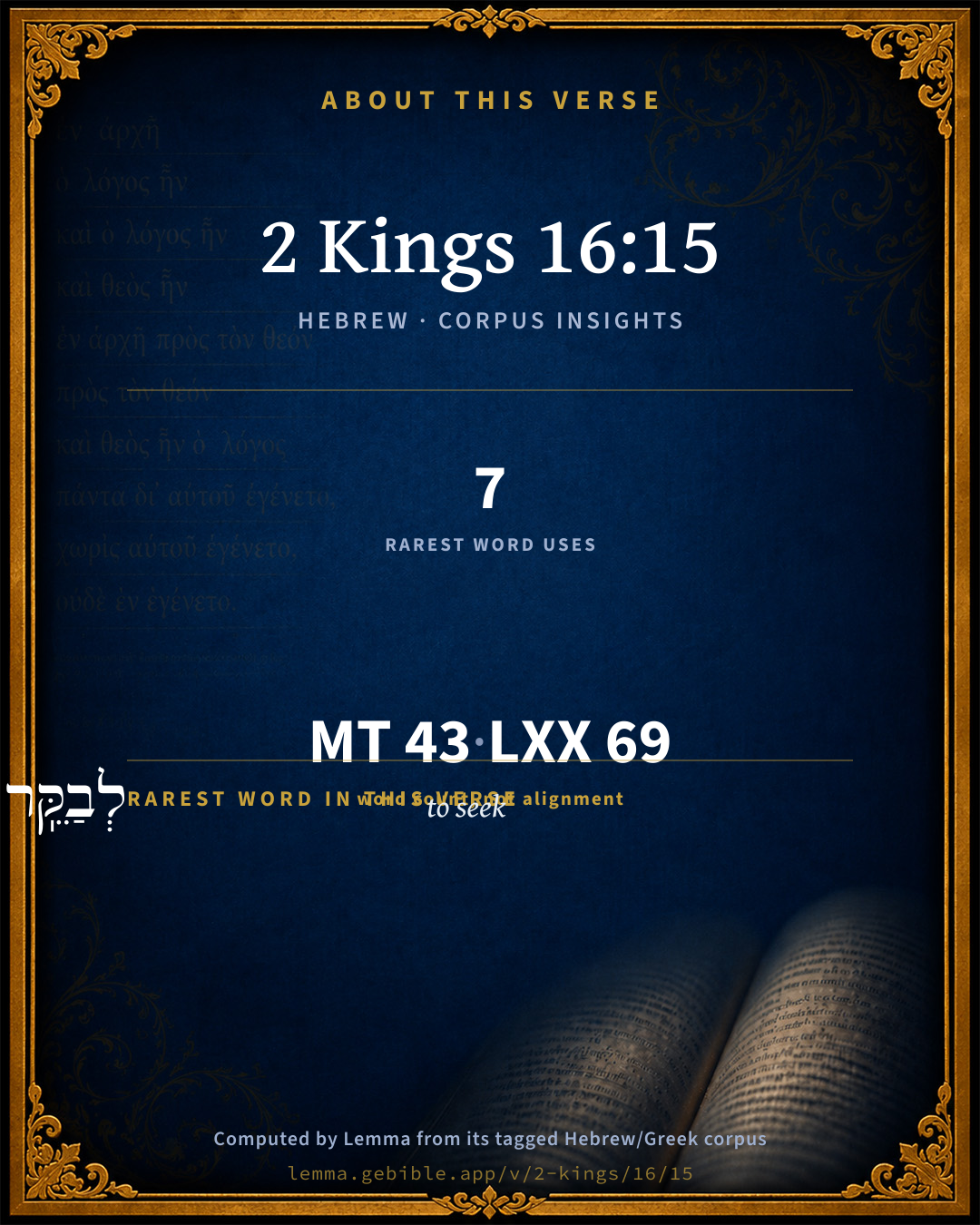
About this verse

These counts appear in no published source. They are computed here, from the morphology-tagged text and Lemma’s own curated glosses. What Lemma adds →

43
words
25
distinct lemmas
Historical
section

Notable vocabulary

The rarest word here is לְבַקֵּֽר to seek H1239 — appearing just 7 times in the whole Hebrew Bible.

Shared distinctive vocabulary

לְבַקֵּֽר to seek H1239 occurs in 7 verses of the Hebrew Bible. Also found in:

Grammatical profile

  • 7 verbs
  • 26 nouns
  • 1 adjective
  • 3 prepositions
  • 6 particles

Verb forms

  • ויצוהו Piel · Sequential Imperfect
  • וַיְצַוֶּ֣ה Piel · Sequential Imperfect
  • לֵאמֹ֗ר Qal · Infinitive Construct
  • הַקְטֵ֣ר Hiphil · Imperative
  • תִּזְרֹ֑ק Qal · Imperfect
  • יִֽהְיֶה Qal · Imperfect
  • לְבַקֵּֽר Piel · Infinitive Construct

Repetition

Words recur within this verse — often emphatic in Hebrew:

  • עֹֽלַת burnt offering H5930 ×4
  • מִנְחַ֨ת offering H4503 ×3
  • כָּל all H3605 ×3
  • ויצוהו to command H6680 ×2
  • הַמֶּֽלֶךְ king H4428 ×2
  • עַ֣ל upon H5921 ×2
  • הַמִּזְבֵּ֣חַ altar H4196 ×2
  • דַּ֥ם blood H1818 ×2

Hebrew & Septuagint length

In English translation the verse runs 74 words from the Hebrew and 85 from the Septuagint (LXX English) — closely comparable.

A rough comparison of the two English renderings, which tokenize alike — not a word-level alignment.

Word counts can differ between the Hebrew and the Greek without any difference in meaning — e.g. the Hebrew direct-object marker אֵת has no separate Greek word, and Greek often adds the article ὁ.

In the original languages it is 43 Hebrew tokens and 69 Greek tokens — but the two are counted differently (Hebrew bundles its prefixes and suffixes into one token; the Greek is in lemma form), so that isn’t a like-for-like length.

Cross-references

23

Topical passages linked to 2 Kings 16:15 in the Treasury of Scripture Knowledge — connected by theme and wording, ordered by reader-vote popularity; previews shown in the World English Bible.

  • Exodus 29:39–41 The one lamb you shall offer in the morning; and the other lamb you shall offer at evening:
  • 1 Kings 8:64 The same day did the king make the middle of the court holy that was before the house of Yahweh; for there he offered the burnt offering, and the meal-offering, and the fat of the peace-offerings, because the brazen altar that was before Yahweh was too little to receive the burnt offering, and the meal-offering, and the fat of the peace-offerings.
  • 2 Kings 18:4 He removed the high places, and broke the pillars, and cut down the Asherah: and he broke in pieces the brazen serpent that Moses had made; for to those days the children of Israel did burn incense to it; and he called it Nehushtan.
  • 2 Chronicles 29:21–24 They brought seven bulls, and seven rams, and seven lambs, and seven male goats, for a sin-offering for the kingdom and for the sanctuary and for Judah. He commanded the priests the sons of Aaron to offer them on the altar of Yahweh.
  • Genesis 44:5 Isn't this that from which my lord drinks, and by which he indeed divines? You have done evil in so doing.'"
  • Leviticus 4:13–26 "'If the whole congregation of Israel sins, and the thing is hidden from the eyes of the assembly, and they have done any of the things which Yahweh has commanded not to be done, and are guilty;
  • Numbers 28:2–10 Command the children of Israel, and tell them, My offering, my food for my offerings made by fire, of a sweet savor to me, shall you observe to offer to me in their due season.
  • 2 Samuel 6:17–18 They brought in the ark of Yahweh, and set it in its place, in the midst of the tent that David had pitched for it; and David offered burnt offerings and peace-offerings before Yahweh.
  • 1 Kings 3:4 The king went to Gibeon to sacrifice there; for that was the great high place: a thousand burnt offerings did Solomon offer on that altar.
  • 2 Kings 3:20 It happened in the morning, about the time of offering the offering, that behold, there came water by the way of Edom, and the country was filled with water.
  • 2 Kings 16:14 The brazen altar, which was before Yahweh, he brought from the forefront of the house, from between his altar and the house of Yahweh, and put it on the north side of his altar.
  • 2 Chronicles 7:4–5 Then the king and all the people offered sacrifice before Yahweh.
  • 2 Chronicles 29:32 The number of the burnt offerings which the assembly brought was seventy bulls, one hundred rams, and two hundred lambs: all these were for a burnt offering to Yahweh.
  • 2 Chronicles 29:35 Also the burnt offerings were in abundance, with the fat of the peace-offerings, and with the drink-offerings for every burnt offering. So the service of the house of Yahweh was set in order.
  • 2 Chronicles 33:6 He also made his children to pass through the fire in the valley of the son of Hinnom; and he practiced sorcery, and used enchantments, and practiced sorcery, and dealt with those who had familiar spirits, and with wizards: he worked much evil in the sight of Yahweh, to provoke him to anger.
  • Isaiah 2:6 For you have forsaken your people, the house of Jacob, Because they are filled from the east, With those who practice divination like the Philistines, And they clasp hands with the children of foreigners.
  • Ezekiel 46:4–7 The burnt offering that the prince shall offer to Yahweh shall be on the Sabbath day six lambs without blemish and a ram without blemish;
  • Ezekiel 46:12–14 When the prince shall prepare a freewill-offering, a burnt offering or peace-offerings as a freewill-offering to Yahweh, one shall open for him the gate that looks toward the east; and he shall prepare his burnt offering and his peace-offerings, as he does on the Sabbath day: then he shall go forth; and after his going forth one shall shut the gate.
  • Daniel 9:21 yes, while I was speaking in prayer, the man Gabriel, whom I had seen in the vision at the beginning, being caused to fly swiftly, touched me about the time of the evening offering.
  • Daniel 9:27 He shall make a firm covenant with many for one week: and in the midst of the week he shall cause the sacrifice and the offering to cease; and on the wing of abominations [shall come] one who makes desolate; and even to the full end, and that determined, shall [wrath] be poured out on the desolate.
  • Daniel 11:31 Forces shall stand on his part, and they shall profane the sanctuary, even the fortress, and shall take away the continual [burnt offering], and they shall set up the abomination that makes desolate.
  • Daniel 12:11 From the time that the continual [burnt offering] shall be taken away, and the abomination that makes desolate set up, there shall be one thousand two hundred ninety days.
  • Hosea 4:12 My people consult with their wooded idol, And answer to a stick of wood. Indeed the spirit of prostitution has led them astray, And they have been unfaithful to their God.

Cross-references courtesy of OpenBible.info (CC BY 4.0).

Hebrew and Greek witnesses Masoretic Hebrew ↔ Greek Septuagint

The same verse in the two great witnesses to the Old Testament, shown verse-for-verse.

These are two independent witnesses, not word-aligned to each other, and the Septuagint is shown in lemma (dictionary) form.

Hebrew 2 Kings 16:15 Masoretic · Westminster Leningrad Codex

ויצוהו וַיְצַוֶּ֣ה הַמֶּֽלֶךְ אָ֠חָז אֶת אוּרִיָּ֨ה הַכֹּהֵ֜ן לֵאמֹ֗ר עַ֣ל הַמִּזְבֵּ֣חַ הַגָּד֡וֹל הַקְטֵ֣ר אֶת עֹֽלַת הַבֹּקֶר֩ וְאֶת מִנְחַ֨ת הָעֶ֜רֶב וְֽאֶת עֹלַ֧ת הַמֶּ֣לֶךְ וְאֶת מִנְחָת֗וֹ וְ֠אֵת עֹלַ֞ת כָּל עַ֤ם הָאָ֨רֶץ֙ וּמִנְחָתָ֣ם וְנִסְכֵּיהֶ֔ם וְכָל דַּ֥ם עֹלָ֛ה וְכָל דַּם זֶ֖בַח עָלָ֣יו תִּזְרֹ֑ק וּמִזְבַּ֧ח הַנְּחֹ֛שֶׁת יִֽהְיֶה לִּ֖י לְבַקֵּֽר

King Ahaz commanded Urijah the priest, saying, On the great altar burn the morning burnt offering, and the evening meal-offering, and the king's burnt offering, and his meal-offering, with the burnt offering of all the people of the land, and their meal-offering, and their drink-offerings; and sprinkle on it all the blood of the burnt offering, and all the blood of the sacrifice: but the brazen altar shall be for me to inquire by.

World English Bible · Public Domain

Greek LXX 2 Kings 16:15 Septuagint · lemma form

καί ἐντέλλομαι ὁ βασιλεύς αχαζ ὁ ουριας ὁ ἱερεύς λέγω ἐπί ὁ θυσιαστήριον ὁ μέγας προςφέρω ὁ ὁλοκαύτωσις ὁ πρωινός καί ὁ θυσία ὁ ἑσπερινός καί ὁ ὁλοκαύτωσις ὁ βασιλεύς καί ὁ θυσία αὐτός καί ὁ ὁλοκαύτωσις πᾶς ὁ λαός καί ὁ θυσία αὐτός καί ὁ σπονδή αὐτός καί πᾶς αἷμα ὁλοκαύτωσις καί πᾶς αἷμα θυσία ἐπί αὐτός προςχέω καί ὁ θυσιαστήριον ὁ χαλκοῦς εἰμί ἐγώ εἰς ὁ πρωΐ

And king Achaz charged Urias the priest, saying, Offer upon the great altar the whole burnt offering in the morning and the meat-offering in the evening, and the whole burnt offering of the king, and his meat-offering, and the whole burnt offering of all the people, and their meat-offering, and their drink-offering; and you shall pour all the blood of the whole burnt offering, and all the blood of any other sacrifice upon it: and the brazen altar shall be for me in the morning.

LXX2012 (modern English Septuagint) · Public Domain

On this verse, The Cambridge Bible for Schools and Colleges discusses the Septuagint’s reading. Read the note in Commentary ↓

Hebrew: Westminster Leningrad Codex (CC BY 4.0). Greek: Septuagint (public domain); English from LXX2012 (modern English Septuagint) (Public Domain). How the Septuagint differs from the Hebrew →

Targum (Aramaic paraphrase)

1

The Targum is the ancient Jewish Aramaic paraphrase of the Hebrew Scriptures — an interpretive translation, not the Hebrew text itself. Onkelos (literal) and Pseudo-Jonathan (expansive) render the Torah, and Jonathan the Prophets. Coverage is partial: where no permissively-licensed English translation exists for a verse, only the Aramaic is shown. This is verse-level text, not a word-by-word alignment to the Hebrew.

  1. Targum Jonathan Prophets (Joshua–Malachi)
    וּפַקֵיד מַלְכָּא אָחָז יַת אוּרִיָה כַּהֲנָא לְמֵימָר עַל מַדְבְּחָא רַבָּא אַסֵיק יַת עֲלַת צַפְרָא וְיַת מִנְחַת רַמְשָׁא וְיַת עֲלַת מַלְכָּא וְיַת מִנְחָתֵיהּ וְיַת עֲלַת כָּל עַמָא דְאַרְעָא וּמִנְחַתְהוֹן וְנִסְכֵּיהוֹן וְכָל דַם עֲלָתָא וְכָל דַם נִכְסַת קוּדְשַׁיָא עֲלוֹהִי תִּזְרוֹק וּמַדְבְּחָא דִנְחָשָׁא יְהֵי לִי לְבַקָרָא:

    (no public-domain English translation for this verse)

    Targum Jonathan — Aramaic: “Mikraot Gedolot” (public domain). English: “Sefaria Community Translation” (CC0 1.0 (public-domain dedication)); “London "Chaldee Paraphrase," 1871” (public domain). Text via Sefaria.

Commentary

Notes on 2 Kings 16:15 from classic Christian and Jewish commentators (each source and its license shown beneath its notes). The classic Christian expositions comment on the surrounding passage and are grouped to its opening verse, so a note may address several verses; the Jewish commentaries on the Tanakh (Rashi and others) are per-verse, so they appear only where the commentator wrote on this verse.

Lemma curates 59 commentaries, every one of them public domain or Creative Commons licensed, each selected and text-cleaned for this edition rather than reprinted as found. About our sources →

Trapp's Complete Commentary

John Trapp

2Ki 16:15 And king Ahaz commanded Urijah the priest, saying, Upon the great altar burn the morning burnt offering, and the evening meat offering, and the king’s burnt sacrifice, and his meat offering, with the burnt offering of all the people of the land, and their meat offering, and their drink offerings; and sprinkle upon it all the blood of the burnt offering, and all the blood of the sacrifice: and the brasen altar shall be for me to enquire [by].

Ver. 15. Upon the great altar,] i.e., The new Damascen altar, quantitate vel dignitate maiore.

And sprinkle upon it.] A type of the application of Christ’s blood; {Heb 9:13-14} the abuse therefore was the greater.

And the brazen altar shall be for me to inquire by.] Or, To see to: q.d., I will do with it as I see good. And Lyra saith that Ahaz afterwards made that famous dial of it. {2Ki 20:11} See to the contrary, 2Ch 29:18-19.

John Trapp, A Commentary or Exposition upon All the Books of the Old and New Testament (1647–1656) — public domain. Text from a community e-Sword module.

Joseph Benson's Commentary

2Ki 16:15. Ahaz commanded, Upon the great altar burn the morning burnt-offering, &c. — He made a solemn injunction, that all the public sacrifices, of what sort soever they were, whether made by himself or by the people, should be constantly offered upon his altar, which he calls the great altar, because it was much larger, it is probable, than the altar of God. The command, probably, referred principally, if not only, to sacrifices to be offered to the true God, whose service, it seems, he had not yet utterly forsaken, but occasionally worshipped idols with him. The brazen altar shall be for me to inquire by — That shall be reserved for my proper use, at which I may seek God, or inquire his will, by sacrifices joined with prayer, when I shall see fit. He says only, לבקר, lebakker, to seek, or to inquire; not to seek the Lord, or to inquire of the Lord, as the phrase is more largely expressed elsewhere: for, says Poole, “he would not vouchsafe to mention the name of the Lord, whom he had so grossly forsaken and despised.” Thus, having thrust out the altar of God from the use for which it was instituted, which was to sanctify the gifts offered upon it, he pretends to advance it above its institution, a practice common with superstitious people. But to overdo is to under do. The altar was never designed for an oracle, but Ahaz will have it for that use. Some, indeed, put a different sense on Ahaz’s words, and understand him to mean, As for the brazen altar, I will consider what to do with it, and will give orders accordingly.”

Joseph Benson's Commentary on the Old and New Testaments (1811–1818) — public domain. Text from a community e-Sword module.

Tyndale Open Study Notes

Tyndale Open Resources

16:15-16 Ahaz ordered that standard daily sacrifices (Num 28:1-8) as well as the individual offerings of the king and people would be made on the new altar. Ahaz then restricted the bronze altar to his personal use (literally for seeking/inquiry), probably to use it for pagan divination. This demand displayed a callous insolence against the Lord and his worship. Uriah the priest complied with Ahaz’s demands (2 Kgs 16:10-11, 16), rather than resisting the king.

Tyndale Open Study Notes — © Tyndale Open Resources, licensed CC BY-SA 4.0. Text via the HelloAO Bible API.

Geneva Bible (1599)

Geneva Bible translators

Here he establisheth by commandment his own wicked proceedings, and doth abolish the commandment and ordinance of God.

Geneva Bible (1599) marginal notes — public domain. Text via Bolls.life.

Ellicott's Commentary for English Readers

(15) The great altar—i.e., as we say, “the high altar,” the new Syrian one. So the high priest is sometimes called “the great priest” (kôhèn hâggâdôl), Ahaz orders that the daily national sacrifices, the royal offerings, and those of private individuals, shall all be offered at the new altar.

The morning burnt offering, and the evening meat offering.—Not that there was no meat offering in the morning, and no burnt offering in the evening. (See Exo_29:38-42; Num_28:3-8.) The morning meat offering is implied in the mention of the burnt offering, because no burnt offering was offered without one (Num_7:87; Num_15:2-12). On the other hand, the evening meat offering was the only part of the evening sacrifice which the congregation could stay out, for the burnt offering had to burn all the night through (Lev_6:9).

The brasen altar.—The contrast seems to imply that the new altar was of a different material.

Shall be for me to enquire by—i.e., for consulting God. So Rashi. Others (as Keil): “I will think about what to do with it.” Perhaps it is simply, “It shall be for me to look at,” i.e., an ornamental duplicate of the other altar. (Comp. Psa_27:4.) Grätz suggests “to draw near” (i.e., to sacrifice), transposing the last two letters of the verb, which does not suit the context; and Thenius would read, “to seek,” after the Syriac, which has “to ask” (i.e., to pray), as if the old altar of sacrifice were henceforth to be an altar of prayer. (?)

A Bible Commentary for English Readers, edited by Charles John Ellicott (1878–1897) — public domain. Text from a community e-Sword module.

The Cambridge Bible for Schools and Colleges

gen. ed. J. J. S. Perowne

15. Upon the great altar] By this name he distinguishes his own altar. We know nothing of its dimensions but we need not refer the adjective ‘great’ to the size of the structure. The king calls it so, because he means it to be the ‘principal’ altar. The same adjective is used for the ‘eldest’ among sons, and for the ‘chief’ among priests.

For an account of the burnt offering, which was accompanied also by a meal offering and a drink offering, see Exo_29:38-42. These burnt offerings were offered, according to the original ordinance, every morning and every evening, and double as much on the Sabbath (Num_28:9-10). It would almost appear that in the time of Ahaz the Mosaic ritual was relaxed, and the burnt offering made in the morning and the meal offering in the evening. But this is not clear.

the king’s burnt sacrifice] R.V. offering. The word is the same as in the previous clause, and in that which follows immediately.

all the blood of the sacrifice] The change made in the previous note was most needful, because here we have a different word, and one which is always rendered ‘sacrifice’. The distinction between ‘burnt offering’ and ‘sacrifice’, of both which all the blood is commanded to be sprinkled on the new altar, is that in the former the whole animal was consumed in the fire, whereas in ‘sacrifices’, e.g. of peace offerings, only some portion of the victim was burnt, and the other parts eaten by the offerers.

and [R.V. but] the brasen altar shall be for me to inquire by] No doubt the verb here used is found in the sense of ‘to inquire’ after God and God’s will, as in Psa_27:4 ‘to inquire in His temple’, though in that verse some render ‘to consider’ ‘to look with pleasure upon’. But Ahaz was not minded to do any such thing. He was casting away Jehovah’s worship as fully and as fast as he could. It seems better therefore to render these words ‘but as regards the brasen altar it shall be for me to inquire’, i.e. I will see later on what shall be done with it. The Vulgate renders ‘paratum erit ad voluntatem meam’, i.e. it shall be used as I hereafter decide. So the verb is found in Pro_20:25, ‘It is a snare … after vows to make inquiry’, i.e. to deliberate and consider whether they shall be paid or not. The LXX. has read the verb with different vowel points and renders it ‘for the morning’ (εἰς τὸ πρωὶ).

The Cambridge Bible for Schools and Colleges (gen. ed. J. J. S. Perowne; Cambridge University Press, 1878–1918) — public domain. Text from a community e-Sword module.

John Gill's Exposition

Thus did Urijah the priest, according to all that King Ahaz commanded. Not only concerning the structure of the altar, but the sacrifices to be offered on it; like king like priest, both apostates and idolaters.

Thus did Urijah the priest, according to all that King Ahaz commanded. Not only concerning the structure of the altar, but the sacrifices to be offered on it; like king like priest, both apostates and idolaters.

2 Kings 16:17

kg2 16:17

kg2 16:17

kg2 16:17And King Ahaz cut off the borders of the bases, and removed the laver from off them,.... In the temple there were ten lavers for the priests to wash in, which are here meant, the singular being put for the plural; and these had bases of brass, on which they were set; and about these bases were borders, which had on them figures of various creatures, lions, oxen, and cherubim; and these Ahaz cut off, either to deface them, in contempt of them, or to convert the brass to other uses, as he might also the bases themselves, since he removed the lavers from off of them, see Kg1 7:27.

and took down the sea from off the brasen oxen that were under it; the molten sea Solomon made, which he set upon twelve oxen made of brass; this Ahaz took down from thence, either to abate its magnificence, and render it despicable, or for the sake of the brass, of which the oxen were made, see Kg1 7:23.

and put it upon a pavement of stones; not upon the floor of the temple, for that was of wood, fir, or cedar, but on rows of stones, placed instead of bases for it to stand upon.

John Gill's Exposition of the Whole Bible (1746–1763) — public domain (CC PDM 1.0). Text via the HelloAO Bible API.

Albert Barnes' Notes on the Bible

The brasen altar shall be for me to inquire by - The bulk of modern commentators translate - “As for the Brasen altar, it will be for me to inquire (or consider) what I shall do with it.”

Albert Barnes' Notes on the Bible (1834–1885) — public domain. Text from a community e-Sword/MySword module.

Haydock's Catholic Bible Commentary

Morning, as prescribed in the law, Exodus xxix. 38. --- King’s ordained for sin: (Leviticus iv. 22.) or instituted by Solomon, who left a fund. (Haydock) (2 Paralipomenon viii. 12.) (Menochius) --- The law says nothing about the king’s daily holocaust and sacrifice of flour. (Haydock) --- But it probably was offered after the morning and evening sacrifices. This Achaz calls his own, (ver. 12.; Calmet) as he had not yet laid aside the practice. --- Pleasure. Hebrew, "to inquire about." (Haydock) --- I shall do what I think proper with it. (Menochius)

George Leo Haydock (1774–1849), Haydock's Catholic Family Bible and Commentary, 1859 edition — public domain. Excludes Psalms (Douay-Rheims chapter numbering differs from Protestant) and Deuterocanonical books (Catholic canon only).

Matthew Poole's English Annotations

Upon the great altar, i.e. this new altar; which was greater than Solomon’s, either in quantity, or in his estimation. Whatsoever is offered to the true God, either in my name, (for possibly he did not yet utterly forsake God, but worshipped idols with him,) or on the behalf of the people, shall be offered upon this new altar; which he seems to prescribe not only to gratify his own humour, but also in design to discourage, and by degrees to extinguish, the worship of the true God; for he concluded that the worshippers of God would never be willing to offer their sacrifices upon his altar. The brazen altar shall be for me to inquire by; that shall be reserved for my proper use, to inquire by, i.e. at which I may seek God, or his favour, or inquire of his will, to wit, by sacrifices joined with prayer, when I shall see fit. He saith only to seek, or to inquire; not seek the Lord, or to inquire of the Lord, as the phrase is more largely expressed elsewhere; but he would not vouchsafe to mention the name of the Lord, whom he had so grossly forsaken and despised.

Matthew Poole's English Annotations on the Holy Bible (1683–1685) — public domain. Text from a community e-Sword/MySword module.

Whedon's Commentary on the Bible

Daniel D. Whedon

15. Upon the great altar — The new altar thus supplanted the ancient altar of Jehovah, and became the great altar, that is, the chief or principal altar, on which all the customary offerings of the temple were thenceforth to be offered as long as Ahaz ruled.

The brazen altar shall be for me to inquire by — Better, with Gesenius, Keil, Furst, and Bahr, to take בקרhere, not in the sense of inquiring or searching by, as an oracle, but, to consider, to weigh in one’s mired. Ahaz ordered the priest to offer all the offerings on the new altar, but reserved the disposal of the brazen altar for further consideration.

Daniel D. Whedon (gen. ed.), Commentary on the Old and New Testaments (1874–1909) — public domain. Text from a community e-Sword module.

The Pulpit Commentary

And King Ahaz commanded Urijah the priest, saying. Here the king, no doubt, stepped out of the sphere of his duties, not to usurp exactly the priestly office, but to give directions in matters which belonged, not to the regale, but to the pontificale. Urijah ought to have refused obedience. Upon the great altar. Certainly not so called because of its size (Keil), for it was probably much smaller than the old altar, but because of its position (see the comment on ver. 14). Burn the morning burnt offering, and the evening meat offering i.e. offer the daily sacrifice both morning and eveningand the king"s burnt sacrifice, and his meat offeringi.e. the customary royal sacrifices (see 1Ki_8:62) with the burnt offering of all the people of the land, and their meat offering, and their drink offeringsi.e. , all the private offerings of the people for themselvesand sprinkle upon it all the blood of the burnt offering, and all the blood of the sacrifice. (comp. Exo_29:16, Exo_29:20; Lev_1:5, 11 3:2, 8, 13 7:2 17:6; Num_18:17, etc.) and the brazen altar shall be for me to inquire by; rather, and as for the brazen altar, it will be for me to inquire concerning it; i.e. I shall hereafter determine what use, if any, it shall be put to. As, by the king"s directions, all the regular and all the occasional sacrifices were to be offered upon his new altar, the other would practically be superfluous. It would have been only logical to remove it, or break it up; but this the king was probably afraid of doing. He therefore said that he would take time to consider what he should do.

The Pulpit Commentary (1880–1919), ed. H.D.M. Spence-Jones & Joseph S. Exell — public domain. Text from a community e-Sword module.

John Wesley's Explanatory Notes

Great altar - This new altar; which was greater than Solomon's. Sacrifice - Whatsoever is offered to the true God, either in my name (for possibly he did not yet utterly forsake God, but worshipped idols with him) or on the behalf of the people, shall be offered on this new altar. Inquire by - That shall be reserved for my proper use, to inquire by; at which I may seek God, or inquire of his will, by sacrifices joined with prayer, when I shall see fit. Having thrust it out from the use for which it was instituted, which was to sanctify the gifts offered upon it, he pretends to advance it above its institution, which it is common for superstitious people to do. But to overdo is to underdo. Our wisdom is, to do just what God has commanded.

John Wesley, Explanatory Notes Upon the Whole Bible (1754–1765) — public domain. Text via the GEBible commentary corpus.

Keil & Delitzsch

C. F. Keil & F. Delitzsch

He also commanded that the daily morning and evening sacrifice, and the special offerings of the king and the people, should be presented upon the new altar, and thereby put a stop to the use of the Solomonian altar, "about which he would consider." The Chethb ויצוּהוּ is not to be altered; the pron. suff. stands before the noun, as is frequently the case in the more diffuse popular speech. The new altar is called "the great altar," probably because it was somewhat larger than that of Solomon. הקטר: used for the burning of the sacrifices. הערב מנחת is not merely the meat-offering offered in the evening, but the whole of the evening sacrifice, consisting of a burnt-offering and a meat-offering, as in Kg1 18:29, Kg1 18:36. לבקּר יהיה־לי, the brazen altar "will be to me for deliberation," i.e., I will reflect upon it, and then make further arrangements. On בּקּר in this sense see Pro 20:25. In the opinion of Ahaz, the altar which had been built after the model of that of Damascus was not to be an idolatrous altar, but an altar of Jehovah. The reason for this arbitrary removal of the altar of Solomon, which had been sanctified by the Lord Himself at the dedication of the temple by fire from heaven, was, in all probability, chiefly that the Damascene altar pleased Ahaz better; and the innovation was a sin against Jehovah, inasmuch as God Himself had prescribed the form for His sanctuary (cf. Exo 25:40; Exo 26:30; Ch1 28:19), so that any altar planned by man and built according to a heathen model was practically the same as an idolatrous altar. - The account of this altar is omitted from the Chronicles; but in v. 23 we have this statement instead: "Ahaz offered sacrifice to the gods of Damascus, who smote him, saying, The gods of the kings of Aram helped them; I will sacrifice to them that they may help me: and they were the ruin of him and of all Israel." Thenius and Bertheau find in this account an alteration of our account of the copying of the Damascene altar introduced by the chronicler as favouring his design, namely, to give as glaring a description as possible of the ungodliness of Ahaz. But they are mistaken. For even if the notice in the Chronicles had really sprung from this alone, the chronicler would have been able from the standpoint of the Mosaic law to designate the offering of sacrifice upon the altar built after the model of an idolatrous Syrian altar as sacrificing to these gods. But it is a question whether the chronicler had in his mind merely the sacrifices offered upon that altar in the temple-court, and not rather sacrifices which Ahaz offered upon some bamah to the gods of Syria, when he was defeated and oppressed by the Syrians, for the purpose of procuring their assistance. As Ahaz offered his son in sacrifice to Moloch according to Kg2 16:3, he might just as well have offered sacrifice to the gods of the Syrians.

Keil & Delitzsch — Biblical Commentary on the Old Testament (1861–1891) — public domain (CC PDM 1.0). Text via the HelloAO Bible API. (Old Testament only.)

unfoldingWord translationNotes

Door43 World Missions Community

the large altar

This refers to the new altar that Ahaz told Uriah to build.

the king's burnt offering and his grain offering

When Ahaz said "the king" and "his," he was referring to himself. The king treated his offerings as special. AT: "my burnt offering and my grain offering" or "the royal burnt offering and royal grain offering" (See: First, Second, or Third Person)

translationWords

command

unfoldingWord translationNotes — © Distant Shores Media and the Door43 World Missions Community, licensed CC BY-SA 4.0. Source: git.door43.org/Door43/en_tn.

Rashi

Rabbi Shlomo Yitzchaki (Rashi)

To visit. At intervals, when it enters my mind to visit it.

Rashi on the Tanakh — English translations: “The Judaica Press complete Tanach with Rashi, translated by A. J. Rosenberg” (CC BY 4.0); “Pentateuch with Rashi's commentary by M. Rosenbaum and A.M. Silbermann, 1929-1934” (public domain); “The Metsudah Tanach series, Lakewood, N.J” (CC BY 4.0); and “The Book of Joshua, Metsudah Publications, 1997” (CC BY 4.0). Text via Sefaria.

Lesson kit

Teaching starters — assembled from the data on this page, not authored interpretation. Every prompt links to the verse data it draws on. Edit before teaching.

2 Kings, in the Historical, opens this verse with 43 words (25 distinct Hebrew lemmas). Its most distinctive word is bâqar (“to seek”). A historical commentator’s framing appears above. Read the whole chapter for the surrounding context.

Discussion questions

  1. How does “to seek” (bâqar) shape what this verse is saying?
  2. How does Leviticus 13:36, which shares the word «to seek», read alongside this verse?
  3. What does the repetition of “burnt offering” (4× in this one verse) do in this verse?
  4. These translations render this verse differently. What is at stake in choosing one wording over another?
  5. «ויצוהו» is a Piel Sequential Imperfect verb. How does that grammatical form shape the action described?
  6. Compare how Trapp's Complete Commentary and Joseph Benson's Commentary read this verse. Where do they agree or differ?

Things to notice

Reading settings

Reading text

Shown beneath each verse's original-language words.

Old Testament
Old Testament edition

Read the OT as the Masoretic Hebrew (MT) or the Greek Septuagint (LXX).

English shown for the Greek Septuagint (in the Hebrew ↔ Greek comparison).

Comparing translations? Open the Compare panel on any verse page to stack up to four side by side.