
Exodus 7:19

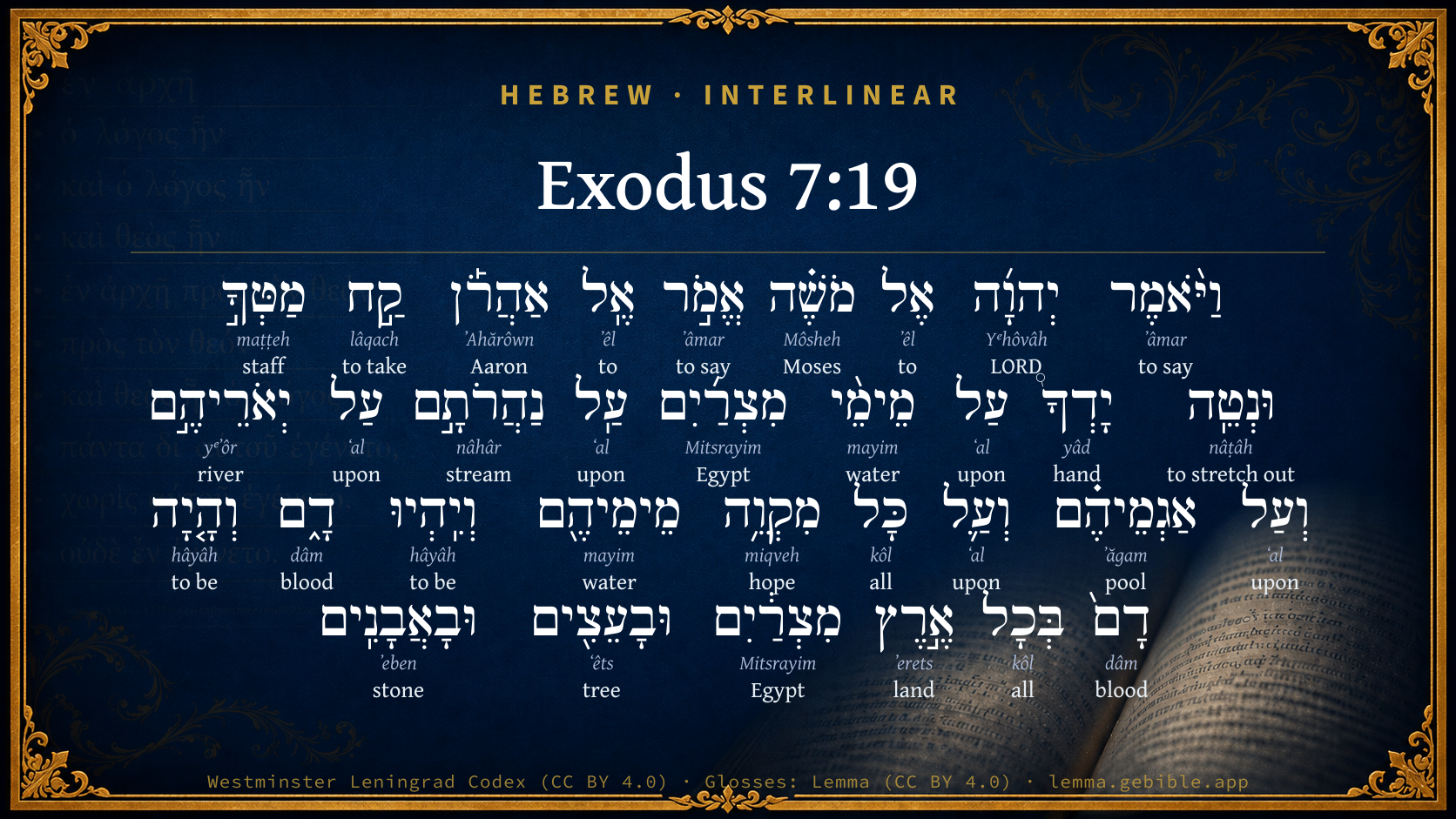
Hebrew (Westminster Leningrad Codex) Exodus 7:19 appears in the Hebrew Old Testament. The text above is from the Westminster Leningrad Codex. Each word links to its Strong’s number, a concise gloss, and parsing drawn from the Open Scriptures Hebrew Bible morphology. Click any word for its full Brown-Driver-Briggs (BDB) entry.
Download image
Cite this verse

Exodus 7:19 (World English Bible). Public Domain. Lemma interlinear Bible study tool, https://lemma.gebible.app/v/exodus/7/19.

Show BibTeX & RIS
BibTeX
RIS
English Translation
Yahweh said to Moses, "Tell Aaron, 'Take your rod, and stretch out your hand over the waters of Egypt, over their rivers, over their streams, and over their pools, and over all their ponds of water, that they may become blood; and there shall be blood throughout all the land of Egypt, both in vessels of wood and in vessels of stone.'"
World English Bible · Public Domain
Highlights
  • 1 first appearance in the Hebrew Bible
Full analysis ↓
Download a study sheet

One document with this verse’s original text, its word-by-word gloss line, the meaning frame, cross-references with their text, attributed commentary, and full source and license credits — printable, and it pastes into notes with its structure intact.

This verse Autodidact and up

Study sheet (.html) Plain text (.txt)

A passage Seminary Student

Up to 50 verses in one chapter. A passage sheet keeps up to 6 commentary sources and 12 cross-references per verse, in the order this page ranks them, and says so on the sheet whenever that leaves anything out. Ask for a single verse and you get the Autodidact verse sheet above.

Everything on this page stays free to read, with no account — the sheet is a download of what is already on screen, not access to it.

Want to remove ads? Support Godless Engineer
Compare translations 3

The same verse in 3 English versions, stacked beneath the original-language interlinear above. Click any original word for its lexicon entry.

Each is an independent rendering of the whole verse — the interlinear is not word-aligned to these translations.

Highlighted words mark where these versions differ — a whole-verse word diff, not a word-by-word alignment.

  • World English Bible Public Domain
    Yahweh said to Moses, "Tell Aaron, 'Take your rod, and stretch out your hand over the waters of Egypt, over their rivers, over their streams, and over their pools, and over all their ponds of water, that they may become blood; and there shall be blood throughout all the land of Egypt, both in vessels of wood and in vessels of stone.'"
  • King James Version Public Domain
    And the LORD spake unto Moses, Say unto Aaron, Take thy rod, and stretch out thine hand upon the waters of Egypt, upon their streams, upon their rivers, and upon their ponds, and upon all their pools of water, that they may become blood; and that there may be blood throughout all the land of Egypt, both in vessels of wood, and in vessels of stone.
  • unfoldingWord Literal Text CC BY-SA 4.0
    And Yahweh said to Moses, “Say to Aaron, ‘Take your staff and stretch out your hand over the waters of Egypt; over their streams, over their canals, and over their pools, and over every reservoir of their water, and it will become blood.’ And there will be blood in all the land of Egypt, both in containers of wood and in containers of stone.”

unfoldingWord Literal Text — © unfoldingWord, licensed CC BY-SA 4.0. Word-aligned USFM3 via Door43 (git.door43.org/unfoldingWord/en_ult).

Versions to compare (up to 4)

3 of 4 selected

Show all 18 translations

Every available English version of this verse, each an independent rendering of the whole verse.

  • World English Bible Public Domain
    Yahweh said to Moses, "Tell Aaron, 'Take your rod, and stretch out your hand over the waters of Egypt, over their rivers, over their streams, and over their pools, and over all their ponds of water, that they may become blood; and there shall be blood throughout all the land of Egypt, both in vessels of wood and in vessels of stone.'"
  • Berean Standard Bible Public Domain
    And the LORD said to Moses, “Tell Aaron, ‘Take your staff and stretch out your hand over the waters of Egypt—over their rivers and canals and ponds and reservoirs—that they may become blood.’ There will be blood throughout the land of Egypt, even in the vessels of wood and stone.”
  • Majority Standard Bible Public Domain
    And the LORD said to Moses, “Tell Aaron, ‘Take your staff and stretch out your hand over the waters of Egypt—over their rivers and canals and ponds and all the reservoirs—that they may become blood.’ There will be blood throughout the land of Egypt, even in the vessels of wood and stone.”
  • King James Version Public Domain
    And the LORD spake unto Moses, Say unto Aaron, Take thy rod, and stretch out thine hand upon the waters of Egypt, upon their streams, upon their rivers, and upon their ponds, and upon all their pools of water, that they may become blood; and that there may be blood throughout all the land of Egypt, both in vessels of wood, and in vessels of stone.
  • American Standard Version (1901) Public Domain
    And Jehovah said unto Moses, Say unto Aaron, Take thy rod, and stretch out thy hand over the waters of Egypt, over their rivers, over their streams, and over their pools, and over all their ponds of water, that they may become blood; and there shall be blood throughout all the land of Egypt, both in vessels of wood and in vessels of stone.
  • Revised Version (1885) Public Domain
    And the LORD said unto Moses, Say unto Aaron, Take thy rod, and stretch out thine hand over the waters of Egypt, over their rivers, over their streams, and over their pools, and over all their ponds of water, that they may become blood; and there shall be blood throughout all the land of Egypt, both in vessels of wood and in vessels of stone.
  • Geneva Bible (1599) Public Domain
    The Lord then spake to Moses, Say vnto Aaron, Take thy rod, and stretch out thine hand ouer the waters of Egypt, ouer their streames, ouer their riuers, and ouer their pondes,, and ouer all pooles of their waters, and they shalbe blood, and there shalbe blood throughout all the land of Egypt, both in vessels of wood, and of stone.
  • Douay-Rheims (1899) Public Domain
    The Lord also said to Moses: Say to Aaron, Take thy rod, and stretch forth thy hand upon the waters of Egypt, and upon their rivers, and streams and pools, and all the ponds of waters, that they may be turned into blood: and let blood be in all the land of Egypt, both in vessels of wood and of stone.
  • Young's Literal Translation Public Domain
    And Jehovah saith unto Moses, `Say unto Aaron, Take thy rod, and stretch out thy hand against the waters of Egypt, against their streams, against their rivers, and against their ponds, and against all their collections of waters; and they are blood -- and there hath been blood in all the land of Egypt, both in `vessels of' wood, and in `those of' stone.'
  • Literal Standard Version CC BY-SA 4.0
    And YHWH says to Moses, “Say to Aaron, Take your rod, and stretch out your hand against the waters of Egypt, against their streams, against their rivers, and against their ponds, and against all their collections of waters; and they are blood—and there has been blood in all the land of Egypt, both in [vessels of] wood, and in [those of] stone.”
  • Unlocked Literal Bible CC BY-SA 4.0
    Then Yahweh said to Moses, “Say to Aaron, 'Take your staff and reach out with your hand over the waters of Egypt, and over their rivers, streams, pools, and all their ponds, so that their water may become blood. Do this so that there will be blood throughout all the land of Egypt, even in containers of wood and stone.'”
  • unfoldingWord Literal Text CC BY-SA 4.0
    And Yahweh said to Moses, “Say to Aaron, ‘Take your staff and stretch out your hand over the waters of Egypt; over their streams, over their canals, and over their pools, and over every reservoir of their water, and it will become blood.’ And there will be blood in all the land of Egypt, both in containers of wood and in containers of stone.”
  • Darby Bible Public Domain
    And Jehovah said to Moses, Say unto Aaron, Take thy staff, and stretch out thy hand upon the waters of the Egyptians -- upon their streams, upon their rivers, and upon their ponds, and upon all their reservoirs of water, that they may become blood; and there shall be blood throughout the land of Egypt, both in [vessels of] wood and in [vessels of] stone.
  • World Messianic Bible Public Domain
    The LORD said to Moses, “Tell Aaron, ‘Take your rod, and stretch out your hand over the waters of Egypt, over their rivers, over their streams, and over their pools, and over all their ponds of water, that they may become blood. There will be blood throughout all the land of Egypt, both in vessels of wood and in vessels of stone.’”
  • Webster's Bible Public Domain
    And the LORD spoke to Moses, Say to Aaron, Take thy rod, and stretch out thy hand upon the waters of Egypt, upon their streams, upon their rivers, and upon their ponds, and upon all their pools of water, that they may become blood: and that there may be blood throughout all the land of Egypt, both in vessels of wood, and in vessels of stone.
  • Free Bible Version CC BY-SA 4.0
    The Lord said to Moses, “Tell Aaron, ‘Take your walking stick in your hand and hold it out over the waters of Egypt, over their rivers and canals and ponds and pools, so that they will turn to blood. There will be blood through all of Egypt, even in containers made of wood and stone.’”
  • Bible in Basic English Public Domain
    And the Lord said, Say to Aaron, Let the rod in your hand be stretched out over the waters of Egypt, and over the rivers and the streams and the pools, and over every stretch of water, so that they may be turned to blood; and there will be blood through all the land of Egypt, in vessels of wood and in vessels of stone.
  • JPS Tanakh (1917) Public Domain
    And the LORD said unto Moses: 'Say unto Aaron: Take thy rod, and stretch out thy hand over the waters of Egypt, over their rivers, over their streams, and over their pools, and over all their ponds of water, that they may become blood; and there shall be blood throughout all the land of Egypt, both in vessels of wood and in vessels of stone.'

Literal Standard Version (2020), Covenant Press — licensed CC BY-SA 4.0. Text via the HelloAO Bible API (eBible.org). Unlocked Literal Bible (unfoldingWord) — licensed CC BY-SA 4.0. Text via the HelloAO Bible API (eBible.org). unfoldingWord Literal Text — © unfoldingWord, licensed CC BY-SA 4.0. Word-aligned USFM3 via Door43 (git.door43.org/unfoldingWord/en_ult). Free Bible Version, Dr. Jonathan Gallagher — licensed CC BY-SA 4.0. Text via the HelloAO Bible API (eBible.org).

Word by word

More ways to search: Search by grammar → Find every occurrence → Compare this word →

Practice this passage: Drill this verse → Learn its vocabulary →

אַגְמֵיהֶ֗ם
ʼăgam
H98
“pools · their”
Noun, Common, Masculine, Plural, Construct + Suffix, Personal, 3rd Person, Masculine, Plural
Part of Speech
Noun
Type
Common
Gender
Masculine
Number
Plural
State
Construct
Full BDB Definition

Origin: from an unused root (meaning to collect as water)

TWOT: 18a

pool, troubled pool - troubled or muddy (gloomy) pools, marshes - any pool, pond - swamp reeds, reeds, rush(es)
  1. וַיֹּ֨אמֶר ʼâmar H559 “and · to say” Conjunction + Verb, Qal, Sequential Imperfect, 3rd Person, Masculine, Singular
  2. יְהוָ֜ה Yᵉhôvâh H3068 “LORD” Noun, Proper
  3. אֶל ʼêl H413 “to” Preposition
  4. מֹשֶׁ֗ה Môsheh H4872 “Moses” Noun, Proper
  5. אֱמֹ֣ר ʼâmar H559 “say” Verb, Qal, Imperative, 2nd Person, Masculine, Singular
  6. אֶֽל ʼêl H413 “to” Preposition
  7. אַהֲרֹ֡ן ʼAhărôwn H175 “Aaron” Noun, Proper
  8. קַ֣ח lâqach H3947 “take” Verb, Qal, Imperative, 2nd Person, Masculine, Singular
  9. מַטְּךָ֣ maṭṭeh H4294 “staff · your” Noun, Common, Masculine, Singular, Construct + Suffix, Personal, 2nd Person, Masculine, Singular
  10. וּנְטֵֽה nâṭâh H5186 “and · stretch out” Conjunction + Verb, Qal, Imperative, 2nd Person, Masculine, Singular
  11. יָדְךָ֩ yâd H3027 “hand · your” Noun, Common, Both, Singular, Construct + Suffix, Personal, 2nd Person, Masculine, Singular
  12. עַל ʻal H5921 “upon” Preposition
  13. מֵימֵ֨י mayim H4325 “water(s) of” Noun, Common, Masculine, Plural, Construct
  14. מִצְרַ֜יִם Mitsrayim H4714 “Egypt” Noun, Proper
  15. עַֽל ʻal H5921 “upon” Preposition
  16. נַהֲרֹתָ֣ם nâhâr H5104 “streams · their” Noun, Common, Masculine, Plural, Construct + Suffix, Personal, 3rd Person, Masculine, Plural
  17. עַל ʻal H5921 “upon” Preposition
  18. יְאֹרֵיהֶ֣ם yᵉʼôr H2975 “rivers · their” Noun, Common, Masculine, Plural, Construct + Suffix, Personal, 3rd Person, Masculine, Plural
  19. וְעַל ʻal H5921 “and · upon” Conjunction + Preposition
  20. וְעַ֛ל ʻal H5921 “and · upon” Conjunction + Preposition
  21. כָּל kôl H3605 “all of” Noun, Common, Masculine, Singular, Construct
  22. מִקְוֵ֥ה miqveh H4723 “hope of” Noun, Common, Masculine, Singular, Construct
  23. מֵימֵיהֶ֖ם mayim H4325 “water(s) · their” Noun, Common, Masculine, Plural, Construct + Suffix, Personal, 3rd Person, Masculine, Plural
  24. וְיִֽהְיוּ hâyâh H1961 “and · to be” Conjunction + Verb, Qal, Imperfect, 3rd Person, Masculine, Plural
  25. דָ֑ם dâm H1818 “blood” Noun, Common, Masculine, Singular, Absolute
  26. וְהָ֤יָה hâyâh H1961 “and · to be” Conjunction + Verb, Qal, Sequential Perfect, 3rd Person, Masculine, Singular
  27. דָם֙ dâm H1818 “blood” Noun, Common, Masculine, Singular, Absolute
  28. בְּכָל kôl H3605 “in/at · all of” Preposition + Noun, Common, Masculine, Singular, Construct
  29. אֶ֣רֶץ ʼerets H776 “land of” Noun, Common, Both, Singular, Construct
  30. מִצְרַ֔יִם Mitsrayim H4714 “Egypt” Noun, Proper
  31. וּבָעֵצִ֖ים ʻêts H6086 “and · in/at the · trees” Conjunction + Preposition, Determined + Noun, Common, Masculine, Plural, Absolute
  32. וּבָאֲבָנִֽים ʼeben H68 “and · in/at the · stones” Conjunction + Preposition, Determined + Noun, Common, Feminine, Plural, Absolute

About this verse

These counts appear in no published source. They are computed here, from the morphology-tagged text and Lemma’s own curated glosses. What Lemma adds →

33
words
22
distinct lemmas
Pentateuch
section

Notable vocabulary

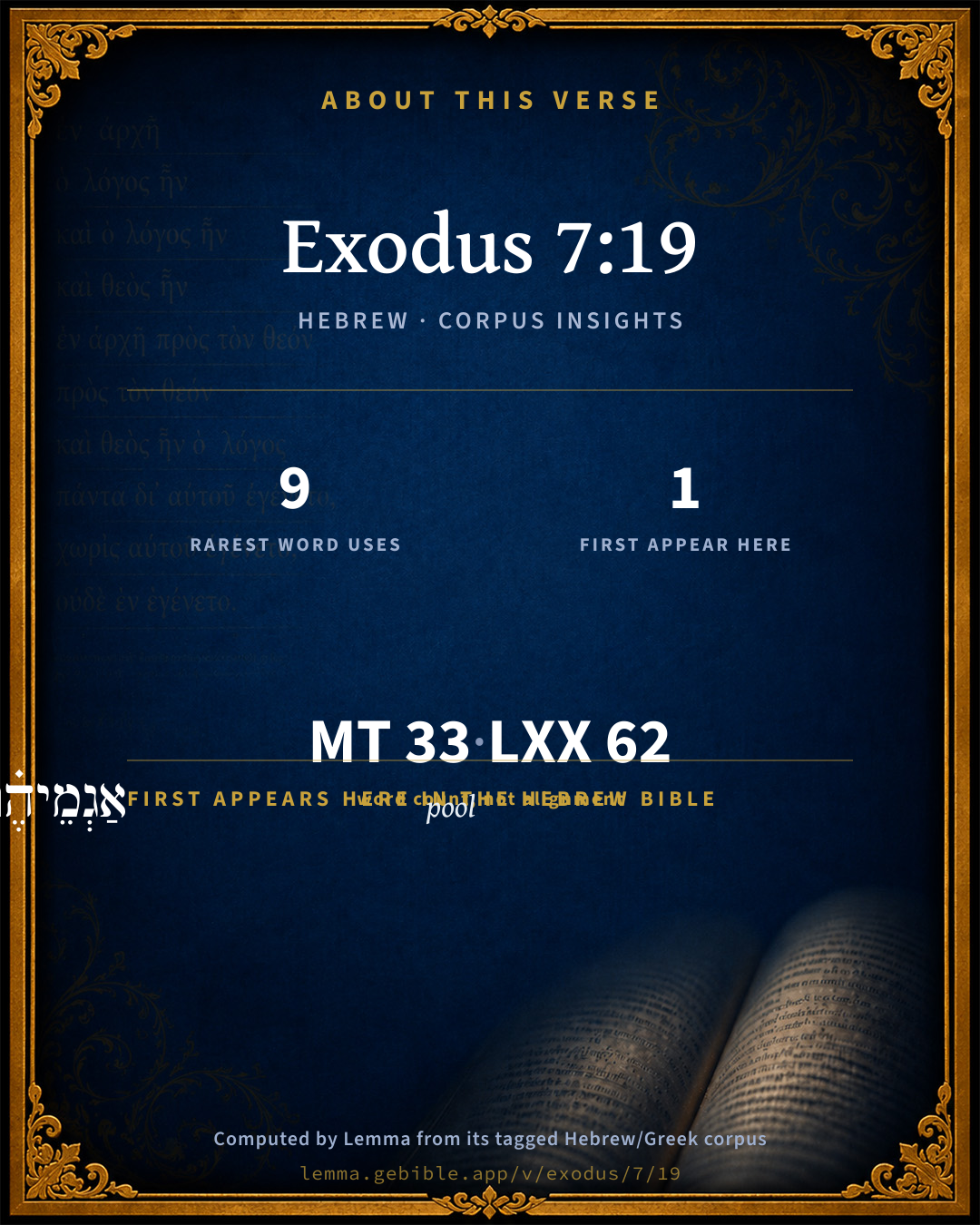
The rarest word here is אַגְמֵיהֶ֗ם pool H98 — appearing just 9 times in the whole Hebrew Bible.

First appearance in Scripture

This word makes its first canonical appearance in the Hebrew Bible here:

  • אַגְמֵיהֶ֗ם pool H98

Shared distinctive vocabulary

אַגְמֵיהֶ֗ם pool H98 occurs in 9 verses of the Hebrew Bible. Also found in:

Grammatical profile

  • 6 verbs
  • 20 nouns
  • 7 prepositions

Verb forms

  • וַיֹּ֨אמֶר Qal · Sequential Imperfect
  • אֱמֹ֣ר Qal · Imperative
  • קַ֣ח Qal · Imperative
  • וּנְטֵֽה Qal · Imperative
  • וְיִֽהְיוּ Qal · Imperfect
  • וְהָ֤יָה Qal · Sequential Perfect

Repetition

Words recur within this verse — often emphatic in Hebrew:

  • עַל upon H5921 ×5
  • וַיֹּ֨אמֶר to say H559 ×2
  • מֵימֵ֨י water H4325 ×2
  • מִצְרַ֜יִם Egypt H4714 ×2
  • כָּל all H3605 ×2
  • וְיִֽהְיוּ to be H1961 ×2
  • דָ֑ם blood H1818 ×2
  • אֶל to H413 ×2

Hebrew & Septuagint length

In English translation the verse runs 62 words from the Hebrew and 68 from the Septuagint (LXX English) — closely comparable.

A rough comparison of the two English renderings, which tokenize alike — not a word-level alignment.

Word counts can differ between the Hebrew and the Greek without any difference in meaning — e.g. the Hebrew direct-object marker אֵת has no separate Greek word, and Greek often adds the article ὁ.

In the original languages it is 33 Hebrew tokens and 62 Greek tokens — but the two are counted differently (Hebrew bundles its prefixes and suffixes into one token; the Greek is in lemma form), so that isn’t a like-for-like length.

Cross-references

9

Topical passages linked to Exodus 7:19 in the Treasury of Scripture Knowledge — connected by theme and wording, ordered by reader-vote popularity; previews shown in the World English Bible.

  • Exodus 14:21 Moses stretched out his hand over the sea, and Yahweh caused the sea to go back by a strong east wind all the night, and made the sea dry land, and the waters were divided.
  • Exodus 8:5–6 Yahweh said to Moses, "Tell Aaron, 'Stretch forth your hand with your rod over the rivers, over the streams, and over the pools, and cause frogs to come up on the land of Egypt.'"
  • Exodus 8:16 Yahweh said to Moses, "Tell Aaron, 'Stretch out your rod, and strike the dust of the earth, that it may become lice throughout all the land of Egypt.'"
  • Exodus 10:12 Yahweh said to Moses, "Stretch out your hand over the land of Egypt for the locusts, that they may come up on the land of Egypt, and eat every herb of the land, even all that the hail has left."
  • Exodus 10:21 Yahweh said to Moses, "Stretch out your hand toward the sky, that there may be darkness over the land of Egypt, even darkness which may be felt."
  • Exodus 14:26 Yahweh said to Moses, "Stretch out your hand over the sea, that the waters may come again on the Egyptians, on their chariots, and on their horsemen."
  • Genesis 1:10 God called the dry land Earth, and the gathering together of the waters he called Seas. God saw that it was good.
  • Exodus 9:22–23 Yahweh said to Moses, "Stretch forth your hand toward the sky, that there may be hail in all the land of Egypt, on man, and on animal, and on every herb of the field, throughout the land of Egypt."
  • Exodus 9:33 Moses went out of the city from Pharaoh, and spread abroad his hands to Yahweh; and the thunders and hail ceased, and the rain was not poured on the earth.

Cross-references courtesy of OpenBible.info (CC BY 4.0).

Hebrew and Greek witnesses Masoretic Hebrew ↔ Greek Septuagint

The same verse in the two great witnesses to the Old Testament, shown verse-for-verse.

These are two independent witnesses, not word-aligned to each other, and the Septuagint is shown in lemma (dictionary) form.

Hebrew Exodus 7:19 Masoretic · Westminster Leningrad Codex

וַיֹּ֨אמֶר יְהוָ֜ה אֶל מֹשֶׁ֗ה אֱמֹ֣ר אֶֽל אַהֲרֹ֡ן קַ֣ח מַטְּךָ֣ וּנְטֵֽה יָדְךָ֩ עַל מֵימֵ֨י מִצְרַ֜יִם עַֽל נַהֲרֹתָ֣ם עַל יְאֹרֵיהֶ֣ם וְעַל אַגְמֵיהֶ֗ם וְעַ֛ל כָּל מִקְוֵ֥ה מֵימֵיהֶ֖ם וְיִֽהְיוּ דָ֑ם וְהָ֤יָה דָם֙ בְּכָל אֶ֣רֶץ מִצְרַ֔יִם וּבָעֵצִ֖ים וּבָאֲבָנִֽים

Yahweh said to Moses, "Tell Aaron, 'Take your rod, and stretch out your hand over the waters of Egypt, over their rivers, over their streams, and over their pools, and over all their ponds of water, that they may become blood; and there shall be blood throughout all the land of Egypt, both in vessels of wood and in vessels of stone.'"

World English Bible · Public Domain

Greek LXX Exodus 7:19 Septuagint · lemma form

εἶπον δέ κύριος πρός μωυσῆς εἶπον ααρων ὁ ἀδελφός σύ λαμβάνω ὁ ῥάβδος σύ καί ἐκτείνω ὁ χείρ σύ ἐπί ὁ ὕδωρ αἴγυπτος καί ἐπί ὁ ποταμός αὐτός καί ἐπί ὁ διῶρυξ αὐτός καί ἐπί ὁ ἕλος αὐτός καί ἐπί πᾶς συνἵστημι ὕδωρ αὐτός καί εἰμί αἷμα καί γίγνομαι αἷμα ἐν πᾶς γῆ αἴγυπτος ἐν τε ὁ ξύλον καί ἐν ὁ λίθος

And the Lord said to Moses, Say to your brother Aaron, Take your rod in your hand, and stretch forth your hand over the waters of Egypt, and over their rivers, and over their canals, and over their ponds, and over all their standing water, and it shall become blood: and there was blood in all the land of Egypt, both in vessels of wood and of stone.

LXX2012 (modern English Septuagint) · Public Domain

Hebrew: Westminster Leningrad Codex (CC BY 4.0). Greek: Septuagint (public domain); English from LXX2012 (modern English Septuagint) (Public Domain). How the Septuagint differs from the Hebrew →

Targum (Aramaic paraphrase)

2

The Targum is the ancient Jewish Aramaic paraphrase of the Hebrew Scriptures — an interpretive translation, not the Hebrew text itself. Onkelos (literal) and Pseudo-Jonathan (expansive) render the Torah, and Jonathan the Prophets. Coverage is partial: where no permissively-licensed English translation exists for a verse, only the Aramaic is shown. This is verse-level text, not a word-by-word alignment to the Hebrew.

  1. Targum Onkelos Torah (Genesis–Deuteronomy)
    וַאֲמַר יְיָ לְמשֶׁה אֱמַר לְאַהֲרֹן טּוֹל חֻטְרָךְ וַאֲרֵים יְדָךְ עַל מַיָא דְמִצְרַיִם עַל נַהֲרֵיהוֹן עַל אֲרִתֵּיהוֹן וְעַל אַגְמֵיהוֹן וְעַל כָּל בֵּית כְּנִישׁוּת מֵימֵיהוֹן וִיהוֹן דְמָא וִיהֵי דְמָא בְּכָל אַרְעָא דְמִצְרַיִם וּבְמָנֵי אָעָא וּבְמָנֵי אַבְנָא:

    (no public-domain English translation for this verse)

    Targum Onkelos — Aramaic: “Onkelos Genesis” (public domain); “Onkelos Exodus” (public domain); “Onkelos Leviticus” (public domain); “Onkelos Numbers” (public domain); “Onkelos Deuteronomy” (public domain). English: “Sefaria Community Translation” (CC0 1.0 (public-domain dedication)); “J.W. Etheridge. The Targums of Onkelos and Jonathan Ben Uzziel on the Pentateuch. London: Longmans, Green, 1862” (public domain). Text via Sefaria.

  2. Targum Pseudo-Jonathan Torah (Genesis–Deuteronomy)
    וַאֲמַר יְיָ לְמשֶׁה אֵימַר לְאַהֲרן סַב חוּטְרָךְ וַאֲרֵים יְדָךְ עַל מוֹי דְמִצְרָאֵי עַל נַהֲרֵיהוֹן עַל פַּצִידֵיהוֹן עַל שִׁיקְיֵיהוֹן וְעַל כָּל כְּנִישׁוּת מֵימֵיהוֹן וִיהוֹן דְמָא בְּכָל אַרְעָא דְמִצְרַיִם וּבְמָאנֵי אָעָא וּבְמָאנֵי אַבְנָא

    And the Lord said to Mosheh, Tell Aharon, Take thy rod and stretch forth thy hand over the waters of the Mizraee over their rivers, Over their trenches, over their canals, and over every place for collecting their waters, and they will become blood; and there shall be blood in all the land of Mizraim, and in vessels of wood and in vessels of stone.

    Targum Pseudo-Jonathan — Aramaic: “Targum Jonathan on Genesis” (public domain); “Targum Jonathan on Exodus” (public domain); “Targum Jonathan on Leviticus” (public domain); “Targum Jonathan on Numbers” (public domain); “Targum Jonathan on Deuteronomy” (public domain). English: “The Targum of Jonathan ben Uzziel, trans. J. W. Etheridge, London, 1862” (public domain). Text via Sefaria.

Commentary

Notes on Exodus 7:19 from classic Christian and Jewish commentators (each source and its license shown beneath its notes). The classic Christian expositions comment on the surrounding passage and are grouped to its opening verse, so a note may address several verses; the Jewish commentaries on the Tanakh (Rashi and others) are per-verse, so they appear only where the commentator wrote on this verse.

Lemma curates 59 commentaries, every one of them public domain or Creative Commons licensed, each selected and text-cleaned for this edition rather than reprinted as found. About our sources →

Trapp's Complete Commentary

John Trapp

Exo 7:19 And the LORD spake unto Moses, Say unto Aaron, Take thy rod, and stretch out thine hand upon the waters of Egypt, upon their streams, upon their rivers, and upon their ponds, and upon all their pools of water, that they may become blood; and [that] there may be blood throughout all the land of Egypt, both in [vessels of] wood, and in [vessels of] stone.

Ver. 19. Upon their ponds.] Fish ponds are in Hebrew called Berechoth, Blessings. But how soon can God "curse our blessings," {Mal 2:2} and destroy us, "after that he hath done us good!" {Jos 24:20}

John Trapp, A Commentary or Exposition upon All the Books of the Old and New Testament (1647–1656) — public domain. Text from a community e-Sword module.

Joseph Benson's Commentary

Exo 7:19. Upon their streams, &c., — both in vessels of wood and vessels of stone — “To what purpose this minuteness?” says the last-mentioned author. “May not the meaning be that the water of the Nile should not only look red and nauseous, like blood, in the river, but in their vessels too, and that no method of purifying it should take place, but, whether drunk out of vessels of wood or out of vessels of stone, by means of which they were wont to purge the Nile water, it should be the same, and should appear like blood.” — Harmer, vol. 2. p. 292.

Joseph Benson's Commentary on the Old and New Testaments (1811–1818) — public domain. Text from a community e-Sword module.

Geneva Bible (1599)

Geneva Bible translators

The first plague.

Geneva Bible (1599) marginal notes — public domain. Text via Bolls.life.

Adam Clarke's Commentary

Verse 19. That there may be blood - both in vessels of wood, and in vessels of stone.] Not only the Nile itself was to be thus changed into blood in all its branches, and the canals issuing from it, but all the water of lakes, ponds, and reservoirs, was to undergo a similar change. And this was to extend even to the water already brought into their houses for culinary and other domestic purposes. As the water of the Nile is known to be very thick and muddy, and the Egyptians are obliged to filter it through pots of a kind of white earth, and sometimes through a paste made of almonds, Mr. Harmer supposes that the vessels of wood and stone mentioned above may refer to the process of filtration, which no doubt has been practised among them from the remotest period. The meaning given above I think to be more natural.

Adam Clarke's Commentary on the Bible (1810–1826) — public domain. Text from a community e-Sword/MySword module.

Ellicott's Commentary for English Readers

(19) The waters of Egypt consist of the main stream of the Nile; its branches; canals derived from it; natural lakes, pools, or ponds, either left by the inundation or anticipative of it, being derived by percolation from the main stream; and artificial reservoirs of a larger or smaller size in gardens, courts, and houses. There is no other stream but the Nile in the whole country; and there are no natural springs, fountains, or brooks. Water may, however, at all times, and in all parts of the Nile Valley, be obtained by digging wells; but, as the soil is impregnated with nitre, the well water is highly unpalatable. It is generally allowed that the author of Exodus shows in the present verse, coupled with Exo_7:24, a very exact knowledge of the Egyptian water system.

Vessels of wood, and vessels of stone.—It was usual to store the Nile water in tanks or cisterns within the houses, in order that it might deposit its sediment. These tanks or cisterns, which existed in all the houses of the better class, were either of wood or stone.

A Bible Commentary for English Readers, edited by Charles John Ellicott (1878–1897) — public domain. Text from a community e-Sword module.

The Cambridge Bible for Schools and Colleges

gen. ed. J. J. S. Perowne

19–20a. Before describing how the Nile was smitten, the compiler introduces P’s account of the command given to Moses. According to this, not the water of the Nile only, but all the water in Egypt, is to become blood.

19. Say unto Aaron] as regularly in P (p. 55).

thy rod] as v. 9.

their rivers] The Nile, and its arms, running through the Delta.

their streams] lit. their Niles, i.e. their Nile-canals,—such as were constructed for irrigation purposes, to convey the water of the Nile to the fields.

all their ponds of water] Heb. every gathering (Gen_1:10, Lev_11:36) of their water. Probably reservoirs (tanks, cisterns, &c.) are in particular thought of: cf. the fem. in Isa_22:11 (‘reservoir’).

20b. and he lifted up] At first sight, in view of v. 19a, the subject seems to be Aaron: Aaron, however, in v. 19, is to stretch out his hand over all the water in Egypt; here the Nile only is smitten, in exact accordance with v. 17. At least therefore in its original context, when the narrative of E was complete, the ‘he’ will have been Moses, who carries the rod in vv. 15b, 17.

The Cambridge Bible for Schools and Colleges (gen. ed. J. J. S. Perowne; Cambridge University Press, 1878–1918) — public domain. Text from a community e-Sword module.

John Gill's Exposition

And the Lord spake unto Moses,.... Pharaoh still being obstinate, and refusing to let the people go:

say unto Aaron, take thy rod, and stretch out thine hand upon the waters of Egypt; upon all of them in general, what were in the river Nile, or derived from it, as follows:

upon their streams; the seven streams of the river Nile; see Gill on Isa 11:15.

upon their rivers; the canals that were cut out of the river Nile, for the watering of their fields and gardens, for they had no other river:

and upon their ponds, and upon all their pools of waters; which were dug near the river, or to which pipes were laid to convey the water thither:

that they may become blood; and so not fit to drink:

and that there may be blood throughout all the land of Egypt,

both in vessels of wood, and in vessels of stone; in which water were kept in private houses, fetched from the river for the use of families; all which were to be turned into blood everywhere, in all parts of the land, and in all places mentioned, immediately upon Aaron's taking his rod, and smiting the waters with it in that part of the river that was before him.

John Gill's Exposition of the Whole Bible (1746–1763) — public domain (CC PDM 1.0). Text via the HelloAO Bible API.

Albert Barnes' Notes on the Bible

The “streams” mean the natural branches of the Nile in Lower Egypt. The word “rivers” should rather be “canals”; they were of great extent, running parallel to the Nile, and communicating with it by sluices, which were opened at the rise, and closed at the subsidence of the inundation. The word rendered “ponds” refers either to natural fountains, or more probably to cisterns or tanks found in every town and village. The “pools”, literally “gathering of waters,” were the reservoirs, always large and some of enormous extent, containing sufficient water to irrigate the country in the dry season.

In vessels of wood - The Nile water is kept in vessels and is purified for use by filtering, and by certain ingredients such as the paste of almonds.

Albert Barnes' Notes on the Bible (1834–1885) — public domain. Text from a community e-Sword/MySword module.

Matthew Poole's English Annotations

Not that he was to go to every pool to use this ceremony there, but he stretched his hand and rod over some of them in the name of all the rest, which he might signify either by his words, or by the various motions of his rod several ways.

Matthew Poole's English Annotations on the Holy Bible (1683–1685) — public domain. Text from a community e-Sword/MySword module.

Whedon's Commentary on the Bible

Daniel D. Whedon

19. Stretch out thine hand upon the waters of Egypt — The language of this verse shows a minute acquaintance with the extensive and complicated water system which was peculiar to Egypt. The streams are the arms which branch out from the Nile, just north of modern Cairo, through the great plain of the delta, carrying the waters down to the Mediterranean. There are two principal and five or more lesser streams. The rivers are the canals running each side of the Nile, and receiving their waters through sluices at the time of the inundation. As the land sloped northward, the water was conveyed through main canals running along the southern or higher side of each field, and thence it spread through branches, straight or curved, down northward over the land. The ponds were the large standing lakes left by the inundation; and the pools — literally, every collection of their waters — were the smaller ponds and reservoirs which they used who lived at a distance from the river.

Wood… stone — This is also a peculiarly Egyptian touch, for the Nile water was kept in large stone tanks for public use, and was also filtered and purified for domestic use in smaller vessels.

Daniel D. Whedon (gen. ed.), Commentary on the Old and New Testaments (1874–1909) — public domain. Text from a community e-Sword module.

The Pulpit Commentary

Say unto Aaron. There is an omission here (and generally throughout the account of the plagues) of the performance by Moses of God"s behest. The Samaritan Pentateuch in each case supplies the omission. It has been argued (Kennicott) that the Hebrew narrative has been contracted; but most critics agree that the incomplete form is the early one, and that, in the Samar. version, the original narrative has been expanded. The waters of Egypt streams rivers ponds pools of water. The waters of Lower Egypt, where this miracle was wrought, consisted of

(1) the various branches of the Nile, natural and artificial, which were seven when Herodotus wrote (Heb_2:17), whence the Nile was called "septemfluus," or "septemgeminus;

(2) the canals derived from each branch to fertilise the lands along its banks;

(3) ponds, marshes, and pools, the results of the overflowing of the Nile, or of its percolation through its banks on either side; and

(4) artificial reservoirs, wherein water was stored for use after the inundation was over. The four terms of the text seem applicable to this four-fold division, and "show an accurate knowledge of Egypt" (Cook), and of its water system. The "streams" are the Nile branches; the" rivers correspond to the canals; the "ponds" are the natural accumulations of waters in permanent lakes or in temporary pools and marshes; while the "pools," or "gatherings of waters" ( margin), are the reservoirs made by art. Aaron was to stretch out his rod over the Nile, but with the intent to smite all the Egyptian waters, and all the waters would at once be smitten, the streams and the canals and the natural lakes and the reservoirs. The miracle would even extend to private dwell-trigs, and the change would take place throughout all the land of Egypt, not only in respect of the open waters spread over the country, but even in respect of that stored, as was usual, in houses, and contained either in vessels of wood or in vessels of stone. With respect to these, it is to be observed that the Nile water was much improved by keeping, since the sediment subsided; and that tanks, sometimes of wood, sometimes of stone, were usual adjuncts of all the better class of houses.

The Pulpit Commentary (1880–1919), ed. H.D.M. Spence-Jones & Joseph S. Exell — public domain. Text from a community e-Sword module.

unfoldingWord translationNotes

Door43 World Missions Community

throughout all

"in every part of"

translationWords

Yahweh

Moses

Aaron

Egypt

unfoldingWord translationNotes — © Distant Shores Media and the Door43 World Missions Community, licensed CC BY-SA 4.0. Source: git.door43.org/Door43/en_tn.

Rashi

Rabbi Shlomo Yitzchaki (Rashi)

אמר אל אהרן SAY UNTO AARON — Because the river had protected Moses when he was cast into it, therefore it was not smitten by him neither at the plague of blood nor at that of frogs, but it was smitten by Aaron (Exodus Rabbah 9:10).

נהרתם THEIR STREAMS — These are the flowing rivers, just like our rivers in France.

יאריהם — These are canals which convey water being made by human agency and extending from the river bank into the fields. The waters of the Nile increase in volume and rise by way of these canals and so irrigate the fields.

אגמיהם — A collection of waters that neither spring up from beneath the ground nor flow along, but which remain in one spot. In old French they call it étang.

בכל ארץ מצרים [THERE WILL BE BLOOD] THROUGHOUT ALL THE LAND OF EGYPT— also in their bathing establishments and in the baths in their houses.

ובעצים ובאבנים — the water which happened to be BOTH IN vessels of WOOD AND in vessels of STONE.

Rashi on the Tanakh — English translations: “The Judaica Press complete Tanach with Rashi, translated by A. J. Rosenberg” (CC BY 4.0); “Pentateuch with Rashi's commentary by M. Rosenbaum and A.M. Silbermann, 1929-1934” (public domain); “The Metsudah Tanach series, Lakewood, N.J” (CC BY 4.0); and “The Book of Joshua, Metsudah Publications, 1997” (CC BY 4.0). Text via Sefaria.

Lesson kit

Teaching starters — assembled from the data on this page, not authored interpretation. Every prompt links to the verse data it draws on. Edit before teaching.

Exodus, in the Pentateuch, opens this verse with 33 words (22 distinct Hebrew lemmas). Its most distinctive word is ʼăgam (“pool”). A historical commentator’s framing appears above. Read the whole chapter for the surrounding context.

Discussion questions

  1. How does “pool” (ʼăgam) shape what this verse is saying?
  2. This is the first place “pool” appears in Scripture (first appears here). What does its debut here establish?
  3. How does Exodus 8:5, which shares the word «pool», read alongside this verse?
  4. What does the repetition of “upon” (5× in this one verse) do in this verse?
  5. These translations render this verse differently; the difference is in the English rendering, not the original. What questions does that raise?
  6. «וַיֹּ֨אמֶר» is a Qal Sequential Imperfect verb. How does that grammatical form shape the action described?
  7. Compare how Trapp's Complete Commentary and Joseph Benson's Commentary read this verse. Where do they agree or differ?

Things to notice

Reading settings

Reading text

Shown beneath each verse's original-language words.

Old Testament
Old Testament edition

Read the OT as the Masoretic Hebrew (MT) or the Greek Septuagint (LXX).

English shown for the Greek Septuagint (in the Hebrew ↔ Greek comparison).

Comparing translations? Open the Compare panel on any verse page to stack up to four side by side.