
Numbers 35:33

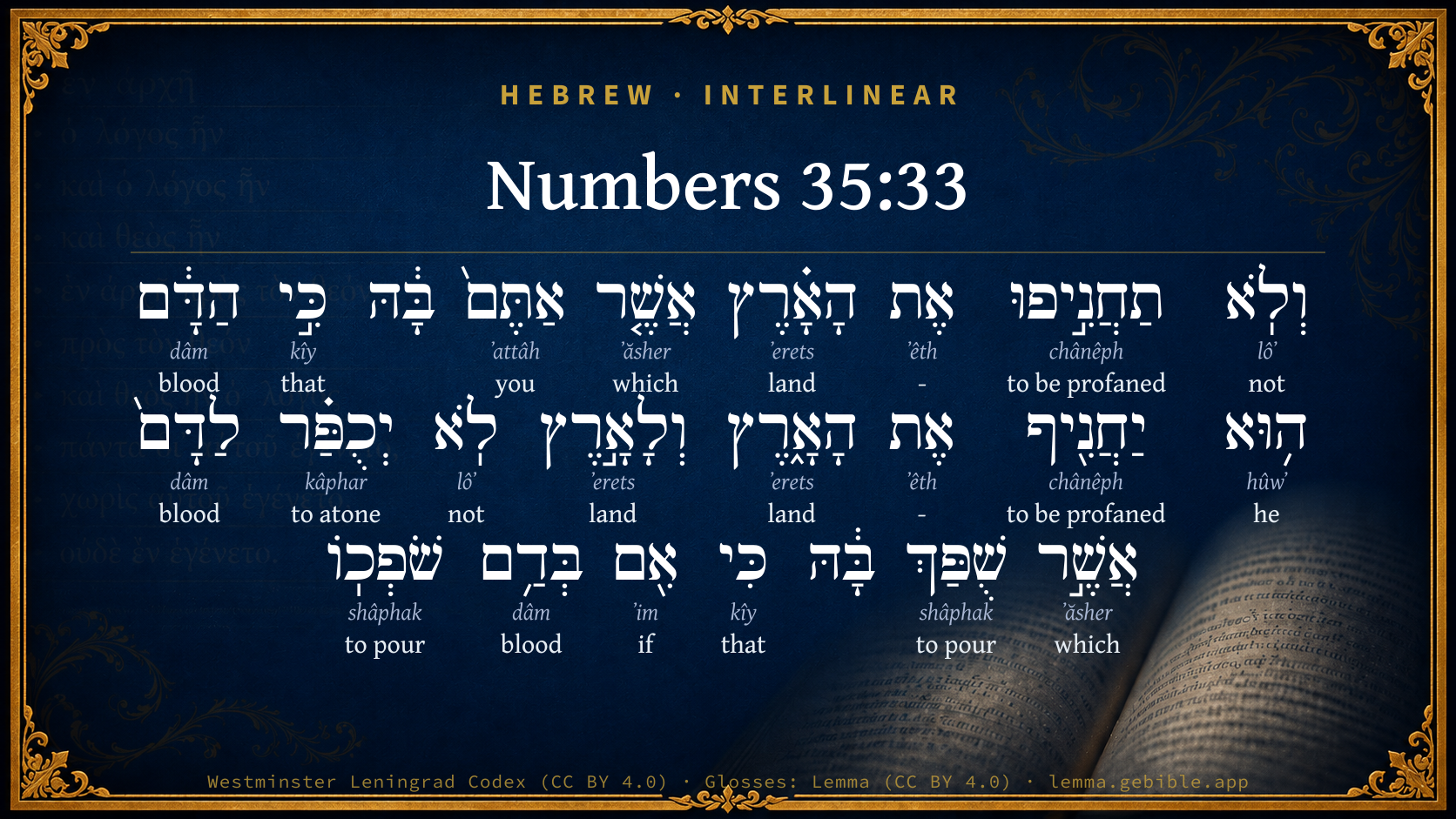
Hebrew (Westminster Leningrad Codex) Numbers 35:33 appears in the Hebrew Old Testament. The text above is from the Westminster Leningrad Codex. Each word links to its Strong’s number, a concise gloss, and parsing drawn from the Open Scriptures Hebrew Bible morphology. Click any word for its full Brown-Driver-Briggs (BDB) entry.
Download image
Cite this verse

Numbers 35:33 (World English Bible). Public Domain. Lemma interlinear Bible study tool, https://lemma.gebible.app/v/numbers/35/33.

Show BibTeX & RIS
BibTeX
RIS
English Translation
So you shall not pollute the land in which you are: for blood, it pollutes the land; and no expiation can be made for the land for the blood that is shed therein, but by the blood of him who shed it.
World English Bible · Public Domain
Highlights
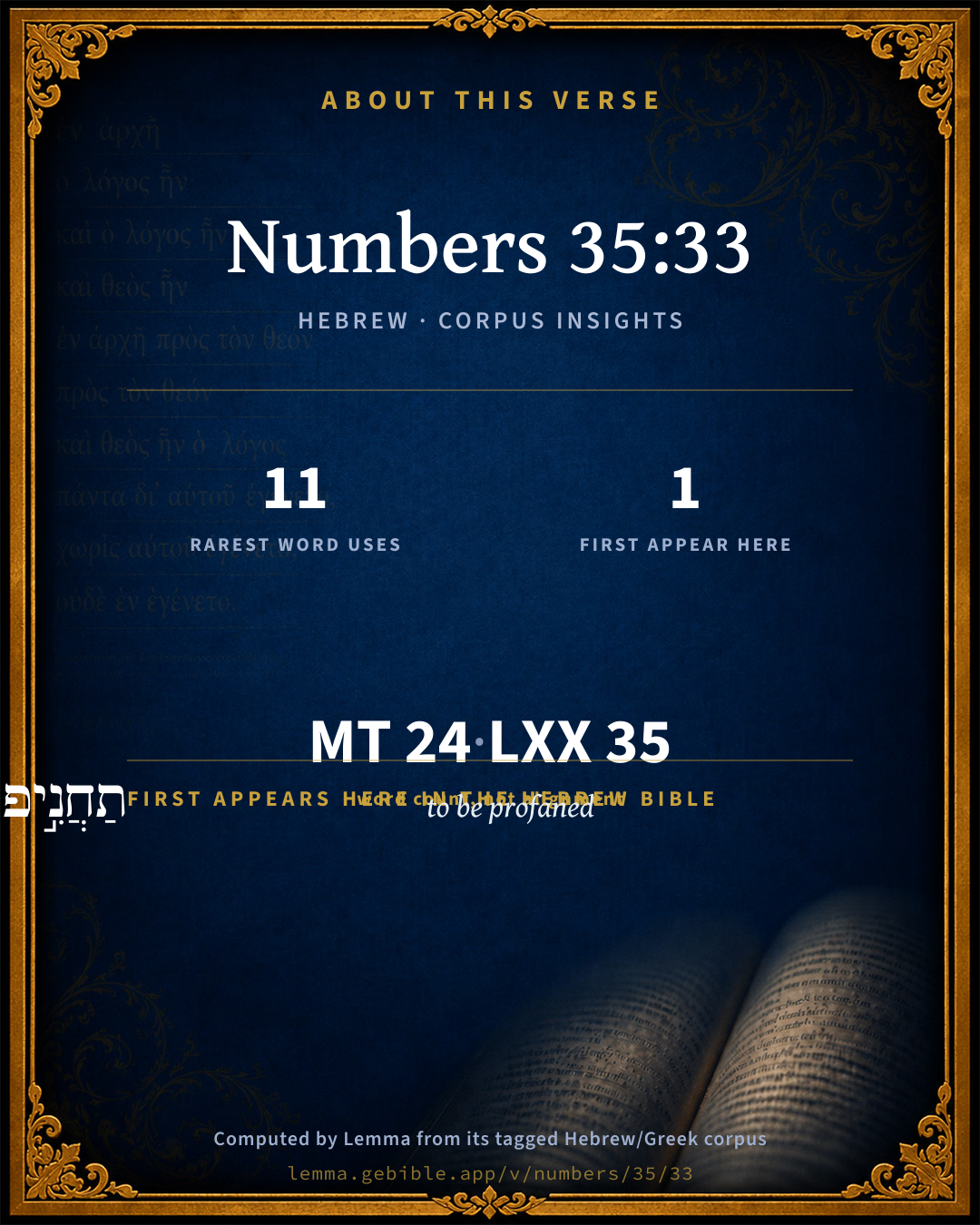
  • 1 first appearance in the Hebrew Bible
Full analysis ↓
Download a study sheet

One document with this verse’s original text, its word-by-word gloss line, the meaning frame, cross-references with their text, attributed commentary, and full source and license credits — printable, and it pastes into notes with its structure intact.

This verse Autodidact and up

Study sheet (.html) Plain text (.txt)

A passage Seminary Student

Up to 50 verses in one chapter. A passage sheet keeps up to 6 commentary sources and 12 cross-references per verse, in the order this page ranks them, and says so on the sheet whenever that leaves anything out. Ask for a single verse and you get the Autodidact verse sheet above.

Everything on this page stays free to read, with no account — the sheet is a download of what is already on screen, not access to it.

Want to remove ads? Support Godless Engineer
Compare translations 3

The same verse in 3 English versions, stacked beneath the original-language interlinear above. Click any original word for its lexicon entry.

Each is an independent rendering of the whole verse — the interlinear is not word-aligned to these translations.

Highlighted words mark where these versions differ — a whole-verse word diff, not a word-by-word alignment.

  • World English Bible Public Domain
    So you shall not pollute the land in which you are: for blood, it pollutes the land; and no expiation can be made for the land for the blood that is shed therein, but by the blood of him who shed it.
  • King James Version Public Domain
    So ye shall not pollute the land wherein ye are: for blood it defileth the land: and the land cannot be cleansed of the blood that is shed therein, but by the blood of him that shed it.
  • unfoldingWord Literal Text CC BY-SA 4.0
    And you shall not pollute the land which you are in because the blood itself pollutes the land. And atonement cannot be made for the land for the blood that is poured out on it except by the blood of the one who poured it out.

unfoldingWord Literal Text — © unfoldingWord, licensed CC BY-SA 4.0. Word-aligned USFM3 via Door43 (git.door43.org/unfoldingWord/en_ult).

Versions to compare (up to 4)

3 of 4 selected

Show all 18 translations

Every available English version of this verse, each an independent rendering of the whole verse.

  • World English Bible Public Domain
    So you shall not pollute the land in which you are: for blood, it pollutes the land; and no expiation can be made for the land for the blood that is shed therein, but by the blood of him who shed it.
  • Berean Standard Bible Public Domain
    Do not pollute the land where you live, for bloodshed pollutes the land, and no atonement can be made for the land on which the blood is shed, except by the blood of the one who shed it.
  • Majority Standard Bible Public Domain
    Do not pollute the land where you live, for bloodshed pollutes the land, and no atonement can be made for the land on which the blood is shed, except by the blood of the one who shed it.
  • King James Version Public Domain
    So ye shall not pollute the land wherein ye are: for blood it defileth the land: and the land cannot be cleansed of the blood that is shed therein, but by the blood of him that shed it.
  • American Standard Version (1901) Public Domain
    So ye shall not pollute the land wherein ye are: for blood, it polluteth the land; and no expiation can be made for the land for the blood that is shed therein, but by the blood of him that shed it.
  • Revised Version (1885) Public Domain
    So ye shall not pollute the land wherein ye are: for blood, it polluteth the land: and no expiation can be made for the land for the blood that is shed therein, but by the blood of him that shed it.
  • Geneva Bible (1599) Public Domain
    So ye shall not pollute the land wherein ye shall dwell: for blood defileth the land: and the land cannot be clensed of the blood that is shed therein, but by the blood of him that shed it.
  • Douay-Rheims (1899) Public Domain
    Defile not the land of your habitation, which is stained with the blood of the innocent: neither can it otherwise be expiated, but by his blood that hath shed the blood of another.
  • Young's Literal Translation Public Domain
    `And ye profane not the land which ye `are' in, for blood profaneth the land; as to the land, it is not pardoned for blood which is shed in it except by the blood of him who sheddeth it;
  • Literal Standard Version CC BY-SA 4.0
    And you do not profane the land which you [are] in, for blood profanes the land; as for the land, it is not pardoned for blood which is shed in it except by the blood of him who sheds it;
  • Unlocked Literal Bible CC BY-SA 4.0
    Do not pollute in this way the land where you live, because blood from murder pollutes the land. No atonement can be made for the land when blood has been shed on it, except by the blood of the one who shed it.
  • unfoldingWord Literal Text CC BY-SA 4.0
    And you shall not pollute the land which you are in because the blood itself pollutes the land. And atonement cannot be made for the land for the blood that is poured out on it except by the blood of the one who poured it out.
  • Darby Bible Public Domain
    And ye shall not pollute the land wherein ye are; for blood, it polluteth the land; and there can be no atonement made for the land, for the blood that hath been shed therein, but by the blood of him that shed it.
  • World Messianic Bible Public Domain
    “‘So you shall not pollute the land where you live; for blood pollutes the land. No atonement can be made for the land for the blood that is shed in it, but by the blood of him who shed it.
  • Webster's Bible Public Domain
    So ye shall not pollute the land in which ye are: for blood it defileth the land: and the land cannot be cleansed of the blood that is shed in it, but by the blood of him that shed it.
  • Free Bible Version CC BY-SA 4.0
    Don't pollute the land where you live because bloodshed pollutes the land, and the land where blood is shed can't be purified except by the blood of the one who shed it.
  • Bible in Basic English Public Domain
    So do not make the land where you are living unholy: for blood makes the land unholy: and there is no way of making the land free from the blood which has come on it, but only by the death of him who was the cause of it.
  • JPS Tanakh (1917) Public Domain
    So ye shall not pollute the land wherein ye are; for blood, it polluteth the land; and no expiation can be made for the land for the blood that is shed therein, but by the blood of him that shed it.

Literal Standard Version (2020), Covenant Press — licensed CC BY-SA 4.0. Text via the HelloAO Bible API (eBible.org). Unlocked Literal Bible (unfoldingWord) — licensed CC BY-SA 4.0. Text via the HelloAO Bible API (eBible.org). unfoldingWord Literal Text — © unfoldingWord, licensed CC BY-SA 4.0. Word-aligned USFM3 via Door43 (git.door43.org/unfoldingWord/en_ult). Free Bible Version, Dr. Jonathan Gallagher — licensed CC BY-SA 4.0. Text via the HelloAO Bible API (eBible.org).

Word by word

More ways to search: Search by grammar → Find every occurrence → Compare this word →

Practice this passage: Drill this verse → Learn its vocabulary →

תַחֲנִ֣יפוּ
chânêph
H2610
“to be profaned”
Verb, Hiphil, Imperfect, 2nd Person, Masculine, Plural
Part of Speech
Verb
Stem
Hiphil
Form
Imperfect
Person
2nd Person
Gender
Masculine
Number
Plural
Full BDB Definition

Origin: a primitive root

TWOT: 696

to be profaned, be defiled, be polluted, be corrupt - (Qal) - to be polluted - to be profane, be godless - (Hiphil) - to pollute - to make profane, make godless, cause to be defiled
  1. וְלֹֽא lôʼ H3808 “and · not” Conjunction + Particle, Negative
  2. אֶת ʼêth H853 “-” Particle, Direct Object
  3. הָאָ֗רֶץ ʼerets H776 “the · land” Particle, Definite Article + Noun, Common, Both, Singular, Absolute
  4. אֲשֶׁ֤ר ʼăsher H834 “which” Particle, Relative
  5. אַתֶּם֙ ʼattâh H859 “you” Pronoun, Personal, 2nd Person, Masculine, Plural
  6. כִּ֣י kîy H3588 “that” Conjunction
  7. הַדָּ֔ם dâm H1818 “the · blood” Particle, Definite Article + Noun, Common, Masculine, Singular, Absolute
  8. ה֥וּא hûwʼ H1931 “he” Pronoun, Personal, 3rd Person, Masculine, Singular
  9. יַחֲנִ֖יף chânêph H2610 “to be profaned” Verb, Hiphil, Imperfect, 3rd Person, Masculine, Singular
  10. אֶת ʼêth H853 “-” Particle, Direct Object
  11. הָאָ֑רֶץ ʼerets H776 “the · land” Particle, Definite Article + Noun, Common, Both, Singular, Absolute
  12. וְלָאָ֣רֶץ ʼerets H776 “and · to/for the · land” Conjunction + Preposition, Determined + Noun, Common, Both, Singular, Absolute
  13. לֹֽא lôʼ H3808 “not” Particle, Negative
  14. יְכֻפַּ֗ר kâphar H3722 “to atone” Verb, Pual, Imperfect, 3rd Person, Masculine, Singular
  15. לַדָּם֙ dâm H1818 “to/for the · blood” Preposition, Determined + Noun, Common, Masculine, Singular, Absolute
  16. אֲשֶׁ֣ר ʼăsher H834 “which” Particle, Relative
  17. שֻׁפַּךְ shâphak H8210 “to pour” Verb, Pual, Perfect, 3rd Person, Masculine, Singular
  18. כִּי kîy H3588 “that” Conjunction
  19. אִ֖ם ʼim H518 “if” Conjunction
  20. בְּדַ֥ם dâm H1818 “in/at · blood of” Preposition + Noun, Common, Masculine, Singular, Construct
  21. שֹׁפְכֽוֹ shâphak H8210 “pouring · him” Verb, Qal, Participle Active, Masculine, Singular, Construct + Suffix, Personal, 3rd Person, Masculine, Singular

About this verse

These counts appear in no published source. They are computed here, from the morphology-tagged text and Lemma’s own curated glosses. What Lemma adds →

24
words
12
distinct lemmas
Pentateuch
section

Notable vocabulary

The rarest word here is תַחֲנִ֣יפוּ to be profaned H2610 — appearing just 11 times in the whole Hebrew Bible.

First appearance in Scripture

This word makes its first canonical appearance in the Hebrew Bible here:

  • תַחֲנִ֣יפוּ to be profaned H2610

Shared distinctive vocabulary

תַחֲנִ֣יפוּ to be profaned H2610 occurs in 9 verses of the Hebrew Bible. Also found in:

Grammatical profile

  • 5 verbs
  • 6 nouns
  • 2 pronouns
  • 2 prepositions
  • 3 conjunctions
  • 6 particles

Verb forms

  • תַחֲנִ֣יפוּ Hiphil · Imperfect
  • יַחֲנִ֖יף Hiphil · Imperfect
  • יְכֻפַּ֗ר Pual · Imperfect
  • שֻׁפַּךְ Pual · Perfect
  • שֹׁפְכֽוֹ Qal · Participle Active

Repetition

Words recur within this verse — often emphatic in Hebrew:

  • הָאָ֗רֶץ land H776 ×3
  • הַדָּ֔ם blood H1818 ×3
  • תַחֲנִ֣יפוּ to be profaned H2610 ×2
  • שֻׁפַּךְ to pour H8210 ×2
  • וְלֹֽא not H3808 ×2
  • אֲשֶׁ֤ר which H834 ×2
  • כִּ֣י that H3588 ×2

Hebrew & Septuagint length

In English translation the verse runs 42 words from the Hebrew and 41 from the Septuagint (LXX English) — closely comparable.

A rough comparison of the two English renderings, which tokenize alike — not a word-level alignment.

Word counts can differ between the Hebrew and the Greek without any difference in meaning — e.g. the Hebrew direct-object marker אֵת has no separate Greek word, and Greek often adds the article ὁ.

In the original languages it is 24 Hebrew tokens and 35 Greek tokens — but the two are counted differently (Hebrew bundles its prefixes and suffixes into one token; the Greek is in lemma form), so that isn’t a like-for-like length.

Cross-references

14

Topical passages linked to Numbers 35:33 in the Treasury of Scripture Knowledge — connected by theme and wording, ordered by reader-vote popularity; previews shown in the World English Bible.

  • Luke 11:50–51 that the blood of all the prophets, which was shed from the foundation of the world, may be required of this generation;
  • Psalms 106:38 They shed innocent blood, Even the blood of their sons and of their daughters, Whom they sacrificed to the idols of Canaan. The land was polluted with blood.
  • Genesis 9:6 Whoever sheds man's blood, by man will his blood be shed, for in the image of God made he man.
  • Leviticus 18:25 The land was defiled: therefore I punished its iniquity, and the land vomitted out her inhabitants.
  • Isaiah 26:21 For, behold, Yahweh comes forth out of his place to punish the inhabitants of the earth for their iniquity: the earth also shall disclose her blood, and shall no more cover her slain.
  • Ezekiel 22:24–27 Son of man, tell her, You are a land that is not cleansed, nor rained on in the day of indignation.
  • Hosea 4:2–3 There is cursing, lying, murder, stealing, and committing adultery; They break boundaries, and bloodshed causes bloodshed.
  • Matthew 23:31–35 Therefore you testify to yourselves that you are children of those who killed the prophets.
  • 2 Kings 23:26 Notwithstanding, Yahweh didn't turn from the fierceness of his great wrath, with which his anger was kindled against Judah, because of all the provocation with which Manasseh had provoked him.
  • 2 Kings 24:4 and also for the innocent blood that he shed; for he filled Jerusalem with innocent blood: and Yahweh would not pardon.
  • Micah 4:11 Now many nations have assembled against you, that say, 'Let her be defiled, And let our eye gloat over Zion.'
  • Deuteronomy 21:1–8 If one be found slain in the land which Yahweh your God gives you to possess it, lying in the field, and it isn't known who has struck him;
  • Deuteronomy 21:23 his body shall not remain all night on the tree, but you shall surely bury him the same day; for he who is hanged is accursed of God; that you don't defile your land which Yahweh your God gives you for an inheritance.
  • Psalms 106:28 They joined themselves also to Baal Peor, And ate the sacrifices of the dead.

Cross-references courtesy of OpenBible.info (CC BY 4.0).

Hebrew and Greek witnesses Masoretic Hebrew ↔ Greek Septuagint

The same verse in the two great witnesses to the Old Testament, shown verse-for-verse.

These are two independent witnesses, not word-aligned to each other, and the Septuagint is shown in lemma (dictionary) form.

Hebrew Numbers 35:33 Masoretic · Westminster Leningrad Codex

וְלֹֽא תַחֲנִ֣יפוּ אֶת הָאָ֗רֶץ אֲשֶׁ֤ר אַתֶּם֙ בָּ֔הּ כִּ֣י הַדָּ֔ם ה֥וּא יַחֲנִ֖יף אֶת הָאָ֑רֶץ וְלָאָ֣רֶץ לֹֽא יְכֻפַּ֗ר לַדָּם֙ אֲשֶׁ֣ר שֻׁפַּךְ בָּ֔הּ כִּי אִ֖ם בְּדַ֥ם שֹׁפְכֽוֹ

So you shall not pollute the land in which you are: for blood, it pollutes the land; and no expiation can be made for the land for the blood that is shed therein, but by the blood of him who shed it.

World English Bible · Public Domain

Greek LXX Numbers 35:33 Septuagint · lemma form

καί οὐ μή φονοκτονέω ὁ γῆ εἰς ὅς σύ καταοἰκέω ὁ γάρ αἷμα οὗτος φονοκτονέω ὁ γῆ καί οὐ ἐκἱλάσκομαι ὁ γῆ ἀπό ὁ αἷμα ὁ ἐκχέω ἐπί αὐτός ἀλλά ἐπί ὁ αἷμα ὁ ἐκχέω

So shall you⌃ not pollute with murder the land in which you⌃ dwell; for this blood pollutes the land, and the land shall not be purged from the blood shed upon it, but by the blood of him that shed it.

LXX2012 (modern English Septuagint) · Public Domain

On this verse, The Pulpit Commentary discusses the Septuagint’s reading. Read the note in Commentary ↓

Hebrew: Westminster Leningrad Codex (CC BY 4.0). Greek: Septuagint (public domain); English from LXX2012 (modern English Septuagint) (Public Domain). How the Septuagint differs from the Hebrew →

Targum (Aramaic paraphrase)

2

The Targum is the ancient Jewish Aramaic paraphrase of the Hebrew Scriptures — an interpretive translation, not the Hebrew text itself. Onkelos (literal) and Pseudo-Jonathan (expansive) render the Torah, and Jonathan the Prophets. Coverage is partial: where no permissively-licensed English translation exists for a verse, only the Aramaic is shown. This is verse-level text, not a word-by-word alignment to the Hebrew.

  1. Targum Onkelos Torah (Genesis–Deuteronomy)
    וְלָא תְּחַיְבוּן יָת אַרְעָא דִי אַתּוּן בָּהּ אֲרֵי דְמָא הוּא מְחַיַב יָת אַרְעָא וּלְאַרְעָא לָא מִתְכַפֵּר עַל דַם זַכַּאי דִי אִתְאַשֵׁד בַּהּ אֶלָהֵן בְּדַם אַשְׁדֵהּ

    (no public-domain English translation for this verse)

    Targum Onkelos — Aramaic: “Onkelos Genesis” (public domain); “Onkelos Exodus” (public domain); “Onkelos Leviticus” (public domain); “Onkelos Numbers” (public domain); “Onkelos Deuteronomy” (public domain). English: “Sefaria Community Translation” (CC0 1.0 (public-domain dedication)); “J.W. Etheridge. The Targums of Onkelos and Jonathan Ben Uzziel on the Pentateuch. London: Longmans, Green, 1862” (public domain). Text via Sefaria.

  2. Targum Pseudo-Jonathan Torah (Genesis–Deuteronomy)
    וְלָא תְטַנְפוּן יַת אַרְעָא דְאַתּוּן בָּהּ אֲרוּם דַם זַכְּאַי דְלָא מִתְפְּרַע הוּא יִטוֹף יַת אַרְעָא וּלְאַרְעָא לָא מִתְכַּפֵּר עַל דַם זַכְּאַי דְאִשְׁתְּדֵי בָּהּ אֱלָהֵן בִּשְׁדִיוּת אֲדַם דְמַאן דְשַׁדְיֵהּ

    Nor contaminate ye the land in which you are, because innocent blood which hath not been avenged will overflow the land, and there is no atonement made for the land upon which innocent blood hath been shed, but by the shedding of the blood of him who shed it.

    Targum Pseudo-Jonathan — Aramaic: “Targum Jonathan on Genesis” (public domain); “Targum Jonathan on Exodus” (public domain); “Targum Jonathan on Leviticus” (public domain); “Targum Jonathan on Numbers” (public domain); “Targum Jonathan on Deuteronomy” (public domain). English: “The Targum of Jonathan ben Uzziel, trans. J. W. Etheridge, London, 1862” (public domain). Text via Sefaria.

Commentary

Notes on Numbers 35:33 from classic Christian and Jewish commentators (each source and its license shown beneath its notes). The classic Christian expositions comment on the surrounding passage and are grouped to its opening verse, so a note may address several verses; the Jewish commentaries on the Tanakh (Rashi and others) are per-verse, so they appear only where the commentator wrote on this verse.

Lemma curates 59 commentaries, every one of them public domain or Creative Commons licensed, each selected and text-cleaned for this edition rather than reprinted as found. About our sources →

Tyndale Open Study Notes

Tyndale Open Resources

35:33 for murder pollutes the land: If the slayer in either a homicide or involuntary manslaughter were not dealt with as commanded, God regarded the land as polluted, because human bloodshed required death (Gen 4:10-11; 9:6; contrast Exod 21:29-30; see also Lev 18:28; Ezek 36:17-18; Hos 4:2-3). In its stern warning about the evil of murder, this entire passage highlights the absolute value of human life (Exod 20:13).

Tyndale Open Study Notes — © Tyndale Open Resources, licensed CC BY-SA 4.0. Text via the HelloAO Bible API.

Geneva Bible (1599)

Geneva Bible translators

So God is mindful of the blood wrongfully shed, that he maketh his dumb creatures to demand vengeance thereof.

Or, murder.

Geneva Bible (1599) marginal notes — public domain. Text via Bolls.life.

Adam Clarke's Commentary

Verse 33. For blood it defileth the land] The very land was considered as guilty till the blood of the murderer was shed in it. No wonder God is so particularly strict in his laws against murderers,

1. Because he is the author of life, and none have any right to dispose of it but himself.

2. Because life is the time to prepare for the eternal world, and on it the salvation of the soul accordingly depends; therefore it is of infinite consequence to the man that his life be lengthened out to the utmost limits assigned by Divine Providence. As he who takes a man's life away before his time may be the murderer of his soul as well as of his body, the severest laws should be enacted against this, both to punish and prevent the crime.

THE Mosaic cities of refuge have in general been considered, not merely as civil institutions, but as types or representations of infinitely better things; and in this light St. Paul seems to have considered them and the altar of God, which was a place of general refuge, as it is pretty evident that he had them in view when writing the following words: "God, willing more abundantly to show unto the heirs of promise the immutability of his counsel, confirmed it by an oath; that by two immutable things, (his oath and promise), in which it was impossible for God to lie, we might have a strong consolation who have FLED for REFUGE to lay HOLD upon the HOPE set before us," Heb 6:17-18. Independently of this, it was a very wise political institute; and while the patriarchal law on this point continued in force, this law had a direct tendency to cool and moderate the spirit of revenge, to secure the proper accomplishment of the ends of justice, and to make way for every claim of mercy and equity. But this is not peculiar to the ordinance of the cities of refuge; every institution of God is distinguished in the same way, having his own glory, in the present and eternal welfare of man, immediately in view.

Adam Clarke's Commentary on the Bible (1810–1826) — public domain. Text from a community e-Sword/MySword module.

John Gill's Exposition

So ye shall not pollute the land wherein ye are,.... The land of Canaan, as it had been by the old inhabitants of it, by idolatry, adultery, and murder:

for blood it defileth the land: the shedding of innocent blood defiles a nation, and the inhabitants of it, brings guilt thereon, and subjects to punishment:

and the land cannot be cleansed of the blood that is shed therein, but by the blood of him that shed it; or "there can be no expiation" (b), or "atonement made" for it in any other way; the blood of the murderer is required at his hands, and nothing short of it will satisfy law and justice, see Gen 9:6.

(b) "non posset expiatio", Junius & Tremellius, Piscator; to the same sense Pagninus, Montanus, Tigurine version.

John Gill's Exposition of the Whole Bible (1746–1763) — public domain (CC PDM 1.0). Text via the HelloAO Bible API.

Haydock's Catholic Bible Commentary

Defile not. To inspire a greater horror for murder the earth was represented as defiled by blood, and only to be purified by the death of the criminal. Without shedding of blood, there is no remission, Hebrews ix. 22. (Haydock) --- On the same principle, our churches, &c., are deemed profane when murder, or some great indecencies, have been committed in them, so that they require a fresh consecration. (Calmet)

George Leo Haydock (1774–1849), Haydock's Catholic Family Bible and Commentary, 1859 edition — public domain. Excludes Psalms (Douay-Rheims chapter numbering differs from Protestant) and Deuterocanonical books (Catholic canon only).

Matthew Poole's English Annotations

These words are added as a reason not of the last law, Num 35:32, for in that case the land was cleansed without the blood of the man-slayer. but of the law next foregoing that, Num 35:31, in which case it holds; and the sense is, If you shall spare the murderer, or take any satisfaction for him, you do together with yourselves involve your land and people in guilt, and will certainly bring down God’s vengeance upon yourselves and them.

Matthew Poole's English Annotations on the Holy Bible (1683–1685) — public domain. Text from a community e-Sword/MySword module.

Whedon's Commentary on the Bible

Daniel D. Whedon

33. Not pollute the land — According to the conception of both Greeks and Hebrews an unavenged murder stained the land with guilt and exposed it to the most dreadful judgments. A government in sympathy with crime, or indifferent to the claims of justice, ought to feel the bolts of divine wrath.

Cannot be cleansed — Literally, “and for the land atonement is not made except in the blood of him that murderously shed blood.” The atonement was not effected by the blood of the murderer as a sacrificial victim, but by the righteous conduct of the authorities and people in slaying him, and thus endeavoring to make murder odious. See the Greek tragedy, “OEdipus Rex.”

Daniel D. Whedon (gen. ed.), Commentary on the Old and New Testaments (1874–1909) — public domain. Text from a community e-Sword module.

The Pulpit Commentary

The land cannot be cleansed. Literally, "there is no expiation (rpkuy) for the land." Septuagint, ouc exilasyhsetai h gh . By these expressions the Lord places the sin of murder in its true light, as a sin against himself. The land, his land, is defiled with the blood of the slain, and nothing can do away with the guilt which cleaves to it but the strict execution of Divine justice upon the murderer. Money might satisfy the relatives of the slain, but cannot satisfy his Maker.

The Pulpit Commentary (1880–1919), ed. H.D.M. Spence-Jones & Joseph S. Exell — public domain. Text from a community e-Sword module.

Keil & Delitzsch

C. F. Keil & F. Delitzsch

The Israelites were not to desecrate their land by sparing the murderer; as blood, i.e., bloodshed or murder, desecrated the land, and there was no expiation (יכפּר) to the land for the blood that was shed in it, except through the blood of the man who had shed it, i.e., through the execution of the murderer, by which justice would be satisfied.

Keil & Delitzsch — Biblical Commentary on the Old Testament (1861–1891) — public domain (CC PDM 1.0). Text via the HelloAO Bible API. (Old Testament only.)

unfoldingWord translationNotes

Door43 World Missions Community

Do not pollute in this way the land where you live, because blood from murder pollutes the land

Making the land unacceptable to Yahweh is spoken of as if it were physically polluting the land. AT: "Do not make the land where you live unacceptable to me in this way, because blood from murder makes the land unacceptable to me" (See: Metaphor)

in this way

This means by disobeying the laws concerning a person who kills someone.

No atonement can be made for the land when blood has been shed on it, except by the blood of the one who shed it

This refers to when a person intentionally kills another person. This can be stated in active form. AT: "When someone has shed blood in the land, only the execution of the murderer can make atonement for the land" (See: Active or Passive)

translationWords

blood

atonement

defile

Yahweh

Israel

unfoldingWord translationNotes — © Distant Shores Media and the Door43 World Missions Community, licensed CC BY-SA 4.0. Source: git.door43.org/Door43/en_tn.

Rashi

Rabbi Shlomo Yitzchaki (Rashi)

ולא תחניפו means AND YE SHALL NOT [MAKE THE LAND] WICKED, as it is translated in the Targum: לא תחיבון.

Rashi on the Tanakh — English translations: “The Judaica Press complete Tanach with Rashi, translated by A. J. Rosenberg” (CC BY 4.0); “Pentateuch with Rashi's commentary by M. Rosenbaum and A.M. Silbermann, 1929-1934” (public domain); “The Metsudah Tanach series, Lakewood, N.J” (CC BY 4.0); and “The Book of Joshua, Metsudah Publications, 1997” (CC BY 4.0). Text via Sefaria.

Ramban (Nachmanides)

Rabbi Moshe ben Nachman (Ramban / Nachmanides)

V’LO TACHANIPHU’ (AND YE SHALL NOT POLLUTE) THE LAND. Because He had said at the beginning: And these things shall be for a statute of judgment unto you throughout your generations in all your habitations, meaning that these judgments apply also outside the Land [of Israel], therefore He mentioned additional stringencies applying to the inhabitants of the Land [of Israel], in honor of the Divine Presence which is [especially] present there, and He warned us not to pollute it and not to defile it. And the meaning of the term chanuphah [mentioned here, which literally means: “flattery,” or “pollution”] is that which is said with reference to the imprecations: Thou shalt carry out much into the field, and shalt gather in little; Thou shalt plant vineyards and dress them, but thou shalt neither drink of the wine;, Verse 39. Thou shalt have olive-trees throughout all thy borders, but thou shalt not anoint thyself with oil;, Verse 40. All thy trees and the fruit of thy land shall the locust make bare, Verse 42. for all expressions of chanuphah indicate doing the opposite of that which is seen by or appears to the eyes. This is the punishment [which will come] to the Land because of idolatry, bloodshed, and immorality, just as it is said, will not the Land ‘chanoph techenaph’ (become polluted)?; the earth also ‘chanepha’ (is polluted) under the inhabitants thereof; ‘vatachniphi’ (and thou hast polluted) the Land with thy harlotries. (polluted)” because of the sins of its inhabitants, which means, according to Ramban, that it will do the opposite of that which is its nature, for it will be planted and cultivated but not produce fruit. And the meaning of the term “defilement” [used in the next verse — And thou shalt not ‘defile’ the Land] is that the Land will become defiled so that the Glory of G-d will not dwell therein if there is innocent blood [shed] in it which has not been atoned for by the blood of him that shed it. Thus the Rabbis have said in the Sifre: 161. “‘V’lo tachaniphu’ the Land — this is an admonition against flatterers.” For at first [in Verses 31-32] He warned us against taking a bribe from murderers, and then [in Verse 33 here] He warned us against flattering them because of their high position or their power, or the honor of their family, even without taking a bribe, because if we flatter them, we will thereby cause the Land to “betray” its inhabitants [as explained above].

Ramban (Nachmanides) on the Tanakh — English translation: “Commentary on the Torah by Ramban (Nachmanides). Translated and annotated by Charles B. Chavel. New York, Shilo Pub. House, 1971-1976” (CC BY 4.0). Text via Sefaria.

Lesson kit

Teaching starters — assembled from the data on this page, not authored interpretation. Every prompt links to the verse data it draws on. Edit before teaching.

Numbers, in the Pentateuch, opens this verse with 24 words (12 distinct Hebrew lemmas). Its most distinctive word is chânêph (“to be profaned”). A historical commentator’s framing appears above. Read the whole chapter for the surrounding context.

Discussion questions

  1. What does “to be profaned” (chânêph) contribute to the verse as a whole?
  2. The word “to be profaned” first appears here in Scripture. What is being introduced at this debut?
  3. Psalms 106:38 shares the word «to be profaned» with this verse. How do the two illuminate each other?
  4. “land” occurs 3× in this one verse. What is the effect of the repetition?
  5. The translations on this page render this verse differently — a whole-verse word diff, not a word-by-word alignment. What might account for the different wordings?
  6. The verb «תַחֲנִ֣יפוּ» is Hiphil Imperfect. How does its form color the action?
  7. Reading how Tyndale Open Study Notes and Geneva Bible (1599) read this verse, where do the two commentators agree and where do they part?

Things to notice

Reading settings

Reading text

Shown beneath each verse's original-language words.

Old Testament
Old Testament edition

Read the OT as the Masoretic Hebrew (MT) or the Greek Septuagint (LXX).

English shown for the Greek Septuagint (in the Hebrew ↔ Greek comparison).

Comparing translations? Open the Compare panel on any verse page to stack up to four side by side.