Ezekiel 16:38

Hebrew (Westminster Leningrad Codex) Ezekiel 16:38 appears in the Hebrew Old Testament. The text above is from the Westminster Leningrad Codex. Each word links to its Strong’s number, a concise gloss, and parsing drawn from the Open Scriptures Hebrew Bible morphology. Click any word for its full Brown-Driver-Briggs (BDB) entry.
Download image
Cite this verse

Ezekiel 16:38 (World English Bible). Public Domain. Lemma interlinear Bible study tool, https://lemma.gebible.app/v/ezekiel/16/38.

Show BibTeX & RIS
BibTeX
RIS
English Translation
I will judge you, as women who break wedlock and shed blood are judged; and I will bring on you the blood of wrath and jealousy.
World English Bible · Public Domain
Download a study sheet

One document with this verse’s original text, its word-by-word gloss line, the meaning frame, cross-references with their text, attributed commentary, and full source and license credits — printable, and it pastes into notes with its structure intact.

This verse Autodidact and up

Study sheet (.html) Plain text (.txt)

A passage Seminary Student

Up to 50 verses in one chapter. A passage sheet keeps up to 6 commentary sources and 12 cross-references per verse, in the order this page ranks them, and says so on the sheet whenever that leaves anything out. Ask for a single verse and you get the Autodidact verse sheet above.

Everything on this page stays free to read, with no account — the sheet is a download of what is already on screen, not access to it.

Want to remove ads? Support Godless Engineer
Compare translations 3

The same verse in 3 English versions, stacked beneath the original-language interlinear above. Click any original word for its lexicon entry.

Each is an independent rendering of the whole verse — the interlinear is not word-aligned to these translations.

Highlighted words mark where these versions differ — a whole-verse word diff, not a word-by-word alignment.

  • World English Bible Public Domain
    I will judge you, as women who break wedlock and shed blood are judged; and I will bring on you the blood of wrath and jealousy.
  • King James Version Public Domain
    And I will judge thee, as women that break wedlock and shed blood are judged; and I will give thee blood in fury and jealousy.
  • unfoldingWord Literal Text CC BY-SA 4.0
    For I will punish you for adultery and the shedding of blood, and I will bring on you the bloodshed of my anger and passion.

unfoldingWord Literal Text — © unfoldingWord, licensed CC BY-SA 4.0. Word-aligned USFM3 via Door43 (git.door43.org/unfoldingWord/en_ult).

Versions to compare (up to 4)

3 of 4 selected

Show all 18 translations

Every available English version of this verse, each an independent rendering of the whole verse.

  • World English Bible Public Domain
    I will judge you, as women who break wedlock and shed blood are judged; and I will bring on you the blood of wrath and jealousy.
  • Berean Standard Bible Public Domain
    And I will sentence you to the punishment of women who commit adultery and those who shed blood; so I will bring upon you the wrath of your bloodshed and jealousy.
  • Majority Standard Bible Public Domain
    And I will sentence you to the punishment of women who commit adultery and those who shed blood; so I will bring upon you the wrath of your bloodshed and jealousy.
  • King James Version Public Domain
    And I will judge thee, as women that break wedlock and shed blood are judged; and I will give thee blood in fury and jealousy.
  • American Standard Version (1901) Public Domain
    And I will judge thee, as women that break wedlock and shed blood are judged; and I will bring upon thee the blood of wrath and jealousy.
  • Revised Version (1885) Public Domain
    And I will judge thee, as women that break wedlock and shed blood are judged; and I will bring upon thee the blood of fury and jealousy.
  • Geneva Bible (1599) Public Domain
    And I wil iudge thee after ye maner of them that are harlots, and of them that shead blood, and I wil giue thee the blood of wrath and ielousie.
  • Douay-Rheims (1899) Public Domain
    And I will judge thee as adulteresses, and they that shed blood are judged: and I will give thee blood in fury and jealousy.
  • Young's Literal Translation Public Domain
    And I have judged thee -- judgments of adultresses, And of women shedding blood, And have given thee blood, fury, and jealousy.
  • Literal Standard Version CC BY-SA 4.0
    And I have judged you—judgments of adultresses, || And of women shedding blood, || And have given you blood, fury, and jealousy.
  • Unlocked Literal Bible CC BY-SA 4.0
    For I will punish you for adultery and the shedding of blood, and I will bring on you the bloodshed of my anger and passion.
  • unfoldingWord Literal Text CC BY-SA 4.0
    For I will punish you for adultery and the shedding of blood, and I will bring on you the bloodshed of my anger and passion.
  • Darby Bible Public Domain
    And I will judge thee with the judgments of women that commit adultery and shed blood; and I will give thee up to the blood of fury and jealousy;
  • World Messianic Bible Public Domain
    I will judge you as women who break wedlock and shed blood are judged; and I will bring on you the blood of wrath and jealousy.
  • Webster's Bible Public Domain
    And I will judge thee, as women that break wedlock and shed blood are judged; and I will give thee blood in fury and jealousy.
  • Free Bible Version CC BY-SA 4.0
    I will impose on you the punishment for women who commit adultery and those who murder; you will be punished in passionate anger.
  • Bible in Basic English Public Domain
    And you will be judged by me as women are judged who have been untrue to their husbands and have taken life; and I will let loose against you passion and bitter feeling.
  • JPS Tanakh (1917) Public Domain
    And I will judge thee, as women that break wedlock and shed blood are judged; and I will bring upon thee the blood of fury and jealousy.

Literal Standard Version (2020), Covenant Press — licensed CC BY-SA 4.0. Text via the HelloAO Bible API (eBible.org). Unlocked Literal Bible (unfoldingWord) — licensed CC BY-SA 4.0. Text via the HelloAO Bible API (eBible.org). unfoldingWord Literal Text — © unfoldingWord, licensed CC BY-SA 4.0. Word-aligned USFM3 via Door43 (git.door43.org/unfoldingWord/en_ult). Free Bible Version, Dr. Jonathan Gallagher — licensed CC BY-SA 4.0. Text via the HelloAO Bible API (eBible.org).

Word by word

More ways to search: Search by grammar → Find every occurrence → Compare this word →

Practice this passage: Drill this verse → Learn its vocabulary →

נֹאֲפ֔וֹת
nâʼaph
H5003
“committing adultery”
Verb, Qal, Participle Active, Feminine, Plural, Absolute
Part of Speech
Verb
Stem
Qal
Form
Participle Active
Gender
Feminine
Number
Plural
State
Absolute
Full BDB Definition

Origin: a primitive root

TWOT: 1273

to commit adultery - (Qal) - to commit adultery - usually of man - always with wife of another - adultery (of women) (participle) - idolatrous worship (figuratively) - (Piel) - to commit adultery - of man - adultery (of women) (participle) - idolatrous worship (figuratively)
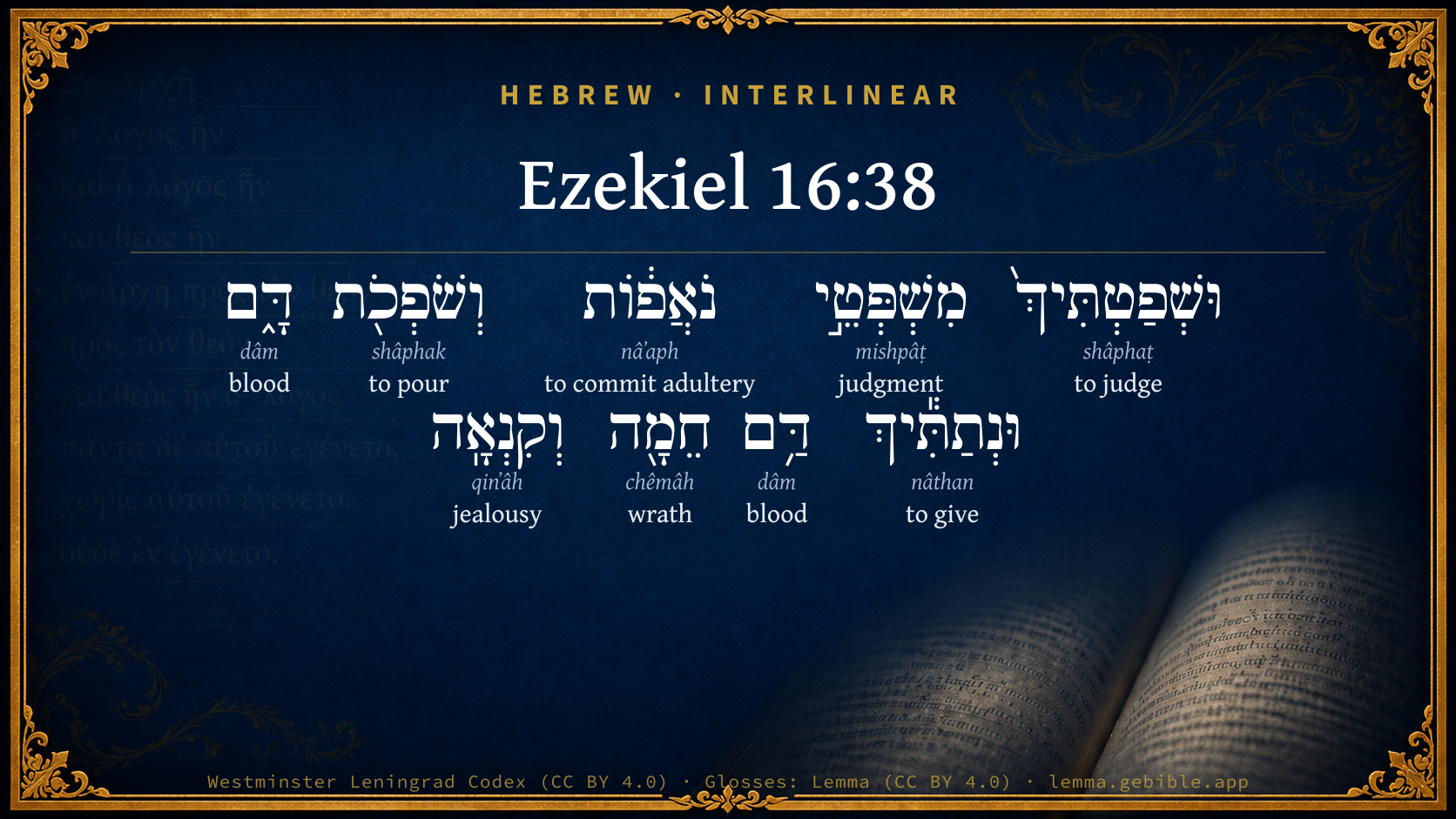
  1. וּשְׁפַטְתִּיךְ֙ shâphaṭ H8199 “and · to judge · you” Conjunction + Verb, Qal, Sequential Perfect, 1st Person, Common, Singular + Suffix, Personal, 2nd Person, Feminine, Singular
  2. מִשְׁפְּטֵ֣י mishpâṭ H4941 “judgments of” Noun, Common, Masculine, Plural, Construct
  3. וְשֹׁפְכֹ֖ת shâphak H8210 “and · pouring” Conjunction + Verb, Qal, Participle Active, Feminine, Plural, Construct
  4. דָּ֑ם dâm H1818 “blood” Noun, Common, Masculine, Singular, Absolute
  5. וּנְתַתִּ֕יךְ nâthan H5414 “and · to give · you” Conjunction + Verb, Qal, Sequential Perfect, 1st Person, Common, Singular + Suffix, Personal, 2nd Person, Feminine, Singular
  6. דַּ֥ם dâm H1818 “blood of” Noun, Common, Masculine, Singular, Construct
  7. חֵמָ֖ה chêmâh H2534 “wrath” Noun, Common, Feminine, Singular, Absolute
  8. וְקִנְאָֽה qinʼâh H7068 “and · jealousy” Conjunction + Noun, Common, Feminine, Singular, Absolute

About this verse

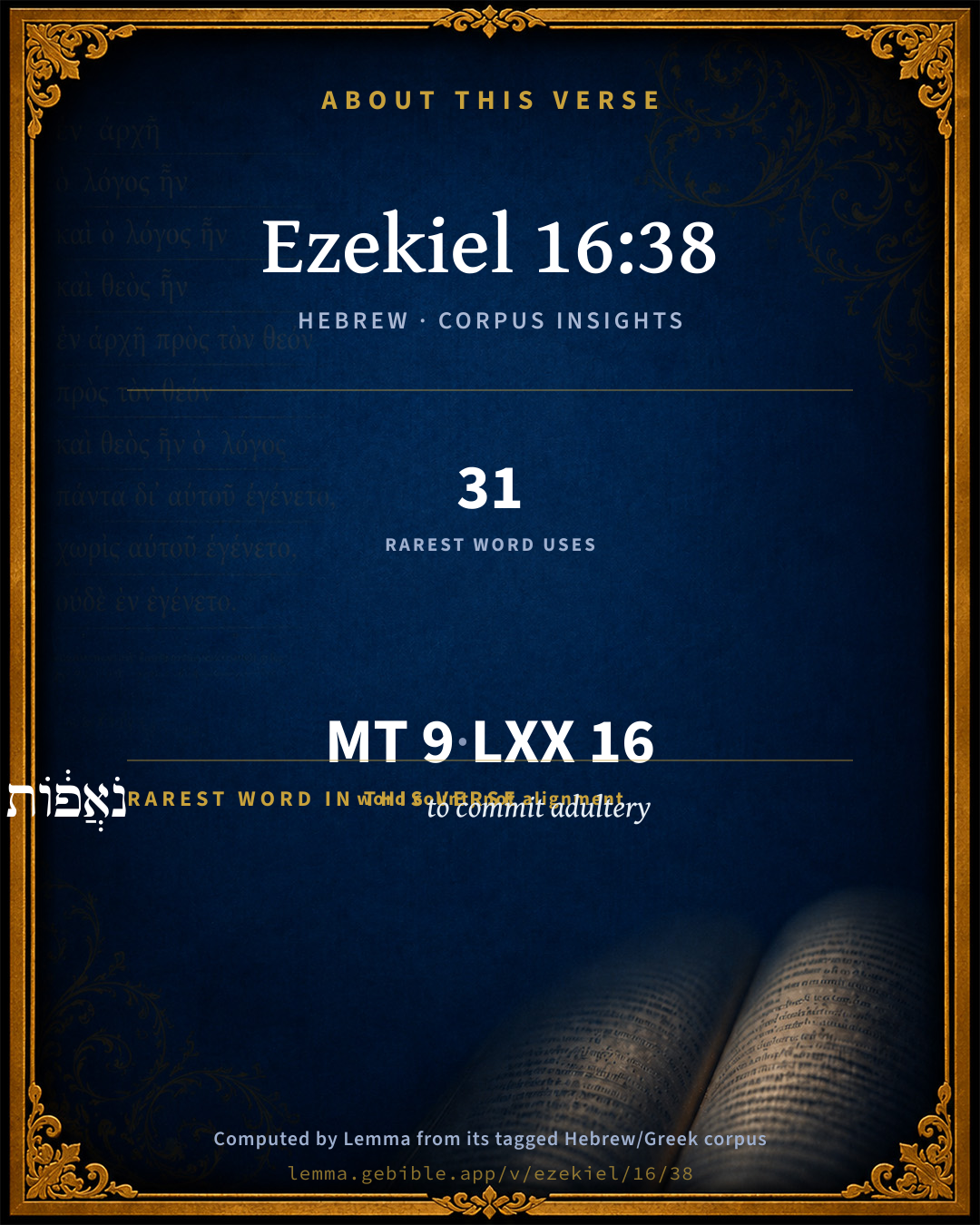
These counts appear in no published source. They are computed here, from the morphology-tagged text and Lemma’s own curated glosses. What Lemma adds →

9
words
8
distinct lemmas
Prophets
section

Shared distinctive vocabulary

נֹאֲפ֔וֹת to commit adultery H5003 occurs in 26 verses of the Hebrew Bible. Also found in:

Grammatical profile

  • 4 verbs
  • 5 nouns

Verb forms

  • וּשְׁפַטְתִּיךְ֙ Qal · Sequential Perfect
  • נֹאֲפ֔וֹת Qal · Participle Active
  • וְשֹׁפְכֹ֖ת Qal · Participle Active
  • וּנְתַתִּ֕יךְ Qal · Sequential Perfect

Repetition

A word recurs within this verse — often emphatic in Hebrew:

  • דָּ֑ם blood H1818 ×2

Hebrew & Septuagint length

In English translation the verse runs 26 words from the Hebrew and 24 from the Septuagint (LXX English) — closely comparable.

A rough comparison of the two English renderings, which tokenize alike — not a word-level alignment.

Word counts can differ between the Hebrew and the Greek without any difference in meaning — e.g. the Hebrew direct-object marker אֵת has no separate Greek word, and Greek often adds the article ὁ.

In the original languages it is 9 Hebrew tokens and 16 Greek tokens — but the two are counted differently (Hebrew bundles its prefixes and suffixes into one token; the Greek is in lemma form), so that isn’t a like-for-like length.

Cross-references

19

Topical passages linked to Ezekiel 16:38 in the Treasury of Scripture Knowledge — connected by theme and wording, ordered by reader-vote popularity; previews shown in the World English Bible.

  • Genesis 9:6 Whoever sheds man's blood, by man will his blood be shed, for in the image of God made he man.
  • Leviticus 20:10 "'The man who commits adultery with another man's wife, even he who commits adultery with his neighbor's wife, the adulterer and the adulteress shall surely be put to death.
  • Jeremiah 18:21 Therefore deliver up their children to the famine, and give them over to the power of the sword; and let their wives become childless, and widows; and let their men be slain of death, [and] their young men struck of the sword in battle.
  • Zephaniah 1:17 I will bring distress on men, that they will walk like blind men, because they have sinned against Yahweh, and their blood will be poured out like dust, and their flesh like dung.
  • Genesis 38:11 Then Judah said to Tamar, his daughter-in-law, "Remain a widow in your father's house, until Shelah, my son, is grown up;" for he said, "Lest he also die, like his brothers." Tamar went and lived in her father's house.
  • Genesis 38:24 It happened about three months later, that it was told Judah, saying, "Tamar, your daughter-in-law, has played the prostitute; and moreover, behold, she is with child by prostitution." Judah said, "Bring her forth, and let her be burnt."
  • Exodus 21:12 "One who strikes a man so that he dies shall surely be put to death,
  • Numbers 35:31 Moreover you shall take no ransom for the life of a murderer who is guilty of death; but he shall surely be put to death.
  • Deuteronomy 22:22–24 If a man be found lying with a woman married to a husband, then they shall both of them die, the man who lay with the woman, and the woman: so shall you put away the evil from Israel.
  • Psalms 79:3–5 Their blood they have shed like water around Jerusalem. There was no one to bury them.
  • Ezekiel 16:20–21 Moreover you have taken your sons and your daughters, whom you have borne to me, and these have you sacrificed to them to be devoured. Were your prostitution a small matter,
  • Ezekiel 16:36 Thus says the Lord Yahweh, Because your filthiness was poured out, and your nakedness uncovered through your prostitution with your lovers; and because of all the idols of your abominations, and for the blood of your children, that you gave to them;
  • Ezekiel 16:40 They shall also bring up a company against you, and they shall stone you with stones, and thrust you through with their swords.
  • Ezekiel 23:25 I will set my jealousy against you, and they shall deal with you in fury; they shall take away your nose and your ears; and your residue shall fall by the sword: they shall take your sons and your daughters; and your residue shall be devoured by the fire.
  • Ezekiel 23:45–47 Righteous men, they shall judge them with the judgment of adulteresses, and with the judgment of women who shed blood; because they are adulteresses, and blood is in their hands.
  • Nahum 1:2 Yahweh is a jealous God and avenges. Yahweh avenges and is full of wrath. Yahweh takes vengeance on his adversaries, and he maintains wrath against his enemies.
  • Matthew 1:18–19 Now the birth of Jesus Christ was like this; for after his mother, Mary, was engaged to Joseph, before they came together, she was found pregnant by the Holy Spirit.
  • John 8:3–5 The scribes and the Pharisees brought a woman taken in adultery. Having set her in the midst,
  • Revelation 16:6 For they poured out the blood of the saints and the prophets, and you have given them blood to drink. They deserve this."

Cross-references courtesy of OpenBible.info (CC BY 4.0).

Hebrew and Greek witnesses Masoretic Hebrew ↔ Greek Septuagint

The same verse in the two great witnesses to the Old Testament, shown verse-for-verse.

These are two independent witnesses, not word-aligned to each other, and the Septuagint is shown in lemma (dictionary) form.

Hebrew Ezekiel 16:38 Masoretic · Westminster Leningrad Codex

וּשְׁפַטְתִּיךְ֙ מִשְׁפְּטֵ֣י נֹאֲפ֔וֹת וְשֹׁפְכֹ֖ת דָּ֑ם וּנְתַתִּ֕יךְ דַּ֥ם חֵמָ֖ה וְקִנְאָֽה

I will judge you, as women who break wedlock and shed blood are judged; and I will bring on you the blood of wrath and jealousy.

World English Bible · Public Domain

Greek LXX Ezekiel 16:38 Septuagint · lemma form

καί ἐκδικέω σύ ἐκδίκησις μοιχαλίς καί ἐκχέω αἷμα καί τίθημι σύ ἐν αἷμα θυμός καί ζῆλος

And I will be avenged on you with the vengeance of an adulteress, and I will bring upon you blood of fury and jealousy.

LXX2012 (modern English Septuagint) · Public Domain

Hebrew: Westminster Leningrad Codex (CC BY 4.0). Greek: Septuagint (public domain); English from LXX2012 (modern English Septuagint) (Public Domain). How the Septuagint differs from the Hebrew →

Targum (Aramaic paraphrase)

1

The Targum is the ancient Jewish Aramaic paraphrase of the Hebrew Scriptures — an interpretive translation, not the Hebrew text itself. Onkelos (literal) and Pseudo-Jonathan (expansive) render the Torah, and Jonathan the Prophets. Coverage is partial: where no permissively-licensed English translation exists for a verse, only the Aramaic is shown. This is verse-level text, not a word-by-word alignment to the Hebrew.

  1. Targum Jonathan Prophets (Joshua–Malachi)
    וְאִתְפְּרַע מִנִיךְ פּוּרְעֲנּוּת גָיְפָן וְאַשְׁדִת דַם וְאֶמְסְרִינָךְ לִקְטוֹל בִּרְגַז וּבְחֵימָה:

    (no public-domain English translation for this verse)

    Targum Jonathan — Aramaic: “Mikraot Gedolot” (public domain). English: “Sefaria Community Translation” (CC0 1.0 (public-domain dedication)); “London "Chaldee Paraphrase," 1871” (public domain). Text via Sefaria.

Commentary

Notes on Ezekiel 16:38 from classic Christian and Jewish commentators (each source and its license shown beneath its notes). The classic Christian expositions comment on the surrounding passage and are grouped to its opening verse, so a note may address several verses; the Jewish commentaries on the Tanakh (Rashi and others) are per-verse, so they appear only where the commentator wrote on this verse.

Lemma curates 59 commentaries, every one of them public domain or Creative Commons licensed, each selected and text-cleaned for this edition rather than reprinted as found. About our sources →

Trapp's Complete Commentary

John Trapp

Eze 16:38 And I will judge thee, as women that break wedlock and shed blood are judged; and I will give thee blood in fury and jealousy.

Ver. 38. And I will judge thee as women that break wedlock.] See Lev 20:10 Deu 22:22. The Egyptians cut off the harlot’s nose, and the adulterer’s privy members; the Romans beheaded them; the old Germans whipped them through the streets; Canutus, the Danish king in this land, banished them; Tenedius, a king in another land, did cut them in sunder with an axe; by our laws they are to be hanged, as by the Jews’ laws to be stoned. {Eze 16:40}

And shed blood.] See Eze 16:35.

I will give thee blood.] God loveth to retaliate.

John Trapp, A Commentary or Exposition upon All the Books of the Old and New Testament (1647–1656) — public domain. Text from a community e-Sword module.

Geneva Bible (1599)

Geneva Bible translators

I will judge thee to death, as the adulterers and murderers.

Geneva Bible (1599) marginal notes — public domain. Text via Bolls.life.

Jamieson, Fausset & Brown

Robert Jamieson, A. R. Fausset & David Brown

judge thee, as women that break wedlock-- (Lev 20:10; compare Eze 16:2). In the case of individual adulteresses, stoning was the penalty (Joh 8:4-5). In the case of communities, the sword. Also apostasy (Deu 13:10) and sacrificing children to Molech (Lev 20:1-5) incurred stoning. Thus the penalty was doubly due to Israel; so the other which was decreed against an apostate city (Deu 13:15-16) is added, "they shall stone thee with stones and thrust thee through with . . . swords." The Chaldeans hurled stones on Jerusalem at the siege and slew with the sword on its capture.

shed blood . . . judged-- (Gen 9:6).

jealousy--image taken from the fury of a husband in jealousy shedding the blood of an unfaithful wife, such as Israel had been towards God, her husband spiritually. Literally, "I will make thee (to become) blood of fury and jealousy."

Jamieson, Fausset & Brown — Commentary Critical and Explanatory on the Whole Bible (1871) — public domain (CC PDM 1.0). Text via the HelloAO Bible API.

John Calvin's Commentaries

This verse is only added for the sake of explanation. Already God had explained shortly and clearly every event which should happen to the Jews, yet they should perish in the greatest disgrace and be destitute of all help, since through distrust in God they sought the favor of men, like a woman eager for lovers. But he confirms the same teaching, that they should suffer double punishment, since they not only polluted themselves thus shamefully, but also by impious slaughters, since they burnt their children in honor of false gods. This sentence may be explained generally, I will judge you with the judgments of women pouring out blood, as we know that not only idolatry was rampant at Jerusalem, but rapine, and all kinds of cruelty; for since they had departed from God and his worship, they boldly violated his law. By the second word we may understand all the crimes by which they had provoked God’s anger on account of their cruelty. But since he has lately spoken of sons, I willingly retain that sense, that they should suffer as an adulteress and a parricide who has put her children to death. But they thought that they obeyed: but he not only rejects, but abominates such foolish thoughts; for nothing is more disgraceful than, under the pretense of piety, to slay and to burn one’s own children: this, I say, was a profanation of God’s name scarcely tolerable. No wonder, then, that he denounces double vengeance, since, when the Jews pleaded their zeal, God branded upon them the mark of wickedness, though they thought him bound to their interests. It afterwards follows —

John Calvin's Commentaries (1540-1563) — public domain. Text from the Calvin Translation Society English edition (1840s-50s) via the Christian Classics Ethereal Library (ccel.org). Calvin's coverage is partial (roughly two-thirds of the Bible); uncommented books and verses are honest gaps, never fabricated. The 19th-century editor's footnotes and remarks are omitted so the notes are faithfully Calvin's own voice.

Ellicott's Commentary for English Readers

(38) Women that break wedlock and shed blood.—Under the Mosaic law the penalty for adultery was death (Lev_20:10), and the same penalty also was attached to the devotion of “seed to Moloch” (Lev_20:1-5), and to murder (Exo_21:12). The Jewish method of capital punishment on individuals was by stoning (see Lev_20:2, and comp. Joh_8:5), and of punishing an apostate city was by the sword (Deu_13:15). Hence both modes are mentioned together in Eze_16:40, though somewhat at the expense of the consistency of the allegory. The last clause would be more exactly translated, “I will make thee blood of fury and jealousy,” the fury referring to the avenging of murder, and the jealousy to the punishment of adultery, each requiring the life, or blood, of the offender.

A Bible Commentary for English Readers, edited by Charles John Ellicott (1878–1897) — public domain. Text from a community e-Sword module.

The Cambridge Bible for Schools and Colleges

gen. ed. J. J. S. Perowne

38. shed blood] Reference to child murder, Eze_16:20; Eze_16:36. Cf. ch. Eze_23:45; Lev_20:10; Deu_22:22.

give thee blood in fury] Lit. make thee the blood of fury, i.e. bring on thee the bloody death which fury and jealousy executes. On cons. cf. ch. Eze_26:21, Eze_35:6.

The Cambridge Bible for Schools and Colleges (gen. ed. J. J. S. Perowne; Cambridge University Press, 1878–1918) — public domain. Text from a community e-Sword module.

John Gill's Exposition

And I also will give thee into their hand,.... Into the hand of their lovers and enemies that should be gathered against them, the Assyrians and Chaldeans, with others that joined them, as in Eze 16:37;

and they shall throw down thine eminent place, and shall break down thine high places; the city of Jerusalem, the temple, and altars; and not only these, but even the high places and altars which were set up for idolatrous uses; all should be destroyed by the Chaldean army. The Targum is,

"and they shall destroy thy walls, and thy high places shall be destroyed:''

they shall strip thee also of thy clothes; as persons commonly are when taken captives:

and shall take thy fair jewels; or, "the vessels of thy glory" (s); the vessels of the sanctuary of gold and silver, and their own household furniture, with all their riches and substance:

and leave thee naked and bare; as at first when in Egypt; see Eze 16:7.

(s) "vasa decoris tui", V. L. "instrumenta ornatus tui", Junius & Tremellius, Polanus; "vasa ornatus tui", Piscator, Starckius.

John Gill's Exposition of the Whole Bible (1746–1763) — public domain (CC PDM 1.0). Text via the HelloAO Bible API.

Haydock's Catholic Bible Commentary

Judge; punish thee by stoning to death, Leviticus xx. 10. The walls of the Jews were battered to the ground.

George Leo Haydock (1774–1849), Haydock's Catholic Family Bible and Commentary, 1859 edition — public domain. Excludes Psalms (Douay-Rheims chapter numbering differs from Protestant) and Deuterocanonical books (Catholic canon only).

Matthew Poole's English Annotations

And I, who am thy Lord and Husband, whose authority and kindness thou hast so contemned and abused,

will judge thee; both condemn thee to suffer what thou deservest, and execute what thou art condemned to;

as women that break wedlock, who were sometimes strangled, sometimes stoned, sometimes burnt, were put to death to be sure, Lev 20:10; Deu 22:22. It may intimate the future destruction of her adulterous lovers, for both the adulterer and adulteress were to die. Site was guilty of the unnatural murder of her children, and God will, according to his own law, Gen 9:5,6; Num 35:31,32, cause her blood to be shed.

Will give thee blood; the like phrase you have Rev 16:6, and elsewhere; the like judgment is expressed by watering the land with blood, as Eze 32:6, and by preparing one for blood, Eze 35:6; Thou gavest the blood of thy children to idols in sacrifice, I will give thee thine own blood to drink; thou didst it in contempt of my law, I will do it in vindication of my law.

In fury and jealousy; passions that do usually appear in the revenges that abused husbands take on their wives which have intolerably dishonoured and wronged them; and God expresseth his great indignation, and the severity of his just displeasure, by allusion hereunto.

Matthew Poole's English Annotations on the Holy Bible (1683–1685) — public domain. Text from a community e-Sword/MySword module.

Whedon's Commentary on the Bible

Daniel D. Whedon

38. I will judge thee — The scorn of the nations whose favor she has courted will be the least of her punishment.

I will give thee blood in fury and jealousy — Rather, I will make thee to be the blood of fury and jealousy. The meaning is that hers shall be the bloody death which, according to the law, the furious husband could inflict upon the wife who has been untrue to the marriage vow and has shed the blood of her child. (See Eze_16:20; Eze_16:36; Eze_23:25; Lev_20:10; Deu_22:22.) Toy translates, “I will inflict on thee the bloody requital of furious indignation.”

Daniel D. Whedon (gen. ed.), Commentary on the Old and New Testaments (1874–1909) — public domain. Text from a community e-Sword module.

The Pulpit Commentary

The bloodshed may refer, as in ver. 36, to the Moloch sacrifices, or may include also other crimea, assassinations and judicial murders. (Jer_2:34) Strictly speaking, the punishment of the adulteress was death by stoning. (Lev_20:2, Lev_20:10; Deu_21:21 Deu_22:21; Joh_8:5) Did Ezekiel think of the stones cast against the city from the catapult engines of the Chahleans as a literal counterpart of that punishment? In the last clause read, with the Revised Version, I will bring upon thee the blood of fury and jealousy; sc. the death which was inflicted by the indignation of Jehovah as the Husband against whom Judah had sinned.

The Pulpit Commentary (1880–1919), ed. H.D.M. Spence-Jones & Joseph S. Exell — public domain. Text from a community e-Sword module.

John Wesley's Explanatory Notes

Blood - Thou gavest the blood of thy children to idols in sacrifice; I will give thee thine own blood to drink.

John Wesley, Explanatory Notes Upon the Whole Bible (1754–1765) — public domain. Text via the GEBible commentary corpus.

unfoldingWord translationNotes

Door43 World Missions Community

General Information:

Yahweh continues to speak about Jerusalem as if the city were his unfaithful wife. The city represents the people who live there. (See: Metaphor and Metonymy)

the shedding of blood

This phrase represents murder in any form. AT: "murder" (See: Metonymy)

I will bring on you the bloodshed of my anger and passion

Here "bloodshed" represents murder in any form. Possible meanings are 1) Yahweh speaks of punishing her for murder as if he were bringing bloodshed upon her. AT: "In my anger and passion, I will punish you for committing murder" or 2) Yahweh speaks of putting her to death as if he were bringing bloodshed upon her. AT: "In my anger and passion, I will shed your blood" (See: Metonymy and Metaphor)

I will give you into their hands

Here "hands" represents power or control. AT: "I will place you in their control" or "I will allow them to have power over you" (See: Metonymy)

throw down your vaulted chamber

Possible meanings are that they will destroy 1) the place where she worshiped her idols or 2) the place where she practiced her prostitution. See how you translated "vaulted chamber" in Ezekiel 16:24.

naked and bare

These two words mean the same thing. See how you translated this in Ezekiel 16:7. AT: "completely naked" (See: Doublet)

translationWords

punish

adultery

bloodshed

anger

hand

high place

unfoldingWord translationNotes — © Distant Shores Media and the Door43 World Missions Community, licensed CC BY-SA 4.0. Source: git.door43.org/Door43/en_tn.

Rashi

Rabbi Shlomo Yitzchaki (Rashi)

and I shall deliver you [to those who shed] blood with fury and zeal And I shall deliver you to those who slay with fury and zeal and anger.

Rashi on the Tanakh — English translations: “The Judaica Press complete Tanach with Rashi, translated by A. J. Rosenberg” (CC BY 4.0); “Pentateuch with Rashi's commentary by M. Rosenbaum and A.M. Silbermann, 1929-1934” (public domain); “The Metsudah Tanach series, Lakewood, N.J” (CC BY 4.0); and “The Book of Joshua, Metsudah Publications, 1997” (CC BY 4.0). Text via Sefaria.

Lesson kit

Teaching starters — assembled from the data on this page, not authored interpretation. Every prompt links to the verse data it draws on. Edit before teaching.

Ezekiel, in the Prophets, opens this verse with 9 words (8 distinct Hebrew lemmas). Its most distinctive word is nâʼaph (“to commit adultery”). A historical commentator’s framing appears above. Read the whole chapter for the surrounding context.

Discussion questions

  1. What does “to commit adultery” (nâʼaph) contribute to the verse as a whole?
  2. How does Exodus 20:14, which shares the word «to commit adultery», read alongside this verse?
  3. What does the repetition of “blood” (2× in this one verse) do in this verse?
  4. These translations render this verse differently. What is at stake in choosing one wording over another?
  5. «וּשְׁפַטְתִּיךְ֙» is a Qal Sequential Perfect verb. How does that grammatical form shape the action described?
  6. Compare how Trapp's Complete Commentary and Geneva Bible (1599) read this verse. Where do they agree or differ?

Things to notice

Reading settings

Reading text

Shown beneath each verse's original-language words.

Old Testament
Old Testament edition

Read the OT as the Masoretic Hebrew (MT) or the Greek Septuagint (LXX).

English shown for the Greek Septuagint (in the Hebrew ↔ Greek comparison).

Comparing translations? Open the Compare panel on any verse page to stack up to four side by side.