Deuteronomy 19:13

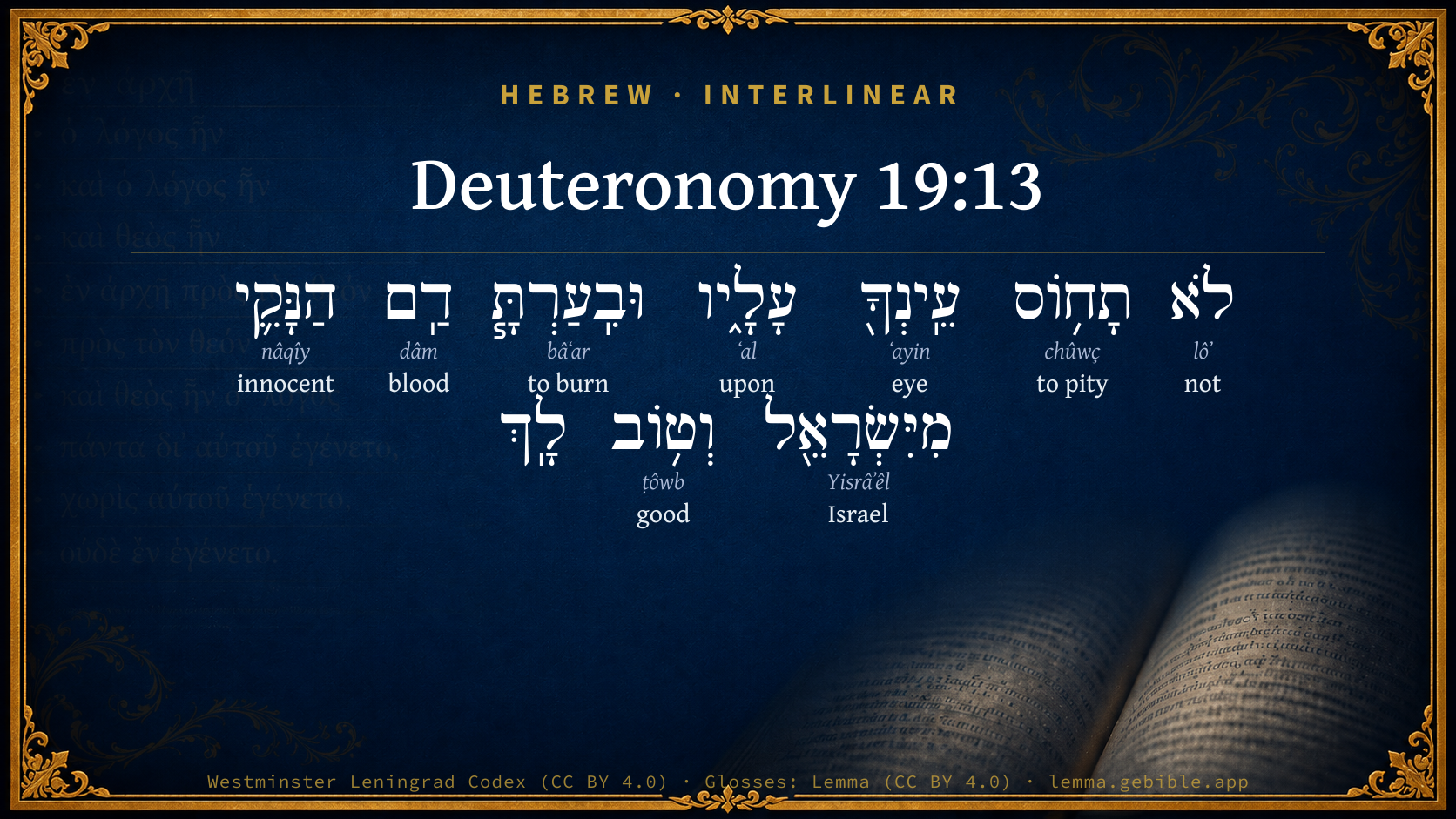
Hebrew (Westminster Leningrad Codex) Deuteronomy 19:13 appears in the Hebrew Old Testament. The text above is from the Westminster Leningrad Codex. Each word links to its Strong’s number, a concise gloss, and parsing drawn from the Open Scriptures Hebrew Bible morphology. Click any word for its full Brown-Driver-Briggs (BDB) entry.
Download image
Cite this verse

Deuteronomy 19:13 (World English Bible). Public Domain. Lemma interlinear Bible study tool, https://lemma.gebible.app/v/deuteronomy/19/13.

Show BibTeX & RIS
BibTeX
RIS
English Translation
Your eye shall not pity him, but you shall put away the innocent blood from Israel, that it may go well with you.
World English Bible · Public Domain
Download a study sheet

One document with this verse’s original text, its word-by-word gloss line, the meaning frame, cross-references with their text, attributed commentary, and full source and license credits — printable, and it pastes into notes with its structure intact.

This verse Autodidact and up

Study sheet (.html) Plain text (.txt)

A passage Seminary Student

Up to 50 verses in one chapter. A passage sheet keeps up to 6 commentary sources and 12 cross-references per verse, in the order this page ranks them, and says so on the sheet whenever that leaves anything out. Ask for a single verse and you get the Autodidact verse sheet above.

Everything on this page stays free to read, with no account — the sheet is a download of what is already on screen, not access to it.

Want to remove ads? Support Godless Engineer
Compare translations 3

The same verse in 3 English versions, stacked beneath the original-language interlinear above. Click any original word for its lexicon entry.

Each is an independent rendering of the whole verse — the interlinear is not word-aligned to these translations.

Highlighted words mark where these versions differ — a whole-verse word diff, not a word-by-word alignment.

  • World English Bible Public Domain
    Your eye shall not pity him, but you shall put away the innocent blood from Israel, that it may go well with you.
  • King James Version Public Domain
    Thine eye shall not pity him, but thou shalt put away the guilt of innocent blood from Israel, that it may go well with thee.
  • unfoldingWord Literal Text CC BY-SA 4.0
    Your eye shall not pity him, and you shall remove the blood of the innocent from Israel, and it will go well for you.

unfoldingWord Literal Text — © unfoldingWord, licensed CC BY-SA 4.0. Word-aligned USFM3 via Door43 (git.door43.org/unfoldingWord/en_ult).

Versions to compare (up to 4)

3 of 4 selected

Show all 18 translations

Every available English version of this verse, each an independent rendering of the whole verse.

  • World English Bible Public Domain
    Your eye shall not pity him, but you shall put away the innocent blood from Israel, that it may go well with you.
  • Berean Standard Bible Public Domain
    You must show him no pity. You are to purge from Israel the guilt of shedding innocent blood, that it may go well with you.
  • Majority Standard Bible Public Domain
    You must show him no pity. You are to purge from Israel the guilt of shedding innocent blood, that it may go well with you.
  • King James Version Public Domain
    Thine eye shall not pity him, but thou shalt put away the guilt of innocent blood from Israel, that it may go well with thee.
  • American Standard Version (1901) Public Domain
    Thine eye shall not pity him, but thou shalt put away the innocent blood from Israel, that it may go well with thee.
  • Revised Version (1885) Public Domain
    Thine eye shall not pity him, but thou shalt put away the innocent blood from Israel, that it may go well with thee.
  • Geneva Bible (1599) Public Domain
    Thine eye shall not spare him, but thou shalt put away the crie of innocent blood from Israel, that it may goe well with thee.
  • Douay-Rheims (1899) Public Domain
    Thou shalt not pity him, and thou shalt take away the guilt of innocent blood out of Israel, that it may be well with thee.
  • Young's Literal Translation Public Domain
    thine eye hath no pity on him, and thou hast put away the innocent blood from Israel, and it is well with thee.
  • Literal Standard Version CC BY-SA 4.0
    your eye has no pity on him, and you have put away the innocent blood from Israel, and it is well with you.
  • Unlocked Literal Bible CC BY-SA 4.0
    Your eye must not pity him; instead, you must eradicate the bloodguilt from Israel, that it may go well with you.
  • unfoldingWord Literal Text CC BY-SA 4.0
    Your eye shall not pity him, and you shall remove the blood of the innocent from Israel, and it will go well for you.
  • Darby Bible Public Domain
    Thine eye shall not spare him; and thou shalt put away innocent blood from Israel, that it may be well with thee.
  • World Messianic Bible Public Domain
    Your eye shall not pity him, but you shall purge the innocent blood from Israel that it may go well with you.
  • Webster's Bible Public Domain
    Thy eye shall not pity him, but thou shall remove the guilt of innocent blood from Israel, that it may be well with thee.
  • Free Bible Version CC BY-SA 4.0
    Show him no mercy. You are to eliminate from Israel the guilt of shedding the blood of the innocent, and then all will be well.
  • Bible in Basic English Public Domain
    Have no pity on him, so that Israel may be clear from the crime of putting a man to death without cause, and it will be well for you.
  • JPS Tanakh (1917) Public Domain
    Thine eye shall not pity him, but thou shalt put away the blood of the innocent from Israel, that it may go well with thee.

Literal Standard Version (2020), Covenant Press — licensed CC BY-SA 4.0. Text via the HelloAO Bible API (eBible.org). Unlocked Literal Bible (unfoldingWord) — licensed CC BY-SA 4.0. Text via the HelloAO Bible API (eBible.org). unfoldingWord Literal Text — © unfoldingWord, licensed CC BY-SA 4.0. Word-aligned USFM3 via Door43 (git.door43.org/unfoldingWord/en_ult). Free Bible Version, Dr. Jonathan Gallagher — licensed CC BY-SA 4.0. Text via the HelloAO Bible API (eBible.org).

Word by word

More ways to search: Search by grammar → Find every occurrence → Compare this word →

Practice this passage: Drill this verse → Learn its vocabulary →

תָח֥וֹס
chûwç
H2347
“to pity”
Verb, Qal, Imperfect, 3rd Person, Feminine, Singular
Part of Speech
Verb
Stem
Qal
Form
Imperfect
Person
3rd Person
Gender
Feminine
Number
Singular
Full BDB Definition

Origin: a primitive root

TWOT: 626

(Qal) to pity, have compassion, spare, look upon with compassion
  1. לֹא lôʼ H3808 “not” Particle, Negative
  2. עֵֽינְךָ֖ ʻayin H5869 “eye · your” Noun, Common, Both, Singular, Construct + Suffix, Personal, 2nd Person, Masculine, Singular
  3. עָלָ֑יו ʻal H5921 “upon · him” Preposition + Suffix, Personal, 3rd Person, Masculine, Singular
  4. וּבִֽעַרְתָּ֧ bâʻar H1197 “and · to burn” Conjunction + Verb, Piel, Sequential Perfect, 2nd Person, Masculine, Singular
  5. דַֽם dâm H1818 “blood of” Noun, Common, Masculine, Singular, Construct
  6. הַנָּקִ֛י nâqîy H5355 “the · innocent” Particle, Definite Article + Adjective, Adjective, Masculine, Singular, Absolute
  7. מִיִּשְׂרָאֵ֖ל Yisrâʼêl H3478 “from · Israel” Preposition + Noun, Proper
  8. וְט֥וֹב ṭôwb H2896 “and · good” Conjunction + Verb, Qal, Sequential Perfect, 3rd Person, Masculine, Singular

About this verse

These counts appear in no published source. They are computed here, from the morphology-tagged text and Lemma’s own curated glosses. What Lemma adds →

10
words
9
distinct lemmas
Pentateuch
section

Notable vocabulary

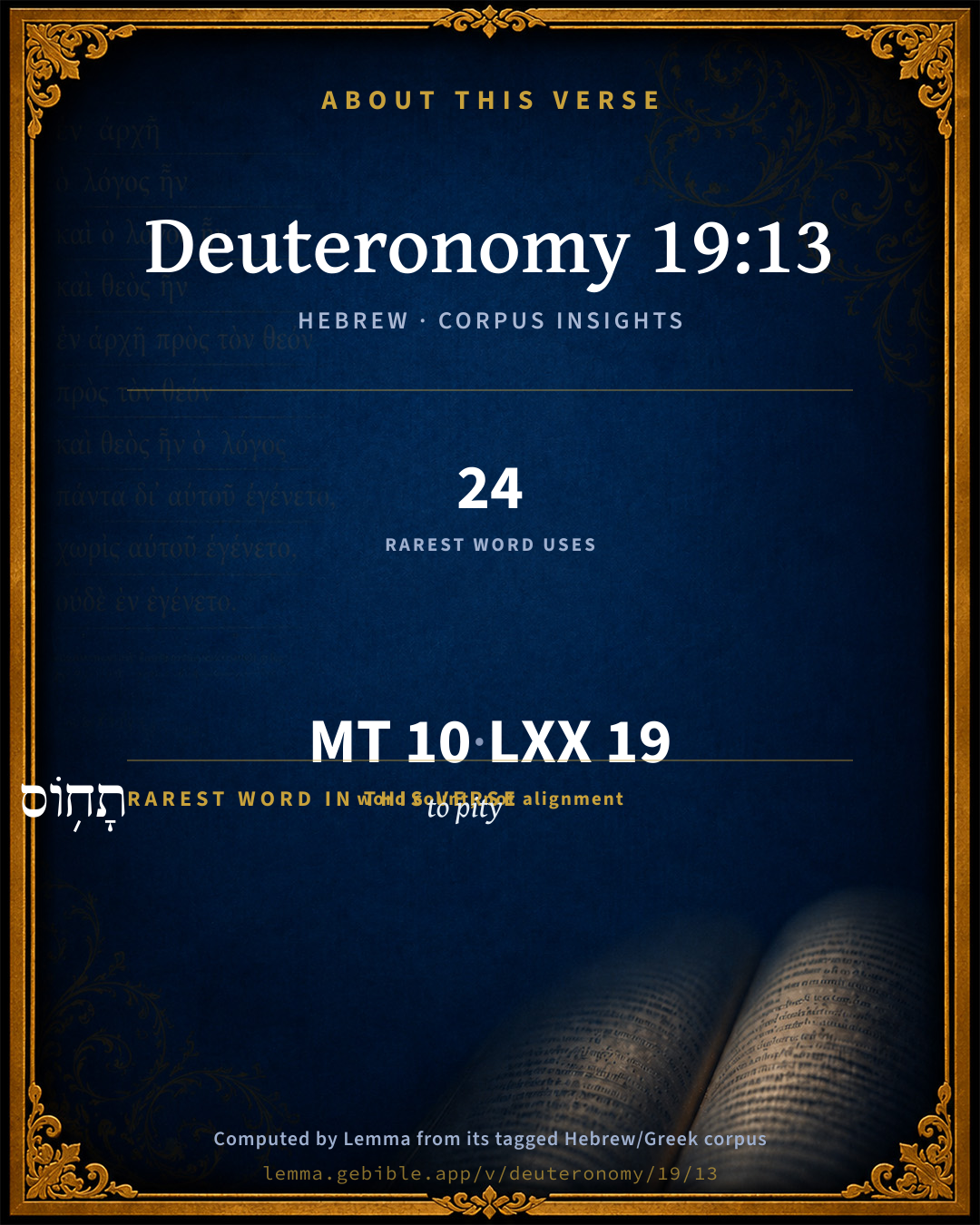
The rarest word here is תָח֥וֹס to pity H2347 — appearing just 24 times in the whole Hebrew Bible.

Shared distinctive vocabulary

תָח֥וֹס to pity H2347 occurs in 24 verses of the Hebrew Bible. Also found in:

Grammatical profile

  • 3 verbs
  • 3 nouns
  • 1 adjective
  • 2 prepositions
  • 1 particle

Verb forms

  • תָח֥וֹס Qal · Imperfect
  • וּבִֽעַרְתָּ֧ Piel · Sequential Perfect
  • וְט֥וֹב Qal · Sequential Perfect

Hebrew & Septuagint length

In English translation the verse runs 23 words from the Hebrew and 21 from the Septuagint (LXX English) — closely comparable.

A rough comparison of the two English renderings, which tokenize alike — not a word-level alignment.

Word counts can differ between the Hebrew and the Greek without any difference in meaning — e.g. the Hebrew direct-object marker אֵת has no separate Greek word, and Greek often adds the article ὁ.

In the original languages it is 10 Hebrew tokens and 19 Greek tokens — but the two are counted differently (Hebrew bundles its prefixes and suffixes into one token; the Greek is in lemma form), so that isn’t a like-for-like length.

Cross-references

13

Topical passages linked to Deuteronomy 19:13 in the Treasury of Scripture Knowledge — connected by theme and wording, ordered by reader-vote popularity; previews shown in the World English Bible.

  • 1 Kings 2:31 The king said to him, Do as he has said, and fall on him, and bury him; that you may take away the blood, which Joab shed without cause, from me and from my father's house.
  • Deuteronomy 7:2 and when Yahweh your God shall deliver them up before you, and you shall strike them; then you shall utterly destroy them: you shall make no covenant with them, nor show mercy to them;
  • Deuteronomy 7:16 You shall consume all the peoples who Yahweh your God shall deliver to you; your eye shall not pity them: neither shall you serve their gods; for that will be a snare to you.
  • Deuteronomy 21:9 So shall you put away the innocent blood from the midst of you, when you shall do that which is right in the eyes of Yahweh.
  • Numbers 35:33–34 So you shall not pollute the land in which you are: for blood, it pollutes the land; and no expiation can be made for the land for the blood that is shed therein, but by the blood of him who shed it.
  • 2 Samuel 21:1 There was a famine in the days of David three years, year after year; and David sought the face of Yahweh. Yahweh said, It is for Saul, and for his bloody house, because he put to death the Gibeonites.
  • Genesis 9:6 Whoever sheds man's blood, by man will his blood be shed, for in the image of God made he man.
  • Leviticus 24:17 "'He who strikes any man mortally shall surely be put to death.
  • Leviticus 24:21 He who kills an animal shall make it good; and he who kills a man shall be put to death.
  • Deuteronomy 13:8 you shall not consent to him, nor listen to him; neither shall your eye pity him, neither shall you spare, neither shall you conceal him:
  • Deuteronomy 25:12 then you shall cut off her hand, your eye shall have no pity.
  • 2 Samuel 21:14 They buried the bones of Saul and Jonathan his son in the country of Benjamin in Zela, in the tomb of Kish his father: and they performed all that the king commanded. After that God was entreated for the land.
  • Ezekiel 16:5 No eye pitied you, to do any of these things to you, to have compassion on you; but you were cast out in the open field, for that your person was abhorred, in the day that you were born.

Cross-references courtesy of OpenBible.info (CC BY 4.0).

Hebrew and Greek witnesses Masoretic Hebrew ↔ Greek Septuagint

The same verse in the two great witnesses to the Old Testament, shown verse-for-verse.

These are two independent witnesses, not word-aligned to each other, and the Septuagint is shown in lemma (dictionary) form.

Hebrew Deuteronomy 19:13 Masoretic · Westminster Leningrad Codex

לֹא תָח֥וֹס עֵֽינְךָ֖ עָלָ֑יו וּבִֽעַרְתָּ֧ דַֽם הַנָּקִ֛י מִיִּשְׂרָאֵ֖ל וְט֥וֹב לָֽךְ

Your eye shall not pity him, but you shall put away the innocent blood from Israel, that it may go well with you.

World English Bible · Public Domain

Greek LXX Deuteronomy 19:13 Septuagint · lemma form

οὐ φείδομαι ὁ ὀφθαλμός σύ ἐπί αὐτός καί καθαρίζω ὁ αἷμα ὁ ἀναίτιος ἐκ ἰσραήλ καί εὖ σύ εἰμί

Your eye shall not spare him; so shall you purge innocent blood from Israel, and it shall be well with you.

LXX2012 (modern English Septuagint) · Public Domain

Hebrew: Westminster Leningrad Codex (CC BY 4.0). Greek: Septuagint (public domain); English from LXX2012 (modern English Septuagint) (Public Domain). How the Septuagint differs from the Hebrew →

Targum (Aramaic paraphrase)

2

The Targum is the ancient Jewish Aramaic paraphrase of the Hebrew Scriptures — an interpretive translation, not the Hebrew text itself. Onkelos (literal) and Pseudo-Jonathan (expansive) render the Torah, and Jonathan the Prophets. Coverage is partial: where no permissively-licensed English translation exists for a verse, only the Aramaic is shown. This is verse-level text, not a word-by-word alignment to the Hebrew.

  1. Targum Onkelos Torah (Genesis–Deuteronomy)
    לָא תְחוּס עֵינָךְ עֲלוֹהִי וּתְפַלֵי אַשְׁדִי דָם זַכַּי מִיִשְׂרָאֵל וְיֵיטַב לָךְ

    (no public-domain English translation for this verse)

    Targum Onkelos — Aramaic: “Onkelos Genesis” (public domain); “Onkelos Exodus” (public domain); “Onkelos Leviticus” (public domain); “Onkelos Numbers” (public domain); “Onkelos Deuteronomy” (public domain). English: “Sefaria Community Translation” (CC0 1.0 (public-domain dedication)); “J.W. Etheridge. The Targums of Onkelos and Jonathan Ben Uzziel on the Pentateuch. London: Longmans, Green, 1862” (public domain). Text via Sefaria.

  2. Targum Pseudo-Jonathan Torah (Genesis–Deuteronomy)
    לָא תֵיחוּס עֵינֵיכוֹן עֲלוֹי וּתְפַלּוּן שַׁדְיֵי דַם זַכַּאי מִיִּשְרָאֵל וְיֵיטִיב לְכוֹן

    Your eye shall not spare him, but you shall put away shedders of innocent blood from Israel, that it may be well with you.

    Targum Pseudo-Jonathan — Aramaic: “Targum Jonathan on Genesis” (public domain); “Targum Jonathan on Exodus” (public domain); “Targum Jonathan on Leviticus” (public domain); “Targum Jonathan on Numbers” (public domain); “Targum Jonathan on Deuteronomy” (public domain). English: “The Targum of Jonathan ben Uzziel, trans. J. W. Etheridge, London, 1862” (public domain). Text via Sefaria.

Commentary

Notes on Deuteronomy 19:13 from classic Christian and Jewish commentators (each source and its license shown beneath its notes). The classic Christian expositions comment on the surrounding passage and are grouped to its opening verse, so a note may address several verses; the Jewish commentaries on the Tanakh (Rashi and others) are per-verse, so they appear only where the commentator wrote on this verse.

Lemma curates 59 commentaries, every one of them public domain or Creative Commons licensed, each selected and text-cleaned for this edition rather than reprinted as found. About our sources →

Tyndale Open Study Notes

Tyndale Open Resources

19:13 Purge (literally burn): The only way for the land to be free of culpability in matters of homicide was for blood vengeance to be enacted, which would burn out the impurity. See also 13:5; 17:12.

Tyndale Open Study Notes — © Tyndale Open Resources, licensed CC BY-SA 4.0. Text via the HelloAO Bible API.

Geneva Bible (1599)

Geneva Bible translators

Then whosoever pardoneth murder, offendeth against the word of God.

Geneva Bible (1599) marginal notes — public domain. Text via Bolls.life.

The Cambridge Bible for Schools and Colleges

gen. ed. J. J. S. Perowne

13. Only by such action on the part of the local authorities and the kinsmen of the murdered man can the guilt of the crime be removed from the whole nation. To this extent the ancient custom of the vendetta is recognised as part of the theocratic system.

thou shalt put away] See on Deu_13:5 (6).

that it may go well with thee] Another recurrent phrase; Deu_4:40, Deu_5:16; Deu_5:29, etc.

Additional Note: The Vendetta, ‘the one element of jurisprudence in the wild life of the desert,’ springs from, the simple principle of blood for blood, still valid in the law of Israel, Gen_9:6. Its moral effects are twofold and contrary. On the one hand it is a restraint upon manslaughter, the possibilities of vengeance which it lets loose engendering reluctance to take life except in self-defence. On the other, when once a man has been slain, there is no chance of a fair trial for the slayer; though his deed may have been an accident he may have to atone for it with his life; while the excitement of whole families and tribes to avenge it is a fertile source of disorder and of war, which may last and has lasted for a century. The duty of the vendetta extends sometimes to the third sometimes to the fifth degree of kinship, but among the Sinai Arabs to the sixth from the grandfather down (Jennings Bramley, PEFQ 1907, 135). Hence even in the wildest parts of Arabia there arose the right of sanctuary in any tent from which it was claimed, and the respite was used for the investigation of the case, and even in cases of wilful murder for the arrangement of some compromise—financial or otherwise—between the slayer and the kinsmen of the slain. In these negotiations the tribal authorities would often intervene. But even this has been found insufficient to secure order and justice, and wherever a central authority has been established among the Arabs one of its first efforts has been to control and regulate, or even to abolish, the vendetta. For modern examples—the Wahabees, Mohammed ‘Ali, the Russians in the Caucasus and the Sublime Porte—see Von Oppenheim, Vom Mittelmeer zum Pers. Golf. Similarly in Israel. The earlier law (as we have seen) gave sanctuary at every altar of Jehovah. When only the One Altar remained the opportunity came to modify the whole consuetudinary law; the vendetta was not abolished but controlled by the rights of sanctuary in certain accessible cities and by the interference of the local authorities. These provisions, apparently first made by D and elaborated in P, secured a fair trial and the acquittal of the innocent slayer; but they do not allow any such compromise, financial or otherwise, as frequently takes place among the Arabs between the wilful murderer and the kinsmen of his victim. In Israel the wilful murderer must die. Such distinctions of Israel’s system from the customs of her Semitic neighbours, involving as they do both a greater humanity in one direction and a greater severity in the other, are of the highest ethical interest.

The Cambridge Bible for Schools and Colleges (gen. ed. J. J. S. Perowne; Cambridge University Press, 1878–1918) — public domain. Text from a community e-Sword module.

John Gill's Exposition

Thou shalt not remove thy neighbour's landmark,.... By which one man's land is distinguished from another; for so to do is to injure a man's property, and alienate his lands to the use of another, which must be a very great evil, and render those that do it obnoxious to a curse, Deu 27:17.

which they of old have set in thine inheritance, which thou shall inherit in the land that the Lord thy God giveth thee to possess it; the land of Canaan: this is thought to refer to the bounds and limits set in the land by Eleazar and Joshua, and those concerned with them at the division of it; when not only the tribes were bounded; and distinguished by certain marks, but every man's estate, and the possession of every family in every tribe which though not as yet done when this law was made, yet, as it respects future times, might be said to be done of old, whenever there was any transgression of it, which it cannot be supposed would be very quickly done; and it is a law not only binding on the inhabitants of the land of Canaan, but all others, it being agreeably to the light and law of nature, and which was regarded among the Heathens, Pro 22:28.

John Gill's Exposition of the Whole Bible (1746–1763) — public domain (CC PDM 1.0). Text via the HelloAO Bible API.

Haydock's Catholic Bible Commentary

Innocent. Many Latin copies have "guilty blood," noxium. By putting the offender to death, Israel was expiated from the blood which had been shed unjustly. (Calmet)

George Leo Haydock (1774–1849), Haydock's Catholic Family Bible and Commentary, 1859 edition — public domain. Excludes Psalms (Douay-Rheims chapter numbering differs from Protestant) and Deuterocanonical books (Catholic canon only).

Rashi

Rabbi Shlomo Yitzchaki (Rashi)

לא תחוס עינך THINE EYE SHALL NOT PITY [HIM] — i.e. that thou shall not say, The first (the one) person has already been killed, why should we kill this also, so that two Israelites will be killed? (Sifrei Devarim 187:7).

Rashi on the Tanakh — English translations: “The Judaica Press complete Tanach with Rashi, translated by A. J. Rosenberg” (CC BY 4.0); “Pentateuch with Rashi's commentary by M. Rosenbaum and A.M. Silbermann, 1929-1934” (public domain); “The Metsudah Tanach series, Lakewood, N.J” (CC BY 4.0); and “The Book of Joshua, Metsudah Publications, 1997” (CC BY 4.0). Text via Sefaria.

Ramban (Nachmanides)

Rabbi Moshe ben Nachman (Ramban / Nachmanides)

THINE EYE SHALT NOT PITY HIM. “This means that you shall not say, ‘The first person has already been killed. Why should we kill him also, with the result that two people will be killed?’” This is Rashi’s language quoting the Sifre. 187. The meaning thereof is that you should not say, “Rather than having pity on the blood of the slain it would be better to have pity on the blood of the living one.”The correct interpretation of the verse is as follows: Scripture has commanded concerning those liable to death, so thou shalt put away the evil from the midst of thee, this being a positive commandment. But in matters of prevalent danger [to society], He warned further with a negative commandment that [the murderers] not be spared from [punishment at] our hands, neither on account of fear of them nor because we might show them mercy. He mentioned the same in the case of the inciter., 13:9. He also stated, Thou shalt not suffer a sorceress to live because of her being full of tumult who sells many through her sorceries.. And thou shalt cut off her hand, thine eye shall have no pity — this was commanded because the fools praise her for having been a help to her husband [who was fighting with another man], or because embarrassment is common and involves no monetary loss [and therefore the Torah was strict in the punishment thereof]. Similarly in the case of plotting witnesses He commanded that we have no pity on them, [thinking that] because nothing had yet been done to the accused [therefore we should not punish them], or perhaps [the strictness is] due to the prevalence of their danger.

THAT IT MAY GO WELL WITH THEE. The meaning thereof is that avenging innocent blood is a commandment and is a great blessing to you to deliver your soul from death, because pity upon murderers causes more bloodshed by these murderers and by others who break away [from society].

Ramban (Nachmanides) on the Tanakh — English translation: “Commentary on the Torah by Ramban (Nachmanides). Translated and annotated by Charles B. Chavel. New York, Shilo Pub. House, 1971-1976” (CC BY 4.0). Text via Sefaria.

Lesson kit

Teaching starters — assembled from the data on this page, not authored interpretation. Every prompt links to the verse data it draws on. Edit before teaching.

Deuteronomy, in the Pentateuch, opens this verse with 10 words (9 distinct Hebrew lemmas). Its most distinctive word is chûwç (“to pity”). A historical commentator’s framing appears above. Read the whole chapter for the surrounding context.

Discussion questions

  1. How does “to pity” (chûwç) shape what this verse is saying?
  2. How does Genesis 45:20, which shares the word «to pity», read alongside this verse?
  3. The translations on this page render this verse differently — a whole-verse word diff, not a word-by-word alignment. What might account for the different wordings?
  4. «תָח֥וֹס» is a Qal Imperfect verb. How does that grammatical form shape the action described?
  5. Compare how Tyndale Open Study Notes and Geneva Bible (1599) read this verse. Where do they agree or differ?

Things to notice

Reading settings

Reading text

Shown beneath each verse's original-language words.

Old Testament
Old Testament edition

Read the OT as the Masoretic Hebrew (MT) or the Greek Septuagint (LXX).

English shown for the Greek Septuagint (in the Hebrew ↔ Greek comparison).

Comparing translations? Open the Compare panel on any verse page to stack up to four side by side.