Psalms 68:23

Hebrew (Westminster Leningrad Codex) Psalms 68:23 appears in the Hebrew Old Testament. The text above is from the Westminster Leningrad Codex. Each word links to its Strong’s number, a concise gloss, and parsing drawn from the Open Scriptures Hebrew Bible morphology. Click any word for its full Brown-Driver-Briggs (BDB) entry.
Download image
Cite this verse

Psalms 68:23 (World English Bible). Public Domain. Lemma interlinear Bible study tool, https://lemma.gebible.app/v/psalms/68/23.

Show BibTeX & RIS
BibTeX
RIS
English Translation
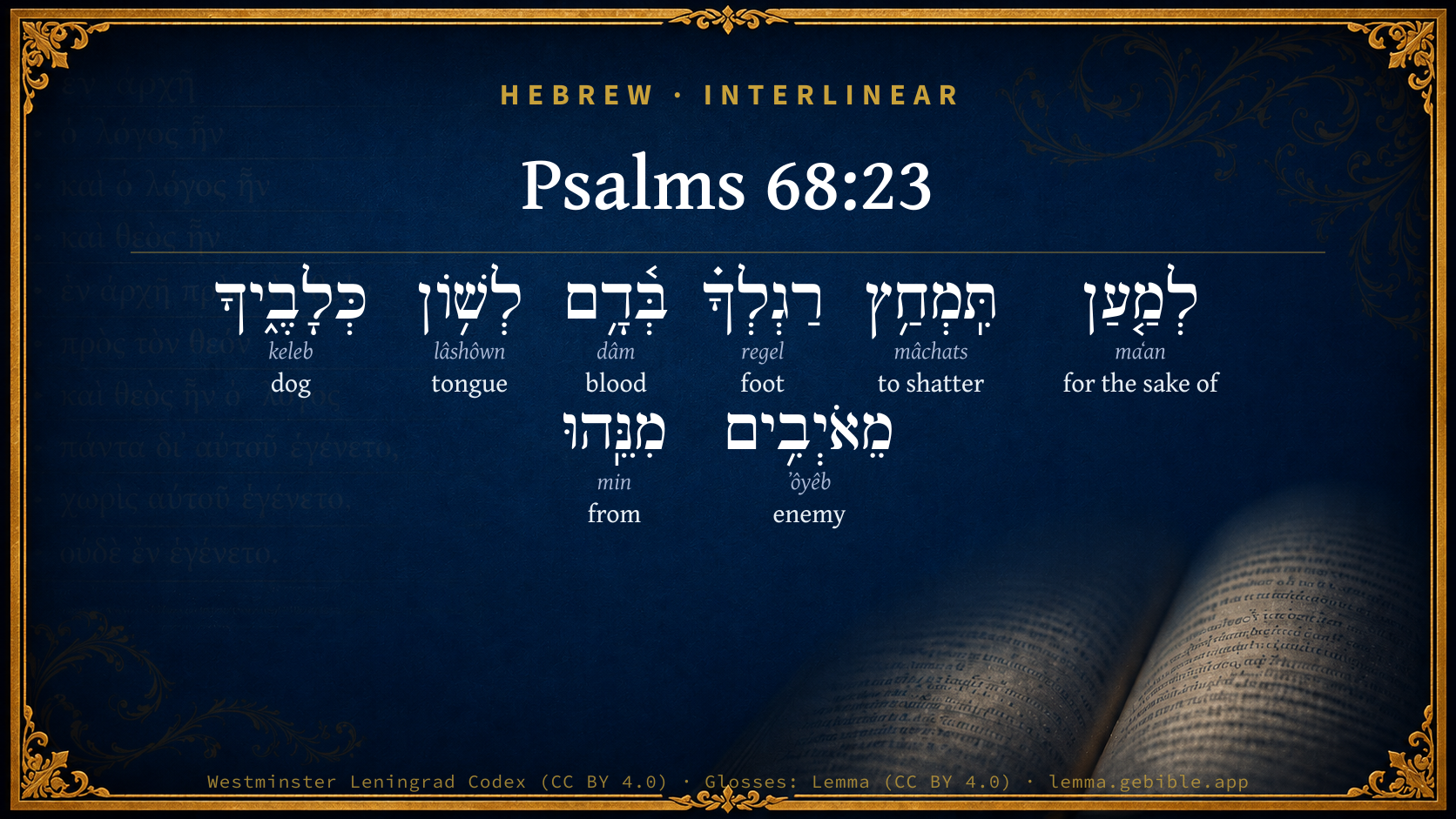
That you may crush them, dipping your foot in blood, That the tongues of your dogs may have their portion from your enemies."
World English Bible · Public Domain
Download a study sheet

One document with this verse’s original text, its word-by-word gloss line, the meaning frame, cross-references with their text, attributed commentary, and full source and license credits — printable, and it pastes into notes with its structure intact.

This verse Autodidact and up

Study sheet (.html) Plain text (.txt)

A passage Seminary Student

Up to 50 verses in one chapter. A passage sheet keeps up to 6 commentary sources and 12 cross-references per verse, in the order this page ranks them, and says so on the sheet whenever that leaves anything out. Ask for a single verse and you get the Autodidact verse sheet above.

Everything on this page stays free to read, with no account — the sheet is a download of what is already on screen, not access to it.

Want to remove ads? Support Godless Engineer
Compare translations 3

The same verse in 3 English versions, stacked beneath the original-language interlinear above. Click any original word for its lexicon entry.

Each is an independent rendering of the whole verse — the interlinear is not word-aligned to these translations.

Highlighted words mark where these versions differ — a whole-verse word diff, not a word-by-word alignment.

  • World English Bible Public Domain
    That you may crush them, dipping your foot in blood, That the tongues of your dogs may have their portion from your enemies."
  • King James Version Public Domain
    That thy foot may be dipped in the blood of thine enemies, and the tongue of thy dogs in the same.
  • unfoldingWord Literal Text CC BY-SA 4.0
    so that your foot may smash in blood, the tongue of your dogs, its portion from the enemies.”

unfoldingWord Literal Text — © unfoldingWord, licensed CC BY-SA 4.0. Word-aligned USFM3 via Door43 (git.door43.org/unfoldingWord/en_ult).

Versions to compare (up to 4)

3 of 4 selected

Show all 18 translations

Every available English version of this verse, each an independent rendering of the whole verse.

  • World English Bible Public Domain
    That you may crush them, dipping your foot in blood, That the tongues of your dogs may have their portion from your enemies."
  • Berean Standard Bible Public Domain
    that your foot may be dipped in the blood of your foes—the tongues of your dogs in the same.”
  • Majority Standard Bible Public Domain
    that your foot may be dipped in the blood of your foes—the tongues of your dogs in the same.”
  • King James Version Public Domain
    That thy foot may be dipped in the blood of thine enemies, and the tongue of thy dogs in the same.
  • American Standard Version (1901) Public Domain
    That thou mayest crush `them', `dipping' thy foot in blood, That the tongue of thy dogs may have its portion from `thine' enemies.
  • Revised Version (1885) Public Domain
    That thou mayest dip thy foot in blood, that the tongue of thy dogs may have its portion from thine enemies.
  • Geneva Bible (1599) Public Domain
    That thy foote may bee dipped in blood, and the tongue of thy dogges in the blood of the enemies, euen in it.
  • Douay-Rheims (1899) Public Domain
    The Lord said: I will turn them from Basan, I will turn them into the depth of the sea:
  • Young's Literal Translation Public Domain
    So that thou dashest thy foot in blood, `In the blood of' enemies -- the tongue of Thy dogs.'
  • Literal Standard Version CC BY-SA 4.0
    So that you dash your foot || In the blood of enemies—the tongue of Your dogs.”
  • Unlocked Literal Bible CC BY-SA 4.0
    so that you may crush your enemies, dipping your foot in blood, and so that the tongues of your dogs may have their share from your enemies.”
  • unfoldingWord Literal Text CC BY-SA 4.0
    so that your foot may smash in blood, the tongue of your dogs, its portion from the enemies.”
  • Darby Bible Public Domain
    That thou mayest dip thy foot in blood: the tongue of thy dogs has its portion from enemies.
  • World Messianic Bible Public Domain
    that you may crush them, dipping your foot in blood, that the tongues of your dogs may have their portion from your enemies.”
  • Webster's Bible Public Domain
    \\68:22\\The Lord said, I will bring again from Bashan, I will bring my people again from the depths of the sea.
  • Free Bible Version CC BY-SA 4.0
    so that you may walk in their blood. Even your dogs will have their share of your enemies.”
  • Bible in Basic English Public Domain
    So that your foot may be red with blood, and the tongues of your dogs with the same.
  • JPS Tanakh (1917) Public Domain
    (68-24) That thy foot may wade through blood, that the tongue of thy dogs may have its portion from thine enemies.'

Literal Standard Version (2020), Covenant Press — licensed CC BY-SA 4.0. Text via the HelloAO Bible API (eBible.org). Unlocked Literal Bible (unfoldingWord) — licensed CC BY-SA 4.0. Text via the HelloAO Bible API (eBible.org). unfoldingWord Literal Text — © unfoldingWord, licensed CC BY-SA 4.0. Word-aligned USFM3 via Door43 (git.door43.org/unfoldingWord/en_ult). Free Bible Version, Dr. Jonathan Gallagher — licensed CC BY-SA 4.0. Text via the HelloAO Bible API (eBible.org).

Word by word

More ways to search: Search by grammar → Find every occurrence → Compare this word →

Practice this passage: Drill this verse → Learn its vocabulary →

About this verse

These counts appear in no published source. They are computed here, from the morphology-tagged text and Lemma’s own curated glosses. What Lemma adds →

8
words
8
distinct lemmas
Wisdom
section

Notable vocabulary

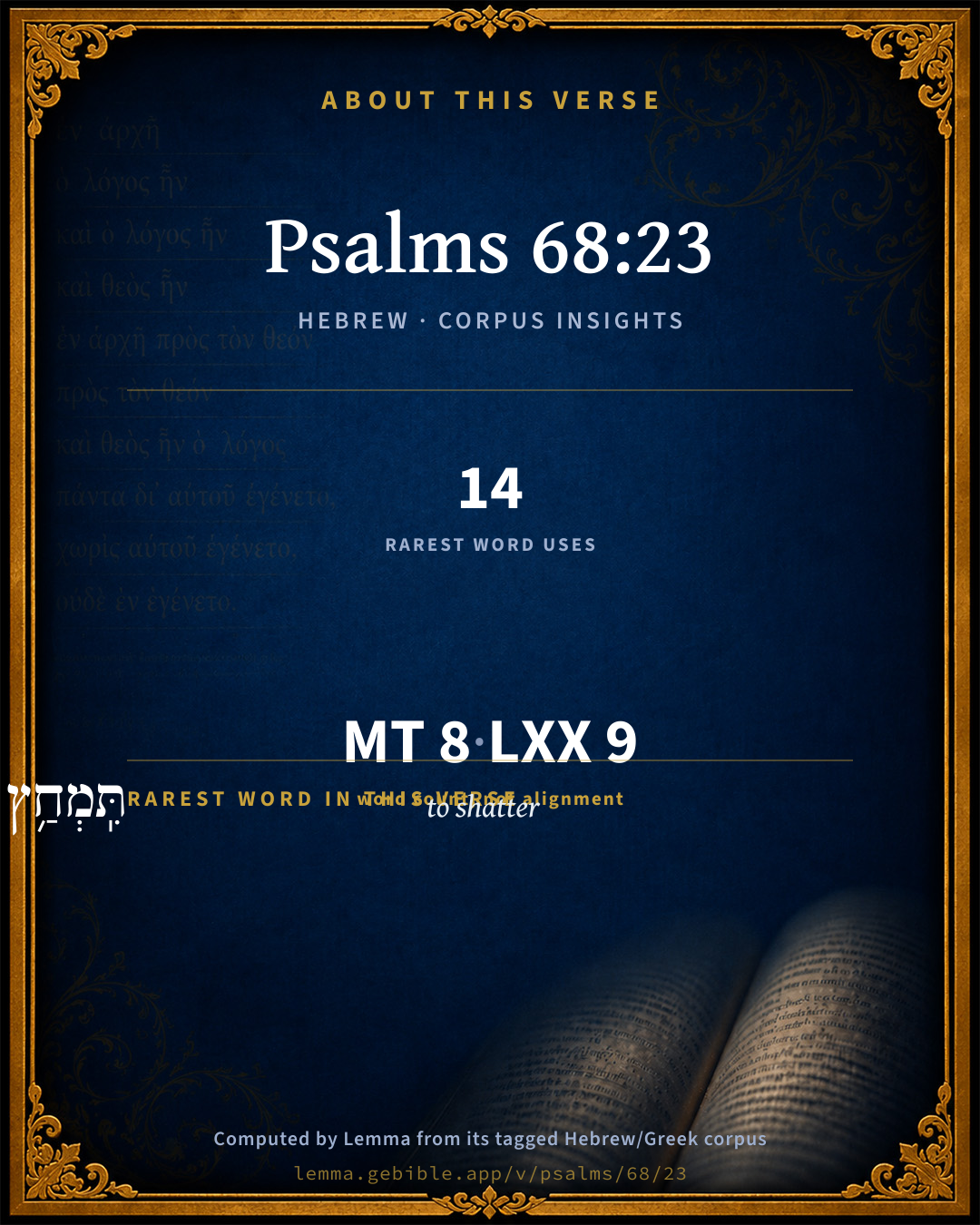
The rarest word here is תִּֽמְחַ֥ץ to shatter H4272 — appearing just 14 times in the whole Hebrew Bible.

Shared distinctive vocabulary

תִּֽמְחַ֥ץ to shatter H4272 occurs in 14 verses of the Hebrew Bible. Also found in:

Grammatical profile

  • 2 verbs
  • 5 nouns
  • 1 preposition

Verb forms

  • תִּֽמְחַ֥ץ Qal · Imperfect
  • מֵאֹיְבִ֥ים Qal · Participle Active

Hebrew & Septuagint length

In English translation the verse runs 23 words from the Hebrew and 21 from the Septuagint (LXX English) — closely comparable.

A rough comparison of the two English renderings, which tokenize alike — not a word-level alignment.

Word counts can differ between the Hebrew and the Greek without any difference in meaning — e.g. the Hebrew direct-object marker אֵת has no separate Greek word, and Greek often adds the article ὁ.

In the original languages it is 8 Hebrew tokens and 9 Greek tokens — but the two are counted differently (Hebrew bundles its prefixes and suffixes into one token; the Greek is in lemma form), so that isn’t a like-for-like length.

Cross-references

6

Topical passages linked to Psalms 68:23 in the Treasury of Scripture Knowledge — connected by theme and wording, ordered by reader-vote popularity; previews shown in the World English Bible.

  • 1 Kings 21:19 You shall speak to him, saying, Thus says Yahweh, Have you killed and also taken possession? You shall speak to him, saying, Thus says Yahweh, In the place where dogs licked the blood of Naboth shall dogs lick your blood, even yours.
  • Psalms 58:10 The righteous shall rejoice when he sees the vengeance. He shall wash his feet in the blood of the wicked;
  • 1 Kings 22:38 They washed the chariot by the pool of Samaria; and the dogs licked up his blood (now the prostitutes washed themselves [there]); according to the word of Yahweh which he spoke.
  • Revelation 19:17–21 I saw an angel standing in the sun. He cried with a loud voice, saying to all the birds that fly in the sky, "Come! Be gathered together to the great supper of God,
  • 2 Kings 9:33–37 He said, Throw her down. So they threw her down; and some of her blood was sprinkled on the wall, and on the horses: and he trod her under foot.
  • Isaiah 63:1–6 Who is this who comes from Edom, with dyed garments from Bozrah? this who is glorious in his clothing, marching in the greatness of his strength? I who speak in righteousness, mighty to save.

Cross-references courtesy of OpenBible.info (CC BY 4.0).

Hebrew and Greek witnesses Masoretic Hebrew ↔ Greek Septuagint

The same verse in the two great witnesses to the Old Testament, shown verse-for-verse.

You’re reading Greek Psalm 67 (Hebrew Psalm 68). The Septuagint counts the superscription, so verse numbers can differ from the Hebrew — chapter-level alignment, not verse-by-verse. Numbering follows Rahlfs.

These are two independent witnesses, not word-aligned to each other, and the Septuagint is shown in lemma (dictionary) form.

Hebrew Psalms 68:23 Masoretic · Westminster Leningrad Codex

לְמַ֤עַן תִּֽמְחַ֥ץ רַגְלְךָ֗ בְּ֫דָ֥ם לְשׁ֥וֹן כְּלָבֶ֑יךָ מֵאֹיְבִ֥ים מִנֵּֽהוּ

That you may crush them, dipping your foot in blood, That the tongues of your dogs may have their portion from your enemies."

World English Bible · Public Domain

Greek LXX Greek Psalm 67:23 Septuagint · lemma form

εἶπον κύριος ἐκ βασαν ἐπιστρέφω ἐπιστρέφω ἐν βυθός θάλασσα

That your foot may be dipped in blood, and the tongue of your dogs be stained with that of your enemies.

LXX2012 (modern English Septuagint) · Public Domain

On this verse, Whedon's Commentary on the Bible discusses the Septuagint’s reading. Read the note in Commentary ↓

Hebrew: Westminster Leningrad Codex (CC BY 4.0). Greek: Septuagint (public domain); English from LXX2012 (modern English Septuagint) (Public Domain). How the Septuagint differs from the Hebrew →

Commentary

Notes on Psalms 68:23 from classic Christian and Jewish commentators (each source and its license shown beneath its notes). The classic Christian expositions comment on the surrounding passage and are grouped to its opening verse, so a note may address several verses; the Jewish commentaries on the Tanakh (Rashi and others) are per-verse, so they appear only where the commentator wrote on this verse.

Lemma curates 59 commentaries, every one of them public domain or Creative Commons licensed, each selected and text-cleaned for this edition rather than reprinted as found. About our sources →

John Gill's Exposition

That thy foot may be dipped in the blood of thine enemies,.... This verse is in connection with Psa 68:21, with Psa 68:23 being to be read in a parenthesis: the sense is, that the Messiah would so wound the head and hairy scalp of his people's enemies, and there should be such a large effusion of blood, that their feet should be dipped therein, Rev 14:20; See Gill on Psa 58:10;

and the tongue of thy dogs in the same; who should lick it up, as the dogs licked the blood of Jezebel, Kg1 21:19; and so such a carnage will be made of antichrist and his followers, that the fowls of the heavens will be called upon to eat the flesh of kings, captains, and mighty ones, Rev 19:17.

John Gill's Exposition of the Whole Bible (1746–1763) — public domain (CC PDM 1.0). Text via the HelloAO Bible API.

Trapp's Complete Commentary

John Trapp

Psa 68:23 That thy foot may be dipped in the blood of [thine] enemies, [and] the tongue of thy dogs in the same.

Ver. 23. That thy foot may be dipped] Heb. redded, imbrued, made gore bloody. Hereby is implied a very great slaughter. Confer Rev 19:17-18; Rev 19:21.

John Trapp, A Commentary or Exposition upon All the Books of the Old and New Testament (1647–1656) — public domain. Text from a community e-Sword module.

J. A. Alexander on Psalms

Joseph Addison Alexander

24. (Psa 68:23). In order that thou mayest crush (them)—thy foot in blood—(and) the tongue of thy dogs (in blood) from the enemies (even) from him. The general import of tins verse is clear, but its construction doubtful and obscure. The first verb cannot mean to dip or wash without an arbitrary chancre of text by reading as in Psa 58:10. The original verb must have the same sense as in Psa 68:21, and may have the same object, namely, the enemies of God and of his people. The next words may then be taken as a parenthetical and qualifying clause, like sword in hand, and other such forms in English. Thy foot in blood, i.e. with thy foot in their blood, or so that thy foot shall tread in their blood. The last word in Hebrew is by some understood as a noun with a suffix meaning its portion, i.e. the share of the tongue; but for this there is no, authority in usage. Others translate the phrase, of it, i.e. of the blood, and the whole clause, the tongue of thy dogs (shall receive) of it from the enemies. According to the first version given above, the last phrase is a mere specification of the one before it; from the enemies, (even) from him, referring to some real or ideal representative of the entire class.

Joseph Addison Alexander, The Psalms Translated and Explained (1850) — public domain. Text from a community e-Sword module.

Geneva Bible (1599)

Geneva Bible translators

That is, in the blood of that great slaughter, where dogs shall lap blood.

Geneva Bible (1599) marginal notes — public domain. Text via Bolls.life.

Adam Clarke's Commentary

Verse 23. That thy foot may be dipped in the blood] God will make such a slaughter among his enemies, the Amorites, that thou shalt walk over their dead bodies; and beasts of prey shall feed upon them.

Adam Clarke's Commentary on the Bible (1810–1826) — public domain. Text from a community e-Sword/MySword module.

Ellicott's Commentary for English Readers

(23) That thy foot.—This makes an unnecessary transposition of a very involved sentence. The image is perfectly clear, though the syntax, as often happens in all languages, goes tripping itself up. The conqueror, after wading in the blood of his enemies, is met by the dogs, who lick his gory feet. With a change of one letter we may render, “That thou mayest wash thy foot in blood—yea, the tongue of thy dogs in (the blood of) thine enemies.

A Bible Commentary for English Readers, edited by Charles John Ellicott (1878–1897) — public domain. Text from a community e-Sword module.

The Cambridge Bible for Schools and Colleges

gen. ed. J. J. S. Perowne

23. That thou mayest dip thy foot in blood,

That the tongue of thy dogs may have its portion from (thine) enemies.

This rendering of the R.V. probably gives the right sense, though the Heb. presents some difficulties. For dip should probably be read wash, as in Psa_58:10, which passage (with the notes) should be compared. The thought of the approaching vengeance upon the enemies of Israel is a prominent one in Isaiah 40-66. See e.g. Isa_41:15 f.; Isa_49:26; Isa_63:1 ff. The judgement of the oppressor is in fact the necessary condition of the deliverance of the oppressed, indispensable moreover as the vindication of God’s eternal justice.

The Cambridge Bible for Schools and Colleges (gen. ed. J. J. S. Perowne; Cambridge University Press, 1878–1918) — public domain. Text from a community e-Sword module.

Albert Barnes' Notes on the Bible

That thy foot may be dipped in the blood of thine enemies ... - Margin, “red.” A more literal rendering would be, “That thou mayest crush - thy foot in blood - the tongue of thy dogs from the enemies, from him.” The idea of “dipping” the foot in blood is not in the passage directly; but the leading thought is that of “crushing” the enemy. It is then “added” that the foot would be in blood. So of the tongue of the dogs. The “meaning” is, that the tongues of dogs would be employed in licking up the blood of the enemies, though that is not “expressed” in so many words. The sense of the whole is, that the foes of the people would be slain.

Albert Barnes' Notes on the Bible (1834–1885) — public domain. Text from a community e-Sword/MySword module.

Matthew Poole's English Annotations

And as it was at the Red Sea and at Bashan before, so yet again thine enemies shall be slain in such great numbers, that thou mayst wade in their blood, and thy dogs lick it up in the field.

Matthew Poole's English Annotations on the Holy Bible (1683–1685) — public domain. Text from a community e-Sword/MySword module.

The Treasury of David

Charles H. Spurgeon

Ver. 23. That thy foot may be dipped in the blood of thine enemies. Vengeance shall be awarded to the oppressed people, and that most complete and terrible.

And the tongue of thy dogs in the same. So overwhelming should be the defeat of the foe that dogs should lick their blood. Here "the stern joy which warriors feel" expresses itself in language most natural to the oriental ear. To us, except in a spiritual sense, the verse sounds harshly; but read it with an inner sense, and we also desire the utter and crushing defeat of all evil, and that wrong and sin may be the objects of profound contempt. Terrible is the God of Israel when he cometh forth as a man of war, and dreadful is even the Christ of God when he bares his arm to smite his enemies. Contemplate Revelation 19 and note the following: --"And I saw heaven opened, and behold a white horse; and he that sat upon him was called Faithful and True, and in righteousness he doth judge and make war. His eyes were as a flame of fire, and on his head were many crowns; and he had a name written, that no man knew, but he himself. And he was clothed with a vesture dipped in blood; and his name is called The Word of God... And I saw an angel standing in the sun; and he cried with a loud voice, saying to all the fowls that fly in the midst of heaven, come and gather yourselves together unto the supper of the great God; that ye may eat the flesh of kings, and the flesh of captains, and the flesh of mighty men, and the flesh of horses, and of them that sit upon them, and the flesh of all men, both free and bond, both small and great. And I saw the beast, and the kings of the earth, and their armies, gathered together to make war against him that sat on the horse, and against his army. And the beast was taken, and with him the false prophet that wrought miracles before him, with which he deceived them that had the mark of the beast, and them that worshipped his image. These both were cast alive into a lake of fire burning with brimstone. And the remnant were slain with the sword of him that sat upon the horse, which sword proceeded out of his mouth: and all the fowls were filled with their flesh."

Ver. 23. That thy foot may be dipped, etc. The blood of thy enemies, shed in such abundance that thy dogs shall lap and drink it, shall be the sea in which thou shalt pass, and that red without a figure. And, proportionably shall be the destruction on the enemies of Christ and Christians in the age of the Messiah. Henry Hammond.

None.

Psalms 68:24*

Charles H. Spurgeon's The Treasury of David (1869–1885) — public domain. Psalms only. Text from a community e-Sword/MySword module.

Whedon's Commentary on the Bible

Daniel D. Whedon

23. Thy foot… dipped in… blood—The Hebrew word for “dipped” means to dash, crush, and is translated wound in Psa_68:21. The Septuagint has it, βαπτω, (bapto,) to dip, stain, colour. The metaphor is that of passing over the dead bodies of the slain on the battlefield while pursuing a retreating enemy, when the feet become stained with blood. Same as “treading under foot” an enemy, Psa_44:5; see, also, Isa_63:1. The idea of great slaughter is conveyed. So “dipping the foot in oil” has the idea of copiousness. Deu_33:24; Job_29:6. See, of God’s enemies, Rev_19:17-18; Rev_19:21.

And the tongue of thy dogs—An expression of great contempt and dishonour of the dead. See 1Ki_21:19. Wild dogs and jackals always followed an army. Thus will the enemies of Jehovah perish.

Daniel D. Whedon (gen. ed.), Commentary on the Old and New Testaments (1874–1909) — public domain. Text from a community e-Sword module.

The Pulpit Commentary

That thy foot may be dipped in the blood of thine enemies; i.e. "I will bring them back for thee, my people, to dip your feet in their blood." The same metaphor is used in Isa_63:1-3; but it is Godhimself who, in that passage, has his feet reddened in his enemies" blood, And the tongue of thy dogs in the same. The Authorized Version has omitted one word of the original here. Translate, And that the tongue of thy dogs may have its portion from the same. (comp. 2Ki_9:35 Jer_15:3)

The Pulpit Commentary (1880–1919), ed. H.D.M. Spence-Jones & Joseph S. Exell — public domain. Text from a community e-Sword module.

John Wesley's Explanatory Notes

That, &c. - And as it was at the Red Sea, and at Bashan before, so yet again thine enemies shall be slain in such numbers, that thou mayst wade in their blood, and thy dogs lick it up in the field.

John Wesley, Explanatory Notes Upon the Whole Bible (1754–1765) — public domain. Text via the GEBible commentary corpus.

Rashi

Rabbi Shlomo Yitzchaki (Rashi)

The Lord said, “I shall restore from Bashan” For so He promised to restore us from the mighty ones of Bashan and from the islands of the sea.

Rashi on the Tanakh — English translations: “The Judaica Press complete Tanach with Rashi, translated by A. J. Rosenberg” (CC BY 4.0); “Pentateuch with Rashi's commentary by M. Rosenbaum and A.M. Silbermann, 1929-1934” (public domain); “The Metsudah Tanach series, Lakewood, N.J” (CC BY 4.0); and “The Book of Joshua, Metsudah Publications, 1997” (CC BY 4.0). Text via Sefaria.

Lesson kit

Teaching starters — assembled from the data on this page, not authored interpretation. Every prompt links to the verse data it draws on. Edit before teaching.

Psalms, in the Wisdom, opens this verse with 8 words (8 distinct Hebrew lemmas). Its most distinctive word is mâchats (“to shatter”). A historical commentator’s framing appears above. Read the whole chapter for the surrounding context.

Discussion questions

  1. How does “to shatter” (mâchats) shape what this verse is saying?
  2. How does Numbers 24:8, which shares the word «to shatter», read alongside this verse?
  3. These translations render this verse differently; the difference is in the English rendering, not the original. What questions does that raise?
  4. «תִּֽמְחַ֥ץ» is a Qal Imperfect verb. How does that grammatical form shape the action described?
  5. Compare how John Gill's Exposition and Trapp's Complete Commentary read this verse. Where do they agree or differ?

Things to notice

Reading settings

Reading text

Shown beneath each verse's original-language words.

Old Testament
Old Testament edition

Read the OT as the Masoretic Hebrew (MT) or the Greek Septuagint (LXX).

English shown for the Greek Septuagint (in the Hebrew ↔ Greek comparison).

Comparing translations? Open the Compare panel on any verse page to stack up to four side by side.