Genesis 9:6

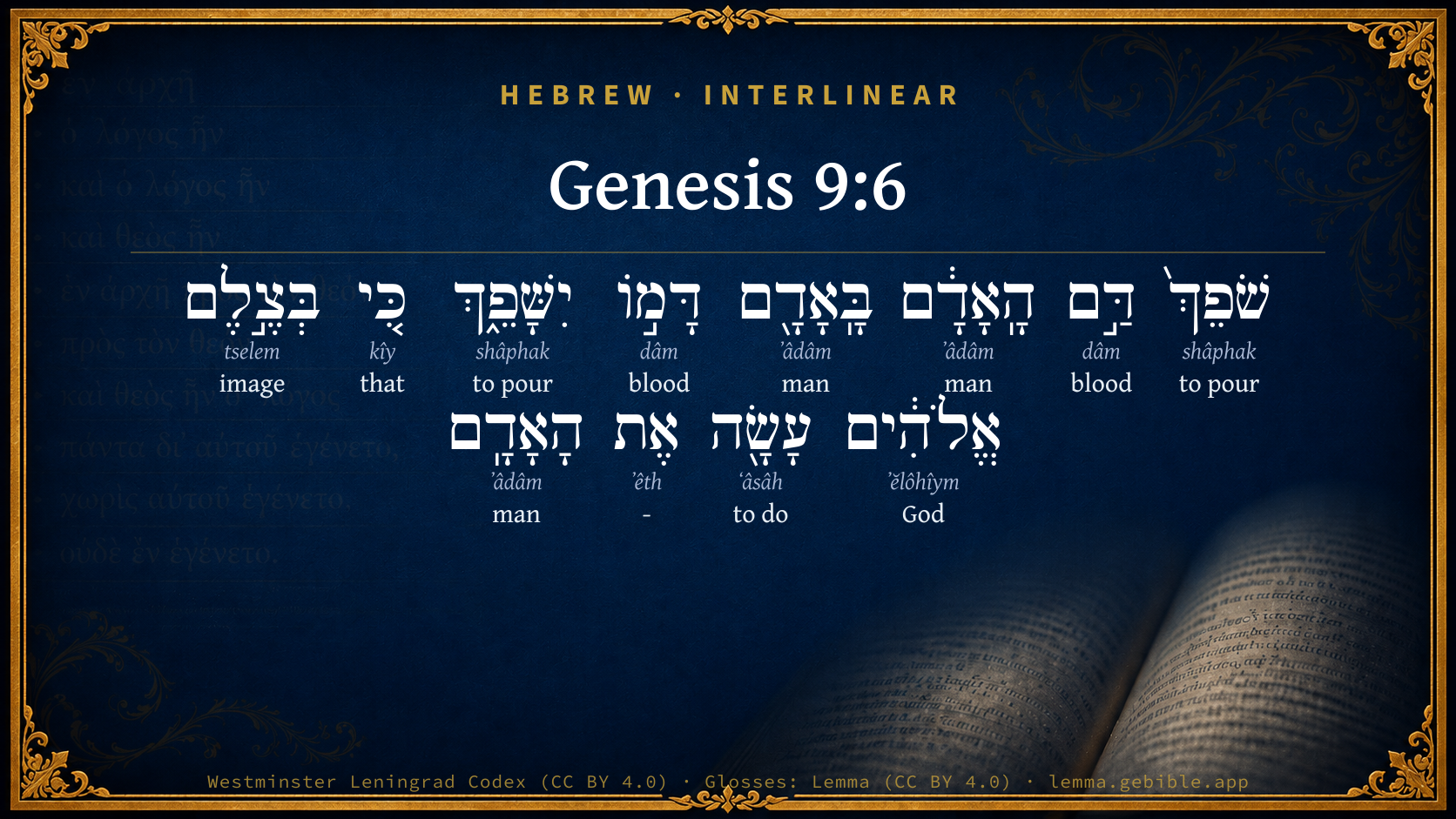
Hebrew (Westminster Leningrad Codex) Genesis 9:6 appears in the Hebrew Old Testament. The text above is from the Westminster Leningrad Codex. Each word links to its Strong’s number, a concise gloss, and parsing drawn from the Open Scriptures Hebrew Bible morphology. Click any word for its full Brown-Driver-Briggs (BDB) entry.
Download image
Cite this verse

Genesis 9:6 (World English Bible). Public Domain. Lemma interlinear Bible study tool, https://lemma.gebible.app/v/genesis/9/6.

Show BibTeX & RIS
BibTeX
RIS
English Translation
Whoever sheds man's blood, by man will his blood be shed, for in the image of God made he man.
World English Bible · Public Domain
Highlights
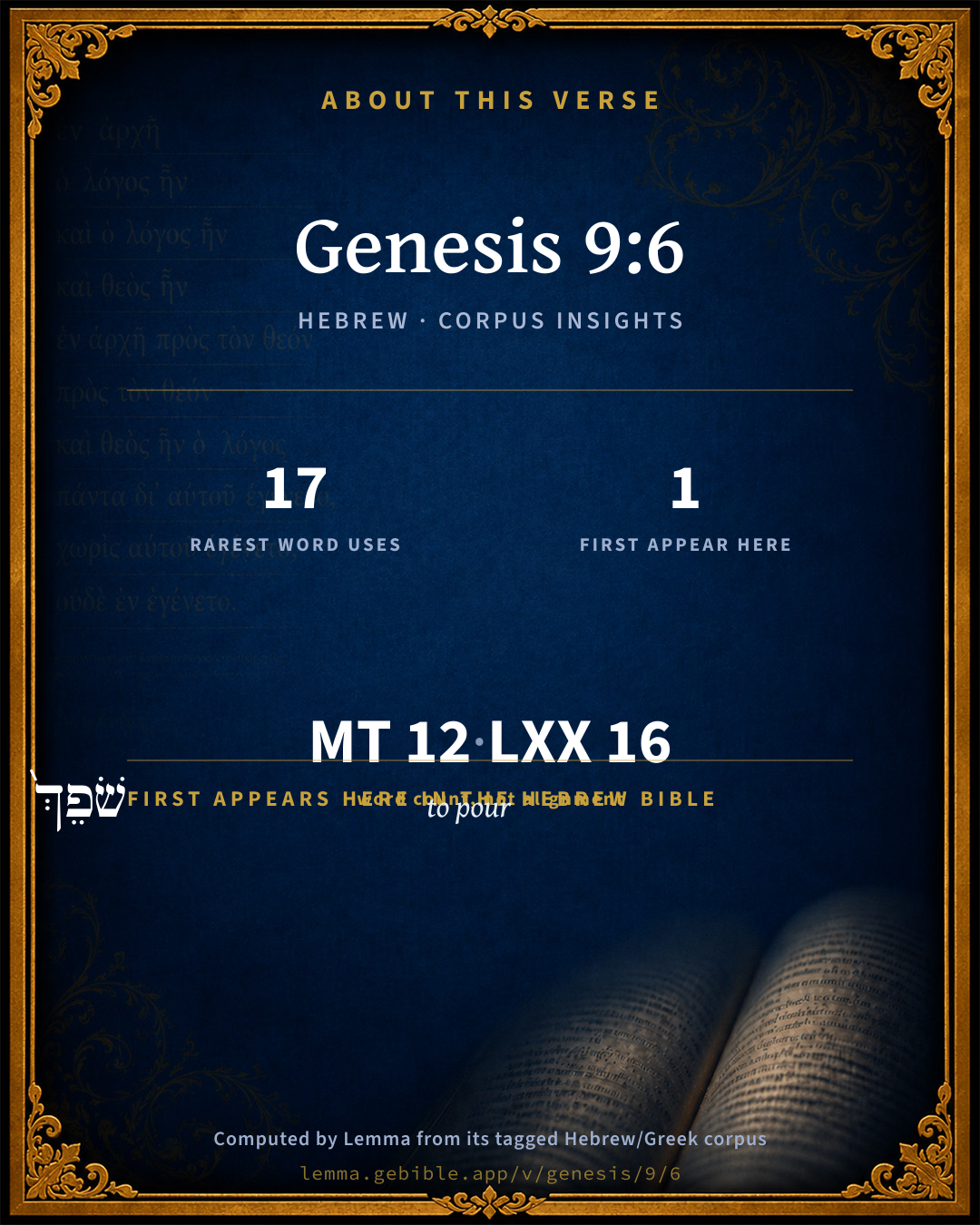
  • 1 first appearance in the Hebrew Bible
Full analysis ↓
Download a study sheet

One document with this verse’s original text, its word-by-word gloss line, the meaning frame, cross-references with their text, attributed commentary, and full source and license credits — printable, and it pastes into notes with its structure intact.

This verse Autodidact and up

Study sheet (.html) Plain text (.txt)

A passage Seminary Student

Up to 50 verses in one chapter. A passage sheet keeps up to 6 commentary sources and 12 cross-references per verse, in the order this page ranks them, and says so on the sheet whenever that leaves anything out. Ask for a single verse and you get the Autodidact verse sheet above.

Everything on this page stays free to read, with no account — the sheet is a download of what is already on screen, not access to it.

Want to remove ads? Support Godless Engineer
Compare translations 3

The same verse in 3 English versions, stacked beneath the original-language interlinear above. Click any original word for its lexicon entry.

Each is an independent rendering of the whole verse — the interlinear is not word-aligned to these translations.

Highlighted words mark where these versions differ — a whole-verse word diff, not a word-by-word alignment.

  • World English Bible Public Domain
    Whoever sheds man's blood, by man will his blood be shed, for in the image of God made he man.
  • King James Version Public Domain
    Whoso sheddeth man's blood, by man shall his blood be shed: for in the image of God made he man.
  • unfoldingWord Literal Text CC BY-SA 4.0
    The one shedding the blood of a man, by mankind his blood must be shed, because in the image of God he made mankind.

unfoldingWord Literal Text — © unfoldingWord, licensed CC BY-SA 4.0. Word-aligned USFM3 via Door43 (git.door43.org/unfoldingWord/en_ult).

Versions to compare (up to 4)

3 of 4 selected

Show all 18 translations

Every available English version of this verse, each an independent rendering of the whole verse.

  • World English Bible Public Domain
    Whoever sheds man's blood, by man will his blood be shed, for in the image of God made he man.
  • Berean Standard Bible Public Domain
    Whoever sheds the blood of man, by man his blood will be shed; for in His own image God has made mankind.
  • Majority Standard Bible Public Domain
    Whoever sheds the blood of man, by man his blood will be shed; for in His own image God has made mankind.
  • King James Version Public Domain
    Whoso sheddeth man's blood, by man shall his blood be shed: for in the image of God made he man.
  • American Standard Version (1901) Public Domain
    Whoso sheddeth man's blood, by man shall his blood be shed: For in the image of God made he man.
  • Revised Version (1885) Public Domain
    Whoso sheddeth man’s blood, by man shall his blood be shed: for in the image of God made he man.
  • Geneva Bible (1599) Public Domain
    Who so sheadeth mans blood, by man shall his blood be shed: for in the image of God hath he made man.
  • Douay-Rheims (1899) Public Domain
    Whosoever shall shed man's blood, his blood shall be shed: for man was made to the image of God.
  • Young's Literal Translation Public Domain
    whoso sheddeth man's blood, by man is his blood shed: for in the image of God hath He made man.
  • Literal Standard Version CC BY-SA 4.0
    whoever sheds man’s blood, by man is his blood shed: for in the image of God has He made man.
  • Unlocked Literal Bible CC BY-SA 4.0
    Whoever sheds man's blood, by man will his blood be shed, for it was in the image of God that he made man.
  • unfoldingWord Literal Text CC BY-SA 4.0
    The one shedding the blood of a man, by mankind his blood must be shed, because in the image of God he made mankind.
  • Darby Bible Public Domain
    Whoso sheddeth Man's blood, by Man shall his blood be shed; for in the image of God he hath made Man.
  • World Messianic Bible Public Domain
    Whoever sheds man’s blood, his blood will be shed by man, for God made man in his own image.
  • Webster's Bible Public Domain
    Whoever sheddeth man's blood, by man shall his blood be shed: for in the image of God made he man.
  • Free Bible Version CC BY-SA 4.0
    Whoever sheds the blood of a human being will have their blood shed by human beings. For God made human beings in his image.
  • Bible in Basic English Public Domain
    Whoever takes a man's life, by man will his life be taken; because God made man in his image.
  • JPS Tanakh (1917) Public Domain
    Whoso sheddeth man's blood, by man shall his blood be shed; for in the image of God made He man.

Literal Standard Version (2020), Covenant Press — licensed CC BY-SA 4.0. Text via the HelloAO Bible API (eBible.org). Unlocked Literal Bible (unfoldingWord) — licensed CC BY-SA 4.0. Text via the HelloAO Bible API (eBible.org). unfoldingWord Literal Text — © unfoldingWord, licensed CC BY-SA 4.0. Word-aligned USFM3 via Door43 (git.door43.org/unfoldingWord/en_ult). Free Bible Version, Dr. Jonathan Gallagher — licensed CC BY-SA 4.0. Text via the HelloAO Bible API (eBible.org).

Word by word

More ways to search: Search by grammar → Find every occurrence → Compare this word →

Practice this passage: Drill this verse → Learn its vocabulary →

בְּצֶ֣לֶם
tselem
H6754
“in/at · image of”
Preposition + Noun, Common, Masculine, Singular, Construct
Part of Speech
Preposition + Noun
Type
Common
Gender
Masculine
Number
Singular
State
Construct
Full BDB Definition

Origin: from an unused root meaning to shade

TWOT: 1923a

image - images (of tumours, mice, heathen gods) - image, likeness (of resemblance) - mere, empty, image, semblance (figuratively)
  1. שֹׁפֵךְ֙ shâphak H8210 “pouring” Verb, Qal, Participle Active, Masculine, Singular, Construct
  2. דַּ֣ם dâm H1818 “blood of” Noun, Common, Masculine, Singular, Construct
  3. הָֽאָדָ֔ם ʼâdâm H120 “the · man” Particle, Definite Article + Noun, Common, Masculine, Singular, Absolute
  4. בָּֽאָדָ֖ם ʼâdâm H120 “in/at the · man” Preposition, Determined + Noun, Common, Masculine, Singular, Absolute
  5. דָּמ֣וֹ dâm H1818 “blood · his” Noun, Common, Masculine, Singular, Construct + Suffix, Personal, 3rd Person, Masculine, Singular
  6. יִשָּׁפֵ֑ךְ shâphak H8210 “to pour” Verb, Niphal, Imperfect, 3rd Person, Masculine, Singular
  7. כִּ֚י kîy H3588 “that” Conjunction
  8. אֱלֹהִ֔ים ʼĕlôhîym H430 “God(s)” Noun, Common, Masculine, Plural, Absolute
  9. עָשָׂ֖ה ʻâsâh H6213 “to do” Verb, Qal, Perfect, 3rd Person, Masculine, Singular
  10. אֶת ʼêth H853 “-” Particle, Direct Object
  11. הָאָדָֽם ʼâdâm H120 “the · man” Particle, Definite Article + Noun, Common, Masculine, Singular, Absolute

About this verse

These counts appear in no published source. They are computed here, from the morphology-tagged text and Lemma’s own curated glosses. What Lemma adds →

12
words
8
distinct lemmas
Pentateuch
section

Notable vocabulary

The rarest word here is בְּצֶ֣לֶם image H6754 — appearing just 17 times in the whole Hebrew Bible.

First appearance in Scripture

This word makes its first canonical appearance in the Hebrew Bible here:

  • שֹׁפֵךְ֙ to pour H8210

Shared distinctive vocabulary

בְּצֶ֣לֶם image H6754 occurs in 15 verses of the Hebrew Bible. Also found in:

Grammatical profile

  • 3 verbs
  • 7 nouns
  • 1 conjunction
  • 1 particle

Verb forms

  • שֹׁפֵךְ֙ Qal · Participle Active
  • יִשָּׁפֵ֑ךְ Niphal · Imperfect
  • עָשָׂ֖ה Qal · Perfect

Repetition

Words recur within this verse — often emphatic in Hebrew:

  • הָֽאָדָ֔ם man H120 ×3
  • שֹׁפֵךְ֙ to pour H8210 ×2
  • דַּ֣ם blood H1818 ×2

Hebrew & Septuagint length

In English translation the verse runs 20 words from the Hebrew and 23 from the Septuagint (LXX English) — closely comparable.

A rough comparison of the two English renderings, which tokenize alike — not a word-level alignment.

Word counts can differ between the Hebrew and the Greek without any difference in meaning — e.g. the Hebrew direct-object marker אֵת has no separate Greek word, and Greek often adds the article ὁ.

In the original languages it is 12 Hebrew tokens and 16 Greek tokens — but the two are counted differently (Hebrew bundles its prefixes and suffixes into one token; the Greek is in lemma form), so that isn’t a like-for-like length.

Cross-references

16

Topical passages linked to Genesis 9:6 in the Treasury of Scripture Knowledge — connected by theme and wording, ordered by reader-vote popularity; previews shown in the World English Bible.

  • Leviticus 24:17 "'He who strikes any man mortally shall surely be put to death.
  • Matthew 26:52 Then Jesus said to him, "Put your sword back into its place, for all those who take the sword will die by the sword.
  • Revelation 13:10 If anyone has captivity, he will go. If anyone is with the sword, he must be killed. Here is the endurance and the faith of the saints.
  • Exodus 21:12–14 "One who strikes a man so that he dies shall surely be put to death,
  • Numbers 35:33 So you shall not pollute the land in which you are: for blood, it pollutes the land; and no expiation can be made for the land for the blood that is shed therein, but by the blood of him who shed it.
  • Genesis 1:26–27 God said, "Let us make man in our image, after our likeness: and let them have dominion over the fish of the sea, and over the birds of the sky, and over the cattle, and over all the earth, and over every creeping thing that creeps on the earth."
  • James 3:9 With it we bless our God and Father, and with it we curse men, who are made in the image of God.
  • Genesis 5:1 This is the book of the generations of Adam. In the day that God created man, he made him in God's likeness.
  • Genesis 4:14 Behold, you have driven me out this day from the surface of the ground. I will be hidden from your face, and I will be a fugitive and a wanderer in the earth. It will happen that whoever finds me will kill me."
  • 1 Kings 2:28–34 The news came to Joab; for Joab had turned after Adonijah, though he didn't turn after Absalom. Joab fled to the Tent of Yahweh, and caught hold on the horns of the altar.
  • Romans 13:4 for he is a servant of God to you for good. But if you do that which is evil, be afraid, for he doesn't bear the sword in vain; for he is a minister of God, an avenger for wrath to him who does evil.
  • Exodus 22:2–3 If the thief is found breaking in, and is struck so that he dies, there shall be no guilt of bloodshed for him.
  • Leviticus 17:4 and hasn't brought it to the door of the Tent of Meeting, to offer it as an offering to Yahweh before the tabernacle of Yahweh: blood shall be imputed to that man. He has shed blood; and that man shall be cut off from among his people.
  • Numbers 35:25 and the congregation shall deliver the manslayer out of the hand of the avenger of blood, and the congregation shall restore him to his city of refuge, where he was fled: and he shall dwell therein until the death of the high priest, who was anointed with the holy oil.
  • 1 Kings 2:5–6 Moreover you know also what Joab the son of Zeruiah did to me, even what he did to the two captains of the hosts of Israel, to Abner the son of Ner, and to Amasa the son of Jether, whom he killed, and shed the blood of war in peace, and put the blood of war on his sash that was about his loins, and in his shoes that were on his feet.
  • Psalms 51:4 Against you, and you only, have I sinned, And done that which is evil in your sight; That you may be proved right when you speak, And justified when you judge.

Cross-references courtesy of OpenBible.info (CC BY 4.0).

Hebrew and Greek witnesses Masoretic Hebrew ↔ Greek Septuagint

The same verse in the two great witnesses to the Old Testament, shown verse-for-verse.

These are two independent witnesses, not word-aligned to each other, and the Septuagint is shown in lemma (dictionary) form.

Hebrew Genesis 9:6 Masoretic · Westminster Leningrad Codex

שֹׁפֵךְ֙ דַּ֣ם הָֽאָדָ֔ם בָּֽאָדָ֖ם דָּמ֣וֹ יִשָּׁפֵ֑ךְ כִּ֚י בְּצֶ֣לֶם אֱלֹהִ֔ים עָשָׂ֖ה אֶת הָאָדָֽם

Whoever sheds man's blood, by man will his blood be shed, for in the image of God made he man.

World English Bible · Public Domain

Greek LXX Genesis 9:6 Septuagint · lemma form

ὁ ἐκχέω αἷμα ἄνθρωπος ἀντί ὁ αἷμα αὐτός ἐκχέω ὅτι ἐν εἰκών θεός ποιέω ὁ ἄνθρωπος

He that sheds man's blood, instead of that blood shall his own be shed, for in the image of God I made man.

LXX2012 (modern English Septuagint) · Public Domain

On this verse, The Cambridge Bible for Schools and Colleges discusses the Septuagint’s reading. Read the note in Commentary ↓

Hebrew: Westminster Leningrad Codex (CC BY 4.0). Greek: Septuagint (public domain); English from LXX2012 (modern English Septuagint) (Public Domain). How the Septuagint differs from the Hebrew →

Targum (Aramaic paraphrase)

2

The Targum is the ancient Jewish Aramaic paraphrase of the Hebrew Scriptures — an interpretive translation, not the Hebrew text itself. Onkelos (literal) and Pseudo-Jonathan (expansive) render the Torah, and Jonathan the Prophets. Coverage is partial: where no permissively-licensed English translation exists for a verse, only the Aramaic is shown. This is verse-level text, not a word-by-word alignment to the Hebrew.

  1. Targum Onkelos Torah (Genesis–Deuteronomy)
    דְיֵשׁוֹד דְמָא דֶאֱנָשָׁא בְּסַעֲדִין עַל מֵימַר דַיָנַיָא דְמֵהּ יִתְּשָׁד אֲרֵי בְּצַלְמָא דַיְיָ עֲבַד יָת אֱנָשָׁא

    Whoso sheddeth the blood of man, by witnesses, upon the sentence of the judges, his blood shall be shed; because in the image of the Lord made He man.

    Targum Onkelos — Aramaic: “Onkelos Genesis” (public domain); “Onkelos Exodus” (public domain); “Onkelos Leviticus” (public domain); “Onkelos Numbers” (public domain); “Onkelos Deuteronomy” (public domain). English: “Sefaria Community Translation” (CC0 1.0 (public-domain dedication)); “J.W. Etheridge. The Targums of Onkelos and Jonathan Ben Uzziel on the Pentateuch. London: Longmans, Green, 1862” (public domain). Text via Sefaria.

  2. Targum Pseudo-Jonathan Torah (Genesis–Deuteronomy)
    דְיֵישׁוֹד דְמָא דְאֵינָשָׁא בְּסַהֲדִין דְיָינַיָא מְחַיְיבִין לֵיהּ קְטוֹל וּדְיֵישׁוֹד בְּלָא סַהֲדִין מָרֵי עָלְמָא עָתִיד לְאִתְפַּרְעָא מִנֵיהּ לְיוֹם דִינָא רַבָּא אֲרוּם בִּדְיוֹקְנָא דַיְיָ עֲבַד יַת אֵינָשָׁא

    Whoso sheddeth the blood of man, the judges, by witnesses, shall condemn him unto death; but he who sheddeth it without witnesses, the Lord of the world will bring punishment on him in the day of the great judgment; because in the image of the Lord He made man.

    Targum Pseudo-Jonathan — Aramaic: “Targum Jonathan on Genesis” (public domain); “Targum Jonathan on Exodus” (public domain); “Targum Jonathan on Leviticus” (public domain); “Targum Jonathan on Numbers” (public domain); “Targum Jonathan on Deuteronomy” (public domain). English: “The Targum of Jonathan ben Uzziel, trans. J. W. Etheridge, London, 1862” (public domain). Text via Sefaria.

Commentary

Notes on Genesis 9:6 from classic Christian and Jewish commentators (each source and its license shown beneath its notes). The classic Christian expositions comment on the surrounding passage and are grouped to its opening verse, so a note may address several verses; the Jewish commentaries on the Tanakh (Rashi and others) are per-verse, so they appear only where the commentator wrote on this verse.

Lemma curates 59 commentaries, every one of them public domain or Creative Commons licensed, each selected and text-cleaned for this edition rather than reprinted as found. About our sources →

Trapp's Complete Commentary

John Trapp

Gen 9:6 Whoso sheddeth man’s blood, by man shall his blood be shed: for in the image of God made he man.

Ver. 6. Whoso sheddeth man’s blood.] Some are of the opinion, that before the flood, the punishment of murder and other capital crimes, was only excommunication and exclusion from the Church and their father’s family. And that now first, God made murder to be a matter of death. The firstborn had power, at first, over their own families, to bless, curse, cast out, disinherit, yea, and punish with death, {Gen 38:24} even in case of adultery, as some will have it thus among the people of God. {a} But what a madness was that in the Egyptians to make no conscience of murder, that they might enjoy their lust! And what a blindness to make less account of murder than adultery!. {Gen 12:13} I have seen, saith the Preacher in his Travels, the king of Persia many times to alight from his horse, only to do justice to a poor body. He punishs theft and manslaughter so severely, that in an age a man shall not hear either of the one, or of the other. {b} A severity fit for France; where within ten years, six thousand gentlemen have been slain, saith he, as it appears by the king’s pardons. {c}

{a} Godw. Heb. Antiq.

{b} The Preacher’s Travels, by Jo. Cartwright.

{c} Les Ombres des Defunets Seiurs de Villemor et de Fontaines, p. 46.

John Trapp, A Commentary or Exposition upon All the Books of the Old and New Testament (1647–1656) — public domain. Text from a community e-Sword module.

The Biblical Illustrator

Joseph S. Exell

Gen_9:6

Whoso sheddeth mans blood, by man shall his blood be shed.

Death for murder a Divine decree

I. First, I ASSERT THAT THE PUNISHMENT OF DEATH FOR MURDER IS A DIVINE DECREE. As some persons are opposed to the execution of any murderer, it is well to examine both the objections they urge and the command by which this law is asserted. Death for murder is recognized from the beginning of the world. It seems to be written on the conscience of man by God that such a doom rightly awaits a murderer. The case of Cain--the strong case of the opposers of death for murder--is, when rightly understood, a strong case against them. Cain declared that the first person that met him would slay him. Who but God had written this in the tables of his heart? who save He could have engraven this on his conscience? It was a recognized principle from the beginning that the murderer should not live. But it is objected, God interfered and saved his life. Quite true. But then, if God had not interfered, his life would have been justly taken in obedience to the general laws of God implanted in the consciences of all men; and therefore, unless God similarly interferes now by a special and marked revelation, the original rule holds good, and the murderer is put to death. Observe, in order to save Cain, God set a mark upon the man. Why? Because without this he was liable to death. The exception in this case clearly proves the rule! Again: you cannot but be struck with the remarkable care which God manifests in His laws to Israel concerning blood. He warns them against suffering their land to become polluted with blood. The law of inquest is founded upon one part of the Jewish law; and the humane provisions which rendered the owner of any infuriated animal a loser of a vast fine if the animal caused the death of any person not only commends itself for its justice, but again shows the value which is set upon human life. And with a view, I deem, yet further to impress this truth upon mankind, the blood even of the animal, since it is the life thereof, is distinctly ordered to be in nowise eaten, but to be poured upon the ground like water. You may say that these were laws to the Jewish nation, and it is true; but I am persuaded that the polity of the Jewish nation is given as a specimen for all nations to follow. It involves a very great principle, namely, the care which is to be taken over life. It is important also on physiological grounds, or rather physiology supports the great wisdom of this command, for it is known that disobedience to it produces pernicious results on the body and the mind of man.

II. And now, secondly, WE HAVE TO INQUIRE INTO THE REASON WHY THIS COMMAND OF DEATH FOR MURDER IS GIVEN. It might suffice indeed for our guidance to know what God had decreed, and in some instances we have His direction given without any reason being added; yet it is not so here. God, in giving this universal law, has added a reason equally universal. Man is to put the murderer to death because in the image of God man was made. I have heard men contend, Oh! let the murderer live, for life will be more miserable to him than death; and if he is so unfit to live, surely he is unfit to die; why, therefore, put him to death? There is here a strange fallacy, however; for the argument presumes, in the first place, that the sparing of the man aggravates his woe, while the concluding sentence intimates a desire to prevent this agony. Others, again, contend that the murderer being locked up in perpetual prison, society is as safe as though he were executed. This also may be true as far as the individual felon is concerned, but is incorrect probably so far as the example to others is regarded. But the truth of the matter simply is, you have nothing at all to do with it. God has decreed it, and God has assigned a reason for that decree. It is no question about society, or policy, or necessity at all--it is a matter of revelation. God asserts that man was made by Him in His own glorious image; and therefore, and without any other reason, you are to execute death upon every murderer. And mark you, God watches to see that this is done.

III. And, in the third place, I must ask you to observe A REMARKABLY IMPORTANT PRINCIPLE WHICH IS INVOLVED IN THE REASON WHICH GOD ASSIGNS TO ORDERING DEATH AS THE PUNISHMENT FOR MURDER. To those who have been accustomed to view this matter as a simple act of the community in defence of social safety, the principle which I am about to allude to cannot, of course, have presented itself; but to the attentive student of the reason appended in the text, it will follow, I think, as a matter of necessity. It is there plainly enough commanded that death shall by man be inflicted upon the murderer, because man was made in the image of God; so that death is thus inflicted because that which was made in the likeness of God had been destroyed. Now, you need not be reminded that the great destroyer of man as the image and glory of God is sin. I will not detain you on a subject which you all agree upon. By one man sin entered into the world, and death by sin. What then follows? Sin must be destroyed. It is the thing which brought destruction upon man; it is the defiler of that which was the temple of the Holy Ghost; it is the murderer of man, both body and soul. How shall it be destroyed? By one man it entered: can it be by one Man punished and removed? God Himself has, in the text, announced a principle on earth to man. This principle on earth is only a material image of that which is true in the spiritual kingdom. How shall it be made manifest? Behold, then, slowly toiling up the ascent to Golgotha, One whom the Eternal has singled out as the Man that was His Fellow, and who Himself had said, Lo, I come. The sin which ruined us all and secured our destruction is there borne by Him. God made Him, though sinless, to be sin for us; and when at that hour it pleased the Father to bruise Him, to put Him to grief, and to lay on Him the iniquities of us all--when thus bearing that on Him in our stead, which would murder us, He suffered the penalty, and was cursed as He hung upon the tree. He was at once thus suffering that we might have the means of escape, and was as a personal Being, on whom all sin was placed in its highest and most spiritual meaning, undergoing the penalty of that law which enacts, Whoso sheddeth mans blood, by man shall his blood be shed: for in the image of God made He man. All nature, every physical law, and every revealed law of God on earth, is but a material image of the spiritual; as we have borne the image of the earthly, we shall also bear the image of the heavenly. The heavenly laws are presented to us in our earthly state in an earthly form, and are images to us of the spiritual truths which we shall recognize in our heavenly condition. Sin destroyed the image and glory of God in man. Christ undertook to restore all, and in doing so must bear sin away. It is mans destroyer. Christ takes it; and with it His blood was shed. (G. Venables, S. C. L.)

Capital punishment

Whoso sheddeth blood, by man shall his blood be shed. A prediction, say some, not a command. Nay, we reply, not so; for what says God in the preceding verse? Your blood of your lives will I require. Yes; and so sacred is human life, that even the unreasoning beast who kills a man is to be put to death, and no use made of his carcass. At the hand of every beast will I require it, and at the hand of man. It is, then, a distinct command.

I. Now notice THE GROUND UPON WHICH THE COMMAND IS BASED; and notice also, in passing, how completely applicable it is to present as well as former times.

1. In the first place, murder is a sin against human brotherhood. God made men members of one family, and this particular offence strikes at the very root of the tie which binds us together. At the hand of every mans brother--he is brother to the man he has slain--will I require the life of man.

2. God made man in His own image; and though man has fallen, he still retains something of the heavenly resemblance. Murder, in its essence, if you trace it far enough, is not merely an injury inflicted on our fellow--not merely an act by which pain and deprivation are caused to the individual, and loss to society. It is all this, of course; but it is also more than this--it is a striking at God in the person of him who was made in the image of God. Now it is obvious that these two reasons assigned for the treatment of the murderer are of universal and permanent application. Men are brethren now, men are made in the image of God now; and therefore our conclusion is that this commandment given to Noah in the days when God was making a covenant with the whole human race, centred and represented in those eight persons, stands unrepealed on the statute book of heaven, and will stand there so long as there are men to be murdered, and other men who for gain or lust or hatred or malice are willing to murder them.

II. IT IS IDLE TO OBJECT, as some do, that Christianity forbids revenge. It is worse than idle--it is a blundering confusion of thought. Revenge is the gratification of personal feeling, a desire to inflict upon another the suffering which he has inflicted on you; whilst the act which God here commands is the carrying out of a solemn, judicial sentence, the assertion of Divine justice, the practical announcement of Gods eternal wrath against unrighteousness. More idle still is it to say, as some do, that the murderer too is made in the image of God, and is therefore to be spared. Accept this view, and the Divine command before us becomes a nullity. God says expressly that he is not to be spared; God demands his life in return for the life he has taken; God affirms that the offence committed will not be expiated except by the murderers death, that the land in which such a thing is done will remain under the curse of pollution, and that it cannot be cleansed of the blood that is shed therein, but by the blood of him that shed it. Now, if the view thus placed before you be really correct, it follows that there is no room really left for much of the discussion upon the subject of capital punishment which occasionally goes on about us. Let me say that we speak only of the crime of murder. We see no warrant in the Word of God for taking human life for any other offence. But if the view be right, a people, a nation, professing to serve and obey the God revealed to us in the Scripture, has really no option in the matter. It is useless to heap up statistics, to accumulate precedents, to construct elaborate arguments, to make tender and touching appeals--God has spoken, not to Noah only, but to the whole human race; not to one generation only, but to the whole of the successive ages of mankind; and from His authoritative decision there is, and there can be, no possible appeal. And let me say, in conclusion, that I dread these humanitarian views, for this reason, among others--because they seem to shift the basis on which human society rests, and on which alone it can permanently stand. They go upon the assumption that what men decide shall be right, thus ignoring Gods eternal laws of right and wrong. But you must go up to God ultimately for the decision of such a question as this. (G. Calthrop, M. A.)

Our relationships

The terms of the passage are too general to make any narrowing of them down within family limits legitimate. They contain the very advanced truth that every man belongs to every other man; that there is but one great human family; and that our action is not according to the will of God when it is conducted on lines of exclusion. Whether we see it or not, the fact is everywhere assumed in Scripture that that which is good for the whole humanity is good for each member of it. Our policy is to be broadly sympathetic. In Church, in State, religiously, politically, everywhere. The charge is put upon us to preserve human life, not simply our own individual life, but to do all we can to preserve human life everywhere. And this is every mans duty. The life of man, what is it?

The true human life, what is it? That which is fitting and proper to you and me and all men, what is it? Because that is the life we have to preserve. We are not allowed to live in the front of great human problems we never so much as touch with the tip of our finger. Almighty God will not have that. It is contrary to His idea of man and his responsibility. But how many, how very many, even now, in these Christian times, live on a very much lower plane than that! How often do we find ourselves saying, Its no concern of mine whether people are this, that, and the other; if only I can be let alone to do my own business and enjoy my own life, that is all I ask. But that is not all that God asks; it is not all of which our nature is capable; and every man is accountable to God for the capability within him. We live in a world indefinitely improvable. In a right condition of society we live in a world capable of supporting an almost countless population. Now, in this movement the Christian Church has a very important place to fill, and for this simple reason, that it is the trustee of the truth which is to leaven the mass of human opinion and feeling. No life ever yields comfort to its possessor until it is conformed to the idea which He had for it who originally gave it. Everything has its state of fixity, and there is no content and no satisfaction until that state is reached. This is specially and emphatically true of the life of man. We are members of a great human race, in every one of whom there is the feeling of something attainable which has not yet been attained. As to what the something is there is endless diversity of opinion. Now, the Church has something more to do than to take care of itself. Very little good can it do on the principle of simply caring for itself. It has to sound in the ear of humanity, of men everywhere, the truth that is in these words, At the hand of every mans brother will I require the life of man. It has to illustrate by its spirit and temper and by its deeds this fact, that all men belong to all other men. Missionary it must be or die. It has to declare Gods ideas, Gods favour, Gods will to the world, as these have come to us in Jesus. It has to live those ideas before the world, and thus gradually but surely renew the world. It has to be the leaven in the meal. It must be that every man is accountable for the right use of the noblest ideas which ever come into his soul. Quench them he must not. Stifle them he must not. He must nourish them into growth, or his soul will be a graveyard in which are buried the murdered innocents which would have grown into manhood but for the strangling hand of his scepticism. And so, while I speak of the Church as the collective of all God-inspired souls, I beseech you to note that in our text there is no absorption of the individual into the mass. At the hand of every mans brother will I require the life of man. The whole life of man concerns each of us--all of us. That is the truth at the base of universal suffrage. We are responsible for the high or low tone of the life of man in the community in which we live, in the town, in the city, in the state, in the nation. At the hand of every mans brother will I require the life of man. Why, says one, should I be punished for what another man does? Because we are all partakers of one life, and are related, and are a family, and the law is that if one member suffer, all the members shall suffer with it. And so, if there be small-pox in the poor streets, you who live in the better streets begin to be concerned. You dont ask, What have I to do with that mans small-pox? You say to the authorities, Get the man off to the hospital; disinfect his house. Go in and do it. But what right have you to enter that mans house and haul him away to the hospital? What right have you to send the health officer with his disinfectant? You see, your doctrine of individualism breaks down in presence of a contagious and desolating disease, and very properly so. But is it not a miserable confession to make, that we have to learn the doctrine of our relationship to others on the lowest side of it, because we will not recognize it on its highest side? Soul and body are so closely married in this life that no one can divorce them. They act and react on each other. Organization does not produce life; life produces organization. We cannot separate the material and the spiritual. The life of a man is too much of a unit to allow us to do that. And, says the Almighty One, At the hand of every mans brother will I require the life of man. We are part of a nations life. All its questions are our questions; all its struggles are our struggles; all its failures are our failures; all its triumphs are our triumphs. Not till the regenerated brotherhood of the Church rises above its sectisms and boldly puts itself in the fore-front of the nations life as the truth teller, the evangelizer, claiming the life of man for Christ, and testing everything by the principles of life He has given us, does it do its duty or fulfil its mission. (R. Thomas.)

The Biblical Illustrator, edited by Joseph S. Exell (c. 1880s–1900s) — public domain. Text from a community e-Sword module.

Joseph Benson's Commentary

Gen 9:6. Whoso sheddeth man’s blood — Whether upon a sudden provocation, or premeditated, (for rash anger is heart-murder, as well as malice prepense, Mat 5:21-22,) by man shall his blood be shed — That is, by the magistrate, or whoever is appointed to be the avenger of blood. Before the flood, as it should seem by the story of Cain, God took the punishment of murder into his own hands; but now he committed this judgment to men, to masters of families at first, and afterward to the heads of countries. For in the image of God made he man — Man is a creature dear to his Creator, and, therefore, ought to be so to us: God put honour upon him, let us not then put contempt upon him. Such remains of God’s image are still even upon fallen man, that he who unjustly kills a man, defaceth the image of God, and doth dishonour to him. And what then shall we say of those who commit wilful and deliberate murder in duels? And what shall we say of the magistracy in any country that does not suppress this diabolical practice?

Joseph Benson's Commentary on the Old and New Testaments (1811–1818) — public domain. Text from a community e-Sword module.

Tyndale Open Study Notes

Tyndale Open Resources

9:6 For God made human beings in his own image: The death penalty has a theological basis. God’s image gives humans a unique status and authority within creation (1:26-28). Since murder destroys a person made in God’s image, the ultimate penalty must be imposed on a murderer. See also Exod 21:23-25. We are not to pursue personal revenge (Rom 12:17-19) but are to uphold the justice of the “governing authorities” that God has established (Rom 13:1-7).

Tyndale Open Study Notes — © Tyndale Open Resources, licensed CC BY-SA 4.0. Text via the HelloAO Bible API.

Geneva Bible (1599)

Geneva Bible translators

Not only by the magistrate, but oft times God raiseth up one murderer to kill another.

Therefore to kill man is to deface God’s image, and so injury is not only done to man, but also to God.

Geneva Bible (1599) marginal notes — public domain. Text via Bolls.life.

Jamieson, Fausset & Brown

Robert Jamieson, A. R. Fausset & David Brown

Whoso sheddeth man's blood . . . for in the image of God made he man--It is true that image has been injured by the fall, but it is not lost. In this view, a high value is attached to the life of every man, even the poorest and humblest, and an awful criminality is involved in the destruction of it.

Jamieson, Fausset & Brown — Commentary Critical and Explanatory on the Whole Bible (1871) — public domain (CC PDM 1.0). Text via the HelloAO Bible API.

Adam Clarke's Commentary

Verse 6. Whoso sheddeth man's blood, by man shall his blood] Hence it appears that whoever kills a man, unless unwittingly, as the Scripture expresses it, shall forfeit his own life.

A man is accused of the crime of murder; of this crime he is guilty or he is not: if he be guilty of murder he should die; if not, let him be punished according to the demerit of his crime; but for no offence but murder should he lose his life. Taking away the life of another is the highest offence that can be committed against the individual, and against society; and the highest punishment that a man can suffer for such a crime is the loss of his own life. As punishment should be ever proportioned to crimes, so the highest punishment due to the highest crime should not be inflicted for a minor offence. The law of God and the eternal dictates of reason say, that if a man kill another, the loss of his own life is at once the highest penalty he can pay, and an equivalent for his offence as far as civil society is concerned. If the death of the murderer be the highest penalty he can pay for the murder he has committed, then the infliction of this punishment for any minor offence is injustice and cruelty; and serves only to confound the claims of justice, the different degrees of moral turpitude and vice, and to render the profligate desperate: hence the adage so frequent among almost every order of delinquents, "It is as good to be hanged for a sheep as a lamb;" which at once marks their desperation, and the injustice of those penal laws which inflict the highest punishment for almost every species of crime. When shall a wise and judicious legislature see the absurdity and injustice of inflicting the punishment of death for stealing a sheep or a horse, forging a twenty shillings' note, and MURDERING A MAN; when the latter, in its moral turpitude and ruinous consequences, infinitely exceeds the others? * (* On this head the doctor's pious wish has been realized since this paragraph was written - PUBLISHERS)

Adam Clarke's Commentary on the Bible (1810–1826) — public domain. Text from a community e-Sword/MySword module.

John Calvin's Commentaries

6. Whoso sheddeth man’s blood The clause in man which is here added, has the force of amplification. Some expound it, ‘Before witnesses.’ Others refer it to what follows, namely, ‘that by man his blood should be shed.’ But all these interpretations are forced. What I have said must be remembered, that this language rather expresses the atrociousness of the crime; because whosoever kills a man, draws down upon himself the blood and life of his brother. On the whole, they are deceived (in my judgment) who think that a political law, for the punishment of homicides, is here simply intended. Truly I do not deny that the punishment which the laws ordain, and which the judges execute, are founded on this divine sentence; but I say the words are more comprehensive. It is written,

‘Men of blood shall not live out half their days,’ (Psalm 55:23.)

And we see some die in highways, some in stews, and many in wars. Therefore, however magistrates may connive at the crime, God sends executioners from other quarters, who shall render unto sanguinary men their reward. God so threatens and denounces vengeance against the murderer, that he even arms the magistrate with the sword for the avenging of slaughter, in order that the blood of men may not be shed with impunity.

For in the image of God made he man. For the greater confirmation of the above doctrines God declares, that he is not thus solicitous respecting human life rashly, and for no purpose. Men are indeed unworthy of God’s care, if respect be had only to themselves. but since they bear the image of God engraven on them, He deems himself violated in their person. Thus, although they have nothing of their own by which they obtain the favor of God, he looks upon his own gifts in them, and is thereby excited to love and to care for them. This doctrine, however is to be carefully observed that no one can be injurious to his brother without wounding God himself. Were this doctrine deeply fixed in our minds, we should be much more reluctant than we are to inflict injuries. Should any one object, that this divine image has been obliterated, the solution is easy; first, there yet exists some remnant of it, so that man is possessed of no small dignity; and, secondly, the Celestial Creator himself, however corrupted man may be, still keeps in view the end of his original creation; and according to his example, we ought to consider for what end he created men, and what excellence he has bestowed upon them above the rest of living beings.

John Calvin's Commentaries (1540-1563) — public domain. Text from the Calvin Translation Society English edition (1840s-50s) via the Christian Classics Ethereal Library (ccel.org). Calvin's coverage is partial (roughly two-thirds of the Bible); uncommented books and verses are honest gaps, never fabricated. The 19th-century editor's footnotes and remarks are omitted so the notes are faithfully Calvin's own voice.

Ellicott's Commentary for English Readers

(6) By man . . . —This penalty of life for life is not to be left to natural law, but man himself, in such a manner and under such safeguards as the civil law in each country shall order, is to execute the Divine command. And thus protected from violence, both of man and beast, and with all such terrible crimes for bidden as had polluted Adam’s beginning, Noah in peace and security is to commence afresh man’s great work upon earth.

A Bible Commentary for English Readers, edited by Charles John Ellicott (1878–1897) — public domain. Text from a community e-Sword module.

The Cambridge Bible for Schools and Colleges

gen. ed. J. J. S. Perowne

6. Whoso sheddeth man’s blood, &c.] In the first clause of this verse the principle is laid down, that murder is to be punished with death. Blood for blood and life for life is to be the penalty (cf. Gen_9:5). The sanctity of human life is thus protected by Divine sanction. The custom of blood-revenge (cf. Gen_4:10-15), which has entered so largely into the social conditions of Semitic life, whether civilized or barbarous, is here stated in its simplest terms. The murderer’s life is “required.”

The sentence reads like a line of poetry, Shôphêk dãm hâ-âdâm Bâ-âdâm dâmô yis-shâphêk. LXX seems to have misread bâ-âdâm (= “by man”), rendering ἀντὶ τοῦ αἵματος αὐτοῦ = “for his blood” (? b’ dâmô): while in the Latin it is omitted altogether.

for in the image of God, &c.] This clause contains the foundation-principle for the tremendous sentence just promulgated. Man is different from the animals. God made him expressly “in His own image” (see note on Gen_1:27). Violence done to human personality constitutes an outrage against the Divine. Man is to discern in his neighbour “the image of God,” and to honour it as the symbol of Divine origin and human brotherhood. As that “image” is not physical (for God is spirit), nor moral (for man is sinful), it must denote man’s higher nature, expressed by his self-consciousness, freedom of will, reason, affection, &c.

The prohibitions of blood eating and of murder form two of the so-called “commandments of Noah” which were held by the Rabbis of the Jewish synagogue to have been Divinely imposed upon mankind before the days of Abraham; and were, therefore, in theory required from Gentiles living among the Israelites and from Gentiles who attached themselves to the Jewish community.

The “commandments of Noah” are seven—the prohibitions of (1) disobedience, (2) idolatry, (3) blasphemy, (4) adultery, (5) theft, (6) murder, and (7) the eating of blood.

The Cambridge Bible for Schools and Colleges (gen. ed. J. J. S. Perowne; Cambridge University Press, 1878–1918) — public domain. Text from a community e-Sword module.

John Gill's Exposition

Whoso sheddeth man's blood, by man shall his blood be shed,.... That is, he that is guilty of wilful murder shall surely be put to death by the order of the civil magistrate; so the Targum of Jonathan,"by witnesses the judges shall condemn him to death,''that is, the fact being clearly proved by witnesses, the judges shall condemn"him to death,''that is, the fact being clearly proved by witnesses, the judges shall pass the sentence of death upon him, and execute it; for this is but the law of retaliation, a just and equitable one, blood for blood, or life for life; though it seems to be the first law of this kind that empowered the civil magistrate to take away life; God, as it is thought, reserving the right and power to himself before, and which, for some reasons, he thought fit not to make use of in the case of Cain, whom he only banished, and suffered not others to take away his life, but now enacts a law, requiring judges to punish murder with death: and which, according to this law, ought never to go unpunished, or have a lesser punishment inflicted for it: the reason follows:

for in the image of God made he man; which, though sadly defaced and obliterated by sin, yet there are such remains of it, as render him more especially the object of the care and providence of God, and give him a superiority to other creatures; and particularly this image, among others, consists in immortality, which the taking away of his life may seem to contradict; however, it is what no man has a right to do.

John Gill's Exposition of the Whole Bible (1746–1763) — public domain (CC PDM 1.0). Text via the HelloAO Bible API.

Haydock's Catholic Bible Commentary

Shed. God had not subjected Cain to this law of retaliation, as he was the first murderer, and the earth was unpeopled. (Haydock) --- Here he declares, that it is just to inflict such a punishment on the offender. (Menochius) --- Judges are hence authorized to punish murderers with death. (Calmet) --- The general law, thou shalt not kill, admits of exceptions, and forbids killing by private authority, or out of revenge. (Haydock) --- The blood of your lives, may signify the blood on which your life depends; or, according to the Rabbin, it is a prohibition of suicide, which one would think is so contrary to the first law of nature, self-preservation, as to require no prohibition; and yet, to the scandal of philosophers, some have written in its defence! (Haydock)

George Leo Haydock (1774–1849), Haydock's Catholic Family Bible and Commentary, 1859 edition — public domain. Excludes Psalms (Douay-Rheims chapter numbering differs from Protestant) and Deuterocanonical books (Catholic canon only).

Matthew Poole's English Annotations

Whoso sheddeth man’s blood, wilfully and unwarrantably. For there is a double exception to this law:

1. Of casual murder, expressed Num 35:31; Deu 19:4.

2. Of death inflicted by the hand of the magistrate for crimes deserving it, mentioned in the following words, and elsewhere.

By man, i.e. by the hand of man, namely, the magistrate, Rom 13:4; who is hereby empowered and required, upon pain of my highest displeasure, to inflict this punishment. See Exo 21:12; Lev 24:17; Mat 26:57. Or, for that man, i.e. for that man’s sake, whose blood he hath shed, which cries for vengeance.

In the image of God made he man; so that murder is not only an offence against man, but also an injury to God, and a contempt of that image of God which all men are obliged to reverence and maintain, and especially magistrates, who being my vicegerents and servants, are therefore under a particular obligation to punish those who deface and destroy it.

Matthew Poole's English Annotations on the Holy Bible (1683–1685) — public domain. Text from a community e-Sword/MySword module.

Whedon's Commentary on the Bible

Daniel D. Whedon

6. Whoso sheddeth — The command is here repeated and enforced more explicitly. The beast that endangered human life should be slain, (Gen_9:5;) so it shall be man’s duty to take the life of the murderer, for murder is a crime against the divine majesty, which is imaged in man. These words are the divinely granted charter of civil government. The means by which this precept is to be carried out in the details of human government are left to human wisdom and experience, but man is here authorized and commanded to form institutions for the protection and welfare of society, and to defend them, if need be, at the sacrifice of life. Civil government is of God; “The powers that be are ordained of God.” Rom_13:1. So the heathens regarded the magistrate as God’s vicegerent. (Iliad, 1:239.) Luther remarks: “If God here grants to man the power over life and death, much more does he also grant him power over inferior things, such as fortune, family, wife, children, servants, lands. God intends that all these should be placed under the authority of certain men, whose duty is to punish the guilty.” The rulers, as God’s representatives, were designated Elohim among the Hebrews. Psa_82:1. “He judgeth among the Elohim” — magistrates. From these commands the Jewish synagogue drew what they styled the seven Noachic precepts, which were obligatory upon all proselytes. These are seven prohibitions forbidding, 1) idolatry, 2) blasphemy, 3) murder, 4) incest, 5) theft, 6) eating blood, 7) disobedience to magistrates. Civil government has its authority, not from expediency, not from any primeval social compact, but from the ordinance of God. It is not founded on the shifting sands of popular opinion, but on the eternal rock of the divine justice. Obedience to magistrates is enjoined, not because of its expediency, not because of a social covenant, but because “whosoever resisteth the power, (of the magistrate,) resisteth the ordinance of God.” Rom_13:2.

For in the image of God made he man — This is the reason for the stern and stringent command. He who slays a man slays God’s image, and God demands blood for blood. The murderer’s life is forfeited, and it is not only the right, but the duty, of the magistrate, who “bears the sword,” to fulfil the ordinance of God. This was the universal sentiment, or rather instinct, of antiquity, as shown in heathen poetry and law. This, let it be noted, is not a Mosaic precept given to the Hebrew people, but one enjoined upon the race as it goes forth from its cradle upon the renewed earth. Hence in the infancy of society, before judicial processes became regular and methodical, those nearest the scene of a murder felt called upon to avenge it. This is the origin of the institution of Goelism, which, in the patriarchal times, provided for the punishment of the murderer. By the Goel (גואל) is to be understood the nearest relative of the murdered man, whose duty it was to avenge his death, and who is, therefore, called “the avenger,” or rather, the “redeemer, of blood;” that is, one who pays for blood with blood. Goel thus came to mean simply the nearest blood relative. Rth_4:1; Rth_4:6; Rth_4:8, etc. Hence the word is transferred, with great tenderness and power, to the divine Redeemer, the Goel of the race. Christ is our nearest kinsman, our elder brother, who redeems us by giving blood for blood, and who will avenge our spiritual murder upon Satan, that archetypal murderer in the spiritual world. Heb_2:14.

Daniel D. Whedon (gen. ed.), Commentary on the Old and New Testaments (1874–1909) — public domain. Text from a community e-Sword module.

The Pulpit Commentary

Whoso sheddeth. Literally, he shedding, i.e. willfully and unwarrantably; and not simply accidentally, for which kind of manslaughter the law afterwards provided (vide; Num_35:11) or judicially, for that is commanded by the present statute. Man"s blood. Literally, blood of the man, human blood. By man. Not openly and directly by God, but by man himself, acting of course as God"s instrument and agent an instruction which involved the setting up of the magisterial office, by whom the sword might be borne ("Hic igitur fens est, ex quo manat totum jus civile etjus gentium. Luther. (Cf. Num_35:29; Rom_13:4) and equally laid a basis for the law of the goel subsequently established in Israel (Deu_19:6; Jos_20:3) The Chaldee paraphrases, "with witnesses by sentence of the judges." The LXX substitutes for "by man" ajnti tou aimatov aujtou an interpretation followed by Professor Lewis, who quotes Jona ben Gannach in its support, Shall. Not merely a permission legalizing, but an imperative command enjoining, capital punishment, the reason for which follows. For in the image of God made he man. To apply this to the magistracy (Bush, Murphy, Keil), who are sometimes in Scripture styled Elohim, (Psa_82:6) and the ministers of God, (Rom_13:4) and who may be said to have been made in the Divine image in the sense of being endowed with the capacity of ruling and judging, seems forced and unnatural; the clause obviously assigns the original dignity of man (cf. Gen_1:28) as the reason why the murderer cannot be suffered to escape (Calvin, Poole, Alford, "Speaker"s Commentary," Candlish, Lange)

The Pulpit Commentary (1880–1919), ed. H.D.M. Spence-Jones & Joseph S. Exell — public domain. Text from a community e-Sword module.

John Wesley's Explanatory Notes

Whoso sheddeth man's blood - Whether upon a sudden provocation, or premeditated, (for rash anger is heart-murder as well as malice prepense, Matt. v, 21, 22), by man shall his blood be shed - That is, by the magistrate, or whoever is appointed to be the avenger of blood. Before the flood, as it should seem by the story of Cain, God took the punishment of murder into his own hands; but now he committed this judgment to men, to masters of families at first, and afterwards to the heads of countries. For in the image of God made he man - Man is a creature dear to his Creator, and therefore ought to be so to us; God put honour upon him, let us not then put contempt upon him. Such remains of God's image are still even upon fallen man, that he who unjustly kills a man, defaceth the image of God, and doth dishonour to him.

John Wesley, Explanatory Notes Upon the Whole Bible (1754–1765) — public domain. Text via the GEBible commentary corpus.

Rashi

Rabbi Shlomo Yitzchaki (Rashi)

באדם דמו ישפך BY MAN SHALL HIS BLOOD BE SHED — If there are witnesses you kill him. Why? Because in the image of God [made He man] and he has destroyed the Divine image (Genesis Rabbah 34:14)

עשה את האדם HE MADE MAN — This verse is abbreviated and should be “the Maker made man”; there are many similar expressions in the Scriptures.

Rashi on the Tanakh — English translations: “The Judaica Press complete Tanach with Rashi, translated by A. J. Rosenberg” (CC BY 4.0); “Pentateuch with Rashi's commentary by M. Rosenbaum and A.M. Silbermann, 1929-1934” (public domain); “The Metsudah Tanach series, Lakewood, N.J” (CC BY 4.0); and “The Book of Joshua, Metsudah Publications, 1997” (CC BY 4.0). Text via Sefaria.

Radak

Rabbi David Kimhi (Radak)

שפך..באדם ישפך, God says: I, personally, will demand satisfaction on behalf of the slain person if there are no witnesses who can testify against the murderer, so that a human tribunal will execute the guilty person. This is the meaning of the extra word באדם; i.e., by means of the judges.

כי בצלם אלוקים עשה את האדם, for he has been set apart from all other creatures, so much so that God made עשה, him in His image by endowing him with an intellect. This is why humans are also held responsible for killing fellow humans, as they, no less than the animals, destroy a creature that had been made in God’s own image. If man had been forbidden to kill inferior creatures for food until given special permission to do so now after the deluge, how much more sacrosanct is the life of a human being who was created in God’s image? Remember that it required special permission by God for Adam and Eve to use even the plants as food for themselves, although the plants are inferior even to the animals. Keeping all this in mind, it is clear that in order for any creature to be allowed to destroy a human being, a special directive from God ordering this was required. And likewise did God command to spill the blood of a man for his sin, as He commanded in the Torah of Moses. And that is when they are fit for the death penalty according to their sin, every sinner according to what is fitting for him, since he already destroyed his [divine] image by transgressing God's commandments. One who transgresses does not possess a divine image or an intellect. The intellect is that which makes a slave obey his master, [seeing that he would suffer if he did not; therefore when a human being disobeys his master [God], he displays a lack of intellect, i.e., can no longer demand to be treated like a human being].

Radak on the Tanakh — English translations: “Sefaria Community Translation” (CC0 1.0 (public-domain dedication)); “Eliyahu Munk, HaChut Hameshulash” (CC BY 4.0); “Rabbi Mike Feuer, Jerusalem Anthology” (CC BY 4.0); and “R. David Kimhi on the first book of Psalms, Translated by R.G. Finch, London, 1919” (public domain). Text via Sefaria.

Lesson kit

Teaching starters — assembled from the data on this page, not authored interpretation. Every prompt links to the verse data it draws on. Edit before teaching.

Genesis, in the Pentateuch, opens this verse with 12 words (8 distinct Hebrew lemmas). Its most distinctive word is tselem (“image”). A historical commentator’s framing appears above. Read the whole chapter for the surrounding context.

Discussion questions

  1. What does “image” (tselem) contribute to the verse as a whole?
  2. This is the first place “to pour” appears in Scripture (first appears here). What does its debut here establish?
  3. How does Genesis 1:26, which shares the word «image», read alongside this verse?
  4. What does the repetition of “man” (3× in this one verse) do in this verse?
  5. The translations on this page render this verse differently — a whole-verse word diff, not a word-by-word alignment. What might account for the different wordings?
  6. «שֹׁפֵךְ֙» is a Qal Participle Active verb. How does that grammatical form shape the action described?
  7. Compare how Trapp's Complete Commentary and The Biblical Illustrator read this verse. Where do they agree or differ?

Things to notice

Reading settings

Reading text

Shown beneath each verse's original-language words.

Old Testament
Old Testament edition

Read the OT as the Masoretic Hebrew (MT) or the Greek Septuagint (LXX).

English shown for the Greek Septuagint (in the Hebrew ↔ Greek comparison).

Comparing translations? Open the Compare panel on any verse page to stack up to four side by side.