
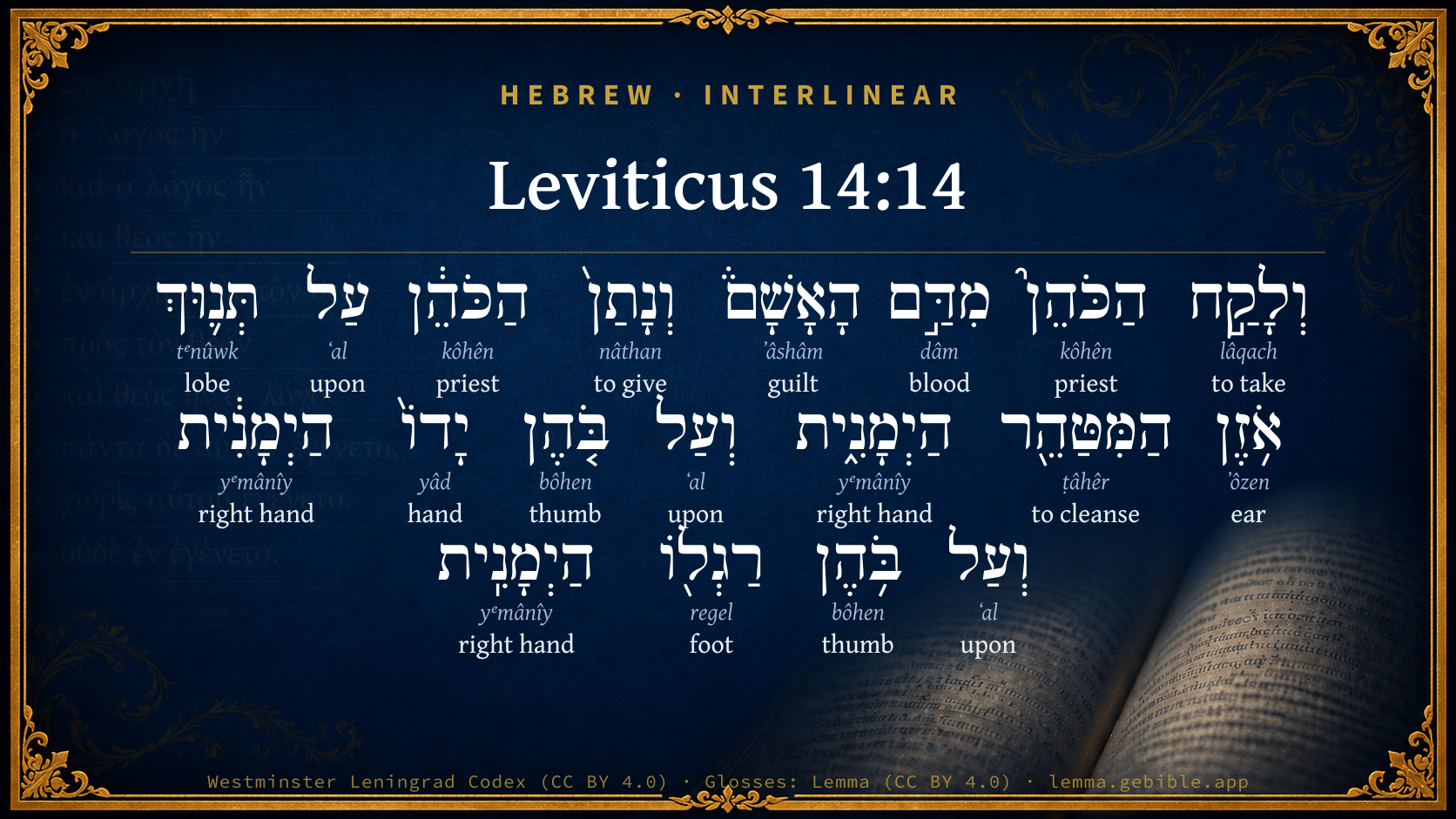
Leviticus 14:14

Hebrew (Westminster Leningrad Codex) Leviticus 14:14 appears in the Hebrew Old Testament. The text above is from the Westminster Leningrad Codex. Each word links to its Strong’s number, a concise gloss, and parsing drawn from the Open Scriptures Hebrew Bible morphology. Click any word for its full Brown-Driver-Briggs (BDB) entry.
Download image
Cite this verse

Leviticus 14:14 (World English Bible). Public Domain. Lemma interlinear Bible study tool, https://lemma.gebible.app/v/leviticus/14/14.

Show BibTeX & RIS
BibTeX
RIS
English Translation
The priest shall take some of the blood of the trespass offering, and the priest shall put it on the tip of the right ear of him who is to be cleansed, and on the thumb of his right hand, and on the big toe of his right foot.
World English Bible · Public Domain
Download a study sheet

One document with this verse’s original text, its word-by-word gloss line, the meaning frame, cross-references with their text, attributed commentary, and full source and license credits — printable, and it pastes into notes with its structure intact.

This verse Autodidact and up

Study sheet (.html) Plain text (.txt)

A passage Seminary Student

Up to 50 verses in one chapter. A passage sheet keeps up to 6 commentary sources and 12 cross-references per verse, in the order this page ranks them, and says so on the sheet whenever that leaves anything out. Ask for a single verse and you get the Autodidact verse sheet above.

Everything on this page stays free to read, with no account — the sheet is a download of what is already on screen, not access to it.

Want to remove ads? Support Godless Engineer
Compare translations 3

The same verse in 3 English versions, stacked beneath the original-language interlinear above. Click any original word for its lexicon entry.

Each is an independent rendering of the whole verse — the interlinear is not word-aligned to these translations.

Highlighted words mark where these versions differ — a whole-verse word diff, not a word-by-word alignment.

  • World English Bible Public Domain
    The priest shall take some of the blood of the trespass offering, and the priest shall put it on the tip of the right ear of him who is to be cleansed, and on the thumb of his right hand, and on the big toe of his right foot.
  • King James Version Public Domain
    And the priest shall take some of the blood of the trespass offering, and the priest shall put it upon the tip of the right ear of him that is to be cleansed, and upon the thumb of his right hand, and upon the great toe of his right foot:
  • unfoldingWord Literal Text CC BY-SA 4.0
    And the priest shall take some of the blood of the guilt offering, and the priest shall put on the lobe of the right ear of the person who is being cleansed and on the thumb of his right hand and on the big toe of his right foot.

unfoldingWord Literal Text — © unfoldingWord, licensed CC BY-SA 4.0. Word-aligned USFM3 via Door43 (git.door43.org/unfoldingWord/en_ult).

Versions to compare (up to 4)

3 of 4 selected

Show all 18 translations

Every available English version of this verse, each an independent rendering of the whole verse.

  • World English Bible Public Domain
    The priest shall take some of the blood of the trespass offering, and the priest shall put it on the tip of the right ear of him who is to be cleansed, and on the thumb of his right hand, and on the big toe of his right foot.
  • Berean Standard Bible Public Domain
    The priest is to take some of the blood from the guilt offering and put it on the right earlobe of the one to be cleansed, on the thumb of his right hand, and on the big toe of his right foot.
  • Majority Standard Bible Public Domain
    The priest is to take some of the blood from the guilt offering and put it on the right earlobe of the one to be cleansed, on the thumb of his right hand, and on the big toe of his right foot.
  • King James Version Public Domain
    And the priest shall take some of the blood of the trespass offering, and the priest shall put it upon the tip of the right ear of him that is to be cleansed, and upon the thumb of his right hand, and upon the great toe of his right foot:
  • American Standard Version (1901) Public Domain
    and the priest shall take of the blood of the trespass-offering, and the priest shall put it upon the tip of the right ear of him that is to be cleansed, and upon the thumb of his right hand, and upon the great toe of his right foot.
  • Revised Version (1885) Public Domain
    and the priest shall take of the blood of the guilt offering, and the priest shall put it upon the tip of the right ear of him that is to be cleansed, and upon the thumb of his right hand, and upon the great toe of his right foot:
  • Geneva Bible (1599) Public Domain
    So the Priest shall take of the blood of the trespasse offring, and put it vpon the lappe of the right eare of him that shalbe clensed, and vpon the thumbe of his right hand, and vpon the great toe of his right foote.
  • Douay-Rheims (1899) Public Domain
    And the priest taking of the blood of the victim that was immolated for trespass, shall put it upon the tip of the right ear of him that is cleansed, and upon the thumb of his right hand and the great toe of his right foot:
  • Young's Literal Translation Public Domain
    `And the priest hath taken of the blood of the guilt-offering, and the priest hath put on the tip of the right ear of him who is to be cleansed, and on the thumb of his right hand, and on the great toe of his right foot;
  • Literal Standard Version CC BY-SA 4.0
    And the priest has taken of the blood of the guilt-offering, and the priest has put [it] on the tip of the right ear of him who is to be cleansed, and on the thumb of his right hand, and on the great toe of his right foot;
  • Unlocked Literal Bible CC BY-SA 4.0
    The priest will take some of the blood of the guilt offering and put it on the tip of the right ear of the person who is to be cleansed, on the thumb of his right hand, and on the big toe of his right foot.
  • unfoldingWord Literal Text CC BY-SA 4.0
    And the priest shall take some of the blood of the guilt offering, and the priest shall put on the lobe of the right ear of the person who is being cleansed and on the thumb of his right hand and on the big toe of his right foot.
  • Darby Bible Public Domain
    And the priest shall take of the blood of the trespass-offering, and the priest shall put it on the tip of the right ear of him that is to be cleansed, and on the thumb of his right hand, and on the great toe of his right foot.
  • World Messianic Bible Public Domain
    The priest shall take some of the blood of the trespass offering, and the priest shall put it on the tip of the right ear of him who is to be cleansed, and on the thumb of his right hand, and on the big toe of his right foot.
  • Webster's Bible Public Domain
    And the priest shall take some of the blood of the trespass-offering, and the priest shall put it upon the tip of the right ear of him that is to be cleansed, and upon the thumb of his right hand, and upon the great toe of his right foot.
  • Free Bible Version CC BY-SA 4.0
    The priest will put some of the blood from the guilt offering on their right earlobe, on their right thumb, and on the big toe of their right foot of the person being made clean.
  • Bible in Basic English Public Domain
    And let the priest take some of the blood of the offering for wrongdoing and put it on the point of the right ear of him who is to be made clean, and on the thumb of his right hand and on the great toe of his right foot;
  • JPS Tanakh (1917) Public Domain
    And the priest shall take of the blood of the guilt-offering, and the priest shall put it upon the tip of the right ear of him that is to be cleansed, and upon the thumb of his right hand, and upon the great toe of his right foot.

Literal Standard Version (2020), Covenant Press — licensed CC BY-SA 4.0. Text via the HelloAO Bible API (eBible.org). Unlocked Literal Bible (unfoldingWord) — licensed CC BY-SA 4.0. Text via the HelloAO Bible API (eBible.org). unfoldingWord Literal Text — © unfoldingWord, licensed CC BY-SA 4.0. Word-aligned USFM3 via Door43 (git.door43.org/unfoldingWord/en_ult). Free Bible Version, Dr. Jonathan Gallagher — licensed CC BY-SA 4.0. Text via the HelloAO Bible API (eBible.org).

Word by word

More ways to search: Search by grammar → Find every occurrence → Compare this word →

Practice this passage: Drill this verse → Learn its vocabulary →

תְּנ֛וּךְ
tᵉnûwk
H8571
“lobe of”
Noun, Common, Masculine, Singular, Construct
Part of Speech
Noun
Type
Common
Gender
Masculine
Number
Singular
State
Construct
Full BDB Definition

Origin: perhaps from the same as H594 through the idea of protraction

TWOT: 2527a

tip, lobe (of ear)
  1. וְלָקַ֣ח lâqach H3947 “and · to take” Conjunction + Verb, Qal, Sequential Perfect, 3rd Person, Masculine, Singular
  2. הַכֹּהֵן֮ kôhên H3548 “the · priest” Particle, Definite Article + Noun, Common, Masculine, Singular, Absolute
  3. מִדַּ֣ם dâm H1818 “from · blood of” Preposition + Noun, Common, Masculine, Singular, Construct
  4. הָאָשָׁם֒ ʼâshâm H817 “the · guilt” Particle, Definite Article + Noun, Common, Masculine, Singular, Absolute
  5. וְנָתַן֙ nâthan H5414 “and · to give” Conjunction + Verb, Qal, Sequential Perfect, 3rd Person, Masculine, Singular
  6. הַכֹּהֵ֔ן kôhên H3548 “the · priest” Particle, Definite Article + Noun, Common, Masculine, Singular, Absolute
  7. עַל ʻal H5921 “upon” Preposition
  8. אֹ֥זֶן ʼôzen H241 “ear of” Noun, Common, Feminine, Singular, Construct
  9. הַמִּטַּהֵ֖ר ṭâhêr H2891 “the · cleansing” Particle, Definite Article + Verb, Hithpael, Participle Active, Masculine, Singular, Absolute
  10. הַיְמָנִ֑ית yᵉmânîy H3233 “the · right hand” Particle, Definite Article + Adjective, Adjective, Feminine, Singular, Absolute
  11. וְעַל ʻal H5921 “and · upon” Conjunction + Preposition
  12. בֹּ֤הֶן bôhen H931 “thumb of” Noun, Common, Feminine, Singular, Construct
  13. יָדוֹ֙ yâd H3027 “hand · his” Noun, Common, Both, Singular, Construct + Suffix, Personal, 3rd Person, Masculine, Singular
  14. הַיְמָנִ֔ית yᵉmânîy H3233 “the · right hand” Particle, Definite Article + Adjective, Adjective, Feminine, Singular, Absolute
  15. וְעַל ʻal H5921 “and · upon” Conjunction + Preposition
  16. בֹּ֥הֶן bôhen H931 “thumb of” Noun, Common, Feminine, Singular, Construct
  17. רַגְל֖וֹ regel H7272 “foot · his” Noun, Common, Feminine, Singular, Construct + Suffix, Personal, 3rd Person, Masculine, Singular
  18. הַיְמָנִֽית yᵉmânîy H3233 “the · right hand” Particle, Definite Article + Adjective, Adjective, Feminine, Singular, Absolute

About this verse

These counts appear in no published source. They are computed here, from the morphology-tagged text and Lemma’s own curated glosses. What Lemma adds →

19
words
13
distinct lemmas
Pentateuch
section

Notable vocabulary

The rarest word here is תְּנ֛וּךְ lobe H8571 — appearing just 8 times in the whole Hebrew Bible.

Shared distinctive vocabulary

תְּנ֛וּךְ lobe H8571 occurs in 7 verses of the Hebrew Bible. Also found in:

Grammatical profile

  • 3 verbs
  • 10 nouns
  • 3 adjectives
  • 3 prepositions

Verb forms

  • וְלָקַ֣ח Qal · Sequential Perfect
  • וְנָתַן֙ Qal · Sequential Perfect
  • הַמִּטַּהֵ֖ר Hithpael · Participle Active

Repetition

Words recur within this verse — often emphatic in Hebrew:

  • עַל upon H5921 ×3
  • הַיְמָנִ֑ית right hand H3233 ×3
  • הַכֹּהֵן֮ priest H3548 ×2
  • בֹּ֤הֶן thumb H931 ×2

Hebrew & Septuagint length

In English translation the verse runs 49 words from the Hebrew and 46 from the Septuagint (LXX English) — closely comparable.

A rough comparison of the two English renderings, which tokenize alike — not a word-level alignment.

Word counts can differ between the Hebrew and the Greek without any difference in meaning — e.g. the Hebrew direct-object marker אֵת has no separate Greek word, and Greek often adds the article ὁ.

Cross-references

13

Topical passages linked to Leviticus 14:14 in the Treasury of Scripture Knowledge — connected by theme and wording, ordered by reader-vote popularity; previews shown in the World English Bible.

  • Exodus 29:20 Then you shall kill the ram, and take some of its blood, and put it on the tip of the right ear of Aaron, and on the tip of the right ear of his sons, and on the thumb of their right hand, and on the big toe of their right foot, and sprinkle the blood on the altar round about.
  • Leviticus 8:23–24 He killed it; and Moses took some of its blood, and put it on the tip of Aaron's right ear, and on the thumb of his right hand, and on the great toe of his right foot.
  • 2 Corinthians 7:1 Having therefore these promises, beloved, let us cleanse ourselves from all defilement of flesh and spirit, perfecting holiness in the fear of God.
  • Isaiah 1:5 Why should you be beaten more, That you revolt more and more? The whole head is sick, And the whole heart faint.
  • Romans 6:13 Neither present your members to sin as instruments of unrighteousness, but present yourselves to God, as alive from the dead, and your members as instruments of righteousness to God.
  • Romans 6:19 I speak in human terms because of the weakness of your flesh, for as you presented your members as servants to uncleanness and to wickedness upon wickedness, even so now present your members as servants to righteousness for sanctification.
  • Romans 12:1 Therefore I urge you, brothers, by the mercies of God, to present your bodies a living sacrifice, holy, acceptable to God, which is your spiritual service.
  • 1 Corinthians 6:20 for you were bought with a price. Therefore glorify God in your body and in your spirit, which are God's.
  • Philippians 1:20 according to my earnest expectation and hope, that I will in no way be disappointed, but with all boldness, as always, now also Christ will be magnified in my body, whether by life, or by death.
  • 1 Peter 1:14–15 as children of obedience, not conforming yourselves according to your former lusts as in your ignorance,
  • 1 Peter 2:5 You also, as living stones, are built up as a spiritual house, to be a holy priesthood, to offer up spiritual sacrifices, acceptable to God through Jesus Christ.
  • 1 Peter 2:9–10 But you are a chosen race, a royal priesthood, a holy nation, a people for God's own possession, that you may show forth the excellencies of him who called you out of darkness into his marvelous light:
  • Revelation 1:5–6 and from Jesus Christ, the faithful witness, the firstborn of the dead, and the ruler of the kings of the earth. To him who loves us, and washed us from our sins by his blood;

Cross-references courtesy of OpenBible.info (CC BY 4.0).

Hebrew and Greek witnesses Masoretic Hebrew ↔ Greek Septuagint

The same verse in the two great witnesses to the Old Testament, shown verse-for-verse.

These are two independent witnesses, not word-aligned to each other, and the Septuagint is shown in lemma (dictionary) form.

Hebrew Leviticus 14:14 Masoretic · Westminster Leningrad Codex

וְלָקַ֣ח הַכֹּהֵן֮ מִדַּ֣ם הָאָשָׁם֒ וְנָתַן֙ הַכֹּהֵ֔ן עַל תְּנ֛וּךְ אֹ֥זֶן הַמִּטַּהֵ֖ר הַיְמָנִ֑ית וְעַל בֹּ֤הֶן יָדוֹ֙ הַיְמָנִ֔ית וְעַל בֹּ֥הֶן רַגְל֖וֹ הַיְמָנִֽית

The priest shall take some of the blood of the trespass offering, and the priest shall put it on the tip of the right ear of him who is to be cleansed, and on the thumb of his right hand, and on the big toe of his right foot.

World English Bible · Public Domain

Greek LXX Leviticus 14:14 Septuagint · lemma form

καί λαμβάνω ὁ ἱερεύς ἀπό ὁ αἷμα ὁ ὁ πλημμέλεια καί ἐπιτίθημι ὁ ἱερεύς ἐπί ὁ λοβός ὁ οὖς ὁ καθαρίζω ὁ δεξιός καί ἐπί ὁ ἄκρος ὁ χείρ ὁ δεξιός καί ἐπί ὁ ἄκρος ὁ πούς ὁ δεξιός

And the priest shall take of the blood of the trespass-offering, and the priest shall put it on the tip of the right ear of the person under cleansing, and on the thumb of his right hand, and on the great toe of his right foot.

LXX2012 (modern English Septuagint) · Public Domain

Hebrew: Westminster Leningrad Codex (CC BY 4.0). Greek: Septuagint (public domain); English from LXX2012 (modern English Septuagint) (Public Domain). How the Septuagint differs from the Hebrew →

Targum (Aramaic paraphrase)

2

The Targum is the ancient Jewish Aramaic paraphrase of the Hebrew Scriptures — an interpretive translation, not the Hebrew text itself. Onkelos (literal) and Pseudo-Jonathan (expansive) render the Torah, and Jonathan the Prophets. Coverage is partial: where no permissively-licensed English translation exists for a verse, only the Aramaic is shown. This is verse-level text, not a word-by-word alignment to the Hebrew.

  1. Targum Onkelos Torah (Genesis–Deuteronomy)
    וְיִסַב כַּהֲנָא מִדְמָא דַאֲשָׁמָא וְיִתֵּן כַּהֲנָא עַל רוּם אוּדְנָא דְמִדַכֵּי דְיַמִינָא וְעַל אִלְיוֹן יְדֵהּ דְיַמִינָא וְעַל אִלְיוֹן רַגְלֵהּ דְיַמִינָא

    (no public-domain English translation for this verse)

    Targum Onkelos — Aramaic: “Onkelos Genesis” (public domain); “Onkelos Exodus” (public domain); “Onkelos Leviticus” (public domain); “Onkelos Numbers” (public domain); “Onkelos Deuteronomy” (public domain). English: “Sefaria Community Translation” (CC0 1.0 (public-domain dedication)); “J.W. Etheridge. The Targums of Onkelos and Jonathan Ben Uzziel on the Pentateuch. London: Longmans, Green, 1862” (public domain). Text via Sefaria.

  2. Targum Pseudo-Jonathan Torah (Genesis–Deuteronomy)
    וְיִסַב כַּהֲנָא מִן אַדְמָא דַאֲשָׁמָא וְיִתֵּן כַּהֲנָא עַל גְדֵירָא מִיצְעָא דְאוּדְנָא דְמִידַכֵּי דְיַמִינָא וְעַל פּוּרְקָא מִיצְעָא דְיָדֵיהּ דְיַמִינָא וְעַל פּוּרְקָא מִיצְעָא דְרִיגְלֵיהּ דְיַמִינָא

    And the priest shall take of the blood of the trespass offering, and shall put it upon the middle point of the right ear of him who is to be cleansed, and upon the middle joint of his right hand, and on the middle joint of his right foot.

    Targum Pseudo-Jonathan — Aramaic: “Targum Jonathan on Genesis” (public domain); “Targum Jonathan on Exodus” (public domain); “Targum Jonathan on Leviticus” (public domain); “Targum Jonathan on Numbers” (public domain); “Targum Jonathan on Deuteronomy” (public domain). English: “The Targum of Jonathan ben Uzziel, trans. J. W. Etheridge, London, 1862” (public domain). Text via Sefaria.

Commentary

Notes on Leviticus 14:14 from classic Christian and Jewish commentators (each source and its license shown beneath its notes). The classic Christian expositions comment on the surrounding passage and are grouped to its opening verse, so a note may address several verses; the Jewish commentaries on the Tanakh (Rashi and others) are per-verse, so they appear only where the commentator wrote on this verse.

Lemma curates 59 commentaries, every one of them public domain or Creative Commons licensed, each selected and text-cleaned for this edition rather than reprinted as found. About our sources →

Trapp's Complete Commentary

John Trapp

Lev 14:14 And the priest shall take [some] of the blood of the trespass offering, and the priest shall put [it] upon the tip of the right ear of him that is to be cleansed, and upon the thumb of his right hand, and upon the great toe of his right foot:

Ver. 14. Upon the tip of the right ear.] To signify that all Christ’s sanctified ones have a hearing ear, an active hand, a nimble foot to walk in the way that is called holy.

John Trapp, A Commentary or Exposition upon All the Books of the Old and New Testament (1647–1656) — public domain. Text from a community e-Sword module.

Joseph Benson's Commentary

Lev 14:14. The priest shall put it — To signify that he was now free to hear God’s word in the appointed places, and to touch any person or thing without defiling it, and to go whither he pleased.

Joseph Benson's Commentary on the Old and New Testaments (1811–1818) — public domain. Text from a community e-Sword module.

Tyndale Open Study Notes

Tyndale Open Resources

14:14 The lobe, thumb, and big toe represent what the whole person hears and does, and where he or she goes (also 14:17, 28; see study note on 8:23).

Tyndale Open Study Notes — © Tyndale Open Resources, licensed CC BY-SA 4.0. Text via the HelloAO Bible API.

Adam Clarke's Commentary

Verse 14. Upon the tip of the right ear, &c.] See Clarke on Ex 29:20.

Adam Clarke's Commentary on the Bible (1810–1826) — public domain. Text from a community e-Sword/MySword module.

Ellicott's Commentary for English Readers

(14) And the priest shall take some of the blood.—During the second Temple two priests caught the blood of the trespass offering—one into a vessel, and the other into the hollow of his hand. The one who caught the blood in the vessel sprinkled it against the wall of the altar, whilst the other who had the blood in the hollow of his hand went to the convalescent, who was waiting in the porch of Nicanor opposite the eastern door, with his face turned to the west.

And the priest shall put it upon the tip of the right ear.—Still unable to enter the court of the sanctuary, because he had not as yet been cleansed, the restored leper put his head through the gate of Nicanor, when the priest who caught the blood in the hollow of his hand, and who stood within the court, close to the entrance, (because the blood of the expiatory sacrifices could not be brought beyond the limits of the court of Israel), put some of it on the cartilage of his right ear. He then put through his right hand, and the priest put some of the blood on his thumb; he then again put through his right foot, and the priest put some of the blood on the great toe. To expedite the process, the restored leper was also allowed to put through all the three members at once. If the cured leper had not a thumb on his right hand, or a toe on his right foot, or a right ear, he was never cleansed. The right members were chosen for these symbolical acts, as in the case of the consecration of the priest, because they are represented as the strongest, and are therefore the most able to execute the will of God, for which reason they were henceforth dedicated to His service. (See Lev_7:24.)

A Bible Commentary for English Readers, edited by Charles John Ellicott (1878–1897) — public domain. Text from a community e-Sword module.

The Cambridge Bible for Schools and Colleges

gen. ed. J. J. S. Perowne

14. In N.T. times the leper put his head, hand, and foot through the gate of Nicanor and the priest applied the blood and the oil. Two priests officiated; one caught the blood in a bowl and threw it on the sides of the altar; the other received some of the blood in his hand and applied it to the leper (Neg. xiv. §§ 8–10). The blood of the Guilt-Offering was applied in the same way in which the blood of the Ram of consecration was applied to the priests (Lev_8:23 f.), but the whole ceremony was performed by one person.

The Cambridge Bible for Schools and Colleges (gen. ed. J. J. S. Perowne; Cambridge University Press, 1878–1918) — public domain. Text from a community e-Sword module.

John Gill's Exposition

And the priest shall take some of the blood of the trespass offering,.... According to the Misnah (r), two priests received the blood of it, one in a vessel and the other in his hand; he that received it in a vessel went and sprinkled it upon the wall (or top, as Maimonides (s)) of the altar; and he that received it in his hand went to the leper, and the leper having dipped himself in the chamber of the lepers, went and stood in the gate of Nicanor:

and the priest shall put it upon the tip of the right ear of him that is to be cleansed, and upon the thumb of his right hand, and upon the great toe of his right foot; as was done at the consecration of the high priest; see Gill on Exo 29:20, Lev 8:24, now as the leper stood at the door of the tabernacle without the court, he was obliged to put in his head, his right hand, and his right foot, in order to have the blood put on them by the priest, who was in the court; and these were put in either separately one after another, or together: the tradition runs thus (t), he (the leper) thrust in his head, and (the priest) put (the blood) upon the tip of his ear; his hand, and he put it upon the thumb of his hand; his foot, and he put it upon the great toe of his foot: and the application of the blood to these parts showed that the leper had now a right to hear the word of God, to partake of all privileges, to touch anything without defiling it, and to go into any house or company where he thought fit, he was now at full liberty; more evangelically these things may signify the sanctification and cleansing of those parts, and of the whole man by the blood of Christ; and particularly may signify, that as the ear is unclean, uncircumcised, and unsanctified in a leprous sinner and even there are hearing sins in the best of men, the ear is sanctified, and hearing sins removed by the blood of Christ; and as the right hand, being the instrument of action, may denote the evil works of men, and even since the most righteous performances of the best of men are attended with sin, the blood of Christ, which cleanses from all sin, had need to be put upon them; and whereas the conversation of then, which the foot may be an emblem of, is sinful and vain, it is by the blood of Christ that they are redeemed from it; and the influence of that blood sprinkled on the conscience will oblige and constrain men to live and walk soberly, righteously, and godly.

(r) Ut supra. (Misn. Negaim, c. 14. sect. 8) (s) Ut supra. (Hilchot Mechosre Capharah, c. 4. sect. 2.) (t) Ut supra, (r)) sect. 9.

John Gill's Exposition of the Whole Bible (1746–1763) — public domain (CC PDM 1.0). Text via the HelloAO Bible API.

Albert Barnes' Notes on the Bible

In the same way, and with the same significance as in Lev 8:23. It is said that a portion of the blood was caught by the priest in the palm of his hand as it ran from the victim.

Albert Barnes' Notes on the Bible (1834–1885) — public domain. Text from a community e-Sword/MySword module.

Haydock's Catholic Bible Commentary

Taking of the blood, &c. These ceremonies, used in the cleansing of a leper, were mysterious and very significative. The sprinkling seven times with the blood of the little bird, the washing himself and his clothes, the shaving his hair and his beard, signify the means which are to be used in the reconciliation of a sinner, and the steps by which he is to return to God, viz. by the repeated application of the blood of Christ; the washing his conscience with the waters of compunction; and retrenching all vanities and superfluities, by employing all that is over and above what is necessary in alms deeds. The sin-offering, and the holocaust or burnt-offering, which he was to offer at his cleansing, signify the sacrifice of a contrite and humble heart, and that of adoration in spirit and truth, with gratitude and thankfulness, for the forgiveness of sins, with which we are ever to appear before the Almighty. The touching the right ear, the thumb of the right hand, and the great toe of the right foot, first with the blood of the victim, and then with the remainder of the oil, which had been sprinkled seven times before the Lord, signify the application of the blood of Christ, and the unction of the sevenfold grace of the Holy Ghost to the sinner’s right ear, that he may duly hearken to and obey the law of God; and to his right hand and foot, that the works of his hands, and all the steps or affections of his soul, signified by the feet, may be rightly directed to God. (Challoner) See chap. viii. 23. --- These ceremonies might serve to call to the leper’s recollection the benefit which he had received, and to distinguish him from others. (Calmet)

George Leo Haydock (1774–1849), Haydock's Catholic Family Bible and Commentary, 1859 edition — public domain. Excludes Psalms (Douay-Rheims chapter numbering differs from Protestant) and Deuterocanonical books (Catholic canon only).

Matthew Poole's English Annotations

To signify that he was now free to hear God’s word in the appointed places, from which he was before excluded, and to touch any person or tiring without defiling it, and to go whither he pleased.

Matthew Poole's English Annotations on the Holy Bible (1683–1685) — public domain. Text from a community e-Sword/MySword module.

Whedon's Commentary on the Bible

Daniel D. Whedon

14. Right ear — The organ which may have been a willing channel for folly, impurity, or slander must be cleansed by the blood of sprinkling.

Hand — This instrument of the wicked will need the purifying blood, while the foot, which has often run in the way of sin, must be purged as an offending member. This mode of purification in detail is almost exactly like the order for the consecration of the priests. Lev_8:24, note.

Daniel D. Whedon (gen. ed.), Commentary on the Old and New Testaments (1874–1909) — public domain. Text from a community e-Sword module.

The Pulpit Commentary

And the priest shall take some of the blood of the trespass offering, and the priest shall put it upon the tip of the right ear of him that is to be cleansed. The Mishna describes the ceremony as follows: leper stands before the trespass offering, lays his hand upon it and kills it. Two priests catch up the blood one in a vessel, the other in his band. He who catches it up in the vessel goes and throws it on the side of the altar, and he who catches it in his hand goes and stands before the leper. And the leper who had previously bathed in the court of the lepers, goes and stands in the gate of Nicanor. Rabbi Jehudah says he needs not bathe. He thrusts in his head (viz. into the great court, which he may not yet enter), and the priest puts of the blood upon the tip of his ear; he thrusts in his hand, and he puts it upon the thumb of his hand; he thrusts in his foot, and he puts it upon the great toe of his foot" ("Negaim," 14:7, quoted by Edersheim, "Temple Service," chapter 18). No doubt, the ear, the thumb, and the great toe are selected for the purpose of showing, as in the case of the consecration of the priest, that the senses and the active powers of the restored Israelite must be dedicated hence, forth to God.

The Pulpit Commentary (1880–1919), ed. H.D.M. Spence-Jones & Joseph S. Exell — public domain. Text from a community e-Sword module.

John Wesley's Explanatory Notes

The priest shall put it - To signify, that he was now free to hear God's word in the appointed places, and to touch any person or thing without defiling it, and to go whither he pleased.

John Wesley, Explanatory Notes Upon the Whole Bible (1754–1765) — public domain. Text via the GEBible commentary corpus.

unfoldingWord translationNotes

Door43 World Missions Community

the person who is to be cleansed

This can be translated in active form. AT: "the person he is cleansing" (See: Active or Passive)

log

One log is 0.31 liters. (See: Biblical Volume)

sprinkle some of the oil ... before Yahweh

"sprinkle some of the oil ... in Yahweh's presence." There is no indication of what the priest sprinkled the oil on.

translationWords

priest

blood

guilt offering

clean

oil

Yahweh

unfoldingWord translationNotes — © Distant Shores Media and the Door43 World Missions Community, licensed CC BY-SA 4.0. Source: git.door43.org/Door43/en_tn.

Rashi

Rabbi Shlomo Yitzchaki (Rashi)

תנוך is the inner wall of the ear. The etymology of the word תנוך is unknown to me, and the compilers of glossaries call it (translate it by) tendron (cf. Rashi on Exodus 29:22).

בהן means THUMB.

Rashi on the Tanakh — English translations: “The Judaica Press complete Tanach with Rashi, translated by A. J. Rosenberg” (CC BY 4.0); “Pentateuch with Rashi's commentary by M. Rosenbaum and A.M. Silbermann, 1929-1934” (public domain); “The Metsudah Tanach series, Lakewood, N.J” (CC BY 4.0); and “The Book of Joshua, Metsudah Publications, 1997” (CC BY 4.0). Text via Sefaria.

Lesson kit

Teaching starters — assembled from the data on this page, not authored interpretation. Every prompt links to the verse data it draws on. Edit before teaching.

Leviticus, in the Pentateuch, opens this verse with 19 words (13 distinct Hebrew lemmas). Its most distinctive word is tᵉnûwk (“lobe”). A historical commentator’s framing appears above. Read the whole chapter for the surrounding context.

Discussion questions

  1. The word tᵉnûwk carries the sense “lobe.” How does it shape the verse?
  2. Exodus 29:20 shares the word «lobe» with this verse. How do the two illuminate each other?
  3. “upon” occurs 3× in this one verse. What is the effect of the repetition?
  4. The translations on this page render this verse differently — a whole-verse word diff, not a word-by-word alignment. What might account for the different wordings?
  5. The verb «וְלָקַ֣ח» is Qal Sequential Perfect. How does its form color the action?
  6. Reading how Trapp's Complete Commentary and Joseph Benson's Commentary read this verse, where do the two commentators agree and where do they part?

Things to notice

Reading settings

Reading text

Shown beneath each verse's original-language words.

Old Testament
Old Testament edition

Read the OT as the Masoretic Hebrew (MT) or the Greek Septuagint (LXX).

English shown for the Greek Septuagint (in the Hebrew ↔ Greek comparison).

Comparing translations? Open the Compare panel on any verse page to stack up to four side by side.