2 Kings 9:33

Hebrew (Westminster Leningrad Codex) 2 Kings 9:33 appears in the Hebrew Old Testament. The text above is from the Westminster Leningrad Codex. Each word links to its Strong’s number, a concise gloss, and parsing drawn from the Open Scriptures Hebrew Bible morphology. Click any word for its full Brown-Driver-Briggs (BDB) entry.
Download image
Cite this verse

2 Kings 9:33 (World English Bible). Public Domain. Lemma interlinear Bible study tool, https://lemma.gebible.app/v/2-kings/9/33.

Show BibTeX & RIS
BibTeX
RIS
English Translation
He said, Throw her down. So they threw her down; and some of her blood was sprinkled on the wall, and on the horses: and he trod her under foot.
World English Bible · Public Domain
Download a study sheet

One document with this verse’s original text, its word-by-word gloss line, the meaning frame, cross-references with their text, attributed commentary, and full source and license credits — printable, and it pastes into notes with its structure intact.

This verse Autodidact and up

Study sheet (.html) Plain text (.txt)

A passage Seminary Student

Up to 50 verses in one chapter. A passage sheet keeps up to 6 commentary sources and 12 cross-references per verse, in the order this page ranks them, and says so on the sheet whenever that leaves anything out. Ask for a single verse and you get the Autodidact verse sheet above.

Everything on this page stays free to read, with no account — the sheet is a download of what is already on screen, not access to it.

Want to remove ads? Support Godless Engineer
Compare translations 3

The same verse in 3 English versions, stacked beneath the original-language interlinear above. Click any original word for its lexicon entry.

Each is an independent rendering of the whole verse — the interlinear is not word-aligned to these translations.

Highlighted words mark where these versions differ — a whole-verse word diff, not a word-by-word alignment.

  • World English Bible Public Domain
    He said, Throw her down. So they threw her down; and some of her blood was sprinkled on the wall, and on the horses: and he trod her under foot.
  • King James Version Public Domain
    And he said, Throw her down. So they threw her down: and some of her blood was sprinkled on the wall, and on the horses: and he trode her under foot.
  • unfoldingWord Literal Text CC BY-SA 4.0
    And he said, “Throw her down.” And they threw her down, and some of her blood sprinkled on the wall and on the horses, and he trampled her.

unfoldingWord Literal Text — © unfoldingWord, licensed CC BY-SA 4.0. Word-aligned USFM3 via Door43 (git.door43.org/unfoldingWord/en_ult).

Versions to compare (up to 4)

3 of 4 selected

Show all 18 translations

Every available English version of this verse, each an independent rendering of the whole verse.

  • World English Bible Public Domain
    He said, Throw her down. So they threw her down; and some of her blood was sprinkled on the wall, and on the horses: and he trod her under foot.
  • Berean Standard Bible Public Domain
    “Throw her down!” yelled Jehu. So they threw her down, and her blood splattered on the wall and on the horses as they trampled her underfoot.
  • Majority Standard Bible Public Domain
    “Throw her down!” yelled Jehu. So they threw her down, and her blood splattered on the wall and on the horses as they trampled her underfoot.
  • King James Version Public Domain
    And he said, Throw her down. So they threw her down: and some of her blood was sprinkled on the wall, and on the horses: and he trode her under foot.
  • American Standard Version (1901) Public Domain
    And he said, Throw her down. So they threw her down; and some of her blood was sprinkled on the wall, and on the horses: and he trod her under foot.
  • Revised Version (1885) Public Domain
    And he said, Throw her down. So they threw her down: and some of her blood was sprinkled on the wall, and on the horses: and he trode her under foot.
  • Geneva Bible (1599) Public Domain
    And he sayde, Cast her downe: and they cast her downe, and hee sprinkled of her blood vpon the wall, and vpon the horses, and he trode her vnder foote.
  • Douay-Rheims (1899) Public Domain
    And he said to them: Throw her down headlong: and they threw her down, and the wall was sprinkled with her blood, and the hoofs of the horses trod upon her.
  • Young's Literal Translation Public Domain
    And he saith, `Let her go;' and they let her go, and `some' of her blood is sprinkled on the wall, and on the horses, and he treadeth her down.
  • Literal Standard Version CC BY-SA 4.0
    and he says, “Let her go”; and they let her go, and [some] of her blood is sprinkled on the wall, and on the horses, and he treads her down.
  • Unlocked Literal Bible CC BY-SA 4.0
    So Jehu said, “Throw her down.” So they threw Jezebel down, and some of her blood spattered on the wall and the horses, and Jehu trampled her underfoot.
  • unfoldingWord Literal Text CC BY-SA 4.0
    And he said, “Throw her down.” And they threw her down, and some of her blood sprinkled on the wall and on the horses, and he trampled her.
  • Darby Bible Public Domain
    And he said, Throw her down! And they threw her down; and some of her blood was sprinkled on the wall, and on the horses; and he trampled on her.
  • World Messianic Bible Public Domain
    He said, “Throw her down!” So they threw her down; and some of her blood was sprinkled on the wall, and on the horses. Then he trampled her under foot.
  • Webster's Bible Public Domain
    And he said, Throw her down. So they threw her down: and some of her blood was sprinkled on the wall, and on the horses: and he trod her under foot.
  • Free Bible Version CC BY-SA 4.0
    “Throw her down!” he shouted. And they threw her down. Her blood spattered on the wall and on the horses which then trampled her.
  • Bible in Basic English Public Domain
    And he said, Take her and put her out of the window. So they sent her down with force, and her blood went in a shower on the wall and on the horses; and she was crushed under their feet.
  • JPS Tanakh (1917) Public Domain
    And he said: 'Throw her down.' So they threw her down; and some of her blood was sprinkled on the wall, and on the horses; and she was trodden under foot.

Literal Standard Version (2020), Covenant Press — licensed CC BY-SA 4.0. Text via the HelloAO Bible API (eBible.org). Unlocked Literal Bible (unfoldingWord) — licensed CC BY-SA 4.0. Text via the HelloAO Bible API (eBible.org). unfoldingWord Literal Text — © unfoldingWord, licensed CC BY-SA 4.0. Word-aligned USFM3 via Door43 (git.door43.org/unfoldingWord/en_ult). Free Bible Version, Dr. Jonathan Gallagher — licensed CC BY-SA 4.0. Text via the HelloAO Bible API (eBible.org).

Word by word

More ways to search: Search by grammar → Find every occurrence → Compare this word →

Practice this passage: Drill this verse → Learn its vocabulary →

שמטהו
shâmaṭ
H8058
“release · him”
Verb, Qal, Imperative, 2nd Person, Masculine, Plural + Suffix, Personal, 3rd Person, Masculine, Singular
Part of Speech
Verb
Stem
Qal
Form
Imperative
Person
2nd Person
Gender
Masculine
Number
Plural
Full BDB Definition

Origin: a primitive root

TWOT: 2408

to release, let drop or loose or rest or fall - (Qal) to let drop or fall - (Niphal) to be made to fall down, be thrown down - (Hiphil) - to cause to let drop - to release, let drop
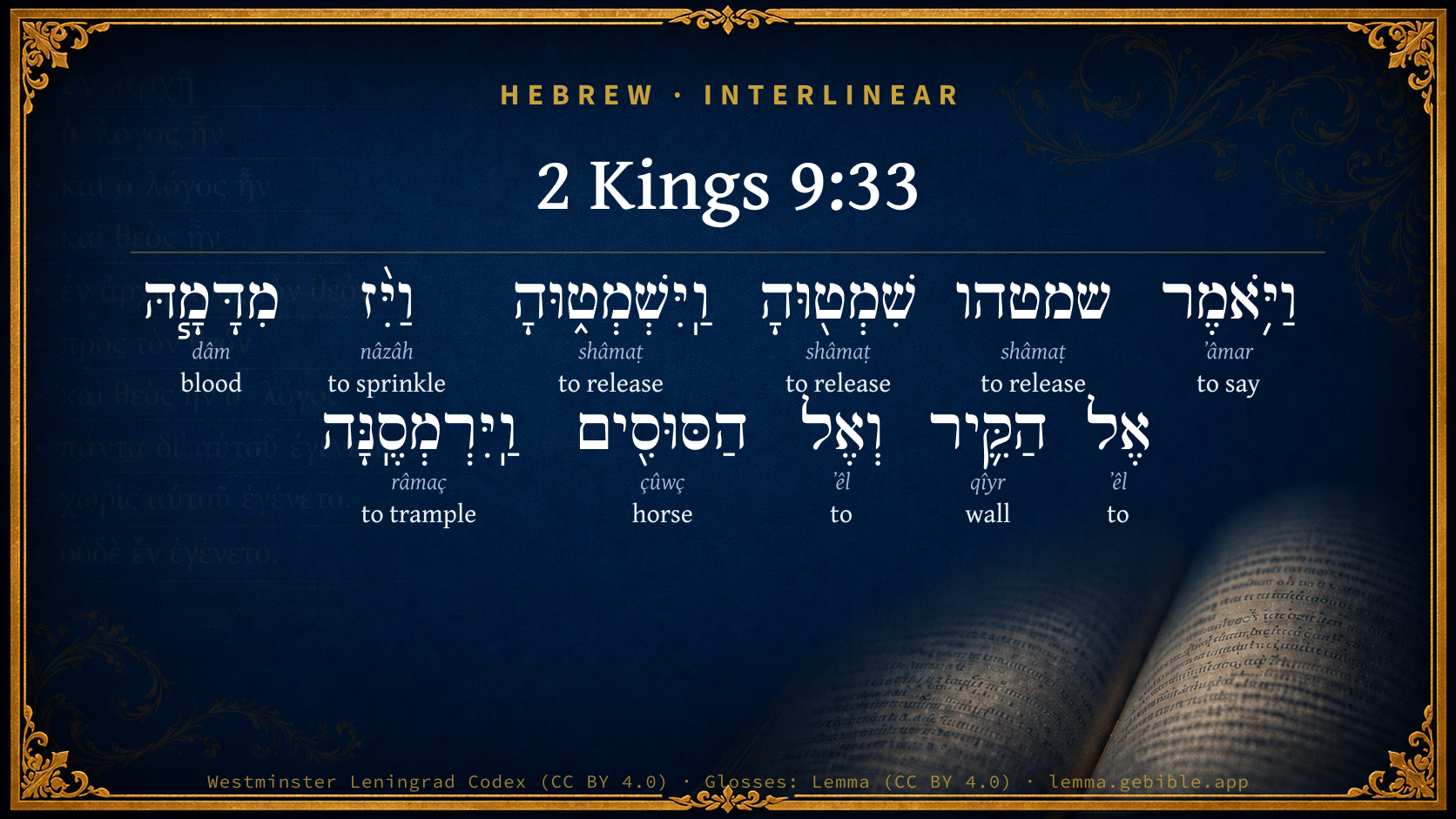
  1. וַיֹּ֥אמֶר ʼâmar H559 “and · to say” Conjunction + Verb, Qal, Sequential Imperfect, 3rd Person, Masculine, Singular
  2. שִׁמְט֖וּהָ shâmaṭ H8058 “release · her” Verb, Qal, Imperative, 2nd Person, Masculine, Plural + Suffix, Personal, 3rd Person, Feminine, Singular
  3. וַֽיִּשְׁמְט֑וּהָ shâmaṭ H8058 “and · to release · her” Conjunction + Verb, Qal, Sequential Imperfect, 3rd Person, Masculine, Plural + Suffix, Personal, 3rd Person, Feminine, Singular
  4. וַיִּ֨ז nâzâh H5137 “and · to sprinkle” Conjunction + Verb, Qal, Sequential Imperfect, 3rd Person, Masculine, Singular
  5. מִדָּמָ֧הּ dâm H1818 “from · blood · her” Preposition + Noun, Common, Masculine, Singular, Construct + Suffix, Personal, 3rd Person, Feminine, Singular
  6. אֶל ʼêl H413 “to” Preposition
  7. הַקִּ֛יר qîyr H7023 “the · wall” Particle, Definite Article + Noun, Common, Masculine, Singular, Absolute
  8. וְאֶל ʼêl H413 “and · to” Conjunction + Preposition
  9. הַסּוּסִ֖ים çûwç H5483 “the · horses” Particle, Definite Article + Noun, Common, Masculine, Plural, Absolute
  10. וַֽיִּרְמְסֶֽנָּה râmaç H7429 “and · to trample · her” Conjunction + Verb, Qal, Sequential Imperfect, 3rd Person, Masculine, Singular + Suffix, Personal, 3rd Person, Feminine, Singular

About this verse

These counts appear in no published source. They are computed here, from the morphology-tagged text and Lemma’s own curated glosses. What Lemma adds →

11
words
8
distinct lemmas
Historical
section

Notable vocabulary

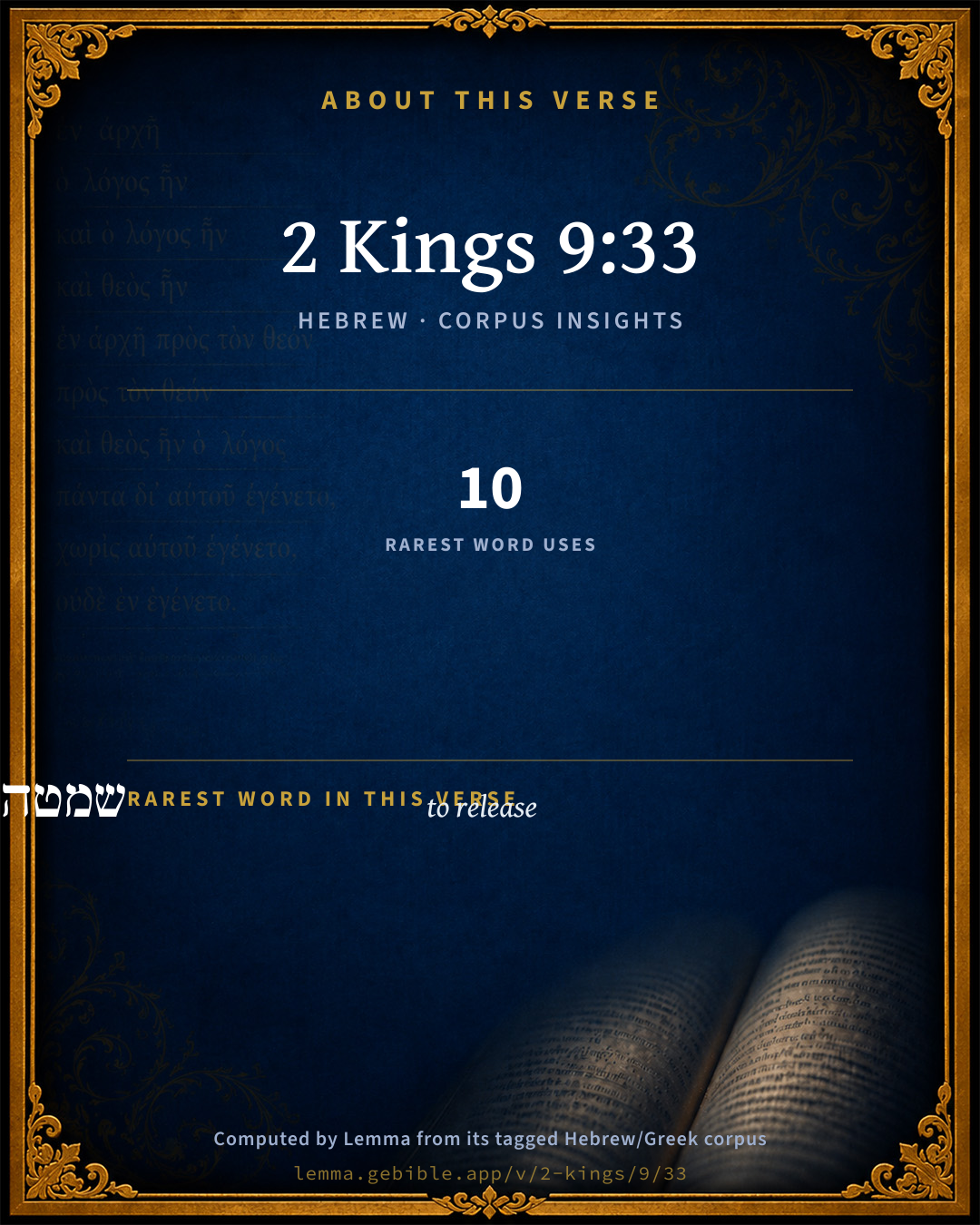
The rarest word here is שמטהו to release H8058 — appearing just 10 times in the whole Hebrew Bible.

Shared distinctive vocabulary

שמטהו to release H8058 occurs in 8 verses of the Hebrew Bible. Also found in:

Grammatical profile

  • 6 verbs
  • 3 nouns
  • 2 prepositions

Verb forms

  • וַיֹּ֥אמֶר Qal · Sequential Imperfect
  • שמטהו Qal · Imperative
  • שִׁמְט֖וּהָ Qal · Imperative
  • וַֽיִּשְׁמְט֑וּהָ Qal · Sequential Imperfect
  • וַיִּ֨ז Qal · Sequential Imperfect
  • וַֽיִּרְמְסֶֽנָּה Qal · Sequential Imperfect

Repetition

Words recur within this verse — often emphatic in Hebrew:

  • שמטהו to release H8058 ×3
  • אֶל to H413 ×2

Hebrew & Septuagint length

In English translation the verse runs 30 words from the Hebrew and 30 from the Septuagint (LXX English) — the same length.

A rough comparison of the two English renderings, which tokenize alike — not a word-level alignment.

Word counts can differ between the Hebrew and the Greek without any difference in meaning — e.g. the Hebrew direct-object marker אֵת has no separate Greek word, and Greek often adds the article ὁ.

Cross-references

9

Topical passages linked to 2 Kings 9:33 in the Treasury of Scripture Knowledge — connected by theme and wording, ordered by reader-vote popularity; previews shown in the World English Bible.

  • Micah 7:10 Then my enemy will see it, And shame will cover her who said to me, Where is Yahweh your God? Then my enemy will see me and will cover her shame. Now she will be trodden down like the mire of the streets.
  • 1 Kings 21:11 The men of his city, even the elders and the nobles who lived in his city, did as Jezebel had sent to them, according as it was written in the letters which she had sent to them.
  • 2 Kings 7:20 it happened even so to him; for the people trod on him in the gate, and he died.
  • 2 Kings 9:26 Surely I have seen yesterday the blood of Naboth, and the blood of his sons, says Yahweh; and I will requite you in this plat, says Yahweh. Now therefore take and cast him into the plat [of ground], according to the word of Yahweh.
  • Isaiah 25:10 For in this mountain will the hand of Yahweh rest; and Moab shall be trodden down in his place, even as straw is trodden down in the water of the dung-hill.
  • Lamentations 1:15 The Lord has set at nothing all my mighty men in the midst of me; He has called a solemn assembly against me to crush my young men: The Lord has trodden as in a winepress the virgin daughter of Judah.
  • Malachi 4:3 You shall tread down the wicked; for they will be ashes under the soles of your feet in the day that I make," says Yahweh of Hosts.
  • Matthew 5:13 "You are the salt of the earth, but if the salt has lost its flavor, with what will it be salted? It is then good for nothing, but to be cast out and trodden under the feet of men.
  • Hebrews 10:29 How much worse punishment, do you think, will he be judged worthy of, who has trodden under foot the Son of God, and has counted the blood of the covenant with which he was sanctified an unholy thing, and has insulted the Spirit of grace?

Cross-references courtesy of OpenBible.info (CC BY 4.0).

Hebrew and Greek witnesses Masoretic Hebrew ↔ Greek Septuagint

The same verse in the two great witnesses to the Old Testament, shown verse-for-verse.

These are two independent witnesses, not word-aligned to each other, and the Septuagint is shown in lemma (dictionary) form.

Hebrew 2 Kings 9:33 Masoretic · Westminster Leningrad Codex

וַיֹּ֥אמֶר שמטהו שִׁמְט֖וּהָ וַֽיִּשְׁמְט֑וּהָ וַיִּ֨ז מִדָּמָ֧הּ אֶל הַקִּ֛יר וְאֶל הַסּוּסִ֖ים וַֽיִּרְמְסֶֽנָּה

He said, Throw her down. So they threw her down; and some of her blood was sprinkled on the wall, and on the horses: and he trod her under foot.

World English Bible · Public Domain

Greek LXX 2 Kings 9:33 Septuagint · lemma form

καί εἶπον κυλίω αὐτός καί κυλίζω αὐτός καί ῥαντίζω ὁ αἷμα αὐτός πρός ὁ τοῖχος καί πρός ὁ ἵππος καί συνπατέω αὐτός

And he said, Throw her down. And they threw her down; and some of her blood was sprinkled on the wall, and on the horses: and they trampled on her.

LXX2012 (modern English Septuagint) · Public Domain

On this verse, The Cambridge Bible for Schools and Colleges discusses the Septuagint’s reading. Read the note in Commentary ↓

Hebrew: Westminster Leningrad Codex (CC BY 4.0). Greek: Septuagint (public domain); English from LXX2012 (modern English Septuagint) (Public Domain). How the Septuagint differs from the Hebrew →

Targum (Aramaic paraphrase)

1

The Targum is the ancient Jewish Aramaic paraphrase of the Hebrew Scriptures — an interpretive translation, not the Hebrew text itself. Onkelos (literal) and Pseudo-Jonathan (expansive) render the Torah, and Jonathan the Prophets. Coverage is partial: where no permissively-licensed English translation exists for a verse, only the Aramaic is shown. This is verse-level text, not a word-by-word alignment to the Hebrew.

  1. Targum Jonathan Prophets (Joshua–Malachi)
    וַאֲמַר מַגְרוֹהָא וּמַגְרוּהָא וּנְדָא מִדָמָהּ עַל כּוֹתְלָא וְעַל סוּסְוָתָא וְדָשׁוּהָ:

    (no public-domain English translation for this verse)

    Targum Jonathan — Aramaic: “Mikraot Gedolot” (public domain). English: “Sefaria Community Translation” (CC0 1.0 (public-domain dedication)); “London "Chaldee Paraphrase," 1871” (public domain). Text via Sefaria.

Commentary

Notes on 2 Kings 9:33 from classic Christian and Jewish commentators (each source and its license shown beneath its notes). The classic Christian expositions comment on the surrounding passage and are grouped to its opening verse, so a note may address several verses; the Jewish commentaries on the Tanakh (Rashi and others) are per-verse, so they appear only where the commentator wrote on this verse.

Lemma curates 59 commentaries, every one of them public domain or Creative Commons licensed, each selected and text-cleaned for this edition rather than reprinted as found. About our sources →

Trapp's Complete Commentary

John Trapp

2Ki 9:33 And he said, Throw her down. So they threw her down: and [some] of her blood was sprinkled on the wall, and on the horses: and he trode her under foot.

Ver. 33. And some of her blood.] Her brains, that devised mischief against the servants of God, are strewed upon the walls: and she that insulted upon the prophets, is trampled upon by the horses’ heels.

John Trapp, A Commentary or Exposition upon All the Books of the Old and New Testament (1647–1656) — public domain. Text from a community e-Sword module.

Geneva Bible (1599)

Geneva Bible translators

This he did by the motion of the Spirit of God, that her blood should be shed, that had shed the blood of innocents, to be a spectacle and example of God’s judgments to all tyrants.

Geneva Bible (1599) marginal notes — public domain. Text via Bolls.life.

Adam Clarke's Commentary

Verse 33. So they threw her down] What a terrible death! She was already, by the fall, almost dashed to pieces; and the brutal Jehu trampled her already mangled body under his horse's feet!

Adam Clarke's Commentary on the Bible (1810–1826) — public domain. Text from a community e-Sword/MySword module.

Ellicott's Commentary for English Readers

(33) Throw her down.—Comp. Note on 1Ch_13:9.

Was sprinkled on.—Spirted on to.

He trode her under foot.—All the versions have they—i.e., the horses—trode. Thenius supposes they were excited by the blood being sprinkled upon them. But “he”—i.e., Jehu—“trode her under foot,” plainly means, he drove over her fallen body. Ewald goes beyond the text in stating that Jehu spurned her with his own feet. (For the verb, comp. 2Ki_7:20.)

A Bible Commentary for English Readers, edited by Charles John Ellicott (1878–1897) — public domain. Text from a community e-Sword module.

The Cambridge Bible for Schools and Colleges

gen. ed. J. J. S. Perowne

33. So they threw her down] It is easy to understand how such an imperious mistress would have few friends among her servants. And to them, as well as to her, the news of Jehu’s revolt and Joram’s death would have been brought. So with Eastern fickleness they at once take the side which seems victorious.

some of her blood] The fall was from such a height as to kill her, and apparently she was torn and bruised as she descended, so that the blood from her wounds spirted forth at once.

and he trode her under foot] i.e. Drove his horses and chariot over her fallen body. Hence the LXX. renders ‘they trode her’.

The Cambridge Bible for Schools and Colleges (gen. ed. J. J. S. Perowne; Cambridge University Press, 1878–1918) — public domain. Text from a community e-Sword module.

John Gill's Exposition

And the carcass of Jezebel shall be as dung upon the face of the field in the portion of Jezreel,.... For upon this spot her carcass fell when thrown out of the window of the king's palace, and here it was left; for the vineyard of Naboth the Jezreelite, which was in the portion of Jezreel, was next to the palace, Kg1 21:1, there seems to be some allusion to her name Jezebel, which signifies "where is dung?"

so that they shall not say, this is Jezebel; there being nothing left of her to be seen or pointed to, nor any grave nor monument over it on which was such an inscription, here lies Jezebel; or that might lead posterity to say, this is Jezebel's grave. Now though the words of this verse are not recorded elsewhere, as the words of the Lord, by Elijah, yet as Jehu was present when they were spoken, and within the hearing of them, he now remembered them, and could repeat them, these circumstances bringing them fresh to his mind.

Next: 2 Kings Chapter 10

John Gill's Exposition of the Whole Bible (1746–1763) — public domain (CC PDM 1.0). Text via the HelloAO Bible API.

Matthew Poole's English Annotations

They threw her down; being mercenary creatures, they quickly comply with Jehu’s command, sacrificing her life to save their own.

Matthew Poole's English Annotations on the Holy Bible (1683–1685) — public domain. Text from a community e-Sword/MySword module.

Whedon's Commentary on the Bible

Daniel D. Whedon

33. They threw her down — The eunuchs saw in Jehu their future master, and instantly obeyed his command.

He trode her under foot — He drove his horses and chariot in his usual furious way over the already fearfully mangled body of the queen, crushing out the last spark of life, and scarcely turning to look behind him, drove on into the court of the palace, his horses and chariot becoming sprinkled with her blood. This is one of the most terribly vivid and fearful pictures in all the annals of tragedy.

Daniel D. Whedon (gen. ed.), Commentary on the Old and New Testaments (1874–1909) — public domain. Text from a community e-Sword module.

The Pulpit Commentary

And he said, Throw her down. A splendid example of the wicked man"s prompt and bold and unscrupulous decision. A queen, a queen-mother, always more tenderly regarded than an ordinary queen-regnant, a princess in her own right (see ver. 34), daughter of a neighboring and powerful potentate, settled in her kingdom for over thirty years, the most powerful person the state during that entire period, backed up by the numerous and dominant party of her co-religionists, she is to Jehu nothing but a wicked woman who is in his way; she inspires him with no awe, she does not even touch him with any feeling of respect. "Throw her down." History presents no parallel to such an indignity. Kings and queens had been, time after time, removed by violence; their lives had been taken; they had been transplanted to another sphere of being. But the open casting forth from a window of a crowned head by the menials of the court, at the command of a usurper, was a new thing, unprecedented, unparalleled. It must have been a shock to all established notions of propriety. In commanding it Jehu showed his superiority to existing prejudice, his utter fearlessness, and his willingness to create a new precedent, which might seriously shake the monarchical principle. So they threw her down. There appears to have been no hesitation. The boldness of Jehu communicated itself to those whom he addressed; and the eunuchs violently seized the person of the queen, and precipitated her from the window to the ground below. She fell on the road by which the palace was approached, and lay there bleeding and helpless. And some of her blood was sprinkled on the wall. As she fell, some portion of her body struck against the wall of the palace, and left splashes of blood upon it. There were probably some projections from the wall between the window and the ground. And on the horses. As her body struck the projections, a bloody shower spurted from it, which fell in part upon the horses that drew Jehu"s chariot. And he trode her underfoot. Like Tullia (Liv, 1:48), Jehu had his chariot driven over the prostrate corpse, so that the hoofs of his horses, and perhaps his own person, were sprinkled with the royal blood. Compare the passage of Livy, "Amens, agi-tantibus furiis, Tullia per patris corpus carpentum egisse fertur, partemque sanguinis ac caedis paternae cruento vehiculo, contaminata ipsa respersaque, tutisse ad penates suos virique sui." It is not often that royal corpses, unless in the heat of battle, have received such treatment.

The Pulpit Commentary (1880–1919), ed. H.D.M. Spence-Jones & Joseph S. Exell — public domain. Text from a community e-Sword module.

unfoldingWord translationNotes

Door43 World Missions Community

Throw her down

Jehu was telling the eunuchs to throw Jezebel out of the window.

So they threw Jezebel down

The eunuchs threw Jezebel out of the high window and she died when she hit the ground. (See: Euphemism)

Jehu trampled her underfoot

This means that he drove his horses over her body. AT: "Jehu's horses that were pulling his chariot trampled her body under their feet" (See: Assumed Knowledge and Implicit Information)

See now to

The phrase "see now to" means to give your attention to whatever is specified. AT: "Now go to" (See: Idiom)

for she is a king's daughter

Since Jezebel was the daughter of a king, it was necessary to bury her properly. AT: "because she is a king's daughter and therefore should be buried properly" (See: Assumed Knowledge and Implicit Information)

translationWords

horse

palace

curse

unfoldingWord translationNotes — © Distant Shores Media and the Door43 World Missions Community, licensed CC BY-SA 4.0. Source: git.door43.org/Door43/en_tn.

Rashi

Rabbi Shlomo Yitzchaki (Rashi)

“Push her out!” Of the window to the ground.

Rashi on the Tanakh — English translations: “The Judaica Press complete Tanach with Rashi, translated by A. J. Rosenberg” (CC BY 4.0); “Pentateuch with Rashi's commentary by M. Rosenbaum and A.M. Silbermann, 1929-1934” (public domain); “The Metsudah Tanach series, Lakewood, N.J” (CC BY 4.0); and “The Book of Joshua, Metsudah Publications, 1997” (CC BY 4.0). Text via Sefaria.

Lesson kit

Teaching starters — assembled from the data on this page, not authored interpretation. Every prompt links to the verse data it draws on. Edit before teaching.

2 Kings, in the Historical, opens this verse with 11 words (8 distinct Hebrew lemmas). Its most distinctive word is shâmaṭ (“to release”). A historical commentator’s framing appears above. Read the whole chapter for the surrounding context.

Discussion questions

  1. How does “to release” (shâmaṭ) shape what this verse is saying?
  2. How does Exodus 23:11, which shares the word «to release», read alongside this verse?
  3. What does the repetition of “to release” (3× in this one verse) do in this verse?
  4. These translations render this verse differently. What is at stake in choosing one wording over another?
  5. «וַיֹּ֥אמֶר» is a Qal Sequential Imperfect verb. How does that grammatical form shape the action described?
  6. Compare how Trapp's Complete Commentary and Geneva Bible (1599) read this verse. Where do they agree or differ?

Things to notice

  • These translations choose different wording for 5 words in this verse.
  • “to release” occurs 3× in this single verse.
  • 8 distinct Hebrew lemmas span 11 words in this verse.

Reading settings

Reading text

Shown beneath each verse's original-language words.

Old Testament
Old Testament edition

Read the OT as the Masoretic Hebrew (MT) or the Greek Septuagint (LXX).

English shown for the Greek Septuagint (in the Hebrew ↔ Greek comparison).

Comparing translations? Open the Compare panel on any verse page to stack up to four side by side.