
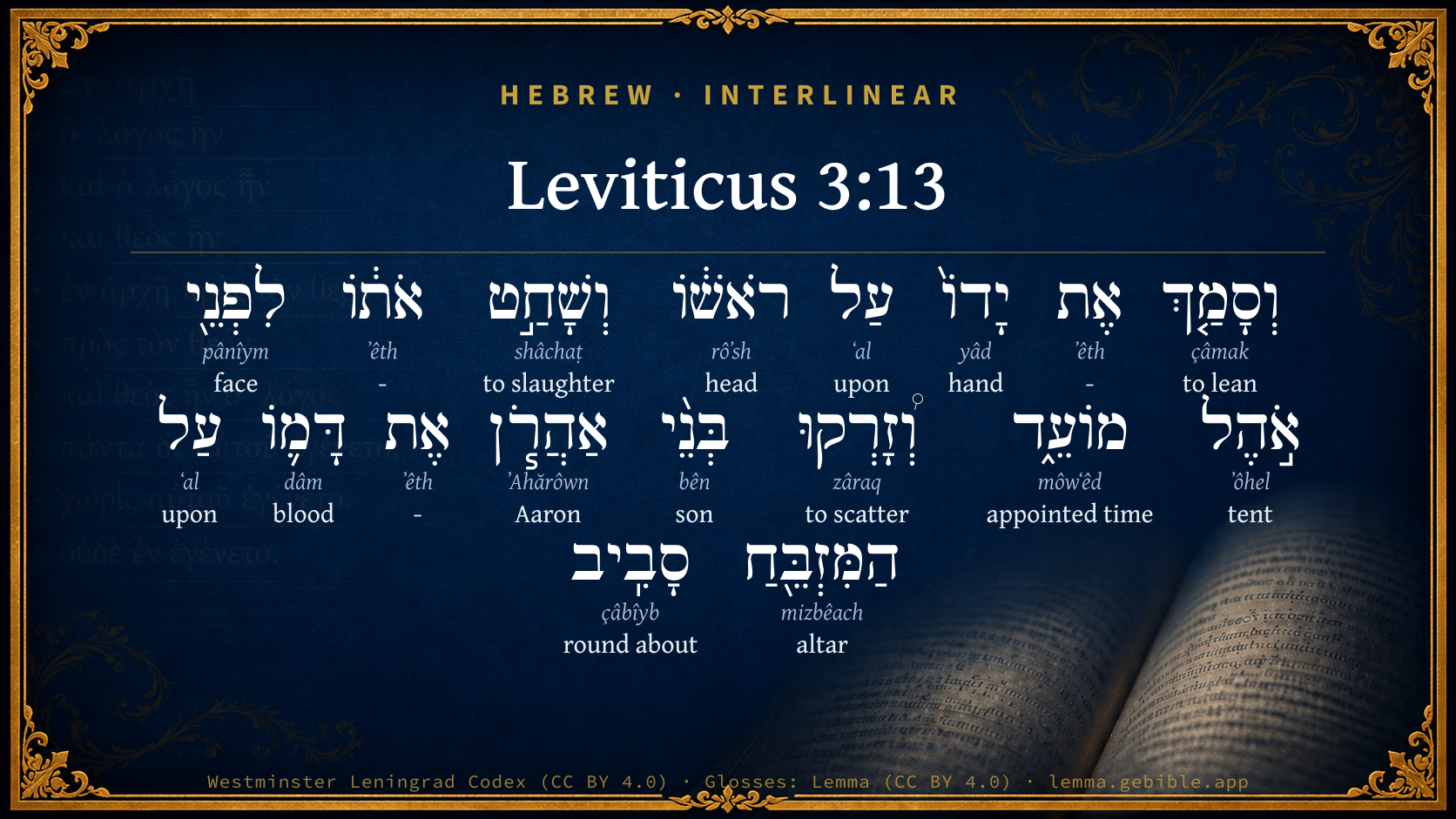
Leviticus 3:13

Hebrew (Westminster Leningrad Codex) Leviticus 3:13 appears in the Hebrew Old Testament. The text above is from the Westminster Leningrad Codex. Each word links to its Strong’s number, a concise gloss, and parsing drawn from the Open Scriptures Hebrew Bible morphology. Click any word for its full Brown-Driver-Briggs (BDB) entry.
Download image
Cite this verse

Leviticus 3:13 (World English Bible). Public Domain. Lemma interlinear Bible study tool, https://lemma.gebible.app/v/leviticus/3/13.

Show BibTeX & RIS
BibTeX
RIS
English Translation
and he shall lay his hand on its head, and kill it before the tent of meeting; and the sons of Aaron shall sprinkle its blood on the altar round about.
World English Bible · Public Domain
Download a study sheet

One document with this verse’s original text, its word-by-word gloss line, the meaning frame, cross-references with their text, attributed commentary, and full source and license credits — printable, and it pastes into notes with its structure intact.

This verse Autodidact and up

Study sheet (.html) Plain text (.txt)

A passage Seminary Student

Up to 50 verses in one chapter. A passage sheet keeps up to 6 commentary sources and 12 cross-references per verse, in the order this page ranks them, and says so on the sheet whenever that leaves anything out. Ask for a single verse and you get the Autodidact verse sheet above.

Everything on this page stays free to read, with no account — the sheet is a download of what is already on screen, not access to it.

Want to remove ads? Support Godless Engineer
Compare translations 3

The same verse in 3 English versions, stacked beneath the original-language interlinear above. Click any original word for its lexicon entry.

Each is an independent rendering of the whole verse — the interlinear is not word-aligned to these translations.

Highlighted words mark where these versions differ — a whole-verse word diff, not a word-by-word alignment.

  • World English Bible Public Domain
    and he shall lay his hand on its head, and kill it before the tent of meeting; and the sons of Aaron shall sprinkle its blood on the altar round about.
  • King James Version Public Domain
    And he shall lay his hand upon the head of it, and kill it before the tabernacle of the congregation: and the sons of Aaron shall sprinkle the blood thereof upon the altar round about.
  • unfoldingWord Literal Text CC BY-SA 4.0
    And he shall lay his hand on its head and he shall slaughter it to the face of the tent of meeting. And the sons of Aaron shall splash its blood on the altar all around.

unfoldingWord Literal Text — © unfoldingWord, licensed CC BY-SA 4.0. Word-aligned USFM3 via Door43 (git.door43.org/unfoldingWord/en_ult).

Versions to compare (up to 4)

3 of 4 selected

Show all 18 translations

Every available English version of this verse, each an independent rendering of the whole verse.

  • World English Bible Public Domain
    and he shall lay his hand on its head, and kill it before the tent of meeting; and the sons of Aaron shall sprinkle its blood on the altar round about.
  • Berean Standard Bible Public Domain
    He must lay his hand on its head and slaughter it in front of the Tent of Meeting. Then Aaron’s sons shall sprinkle its blood on all sides of the altar.
  • Majority Standard Bible Public Domain
    He must lay his hand on its head and slaughter it in front of the Tent of Meeting. Then Aaron’s sons shall splatter its blood on all sides of the altar.
  • King James Version Public Domain
    And he shall lay his hand upon the head of it, and kill it before the tabernacle of the congregation: and the sons of Aaron shall sprinkle the blood thereof upon the altar round about.
  • American Standard Version (1901) Public Domain
    and he shall lay his hand upon the head of it, and kill it before the tent of meeting; and the sons of Aaron shall sprinkle the blood thereof upon the altar round about.
  • Revised Version (1885) Public Domain
    and he shall lay his hand upon the head of it, and kill it before the tent of meeting: and the sons of Aaron shall sprinkle the blood thereof upon the altar round about.
  • Geneva Bible (1599) Public Domain
    And shall put his hande vpon the head of it, and kill it before the Tabernacle of the Congregation, and the sonnes of Aaron shall sprinkle the blood thereof vpon the altar round about.
  • Douay-Rheims (1899) Public Domain
    He shall put his hand upon the head thereof: and shall immolate it in the entry of the tabernacle of the testimony. And the sons of Aaron shall pour the blood thereof round about upon the altar.
  • Young's Literal Translation Public Domain
    and hath laid his hand on its head, and hath slaughtered it before the tent of meeting, and sons of Aaron have sprinkled its blood on the altar round about;
  • Literal Standard Version CC BY-SA 4.0
    and has laid his hand on its head, and has slaughtered it before the Tent of Meeting, and sons of Aaron have sprinkled its blood around the altar;
  • Unlocked Literal Bible CC BY-SA 4.0
    He must lay his hand on the head of the goat and kill it before the tent of meeting. Then the sons of Aaron will sprinkle its blood on the sides of the altar.
  • unfoldingWord Literal Text CC BY-SA 4.0
    And he shall lay his hand on its head and he shall slaughter it to the face of the tent of meeting. And the sons of Aaron shall splash its blood on the altar all around.
  • Darby Bible Public Domain
    And he shall lay his hand on the head of it, and slaughter it before the tent of meeting; and the sons of Aaron shall sprinkle the blood thereof on the altar round about.
  • World Messianic Bible Public Domain
    He shall lay his hand on its head, and kill it before the Tent of Meeting; and the sons of Aaron shall sprinkle its blood around on the altar.
  • Webster's Bible Public Domain
    And he shall lay his hand upon the head of it, and kill it before the tabernacle of the congregation: and the sons of Aaron shall sprinkle its blood upon the altar round about.
  • Free Bible Version CC BY-SA 4.0
    Put your hand on its head and kill it in front of the Tent of Meeting. Then Aaron's sons the priests will sprinkle the blood on all sides of the altar.
  • Bible in Basic English Public Domain
    And let him put his hand on the head of it and put it to death before the Tent of meeting; and the sons of Aaron are to put some of its blood on and round the altar.
  • JPS Tanakh (1917) Public Domain
    And he shall lay his hand upon the head of it, and kill it before the tent of meeting; and the sons of Aaron shall dash the blood thereof against the altar round about.

Literal Standard Version (2020), Covenant Press — licensed CC BY-SA 4.0. Text via the HelloAO Bible API (eBible.org). Unlocked Literal Bible (unfoldingWord) — licensed CC BY-SA 4.0. Text via the HelloAO Bible API (eBible.org). unfoldingWord Literal Text — © unfoldingWord, licensed CC BY-SA 4.0. Word-aligned USFM3 via Door43 (git.door43.org/unfoldingWord/en_ult). Free Bible Version, Dr. Jonathan Gallagher — licensed CC BY-SA 4.0. Text via the HelloAO Bible API (eBible.org).

Word by word

More ways to search: Search by grammar → Find every occurrence → Compare this word →

Practice this passage: Drill this verse → Learn its vocabulary →

וְ֠זָרְקוּ
zâraq
H2236
“and · to scatter”
Conjunction + Verb, Qal, Sequential Perfect, 3rd Person, Common, Plural
Part of Speech
Conjunction + Verb
Stem
Qal
Form
Sequential Perfect
Person
3rd Person
Gender
Common
Number
Plural
Full BDB Definition

Origin: a primitive root

TWOT: 585

to scatter, sprinkle, toss, throw, scatter abundantly, strew - (Qal) to scatter, sprinkle, toss - (Pual) to be sprinkled
  1. וְסָמַ֤ךְ çâmak H5564 “and · to lean” Conjunction + Verb, Qal, Sequential Perfect, 3rd Person, Masculine, Singular
  2. אֶת ʼêth H853 “-” Particle, Direct Object
  3. יָדוֹ֙ yâd H3027 “hand · his” Noun, Common, Both, Singular, Construct + Suffix, Personal, 3rd Person, Masculine, Singular
  4. עַל ʻal H5921 “upon” Preposition
  5. רֹאשׁ֔וֹ rôʼsh H7218 “head · his” Noun, Common, Masculine, Singular, Construct + Suffix, Personal, 3rd Person, Masculine, Singular
  6. וְשָׁחַ֣ט shâchaṭ H7819 “and · to slaughter” Conjunction + Verb, Qal, Sequential Perfect, 3rd Person, Masculine, Singular
  7. אֹת֔וֹ ʼêth H853 “- · him” Particle, Direct Object + Suffix, Personal, 3rd Person, Masculine, Singular
  8. לִפְנֵ֖י pânîym H6440 “to/for · face(s) of” Preposition + Noun, Common, Both, Plural, Construct
  9. אֹ֣הֶל ʼôhel H168 “tent of” Noun, Common, Masculine, Singular, Construct
  10. מוֹעֵ֑ד môwʻêd H4150 “appointed time” Noun, Common, Masculine, Singular, Absolute
  11. בְּנֵ֨י bên H1121 “sons of” Noun, Common, Masculine, Plural, Construct
  12. אַהֲרֹ֧ן ʼAhărôwn H175 “Aaron” Noun, Proper
  13. אֶת ʼêth H853 “-” Particle, Direct Object
  14. דָּמ֛וֹ dâm H1818 “blood · his” Noun, Common, Masculine, Singular, Construct + Suffix, Personal, 3rd Person, Masculine, Singular
  15. עַל ʻal H5921 “upon” Preposition
  16. הַמִּזְבֵּ֖חַ mizbêach H4196 “the · altar” Particle, Definite Article + Noun, Common, Masculine, Singular, Absolute
  17. סָבִֽיב çâbîyb H5439 “round about” Noun, Common, Both, Singular, Absolute

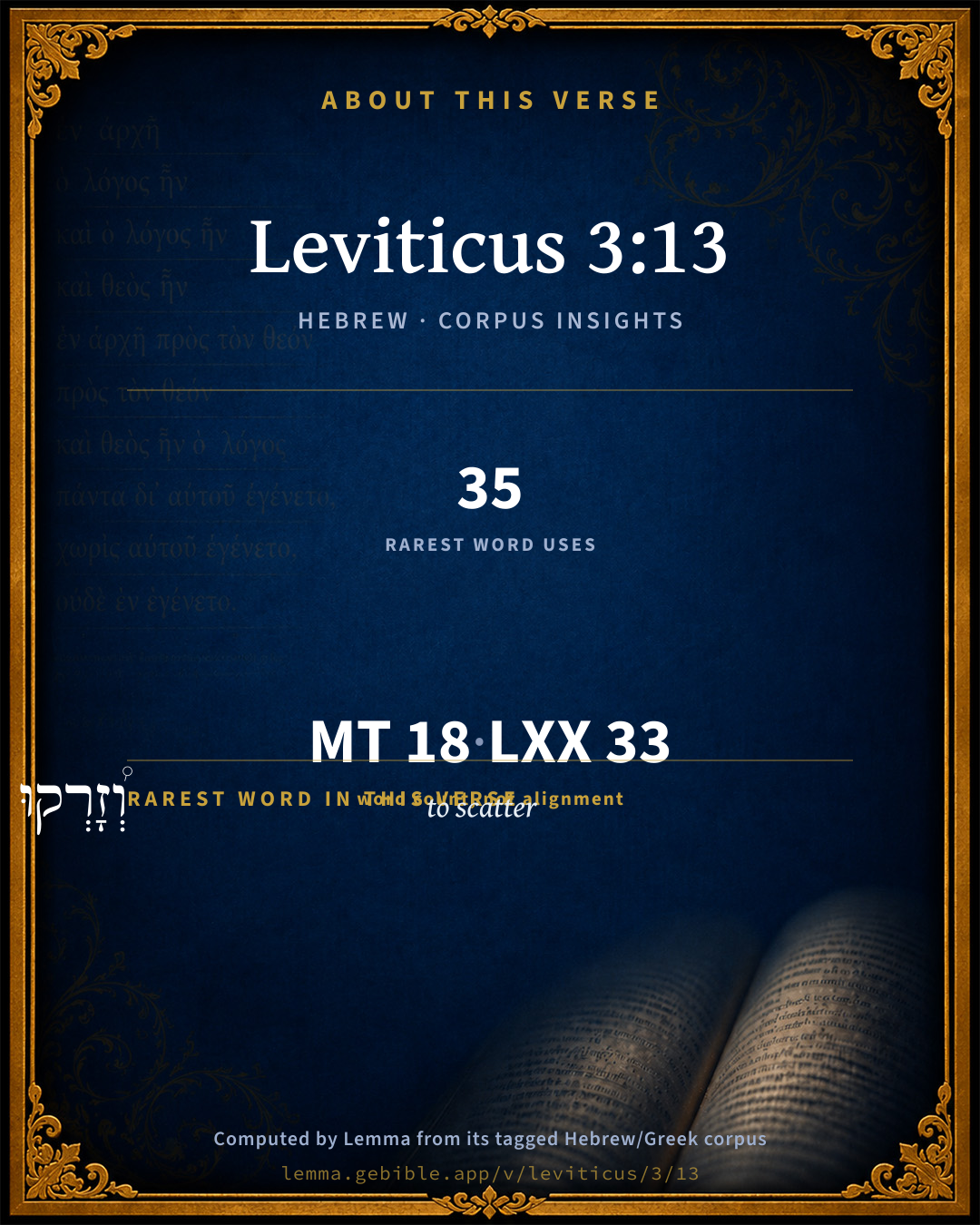
About this verse

These counts appear in no published source. They are computed here, from the morphology-tagged text and Lemma’s own curated glosses. What Lemma adds →

18
words
15
distinct lemmas
Pentateuch
section

Shared distinctive vocabulary

וְ֠זָרְקוּ to scatter H2236 occurs in 33 verses of the Hebrew Bible. Also found in:

Grammatical profile

  • 3 verbs
  • 10 nouns
  • 2 prepositions
  • 3 particles

Verb forms

  • וְסָמַ֤ךְ Qal · Sequential Perfect
  • וְשָׁחַ֣ט Qal · Sequential Perfect
  • וְ֠זָרְקוּ Qal · Sequential Perfect

Repetition

A word recurs within this verse — often emphatic in Hebrew:

Hebrew & Septuagint length

In English translation the verse runs 31 words from the Hebrew and 42 from the Septuagint (LXX English) — closely comparable.

A rough comparison of the two English renderings, which tokenize alike — not a word-level alignment.

Word counts can differ between the Hebrew and the Greek without any difference in meaning — e.g. the Hebrew direct-object marker אֵת has no separate Greek word, and Greek often adds the article ὁ.

In the original languages it is 18 Hebrew tokens and 33 Greek tokens — but the two are counted differently (Hebrew bundles its prefixes and suffixes into one token; the Greek is in lemma form), so that isn’t a like-for-like length.

Cross-references

12

Topical passages linked to Leviticus 3:13 in the Treasury of Scripture Knowledge — connected by theme and wording, ordered by reader-vote popularity; previews shown in the World English Bible.

  • Leviticus 3:8 and he shall lay his hand on the head of his offering, and kill it before the tent of meeting: and Aaron's sons shall sprinkle its blood on the altar round about.
  • Leviticus 3:1–5 "'If his offering is a sacrifice of peace offerings; if he offers it from the herd, whether male or female, he shall offer it without blemish before Yahweh.
  • Isaiah 52:15 so shall he sprinkle many nations; kings shall shut their mouths at him: for that which had not been told them shall they see; and that which they had not heard shall they understand.
  • Isaiah 53:6 All we like sheep have gone astray; everyone has turned to his own way; and Yahweh has laid on him the iniquity of us all.
  • Isaiah 53:11–12 He shall see of the travail of his soul, [and] shall be satisfied: by the knowledge of himself shall my righteous servant justify many; and he shall bear their iniquities.
  • Romans 5:6–11 For while we were yet weak, at the right time Christ died for the ungodly.
  • Romans 5:15–21 But the free gift isn't like the trespass. For if by the trespass of the one the many died, much more did the grace of God, and the gift by the grace of the one man, Jesus Christ, abound to the many.
  • 2 Corinthians 5:21 For him who knew no sin he made to be sin on our behalf; so that in him we might become the righteousness of God.
  • Hebrews 12:24 to Jesus, the mediator of a new covenant, and to the blood of sprinkling that speaks better than that of Abel.
  • 1 Peter 1:2 according to the foreknowledge of God the Father, in sanctification of the Spirit, that you may obey Jesus Christ and be sprinkled in his blood: Grace to you and peace be multiplied.
  • 1 Peter 2:24 who his own self bore our sins in his body on the tree, that we, having died to sins, might live to righteousness; by whose stripes you were healed.
  • 1 Peter 3:18 Because Christ also suffered for sins once, the righteous for the unrighteous, that he might bring you to God; being put to death in the flesh, but made alive in the spirit;

Cross-references courtesy of OpenBible.info (CC BY 4.0).

Hebrew and Greek witnesses Masoretic Hebrew ↔ Greek Septuagint

The same verse in the two great witnesses to the Old Testament, shown verse-for-verse.

These are two independent witnesses, not word-aligned to each other, and the Septuagint is shown in lemma (dictionary) form.

Hebrew Leviticus 3:13 Masoretic · Westminster Leningrad Codex

וְסָמַ֤ךְ אֶת יָדוֹ֙ עַל רֹאשׁ֔וֹ וְשָׁחַ֣ט אֹת֔וֹ לִפְנֵ֖י אֹ֣הֶל מוֹעֵ֑ד וְ֠זָרְקוּ בְּנֵ֨י אַהֲרֹ֧ן אֶת דָּמ֛וֹ עַל הַמִּזְבֵּ֖חַ סָבִֽיב

and he shall lay his hand on its head, and kill it before the tent of meeting; and the sons of Aaron shall sprinkle its blood on the altar round about.

World English Bible · Public Domain

Greek LXX Leviticus 3:13 Septuagint · lemma form

καί ἐπιτίθημι ὁ χείρ ἐπί ὁ κεφαλή αὐτός καί σφάζω αὐτός ἔναντι κύριος παρά ὁ θύρα ὁ σκηνή ὁ μαρτύριον καί προςχέω ὁ υἱός ἀαρών ὁ ἱερεύς ὁ αἷμα ἐπί ὁ θυσιαστήριον κύκλος

And he shall lay his hands on its head; and they shall kill it before the Lord by the doors of the tabernacle of witness; and the priests the sons of Aaron shall pour out the blood on the altar round about.

LXX2012 (modern English Septuagint) · Public Domain

Hebrew: Westminster Leningrad Codex (CC BY 4.0). Greek: Septuagint (public domain); English from LXX2012 (modern English Septuagint) (Public Domain). How the Septuagint differs from the Hebrew →

Targum (Aramaic paraphrase)

2

The Targum is the ancient Jewish Aramaic paraphrase of the Hebrew Scriptures — an interpretive translation, not the Hebrew text itself. Onkelos (literal) and Pseudo-Jonathan (expansive) render the Torah, and Jonathan the Prophets. Coverage is partial: where no permissively-licensed English translation exists for a verse, only the Aramaic is shown. This is verse-level text, not a word-by-word alignment to the Hebrew.

  1. Targum Onkelos Torah (Genesis–Deuteronomy)
    וְיִסְמוֹךְ יָת יְדֵהּ עַל רֵישֵׁיהּ וְיִכּוֹס יָתֵהּ קֳדָם מַשְׁכַּן זִמְנָא וְיִזְרְקוּן בְּנֵי אַהֲרֹן יָת דְמֵהּ עַל מַדְבְּחָא סְחוֹר סְחוֹר

    (no public-domain English translation for this verse)

    Targum Onkelos — Aramaic: “Onkelos Genesis” (public domain); “Onkelos Exodus” (public domain); “Onkelos Leviticus” (public domain); “Onkelos Numbers” (public domain); “Onkelos Deuteronomy” (public domain). English: “Sefaria Community Translation” (CC0 1.0 (public-domain dedication)); “J.W. Etheridge. The Targums of Onkelos and Jonathan Ben Uzziel on the Pentateuch. London: Longmans, Green, 1862” (public domain). Text via Sefaria.

  2. Targum Pseudo-Jonathan Torah (Genesis–Deuteronomy)
    וְיִסְמוֹךְ יַד יְמִינֵיהּ עַל רֵישֵׁיהּ וְיִכּוֹס יָתֵיהּ טַבְּחָא קֳדָם מַשְׁכַּן זִמְנָא וְיִדְרְקוּן בְּנֵי אַהֲרן יַת אַדְמֵיהּ עַל מַדְבְּחָא חֲזוֹר חֲזוֹר

    and lay his right hand upon its head, and the slayer shall kill it before the tabernacle of ordinance, and the sons of Aharon shall sprinkle its, blood upon the altar round about.

    Targum Pseudo-Jonathan — Aramaic: “Targum Jonathan on Genesis” (public domain); “Targum Jonathan on Exodus” (public domain); “Targum Jonathan on Leviticus” (public domain); “Targum Jonathan on Numbers” (public domain); “Targum Jonathan on Deuteronomy” (public domain). English: “The Targum of Jonathan ben Uzziel, trans. J. W. Etheridge, London, 1862” (public domain). Text via Sefaria.

Commentary

Notes on Leviticus 3:13 from classic Christian and Jewish commentators (each source and its license shown beneath its notes). The classic Christian expositions comment on the surrounding passage and are grouped to its opening verse, so a note may address several verses; the Jewish commentaries on the Tanakh (Rashi and others) are per-verse, so they appear only where the commentator wrote on this verse.

Lemma curates 59 commentaries, every one of them public domain or Creative Commons licensed, each selected and text-cleaned for this edition rather than reprinted as found. About our sources →

Geneva Bible (1599)

Geneva Bible translators

Meaning, at the north side of the Altar, Lev. 1:1.

Geneva Bible (1599) marginal notes — public domain. Text via Bolls.life.

John Gill's Exposition

And the priest shall burn them upon the altar,.... Which shows that not the fat only, but the inwards and the kidneys, were burnt also; so Maimonides says (l), that the priest salted the parts, and burned them upon the altar; and the priests might not have the breast and shoulder (which were what belonged to them) until the parts were burnt:

it is the food of the offering made by fire; which the Lord ate of, or accepted of:

for a sweet savour; as a type of the sweet smelling sacrifice of Christ, with which he is well pleased:

all the fat is the Lord's; that is, all that was upon the parts mentioned in the several sacrifices of peace offerings, which was to be taken off and burnt: though the Jewish writers understand it of all fat in general, and so interpret the law that follows.

(l) Ut supra, (Maaseh Hakorbanot) c. 9. sect. 11.

John Gill's Exposition of the Whole Bible (1746–1763) — public domain (CC PDM 1.0). Text via the HelloAO Bible API.

Lesson kit

Teaching starters — assembled from the data on this page, not authored interpretation. Every prompt links to the verse data it draws on. Edit before teaching.

Leviticus, in the Pentateuch, opens this verse with 18 words (15 distinct Hebrew lemmas). Its most distinctive word is zâraq (“to scatter”). A historical commentator’s framing appears above. Read the whole chapter for the surrounding context.

Discussion questions

  1. What does “to scatter” (zâraq) contribute to the verse as a whole?
  2. How does Exodus 9:8, which shares the word «to scatter», read alongside this verse?
  3. What does the repetition of “upon” (2× in this one verse) do in this verse?
  4. The translations on this page render this verse differently — a whole-verse word diff, not a word-by-word alignment. What might account for the different wordings?
  5. «וְסָמַ֤ךְ» is a Qal Sequential Perfect verb. How does that grammatical form shape the action described?
  6. Compare how Geneva Bible (1599) and John Gill's Exposition read this verse. Where do they agree or differ?

Things to notice

Reading settings

Reading text

Shown beneath each verse's original-language words.

Old Testament
Old Testament edition

Read the OT as the Masoretic Hebrew (MT) or the Greek Septuagint (LXX).

English shown for the Greek Septuagint (in the Hebrew ↔ Greek comparison).

Comparing translations? Open the Compare panel on any verse page to stack up to four side by side.