
Numbers 35:25

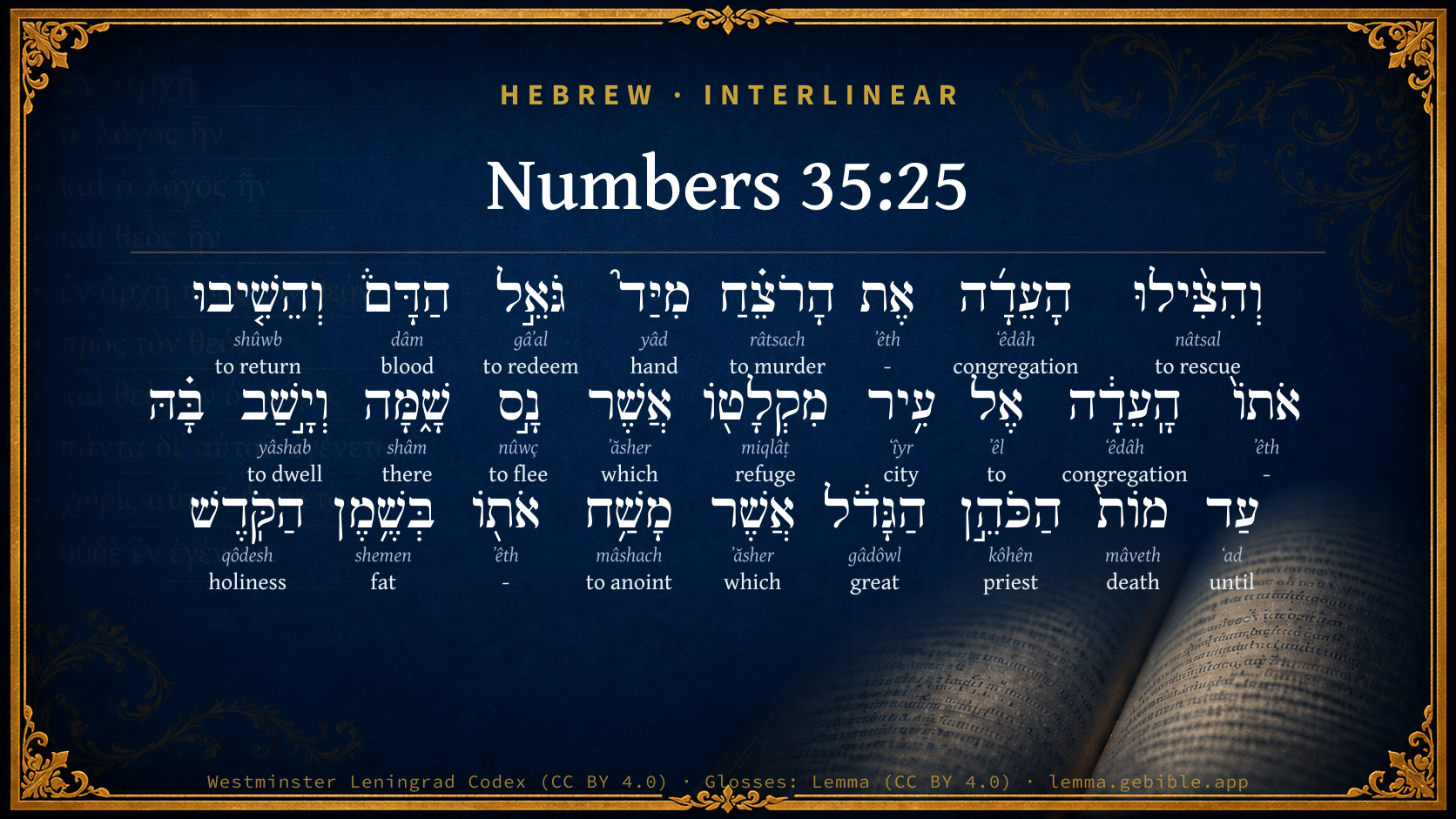
Hebrew (Westminster Leningrad Codex) Numbers 35:25 appears in the Hebrew Old Testament. The text above is from the Westminster Leningrad Codex. Each word links to its Strong’s number, a concise gloss, and parsing drawn from the Open Scriptures Hebrew Bible morphology. Click any word for its full Brown-Driver-Briggs (BDB) entry.
Download image
Cite this verse

Numbers 35:25 (World English Bible). Public Domain. Lemma interlinear Bible study tool, https://lemma.gebible.app/v/numbers/35/25.

Show BibTeX & RIS
BibTeX
RIS
English Translation
and the congregation shall deliver the manslayer out of the hand of the avenger of blood, and the congregation shall restore him to his city of refuge, where he was fled: and he shall dwell therein until the death of the high priest, who was anointed with the holy oil.
World English Bible · Public Domain
Download a study sheet

One document with this verse’s original text, its word-by-word gloss line, the meaning frame, cross-references with their text, attributed commentary, and full source and license credits — printable, and it pastes into notes with its structure intact.

This verse Autodidact and up

Study sheet (.html) Plain text (.txt)

A passage Seminary Student

Up to 50 verses in one chapter. A passage sheet keeps up to 6 commentary sources and 12 cross-references per verse, in the order this page ranks them, and says so on the sheet whenever that leaves anything out. Ask for a single verse and you get the Autodidact verse sheet above.

Everything on this page stays free to read, with no account — the sheet is a download of what is already on screen, not access to it.

Want to remove ads? Support Godless Engineer
Compare translations 3

The same verse in 3 English versions, stacked beneath the original-language interlinear above. Click any original word for its lexicon entry.

Each is an independent rendering of the whole verse — the interlinear is not word-aligned to these translations.

Highlighted words mark where these versions differ — a whole-verse word diff, not a word-by-word alignment.

  • World English Bible Public Domain
    and the congregation shall deliver the manslayer out of the hand of the avenger of blood, and the congregation shall restore him to his city of refuge, where he was fled: and he shall dwell therein until the death of the high priest, who was anointed with the holy oil.
  • King James Version Public Domain
    And the congregation shall deliver the slayer out of the hand of the revenger of blood, and the congregation shall restore him to the city of his refuge, whither he was fled: and he shall abide in it unto the death of the high priest, which was anointed with the holy oil.
  • unfoldingWord Literal Text CC BY-SA 4.0
    And the congregation shall rescue the one who kills from the hand of the avenger of blood, and the congregation shall bring him back into the city of his refuge to which he had fled, and he shall dwell in it until the death of the great priest, him whom he anointed with the oil of holiness.

unfoldingWord Literal Text — © unfoldingWord, licensed CC BY-SA 4.0. Word-aligned USFM3 via Door43 (git.door43.org/unfoldingWord/en_ult).

Versions to compare (up to 4)

3 of 4 selected

Show all 18 translations

Every available English version of this verse, each an independent rendering of the whole verse.

  • World English Bible Public Domain
    and the congregation shall deliver the manslayer out of the hand of the avenger of blood, and the congregation shall restore him to his city of refuge, where he was fled: and he shall dwell therein until the death of the high priest, who was anointed with the holy oil.
  • Berean Standard Bible Public Domain
    The assembly is to protect the manslayer from the hand of the avenger of blood. Then the assembly will return him to the city of refuge to which he fled, and he must live there until the death of the high priest, who was anointed with the holy oil.
  • Majority Standard Bible Public Domain
    The assembly is to protect the manslayer from the hand of the avenger of blood. Then the assembly will return him to the city of refuge to which he fled, and he must live there until the death of the high priest, who was anointed with the holy oil.
  • King James Version Public Domain
    And the congregation shall deliver the slayer out of the hand of the revenger of blood, and the congregation shall restore him to the city of his refuge, whither he was fled: and he shall abide in it unto the death of the high priest, which was anointed with the holy oil.
  • American Standard Version (1901) Public Domain
    and the congregation shall deliver the manslayer out of the hand of the avenger of blood, and the congregation shall restore him to his city of refuge, whither he was fled: and he shall dwell therein until the death of the high priest, who was anointed with the holy oil.
  • Revised Version (1885) Public Domain
    and the congregation shall deliver the manslayer out of the hand of the avenger of blood, and the congregation shall restore him to his city of refuge, whither he was fled: and he shall dwell therein until the death of the high priest, which was anointed with the holy oil.
  • Geneva Bible (1599) Public Domain
    And the Congregation shall deliuer the slayer out of the hande of the auenger of blood, and the Congregation shall restore him vnto the citie of his refuge, whither hee was fled: and hee shall abide there vnto the death of the hie Priest, which is anointed with the holy oyle.
  • Douay-Rheims (1899) Public Domain
    The innocent shall be delivered from the hand of the revenger, and shall be brought back by sentence into the city, to which he had fled, and he shall abide there until the death of the high priest, that is anointed with the holy oil.
  • Young's Literal Translation Public Domain
    `And the company have delivered the man-slayer out of the hand of the redeemer of blood, and the company have caused him to turn back unto the city of his refuge, whither he hath fled, and he hath dwelt in it till the death of the chief priest, who hath been anointed with the holy oil.
  • Literal Standard Version CC BY-SA 4.0
    And the congregation has delivered the manslayer out of the hand of the redeemer of blood, and the congregation has caused him to return to the city of his refuge, to where he has fled, and he has dwelt in it until the death of the chief priest who has been anointed with the holy oil.
  • Unlocked Literal Bible CC BY-SA 4.0
    The community must rescue the accused from the power of the avenger of blood. The community must return the accused to the city of refuge to which he had originally fled. He must live there until the death of the current high priest, the one who was anointed with the holy oil.
  • unfoldingWord Literal Text CC BY-SA 4.0
    And the congregation shall rescue the one who kills from the hand of the avenger of blood, and the congregation shall bring him back into the city of his refuge to which he had fled, and he shall dwell in it until the death of the great priest, him whom he anointed with the oil of holiness.
  • Darby Bible Public Domain
    and the assembly shall rescue the manslayer out of the hand of the avenger of blood, and the assembly shall restore him to the city of his refuge, whither he had fled; and he shall abide in it until the death of the high-priest, who was anointed with the holy oil.
  • World Messianic Bible Public Domain
    The congregation shall deliver the man slayer out of the hand of the avenger of blood, and the congregation shall restore him to his city of refuge, where he had fled. He shall dwell therein until the death of the high priest, who was anointed with the holy oil.
  • Webster's Bible Public Domain
    And the congregation shall deliver the slayer out of the hand of the avenger of blood, and the congregation shall restore him to the city of his refuge, whither he had fled: and he shall abide in it to the death of the high priest, who was anointed with the holy oil.
  • Free Bible Version CC BY-SA 4.0
    The court is to protect the killer from being attacked by the avenger and must return him to the sanctuary town that he ran to, and he must stay there until the death of the high priest, who was anointed with holy oil.
  • Bible in Basic English Public Domain
    And let the people keep the man responsible for the death safe from the hands of him who has the right of punishment for blood, and send him back to his safe town where he had gone in flight: there let him be till the death of the high priest who was marked with the holy oil.
  • JPS Tanakh (1917) Public Domain
    and the congregation shall deliver the manslayer out of the hand of the avenger of blood, and the congregation shall restore him to his city of refuge, whither he was fled; and he shall dwell therein until the death of the high priest, who was anointed with the holy oil.

Literal Standard Version (2020), Covenant Press — licensed CC BY-SA 4.0. Text via the HelloAO Bible API (eBible.org). Unlocked Literal Bible (unfoldingWord) — licensed CC BY-SA 4.0. Text via the HelloAO Bible API (eBible.org). unfoldingWord Literal Text — © unfoldingWord, licensed CC BY-SA 4.0. Word-aligned USFM3 via Door43 (git.door43.org/unfoldingWord/en_ult). Free Bible Version, Dr. Jonathan Gallagher — licensed CC BY-SA 4.0. Text via the HelloAO Bible API (eBible.org).

Word by word

More ways to search: Search by grammar → Find every occurrence → Compare this word →

Practice this passage: Drill this verse → Learn its vocabulary →

מִקְלָט֖וֹ
miqlâṭ
H4733
“refuge · his”
Noun, Common, Masculine, Singular, Construct + Suffix, Personal, 3rd Person, Masculine, Singular
Part of Speech
Noun
Type
Common
Gender
Masculine
Number
Singular
State
Construct
Full BDB Definition

Origin: from H7038 in the sense of taking in

TWOT: 2026a

refuge, asylum
  1. וְהִצִּ֨ילוּ nâtsal H5337 “and · to rescue” Conjunction + Verb, Hiphil, Sequential Perfect, 3rd Person, Common, Plural
  2. הָעֵדָ֜ה ʻêdâh H5712 “the · congregation” Particle, Definite Article + Noun, Common, Feminine, Singular, Absolute
  3. אֶת ʼêth H853 “-” Particle, Direct Object
  4. הָרֹצֵ֗חַ râtsach H7523 “the · murdering” Particle, Definite Article + Verb, Qal, Participle Active, Masculine, Singular, Absolute
  5. מִיַּד֮ yâd H3027 “from · hand of” Preposition + Noun, Common, Both, Singular, Construct
  6. גֹּאֵ֣ל gâʼal H1350 “redeeming” Verb, Qal, Participle Active, Masculine, Singular, Construct
  7. הַדָּם֒ dâm H1818 “the · blood” Particle, Definite Article + Noun, Common, Masculine, Singular, Absolute
  8. וְהֵשִׁ֤יבוּ shûwb H7725 “and · to return” Conjunction + Verb, Hiphil, Sequential Perfect, 3rd Person, Common, Plural
  9. אֹתוֹ֙ ʼêth H853 “- · him” Particle, Direct Object + Suffix, Personal, 3rd Person, Masculine, Singular
  10. הָֽעֵדָ֔ה ʻêdâh H5712 “the · congregation” Particle, Definite Article + Noun, Common, Feminine, Singular, Absolute
  11. אֶל ʼêl H413 “to” Preposition
  12. עִ֥יר ʻîyr H5892 “city of” Noun, Common, Feminine, Singular, Construct
  13. אֲשֶׁר ʼăsher H834 “which” Particle, Relative
  14. נָ֣ס nûwç H5127 “to flee” Verb, Qal, Perfect, 3rd Person, Masculine, Singular
  15. שָׁ֑מָּה shâm H8033 “there · toward” Adverb + Suffix, Demonstrative
  16. וְיָ֣שַׁב yâshab H3427 “and · to dwell” Conjunction + Verb, Qal, Perfect, 3rd Person, Masculine, Singular
  17. עַד ʻad H5704 “until” Preposition
  18. מוֹת֙ mâveth H4194 “death of” Noun, Common, Masculine, Singular, Construct
  19. הַכֹּהֵ֣ן kôhên H3548 “the · priest” Particle, Definite Article + Noun, Common, Masculine, Singular, Absolute
  20. הַגָּדֹ֔ל gâdôwl H1419 “the · great” Particle, Definite Article + Adjective, Adjective, Masculine, Singular, Absolute
  21. אֲשֶׁר ʼăsher H834 “which” Particle, Relative
  22. מָשַׁ֥ח mâshach H4886 “to anoint” Verb, Qal, Perfect, 3rd Person, Masculine, Singular
  23. אֹת֖וֹ ʼêth H853 “- · him” Particle, Direct Object + Suffix, Personal, 3rd Person, Masculine, Singular
  24. בְּשֶׁ֥מֶן shemen H8081 “in/at · fat of” Preposition + Noun, Common, Masculine, Singular, Construct
  25. הַקֹּֽדֶשׁ qôdesh H6944 “the · holiness” Particle, Definite Article + Noun, Common, Masculine, Singular, Absolute

About this verse

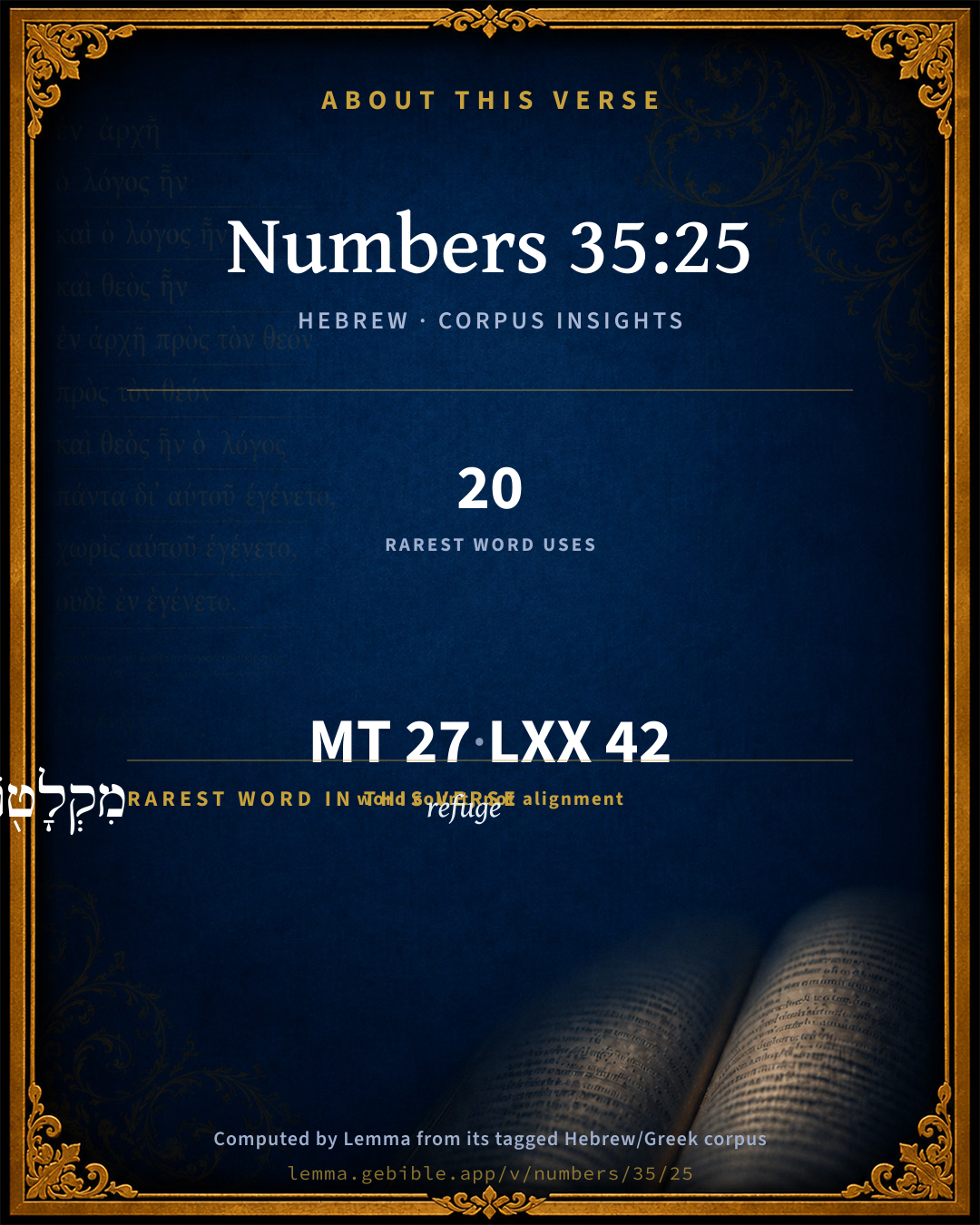
These counts appear in no published source. They are computed here, from the morphology-tagged text and Lemma’s own curated glosses. What Lemma adds →

27
words
22
distinct lemmas
Pentateuch
section

Notable vocabulary

The rarest word here is מִקְלָט֖וֹ refuge H4733 — appearing just 20 times in the whole Hebrew Bible.

Shared distinctive vocabulary

מִקְלָט֖וֹ refuge H4733 occurs in 20 verses of the Hebrew Bible. Also found in:

Grammatical profile

  • 7 verbs
  • 10 nouns
  • 1 adjective
  • 3 prepositions
  • 1 adverb
  • 5 particles

Verb forms

  • וְהִצִּ֨ילוּ Hiphil · Sequential Perfect
  • הָרֹצֵ֗חַ Qal · Participle Active
  • גֹּאֵ֣ל Qal · Participle Active
  • וְהֵשִׁ֤יבוּ Hiphil · Sequential Perfect
  • נָ֣ס Qal · Perfect
  • וְיָ֣שַׁב Qal · Perfect
  • מָשַׁ֥ח Qal · Perfect

Repetition

Words recur within this verse — often emphatic in Hebrew:

  • הָעֵדָ֜ה congregation H5712 ×2
  • אֲשֶׁר which H834 ×2

Hebrew & Septuagint length

In English translation the verse runs 50 words from the Hebrew and 46 from the Septuagint (LXX English) — closely comparable.

A rough comparison of the two English renderings, which tokenize alike — not a word-level alignment.

Word counts can differ between the Hebrew and the Greek without any difference in meaning — e.g. the Hebrew direct-object marker אֵת has no separate Greek word, and Greek often adds the article ὁ.

In the original languages it is 27 Hebrew tokens and 42 Greek tokens — but the two are counted differently (Hebrew bundles its prefixes and suffixes into one token; the Greek is in lemma form), so that isn’t a like-for-like length.

Cross-references

12

Topical passages linked to Numbers 35:25 in the Treasury of Scripture Knowledge — connected by theme and wording, ordered by reader-vote popularity; previews shown in the World English Bible.

  • Exodus 29:7 Then you shall take the anointing oil, and pour it on his head, and anoint him.
  • Leviticus 4:3 if the anointed priest sins so as to bring guilt on the people, then let him offer for his sin, which he has sinned, a young bull without blemish to Yahweh for a sin offering.
  • Leviticus 21:10 "'He who is the high priest among his brothers, upon whose head the anointing oil is poured, and that is consecrated to put on the garments, shall not let the hair of his head hang loose, nor tear his clothes;
  • Joshua 20:6 He shall dwell in that city, until he stand before the congregation for judgment, until the death of the high priest that shall be in those days: then shall the manslayer return, and come to his own city, and to his own house, to the city from whence he fled.
  • Romans 3:24–26 being justified freely by his grace through the redemption that is in Christ Jesus;
  • Hebrews 7:25–28 Therefore he is also able to save to the uttermost those who draw near to God through him, seeing he ever lives to make intercession for them.
  • Hebrews 10:19–22 Having therefore, brothers, boldness to enter into the holy place by the blood of Jesus,
  • Leviticus 8:12 He poured some of the anointing oil on Aaron's head, and anointed him, to sanctify him.
  • Numbers 35:28 because he should have remained in his city of refuge until the death of the high priest: but after the death of the high priest the manslayer shall return into the land of his possession.
  • Ephesians 2:16–18 and might reconcile them both in one body to God through the cross, having killed the hostility thereby.
  • Hebrews 4:14–16 Having then a great high priest, who has passed through the heavens, Jesus, the Son of God, let us hold tightly to our confession.
  • Hebrews 9:12–15 nor yet through the blood of goats and calves, but through his own blood, entered in once for all into the Holy Place, having obtained eternal redemption.

Cross-references courtesy of OpenBible.info (CC BY 4.0).

Hebrew and Greek witnesses Masoretic Hebrew ↔ Greek Septuagint

The same verse in the two great witnesses to the Old Testament, shown verse-for-verse.

These are two independent witnesses, not word-aligned to each other, and the Septuagint is shown in lemma (dictionary) form.

Hebrew Numbers 35:25 Masoretic · Westminster Leningrad Codex

וְהִצִּ֨ילוּ הָעֵדָ֜ה אֶת הָרֹצֵ֗חַ מִיַּד֮ גֹּאֵ֣ל הַדָּם֒ וְהֵשִׁ֤יבוּ אֹתוֹ֙ הָֽעֵדָ֔ה אֶל עִ֥יר מִקְלָט֖וֹ אֲשֶׁר נָ֣ס שָׁ֑מָּה וְיָ֣שַׁב בָּ֗הּ עַד מוֹת֙ הַכֹּהֵ֣ן הַגָּדֹ֔ל אֲשֶׁר מָשַׁ֥ח אֹת֖וֹ בְּשֶׁ֥מֶן הַקֹּֽדֶשׁ

and the congregation shall deliver the manslayer out of the hand of the avenger of blood, and the congregation shall restore him to his city of refuge, where he was fled: and he shall dwell therein until the death of the high priest, who was anointed with the holy oil.

World English Bible · Public Domain

Greek LXX Numbers 35:25 Septuagint · lemma form

καί ἐκαἱρέω ὁ συναγωγή ὁ φονεύω ἀπό ὁ ἀγχιστεύω ὁ αἷμα καί ἀπο καταἵστημι αὐτός ὁ συναγωγή εἰς ὁ πόλις ὁ φυγαδευτήριον αὐτός οὗ καταφεύγω καί καταοἰκέω ἐκεῖ ἕως ἄν ἀποθνήσκω ὁ ἱερεύς ὁ μέγας ὅς χρίω αὐτός ὁ ἔλαιον ὁ ἅγιος

And the congregation shall rescue the slayer from the avenger of blood, and the congregation shall restore him to his city of refuge, whither he fled for refuge; and he shall dwell there till the death of the high-priest, whom they anointed with the holy oil.

LXX2012 (modern English Septuagint) · Public Domain

Hebrew: Westminster Leningrad Codex (CC BY 4.0). Greek: Septuagint (public domain); English from LXX2012 (modern English Septuagint) (Public Domain). How the Septuagint differs from the Hebrew →

Targum (Aramaic paraphrase)

2

The Targum is the ancient Jewish Aramaic paraphrase of the Hebrew Scriptures — an interpretive translation, not the Hebrew text itself. Onkelos (literal) and Pseudo-Jonathan (expansive) render the Torah, and Jonathan the Prophets. Coverage is partial: where no permissively-licensed English translation exists for a verse, only the Aramaic is shown. This is verse-level text, not a word-by-word alignment to the Hebrew.

  1. Targum Onkelos Torah (Genesis–Deuteronomy)
    וִישֵׁזְבוּן כְּנִשְׁתָּא יָת קָטוֹלָא מִיַד גָאֵל דְמָא וִיתִיבוּן יָתֵיהּ כְּנִשְׁתָּא לְקִרְיַת שֵׁזָבוּתֵהּ דִי עֲרַק לְתַמָן וִיתֵב בָּהּ עַד דִימוּת כַּהֲנָא רַבָּא דִי רַבֵּי יָתֵהּ בִּמְשַׁח קוּדְשָׁא

    (no public-domain English translation for this verse)

    Targum Onkelos — Aramaic: “Onkelos Genesis” (public domain); “Onkelos Exodus” (public domain); “Onkelos Leviticus” (public domain); “Onkelos Numbers” (public domain); “Onkelos Deuteronomy” (public domain). English: “Sefaria Community Translation” (CC0 1.0 (public-domain dedication)); “J.W. Etheridge. The Targums of Onkelos and Jonathan Ben Uzziel on the Pentateuch. London: Longmans, Green, 1862” (public domain). Text via Sefaria.

  2. Targum Pseudo-Jonathan Torah (Genesis–Deuteronomy)
    וִישֵׁזְבוּן כְּנִשְׁתָּא יַת קָטוֹלַיָא מִן יַד תָּבַע אַדְמָא וִיתוּבוּן יָתֵיהּ כְּנִשְׁתָּא לְקִרְוַיָא דְקַלְטֵיהּ דְאַפָּךְ לְתַמָן וִיתֵיב בָּהּ עַד זְמַן דִימוּת כַּהֲנָא רַבָּא דְרַבֵּי יָתֵיהּ סַגְיָא בִּמְשַׁח רְבוּתָא וּמְטוֹל דְלָא צַלִי בְּיוֹמָא דְכִפּוּרֵי בְקוֹדֶשׁ קוּדְשַׁיָא עַל תְּלַת עֲבֵירָן קַשְׁיָן דְלָא יְתַקְלוּן עַמָא בֵּית יִשְרָאֵל בְּפוּלְחָנָא נוּכְרָאָה וּבְגִילוּי עֶרְיוּתָא וּבִשְׁדִיוּת אֲדַם זַכְיָא וַהֲוָה בִידֵיהּ לְבַטְלוּתְהוֹן בִּצְלוֹתֵיהּ וְלָא צַלִי מְטוֹל כֵּן אִתְקְנַס לִמְמַת בְּשַׁתָּא הַהוּא

    and the congregation shall release the manslayer from the hand of the avenger of blood, and make him return to his city of refuge whither he had fled; and he shall dwell there until the time that the high priest die, whom the multitude (sagia) had anointed with the oil of anointing;-because he did not pray on the Day of Atonement in the Holy of Holies concerning the three great transgressions, that the people of the house of Israel might not be smitten for strange worship, or impure connexions, or the shedding of innocent blood, when it was in his power to obviate them by his prayer, and he prayed not, therefore hath he been condemned to die in that year.

    Targum Pseudo-Jonathan — Aramaic: “Targum Jonathan on Genesis” (public domain); “Targum Jonathan on Exodus” (public domain); “Targum Jonathan on Leviticus” (public domain); “Targum Jonathan on Numbers” (public domain); “Targum Jonathan on Deuteronomy” (public domain). English: “The Targum of Jonathan ben Uzziel, trans. J. W. Etheridge, London, 1862” (public domain). Text via Sefaria.

Commentary

Notes on Numbers 35:25 from classic Christian and Jewish commentators (each source and its license shown beneath its notes). The classic Christian expositions comment on the surrounding passage and are grouped to its opening verse, so a note may address several verses; the Jewish commentaries on the Tanakh (Rashi and others) are per-verse, so they appear only where the commentator wrote on this verse.

Lemma curates 59 commentaries, every one of them public domain or Creative Commons licensed, each selected and text-cleaned for this edition rather than reprinted as found. About our sources →

John Gill's Exposition

And the congregation shall deliver the slayer out of the hand of the avenger of blood,.... Put him under the care of proper persons, to conduct him to one of the cities of refuge, or put him in the way to it; and restrain the avenger of blood from pursuing him, until such time that it may be judged he is safe arrived there:

and the congregation shall restore him to the city of refuge, whither he was fled; so that it seems by this, when one had been guilty of manslaughter, and fled to one of the cities of refuge, he might be taken from thence and had before a court of justice, and there take his trial; and if it appeared that the fact was committed by him, ignorantly, unawares, and without design, then he was returned to his city of refuge; but, if otherwise, he was put to death, notwithstanding he had fled thither; and so it is said in the Misnah (t), that"at first, or formerly, one that killed another ignorantly or presumptuously, they sent him before to one of the cities of refuge, and the sanhedrim sent and fetched him from thence: he who was condemned to death by the court, they slew him; he that was not condemned was dismissed; he that was condemned to banishment they returned him to his place, according to Num 35:25."

and he shall abide in it, unto the death of the high priest, which was anointed with the holy oil: and then he was to be set at liberty, and return to his house and family and have his former possessions and honours, if he had any, restored unto him, the commission or warrant for his detainer there ceasing, being made void by the death of the high priest; who was the prince of the priests and Levites, to whom those cities belonged, and so under his jurisdiction: or so it was ordered, because such was the general mourning for such a public loss as an high priest, that all private revenges would subside, and the cause of them be buried, in grief and forgetfulness; though, no doubt, this had a respect to something which will be hereafter taken notice of: the Jews say (u), that the mothers of the priests used to supply with a sufficient quantity of food and raiment such who fled to the cities of refuge, that they might not pray for the death of their sons; and according to them, a man's case was very bad when there was no high priest; for so they write (w)"he whose cause is finished (or his case determined in a court of judicature), and there is no high priest; and he that slays an high priest, or an high priest slays another, he never goes out, no not so much as to bear testimony in any cause, and even in what the congregation has need of him, but there are his dwelling, his death, and his burial.''

(t) Misn. Maccot. c. 2. sect. 6. (u) Misn. Maccot. c. 2. sect. 3. (w) Misn. Maccot, c. 2. sect. 7.

John Gill's Exposition of the Whole Bible (1746–1763) — public domain (CC PDM 1.0). Text via the HelloAO Bible API.

Trapp's Complete Commentary

John Trapp

Num 35:25 And the congregation shall deliver the slayer out of the hand of the revenger of blood, and the congregation shall restore him to the city of his refuge, whither he was fled: and he shall abide in it unto the death of the high priest, which was anointed with the holy oil.

Ver. 25. Unto the death of the high priest.] Because he was amongst men, the chief god on earth, and so the offence did most directly strike against him. Or rather, because the high priest was a type of Christ: and so this release was a shadow of our freedom and redemption by the death of Christ.

John Trapp, A Commentary or Exposition upon All the Books of the Old and New Testament (1647–1656) — public domain. Text from a community e-Sword module.

Joseph Benson's Commentary

Num 35:25. He shall abide in it — Shall be confined to it. Which was appointed, 1st, To show the hatefulness of murder in God’s account, by such a severe punishment, inflicted upon the very appearance of it: 2d, For the security of the manslayer, lest the presence of such a person, and his living among the kindred of the deceased, might occasion reproach and bloodshed: And, 3d, To teach others to be very watchful over themselves, lest by negligence they should chance to kill any one, and so be compelled to leave their own homes, families, and friends. The death of the high- priest — Perhaps to show that the death of Christ, the true High-Priest, whom the others represented, is the only means whereby sins are pardoned, and sinners set at liberty.

Joseph Benson's Commentary on the Old and New Testaments (1811–1818) — public domain. Text from a community e-Sword module.

Geneva Bible (1599)

Geneva Bible translators

Under this figure is declared, that our sins could not be remitted, but by the death of the high Priest Jesus Christ.

Geneva Bible (1599) marginal notes — public domain. Text via Bolls.life.

Ellicott's Commentary for English Readers

(25) And he shall abide in it unto the death of the high priest.—Although the death which had been occasioned was accidental, not intentional, nevertheless the shedding of blood demanded expiation. The manslayer was, therefore, required to remain an exile from his own home until the death of the high priest who had been anointed with the holy oil. As the high priest, by reason of the anointing with the holy oil, became qualified to act as the representative of the nation, and in that capacity acted as their mediator on the great day of atonement, so the death of the high priest assumed a symbolical or representative character, and became a type of that of the great High Priest who, through the eternal Spirit, offered Himself without spot to God, and who by His death made a propitiation for the sins of the world. Thus, as by the death of the Jewish high priest a typical atonement was made for the sin of the Israelitish manslayer, and he was restored thereupon to “the land of his possession” amongst his brethren, so by the death of our High Priest they who have fled for refuge to lay hold on the hope set before them, are restored to the inheritance which had been forfeited by sin, and made joint heirs with Christ of those mansions which He has gone before to prepare for those who love Him.

A Bible Commentary for English Readers, edited by Charles John Ellicott (1878–1897) — public domain. Text from a community e-Sword module.

The Cambridge Bible for Schools and Colleges

gen. ed. J. J. S. Perowne

25. shall restore him] It is not stated where the congregation had taken him for judgement, but it was presumably to his own city. It is not, however, impossible that ‘the congregation’ means, as elsewhere in P , the whole community of Israel, and that P tacitly assumed that Jerusalem would be the place of judgement.

the high priest] lit. ‘the great priest.’ The title is used in P of Aaron and his eldest descendants. Outside the Hexateuch, it first appears of Jehoiada (2Ki_12:10), then of Hilkiah (2Ki_22:4; 2Ki_22:8); and after the exile, of Joshua (Hag_1:1 &c., Zec_3:1; Zec_3:8) and Eliashib (Neh_3:1; Neh_3:20; Neh_13:28). The high priest was the head of the religious affairs of the Jewish church, and rose, in the popular estimation, to a higher importance than the civil governor who was appointed by a foreign power. So that ‘until the death of the high priest’ would have almost the same force that the words ‘until the death of the reigning sovereign’ would bear to-day.

The Cambridge Bible for Schools and Colleges (gen. ed. J. J. S. Perowne; Cambridge University Press, 1878–1918) — public domain. Text from a community e-Sword module.

Haydock's Catholic Bible Commentary

Delivered. Hebrew, "the multitude shall deliver the slayer." It seems the judges pronounced sentence, according to the votes of the people assembled; (Calmet) or the plurality of voices among the 21 judges decided the matter. (Grotius) (Haydock) --- High priest. This mystically signified that our deliverance was to be effected by the death of Christ, the high priest and the anointed of God. (Challoner) --- He rescued us from the hand of the revenger, the devil. (Theodoret, q. 50, 51.) --- Before his death, the way of our true country was not open, nor secure. (St. Gregory, hom 6. in Ezec.) (Worthington) --- By this law, Moses shewed a horror for murder, and the respect due to the person of the high priest, during whose life even the involuntary murderer was obliged to keep himself retired in a city of refuge. (Masius) --- At the death of the pontiff, all Israel put on mourning, so that private injuries were to be forgotten, when the public had such cause for sorrow; and in the mean time the vengeance of kinsmen would relent. (Maimonides; More. iii. 40.) --- Murder was punished by the Greeks, in the days of Homer, with banishment, though sometimes this was remitted by the relations, for a sum of money. (Iliad ix.) (Calmet)

George Leo Haydock (1774–1849), Haydock's Catholic Family Bible and Commentary, 1859 edition — public domain. Excludes Psalms (Douay-Rheims chapter numbering differs from Protestant) and Deuterocanonical books (Catholic canon only).

Matthew Poole's English Annotations

He shall abide in it, be confined to it, partly to show the hatefulness of wilful murder in God’s account by so severe a punishment, as this in many cases might prove, inflicted upon the very appearance of it; and partly for the security of the man-slayer, lest the presence of such a person, and his conversation among the kindred of the deceased, might occasion reproach and bloodshed.

Unto the death of the high priest; partly because the public grief for the loss of so public a person was likely to assuage the private griefs and passions of men, the rather, because by this example they were minded of their own mortality, and thereby withheld from taking vengeance; and principally to show that the death of Christ (the true High Priest, whom the others did evidently and eminently represent and typify) is the only mean whereby sins are pardoned, and sinners are set at liberty.

Matthew Poole's English Annotations on the Holy Bible (1683–1685) — public domain. Text from a community e-Sword/MySword module.

Whedon's Commentary on the Bible

Daniel D. Whedon

25. Unto the death of the high priest — The reason for this requirement is not given. May it not be to symbolize that the death of the antitypical High Priest, Jesus Christ, constitutes a successful plea against the demands of divine justice as the sin avenger? It is a Jewish tradition that the mother of the high priest made presents to the refugees that they might not be praying for the death of her son.

Holy oil — Anointing with this oil was a symbol of the Holy Spirit imparted. Hence the high priest’s death may be considered as in a sense expiatory, so that the refugee might return cleansed to his own city. For the preparation of the anointing oil see Exo_30:23-24; Lev_4:3, note.

Daniel D. Whedon (gen. ed.), Commentary on the Old and New Testaments (1874–1909) — public domain. Text from a community e-Sword module.

The Pulpit Commentary

The congregation (hde) shall restore him to the city of his refuge. It is perfectly plain from this (and from Jos_20:6) that the general assembly of all Israel was to summon both homicide and avenger before them with their witnesses, and, if they found the accused innocent, were to send him back under safe escort to the city in which he had taken refuge. He shall abide in it unto the death of the high priest. No doubt his family might join him in his exile, and his life might be fairly happy as well as safe within certain narrow limits; but under ordinary circumstances he must forfeit much and risk more by his enforced absence from home and land. It is not easy to see why the death of the high priest should have set the fugitive free from the law of vengeance, except as foreshadowing the death of Christ. No similar significance is anywhere else attributed to the death of the high priest; and it was rather in its unbroken continuance than in its recurring interruption that the priesthood of Aaron typified that of the Redeemer. To see anything of a vicarious or satisfactory character in the death of the high priest seems to be introducing an element quite foreign to the symbolism of the Old Testament. The stress, however, which is laid upon the fact of his decease (cf. verse 28), and the solemn notice of his having been anointed with the holy oil, seem to point unmistakably to something in his official and consecrated character which made it right that the rigour of the law should die with him. What the Jubilee was to the debtor who had lost his property, that the death of the high priest was to tile homicide who had lost his liberty. If it was the case, as commonly believed, that all blood feuds were absolutely terminated by the death of the high priest, might this not be because the high priest, as chief minister of the law of God, was himself the goel of the whole nation? When he died all processes of" vengeance lapsed, because they had really been commenced in his name.

The Pulpit Commentary (1880–1919), ed. H.D.M. Spence-Jones & Joseph S. Exell — public domain. Text from a community e-Sword module.

Rashi

Rabbi Shlomo Yitzchaki (Rashi)

עד מות הכהן הגדול [HE SHALL ABIDE IN IT] UNTIL THE DEATH OF THE HIGH PRIEST — because he serves to cause the Shechinah to dwell in Israel and thereby prolong their days, whilst the murderer serves to make the Shechinah depart from Israel and thereby shortens the days of the living. He is therefore not worthy that he should stand before a High Priest (that he should be anywhere near a High Priest) (Sifrei Bamidbar 160:9). Another explanation why he had to remain there until the High Priest’s death: Because the High Priest should have prayed that this misfortune might never happen in Israel in his days (cf. Makkot 11a).

אשר משח אתו בשמן הקדש WHO WAS ANOINTED WITH THE HOLY OIL — According to its plain sense, this is one of the elliptical sentences — for it does not expressly mention who anointed him, but it is the same as אשר משחו המושח בשמן המשחה “… the High Priest whom he who carried out the anointing had anointed with the holy oil”. — Our Rabbis, however, expounded it in Treatise Makkot 11b as a proof for a law: that it intends to teach that if, before the sentence on him has been passed that he should go into a city of refuge, the High Priest died and they appointed another in his stead, and afterwards his case was finished, he returns home through the death of the second, because it is said, אשר משח אתו. But did he anoint the priest or did the priest anoint him? for the words may literally mean either: “until the death of the High Priest whom he (the murderer) had anointed” or “until the death of the High Priest who has anointed him (the murderer)” — but the words are used to include the case of the High Priest who was anointed in his days (and whom, as it were he had anointed), viz., that he (such a High Priest) causes him to return home through his death.

Rashi on the Tanakh — English translations: “The Judaica Press complete Tanach with Rashi, translated by A. J. Rosenberg” (CC BY 4.0); “Pentateuch with Rashi's commentary by M. Rosenbaum and A.M. Silbermann, 1929-1934” (public domain); “The Metsudah Tanach series, Lakewood, N.J” (CC BY 4.0); and “The Book of Joshua, Metsudah Publications, 1997” (CC BY 4.0). Text via Sefaria.

Lesson kit

Teaching starters — assembled from the data on this page, not authored interpretation. Every prompt links to the verse data it draws on. Edit before teaching.

Numbers, in the Pentateuch, opens this verse with 27 words (22 distinct Hebrew lemmas). Its most distinctive word is miqlâṭ (“refuge”). A historical commentator’s framing appears above. Read the whole chapter for the surrounding context.

Discussion questions

  1. How does “refuge” (miqlâṭ) shape what this verse is saying?
  2. How does Numbers 35:6, which shares the word «refuge», read alongside this verse?
  3. What does the repetition of “congregation” (2× in this one verse) do in this verse?
  4. The translations on this page render this verse differently — a whole-verse word diff, not a word-by-word alignment. What might account for the different wordings?
  5. «וְהִצִּ֨ילוּ» is a Hiphil Sequential Perfect verb. How does that grammatical form shape the action described?
  6. Compare how John Gill's Exposition and Trapp's Complete Commentary read this verse. Where do they agree or differ?

Things to notice

Reading settings

Reading text

Shown beneath each verse's original-language words.

Old Testament
Old Testament edition

Read the OT as the Masoretic Hebrew (MT) or the Greek Septuagint (LXX).

English shown for the Greek Septuagint (in the Hebrew ↔ Greek comparison).

Comparing translations? Open the Compare panel on any verse page to stack up to four side by side.