
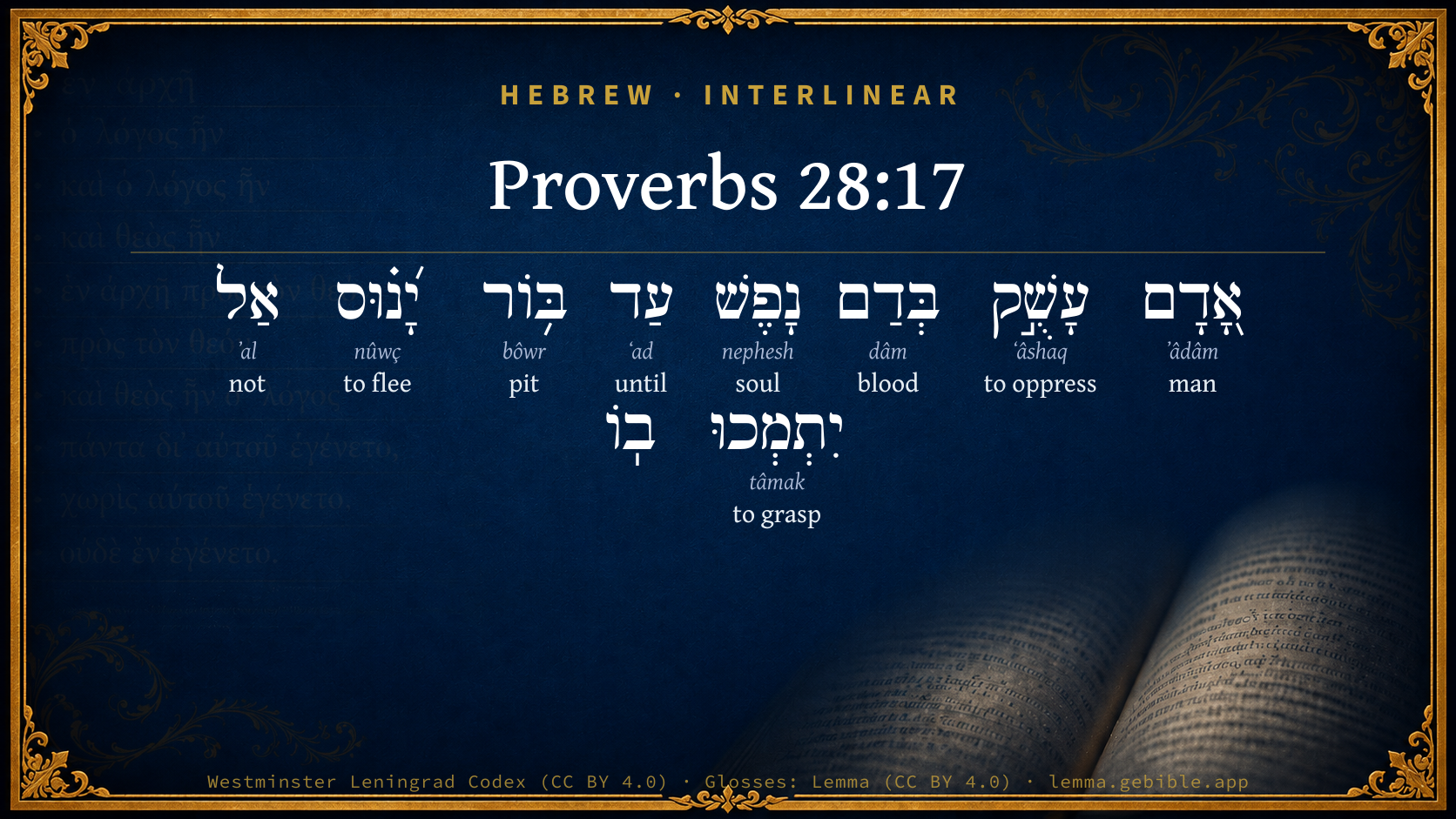
Proverbs 28:17

Hebrew (Westminster Leningrad Codex) Proverbs 28:17 appears in the Hebrew Old Testament. The text above is from the Westminster Leningrad Codex. Each word links to its Strong’s number, a concise gloss, and parsing drawn from the Open Scriptures Hebrew Bible morphology. Click any word for its full Brown-Driver-Briggs (BDB) entry.
Download image
Cite this verse

Proverbs 28:17 (World English Bible). Public Domain. Lemma interlinear Bible study tool, https://lemma.gebible.app/v/proverbs/28/17.

Show BibTeX & RIS
BibTeX
RIS
English Translation
A man who is tormented by life blood will be a fugitive until death; No one will support him.
World English Bible · Public Domain
Download a study sheet

One document with this verse’s original text, its word-by-word gloss line, the meaning frame, cross-references with their text, attributed commentary, and full source and license credits — printable, and it pastes into notes with its structure intact.

This verse Autodidact and up

Study sheet (.html) Plain text (.txt)

A passage Seminary Student

Up to 50 verses in one chapter. A passage sheet keeps up to 6 commentary sources and 12 cross-references per verse, in the order this page ranks them, and says so on the sheet whenever that leaves anything out. Ask for a single verse and you get the Autodidact verse sheet above.

Everything on this page stays free to read, with no account — the sheet is a download of what is already on screen, not access to it.

Want to remove ads? Support Godless Engineer
Compare translations 3

The same verse in 3 English versions, stacked beneath the original-language interlinear above. Click any original word for its lexicon entry.

Each is an independent rendering of the whole verse — the interlinear is not word-aligned to these translations.

Highlighted words mark where these versions differ — a whole-verse word diff, not a word-by-word alignment.

  • World English Bible Public Domain
    A man who is tormented by life blood will be a fugitive until death; No one will support him.
  • King James Version Public Domain
    A man that doeth violence to the blood of any person shall flee to the pit; let no man stay him.
  • unfoldingWord Literal Text CC BY-SA 4.0
    A man oppressed by the blood of a life will flee as far as a pit; let them not support him.

unfoldingWord Literal Text — © unfoldingWord, licensed CC BY-SA 4.0. Word-aligned USFM3 via Door43 (git.door43.org/unfoldingWord/en_ult).

Versions to compare (up to 4)

3 of 4 selected

Show all 18 translations

Every available English version of this verse, each an independent rendering of the whole verse.

  • World English Bible Public Domain
    A man who is tormented by life blood will be a fugitive until death; No one will support him.
  • Berean Standard Bible Public Domain
    A man burdened by bloodguilt will flee into the Pit; let no one support him.
  • Majority Standard Bible Public Domain
    A man burdened by bloodguilt will flee into the Pit; let no one support him.
  • King James Version Public Domain
    A man that doeth violence to the blood of any person shall flee to the pit; let no man stay him.
  • American Standard Version (1901) Public Domain
    A man that is laden with the blood of any person Shall flee unto the pit; let no man stay him.
  • Revised Version (1885) Public Domain
    A man that is laden with the blood of any person shall flee unto the pit; let no man stay him.
  • Geneva Bible (1599) Public Domain
    A man that doeth violence against the blood of a person, shall flee vnto the graue, and they shall not stay him.
  • Douay-Rheims (1899) Public Domain
    A man that doth violence to the blood of a person, if he flee even to the pit, no man will stay him.
  • Young's Literal Translation Public Domain
    A man oppressed with the blood of a soul, Unto the pit fleeth, none taketh hold on him.
  • Literal Standard Version CC BY-SA 4.0
    A man oppressed with the blood of a soul, || Flees to the pit, [and] none takes hold on him [to help].
  • Unlocked Literal Bible CC BY-SA 4.0
    If a man is guilty because he has shed someone's blood, he will be a fugitive until death and no one will help him.
  • unfoldingWord Literal Text CC BY-SA 4.0
    A man oppressed by the blood of a life will flee as far as a pit; let them not support him.
  • Darby Bible Public Domain
    A man laden with the blood of [any] person, fleeth to the pit: let no man stay him.
  • World Messianic Bible Public Domain
    A man who is tormented by blood guilt will be a fugitive until death. No one will support him.
  • Webster's Bible Public Domain
    A man that doeth violence to the blood of any person shall flee to the pit; let no man stay him.
  • Free Bible Version CC BY-SA 4.0
    Someone guilty of murder will go on running away from it until they die. Don't try and stop them.
  • Bible in Basic English Public Domain
    One who has been the cause of a man's death will go in flight to the underworld: let no man give him help.
  • JPS Tanakh (1917) Public Domain
    A man that is laden with the blood of any person shall hasten his steps unto the pit; none will support him.

Literal Standard Version (2020), Covenant Press — licensed CC BY-SA 4.0. Text via the HelloAO Bible API (eBible.org). Unlocked Literal Bible (unfoldingWord) — licensed CC BY-SA 4.0. Text via the HelloAO Bible API (eBible.org). unfoldingWord Literal Text — © unfoldingWord, licensed CC BY-SA 4.0. Word-aligned USFM3 via Door43 (git.door43.org/unfoldingWord/en_ult). Free Bible Version, Dr. Jonathan Gallagher — licensed CC BY-SA 4.0. Text via the HelloAO Bible API (eBible.org).

Word by word

More ways to search: Search by grammar → Find every occurrence → Compare this word →

Practice this passage: Drill this verse → Learn its vocabulary →

About this verse

These counts appear in no published source. They are computed here, from the morphology-tagged text and Lemma’s own curated glosses. What Lemma adds →

10
words
9
distinct lemmas
Wisdom
section

Notable vocabulary

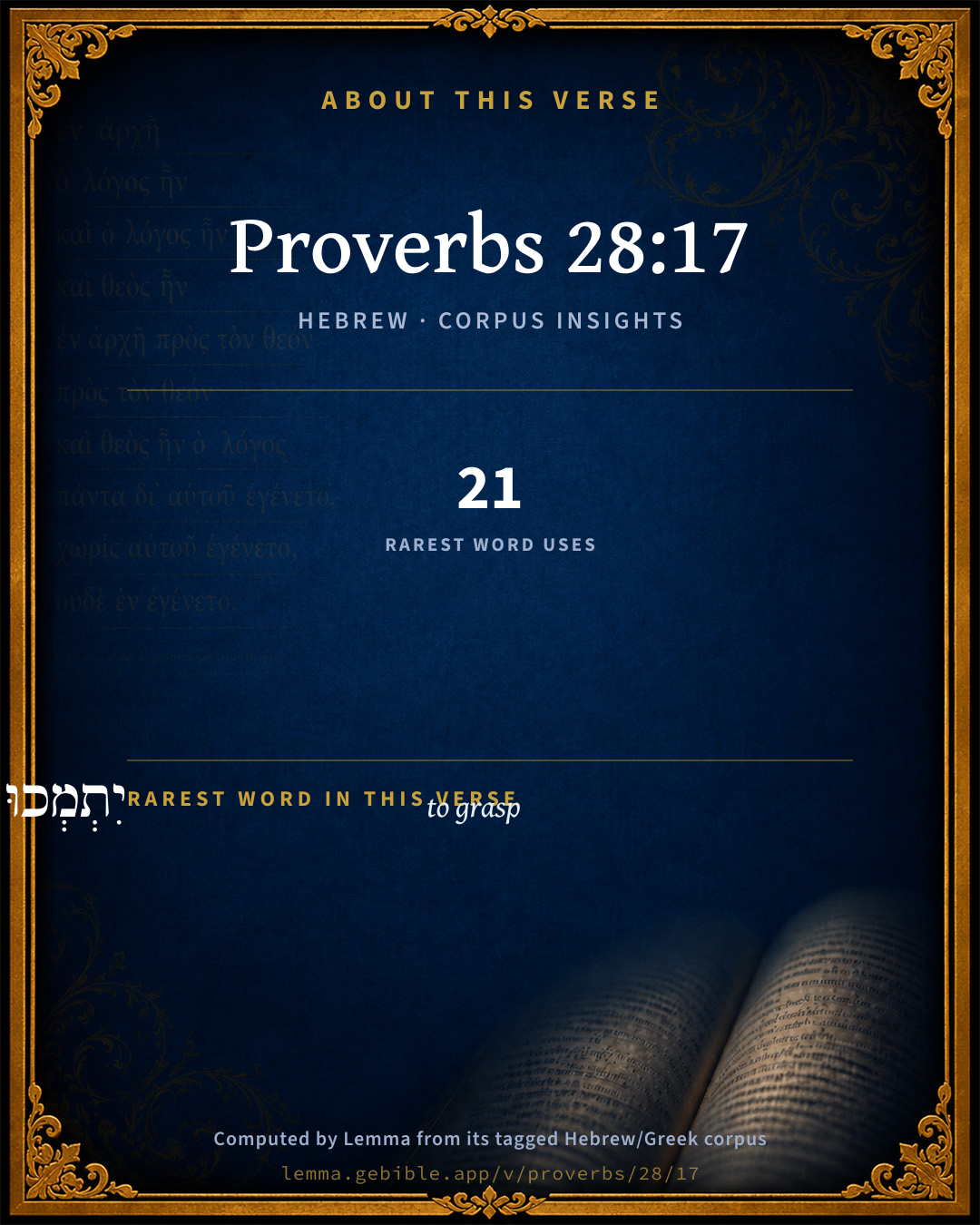
The rarest word here is יִתְמְכוּ to grasp H8551 — appearing just 21 times in the whole Hebrew Bible.

Shared distinctive vocabulary

יִתְמְכוּ to grasp H8551 occurs in 20 verses of the Hebrew Bible. Also found in:

Grammatical profile

  • 3 verbs
  • 4 nouns
  • 2 prepositions
  • 1 particle

Verb forms

  • עָשֻׁ֣ק Qal · Participle Passive
  • יָ֝נ֗וּס Qal · Imperfect
  • יִתְמְכוּ Qal · Jussive

Hebrew & Septuagint length

In English translation the verse runs 19 words from the Hebrew and 39 from the Septuagint (LXX English) — the Septuagint runs noticeably longer here. See the side-by-side →

A rough comparison of the two English renderings, which tokenize alike — not a word-level alignment.

Word counts can differ between the Hebrew and the Greek without any difference in meaning — e.g. the Hebrew direct-object marker אֵת has no separate Greek word, and Greek often adds the article ὁ.

Cross-references

9

Topical passages linked to Proverbs 28:17 in the Treasury of Scripture Knowledge — connected by theme and wording, ordered by reader-vote popularity; previews shown in the World English Bible.

  • Genesis 9:6 Whoever sheds man's blood, by man will his blood be shed, for in the image of God made he man.
  • Exodus 21:14 If a man schemes and comes presumptuously on his neighbor to kill him, you shall take him from my altar, that he may die.
  • 1 Kings 21:19 You shall speak to him, saying, Thus says Yahweh, Have you killed and also taken possession? You shall speak to him, saying, Thus says Yahweh, In the place where dogs licked the blood of Naboth shall dogs lick your blood, even yours.
  • Numbers 35:14–34 You shall give three cities beyond the Jordan, and three cities shall you give in the land of Canaan; they shall be cities of refuge.
  • 1 Kings 21:23 Of Jezebel also spoke Yahweh, saying, The dogs shall eat Jezebel by the rampart of Jezreel.
  • 2 Kings 9:26 Surely I have seen yesterday the blood of Naboth, and the blood of his sons, says Yahweh; and I will requite you in this plat, says Yahweh. Now therefore take and cast him into the plat [of ground], according to the word of Yahweh.
  • 2 Chronicles 24:21–25 They conspired against him, and stoned him with stones at the commandment of the king in the court of the house of Yahweh.
  • Matthew 27:4–5 saying, "I have sinned in that I betrayed innocent blood." But they said, "What is that to us? You see to it."
  • Acts 28:4 When the natives saw the creature hanging from his hand, they said one to another, "No doubt this man is a murderer, whom, though he has escaped from the sea, yet Justice has not allowed to live."

Cross-references courtesy of OpenBible.info (CC BY 4.0).

Hebrew and Greek witnesses Masoretic Hebrew ↔ Greek Septuagint

The same verse in the two great witnesses to the Old Testament, shown verse-for-verse.

Here the Septuagint runs noticeably longer than the Hebrew — LXX2012 (modern English Septuagint) 39 words vs World English Bible 19. A rough length comparison of the two English translations, not a word-level alignment — read both below.

These are two independent witnesses, not word-aligned to each other, and the Septuagint is shown in lemma (dictionary) form.

Hebrew Proverbs 28:17 Masoretic · Westminster Leningrad Codex

אָ֭דָם עָשֻׁ֣ק בְּדַם נָפֶשׁ עַד בּ֥וֹר יָ֝נ֗וּס אַל יִתְמְכוּ בֽוֹ

A man who is tormented by life blood will be a fugitive until death; No one will support him.

World English Bible · Public Domain

Greek LXX Proverbs 28:17 Septuagint · lemma form

ἀνήρ ὁ ἐν αἰτία φόνος ὁ ἐγγυάω φυγή εἰμί καί οὐ ἐν ἀσφάλεια παιδεύω υἱός καί ἀγαπάω σύ καί δίδωμι κόσμος ὁ σός ψυχή οὐ μή ὑποἀκούω ἔθνος παράνομος

He that becomes surety for a man charged with murder shall be an exile, and not in safety. Chasten your son, and he shall love you, and give honor to your soul: he shall not obey a sinful nation.

LXX2012 (modern English Septuagint) · Public Domain

On this verse, The Pulpit Commentary discusses the Septuagint’s reading. Read the note in Commentary ↓

Hebrew: Westminster Leningrad Codex (CC BY 4.0). Greek: Septuagint (public domain); English from LXX2012 (modern English Septuagint) (Public Domain). How the Septuagint differs from the Hebrew →

Commentary

Notes on Proverbs 28:17 from classic Christian and Jewish commentators (each source and its license shown beneath its notes). The classic Christian expositions comment on the surrounding passage and are grouped to its opening verse, so a note may address several verses; the Jewish commentaries on the Tanakh (Rashi and others) are per-verse, so they appear only where the commentator wrote on this verse.

Lemma curates 59 commentaries, every one of them public domain or Creative Commons licensed, each selected and text-cleaned for this edition rather than reprinted as found. About our sources →

Trapp's Complete Commentary

John Trapp

Pro 28:17 A man that doeth violence to the blood of [any] person shall flee to the pit; let no man stay him.

Ver. 17. A man that doth violence unto the blood.] The Hebrew word Adam, here rendered man, hath one letter in the original less than the rest, {Hebrew Text Note} to show that a blood shedder is not worthy to be called man. {a}

Shall flee to the pit, let no man stay him,] i.e., Let him die without mercy; let no man mediate for him, lest he pay down, as Ahab did, life for life, people for people, {1Ki 20:42} lest he draw upon the land guilt of blood, {Num 35:33-34} and hinder the man slayer from repentance to salvation never to be repented of. To blame then are the Papists that open sanctuaries to such; and if a cardinal put his red hat upon the head of a murderer going to execution, he is delivered from death. See Deu 19:13. {See Trapp on "Deu 19:13"}

{a} Buxtorf.

John Trapp, A Commentary or Exposition upon All the Books of the Old and New Testament (1647–1656) — public domain. Text from a community e-Sword module.

Joseph Benson's Commentary

Pro 28:17. A man that doeth violence, &c. — That sheds any man’s blood, or takes away his life by any unjust proceedings; shall flee to the pit — Shall speedily be destroyed, being pursued by divine vengeance, the horrors of a guilty conscience, and the avengers of blood; let no man stay him — None should desire or endeavour to save him from his deserved punishment.

Joseph Benson's Commentary on the Old and New Testaments (1811–1818) — public domain. Text from a community e-Sword module.

Tyndale Open Study Notes

Tyndale Open Resources

28:17 tormented conscience: See 1 Sam 25:31; Rom 2:15; 13:5; cp. Heb 10:22. • Don’t protect him! Murder is such a serious offense that a fine could not replace the death penalty (see Num 35:32).

Tyndale Open Study Notes — © Tyndale Open Resources, licensed CC BY-SA 4.0. Text via the HelloAO Bible API.

Geneva Bible (1599)

Geneva Bible translators

None shall be able to deliver him.

Geneva Bible (1599) marginal notes — public domain. Text via Bolls.life.

Matthew Henry's Commentary

This agrees with that ancient law, Whoso sheddeth man's blood, by man shall his blood be shed (Gen 9:6), and proclaims, 1. The doom of the shedder of blood. He that has committed murder, though he flees for his life, shall be continually haunted with terrors, shall himself flee to the pit, betray himself, and torment himself, like Cain, who, when he had killed his brother, became a fugitive and a vagabond, and trembled continually. 2. The duty of the avenger of blood, whether the magistrate or the next of kin, or whoever are concerned in making inquisition for blood, let them be close and vigorous in the prosecution, and let it not be bought off. Those that acquit the murderer, or do any thing to help him off, come in sharers in the guilt of blood; nor can the land be purged from blood but by the blood of him that shed it, Num 35:33.

Matthew Henry's Commentary on the Whole Bible (1708–1710) — public domain (CC PDM 1.0). Text via the HelloAO Bible API.

Jamieson, Fausset & Brown

Robert Jamieson, A. R. Fausset & David Brown

doeth violence . . . blood, &c.--or, that is oppressed by the blood of life (Gen 9:6), which he has taken.

to the pit--the grave or destruction (Pro 1:12; Job 33:18-24; Psa 143:7).

stay him--sustain or deliver him.

Jamieson, Fausset & Brown — Commentary Critical and Explanatory on the Whole Bible (1871) — public domain (CC PDM 1.0). Text via the HelloAO Bible API.

Adam Clarke's Commentary

Verse 17. That doeth violence to the blood] He who either slays the innocent, or procures his destruction, may flee to hide himself: but let none give him protection. The law demands his life, because he is a murderer; and let none deprive justice of its claim. Murder is the most horrid crime in the sight of God and man; it scarcely ever goes unpunished, and is universally execrated.

Adam Clarke's Commentary on the Bible (1810–1826) — public domain. Text from a community e-Sword/MySword module.

Ellicott's Commentary for English Readers

(17) A man that doeth violence to the blood of any person.—Rather, that is burdened with his blood, has wilfully murdered any one.

Shall flee to the pit.—Fulfilling the curse of Gen_9:6.

Let no man stay him—i.e., attempt to rescue him from the punishment he has deserved.

A Bible Commentary for English Readers, edited by Charles John Ellicott (1878–1897) — public domain. Text from a community e-Sword module.

The Cambridge Bible for Schools and Colleges

gen. ed. J. J. S. Perowne

17. doeth violence to] Rather, is laden with, R.V. See Gen_9:6.

The Cambridge Bible for Schools and Colleges (gen. ed. J. J. S. Perowne; Cambridge University Press, 1878–1918) — public domain. Text from a community e-Sword module.

John Gill's Exposition

A man that doeth violence to the blood of any person,.... That sheds the blood of any in a violent manner; that lays violent hands upon a club, and takes away his life, contrary to the law in Gen 9:6. Or, "that is pressed because of the blood of any person" (q); pressed in his own mind; filled with horror, and tortured in his conscience, for the innocent blood he has shed: the letter "daleth" in the word "Adam" is lesser than usual; and Vitringa, on Isa 34:6; observes, that it signifies a man red with blood, oppressed in his conscience, and depressed by God, which this minute letter is a symbol of; and thinks it applicable to Edom or Rome: or it signifies one pressed, pursued, and dose followed by the avenger of blood;

shall flee to the pit; let no man stay him; support or help him. When such a murderer flees, and is pursued, and unawares falls into a pit, or is like to do so, let no man warn him of it, or help him out of it; or if he flees to a pit to hide himself, let no man hold him or detain him there, or suffer him to continue in such a lurking place, but discover him or pluck him out; or, if he is a fugitive and a vagabond all his days, as Cain, the murderer of his brother, was, till he comes to the pit of the grave, let no man yield him any support or sustenance.

(q) "pressus propter sanguinem animae", Amama, Cartwright; so R. Joseph Kimchi in D. Kimchii Sepher Shorash rad.

John Gill's Exposition of the Whole Bible (1746–1763) — public domain (CC PDM 1.0). Text via the HelloAO Bible API.

Albert Barnes' Notes on the Bible

The case of willful murder, not the lesser crime of manslaughter for which the cities of refuge were appointed. One, with that guilt on his soul, is simply hasting on to his own destruction. Those who see him must simply stand aloof, and let God’s judgments fulfill themselves.

Albert Barnes' Notes on the Bible (1834–1885) — public domain. Text from a community e-Sword/MySword module.

Matthew Poole's English Annotations

A man that doeth violence to the blood of any person, that sheddeth any man’s blood, or taketh away his life unjustly,

shall flee to the pit; shall speedily be destroyed, being pursued by Divine vengeance, and the horrors of a guilty conscience, and the avengers of blood.

Let no man stay him: so it is a prohibition that no man should endeavour to save the life of a wilful murderer, either by intercession, or by offering satisfaction, or any other way; of which see Gen 9:6; Exo 21:14; Num 35:31. Or, as the ancient and many other interpreters render it, no man shall stay him; none shall desire or endeavour to save him from his deserved punishment; he shall die without pity, being an object of public hatred.

Matthew Poole's English Annotations on the Holy Bible (1683–1685) — public domain. Text from a community e-Sword/MySword module.

Whedon's Commentary on the Bible

Daniel D. Whedon

17. Violence to the blood — The first part of this verse is better read: A man burdened with the blood of a person shall flee to the pit — the figure of death.

Let no man stay him — Muenscher reads: “That he may not be taken.” So Conant, substantially: “He will rush on to self-destruction, rather than fall into the hands of the avenger of blood.” Our Authorized Version, however, is justifiable. He is hasting to his doom. “Let murder have its due.” Comp. Gen_9:6; Exo_21:14.

Daniel D. Whedon (gen. ed.), Commentary on the Old and New Testaments (1874–1909) — public domain. Text from a community e-Sword module.

The Pulpit Commentary

A man that doeth violence to the blood of any person shall flee to the pit. This should be, a man oppressed, (Isa_38:14) burdened, with the blood of anyone. The wilful murderer, with his guilt upon his soul, flies in vain from remorse; his crime pursues him even to the grave. For inadvertent manslaughter the cities of refuge offered an asylum, but for deliberate murder there was no safe refuge, either from the stings of conscience or from the avenger of blood, but death. The homicide, like Cain, (Gen_4:14) must be a fugitive and a vagabond in the earth. "Pit" (bor), some take to mean any hiding place, "a cave, or well;" but it is very commonly found in the sense of sepulchre, (Psa_28:1 Isa_14:19, etc.) and is so explained here by most commentators. Let no man stay him. We had in Pro_24:11, etc., an injunction to save human life; but the case was quite different from this of wilful murder. Here it is directed that no one attempt to save him from the punishment which he has incurred, or to comfort him under the remorse which he suffers. Let him be left alone to meet the fate which he has merited. The LXX gives a different idea to the gnome, "He who becomes bail for a man charged with murder shall be banished and shall not be in safety." They add a verse which we shall meet again, almost in the same words, (Pro_29:17, Pro_29:18) "Chasten thy son, and he will love thee, and will give honour to thy soul; he shall not obey a sinful nation.

Vers. 17-22. Judgments on transgressors.

I THE VIOLENT MAN. (Ver. 17) His doom, here as elsewhere, is viewed as sudden; he hastes to Hades lives not out half his days. The truth is general, reflecting the intuition of the moral order. And in accordance with that order it is that pity will be turned away from him that shows no pity. This is no argument for capital punishment, but it is an argument for such a treatment of criminals as will best deter from crime.

II THE INSECURITY OF EVIL WAYS. (Ver. 18) Integrity is alone safe; and in one or other of his crooked ways (such may be one meaning of the text) the sinner will ultimately fall. The dangerous feat is tried once too often. Our interest is attracted to "the dangerous edge of things," and we are astonished that men can stand upon it so often without falling. We do not see the result of the last and fatal attempt; or, seeing it, we do not surmise the previous successful attempts to defy the law of things. Scripture is right; but we do not know enough of events absolutely to verify its truths.

III POVERTY AS A JUDGMENT. (Ver. 19) Here, again, we have a general truth an abstract from the great broad field of life"s facts. On the whole, there is no secret of abundance but industry; nor of poverty but idleness and indulgence in pleasure and amusement as a pursuit. Repose and pleasure are the illusions from which the stern voice of God, speaking through daily experience, is ever rousing us. Hardly any disease of body or of mind, any social evil, is there which may not be traced to self-indulgence and inertia.

IV HASTE TO BE RICH. (Ver. 20) This temper is contrasted with that of the faithful man. There is a different scale of value in the two cases. The good man values things by the moral standard, the covetous man only by the standard of gold. The true way of looking at wealth is as an available means to all ends of health, wisdom, benevolence. These alone are rational ends; but they may be lost sight of in the passionate pursuit of the means. It was a thought deeply impressed on the ancient world that over-eagerness for riches must involve dishonesty. "No one quickly grows rich, being at the same time a just man," says Menander. "For he who desires to become rich desires to become rich quickly. But what reverence for the laws? what fear or shame is there ever in the covetous man who hastes to be rich?" says Juvenal. To lessen our desires rather than to increase our means is the true wisdom of life to study to give account of our little rather than to make our little more.

V RESPECT OF PERSONS IN JUDGMENT. (Vers. 21, 22) The vice springs from some mean source from fear, covetousness, or obsequiousness. Cato used to say of Caelius the tribune, that he might be hired for a piece of bread to speak or hold his peace. To prefer interest to the truth, this is the fiery temptation in one form or other of us all. And the keeping back of a part of the truth may be as injurious to others as the utterance of direct falsehood. Any meanness harboured in the soul exposes to constant danger. Timidity may fall into worse sins than those it seeks to avoid. And in other ways extremes meet. While the haster to be rich casts an evil, envious eye on the property of others, he is blind to the menace of poverty from behind. In any case, poverty of soul follows from the constant drain of thought and energy towards things that "perish in the using." How much need have all to beware of those passions which are the "thorns" that spring up and choke the good word of God in the heart! J.

The Pulpit Commentary (1880–1919), ed. H.D.M. Spence-Jones & Joseph S. Exell — public domain. Text from a community e-Sword module.

John Wesley's Explanatory Notes

Violence - That sheddeth any man's blood. Shall flee - Shall speedily be destroyed. Shall slay - None should desire or endeavour to save him from his deserved punishment.

John Wesley, Explanatory Notes Upon the Whole Bible (1754–1765) — public domain. Text via the GEBible commentary corpus.

Keil & Delitzsch

C. F. Keil & F. Delitzsch

17 A man burdened with the guilt of blood upon his soul

Fleeth to the pit; let no one detain him.

Luther translates: "A man that doeth violence to the blood of any one," as if he had read the word עשׁק. Lwenstein persuades himself that עשׁק may mean "having oppressed," and for this refers to לבוּשׁ, having clothed, in the Mishna נשׁוּי, רבוּב, Lat. coenatus, juratus; but none of all these cases are of the same nature, for always the conduct designated is interpreted as a suffering of that which is done, e.g., the drawing on, as a being clothed; the riding, as a being ridden, etc. Of עשׁק, in the sense of the oppression of another, there is no such part. pass. as throws the action as a condition back upon the subject. This is valid also against Aben Ezra, who supposes that עשׁק means oppressing after the forms אנוּר, שׁדוּד, שׁכוּן, for of שׁכוּן, settled = dwelling, that which has just been said is true; that אנוּר is equivalent to אגר, cf. regarding it under Pro 30:1, and that שׁדוּד, Psa 137:8, is equivalent to שׁדד, is not true. Kimchi adds, under the name of his father (Joseph Kimchi), also שׁחוּט, Jer 9:7 = שׁוחט; but that "slaughtered" can be equivalent to slaughtering is impossible. Some MSS have the word עשׂק, which is not inadmissible, but not in the sense of "accused" (Lwenstein), but: persecuted, exposed to war; for עשׁק signifies to treat hostilely, and post-bibl. generally to aspire after or pursue anything, e.g., עסוק בּדברי תורה, R. עשׂ (whence Piel contrectare, cf. Isa 23:2, according to which עשׁק appears to be an intensifying of this עשׂה). However, there is no ground for regarding עשׁק

(Note: Bttcher supposes much rather עשּׁק = מעשּׁק; also, Pro 25:11, דבּר = מדבּר; but that does not follow from the defectiva scriptio, nor from anything else.)

as not original, nor in the sense of "hard pressed;" for it is not used of avenging persecution, but: inwardly pressed, for Isa 38:14 עשׁקה also signifies the anguish of a guilty conscience. Whoever is inwardly bowed down by the blood of a man whom he has murdered, betakes himself to a ceaseless flight to escape the avenger of blood, the punishment of his guilt, and his own inward torment; he flees and finds no rest, till at last the grave (בור according to the Eastern, i.e., the Babylonian, mode of writing בּר) receives him, and death accomplishes the only possible propitiation of the murderer. The exhortation, "let no one detain him," does not mean that one should not lay hold on the fugitive; but, since תּמך בּ does not mean merely to hold fast, but to hold right, that one should not afford him any support, any refuge, any covering or security against the vengeance which pursues him; that one should not rescue him from the arm of justice, and thereby invade and disturb the public administration of justice, which rests on moral foundations; on the other side, the Book of Prov; Pro 24:11., has uttered its exhortation to save a human life whenever it is possible to do so. The proverb lying before us cannot thus mean anything else than that no one should give to the murderer, as such, any assistance; that no one should save him clandestinely, and thereby make himself a partaker of his sin. Grace cannot come into the place of justice till justice has been fully recognised. Human sympathy, human forbearance, under the false title of grace, do not stand in contrast to this justice. We must, however, render אל־יתמכו־בו not directly as an admonition against that which is immoral; it may also be a declaration of that which is impossible: only let no one support him, let no one seek to deliver him from the unrest which drives him from place to place. This is, however, in vain; he is unceasingly driven about to fulfil his lot. But the translation: nemine eum sustinente (Fleischer), is inadmissible; a mere declaration of a fact without any subjective colouring is never אל reven si g seq. fut.

Keil & Delitzsch — Biblical Commentary on the Old Testament (1861–1891) — public domain (CC PDM 1.0). Text via the HelloAO Bible API. (Old Testament only.)

Bridges on Proverbs

Charles Bridges

The first law against the murderer must not be broken down. Like the law of the Sabbath, it was in force from the beginning. ’It was enacted and published before him, out of whose loins the whole world after the flood was to be repeopled; to shew that it was not meant for a national or temporary ordinance, but for an universal and perpetual law.’†1 The reason given for the command confirms its universal obligation. To destroy "the image of God" must be high treason against God himself. (Gen 9:6 .) Again did God declare his mind in the Levitical law. No satisfaction must be taken for the murderer. Another reason is given — "Blood defileth the land," and only the murderer’s blood can cleanse it. (Num 35:33 .) Nay — even the Heathen judged this awful transgressor to be under the divine vengeance. (Act 28:4 .) The death therefore of the murderer is an imperative obligation. It is miscalled philanthropy, that protests against all capital punishments. Shall man pretend to be more merciful than God? Pity is misplaced here. The murderer therefore of his brother is his own murderer. He shall flee to the pit, hurried thither by his own horror of conscience,†2 by the sword of justice,†3 or by the certain judgment of God.†4 Let no man stay him. Let God’s law take its course.

Yet we must not cast off his soul. Visiting the condemned cell is a special exercise of mercy. While we bow to the stern justice of the great law-giver, joyous indeed it is to bring to the sinner under the sentence of the law, the free forgiveness of the Gospel; not as annulling his sin, but shewing the over-abounding of grace beyond the abounding of sin. (Rom 5:20 .)

Footnotes:

†1 Bp. Sanderson’s Sermon on Pro 24:10-12 .

†2 Deu 19:13.

†3 1Ki 2:32 . Exo 21:14 . 2Ki 11:15 .

†4 1Ki 21:19 ; 1Ki 22:38 . 2Ki 9:33-37 .

Charles Bridges, An Exposition of the Book of Proverbs (1846) — public domain. Text from a community e-Sword module.

unfoldingWord translationNotes

Door43 World Missions Community

he has shed someone's blood

Here "blood" represents a person's life. To "shed blood" means to murder someone. AT: "he has killed someone" or "he has murdered someone" (See: Metonymy)

fugitive

a person who is running away to avoid being captured

until death

"until he dies." This means for the rest of his life. AT: "all of his life" (See: Idiom)

Whoever walks with integrity will be kept safe

This can be expressed in active form. AT: "God will keep safe anyone who walks with integrity" (See: Active or Passive)

Whoever

"Anyone who"

walks with integrity

This represents a person living a life of integrity. The abstract noun "integrity" can be expressed as an adverb. AT: "walks honestly" or "lives honestly" (See: Metaphor and Abstract Nouns)

the one whose way is crooked

A dishonest person is spoken of as if he walks on crooked or twisted paths. AT: "the one who does not live honestly" (See: Metaphor)

will suddenly fall

What will happen to a dishonest person is spoken of as if he suddenly fell down. AT: "will suddenly be ruined" or "will suddenly perish" (See: Metaphor)

translationWords

guilt

die

walk

integrity

unfoldingWord translationNotes — © Distant Shores Media and the Door43 World Missions Community, licensed CC BY-SA 4.0. Source: git.door43.org/Door43/en_tn.

Rashi

Rabbi Shlomo Yitzchaki (Rashi)

A man who is guilty of robbing one’s lifeblood (Upon whom the crime of robbing blood lies.) He is one who causes his fellow to sin, and his soul is lost because of him.

will flee to the pit Until his dying day, he will flee for aid, that it should be expiated for him.

but no one will support him from Heaven to give him the possibility to repent, so that he will not be in Paradise while his pupil is in Gehinnom. In this manner, it is expounded upon in Tractate Yoma (87a).

Rashi on the Tanakh — English translations: “The Judaica Press complete Tanach with Rashi, translated by A. J. Rosenberg” (CC BY 4.0); “Pentateuch with Rashi's commentary by M. Rosenbaum and A.M. Silbermann, 1929-1934” (public domain); “The Metsudah Tanach series, Lakewood, N.J” (CC BY 4.0); and “The Book of Joshua, Metsudah Publications, 1997” (CC BY 4.0). Text via Sefaria.

Lesson kit

Teaching starters — assembled from the data on this page, not authored interpretation. Every prompt links to the verse data it draws on. Edit before teaching.

Proverbs, in the Wisdom, opens this verse with 10 words (9 distinct Hebrew lemmas). Its most distinctive word is tâmak (“to grasp”). The Greek Septuagint runs longer here. A historical commentator’s framing appears above. Read the whole chapter for the surrounding context.

Discussion questions

  1. What does “to grasp” (tâmak) contribute to the verse as a whole?
  2. How does Genesis 48:17, which shares the word «to grasp», read alongside this verse?
  3. The Septuagint runs longer here than the Hebrew. What might account for the difference?
  4. These translations render this verse differently. What is at stake in choosing one wording over another?
  5. «עָשֻׁ֣ק» is a Qal Participle Passive verb. How does that grammatical form shape the action described?
  6. Compare how Trapp's Complete Commentary and Joseph Benson's Commentary read this verse. Where do they agree or differ?

Things to notice

Reading settings

Reading text

Shown beneath each verse's original-language words.

Old Testament
Old Testament edition

Read the OT as the Masoretic Hebrew (MT) or the Greek Septuagint (LXX).

English shown for the Greek Septuagint (in the Hebrew ↔ Greek comparison).

Comparing translations? Open the Compare panel on any verse page to stack up to four side by side.