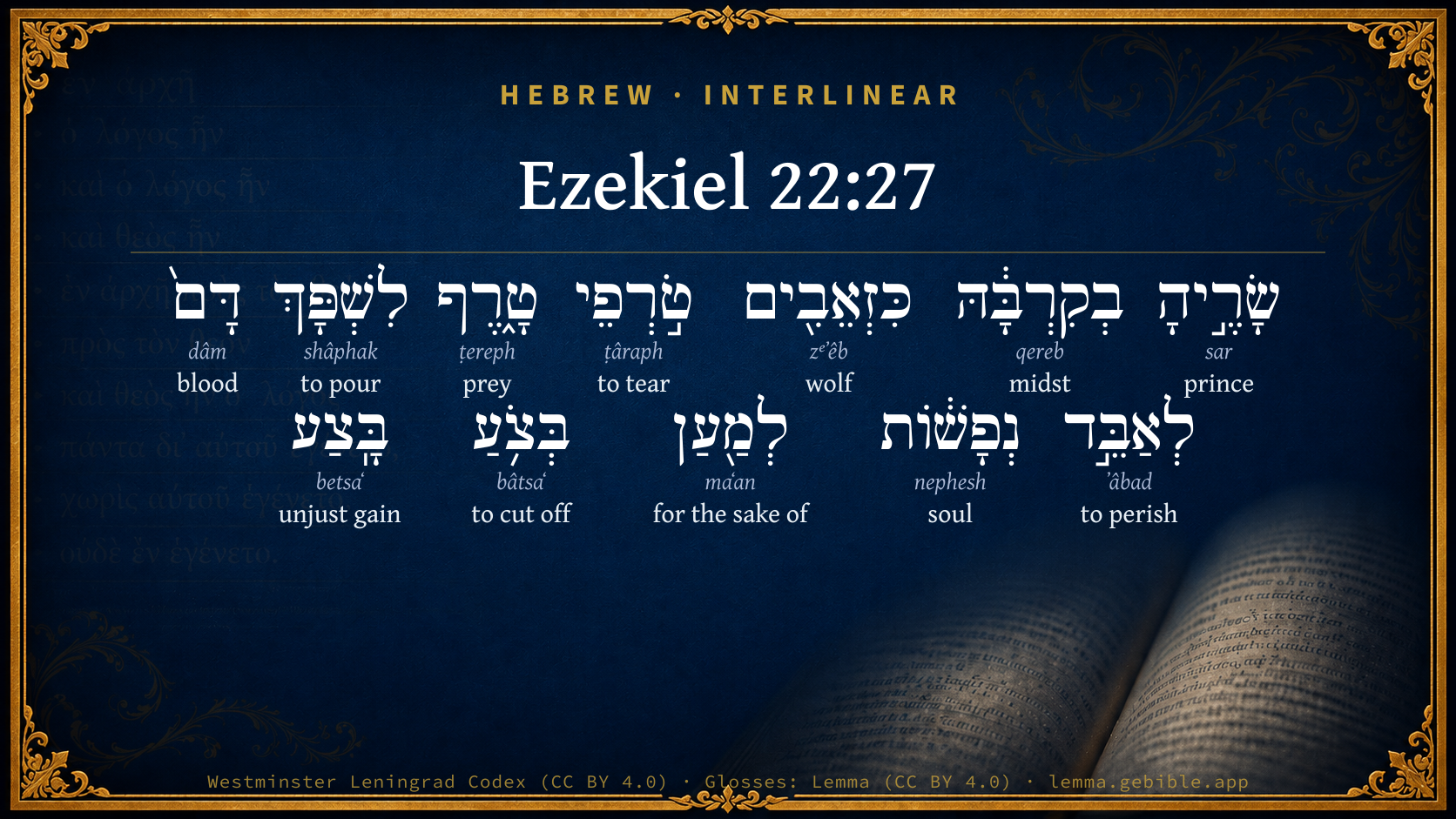
Ezekiel 22:27

Hebrew (Westminster Leningrad Codex) Ezekiel 22:27 appears in the Hebrew Old Testament. The text above is from the Westminster Leningrad Codex. Each word links to its Strong’s number, a concise gloss, and parsing drawn from the Open Scriptures Hebrew Bible morphology. Click any word for its full Brown-Driver-Briggs (BDB) entry.
Download image
Cite this verse

Ezekiel 22:27 (World English Bible). Public Domain. Lemma interlinear Bible study tool, https://lemma.gebible.app/v/ezekiel/22/27.

Show BibTeX & RIS
BibTeX
RIS
English Translation
Her princes in the midst of it are like wolves ravening the prey, to shed blood, [and] to destroy souls, that they may get dishonest gain.
World English Bible · Public Domain
Download a study sheet

One document with this verse’s original text, its word-by-word gloss line, the meaning frame, cross-references with their text, attributed commentary, and full source and license credits — printable, and it pastes into notes with its structure intact.

This verse Autodidact and up

Study sheet (.html) Plain text (.txt)

A passage Seminary Student

Up to 50 verses in one chapter. A passage sheet keeps up to 6 commentary sources and 12 cross-references per verse, in the order this page ranks them, and says so on the sheet whenever that leaves anything out. Ask for a single verse and you get the Autodidact verse sheet above.

Everything on this page stays free to read, with no account — the sheet is a download of what is already on screen, not access to it.

Want to remove ads? Support Godless Engineer
Compare translations 3

The same verse in 3 English versions, stacked beneath the original-language interlinear above. Click any original word for its lexicon entry.

Each is an independent rendering of the whole verse — the interlinear is not word-aligned to these translations.

Highlighted words mark where these versions differ — a whole-verse word diff, not a word-by-word alignment.

  • World English Bible Public Domain
    Her princes in the midst of it are like wolves ravening the prey, to shed blood, [and] to destroy souls, that they may get dishonest gain.
  • King James Version Public Domain
    Her princes in the midst thereof are like wolves ravening the prey, to shed blood, and to destroy souls, to get dishonest gain.
  • unfoldingWord Literal Text CC BY-SA 4.0
    Her princes within her are like wolves tearing apart their victims. They pour out blood and destroy life, to make a profit dishonestly.

unfoldingWord Literal Text — © unfoldingWord, licensed CC BY-SA 4.0. Word-aligned USFM3 via Door43 (git.door43.org/unfoldingWord/en_ult).

Versions to compare (up to 4)

3 of 4 selected

Show all 18 translations

Every available English version of this verse, each an independent rendering of the whole verse.

  • World English Bible Public Domain
    Her princes in the midst of it are like wolves ravening the prey, to shed blood, [and] to destroy souls, that they may get dishonest gain.
  • Berean Standard Bible Public Domain
    Her officials within her are like wolves tearing their prey, shedding blood, and destroying lives for dishonest gain.
  • Majority Standard Bible Public Domain
    Her officials within her are like wolves tearing their prey, shedding blood, and destroying lives for dishonest gain.
  • King James Version Public Domain
    Her princes in the midst thereof are like wolves ravening the prey, to shed blood, and to destroy souls, to get dishonest gain.
  • American Standard Version (1901) Public Domain
    Her princes in the midst thereof are like wolves ravening the prey, to shed blood, `and' to destroy souls, that they may get dishonest gain.
  • Revised Version (1885) Public Domain
    Her princes in the midst thereof are like wolves ravening the prey; to shed blood, and to destroy souls, that they may get dishonest gain.
  • Geneva Bible (1599) Public Domain
    Her princes in the mids thereof are like wolues, rauening the praye to shed blood, and to destroy soules for their owne couetous lucre.
  • Douay-Rheims (1899) Public Domain
    Her princes in the midst of her, are like wolves ravening the prey to shed blood, and to destroy souls, and to run after gains through covetousness.
  • Young's Literal Translation Public Domain
    Its princes in its midst `are' as wolves, Tearing prey, to shed blood, to destroy souls, For the sake of gaining dishonest gain.
  • Literal Standard Version CC BY-SA 4.0
    Its princes [are] as wolves in its midst, || Tearing prey, to shed blood, to destroy souls, || For the sake of gaining dishonest gain.
  • Unlocked Literal Bible CC BY-SA 4.0
    Her princes within her are like wolves tearing apart their victims. They pour out blood and destroy life, to make a profit dishonestly.
  • unfoldingWord Literal Text CC BY-SA 4.0
    Her princes within her are like wolves tearing apart their victims. They pour out blood and destroy life, to make a profit dishonestly.
  • Darby Bible Public Domain
    Her princes in the midst of her are like wolves ravening the prey, to shed blood, to destroy souls, to get dishonest gain.
  • World Messianic Bible Public Domain
    Her princes within it are like wolves ravening the prey, to shed blood and to destroy souls, that they may get dishonest gain.
  • Webster's Bible Public Domain
    Her princes in the midst of her are like wolves ravening the prey, to shed blood, and to destroy souls, to get dishonest gain.
  • Free Bible Version CC BY-SA 4.0
    Her city officials are like wolves ripping up their prey, killing people, destroying lives so they can profit through fraud.
  • Bible in Basic English Public Domain
    Her rulers in her are like wolves violently taking their food; putting men to death and causing the destruction of souls, so that they may get their profit.
  • JPS Tanakh (1917) Public Domain
    Her princes in the midst thereof are like wolves ravening the prey: to shed blood, and to destroy souls, so as to get dishonest gain.

Literal Standard Version (2020), Covenant Press — licensed CC BY-SA 4.0. Text via the HelloAO Bible API (eBible.org). Unlocked Literal Bible (unfoldingWord) — licensed CC BY-SA 4.0. Text via the HelloAO Bible API (eBible.org). unfoldingWord Literal Text — © unfoldingWord, licensed CC BY-SA 4.0. Word-aligned USFM3 via Door43 (git.door43.org/unfoldingWord/en_ult). Free Bible Version, Dr. Jonathan Gallagher — licensed CC BY-SA 4.0. Text via the HelloAO Bible API (eBible.org).

Word by word

More ways to search: Search by grammar → Find every occurrence → Compare this word →

Practice this passage: Drill this verse → Learn its vocabulary →

כִּזְאֵבִ֖ים
zᵉʼêb
H2061
“like/as · wolves”
Preposition + Noun, Common, Masculine, Plural, Absolute
Part of Speech
Preposition + Noun
Type
Common
Gender
Masculine
Number
Plural
State
Absolute
Full BDB Definition

Origin: from an unused root meaning to be yellow

TWOT: 522

wolf
  1. שָׂרֶ֣יהָ sar H8269 “princes · her” Noun, Common, Masculine, Plural, Construct + Suffix, Personal, 3rd Person, Feminine, Singular
  2. בְקִרְבָּ֔הּ qereb H7130 “in/at · midst · her” Preposition + Noun, Common, Masculine, Singular, Construct + Suffix, Personal, 3rd Person, Feminine, Singular
  3. טֹ֣רְפֵי ṭâraph H2963 “tearing” Verb, Qal, Participle Active, Masculine, Plural, Construct
  4. טָ֑רֶף ṭereph H2964 “prey” Noun, Common, Masculine, Singular, Absolute
  5. לִשְׁפָּךְ shâphak H8210 “to pour” Preposition + Verb, Qal, Infinitive Construct
  6. דָּם֙ dâm H1818 “blood” Noun, Common, Masculine, Singular, Absolute
  7. לְאַבֵּ֣ד ʼâbad H6 “to perish” Preposition + Verb, Piel, Infinitive Construct
  8. נְפָשׁ֔וֹת nephesh H5315 “souls” Noun, Common, Both, Plural, Absolute
  9. לְמַ֖עַן maʻan H4616 “for the sake of” Preposition
  10. בְּצֹ֥עַ bâtsaʻ H1214 “to cut off” Verb, Qal, Infinitive Construct
  11. בָּֽצַע betsaʻ H1215 “unjust gain” Noun, Common, Masculine, Singular, Absolute

About this verse

These counts appear in no published source. They are computed here, from the morphology-tagged text and Lemma’s own curated glosses. What Lemma adds →

12
words
12
distinct lemmas
Prophets
section

Notable vocabulary

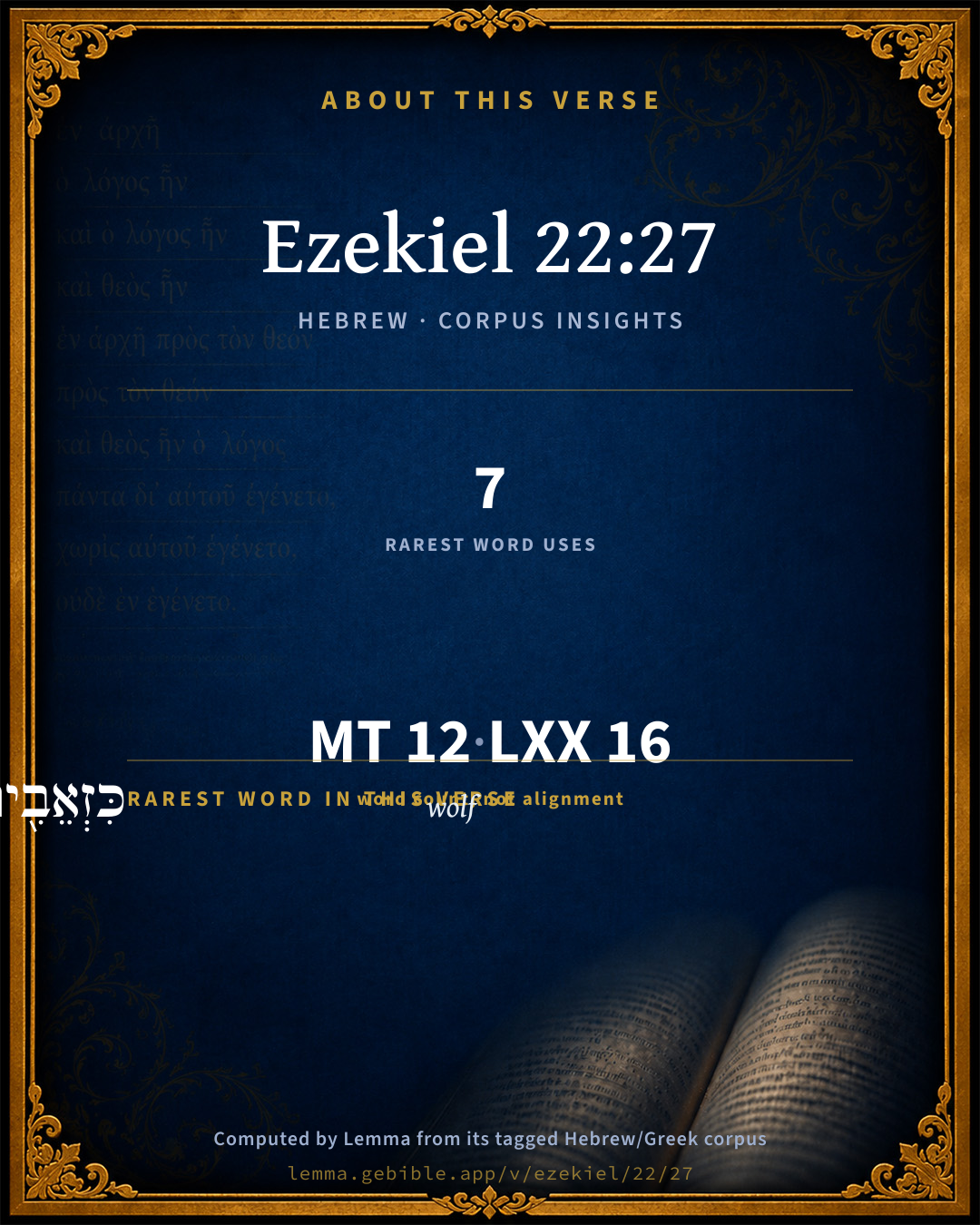
The rarest word here is כִּזְאֵבִ֖ים wolf H2061 — appearing just 7 times in the whole Hebrew Bible.

Shared distinctive vocabulary

כִּזְאֵבִ֖ים wolf H2061 occurs in 7 verses of the Hebrew Bible. Also found in:

Grammatical profile

  • 4 verbs
  • 7 nouns
  • 1 preposition

Verb forms

  • טֹ֣רְפֵי Qal · Participle Active
  • לִשְׁפָּךְ Qal · Infinitive Construct
  • לְאַבֵּ֣ד Piel · Infinitive Construct
  • בְּצֹ֥עַ Qal · Infinitive Construct

Hebrew & Septuagint length

In English translation the verse runs 26 words from the Hebrew and 20 from the Septuagint (LXX English) — closely comparable.

A rough comparison of the two English renderings, which tokenize alike — not a word-level alignment.

Word counts can differ between the Hebrew and the Greek without any difference in meaning — e.g. the Hebrew direct-object marker אֵת has no separate Greek word, and Greek often adds the article ὁ.

In the original languages it is 12 Hebrew tokens and 16 Greek tokens — but the two are counted differently (Hebrew bundles its prefixes and suffixes into one token; the Greek is in lemma form), so that isn’t a like-for-like length.

Cross-references

14

Topical passages linked to Ezekiel 22:27 in the Treasury of Scripture Knowledge — connected by theme and wording, ordered by reader-vote popularity; previews shown in the World English Bible.

  • Ezekiel 22:13 Behold, therefore, I have struck my hand at your dishonest gain which you have made, and at your blood which has been in the midst of you.
  • Isaiah 1:23 Your princes are rebellious, and companions of thieves. Everyone loves bribes, and follows after rewards. They don't judge the fatherless, Neither does the cause of the widow come to them.
  • Ezekiel 22:6 Behold, the princes of Israel, everyone according to his power, have been in you to shed blood.
  • Ezekiel 19:3–6 She brought up one of her cubs: he became a young lion, and he learned to catch the prey; he devoured men.
  • Ezekiel 22:25 There is a conspiracy of her prophets in the midst of it, like a roaring lion ravening the prey: they have devoured souls; they take treasure and precious things; they have made her widows many in the midst of it.
  • Ezekiel 45:9 Thus says the Lord Yahweh: Let it suffice you, princes of Israel: remove violence and spoil, and execute justice and righteousness; dispossessing my people, says the Lord Yahweh.
  • Hosea 7:1–7 When I would heal Israel, Then the iniquity of Ephraim is uncovered, Also the wickedness of Samaria; For they commit falsehood, And the thief enters in, And the gang of robbers ravages outside.
  • Micah 3:2–3 You who hate the good, And love the evil; Who tear off their skin, And their flesh from off their bones;
  • Micah 3:9–11 Please listen to this, you heads of the house of Jacob, And rulers of the house of Israel, Who abhor justice, And pervert all equity.
  • Micah 7:8 Don't rejoice against me, my enemy. When I fall, I will arise. When I sit in darkness, Yahweh will be a light to me.
  • Zephaniah 3:3 Her princes in the midst of her are roaring lions. Her judges are evening wolves. They leave nothing until the next day.
  • Matthew 21:13 He said to them, "It is written, 'My house shall be called a house of prayer,' but you have made it a den of robbers!"
  • James 2:6–7 But you have dishonored the poor man. Don't the rich oppress you, and personally drag you before the courts?
  • James 5:1–4 Come now, you rich, weep and howl for your miseries that are coming on you.

Cross-references courtesy of OpenBible.info (CC BY 4.0).

Hebrew and Greek witnesses Masoretic Hebrew ↔ Greek Septuagint

The same verse in the two great witnesses to the Old Testament, shown verse-for-verse.

These are two independent witnesses, not word-aligned to each other, and the Septuagint is shown in lemma (dictionary) form.

Hebrew Ezekiel 22:27 Masoretic · Westminster Leningrad Codex

שָׂרֶ֣יהָ בְקִרְבָּ֔הּ כִּזְאֵבִ֖ים טֹ֣רְפֵי טָ֑רֶף לִשְׁפָּךְ דָּם֙ לְאַבֵּ֣ד נְפָשׁ֔וֹת לְמַ֖עַן בְּצֹ֥עַ בָּֽצַע

Her princes in the midst of it are like wolves ravening the prey, to shed blood, [and] to destroy souls, that they may get dishonest gain.

World English Bible · Public Domain

Greek LXX Ezekiel 22:27 Septuagint · lemma form

ὁ ἄρχων αὐτός ἐν μέσος αὐτός ὡς λύκος ἁρπάζω ἅρπαγμα ὁ ἐκχέω αἷμα ὅπως πλεονεξία πλεονεκτέω

Her princes in the midst of her are as wolves ravening to shed blood, that they may get dishonest gain.

LXX2012 (modern English Septuagint) · Public Domain

Hebrew: Westminster Leningrad Codex (CC BY 4.0). Greek: Septuagint (public domain); English from LXX2012 (modern English Septuagint) (Public Domain). How the Septuagint differs from the Hebrew →

Targum (Aramaic paraphrase)

1

The Targum is the ancient Jewish Aramaic paraphrase of the Hebrew Scriptures — an interpretive translation, not the Hebrew text itself. Onkelos (literal) and Pseudo-Jonathan (expansive) render the Torah, and Jonathan the Prophets. Coverage is partial: where no permissively-licensed English translation exists for a verse, only the Aramaic is shown. This is verse-level text, not a word-by-word alignment to the Hebrew.

  1. Targum Jonathan Prophets (Joshua–Malachi)
    רַבְרְבָהָא בְגַוָהּ כַדִיבִין חָטְפֵי חֲטוֹף לְמִשְׁפַּךְ דַם זַכַּאי לַאֲבָדָא נַפְשָׁן בְּדִיל לְקַבָּלָא מָמוֹן דִשְׁקַר:

    (no public-domain English translation for this verse)

    Targum Jonathan — Aramaic: “Mikraot Gedolot” (public domain). English: “Sefaria Community Translation” (CC0 1.0 (public-domain dedication)); “London "Chaldee Paraphrase," 1871” (public domain). Text via Sefaria.

Commentary

Notes on Ezekiel 22:27 from classic Christian and Jewish commentators (each source and its license shown beneath its notes). The classic Christian expositions comment on the surrounding passage and are grouped to its opening verse, so a note may address several verses; the Jewish commentaries on the Tanakh (Rashi and others) are per-verse, so they appear only where the commentator wrote on this verse.

Lemma curates 59 commentaries, every one of them public domain or Creative Commons licensed, each selected and text-cleaned for this edition rather than reprinted as found. About our sources →

Trapp's Complete Commentary

John Trapp

Eze 22:27 Her princes in the midst thereof [are] like wolves ravening the prey, to shed blood, [and] to destroy souls, to get dishonest gain.

Ver. 27. Her princes in the midst thereof.] Lupis ferociores et voraciores erant. There was in this state, as physicians say there is in some diseases, corruptio totius substantiae, a general defection: and here they are particularly told of it; so, as Isocrates saith in his oration to Philip King of Macedonia, That which is spoken to all is spoken to none. See Mic 3:11 Zep 3:3.

John Trapp, A Commentary or Exposition upon All the Books of the Old and New Testament (1647–1656) — public domain. Text from a community e-Sword module.

Joseph Benson's Commentary

Eze 22:27-28. Her princes are like wolves — The chief officers of state stick at no method of injustice and oppression whereby they may increase their substance, though it be by taking away the lives and estates of the innocent: see the margin. And her prophets have daubed them, &c. — Have daubed over the evil practices of the great men, by palliating devices: or, have flattered them in their ways of sin and violence, and encouraged them to proceed therein with promises, which, like ill-tempered mortar, will deceive them, though all seems at present smooth and safe.

Joseph Benson's Commentary on the Old and New Testaments (1811–1818) — public domain. Text from a community e-Sword module.

Jamieson, Fausset & Brown

Robert Jamieson, A. R. Fausset & David Brown

princes--who should have employed the influence of their position for the people's welfare, made "gain" their sole aim.

wolves--notorious for fierce and ravening cruelty (Mic 3:2-3, Mic 3:9-11; Joh 10:12).

Jamieson, Fausset & Brown — Commentary Critical and Explanatory on the Whole Bible (1871) — public domain (CC PDM 1.0). Text via the HelloAO Bible API.

Adam Clarke's Commentary

Verse 27. Her princes] Are as bad as her priests; they are rapacious, and grievously oppress the people by unjust impositions in order to increase their revenues.

Adam Clarke's Commentary on the Bible (1810–1826) — public domain. Text from a community e-Sword/MySword module.

Ellicott's Commentary for English Readers

(27) Her princes.—These are not only the kings, but also the nobles and those in authority at court—in other words, the ruling class. Their injustice and violence is a constant theme for prophetic rebuke.

A Bible Commentary for English Readers, edited by Charles John Ellicott (1878–1897) — public domain. Text from a community e-Sword module.

The Cambridge Bible for Schools and Colleges

gen. ed. J. J. S. Perowne

27. Her princes] The “princes” here are the chiefs or leaders of the people, cf. Jer_26:10; Jer_36:12.

get dishonest gain] Cf. Jer_6:13; Jer_8:10. The term is used pretty generally, of selfish advantage.

The Cambridge Bible for Schools and Colleges (gen. ed. J. J. S. Perowne; Cambridge University Press, 1878–1918) — public domain. Text from a community e-Sword module.

John Gill's Exposition

Her princes in the midst thereof are like wolves ravening the prey,.... The king and his nobles, those of the first rank and quality, who ought to have protected the persons and property of the meaner sort; these were like "wolves" themselves, subtle, voracious, and cruel, preying upon harmless persons, as those creatures do upon the sheep and lambs:

to shed blood; innocent blood, as the Targum:

and to destroy souls; take away lives, under a pretence of treasonable practices, and all with a view to get dishonest gain; that their estates may be forfeited, their goods confiscated, and got into their hands.

John Gill's Exposition of the Whole Bible (1746–1763) — public domain (CC PDM 1.0). Text via the HelloAO Bible API.

Matthew Poole's English Annotations

Her princes, as before, Eze 22:25,26. Princes; rulers of all sorts, who should have crushed oppressors and defended the oppressed. Wolves; creatures greedy, bloody, and crafty, resembling dogs that men make use of to defend their folds; so the authority which God had given to defend is by these hypocrites perverted to satisfy the bloody and greedy appetite of tyrannical governors among the Jews: possibly the prophet may tax the degeneracy and baseness of these rulers hereby. Shed blood; innocent blood; a crying sin in princes, who have God’s power committed to them to preserve the innocent.

Destroy souls; undo and ruin families, cutting off the fathers, and impoverishing the widow and fatherless.

Get dishonest gain; confiscating estates not forfeited.

Matthew Poole's English Annotations on the Holy Bible (1683–1685) — public domain. Text from a community e-Sword/MySword module.

Whedon's Commentary on the Bible

Daniel D. Whedon

27. Princes — Rather, captains (Jer_26:10). The subordinate officers are in full sympathy with the iniquitous practices of the court and temple. They are after the spoils at any price. (Compare Jer_6:13.)

Daniel D. Whedon (gen. ed.), Commentary on the Old and New Testaments (1874–1909) — public domain. Text from a community e-Sword module.

The Pulpit Commentary

Wolves. (comp. Hab_1:8; Zep_3:3; Mat_7:15; Act_20:29)

The Pulpit Commentary (1880–1919), ed. H.D.M. Spence-Jones & Joseph S. Exell — public domain. Text from a community e-Sword module.

John Wesley's Explanatory Notes

Destroy souls - Ruin families; cutting off the fathers, and impoverishing the widow, and fatherless.

John Wesley, Explanatory Notes Upon the Whole Bible (1754–1765) — public domain. Text via the GEBible commentary corpus.

Rashi

Rabbi Shlomo Yitzchaki (Rashi)

for the sake of dishonest gain To seize money.

Rashi on the Tanakh — English translations: “The Judaica Press complete Tanach with Rashi, translated by A. J. Rosenberg” (CC BY 4.0); “Pentateuch with Rashi's commentary by M. Rosenbaum and A.M. Silbermann, 1929-1934” (public domain); “The Metsudah Tanach series, Lakewood, N.J” (CC BY 4.0); and “The Book of Joshua, Metsudah Publications, 1997” (CC BY 4.0). Text via Sefaria.

Lesson kit

Teaching starters — assembled from the data on this page, not authored interpretation. Every prompt links to the verse data it draws on. Edit before teaching.

Ezekiel, in the Prophets, opens this verse with 12 words (12 distinct Hebrew lemmas). Its most distinctive word is zᵉʼêb (“wolf”). A historical commentator’s framing appears above. Read the whole chapter for the surrounding context.

Discussion questions

  1. What does “wolf” (zᵉʼêb) contribute to the verse as a whole?
  2. Genesis 49:27 shares the word «wolf» with this verse. How do the two illuminate each other?
  3. These translations render this verse differently; the difference is in the English rendering, not the original. What questions does that raise?
  4. The verb «טֹ֣רְפֵי» is Qal Participle Active. How does its form color the action?
  5. Reading how Trapp's Complete Commentary and Joseph Benson's Commentary read this verse, where do the two commentators agree and where do they part?

Things to notice

Reading settings

Reading text

Shown beneath each verse's original-language words.

Old Testament
Old Testament edition

Read the OT as the Masoretic Hebrew (MT) or the Greek Septuagint (LXX).

English shown for the Greek Septuagint (in the Hebrew ↔ Greek comparison).

Comparing translations? Open the Compare panel on any verse page to stack up to four side by side.