Psalms 51:14

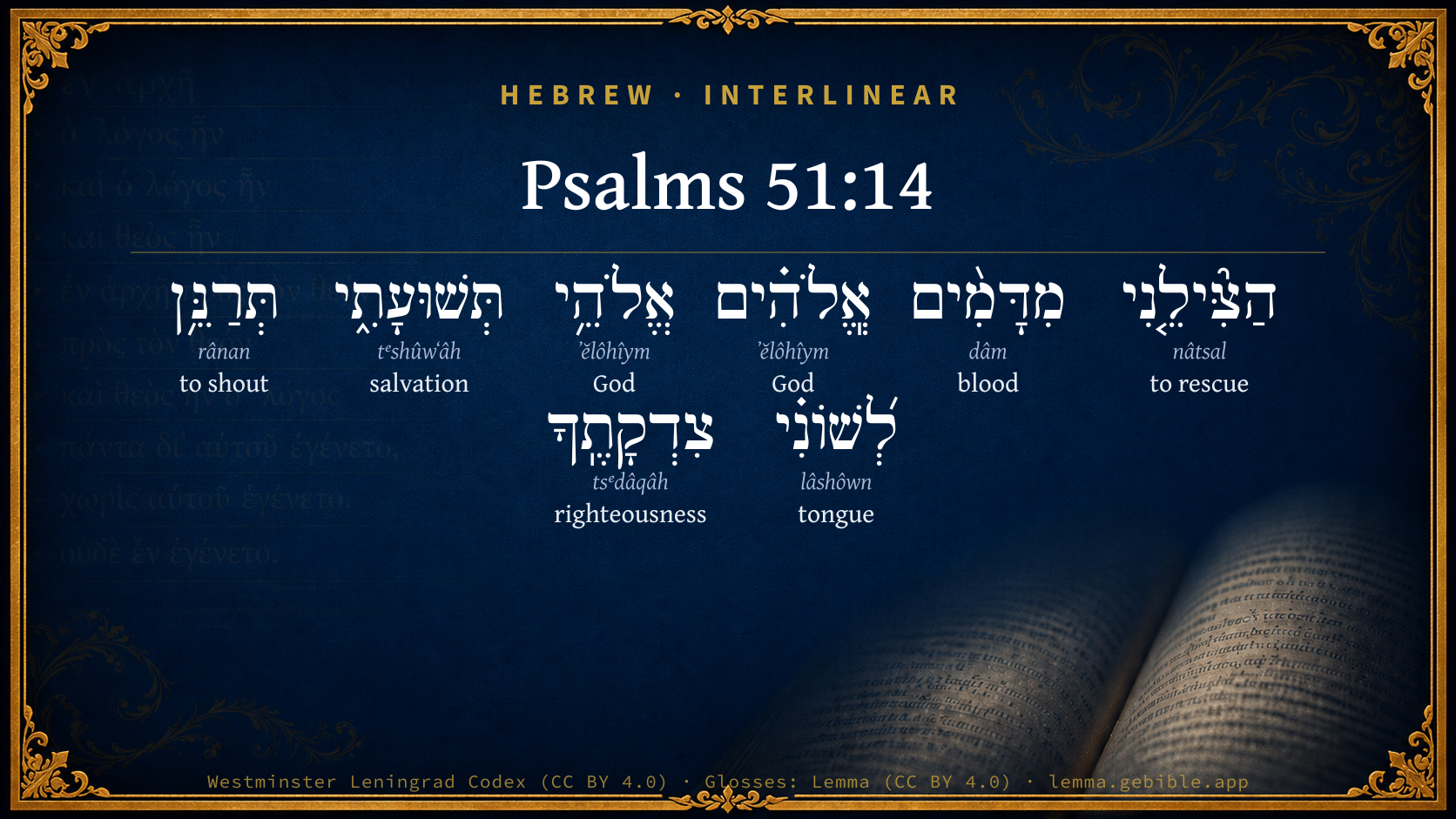
Hebrew (Westminster Leningrad Codex) Psalms 51:14 appears in the Hebrew Old Testament. The text above is from the Westminster Leningrad Codex. Each word links to its Strong’s number, a concise gloss, and parsing drawn from the Open Scriptures Hebrew Bible morphology. Click any word for its full Brown-Driver-Briggs (BDB) entry.
Download image
Cite this verse

Psalms 51:14 (World English Bible). Public Domain. Lemma interlinear Bible study tool, https://lemma.gebible.app/v/psalms/51/14.

Show BibTeX & RIS
BibTeX
RIS
English Translation
Deliver me from bloodguiltiness, O God, the God of my salvation. My tongue shall sing aloud of your righteousness.
World English Bible · Public Domain
Download a study sheet

One document with this verse’s original text, its word-by-word gloss line, the meaning frame, cross-references with their text, attributed commentary, and full source and license credits — printable, and it pastes into notes with its structure intact.

This verse Autodidact and up

Study sheet (.html) Plain text (.txt)

A passage Seminary Student

Up to 50 verses in one chapter. A passage sheet keeps up to 6 commentary sources and 12 cross-references per verse, in the order this page ranks them, and says so on the sheet whenever that leaves anything out. Ask for a single verse and you get the Autodidact verse sheet above.

Everything on this page stays free to read, with no account — the sheet is a download of what is already on screen, not access to it.

Want to remove ads? Support Godless Engineer
Compare translations 3

The same verse in 3 English versions, stacked beneath the original-language interlinear above. Click any original word for its lexicon entry.

Each is an independent rendering of the whole verse — the interlinear is not word-aligned to these translations.

Highlighted words mark where these versions differ — a whole-verse word diff, not a word-by-word alignment.

  • World English Bible Public Domain
    Deliver me from bloodguiltiness, O God, the God of my salvation. My tongue shall sing aloud of your righteousness.
  • King James Version Public Domain
    Deliver me from bloodguiltiness, O God, thou God of my salvation: and my tongue shall sing aloud of thy righteousness.
  • unfoldingWord Literal Text CC BY-SA 4.0
    Deliver me from blood, God, the God of my salvation, may my tongue sing your righteousness.

unfoldingWord Literal Text — © unfoldingWord, licensed CC BY-SA 4.0. Word-aligned USFM3 via Door43 (git.door43.org/unfoldingWord/en_ult).

Versions to compare (up to 4)

3 of 4 selected

Show all 18 translations

Every available English version of this verse, each an independent rendering of the whole verse.

  • World English Bible Public Domain
    Deliver me from bloodguiltiness, O God, the God of my salvation. My tongue shall sing aloud of your righteousness.
  • Berean Standard Bible Public Domain
    Deliver me from bloodguilt, O God, the God of my salvation, and my tongue will sing of Your righteousness.
  • Majority Standard Bible Public Domain
    Deliver me from bloodguilt, O God, the God of my salvation, and my tongue will sing of Your righteousness.
  • King James Version Public Domain
    Deliver me from bloodguiltiness, O God, thou God of my salvation: and my tongue shall sing aloud of thy righteousness.
  • American Standard Version (1901) Public Domain
    Deliver me from bloodguiltiness, O God, thou God of my salvation; `And' my tongue shall sing aloud of thy righteousness.
  • Revised Version (1885) Public Domain
    Deliver me from bloodguiltiness, O God, thou God of my salvation; and my tongue shall sing aloud of thy righteousness.
  • Geneva Bible (1599) Public Domain
    Deliuer me from blood, O God, which art the God of my saluation, and my tongue shall sing ioyfully of thy righteousnes.
  • Douay-Rheims (1899) Public Domain
    Restore unto me the joy of thy salvation, and strengthen me with a perfect spirit.
  • Young's Literal Translation Public Domain
    Deliver me from blood, O God, God of my salvation, My tongue singeth of Thy righteousness.
  • Literal Standard Version CC BY-SA 4.0
    Deliver me from blood, O God, God of my salvation, || My tongue sings of Your righteousness.
  • Unlocked Literal Bible CC BY-SA 4.0
    Forgive me for shedding blood, God of my salvation, and I will shout for the joy of your righteousness.
  • unfoldingWord Literal Text CC BY-SA 4.0
    Deliver me from blood, God, the God of my salvation, may my tongue sing your righteousness.
  • Darby Bible Public Domain
    Deliver me from blood-guiltiness, O God, thou God of my salvation: my tongue shall sing aloud of thy righteousness.
  • World Messianic Bible Public Domain
    Deliver me from the guilt of bloodshed, O God, the God of my salvation. My tongue will sing aloud of your righteousness.
  • Webster's Bible Public Domain
    \\51:12\\Restore to me the joy of thy salvation; and uphold me with thy free spirit.
  • Free Bible Version CC BY-SA 4.0
    God, please forgive me for the blood I have shed, God of my salvation, and I will sing for joy of your goodness.
  • Bible in Basic English Public Domain
    Be my saviour from violent death, O God, the God of my salvation; and my tongue will give praise to your righteousness.
  • JPS Tanakh (1917) Public Domain
    (51-16) Deliver me from bloodguiltiness, O God, Thou God of my salvation; so shall my tongue sing aloud of Thy righteousness.

Literal Standard Version (2020), Covenant Press — licensed CC BY-SA 4.0. Text via the HelloAO Bible API (eBible.org). Unlocked Literal Bible (unfoldingWord) — licensed CC BY-SA 4.0. Text via the HelloAO Bible API (eBible.org). unfoldingWord Literal Text — © unfoldingWord, licensed CC BY-SA 4.0. Word-aligned USFM3 via Door43 (git.door43.org/unfoldingWord/en_ult). Free Bible Version, Dr. Jonathan Gallagher — licensed CC BY-SA 4.0. Text via the HelloAO Bible API (eBible.org).

Word by word

More ways to search: Search by grammar → Find every occurrence → Compare this word →

Practice this passage: Drill this verse → Learn its vocabulary →

תְּשׁוּעָתִ֑י
tᵉshûwʻâh
H8668
“salvation · my”
Noun, Common, Feminine, Singular, Construct + Suffix, Personal, 1st Person, Common, Singular
Part of Speech
Noun
Type
Common
Gender
Feminine
Number
Singular
State
Construct
Full BDB Definition

Origin: from H7768 in the sense of H3467

TWOT: 929e

salvation, deliverance - deliverance (usually by God through human agency) - salvation (spiritual in sense)
  1. הַצִּ֘ילֵ֤נִי nâtsal H5337 “rescue · me” Verb, Hiphil, Imperative, 2nd Person, Masculine, Singular + Suffix, Personal, 1st Person, Common, Singular
  2. מִדָּמִ֨ים dâm H1818 “from · blood” Preposition + Noun, Common, Masculine, Plural, Absolute
  3. אֱֽלֹהִ֗ים ʼĕlôhîym H430 “God(s)” Noun, Common, Masculine, Plural, Absolute
  4. אֱלֹהֵ֥י ʼĕlôhîym H430 “God(s) of” Noun, Common, Masculine, Plural, Construct
  5. תְּרַנֵּ֥ן rânan H7442 “to shout” Verb, Piel, Imperfect, 3rd Person, Feminine, Singular
  6. לְ֝שׁוֹנִ֗י lâshôwn H3956 “tongue · my” Noun, Common, Both, Singular, Construct + Suffix, Personal, 1st Person, Common, Singular
  7. צִדְקָתֶֽךָ tsᵉdâqâh H6666 “righteousness · your” Noun, Common, Feminine, Singular, Construct + Suffix, Personal, 2nd Person, Masculine, Singular

About this verse

These counts appear in no published source. They are computed here, from the morphology-tagged text and Lemma’s own curated glosses. What Lemma adds →

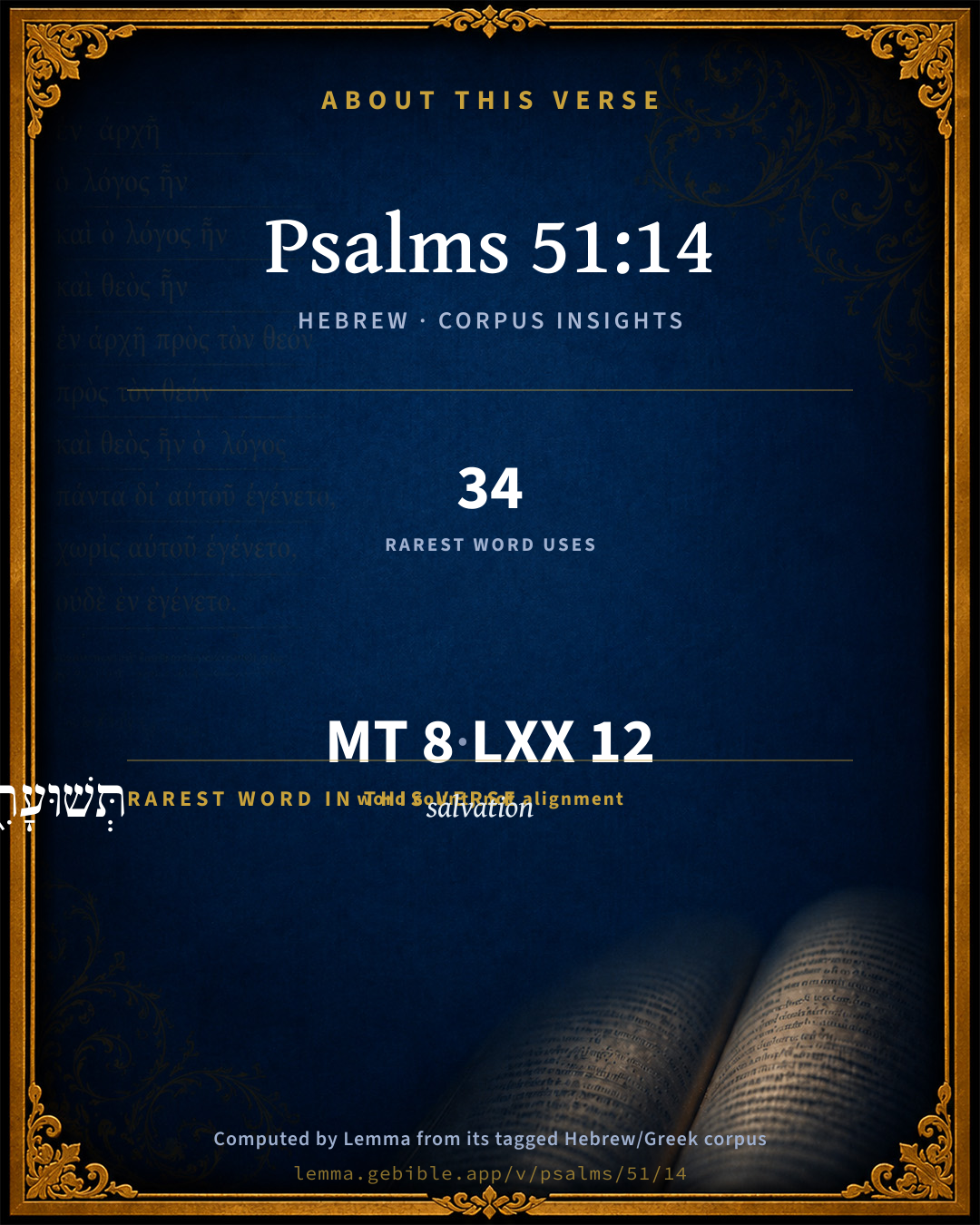
8
words
7
distinct lemmas
Wisdom
section

Shared distinctive vocabulary

תְּשׁוּעָתִ֑י salvation H8668 occurs in 32 verses of the Hebrew Bible. Also found in:

Grammatical profile

  • 2 verbs
  • 6 nouns

Verb forms

  • הַצִּ֘ילֵ֤נִי Hiphil · Imperative
  • תְּרַנֵּ֥ן Piel · Imperfect

Repetition

A word recurs within this verse — often emphatic in Hebrew:

  • אֱֽלֹהִ֗ים God H430 ×2

Hebrew & Septuagint length

In English translation the verse runs 19 words from the Hebrew and 19 from the Septuagint (LXX English) — the same length.

A rough comparison of the two English renderings, which tokenize alike — not a word-level alignment.

Word counts can differ between the Hebrew and the Greek without any difference in meaning — e.g. the Hebrew direct-object marker אֵת has no separate Greek word, and Greek often adds the article ὁ.

In the original languages it is 8 Hebrew tokens and 12 Greek tokens — but the two are counted differently (Hebrew bundles its prefixes and suffixes into one token; the Greek is in lemma form), so that isn’t a like-for-like length.

Cross-references

27

Topical passages linked to Psalms 51:14 in the Treasury of Scripture Knowledge — connected by theme and wording, ordered by reader-vote popularity; previews shown in the World English Bible.

  • 2 Samuel 12:9 Why have you despised the word of Yahweh, to do that which is evil in his sight? You have struck Uriah the Hittite with the sword, and have taken his wife to be your wife, and have slain him with the sword of the children of Ammon.
  • Psalms 35:28 My tongue shall talk about your righteousness and about your praise all day long.
  • Genesis 9:6 Whoever sheds man's blood, by man will his blood be shed, for in the image of God made he man.
  • Psalms 26:9 Don't gather my soul with sinners, Nor my life with bloodthirsty men;
  • Hosea 4:2 There is cursing, lying, murder, stealing, and committing adultery; They break boundaries, and bloodshed causes bloodshed.
  • Acts 20:26 Therefore I testify to you this day that I am clean from the blood of all men,
  • Romans 10:3 For being ignorant of God's righteousness, and seeking to establish their own righteousness, they didn't subject themselves to the righteousness of God.
  • Genesis 42:22 Reuben answered them, saying, "Didn't I tell you, saying, 'Don't sin against the child,' and you wouldn't listen? Therefore also, behold, his blood is required."
  • 2 Samuel 3:28 Afterward, when David heard it, he said, I and my kingdom are guiltless before Yahweh forever of the blood of Abner the son of Ner:
  • 2 Samuel 11:15–17 He wrote in the letter, saying, Set Uriah in the forefront of the hottest battle, and retire you from him, that he may be struck, and die.
  • 2 Samuel 21:1 There was a famine in the days of David three years, year after year; and David sought the face of Yahweh. Yahweh said, It is for Saul, and for his bloody house, because he put to death the Gibeonites.
  • Ezra 9:13 After all that is come on us for our evil deeds, and for our great guilt, seeing that you our God have punished us less than our iniquities deserve, and have given us such a remnant,
  • Nehemiah 9:33 However you are just in all that is come on us; for you have dealt truly, but we have done wickedly;
  • Psalms 25:5 Guide me in your truth, and teach me, For you are the God of my salvation, I wait for you all day long.
  • Psalms 38:22 Hurry to help me, Lord, my salvation.
  • Psalms 55:23 But you, God, will bring them down into the pit of destruction. Bloodthirsty and deceitful men shall not live out half their days, But I will trust in you.
  • Psalms 68:20 God is to us a God of deliverance. To Yahweh, the Lord, belongs escape from death.
  • Psalms 71:15–24 My mouth will tell about your righteousness, And of your salvation all day, Though I don't know its full measure.
  • Psalms 86:12–13 I will praise you, Lord my God, with my whole heart. I will glorify your name forevermore.
  • Psalms 88:1 Yahweh, the God of my salvation, I have cried day and night before you.
  • Isaiah 12:2 Behold, God is my salvation. I will trust, and will not be afraid; for Yah, Yahweh, is my strength and song; and he has become my salvation."
  • Isaiah 45:17 [But] Israel shall be saved by Yahweh with an everlasting salvation: you shall not be disappointed nor confounded world without end.
  • Ezekiel 33:8 When I tell the wicked, O wicked man, you shall surely die, and you don't speak to warn the wicked from his way; that wicked man shall die in his iniquity, but his blood will I require at your hand.
  • Daniel 9:7 Lord, righteousness belongs to you, but to us confusion of face, as at this day; to the men of Judah, and to the inhabitants of Jerusalem, and to all Israel, who are near, and who are far off, through all the countries where you have driven them, because of their trespass that they have trespassed against you.
  • Daniel 9:16 Lord, according to all your righteousness, let your anger and please let your wrath be turned away from your city Jerusalem, your holy mountain; because for our sins, and for the iniquities of our fathers, Jerusalem and your people are become a reproach to all who are round about us.
  • Habakkuk 3:18 Yet I will rejoice in Yahweh. I will be joyful in the God of my salvation!
  • Acts 18:6 When they opposed him and blasphemed, he shook out his clothing and said to them, "Your blood be on your own heads! I am clean. From now on, I will go to the Gentiles!"

Cross-references courtesy of OpenBible.info (CC BY 4.0).

Hebrew and Greek witnesses Masoretic Hebrew ↔ Greek Septuagint

The same verse in the two great witnesses to the Old Testament, shown verse-for-verse.

You’re reading Greek Psalm 50 (Hebrew Psalm 51). The Septuagint counts the superscription, so verse numbers can differ from the Hebrew — chapter-level alignment, not verse-by-verse. Numbering follows Rahlfs.

These are two independent witnesses, not word-aligned to each other, and the Septuagint is shown in lemma (dictionary) form.

Hebrew Psalms 51:14 Masoretic · Westminster Leningrad Codex

הַצִּ֘ילֵ֤נִי מִדָּמִ֨ים אֱֽלֹהִ֗ים אֱלֹהֵ֥י תְּשׁוּעָתִ֑י תְּרַנֵּ֥ן לְ֝שׁוֹנִ֗י צִדְקָתֶֽךָ

Deliver me from bloodguiltiness, O God, the God of my salvation. My tongue shall sing aloud of your righteousness.

World English Bible · Public Domain

Greek LXX Greek Psalm 50:14 Septuagint · lemma form

ἀποδίδωμι ἐγώ ὁ ἀγαλλίασις ὁ σωτήριον σύ καί πνεῦμα ἡγεμονικός στηρίζω ἐγώ

Deliver me from blood-guiltiness, O God, the God of my salvation: and my tongue shall joyfully declare your righteousness.

LXX2012 (modern English Septuagint) · Public Domain

On this verse, Ellicott's Commentary for English Readers discusses the Septuagint’s reading. Read the note in Commentary ↓

Hebrew: Westminster Leningrad Codex (CC BY 4.0). Greek: Septuagint (public domain); English from LXX2012 (modern English Septuagint) (Public Domain). How the Septuagint differs from the Hebrew →

Commentary

Notes on Psalms 51:14 from classic Christian and Jewish commentators (each source and its license shown beneath its notes). The classic Christian expositions comment on the surrounding passage and are grouped to its opening verse, so a note may address several verses; the Jewish commentaries on the Tanakh (Rashi and others) are per-verse, so they appear only where the commentator wrote on this verse.

Lemma curates 59 commentaries, every one of them public domain or Creative Commons licensed, each selected and text-cleaned for this edition rather than reprinted as found. About our sources →

Matthew Henry's Commentary

I. David prays against the guilt of sin, and prays for the grace of God, enforcing both petitions from a plea taken from the glory of God, which he promises with thankfulness to show forth. 1. He prays against the guilt of sin, that he might be delivered from that, and promises that then he would praise God, Psa 51:14. The particular sin he prays against is blood-guiltiness, the sin he had now been guilty of, having slain Uriah with the sword of the children of Ammon. Hitherto perhaps he had stopped the mouth of conscience with that frivolous excuse, that he did not kill him himself; but now he was convinced that he was the murderer, and, hearing the blood cry to God for vengeance, he cries to God for mercy: "Deliver me from blood-guiltiness; let me not lie under the guilt of this kind which I have contracted, but let it be pardoned to me, and let me never be left to myself to contract the like guilt again." Note, It concerns us all to pray earnestly against the guilt of blood. In this prayer he eyes God as the God of salvation. Note, Those to whom God is the God of salvation he will deliver from guilt; for the salvation he is the God of is salvation from sin. We may therefore plead this with him, "Lord, thou art the God of my salvation, therefore deliver me from the dominion of sin." He promises that, if God would deliver him, his tongue should sing aloud of his righteousness; God should have the glory both of pardoning mercy and of preventing grace. God's righteousness is often put for his grace, especially in the great business of justification and sanctification. This he would comfort himself in and therefore sing of; and this he would endeavour both to acquaint and to affect others with; he would sing aloud of it. This all those should do that have had the benefit of it, and owe their all to it. 2. He prays for the grace of God and promises to improve that grace to his glory (Psa 51:15): "O Lord! open thou my lips, not only that I may teach and instruct sinners" (which the best preacher cannot do to any purpose unless God give him the opening of the mouth, and the tongue of the learned), "but that my mouth may show forth thy praise, not only that I may have abundant matter for praise, but a heart enlarged in praise." Guilt had closed his lips, had gone near to stop the mouth of prayer; he could not for shame, he could not for fear, come into the presence of that God whom he knew he had offended, much less speak to him; his heart condemned him, and therefore he had little confidence towards God. It cast a damp particularly upon his praises; when he had lost the joys of his salvation his harp was hung upon the willow-trees; therefore he prays, "Lord, open my life, put my heart in tune for praise again." To those that are tongue-tied by reason of guilt the assurance of the forgiveness of their sins says effectually, Ephphatha - Be opened; and, when the lips are opened, what should they speak but the praises of God, as Zacharias did? Luk 1:64.

II. David offers the sacrifice of a penitent contrite heart, as that which he knew God would be pleased with. 1. He knew well that the sacrificing of beasts was in itself of no account with God (Psa 51:16): Thou desirest not sacrifice (else would I give it with all my heart to obtain pardon and peace); thou delightest not in burnt-offering. Here see how glad David would have been to give thousands of rams to make atonement for sin. Those that are thoroughly convinced of their misery and danger by reason of sin would spare no cost to obtain the remission of it, Mic 6:6, Mic 6:7. But see how little God valued this. As trials of obedience, and types of Christ, he did indeed require sacrifices to be offered; but he had no delight in them for any intrinsic worth or value they had. Sacrifice and offering thou wouldst not. As they cannot make satisfaction for sin, so God cannot take any satisfaction in them, any otherwise than as the offering of them is expressive of love and duty to him. 2. He knew also how acceptable true repentance is to God (Psa 51:17): The sacrifices of God are a broken spirit. See here, (1.) What the good work is that is wrought in every true penitent - a broken spirit, a broken and a contrite heart. It is a work wrought upon the heart; that is it that God looks at, and requires, in all religious exercises, particularly in the exercises of repentance. It is a sharp work wrought there, no less than the breaking of the heart; not in despair (as we say, when a man is undone, His heart is broken), but in necessary humiliation and sorrow for sin. It is a heart breaking with itself, and breaking from its sin; it is a heart pliable to the word of God, and patient under the rod of God, a heart subdued and brought into obedience; it is a heart that is tender, like Josiah's, and trembles at God's word. Oh that there were such a heart in us! (2.) How graciously God is pleased to accept of this. It is the sacrifices of God, not one, but many; it is instead of all burnt-offering and sacrifice. The breaking of Christ's body for sin is the only sacrifice of atonement, for no sacrifice but that could take away sin; but the breaking of our hearts for sin is a sacrifice of acknowledgment, a sacrifice of God, for to him it is offered up; he requires it, he prepares it (he provides this lamb for a burnt-offering), and he will accept of it. That which pleased God was not the feeding of a beast, and making much of it, but killing it; so it is not the pampering of our flesh, but the mortifying of it, that God will accept. The sacrifice was bound, was bled, was burnt; so the penitent heart is bound by convictions, bleeds in contrition, and then burns in holy zeal against sin and for God. The sacrifice was offered upon the altar that sanctified the gift; so the broken heart is acceptable to God only through Jesus Christ; there is no true repentance without faith in him; and this is the sacrifice which he will not despise. Men despise that which is broken, but God will not. He despised the sacrifice of torn and broken beasts, but he will not despise that of a torn and broken heart. He will not overlook it; he will not refuse or reject it; though it make God no satisfaction for the wrong done him by sin, yet he does not despise it. The proud Pharisee despised the broken-hearted publican, and he thought very meanly of himself; but God did not despise him. More is implied than is expressed; the great God overlooks heaven and earth, to look with favour upon a broken and contrite heart, Isa 66:1, Isa 66:2; Isa 57:15.

III. David intercedes for Zion and Jerusalem, with an eye to the honour of God. See what a concern he had,

1. For the good of the church of God (Psa 51:18): Do good in thy good pleasure unto Zion, that is, (1.) "To all the particular worshippers in Zion, to all that love and fear thy name; keep them from falling into such wounding wasting sins as these of mine; defend and succour all that fear thy name." Those that have been in spiritual troubles themselves know how to pity and pray for those that are in like manner afflicted. Or, (2.) To the public interests of Israel. David was sensible of the wrong he had done to Judah and Jerusalem by his sin, how it had weakened the hands and saddened the hearts of good people, and opened the mouths of their adversaries; he was likewise afraid lest, he being a public person, his sin should bring judgments upon the city and kingdom, and therefore he prays to God to secure and advance those public interests which he had damaged and endangered. He prays that God would prevent those national judgments which his sin had deserved, that he would continue those blessings, and carry on that good work, which it had threatened to retard and put a stop to. He prays, not only that God would do good to Zion, as he did to other places, by his providence, but that he would do it in his good pleasure, with the peculiar favour he bore to that place which he had chosen to put his name there, that the walls of Jerusalem, which perhaps were now in the building, might be built up, and that good work finished. Note, [1.] When we have most business of our own, and of greatest importance at the throne of grace, yet then we must not forget to pray for the church of God; nay, or Master has taught us in our daily prayers to begin with that, Hallowed be thy name, Thy kingdom come. [2.] The consideration of the prejudice we have done to the public interests by our sins should engage us to do them all the service we can, particularly by our prayers.

2. For the honour of the churches of God, Psa 51:19. If God would show himself reconciled to him and his people, as he had prayed, then they should go on with the public services of his house, (1.) Cheerfully to themselves. The sense of God's goodness to them would enlarge their hearts in all the instances and expressions of thankfulness and obedience. They will then come to his tabernacle with burnt-offerings, with whole burnt-offerings, which were intended purely for the glory of God, and they shall offer, not lambs and rams only, but bullocks, the costliest sacrifices, upon his altar. (2.) Acceptably to God: "Thou shalt be pleased with them, that is, we shall have reason to hope so when we perceive the sin taken away which threatened to hinder thy acceptance." Note, It is a great comfort to a good man to think of the communion that is between God and his people in their public assemblies, how he is honoured by their humble attendance on him and they are happy in his gracious acceptance of it.

Matthew Henry's Commentary on the Whole Bible (1708–1710) — public domain (CC PDM 1.0). Text via the HelloAO Bible API.

Trapp's Complete Commentary

John Trapp

Psa 51:14 Deliver me from bloodguiltiness, O God, thou God of my salvation: [and] my tongue shall sing aloud of thy righteousness.

Ver. 14. Deliver me from blood guiltiness, O God] Heb. from bloods; in every drop whereof is a tongue crying for vengeance. Besides, if David’s adultery was a sin of infirmity (he was preoccupied, as Gal 6:1), yet his murdering of Uriah, and many others that fell together with him, was a sin of presumption; a deliberate prepensed evil, done in cold blood, and therefore lay very heavily upon his conscience. Howbeit he obtained pardon for this great sin also; so that it never troubled him on his deathbed, as some other did, though not so great, whereof he had not so thoroughly repented, 1Ki 2:5-9

Thou God of my salvation] By making choice of this so fit an attribute, he stirreth up himself to take better hold.

And my tongue shall sing aloud of thy righteousness] That is, of thy faithfulness in performing thy promise of pardon to the penitent. As Aaron’s golden bells sounded, so should our tongues sound God’s praises, and sing them aloud, shrill them out.

John Trapp, A Commentary or Exposition upon All the Books of the Old and New Testament (1647–1656) — public domain. Text from a community e-Sword module.

The Biblical Illustrator

Joseph S. Exell

Psa_51:14

Deliver me from blood-guiltiness, O God, thou God of my salvation; and my tongue shall sing aloud of Thy righteousness.

Soul murder--who is guilty

Some may question whether such a text as this should be chosen for an ordinary congregation, No one here is guilty of blood. But there are more ways than one of incurring this guilt. And one chief way is in the destroying of souls.

I. A startling crime. We are all guilty of such crime in the death of our Lord; in anger without cause; by youthful transgressions which have led others into sin; by false teaching, insinuating doubts, and causing men to err from the truth and perish. It is a dastardly thing to poison the wells of a city, but what is it to poison the well of truth and make soul-thirst the medium of soul-ruin? Others actually trade in luring men to sin; by this craft they get their wealth. And these are those who delight to lead others astray. Ill example; neglect of religion at home; indifference as to saving souls general want of earnestness--all these bring us under the guilt here told of.

II. Let us make earnest confession of our sin and pray for deliverance from it.

III. A commendable vow. David says if God will deliver him he will sing aloud, etc. Oh, to be clear of others blood. (C. H. Spurgeon.)

Blood-guiltiness

I. Who is guilty of it?

1. Those who neglect the atonement of Christ, and continue obstinately to persevere in sin until they lose their own souls.

2. Those who teach principles that lead others to trample upon the blood of Christ.

3. Those who set an example that leads others to disregard religion and die in their sins.

4. Those who neglect to do for others what might promote their salvation.

5. Those who hold their peace when they see prevailing any iniquities that are destroying the souls of men.

II. What it involves.

1. It stains deep.

2. It corrodes fearfully.

3. Oh, what a view this subject gives us of this worlds guilty population I We walk the streets of our city with a multitude of murderers, who will have all this train of blood-guiltiness upon them in the last day.

4. Why, then, are we so surprised that so few are saved, and so many destroyed? (D. A. Clark.)

Blood-guiltiness

Like enough that David at first beguiled himself with this, that inasmuch as Uriah was slain in the field, therefore he was clear; but now he saw this was but a poor shift; God, who was greater than his heart, had now raised up his heart to be a witness against him, and to charge him not only with desiring Uriahs death, but with devising which way closely to bring him to his end. And thus he was guilty of blood who shed no blood; and so may this be found true in many others. A magistrate may be guilty of the sins of the people by not punishing, or by too slight and easy punishing; a man of rule and reckoning in the world may be chargeable with the evils of his inferiors, because his example hath enboldened them. A minister may make himself a party in the enormities of his parish by not preaching against them, or by being too sparing, or too covert, or too gentle in reproving them. It may be I persuade not my people to be ignorant, to be superstitious, to be profaners of the Sabbath; yet, inasmuch as I labour not against these evils in them, my silence, my slighting over of these things, strengtheneth their hands and their hearts to a continuance therein; by this I become guilty before God. Men of ability may be guilty of others perishing, albeit they do to them no kind of actual violence; as by not inquiring into the necessities of those that want, by not making them partakers of their plenty. (S. Hieron.)

Thou God of my salvation.--

God is the God of our salvation

David now comes to God to free him from the guilt of a particular sin, which was his blood-guiltiness; and how, now, does he both persuade God and also satisfy and comfort himself in this particular? Namely, from this consideration, that he was the God of his salvation in the latitude and full extent of it. As if he bad said, Thou which wilt save me from all other sins besides, save me also from this. And Thou which hast been my help and Saviour in times past, be Thou now also so unto me. That which we may observe from it is this, that the way to have particular help from God is to have a general interest in Him; He must be our God and the God of our salvation before we can expect that He should actually and particularly save us. God does not do anything to His servant in this kind for a mere fit, but upon a more general principle. All Gods goodness to His servants in the particular dispensation of mercy is founded in His relations to them, and theirs to Him, and the particular flows from the general. And so, if we would have any comfort from Him at any time to this purpose, we must first of all be sure to lay this for a ground and foundation of it. The consideration of this point shows the misery and unhappiness of such persons as are in a state of strangeness to God, and have not as yet made their peace with Him, why they can expect nothing comfortably from Him while they are in that condition, neither pardon of sin, nor power against it, nor at last eternal salvation itself. Why? Because God is not yet theirs, which relation is the ground of all comfort. What I do we think that God saves a man at the very first of His dealings with him? No such matter, but there is somewhat else which goes before it; God makes us sons before He gives us the inheritance; and He plucks us out of the state of nature before he brings us into the condition of glory; and he is the God of our salvation before He saves in such a particular. (Thomas Horton, D. D.)

My tongue shall sing aloud of Thy righteousness.--

Davids promise to sing of Gods righteousness

I. Whoso receives or expects any mercy or favour from God must know himself bound to return somewhat back by way of thankfulness unto God.

II. The exercise and act of singing is a duty well becoming Gods people, for the declaration of their due acknowledgment of Gods kindness. And that we might not conceive of this duty as of a service ceremonial, and so ceasing in Christ, who is the body of all ancient types; St. Paul commended it to the practice of Christians in the New Testament; persuading them to psalms, and hymns, and spiritual songs; and it is St. Jamess rule, that if any man have a disposition to discover the inward rejoicing of his heart in the feeling of Gods mercies, he should sing. It is an excellent means to quicken and enliven the dulness of mans spirits. It is very effectual both to discover and stir up joy.

III. The tongue and voice of man ought to be used by him for the declaring of Gods praise. It is called a mans glory, both because it is one of the excellencies and prerogatives of man over other creatures, that he is enabled to use his tongue to the expressing of his hand; and because it is the instrument ordained to the setting forth of Gods glory, in the advancement whereof the glory of man as Gods principal creature doth consist. The special matter of praising God is conveyed unto us by the tongue. The knowledge of salvation through Christ is the main ground of glorifying God. And is it not the tongue of man, which God hath consecrated to the begetting of it within us? Now, as God, by the tongues of those whom He hath appointed to be vessels of bearing His name to the world, conveyeth the matter of His praise into our hearts, so by our tongues He requires a testification thereof. By the tongue we receive good, by the tongue we ought to manifest that good we have received; neither can there be a more fitting means for us to be instruments of good to others, than the well-using of our tongues; those duties of admonition, exhortation, comfort, whereby one Christian is bound to further the salvation of another, how shall they be so well performed as by the tongue? That law of grace, which is in the tongue of Gods children, is that which must minister grace unto those which hear us, according to the apostles rule. There is a certain holy salt in the tongue of a godly man, by which others may be seasoned; whereupon it is said, that the lips of a righteous man do feed many; many do receive refreshing and comfort by his talk. Then again, whether it is not a matter of equity that the tongue should be employed for His honour, by whom it is endued with that faculty with which it is accomplished? (S. Hieron.)

The Biblical Illustrator, edited by Joseph S. Exell (c. 1880s–1900s) — public domain. Text from a community e-Sword module.

Joseph Benson's Commentary

Psa 51:14-15. Deliver me from blood-guiltiness — Hebrew, מדמים, middamim, from bloods, because he had been the cause of the death, not only of Uriah, but of others of the Lord’s people with him, 2Sa 11:17. My tongue shall sing of thy righteousness, of thy faithfulness in making good thy promises; or, rather, of thy clemency and goodness, as the word righteousness often signifies. Open thou my lips — Which are shut with shame, and grief, and horror. Restore unto me the opportunity, ability, and liberty which I formerly had of speaking to thee in prayer and praise, and to my fellow-creatures, by way of instruction, reproof, or exhortation, with freedom and boldness. And my mouth shall show forth thy praise — In thy mercy and thy faithfulness remember thy gracious promises, and accomplish them, notwithstanding my unworthiness, and, as I shall be furnished with new motives and occasions for gratitude and thankfulness, my mouth shall everywhere declare thy goodness, to thy perpetual praise and glory.

Joseph Benson's Commentary on the Old and New Testaments (1811–1818) — public domain. Text from a community e-Sword module.

J. A. Alexander on Psalms

Joseph Addison Alexander

16. (Psa 51:14). Free me from blood, O God, God of my salvation, (and) my tongue shall celebrate thy righteousness. The first clause contains the condition of the second, and the whole is equivalent to saying "If thou wilt save me, I will praise thee." Blood, literally bloods, the plural being idiomatically used when there is reference to murder. See above, on Psa 5:7 (6). There may be an allusion to the frequent personification of the victim's blood, as crying out for vengeance on the murderer or pursuing him (Gen 4:10; Gen 9:5-6). The verb translated free is applied to deliverance from enemies in Psa 7:2 (1), and from sins (as here) in Psa 39:9 (8). The strength of the desire here expressed may derive some illustration from the threatening in 2Sa 12:9-10. Celebrate, applaud by shout or song. See above, on Psa 5:12 (11), Psa 20:6 (5), Psa 32:11; Psa 33:1.

Joseph Addison Alexander, The Psalms Translated and Explained (1850) — public domain. Text from a community e-Sword module.

Tyndale Open Study Notes

Tyndale Open Resources

51:14 shedding blood: This idiom includes any injustice, not just homicide (9:12; 58:10; see 2 Sam 11:14-26; cp. Isa 1:15-17).

Tyndale Open Study Notes — © Tyndale Open Resources, licensed CC BY-SA 4.0. Text via the HelloAO Bible API.

Geneva Bible (1599)

Geneva Bible translators

From the murder of Uriah, and the others that were slain with him, 2 Sam. 11:17.

Geneva Bible (1599) marginal notes — public domain. Text via Bolls.life.

Jamieson, Fausset & Brown

Robert Jamieson, A. R. Fausset & David Brown

Deliver--or, "Free me" (Psa 39:8) from the guilt of murder (Sa2 12:9-10; Psa 5:6).

righteousness--as in Psa 7:17; Psa 31:1.

Jamieson, Fausset & Brown — Commentary Critical and Explanatory on the Whole Bible (1871) — public domain (CC PDM 1.0). Text via the HelloAO Bible API.

Adam Clarke's Commentary

Verse 14. Deliver me from blood-guiltiness] This is one of the expressions that gives most colour to the propriety of the title affixed to this Psalm. Here he may have in view the death of Uriah, and consider that his blood cries for vengeance against him; and nothing but the mere mercy of God can wipe this blood from his conscience. The prayer here is earnest and energetic: O God! thou God of my salvation! deliver me! The Chaldee reads, "Deliver me (מדין קטול middin ketol) from the judgment of slaughter."

My tongue shall sing aloud] My tongue shall praise thy righteousness. I shall testify to all that thou hast the highest displeasure against sin, and wilt excuse it in no person; and that so merciful art thou, that if a sinner turn to thee with a deeply penitent and broken heart, thou wilt forgive his iniquities. None, from my case, can ever presume; none, from my case, need ever despair.

Adam Clarke's Commentary on the Bible (1810–1826) — public domain. Text from a community e-Sword/MySword module.

John Calvin's Commentaries

14 Deliver me from bloods His recurring so often to petitions for pardon, proves how far David was from flattering himself with unfounded hopes, and what a severe struggle he sustained with inward terrors. According to some, he prays in this verse to be delivered from the guilt of the blood of Uriah, and, in general, of the whole army. But the term bloods in Hebrew may denote any capital crime, and, in my opinion, he is here to be considered as alluding to the sentence of death, to which he felt himself to be obnoxious, and from which he requests deliverance. By the righteousness of God, which he engages to celebrate, we are to understand his goodness; for this attribute, as usually ascribed to God in the Scriptures, does not so much denote the strictness with which he exacts vengeance, as his faithfulness in fulfilling the promises and extending help to all who seek him in the hour of need. There is much emphasis and vehemency in the mode of his address, O God! the God of my salvation, intimating at once how tremblingly he was alive to the danger of his situation, and how strongly his faith terminated upon God as the ground of his hope. Similar is the strain of the verse which follows. He prays that his lips may be opened; in other words, that God would afford him matter of praise. The meaning usually attached to the expression is, that God would so direct his tongue by the Spirit as to fit him for singing his praises. But though it is true that God must supply us with words, and that if he do not, we cannot fail to be silent in his praise, David seems rather to intimate that his mouth must be shut until God called him to the exercise of thanksgiving by extending pardon. In another place we find him declaring that a new song had been put in his mouth, (Psalm 40:3,)and it seems to be in this sense that he here desires his lips to be opened. He again signifies the gratitude which he would feel, and which he would express, intimating, that he sought the mercy of God with no other view than that he might become the herald of it to others. My mouth, he says emphatically, shall show forth thy praise.

John Calvin's Commentaries (1540-1563) — public domain. Text from the Calvin Translation Society English edition (1840s-50s) via the Christian Classics Ethereal Library (ccel.org). Calvin's coverage is partial (roughly two-thirds of the Bible); uncommented books and verses are honest gaps, never fabricated. The 19th-century editor's footnotes and remarks are omitted so the notes are faithfully Calvin's own voice.

Ellicott's Commentary for English Readers

(14) Bloodguiltiness . . .—Literally, as in the margin, bloods. So in LXX. and in Vulg., but thus hardly making it clear whether the word implies the guilt of blood already shed or anticipated violence. The latter would rather have taken the form of Psa_59:2, “from men of blood.” Probably we should read “from death,” as in Psa_56:13.

A Bible Commentary for English Readers, edited by Charles John Ellicott (1878–1897) — public domain. Text from a community e-Sword module.

The Cambridge Bible for Schools and Colleges

gen. ed. J. J. S. Perowne

14. Deliver me from bloodguiltiness] From the power and the punishment of my sin. Cp. Psa_39:8; Psa_40:12. No doubt ‘bloodguiltiness’ may include all ‘mortal sin,’ for which death was the punishment (see Eze_18:13; Psa_9:12, note); and the word is applicable enough to the nation which is repeatedly charged with the crime of murder (Isa_1:15; Isa_4:4; Jer_19:4; Eze_7:23; 2Ki_24:3-4; &c.); but it is distinctly appropriate to David’s crimes of adultery and murder. Cp. 2Sa_12:5; 2Sa_12:13.

thy righteousness] God’s righteousness, i.e. His faithfulness to His character and covenant, is exhibited in the pardon of the penitent not less than in the judgement of the impenitent. “If we confess our sins, he is faithful and righteous to forgive us our sins, and to cleanse us from all unrighteousness” (1Jn_1:9). Contrast Rom_2:4 ff.

The Cambridge Bible for Schools and Colleges (gen. ed. J. J. S. Perowne; Cambridge University Press, 1878–1918) — public domain. Text from a community e-Sword module.

John Gill's Exposition

Deliver me from blood guiltiness,.... Or "from bloods" (q); meaning not the corruption of nature; see Eze 16:6; though to be rid of that, and to be free from the guilt and condemnation of it, is very desirable, Rom 7:24; but either from capital punishment in his family, the effusion of blood and slaughter in it, threatened him on account of his sin, Sa2 12:10. So the Targum is,

"deliver me from the judgment of slaying or killing;''

or rather from the guilt of the blood of Uriah, and other servants of his, he had been the occasion of shedding, and was chargeable with, being accessary thereunto, Sa2 11:15; which lay heavy upon his conscience, pressed him on every side, as if he was in prison, and brought upon him a spirit of bondage to fear; and therefore he prays to be delivered from it, by the application of pardoning grace, which would be like proclaiming liberty to the captive;

O God, thou God of my salvation; who has contrived it for his people, chosen them to it, secured it for them in covenant, and provided his Son to be the author of it, and sends his Spirit to apply it. The psalmist knew, that being God he could pardon his sin, remove his guilt, and free him from obligation to punishment, which none else could; and being the "God of his salvation", and his covenant God, he had reason to hope and believe he would;

and my tongue shall sing aloud of thy righteousness; goodness, grace, and mercy, in forgiving sin; for "righteousness" sometimes designs clemency, goodness, and mercy; see Psa 31:1; and faithfulness in making good the divine promise to forgive such who are sensible of sin, and repent of it, acknowledge it, and ask for mercy; or the righteousness of Christ, well known to David, Rom 4:6; which justifies from all sin, removes the guilt of it, and fills the soul with joy and gladness, Isa 61:10.

(q) "de sanguinibus", V. L. Pagninus, Montanus, Tigurine version, Vatablus, Musculus; so Ainsworth.

John Gill's Exposition of the Whole Bible (1746–1763) — public domain (CC PDM 1.0). Text via the HelloAO Bible API.

Albert Barnes' Notes on the Bible

Deliver me from blood-guiltiness, O God - Margin, as in Hebrew, “bloods.” So it is rendered by the Septuagint and the Latin Vulgate. Luther renders it “blood-guilt.” DeWette, “from blood.” Compare Isa 4:4. The “plural” form - “bloods” - is used probably to mark “intensity,” or to denote “great” guilt. The allusion is to the guilt of shedding blood, or taking life (compare Gen 9:5-6), and the reference is undoubtedly to his guilt in causing Uriah, the husband of Bathsheba, to be slain. 2Sa 11:14-17. It was this which weighed upon his conscience, and filled him with alarm. The guilt of this he prayed might be taken away, that he might have peace. The “fact” of the shedding of that blood could never be changed; the real “criminality” of that fact would always remain the same; the “crime” itself could never be declared to be innocence; his own personal “ill desert” for having caused the shedding of that blood would always remain; but the sin might be pardoned, and his soul could thus find peace.

The penalty might be remitted, and, though guilty, he might be assured of the divine favor. He could not, indeed, repair the evil to Uriah - for “he” had gone beyond the power of David for good or for evil - but he could do much to express his sense of the wrong; he could do much to save others from a similar course; he could do much to benefit society by keeping others from the like guilt. He could not, indeed, recall Uriah from the grave, and repair the evil which he had done to “him,” but he might save others from such a crime, and thus preserve many a useful life from the effects of unrestrained guilty passions. We cannot, indeed, by penitence recall those whom we have murdered; we cannot restore purity to those whom we have seduced; we cannot restore faith to the young man whom we may have made a sceptic; but we may do much to restrain others from sin, and much to benefit the world even when we have been guilty of wrongs that cannot be repaired.

Thou God of my salvation - On whom I am dependent for salvation; who art alone the source of salvation to me.

And my tongue shall sing aloud of thy righteousness - Compare the notes at Psa 35:28.

Albert Barnes' Notes on the Bible (1834–1885) — public domain. Text from a community e-Sword/MySword module.

Matthew Poole's English Annotations

From blood-guiltiness, Heb. from bloods, because he had been the cause of the death, not only of Uriah, but of others of the Lord’s people with him, 2Sa 11:17.

Thy righteousness; either,

1. Thy faithfulness in making good thy promises; or rather,

2. Thy clemency and goodness, as that word is frequently used.

Matthew Poole's English Annotations on the Holy Bible (1683–1685) — public domain. Text from a community e-Sword/MySword module.

The Treasury of David

Charles H. Spurgeon

Ver. 14. Deliver me from bloodguiltiness. He had been the means of the death of Uriah, the Hittite, a faithful and attached follower, and he now confesses that fact. Besides, his sin of adultery was a capital offence, and he puts himself down as one worthy to die the death. Honest penitents do not fetch a compass and confess their sins in an elegant periphrasis, but they come to the point, call a spade a spade, and make a clean breast of all. What other course is rational in dealing with the Omniscient? O God, thou God of my salvation. He had not ventured to come so near before. It had been, O God, up till now, but here he cries, Thou God of my salvation. Faith grows by the exercise of prayer. He confesses sin more plainly in this verse than before, and yet he deals with God more confidently: growing upward and downward at the same time are perfectly consistent. None but the King can remit the death penalty, it is therefore a joy to faith that God is King, and that he is the author and finisher of our salvation. And my tongue shall sing aloud of thy righteousness. One would rather have expected him to say, I will sing of thy mercy; but David can see the divine way of justification, that righteousness of God which Paul afterwards spoke of by which the ungodly are justified, and he vows to sing, yea, and to sing lustily of that righteous way of mercy. After all, it is the righteousness of divine mercy which is its greatest wonder. Note how David would preach in the last verse, and now here he would sing. We can never do too much for the Lord to whom we owe more than all. If we could be preacher, precentor, doorkeeper, pew opener, foot washer, and all in one, all would be too little to show forth all our gratitude. A great sinner pardoned makes a great singer. Sin has a loud voice, and so should our thankfulness have. We shall not sing our own praises if we be saved, but our theme will be the Lord our righteousness, in whose merits we stand righteously accepted.

Ver. 14. (first clause). Deliver me from bloods. The term bloods in Hebrew may denote any capital crime; and in my opinion he is here to be considered as alluding to the sentence of death, to which he felt himself to be obnoxious, and from which he requests deliverance. John Calvin.

Ver. 14. (first clause). The Chaldee reads, Deliver me from the judgment of murder.

Ver. 14. O God, thou God of my salvation. O God, is a good invocation, for he heareth prayers. Yet to distinguish him from all false gods he is so particular as to single him from all other: Thou God. And to magnify him, and to reenforce his petition, he calleth him Deum salutis, "the God of my salvation, "which expresses him able to deliver him; for it is his nature, and his love, and his glory, to be a preserver of men. And to bring home this joy and comfort into his own heart, he addeth, salutis meae, "of my salvation." So it is oratio fervens, and the apostle telleth us that such a prayer prevaileth much with God. For God may be a Saviour and a deliverer, and yet we may escape his saving hand, his right hand may skip us. We can have no comfort in the favours of God, except we can apply them at home; rather we may "think on God and be troubled." Samuel Page.

Ver. 14. And my tongue shall sing aloud of thy righteousness. Hierom, Basil, Euthymius, and other ancient doctors observe that natural corruptions and actual sins are the very rampiers which stop the free passage of song Ps 51:15. So David doth himself expound himself: Deliver me from bloodguiltiness, O God: and my tongue shall sing aloud of thy righteousness. His lack of thankfulness did cry, his adultery cry, his murder cry unto the Lord for revenge; but alas! himself was mute, till God in exceeding great mercy did stop the mouths of his clamorous adversaries, and gave him leave to speak. John Boys.

Ver. 14. Aloud. This for God, for himself, for the church. 1. For God, that his honour may be proclaimed, therefore they borrowed the voice of still and loud instruments...2. For himself. Having received such a benefit, he cannot contain himself, this new wine of spiritual joy which filleth his vessel must have a vent. All passions are loud. Anger chides loud, sorrow cries loud, fear shrieks loud, and joy sings loud. So he expresses the vehemency of his affection; for to whom much is forgiven, they love much. 3. For others. Iron sharpens iron--examples of zeal and devotion affect much, and therefore solemn and public assemblies do generally tender the best service to God, because one provoketh another. Samuel Page.

None.

Psalms 51:15*

Charles H. Spurgeon's The Treasury of David (1869–1885) — public domain. Psalms only. Text from a community e-Sword/MySword module.

Whedon's Commentary on the Bible

Daniel D. Whedon

14. Bloodguiltiness—A direct allusion to 2Sa_11:14-17. He covers nothing of his sin, but openly calls things by their right names. The word rendered “bloodguiltiness” is in the Hebrew simply bloods, (plural.) In the singular it is often used for wilful blood shedding, the taking of human life by violence; in the plural, as here, uniformly so.

Sing aloud of thy righteousness—Thus, after forgiveness, according to the law of Moses, comes the offering of praise and thanksgiving. See on Psa_51:19, and Psa_107:22

Daniel D. Whedon (gen. ed.), Commentary on the Old and New Testaments (1874–1909) — public domain. Text from a community e-Sword module.

The Pulpit Commentary

Deliver me from bloodguiltiness, O God. In David"s mouth this prayer is readily intelligible. In that of Babylonian exiles, the victims of oppression and wrong, it would be most extraordinary. Thou God of my salvation. (comp. Psa_18:46 Psa_25:5 Psa_27:9:88:1, etc.) And my tongue shall sing aloud of thy righteousness. In further acknowledgment of God"s goodness, and as, in some sort, a return for it, David will employ himself in singing the praises of God (see his many psalms of praise) and will especially exalt God"s righteousness. "Jehovah," as Professor Cheyne observes, "is equally righteous when he sends and when he removes chastisements."

The Pulpit Commentary (1880–1919), ed. H.D.M. Spence-Jones & Joseph S. Exell — public domain. Text from a community e-Sword module.

John Wesley's Explanatory Notes

Thy righteousness - Thy clemency and goodness.

John Wesley, Explanatory Notes Upon the Whole Bible (1754–1765) — public domain. Text via the GEBible commentary corpus.

Keil & Delitzsch

C. F. Keil & F. Delitzsch

The third part now begins with a doubly urgent prayer. The invocation of God by the name Elohim is here made more urgent by the addition of אלהי תשׁוּעתי; inasmuch as the prayers for justification and for renewing blend together in the "deliver me." David does not seek to lessen his guilt; he calls it in דּמים by its right name, - a word which signifies blood violently shed, and then also a deed of blood and blood-guiltiness (Psa 9:13; Psa 106:38, and frequently). We have also met with הצּיל construed with מן of the sin in Psa 39:9. He had given Uriah over to death in order to possess himself of Bathsheba. And the accusation of his conscience spoke not merely of adultery, but also of murder. Nevertheless the consciousness of sin no longer smites him to the earth, Mercy has lifted him up; he prays only that she would complete her work in him, then shall his tongue exultingly praise (רנּן with an accusative of the object, as in Psa 59:17) God's righteousness, which, in accordance with the promise, takes the sinner under its protection. But in order to perform what he vowed he would do under such circumstances, he likewise needs grace, and prays, therefore, for a joyous opening of his mouth. In sacrifices God delighteth not (Psa 40:7, cf. Isa 1:11), otherwise he would bring some (ואתּנה, darem, sc. si velles, vid., on Psa 40:6); whole-burnt-offerings God doth not desire: the sacrifices that are well-pleasing to Him and most beloved by Him, in comparison with which the flesh and the dead work of the עולות and the זבחים (שׁלמים) is altogether worthless, are thankfulness (Psa 50:23) out of the fulness of a penitent and lowly heart. There is here, directly at least, no reference to the spiritual antitype of the sin-offering, which is never called זבה. The inward part of a man is said to be broken and crushed when his sinful nature is broken, his ungodly self slain, his impenetrable hardness softened, his haughty vainglorying brought low, - in fine, when he is in himself become as nothing, and when God is everything to him. Of such a spirit and heart, panting after grace or favour, consist the sacrifices that are truly worthy God's acceptance and well-pleasing to Him (cf. Isa 57:15, where such a spirit and such a heart are called God's earthly temple).

(Note: The Talmud finds a significance in the plural זבחי. Joshua ben Levi (B. Sanhedrin 43b) says: At the time when the temple was standing, whoever brought a burnt-offering received the reward of it, and whoever brought a meat-offering, the reward of it; but the lowly was accounted by the Scriptures as one who offered every kind of sacrifice at once (כאילו הקריב כל הקרבנות כולן). In Irenaeaus, iv. 17, 2, and Clemens Alexandrinus, Paedag. iii. 12, is found to θυσία τῷ Θεῷ καρδία συντετριμμένη the addition: ὀσμὴ εὐωδίας τῷ Θεῷ καρδία δοξάζουσα τὸν πεπλακότα αὐτήν.)

Keil & Delitzsch — Biblical Commentary on the Old Testament (1861–1891) — public domain (CC PDM 1.0). Text via the HelloAO Bible API. (Old Testament only.)

unfoldingWord translationNotes

Door43 World Missions Community

shedding blood

This phrase refers to killing another person. (See: Metonymy)

Lord, open my lips, and my mouth will express your praise

Here the person is represented by his "mouth." Being able to talk is spoken of as the lips being open. Here not being able to speak is a symbol of being guilty of sin and not being able to make a defense. AT: "Lord, make me able to speak, and I will praise you" (See: Synecdoche)

you do not delight in sacrifice ... you have no pleasure in burnt offerings

This means that God wants something more important than these things. AT: "A sacrifice is not enough to please you ... you want something more than burn offerings" (See: Assumed Knowledge and Implicit Information)

translationWords

forgive

blood

God

save

joy

righteous

lord

praise

delight

sacrifice

burnt offering

unfoldingWord translationNotes — © Distant Shores Media and the Door43 World Missions Community, licensed CC BY-SA 4.0. Source: git.door43.org/Door43/en_tn.

Rashi

Rabbi Shlomo Yitzchaki (Rashi)

Restore to me the joy of Your salvation The holy spirit, which has left me.

noble Heb. נדיבה, an expression of nobility and leadership.

Rashi on the Tanakh — English translations: “The Judaica Press complete Tanach with Rashi, translated by A. J. Rosenberg” (CC BY 4.0); “Pentateuch with Rashi's commentary by M. Rosenbaum and A.M. Silbermann, 1929-1934” (public domain); “The Metsudah Tanach series, Lakewood, N.J” (CC BY 4.0); and “The Book of Joshua, Metsudah Publications, 1997” (CC BY 4.0). Text via Sefaria.

Lesson kit

Teaching starters — assembled from the data on this page, not authored interpretation. Every prompt links to the verse data it draws on. Edit before teaching.

Psalms, in the Wisdom, opens this verse with 8 words (7 distinct Hebrew lemmas). Its most distinctive word is tᵉshûwʻâh (“salvation”). A historical commentator’s framing appears above. Read the whole chapter for the surrounding context.

Discussion questions

  1. How does “salvation” (tᵉshûwʻâh) shape what this verse is saying?
  2. How does Judges 15:18, which shares the word «salvation», read alongside this verse?
  3. What does the repetition of “God” (2× in this one verse) do in this verse?
  4. These translations render this verse differently. What is at stake in choosing one wording over another?
  5. «הַצִּ֘ילֵ֤נִי» is a Hiphil Imperative verb. How does that grammatical form shape the action described?
  6. Compare how Matthew Henry's Commentary and Trapp's Complete Commentary read this verse. Where do they agree or differ?

Things to notice

Reading settings

Reading text

Shown beneath each verse's original-language words.

Old Testament
Old Testament edition

Read the OT as the Masoretic Hebrew (MT) or the Greek Septuagint (LXX).

English shown for the Greek Septuagint (in the Hebrew ↔ Greek comparison).

Comparing translations? Open the Compare panel on any verse page to stack up to four side by side.