Joshua 20:3

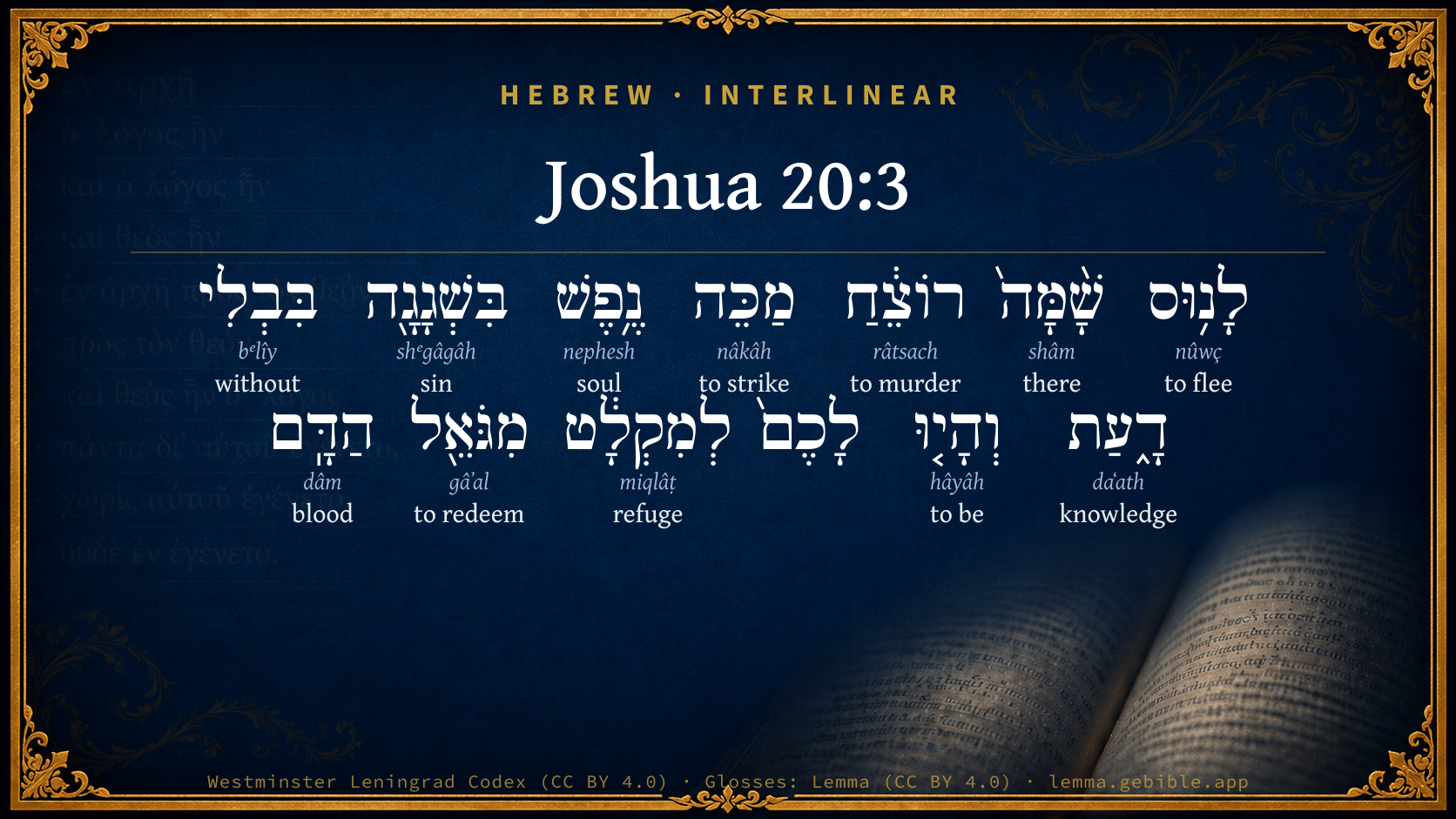
Hebrew (Westminster Leningrad Codex) Joshua 20:3 appears in the Hebrew Old Testament. The text above is from the Westminster Leningrad Codex. Each word links to its Strong’s number, a concise gloss, and parsing drawn from the Open Scriptures Hebrew Bible morphology. Click any word for its full Brown-Driver-Briggs (BDB) entry.
Download image
Cite this verse

Joshua 20:3 (World English Bible). Public Domain. Lemma interlinear Bible study tool, https://lemma.gebible.app/v/joshua/20/3.

Show BibTeX & RIS
BibTeX
RIS
English Translation
that the manslayer who kills any person unwittingly [and] unawares may flee there: and they shall be to you for a refuge from the avenger of blood.
World English Bible · Public Domain
Download a study sheet

One document with this verse’s original text, its word-by-word gloss line, the meaning frame, cross-references with their text, attributed commentary, and full source and license credits — printable, and it pastes into notes with its structure intact.

This verse Autodidact and up

Study sheet (.html) Plain text (.txt)

A passage Seminary Student

Up to 50 verses in one chapter. A passage sheet keeps up to 6 commentary sources and 12 cross-references per verse, in the order this page ranks them, and says so on the sheet whenever that leaves anything out. Ask for a single verse and you get the Autodidact verse sheet above.

Everything on this page stays free to read, with no account — the sheet is a download of what is already on screen, not access to it.

Want to remove ads? Support Godless Engineer
Compare translations 3

The same verse in 3 English versions, stacked beneath the original-language interlinear above. Click any original word for its lexicon entry.

Each is an independent rendering of the whole verse — the interlinear is not word-aligned to these translations.

Highlighted words mark where these versions differ — a whole-verse word diff, not a word-by-word alignment.

  • World English Bible Public Domain
    that the manslayer who kills any person unwittingly [and] unawares may flee there: and they shall be to you for a refuge from the avenger of blood.
  • King James Version Public Domain
    That the slayer that killeth any person unawares and unwittingly may flee thither: and they shall be your refuge from the avenger of blood.
  • unfoldingWord Literal Text CC BY-SA 4.0
    for the fleeing there of the one killing striking a person by mistake without intent. And they will be for you for a refuge from the avenger of blood.

unfoldingWord Literal Text — © unfoldingWord, licensed CC BY-SA 4.0. Word-aligned USFM3 via Door43 (git.door43.org/unfoldingWord/en_ult).

Versions to compare (up to 4)

3 of 4 selected

Show all 18 translations

Every available English version of this verse, each an independent rendering of the whole verse.

  • World English Bible Public Domain
    that the manslayer who kills any person unwittingly [and] unawares may flee there: and they shall be to you for a refuge from the avenger of blood.
  • Berean Standard Bible Public Domain
    so that anyone who kills another unintentionally or accidentally may flee there. These will be your refuge from the avenger of blood.
  • Majority Standard Bible Public Domain
    so that anyone who kills another unintentionally or accidentally may flee there. These will be your refuge from the avenger of blood.
  • King James Version Public Domain
    That the slayer that killeth any person unawares and unwittingly may flee thither: and they shall be your refuge from the avenger of blood.
  • American Standard Version (1901) Public Domain
    that the manslayer that killeth any person unwittingly `and' unawares may flee thither: and they shall be unto you for a refuge from the avenger of blood.
  • Revised Version (1885) Public Domain
    that the manslayer that killeth any person unwittingly and unawares may flee thither: and they shall be unto you for a refuge from the avenger of blood.
  • Geneva Bible (1599) Public Domain
    That the slaier that killeth any person by ignorance, and vnwittingly, may flee thither, and they shall be your refuge from the auenger of blood.
  • Douay-Rheims (1899) Public Domain
    That whosoever shall kill a person unawares may flee to them: and may escape the wrath of the kinsman, who is the avenger of blood:
  • Young's Literal Translation Public Domain
    for the fleeing thither of a man-slayer smiting life inadvertently, without knowledge; and they have been to you for a refuge from the redeemer of blood.
  • Literal Standard Version CC BY-SA 4.0
    for the fleeing there of a manslayer striking life through ignorance, without knowledge; and they have been for a refuge to you from the redeemer of blood.
  • Unlocked Literal Bible CC BY-SA 4.0
    Do this so that one who unintentionally kills a person can go there. These cities will be a place of refuge from anyone who seeks to avenge the blood of a person who was killed.
  • unfoldingWord Literal Text CC BY-SA 4.0
    for the fleeing there of the one killing striking a person by mistake without intent. And they will be for you for a refuge from the avenger of blood.
  • Darby Bible Public Domain
    that the slayer who unwittingly without intent smiteth any one mortally may flee thither: and they shall be your refuge from the avenger of blood.
  • World Messianic Bible Public Domain
    that the man slayer who kills any person accidentally or unintentionally may flee there. They shall be to you for a refuge from the avenger of blood.
  • Webster's Bible Public Domain
    That the slayer that killeth any person unawares and ignorantly, may flee thither: and they shall be your refuge from the avenger of blood.
  • Free Bible Version CC BY-SA 4.0
    Then any man who kills somebody by accident, unintentionally, can run there and they will be protected from those who wish to take revenge.
  • Bible in Basic English Public Domain
    So that any man who in error and without design has taken the life of another, may go in flight to them: and they will be safe places for you from him who has the right of punishment for blood.
  • JPS Tanakh (1917) Public Domain
    that the manslayer that killeth any person through error and unawares may flee thither; and they shall be unto you for a refuge from the avenger of blood.

Literal Standard Version (2020), Covenant Press — licensed CC BY-SA 4.0. Text via the HelloAO Bible API (eBible.org). Unlocked Literal Bible (unfoldingWord) — licensed CC BY-SA 4.0. Text via the HelloAO Bible API (eBible.org). unfoldingWord Literal Text — © unfoldingWord, licensed CC BY-SA 4.0. Word-aligned USFM3 via Door43 (git.door43.org/unfoldingWord/en_ult). Free Bible Version, Dr. Jonathan Gallagher — licensed CC BY-SA 4.0. Text via the HelloAO Bible API (eBible.org).

Word by word

More ways to search: Search by grammar → Find every occurrence → Compare this word →

Practice this passage: Drill this verse → Learn its vocabulary →

בִּשְׁגָגָ֖ה
shᵉgâgâh
H7684
“in/at · sin”
Preposition + Noun, Common, Feminine, Singular, Absolute
Part of Speech
Preposition + Noun
Type
Common
Gender
Feminine
Number
Singular
State
Absolute
Full BDB Definition

Origin: from H7683

TWOT: 2324a

sin, sin of error or inadvertence, inadvertent sin - error
  1. לָנ֥וּס nûwç H5127 “to flee” Preposition + Verb, Qal, Infinitive Construct
  2. שָׁ֨מָּה֙ shâm H8033 “there · toward” Adverb + Suffix, Demonstrative
  3. רוֹצֵ֔חַ râtsach H7523 “murdering” Verb, Qal, Participle Active, Masculine, Singular, Absolute
  4. מַכֵּה nâkâh H5221 “striking” Verb, Hiphil, Participle Active, Masculine, Singular, Construct
  5. נֶ֥פֶשׁ nephesh H5315 “soul” Noun, Common, Both, Singular, Absolute
  6. בִּבְלִי bᵉlîy H1097 “in/at · without of” Preposition + Noun, Common, Masculine, Singular, Construct
  7. דָ֑עַת daʻath H1847 “knowledge” Noun, Common, Feminine, Singular, Absolute
  8. וְהָי֤וּ hâyâh H1961 “and · to be” Conjunction + Verb, Qal, Perfect, 3rd Person, Common, Plural
  9. לְמִקְלָ֔ט miqlâṭ H4733 “to/for · refuge” Preposition + Noun, Common, Masculine, Singular, Absolute
  10. מִגֹּאֵ֖ל gâʼal H1350 “from · redeeming” Preposition + Verb, Qal, Participle Active, Masculine, Singular, Construct
  11. הַדָּֽם dâm H1818 “the · blood” Particle, Definite Article + Noun, Common, Masculine, Singular, Absolute

About this verse

These counts appear in no published source. They are computed here, from the morphology-tagged text and Lemma’s own curated glosses. What Lemma adds →

13
words
12
distinct lemmas
Historical
section

Notable vocabulary

The rarest word here is בִּשְׁגָגָ֖ה sin H7684 — appearing just 19 times in the whole Hebrew Bible.

Shared distinctive vocabulary

בִּשְׁגָגָ֖ה sin H7684 occurs in 18 verses of the Hebrew Bible. Also found in:

Grammatical profile

  • 5 verbs
  • 6 nouns
  • 1 preposition
  • 1 adverb

Verb forms

  • לָנ֥וּס Qal · Infinitive Construct
  • רוֹצֵ֔חַ Qal · Participle Active
  • מַכֵּה Hiphil · Participle Active
  • וְהָי֤וּ Qal · Perfect
  • מִגֹּאֵ֖ל Qal · Participle Active

Hebrew & Septuagint length

In English translation the verse runs 27 words from the Hebrew and 44 from the Septuagint (LXX English) — the Septuagint runs noticeably longer here. See the side-by-side →

A rough comparison of the two English renderings, which tokenize alike — not a word-level alignment.

Word counts can differ between the Hebrew and the Greek without any difference in meaning — e.g. the Hebrew direct-object marker אֵת has no separate Greek word, and Greek often adds the article ὁ.

Hebrew and Greek witnesses Masoretic Hebrew ↔ Greek Septuagint

The same verse in the two great witnesses to the Old Testament, shown verse-for-verse.

Here the Septuagint runs noticeably longer than the Hebrew — LXX2012 (modern English Septuagint) 44 words vs World English Bible 27. A rough length comparison of the two English translations, not a word-level alignment — read both below.

These are two independent witnesses, not word-aligned to each other, and the Septuagint is shown in lemma (dictionary) form.

Hebrew Joshua 20:3 Masoretic · Westminster Leningrad Codex

לָנ֥וּס שָׁ֨מָּה֙ רוֹצֵ֔חַ מַכֵּה נֶ֥פֶשׁ בִּשְׁגָגָ֖ה בִּבְלִי דָ֑עַת וְהָי֤וּ לָכֶם֙ לְמִקְלָ֔ט מִגֹּאֵ֖ל הַדָּֽם

that the manslayer who kills any person unwittingly [and] unawares may flee there: and they shall be to you for a refuge from the avenger of blood.

World English Bible · Public Domain

Greek LXX Joshua 20:3 Septuagint · lemma form

φυγαδευτήριον ὁ φονευτής ὁ πατάσσω ψυχή ἀκουσίως καί εἰμί σύ ὁ πόλις φυγαδευτήριον καί οὐ ἀποθνήσκω ὁ φονευτής ὑπό ὁ ἀγχιστεύω ὁ αἷμα ἕως ἄν καταἵστημι ἐναντίον ὁ συναγωγή εἰς κρίσις

Even a refuge to the slayer who has struck a man unintentionally; and the cities shall be to you a refuge, and the slayer shall not be put to death by the avenger of blood, until he have stood before the congregation for judgment.

LXX2012 (modern English Septuagint) · Public Domain

On this verse, The Pulpit Commentary discusses the Septuagint’s reading. Read the note in Commentary ↓

Hebrew: Westminster Leningrad Codex (CC BY 4.0). Greek: Septuagint (public domain); English from LXX2012 (modern English Septuagint) (Public Domain). How the Septuagint differs from the Hebrew →

Targum (Aramaic paraphrase)

1

The Targum is the ancient Jewish Aramaic paraphrase of the Hebrew Scriptures — an interpretive translation, not the Hebrew text itself. Onkelos (literal) and Pseudo-Jonathan (expansive) render the Torah, and Jonathan the Prophets. Coverage is partial: where no permissively-licensed English translation exists for a verse, only the Aramaic is shown. This is verse-level text, not a word-by-word alignment to the Hebrew.

  1. Targum Jonathan Prophets (Joshua–Malachi)
    לְמֵעֲרוֹק לְתַמָן קָטוֹלָא דְיִקְטוֹל נַפְשָׁא בְּשָׁלוּ בְּלָא מַדְעֵיה וְיֶהֱוְיָן לְכוֹן לְשֵׁזָבָא מִגָאֵל דְמָא:

    (no public-domain English translation for this verse)

    Targum Jonathan — Aramaic: “Mikraot Gedolot” (public domain). English: “Sefaria Community Translation” (CC0 1.0 (public-domain dedication)); “London "Chaldee Paraphrase," 1871” (public domain). Text via Sefaria.

Commentary

Notes on Joshua 20:3 from classic Christian and Jewish commentators (each source and its license shown beneath its notes). The classic Christian expositions comment on the surrounding passage and are grouped to its opening verse, so a note may address several verses; the Jewish commentaries on the Tanakh (Rashi and others) are per-verse, so they appear only where the commentator wrote on this verse.

Lemma curates 59 commentaries, every one of them public domain or Creative Commons licensed, each selected and text-cleaned for this edition rather than reprinted as found. About our sources →

Trapp's Complete Commentary

John Trapp

Jos 20:3 That the slayer that killeth [any] person unawares [and] unwittingly may flee thither: and they shall be your refuge from the avenger of blood.

Ver. 3. That killeth any person unawares and unwittingly.] Not presumptuously, with a high hand, and of forethought malice; but either by chance medley, as they call it, or in his own necessary defence, when he must either kill or be killed, and he cannot avoid it. For that tenet of Soto is false, Defensio cum interfectione est licita, quia fuga est ignominiosa.

John Trapp, A Commentary or Exposition upon All the Books of the Old and New Testament (1647–1656) — public domain. Text from a community e-Sword module.

Joseph Benson's Commentary

Jos 20:3. Unwittingly — Hebrew, Through ignorance, or error, or mistake, and without knowledge. The same thing is twice repeated, to cut off all expectations that wilful murderers might have of protection here. God having declared that such should be taken even from his altar, that they might be killed. It is strange that any Christians should make their sanctuaries give protection to such persons whom God hath so expressly excepted from it! Avenger — The nearest kinsman, who had right or power to demand or take vengeance for the slaughter.

Joseph Benson's Commentary on the Old and New Testaments (1811–1818) — public domain. Text from a community e-Sword module.

Tyndale Open Study Notes

Tyndale Open Resources

20:3 The relatives of a murder or manslaughter victim had the responsibility of seeking revenge for the death. If the avenger (Hebrew go’el) found the killer outside a city of refuge, he could kill him without punishment.

Tyndale Open Study Notes — © Tyndale Open Resources, licensed CC BY-SA 4.0. Text via the HelloAO Bible API.

Geneva Bible (1599)

Geneva Bible translators

At unawares, and bearing him no grudge.

Geneva Bible (1599) marginal notes — public domain. Text via Bolls.life.

The Cambridge Bible for Schools and Colleges

gen. ed. J. J. S. Perowne

3. That the slayer that killeth any person unawares] In accordance with these regulations a wide distinction was made between the man who committed wilful murder, and one who slew another by mistake, in ignorance, and unintentionally. (a) In the former case the guilty criminal met with no compassion from the Mosaic Code. He was regarded as accursed. The horns of the altar were to be no refuge for him. He was to be dragged from them by force to suffer his doom, nor could rank or wealth exempt him from it (Num_35:31-32). (b) In the latter case, where life had been taken unawares, a more merciful system of legislation intervened. In contradistinction to the customs of the Greeks and Romans and even of the Middle Ages, which made places of sanctuary available to criminals of every kind, the Jewish Lawgiver reserved them for unintentional acts of murder, and for these alone. The distinguishing marks of such acts are clearly laid down in Num_35:25-34; Deu_19:4-6.

from the avenger of blood] “that he moue ascaap the wrath of the neiçboure, that is wreker of the blood,” Wyclif. The involuntary shedder of blood was permitted to take flight to a city of refuge.

The Cambridge Bible for Schools and Colleges (gen. ed. J. J. S. Perowne; Cambridge University Press, 1878–1918) — public domain. Text from a community e-Sword module.

John Gill's Exposition

That the slayer that killeth any person unawares, and unwittingly, may flee thither,.... Who through mere accident, and without design, killed a person, friend or foe, one of his own kindred, or a stranger, without any malice against him, or intention to take away his life:

and they shall be your refuge from the avenger of blood; from any of the relations of the deceased, who might be stirred up to avenge the blood of his kinsman on the slayer; see Num 35:12.

John Gill's Exposition of the Whole Bible (1746–1763) — public domain (CC PDM 1.0). Text via the HelloAO Bible API.

Haydock's Catholic Bible Commentary

Of blood, and authorized to kill the manslayer, (Menochius) if he find him out of one of these cities. See Numbers xxxv. 6., and Deuteronomy xix. 4. Revenge was never lawful: but to prosecute offenders in the courts of justice, (Calmet) or agreeably to the law of God, can never deserve blame. (Haydock) --- If some of the saints of the old law seem to have taken delight in revenge, their expressions must be explained in a favourable sense. David, who is accused of this crime, (Calmet) repels the charge with horror, Psalm vii. 5. The evils which he denounces to his adversaries, were predictions of what they had reason to expect, Psalm lvii. 11., and Jeremias xi. 20. (Haydock) --- If some of the Jews looked upon vengeance as lawful, it cannot be a matter of surprise, when we reflect that even some, who have been taught the mild law of the gospel, think themselves bound, in some cases, to revenge an affront. (Calmet) --- So far have the maxims of the world supplanted Christianity in their breasts! How severely does Jacob rebuke his children for what they had done to the Sichemites, though they falsely thought that the affront offered to their sister, would justify them! (Genesis xxxiv.) (Haydock)

George Leo Haydock (1774–1849), Haydock's Catholic Family Bible and Commentary, 1859 edition — public domain. Excludes Psalms (Douay-Rheims chapter numbering differs from Protestant) and Deuterocanonical books (Catholic canon only).

Matthew Poole's English Annotations

Unawares and unwittingly, Heb. through ignorance, or error, or mistake, and without knowledge; the same thing twice repeated, to cut off all the claims and expectations that wilful murderers might have of protection here; and God having declared that such should be taken even from his altar, that they might be killed, Exo 21:14; and accordingly Joab was by Solomon’s order killed even at the altar, 1Ki 2:28-31,34. It is the more strange and impudent that any Christians should make their sanctuaries give protection to such persons whom God hath so expressly excepted from it, which the papists do; and their doctors are not ashamed to defend it upon frivolous reasons.

The avenger of blood; the kinsman, who had right or power to demand or take vengeance of the slaughter.

Matthew Poole's English Annotations on the Holy Bible (1683–1685) — public domain. Text from a community e-Sword/MySword module.

Whedon's Commentary on the Bible

Daniel D. Whedon

3. Unawares and unwittingly — The design of the city of refuge was not to screen criminals, but to afford an opportunity to all accused of so grave a charge to show the absence of a guilty intent. In order to do this the guilty must be temporarily received as well as the innocent.

Avenger of blood — The next of kin, or the Goel, as he is styled in the Hebrew, and still called in the East. In Gen_9:5, Jehovah says, “Your blood in return for the lifeblood which you have shed will I require.” He here expresses his estimate of the sacredness of human life. The avenger of blood is his agent for searching out and punishing murder. In the absence of magistrates and tribunals, one man in each family was required to act as a sheriff for the redress of his kindred and the protection of the body politic. In ancient Greece the land was regarded as defiled and accursed of the gods so long as a murderer dwelt therein unpunished.

Daniel D. Whedon (gen. ed.), Commentary on the Old and New Testaments (1874–1909) — public domain. Text from a community e-Sword module.

The Pulpit Commentary

Unawares and unwittingly. Literally, in error, in not knowing. Num_35:16-18 and Deu_19:5, give a clear explanation of what is here meant. Knobel notices that the first of these expressions is found in Lev_4:2, and the second in Deu_4:42. The latter is "superfluous," and therefore a "filling up of the Deuteronomist." The "Deuteronomist" must have been very active in his "filling up." If he were really so lynx-eyed in a matter of style, it is a wonder that he was so careless, as we are told he is, in matters of fact. To more ordinary minds it would seem as if the author, familiar with the books of Moses, was quoting Deuteronomy for the precept, and Leviticus for the nature of the offence. The avenger of blood. The Hebrew word is worthy of notice. It is Goel; that is, literally, redeemer, one who buys back at the appointed price what has fallen into other hands, as a farm, a field, a slave, or anything consecrated to God. Hence, since the duly of such redemption, on the death of the owner, devolved upon the nearest relative, it came to mean "blood relation." Thus Boaz (Rth_4:1, Rth_4:6, Rth_4:8) is called the Goel of Elimelech and his widow. In the present passage, the phrase "the redeemer (LXX agcisteuwn next of kin) of the blood" signifies the exactor of the only penalty which can satisfy justice, namely, the death of the murderer. So we are taught in Gen_9:6 Exo_21:12, 14 Lev_24:17, Lev_24:21. This duty, which in civilised society belongs to the government, in uncivilised tribes is usually left to the relatives of the murdered man. Hence the terrible blood feuds which have raged between families for generations, and which are not only to be found among savage nations, but even in countries which lay claim to civilisation. In Ireland, for instance, it is not so long ago since one of these blood feuds in the county Tipperary had acquired such formidable proportions that the authorities of the Roman Catholic Church there were compelled to resort to a mission in order to put an end to it. A man had been killed nearly a century before in an affray which commenced about the age of a colt. His relatives felt bound to avenge the murder, and their vengeance was again deemed to require fresh vengeance, until faction fights between the "Three-Year-Olds" and the "Four-Year-Olds" had grown almost into petty wars. A thrilling story written by the late Prosper Merimee turns upon the Corsican vendetta, and so true is this story to life that in the very year (1879) in which these words were written an occurrence precisely similar, save in its termination, was reported in the daily journals to have taken place in that island. The only way in which the feud could be terminated was by summoning the representatives of the two families before the authorities and exacting an oath from them that they would cease their strife. It is no small corroboration of the Divine origin of the Mosaic law that we find here a provision for mitigating the evils of this rude code, and for at least delivering the accidental homicide from the penalty of this law of retaliation. Yet for the offence of wilful murder the penalties enjoined by the Jewish law were terribly severe. A deliberate violation of the sanctity of human life was an offence for which no palliation could be pleaded. No right of sanctuary was to be granted to him who had wantonly slain a fellow creature. "No satisfaction" was to be taken for his life. (Num_35:31) "The land cannot be cleansed of the blood that is shed therein, save by the blood of him that shed it" (ver. 33). Such provisions might be expected of a lawgiver who had laid down as the fundamental principle of humanity that man was created "in the image of God," after His likeness; that God had "breathed the breath of life" into him, and man had thus "become a living soul". (Gen_1:27 Gen_2:7) Such inward harmony is there between Moses" inspired revelations concerning God"s purpose in creation, and the precepts he was commanded to deliver to the children of Israel.

The Pulpit Commentary (1880–1919), ed. H.D.M. Spence-Jones & Joseph S. Exell — public domain. Text from a community e-Sword module.

John Wesley's Explanatory Notes

Unwittingly - Hebrew. Through ignorance, or error, or mistake, and without knowledge. The same thing twice repeated to cut off all the expectations that wilful murderers might have of protection here; God having declared, that such should be taken even from his altar, that they might be killed. It is strange that any Christians should make their sanctuaries give protection to such persons whom God hath so expressly excepted from it! Avenger - The nearest kinsman, who had right or power to demand, or take vengeance of the slaughter.

John Wesley, Explanatory Notes Upon the Whole Bible (1754–1765) — public domain. Text via the GEBible commentary corpus.

Scofield Reference Notes

C. I. Scofield

avenger

Heb. "goel," Redemp. (Kinsman type). (See Scofield "Isa 59:20").

The Scofield Reference Bible (1917 edition), notes by C. I. Scofield — public domain. Text from a community e-Sword module.

Lesson kit

Teaching starters — assembled from the data on this page, not authored interpretation. Every prompt links to the verse data it draws on. Edit before teaching.

Joshua, in the Historical, opens this verse with 13 words (12 distinct Hebrew lemmas). Its most distinctive word is shᵉgâgâh (“sin”). The Greek Septuagint runs longer here. A historical commentator’s framing appears above. Read the whole chapter for the surrounding context.

Discussion questions

  1. The word shᵉgâgâh carries the sense “sin.” How does it shape the verse?
  2. How does Leviticus 4:2, which shares the word «sin», read alongside this verse?
  3. The Septuagint runs longer here than the Hebrew. What might account for the difference?
  4. These translations render this verse differently. What is at stake in choosing one wording over another?
  5. «לָנ֥וּס» is a Qal Infinitive Construct verb. How does that grammatical form shape the action described?
  6. Compare how Trapp's Complete Commentary and Joseph Benson's Commentary read this verse. Where do they agree or differ?

Things to notice

Reading settings

Reading text

Shown beneath each verse's original-language words.

Old Testament
Old Testament edition

Read the OT as the Masoretic Hebrew (MT) or the Greek Septuagint (LXX).

English shown for the Greek Septuagint (in the Hebrew ↔ Greek comparison).

Comparing translations? Open the Compare panel on any verse page to stack up to four side by side.