
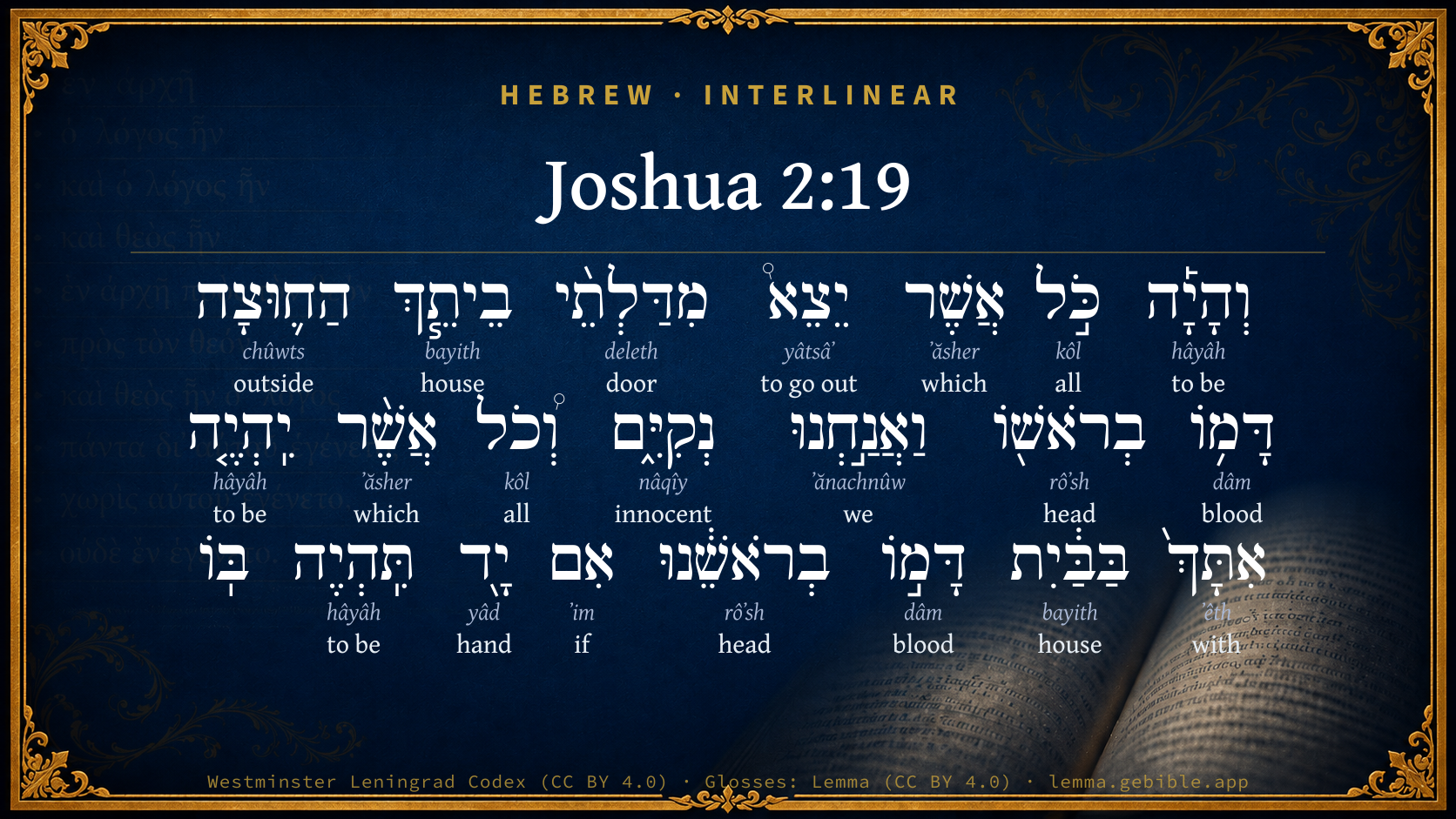
Joshua 2:19

Hebrew (Westminster Leningrad Codex) Joshua 2:19 appears in the Hebrew Old Testament. The text above is from the Westminster Leningrad Codex. Each word links to its Strong’s number, a concise gloss, and parsing drawn from the Open Scriptures Hebrew Bible morphology. Click any word for its full Brown-Driver-Briggs (BDB) entry.
Download image
Cite this verse

Joshua 2:19 (World English Bible). Public Domain. Lemma interlinear Bible study tool, https://lemma.gebible.app/v/joshua/2/19.

Show BibTeX & RIS
BibTeX
RIS
English Translation
It shall be, that whoever shall go out of the doors of your house into the street, his blood shall be on his head, and we shall be guiltless: and whoever shall be with you in the house, his blood shall be on our head, if any hand be on him.
World English Bible · Public Domain
Download a study sheet

One document with this verse’s original text, its word-by-word gloss line, the meaning frame, cross-references with their text, attributed commentary, and full source and license credits — printable, and it pastes into notes with its structure intact.

This verse Autodidact and up

Study sheet (.html) Plain text (.txt)

A passage Seminary Student

Up to 50 verses in one chapter. A passage sheet keeps up to 6 commentary sources and 12 cross-references per verse, in the order this page ranks them, and says so on the sheet whenever that leaves anything out. Ask for a single verse and you get the Autodidact verse sheet above.

Everything on this page stays free to read, with no account — the sheet is a download of what is already on screen, not access to it.

Want to remove ads? Support Godless Engineer
Compare translations 3

The same verse in 3 English versions, stacked beneath the original-language interlinear above. Click any original word for its lexicon entry.

Each is an independent rendering of the whole verse — the interlinear is not word-aligned to these translations.

Highlighted words mark where these versions differ — a whole-verse word diff, not a word-by-word alignment.

  • World English Bible Public Domain
    It shall be, that whoever shall go out of the doors of your house into the street, his blood shall be on his head, and we shall be guiltless: and whoever shall be with you in the house, his blood shall be on our head, if any hand be on him.
  • King James Version Public Domain
    And it shall be, that whosoever shall go out of the doors of thy house into the street, his blood shall be upon his head, and we will be guiltless: and whosoever shall be with thee in the house, his blood shall be on our head, if any hand be upon him.
  • unfoldingWord Literal Text CC BY-SA 4.0
    And it will be, anyone who goes out from the doors of your house to the outside, his blood on his head and we innocent. But anyone who is with you in the house, his blood on our head if a hand shall be on him.

unfoldingWord Literal Text — © unfoldingWord, licensed CC BY-SA 4.0. Word-aligned USFM3 via Door43 (git.door43.org/unfoldingWord/en_ult).

Versions to compare (up to 4)

3 of 4 selected

Show all 18 translations

Every available English version of this verse, each an independent rendering of the whole verse.

  • World English Bible Public Domain
    It shall be, that whoever shall go out of the doors of your house into the street, his blood shall be on his head, and we shall be guiltless: and whoever shall be with you in the house, his blood shall be on our head, if any hand be on him.
  • Berean Standard Bible Public Domain
    If anyone goes out the door of your house into the street, his blood will be on his own head, and we will be innocent. But if a hand is laid on anyone with you in the house, his blood will be on our heads.
  • Majority Standard Bible Public Domain
    If anyone goes out the door of your house into the street, his blood will be on his own head, and we will be innocent. But if a hand is laid on anyone with you in the house, his blood will be on our heads.
  • King James Version Public Domain
    And it shall be, that whosoever shall go out of the doors of thy house into the street, his blood shall be upon his head, and we will be guiltless: and whosoever shall be with thee in the house, his blood shall be on our head, if any hand be upon him.
  • American Standard Version (1901) Public Domain
    And it shall be, that whosoever shall go out of the doors of thy house into the street, his blood shall be upon his head, and we shall be guiltless: and whosoever shall be with thee in the house, his blood shall be on our head, if any hand be upon him.
  • Revised Version (1885) Public Domain
    And it shall be, that whosoever shall go out of the doors of thy house into the street, his blood shall be upon his head, and we will be guiltless: and whosoever shall be with thee in the house, his blood shall be on our head, if any hand be upon him.
  • Geneva Bible (1599) Public Domain
    And whosoeuer then doeth goe out at the doores of thine house into the streete, his blood shalbe vpon his head, and we will be giltlesse: but whosoeuer shall be with thee in the house, his blood shalbe on our head, if any hande touch him:
  • Douay-Rheims (1899) Public Domain
    And they said to her: We shall be blameless of this oath, which thou hast made us swear:
  • Young's Literal Translation Public Domain
    and it hath been, any one who goeth out from the doors of thy house without, his blood `is' on his head, and we are innocent; and any one who is with thee in the house, his blood `is' on our head, if a hand is on him;
  • Literal Standard Version CC BY-SA 4.0
    and it has been, anyone who goes out from the doors of your house outside, his blood [is] on his head, and we are innocent; and anyone who is with you in the house, his blood [is] on our head, if a hand is on him;
  • Unlocked Literal Bible CC BY-SA 4.0
    Whoever goes out of the doors of your house into the street, their blood will be upon their own heads and we will be guiltless. But if a hand is laid upon any who is with you in the house, his blood will be on our head.
  • unfoldingWord Literal Text CC BY-SA 4.0
    And it will be, anyone who goes out from the doors of your house to the outside, his blood on his head and we innocent. But anyone who is with you in the house, his blood on our head if a hand shall be on him.
  • Darby Bible Public Domain
    and it shall be, that whoever shall go out of the doors of thy house into the street, -- his blood shall be upon his head, and we shall be innocent; but every one who shall be with thee in the house, his blood shall be upon our head, if any hand be upon him.
  • World Messianic Bible Public Domain
    It shall be that whoever goes out of the doors of your house into the street, his blood will be on his head, and we will be guiltless. Whoever is with you in the house, his blood shall be on our head, if any hand is on him.
  • Webster's Bible Public Domain
    And it shall be, that whoever shall go out of the doors of thy house into the street, his blood shall be upon his head, and we will be guiltless: and whoever shall be with thee in the house, his blood shall be on our head, if any hand be upon him.
  • Free Bible Version CC BY-SA 4.0
    If anyone leaves your house and is killed, that's their fault—we're not responsible for their death. But if anyone lays a hand on someone who is inside your house, we take full responsibility for their death.
  • Bible in Basic English Public Domain
    Then if anyone goes out of your house into the street, his blood will be on his head, we will not be responsible; but if any damage comes to anyone in the house, his blood will be on our heads.
  • JPS Tanakh (1917) Public Domain
    And it shall be, that whosoever shall go out of the doors of thy house into the street, his blood shall be upon his head, and we will be guiltless; and whosoever shall be with thee in the house, his blood shall be on our head, if any hand be upon him.

Literal Standard Version (2020), Covenant Press — licensed CC BY-SA 4.0. Text via the HelloAO Bible API (eBible.org). Unlocked Literal Bible (unfoldingWord) — licensed CC BY-SA 4.0. Text via the HelloAO Bible API (eBible.org). unfoldingWord Literal Text — © unfoldingWord, licensed CC BY-SA 4.0. Word-aligned USFM3 via Door43 (git.door43.org/unfoldingWord/en_ult). Free Bible Version, Dr. Jonathan Gallagher — licensed CC BY-SA 4.0. Text via the HelloAO Bible API (eBible.org).

Word by word

More ways to search: Search by grammar → Find every occurrence → Compare this word →

Practice this passage: Drill this verse → Learn its vocabulary →

נְקִיִּ֑ם
nâqîy
H5355
“innocent”
Adjective, Adjective, Masculine, Plural, Absolute
Part of Speech
Adjective
Type
Adjective
Gender
Masculine
Number
Plural
State
Absolute
Full BDB Definition

Origin: from H5352

TWOT: 1412a , 1412b

clean, free from, exempt, clear, innocent - free from guilt, clean, innocent - free from punishment - free or exempt from obligations - innocent
  1. וְהָיָ֡ה hâyâh H1961 “and · to be” Conjunction + Verb, Qal, Sequential Perfect, 3rd Person, Masculine, Singular
  2. כֹּ֣ל kôl H3605 “all” Noun, Common, Masculine, Singular, Absolute
  3. אֲשֶׁר ʼăsher H834 “which” Particle, Relative
  4. יֵצֵא֩ yâtsâʼ H3318 “to go out” Verb, Qal, Imperfect, 3rd Person, Masculine, Singular
  5. מִדַּלְתֵ֨י deleth H1817 “from · doors of” Preposition + Noun, Common, Feminine, Dual, Construct
  6. בֵיתֵ֧ךְ bayith H1004 “house · your” Noun, Common, Masculine, Singular, Construct + Suffix, Personal, 2nd Person, Feminine, Singular
  7. הַח֛וּצָה chûwts H2351 “the · outside · toward” Particle, Definite Article + Noun, Common, Masculine, Singular, Absolute + Suffix, Demonstrative
  8. דָּמ֥וֹ dâm H1818 “blood · his” Noun, Common, Masculine, Singular, Construct + Suffix, Personal, 3rd Person, Masculine, Singular
  9. בְרֹאשׁ֖וֹ rôʼsh H7218 “in/at · head · his” Preposition + Noun, Common, Masculine, Singular, Construct + Suffix, Personal, 3rd Person, Masculine, Singular
  10. וַאֲנַ֣חְנוּ ʼănachnûw H587 “and · we” Conjunction + Pronoun, Personal, 1st Person, Common, Plural
  11. וְ֠כֹל kôl H3605 “and · all” Conjunction + Noun, Common, Masculine, Singular, Absolute
  12. אֲשֶׁ֨ר ʼăsher H834 “which” Particle, Relative
  13. יִֽהְיֶ֤ה hâyâh H1961 “to be” Verb, Qal, Imperfect, 3rd Person, Masculine, Singular
  14. אִתָּךְ֙ ʼêth H854 “with · you” Preposition + Suffix, Personal, 2nd Person, Feminine, Singular
  15. בַּבַּ֔יִת bayith H1004 “in/at the · house” Preposition, Determined + Noun, Common, Masculine, Singular, Absolute
  16. דָּמ֣וֹ dâm H1818 “blood · his” Noun, Common, Masculine, Singular, Construct + Suffix, Personal, 3rd Person, Masculine, Singular
  17. בְרֹאשֵׁ֔נוּ rôʼsh H7218 “in/at · head · our” Preposition + Noun, Common, Masculine, Singular, Construct + Suffix, Personal, 1st Person, Common, Plural
  18. אִם ʼim H518 “if” Conjunction
  19. יָ֖ד yâd H3027 “hand” Noun, Common, Both, Singular, Absolute
  20. תִּֽהְיֶה hâyâh H1961 “to be” Verb, Qal, Imperfect, 3rd Person, Feminine, Singular

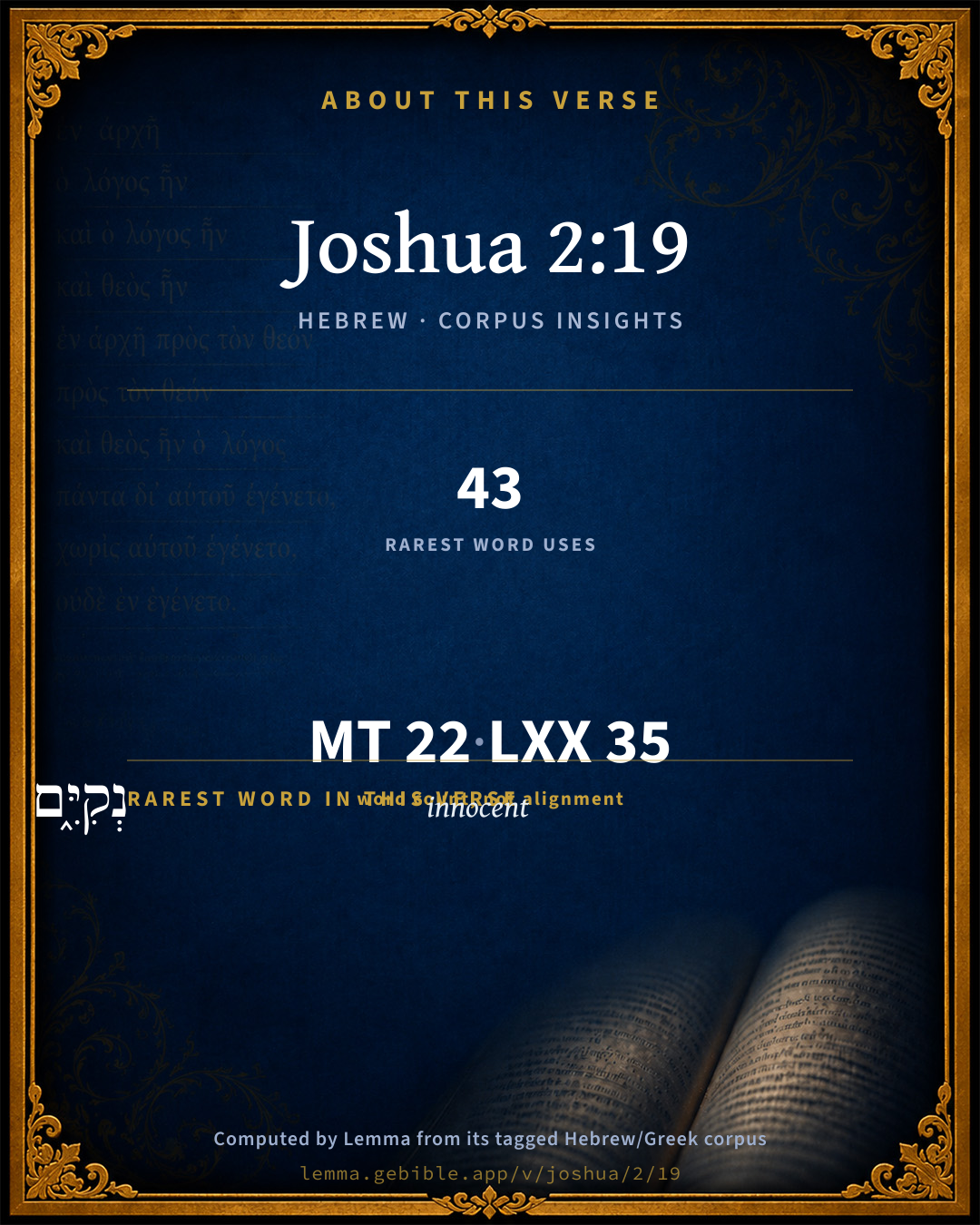
About this verse

These counts appear in no published source. They are computed here, from the morphology-tagged text and Lemma’s own curated glosses. What Lemma adds →

22
words
14
distinct lemmas
Historical
section

Shared distinctive vocabulary

נְקִיִּ֑ם innocent H5355 occurs in 42 verses of the Hebrew Bible. Also found in:

Grammatical profile

  • 4 verbs
  • 11 nouns
  • 1 adjective
  • 1 pronoun
  • 2 prepositions
  • 1 conjunction
  • 2 particles

Verb forms

  • וְהָיָ֡ה Qal · Sequential Perfect
  • יֵצֵא֩ Qal · Imperfect
  • יִֽהְיֶ֤ה Qal · Imperfect
  • תִּֽהְיֶה Qal · Imperfect

Repetition

Words recur within this verse — often emphatic in Hebrew:

  • וְהָיָ֡ה to be H1961 ×3
  • כֹּ֣ל all H3605 ×2
  • בֵיתֵ֧ךְ house H1004 ×2
  • דָּמ֥וֹ blood H1818 ×2
  • בְרֹאשׁ֖וֹ head H7218 ×2
  • אֲשֶׁר which H834 ×2

Hebrew & Septuagint length

In English translation the verse runs 51 words from the Hebrew and 47 from the Septuagint (LXX English) — closely comparable.

A rough comparison of the two English renderings, which tokenize alike — not a word-level alignment.

Word counts can differ between the Hebrew and the Greek without any difference in meaning — e.g. the Hebrew direct-object marker אֵת has no separate Greek word, and Greek often adds the article ὁ.

In the original languages it is 22 Hebrew tokens and 35 Greek tokens — but the two are counted differently (Hebrew bundles its prefixes and suffixes into one token; the Greek is in lemma form), so that isn’t a like-for-like length.

Cross-references

20

Topical passages linked to Joshua 2:19 in the Treasury of Scripture Knowledge — connected by theme and wording, ordered by reader-vote popularity; previews shown in the World English Bible.

  • Acts 27:31 Paul said to the centurion and to the soldiers, "Unless these stay in the ship, you can't be saved."
  • Exodus 12:13 The blood shall be to you for a token on the houses where you are: and when I see the blood, I will pass over you, and there shall no plague be on you to destroy you, when I strike the land of Egypt.
  • Exodus 12:23 For Yahweh will pass through to strike the Egyptians; and when he sees the blood on the lintel, and on the two side-posts, Yahweh will pass over the door, and will not allow the destroyer to come in to your houses to strike you.
  • 1 Kings 2:36–42 The king sent and called for Shimei, and said to him, Build yourself a house in Jerusalem, and dwell there, and don't go forth from there any where.
  • Ezekiel 33:4–5 then whoever hears the sound of the trumpet, and doesn't take warning, if the sword come, and take him away, his blood shall be on his own head.
  • Acts 18:6 When they opposed him and blasphemed, he shook out his clothing and said to them, "Your blood be on your own heads! I am clean. From now on, I will go to the Gentiles!"
  • Leviticus 20:9 "'For everyone who curses his father or his mother shall surely be put to death: he has cursed his father or his mother; his blood shall be upon him.
  • Leviticus 20:11 The man who lies with his father's wife has uncovered his father's nakedness: both of them shall surely be put to death; their blood shall be upon them.
  • Numbers 35:26–28 But if the manslayer shall at any time go beyond the border of his city of refuge, where he flees,
  • Joshua 2:14 The men said to her, Our life for yours, if you don't utter this our business; and it shall be, when Yahweh gives us the land, that we will deal kindly and truly with you.
  • 2 Samuel 1:16 David said to him, Your blood be on your head; for your mouth has testified against you, saying, I have slain Yahweh's anointed.
  • 2 Samuel 3:28–29 Afterward, when David heard it, he said, I and my kingdom are guiltless before Yahweh forever of the blood of Abner the son of Ner:
  • 2 Samuel 4:11 How much more, when wicked men have slain a righteous person in his own house on his bed, shall I not now require his blood of your hand, and take you away from the earth?
  • 1 Kings 2:32 Yahweh will return his blood on his own head, because he fell on two men more righteous and better than he, and killed them with the sword, and my father David didn't know it, [to wit], Abner the son of Ner, captain of the host of Israel, and Amasa the son of Jether, captain of the host of Judah.
  • Matthew 24:17 Let him who is on the housetop not go down to take out things that are in his house.
  • Matthew 27:24–25 So when Pilate saw that nothing was being gained, but rather that a disturbance was starting, he took water, and washed his hands before the multitude, saying, "I am innocent of the blood of this righteous person. You see to it."
  • Acts 20:26 Therefore I testify to you this day that I am clean from the blood of all men,
  • Philippians 3:9 and be found in him, not having a righteousness of my own, that which is of the law, but that which is through faith in Christ, the righteousness which is from God by faith;
  • Hebrews 10:29 How much worse punishment, do you think, will he be judged worthy of, who has trodden under foot the Son of God, and has counted the blood of the covenant with which he was sanctified an unholy thing, and has insulted the Spirit of grace?
  • 1 John 2:27–28 As for you, the anointing which you received from him remains in you, and you don't need for anyone to teach you. But as his anointing teaches you concerning all things, and is true, and is no lie, and even as it taught you, you will remain in him.

Cross-references courtesy of OpenBible.info (CC BY 4.0).

Hebrew and Greek witnesses Masoretic Hebrew ↔ Greek Septuagint

The same verse in the two great witnesses to the Old Testament, shown verse-for-verse.

These are two independent witnesses, not word-aligned to each other, and the Septuagint is shown in lemma (dictionary) form.

Hebrew Joshua 2:19 Masoretic · Westminster Leningrad Codex

וְהָיָ֡ה כֹּ֣ל אֲשֶׁר יֵצֵא֩ מִדַּלְתֵ֨י בֵיתֵ֧ךְ הַח֛וּצָה דָּמ֥וֹ בְרֹאשׁ֖וֹ וַאֲנַ֣חְנוּ נְקִיִּ֑ם וְ֠כֹל אֲשֶׁ֨ר יִֽהְיֶ֤ה אִתָּךְ֙ בַּבַּ֔יִת דָּמ֣וֹ בְרֹאשֵׁ֔נוּ אִם יָ֖ד תִּֽהְיֶה בּֽוֹ

It shall be, that whoever shall go out of the doors of your house into the street, his blood shall be on his head, and we shall be guiltless: and whoever shall be with you in the house, his blood shall be on our head, if any hand be on him.

World English Bible · Public Domain

Greek LXX Joshua 2:19 Septuagint · lemma form

καί εἰμί πᾶς ὅς ἄν ἐκἔρχομαι ὁ θύρα ὁ οἰκία σύ ἔξω ἔνοχος ἑαυτοῦ εἰμί ἐγώ δέ ἀθῷος ὁ ὅρκος σύ οὗτος καί ὅσος ἐάν γίγνομαι μετά σύ ἐν ὁ οἰκία σύ ἐγώ ἔνοχος εἰμί

And it shall come to pass that whoever shall go outside the door of your house, his guilt shall be upon him, and we shall be quit of this your oath; and we will be responsible for all that shall be found with you in your house.

LXX2012 (modern English Septuagint) · Public Domain

Hebrew: Westminster Leningrad Codex (CC BY 4.0). Greek: Septuagint (public domain); English from LXX2012 (modern English Septuagint) (Public Domain). How the Septuagint differs from the Hebrew →

Targum (Aramaic paraphrase)

1

The Targum is the ancient Jewish Aramaic paraphrase of the Hebrew Scriptures — an interpretive translation, not the Hebrew text itself. Onkelos (literal) and Pseudo-Jonathan (expansive) render the Torah, and Jonathan the Prophets. Coverage is partial: where no permissively-licensed English translation exists for a verse, only the Aramaic is shown. This is verse-level text, not a word-by-word alignment to the Hebrew.

  1. Targum Jonathan Prophets (Joshua–Malachi)
    וִיהֵי כָּל דְיִפּוֹק בַּר מִדָשֵׁי בֵּיתֵךְ לְבָרָא חוֹבַת קְטוֹלֵיהּ בְּרֵישֵׁיהּ וַאֲנַחְנָא זַכָּאִין וְכֹל דִי יְהֵי עִמָךְ בְּבֵיתָא חוֹבַת קְטוֹלֵיהּ בְּרֵישָׁנָא אִם יַד אֱנָשׁ תְהֵי בֵיהּ:

    (no public-domain English translation for this verse)

    Targum Jonathan — Aramaic: “Mikraot Gedolot” (public domain). English: “Sefaria Community Translation” (CC0 1.0 (public-domain dedication)); “London "Chaldee Paraphrase," 1871” (public domain). Text via Sefaria.

Commentary

Notes on Joshua 2:19 from classic Christian and Jewish commentators (each source and its license shown beneath its notes). The classic Christian expositions comment on the surrounding passage and are grouped to its opening verse, so a note may address several verses; the Jewish commentaries on the Tanakh (Rashi and others) are per-verse, so they appear only where the commentator wrote on this verse.

Lemma curates 59 commentaries, every one of them public domain or Creative Commons licensed, each selected and text-cleaned for this edition rather than reprinted as found. About our sources →

Joseph Benson's Commentary

Jos 2:19. Upon his head — The blame of his death shall rest wholly upon himself, as being occasioned by his own neglect of the means of safety. Our head — We are willing to bear the sin, and shame, and punishment of it. If any hand be upon him — So as to kill him.

Joseph Benson's Commentary on the Old and New Testaments (1811–1818) — public domain. Text from a community e-Sword module.

Tyndale Open Study Notes

Tyndale Open Resources

2:19 it will not be our fault. But . . . we will accept the responsibility: The spies used a standard formula to accept responsibility for any of Rahab’s family remaining with her in her house, but not for those who did not.

Tyndale Open Study Notes — © Tyndale Open Resources, licensed CC BY-SA 4.0. Text via the HelloAO Bible API.

Geneva Bible (1599)

Geneva Bible translators

He shall be guilty of his own death.

Geneva Bible (1599) marginal notes — public domain. Text via Bolls.life.

Ellicott's Commentary for English Readers

(19) Whosoever shall go out of the doors of thy house into the street, his blood shall be upon his head.—Comp. Exo_12:22 (the account of the Passover), “Ye shall. . . . strike the lintel and the two side-posts with the blood that is in the bason: and none of you shall go out at the door of his house until the morning; for the Lord will pass through to smite the Egyptians.” What the blood was to the houses of Israel in Egypt, that the scarlet line in the window was to the house of Rahab. Both alike prefigured “the precious blood of Christ.”

A Bible Commentary for English Readers, edited by Charles John Ellicott (1878–1897) — public domain. Text from a community e-Sword module.

The Cambridge Bible for Schools and Colleges

gen. ed. J. J. S. Perowne

19. his blood] = his “bloodguiltiness,” his “responsibility for blood.” Compare 2Sa_21:1, “It is for Saul, and his bloody (= “blood-thirsty”) house, because he slew the Gibeonites;” Eze_22:2, “Wilt thou judge the bloody (= “bloodguilty”) city? yea thou shalt shew her all her abominations.

The Cambridge Bible for Schools and Colleges (gen. ed. J. J. S. Perowne; Cambridge University Press, 1878–1918) — public domain. Text from a community e-Sword module.

John Gill's Exposition

And it shall be, that whosoever shall go out of the door of thy house into the street,.... After they have been taken in, and when the Israelites were come into the city:

his blood shall be upon his head, and we will be guiltless; if he is killed by any person, his death will be owing to himself, and no blame to be laid on us; nor shall we reckon ourselves guilty of the breach of the oath taken:

and whosoever shall be with thee in the house, his blood shall be on our head, if any hand be upon him: if anyone within doors is killed by an Israelite entering in, the guilt of the blood shall lie upon us, and we will be answerable, according to the tenor of the oath, "our life for yours", Jos 2:14.

John Gill's Exposition of the Whole Bible (1746–1763) — public domain (CC PDM 1.0). Text via the HelloAO Bible API.

Matthew Poole's English Annotations

His blood shall be upon his head; the blame of his death shall rest wholly upon himself, as being occasioned by his own neglect or contempt of the means of safety.

His blood shall be on our head; we are willing to bear the sin, and shame, and punishment of it.

If any hand be upon him, to wit, so as to kill him, as this phrase is used, Est 6:2; Job 1:12.

Matthew Poole's English Annotations on the Holy Bible (1683–1685) — public domain. Text from a community e-Sword/MySword module.

Whedon's Commentary on the Bible

Daniel D. Whedon

19. [

His blood shall be upon his head — A technical formula of retribution indicating the punishment of death when justly brought upon one’s self, and equivalent to, Let the guilt of his death fall back upon himself. See note on Act_18:6.]

If any hand be upon him — That is, to injure or to slay.

Daniel D. Whedon (gen. ed.), Commentary on the Old and New Testaments (1874–1909) — public domain. Text from a community e-Sword module.

The Pulpit Commentary

His blood shall be upon his head. (cf. Lev_20:9) "If we will wander out of the limits that God has set us, we cast ourselves out of His protection." (Bp. Hall).

The Pulpit Commentary (1880–1919), ed. H.D.M. Spence-Jones & Joseph S. Exell — public domain. Text from a community e-Sword module.

John Wesley's Explanatory Notes

Upon his head - The blame of his death shall rest wholly upon himself, as being occasioned by his own neglect of the means of safety. Our head - We are willing to bear the sin, and shame, and punishment of it. Be upon him - So as to kill him.

John Wesley, Explanatory Notes Upon the Whole Bible (1754–1765) — public domain. Text via the GEBible commentary corpus.

Rashi

Rabbi Shlomo Yitzchaki (Rashi)

His blood is on his own head. The guilt of his killing is on his own head, for he will have caused his own death.

His blood is on our heads. The guilt of his killing will be upon us.

Rashi on the Tanakh — English translations: “The Judaica Press complete Tanach with Rashi, translated by A. J. Rosenberg” (CC BY 4.0); “Pentateuch with Rashi's commentary by M. Rosenbaum and A.M. Silbermann, 1929-1934” (public domain); “The Metsudah Tanach series, Lakewood, N.J” (CC BY 4.0); and “The Book of Joshua, Metsudah Publications, 1997” (CC BY 4.0). Text via Sefaria.

Lesson kit

Teaching starters — assembled from the data on this page, not authored interpretation. Every prompt links to the verse data it draws on. Edit before teaching.

Joshua, in the Historical, opens this verse with 22 words (14 distinct Hebrew lemmas). Its most distinctive word is nâqîy (“innocent”). A historical commentator’s framing appears above. Read the whole chapter for the surrounding context.

Discussion questions

  1. The word nâqîy carries the sense “innocent.” How does it shape the verse?
  2. Genesis 24:41 shares the word «innocent» with this verse. How do the two illuminate each other?
  3. “to be” occurs 3× in this one verse. What is the effect of the repetition?
  4. These translations render this verse differently; the difference is in the English rendering, not the original. What questions does that raise?
  5. The verb «וְהָיָ֡ה» is Qal Sequential Perfect. How does its form color the action?
  6. Reading how Joseph Benson's Commentary and Tyndale Open Study Notes read this verse, where do the two commentators agree and where do they part?

Things to notice

Reading settings

Reading text

Shown beneath each verse's original-language words.

Old Testament
Old Testament edition

Read the OT as the Masoretic Hebrew (MT) or the Greek Septuagint (LXX).

English shown for the Greek Septuagint (in the Hebrew ↔ Greek comparison).

Comparing translations? Open the Compare panel on any verse page to stack up to four side by side.