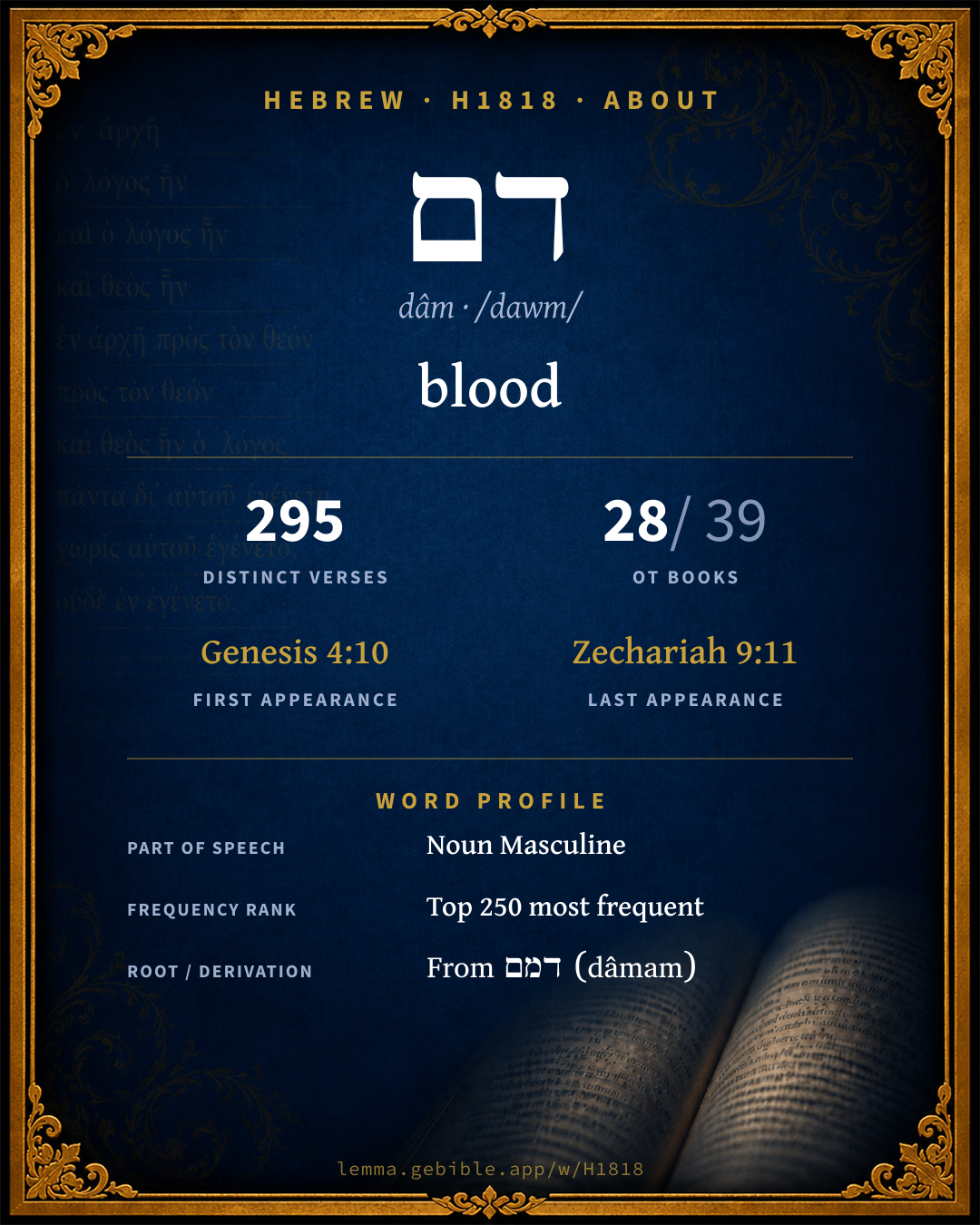
דָּם
blood
‘blood’ is one of 2 main senses fuller range ↓
Full lexicon entry — Brown-Driver-Briggs (BDB)
From Brown-Driver-Briggs (BDB)
Where this word appears
See every Absolute-state word in the Hebrew Bible →
Grammar key — what these labels mean
Part of speech
- Noun
- A naming word — a person, place, thing, or idea.
Noun type
- Common
- A common noun — a general class of person, place, or thing (“king,” “city,” “water”), not a specific name.
State
- Absolute
- The independent form of a noun, not bound to a following word.
- Construct
- A noun bound to a following noun in a possessive / “of” relationship (the construct chain).
Gender
- Masculine
- Grammatically masculine.
Number
- Singular
- One.
- Plural
- More than one (in Hebrew, generally three or more).
Every verse where H1818 appears in the Book of Isaiah — 14 distinct verses. Click any verse to open its interlinear word-by-word view. Verse text shown in the World English Bible for context — . Each verse’s Hebrew form is shown with its reference; the English is not keyword-highlighted, since the data carries no word-level English alignment. Use “Compare translations” on any verse to read it across multiple English versions. This concordance covers the Hebrew Bible; Septuagint (Greek Old Testament) occurrences are not indexed here.
Isaiah
- Isaiah 1:11 וְ/דַ֨ם conj + n c ms cs "What are the multitude of your sacrifices to me?," says Yahweh. "I have had enough of the burnt offerings of rams, And the fat of fed animals. I don't delight in the blood of bulls, Or of lambs, Or of male goats.
- Isaiah 1:15 דָּמִ֥ים n c mp When you spread forth your hands, I will hide my eyes from you; Yes, when you make many prayers, I will not hear. Your hands are full of blood.
- Isaiah 4:4 דְּמֵ֥י n c mp cs when the Lord shall have washed away the filth of the daughters of Zion, and shall have purged the blood of Jerusalem from its midst, by the spirit of justice, and by the spirit of burning.
- Isaiah 9:5 בְ/דָמִ֑ים prep + n c mp For all the armor of the armed man in the tumult, and the garments rolled in blood, shall be for burning, for fuel of fire.
- Isaiah 15:9 דָ֔ם n c ms For the waters of Dimon are full of blood; for I will bring yet more on Dimon, a lion on them of Moab that escape, and on the remnant of the land.
- Isaiah 26:21 דָּמֶ֔י/הָ n c mp cs + sfx pers 3fs For, behold, Yahweh comes forth out of his place to punish the inhabitants of the earth for their iniquity: the earth also shall disclose her blood, and shall no more cover her slain.
- Isaiah 33:15 דָּמִ֔ים n c mp He who walks righteously, and speaks blamelessly; he who despises the gain of oppressions, who shakes his hands from taking a bribe, who stops his ears from hearing of blood, and shuts his eyes from looking on evil:
- Isaiah 34:3 מִ/דָּמָֽ/ם prep + n c ms cs + sfx pers 3mp Their slain also shall be cast out, and the stench of their dead bodies shall come up; and the mountains shall be melted with their blood.
- Isaiah 34:6 דָם֙ מִ/דַּ֤ם n c ms prep + n c ms cs The sword of Yahweh is filled with blood, it is made fat with fatness, with the blood of lambs and goats, with the fat of the kidneys of rams; for Yahweh has a sacrifice in Bozrah, and a great slaughter in the land of Edom.
- Isaiah 34:7 מִ/דָּ֔ם prep + n c ms The wild-oxen shall come down with them, and the bulls with the bulls: and their land shall be drunken with blood, and their dust made fat with fatness.
- Isaiah 49:26 דָּמָ֣/ם n c ms cs + sfx pers 3mp I will feed those who oppress you with their own flesh; and they shall be drunken with their own blood, as with sweet wine: and all flesh shall know that I, Yahweh, am your Savior, and your Redeemer, the Mighty One of Jacob.
- Isaiah 59:3 בַ/דָּ֔ם prep det + n c ms For your hands are defiled with blood, and your fingers with iniquity; your lips have spoken lies, your tongue mutters wickedness.
- Isaiah 59:7 דָּ֣ם n c ms Their feet run to evil, and they make haste to shed innocent blood: their thoughts are thoughts of iniquity; desolation and destruction are in their paths.
- Isaiah 66:3 דַּם n c ms cs He who kills an ox is as he who kills a man; he who sacrifices a lamb, as he who breaks a dog's neck; he who offers an offering, [as he who offers] pig's blood; he who burns frankincense, as he who blesses an idol. Yes, they have chosen their own ways, and their soul delights in their abominations:
About this entry
At a glance — auto-summarized from this page’s data, not written by a person. Every figure links to its source below. This summary describes the numbers; it doesn’t interpret them.
דם (dâm) is a Hebrew noun most often rendered “blood.” Debuting at Genesis 4:10, it then recurs through the corpus. With 295 verses in 28 books, it is a common word in the Hebrew Bible. It is not a single-sense word — see its full sense range. From the same root come דמם, דומם and דממה. For the data behind this summary, explore the sense tree and the renderings breakdown below.
Gloss history
Strong's 1890 vs modern scholarship
About this word
Strong's H1818 catalogs a Hebrew word from the Hebrew Old Testament.
These counts are not copied from any lexicon or concordance. They are computed here, from the morphology-tagged Hebrew Old Testament. What Lemma adds →
- 295
- distinct verses
- The word appears in 295 distinct verses.
- 28 / 39
- OT books
- The word appears in 28 of 39 Old Testament books.
- #137
- by frequency
- Top 250 most frequent Hebrew words (rank 137 of 8,640 Hebrew words by occurrence).
View all 295 occurrences in the concordance →
By section of the Old Testament
By traditional corpus
Conventional, traditional groupings — biblical authorship is debated, so this is a traditional corpus grouping, not an authorship claim. Each share is this word’s portion of its verses in that division of the Hebrew canon. Each figure is a share of the word’s 295 distinct verses.
- Prophets (Nevi'im) 131 verses · 44%
- Torah (Pentateuch) 125 verses · 42%
- Writings (Ketuvim) 39 verses · 13%
How translations render this word
Counts come from each version’s own published word-to-Strong’s tagging or interlinear alignment — an approximate guide to how each version renders this word, not a word-level alignment the data otherwise carries. Because each total is that version’s own tagged count, the per-version totals vary from one another and need not match the appearance or distinct-verse counts above. These counts may also differ from a printed concordance because Lemma counts each distinctly tagged rendering and does not collapse phrase taggings into a single head-word total. This is a fixed set of word-tagged versions (KJV, ASV, BSB, ULT) and does not change with the reading translation you choose elsewhere. Each version’s license is shown beside its name below (and on Sources).
- King James Version: Blood 285×, Bloody 11×, All the blood 7×
- American Standard Version: Blood 263×, All the blood 7×, Bloody 6×
- Berean Standard Bible: Blood 247×, Bloodshed 34×, Some of the blood 6×
- unfoldingWord Literal Text: Blood 241×, Blood of 55×, Bloodshed 18×
King James Version Public Domain
Renders H1818 across 358 tagged occurrences — most commonly:
Plus 39 renderings that appear only once — usually multi-word phrases or single function words the recovered tagging swept in, not distinct renderings. Not rendered by a distinct English word in 3 further occurrences.
American Standard Version Public Domain
Renders H1818 across 357 tagged occurrences — most commonly:
Plus 56 renderings that appear only once — usually multi-word phrases or single function words the recovered tagging swept in, not distinct renderings.
Berean Standard Bible Public Domain
Renders H1818 across 347 tagged occurrences — most commonly:
Plus 31 renderings that appear only once — usually multi-word phrases or single function words the recovered tagging swept in, not distinct renderings. Not rendered by a distinct English word in 13 further occurrences.
unfoldingWord Literal Text CC BY-SA 4.0
Renders H1818 across 373 tagged occurrences — most commonly:
Plus other, less common renderings. Plus 19 renderings that appear only once — usually multi-word phrases or single function words the recovered tagging swept in, not distinct renderings.
16 senses and sub-senses in the full BDB
What do BDB’s symbols mean?
BDB uses these scholarly abbreviations:
| Symbol | Meaning |
|---|---|
| 𝔊 | the Septuagint (the ancient Greek translation, LXX) |
| 𝔙 | the Vulgate (the Latin translation) |
| 𝔖 | the Syriac version (the Peshitta) |
| 𝔗 | the Targum (the Aramaic translation) |
| ψ | the Psalms |
| √ | root (the underlying root or stem) |
| ‖ | parallel passage (a synonymous or contrasted parallel) |
| † | the dagger: every passage where the word occurs is cited |
The 16 senses and sub-senses the full Brown-Driver-Briggs lexicon distinguishes for this word, in lexicon order (not ranked by frequency), with BDB’s own verbatim wording and sub-sense lettering. Shown in Hebrew script with BDB’s own scholarly abbreviations. The condensed entry is in the Lexicon Entry tab. See also the Forms in the corpus table below.
- 1. blood of man or animal, = the life (נֶפֶשׁ) Gn 9:4 (P) Dt 12:23; Lv 17:14(×2) (H); cf. נֶפֶשׁ הַבָּשָׂר בַּדָּם הִוא v 11 (H & דִּמְכֶם לְנַפְשֹׁתֵיכֶם Gn 9:5 (P); see also ψ 72:14 וְיֵיקַר דָּמָם בְּעֵינָיו; hence blood of animals not to be eaten Lv 3:17; 7:26, 27 (all P) 17:10(×2), 12(×2), 14; 19:26 (all H) Dt 12:16, 23; 15:23; 1 S 14:32, 33, 34; Ez 33:25 (cf. RSK 310), but to be poured out & covered with dust Lv 17:13 (cf. RSSem i. 216 f.). e.g. Genesis 9:4
- 2. usually blood become visible,
- a. as from a wound ד׳ הַמַּכָּה 1 K 22:35 (cf. חֲתַן דָּמִים Ex 4:25, 26 v. infr. h); licked by dogs 1 K 21:19(×2); 22:38; Ex 32:6; from the nose Pr 30:33; bloody issue of a woman Lv 15:19 cf. v 25; pl. דְּמֵי טָֽהֳרָה 12:4, 5, & מְקֹר דָּמֶיהָ v 7 (all P) 20:18 (H); blood in which child welters Ez 16:6(×2), 22 + v 6 (del. A B 𝔖 Co al.); of goat Gn 37:31 (JE); of slain bird Lv 14:6, 51, 52. e.g. 1 Kings 22:35
- b. often obj. of שָׁפַךְ spill, shed Gn 9:6 (P); 37:22 (E); Nu 35:33 (P); Lv 17:4 (H); Dt 21:7; 1 S 25:31; 1 K 18:28; 2 K 21:16; 24:4; 1 Ch 22:8; Ez 16:38; 22:4, 6, 9, 12, 27; 23:45; 33:25; 36:18 (del. B Co) Pr 1:16; also ψ 79:3 שָֽׁפְכוּ דָמָם כַּמַּיִם; שֹׁפֵךְ דָּם a blood-shedder Ez 18:10; עִיר שֹׁפֶכֶת דָּם Ez 22:3 cf. v 4 (also 1 K 2:31; Je 22:3, 17; 1 Ch 22:8; 28:3; Pr 6:17; La 4:13); less often subj. of pass. שָׁפוּךְ, נִשְׁפָּךְ, etc. Gn 9:6; Nu 35:33 (both P); Dt 19:10; Zp 1:17; ψ 79:10. e.g. Genesis 9:6
- c. דַּם חָלָל Dt 32:42 (song) blood of slain; ד׳ חֲלָלִים 2 S 1:22 so Nu 23:24 (JE), obj. of שָׁתָה, of Isr. under fig. of lion; cf. also Ez 39:17, 18, 19, & 2 S 23:27 = 1 Ch 11:19 (דַּם הָאֲנָשִׁים hyperbol. for imperilled life); as food of young eagles Jb 39:30. e.g. Deuteronomy 32:42
- d. often of innocent blood, i.e. blood shed with injustice & cruelty, דָּם נָקִי Dt 21:8, 9; 1 S 19:5; 2 K 21:16; 24:4 ψ 94:21; 106:38 cf. v 38 Pr 6:17; Is 59:7; Je 7:6; 22:3 (also 26:15); דָּם נָקִיא Jo 4:19; Jon 1:14; also in cstr. דַּם נָקִי Dt 19:10; cf. 27:25 לְהַכּוֹת נֶפֶשׁ ד׳ נ׳; דַּם הַנָּקִי Dt 19:13; Je 22:17; 2 K 24:4; דַּם נְקִיִּים Je 19:4; דַּם נַפְשׁוֹת אֶבְיוֹנִים נְקִיִּים Je 2:34; further דַּם צַדִּיקִים La 4:13; דְּמֵי חִנָּם 1 K 2:31; in ψ 30:10 דָּמִי = my death (‖ רִדְתִּי אֶל־שַׁחַת e.g. Deuteronomy 21:8
- e. avenger of blood גֹּאֵל הַדָּם Nu 35:19, 21, 24, 25, 27(×2) (all P); Dt 19:6, 12; Jos 20:3, 5, 9; 2 S 14:11. e.g. Numbers 35:19
- f. pl. דָּמִים of abundance, blood in quantity, hence sometimes of blood shed by rude violence, and of blood-stains;—Gn 4:10, 11 (J) as crying from the ground for vengeance (cf. RSSem i. 397), comp. also 2 S 3:28; 16:8; 2 K 9:26(×2); Is 1:15; 9:4; 26:21; Ez 16:6(×3), 9, 36 (on text of v 6 vid. supr.) Zc 9:7; 2 Ch 24:25; דְּמֵי אָדָם Hb 2:8, 17, and in other connexions; but interchangeably with sg. 2 S 3:27; 20:12; 2 K 9:33; Is 34:3, 6,(×2), 7; Ez 21:37; 22:13 (pl. Co) 24:8(×2) al.; v. especially אֶרֶץ אַל־תְּכַסִּי דָמִי Jb 16:18; דְּמֵי ירושׁלם blood-stains of Jerusalem Is 4:4; = slaughter, sg. Gn 37:26 (J); Je 48:10; Ez 5:17; 28:23 (‖ דֶּבֶר) 38:22 (‖ id.); דַּם־עֲבָדָיו Dt 32:43 (song: cf. ψ 79:10); pl. דְּמֵי עֲבָדַי 2 K 9:7(×2); דְּמֵי יִזְרְעֶאל Ho 1:4 bloodshed at Jezreel; cf. דָּמִים בְּדָמִים נָנָ֑עוּ Ho 4:2; דְּמֵי מִלְחָמָה 1 K 2:5(×2); in Ez 9:9 וַתִּמָּלֵא הָאָרֶץ חָמָם (Bear) read דָּמִים for חָמָס v. d. H Vrss Co Comm.; אָרַב לְדָם lie in wait for blood Pr 1:11 cf. v 18; 12:6; Mi 7:2; דָּמִים of a plan of murder Is 33:15 (obj. of שׁמע); מִשְׁפַּט דָּמִים Ez 7:23 bloody crime; as symbol of oppression, violence Mi 3:10 (‖ עַוְלָה), Hb 2:12 (‖ id.) e.g. Genesis 4:10
- g. דָּמִים = guilt of bloodshed, blood-guiltiness Ex 22:1, then more generally, mortal sin (RSOTJC 417, 2nd ed. 441, cf. Ez 18:13) ψ 51:16 (cf. Ho 12:15); also בּוֹא בְדָמִים 1 S 25:26, 33. e.g. Exodus 22:1
- h. pl. also in phrases: חֲתַן דָּמִים bloody bridegroom Ex 4:25, 26; also those denoting character, chiefly poet., אִישׁ הַדָּמִים bloody man (sanguinary) 2 S 16:8 ψ 5:7 אִישׁ הַדָּמִים 2 S 16:7; אַנְשֵׁי דָּמִים, ψ 26:9; 55:24; 59:3; 139:19; Pr 29:10; ואל־בֵּית הַדָּמִים bloody house 2 S 21:1 but read with 𝔊 We Dr ואל בֵּיתֹה דמים, & on his house is blood; עִיר דָּמִים Na 3:1; עִיר הַדָּמִים Ez 22:2; 24:6 + v 9 (del. B Co). e.g. Exodus 4:25
- i. דָּמָיו בּוֹ his blood is in (upon) him, he is responsible for his own death Lv 20:9 cf. v 11, 12, 13, 16, 27 (all H), Ez 18:13 (+ יִהְיֶה); דָּמוֹ בּוֹ Ez 33:5; דָּמוֹ בְּרֹאשׁוֹ Jos 2:19(×2); so with שָׁבוּ 1 K 2:33 יִהְיֶה v 37; Ez 33:4; דָּֽמְי֯ךָ עַל רֹאשֶׁ֑ךָ 2 S 1:16, and הֵשִׁיב י׳ אֶת־דָּמוֹ עַל־רֹאשׁוֹ 1 K 2:32; also לֹא תָשִׂים דָּמִים בְּבֵיתְךָ Dt 22:8; and דָּמָם לָשׁוּם עַל אֲבִימֶלֶךְ Ju 9:24; (אל) נָתַן דָּם על Je 26:15; Jon 1:14; וְהָיָה עָלֶיךָ דָּמִים Dt 19:10, v 2 S 21:1 supr.; also sg. Ez 22:4 בְּדָמֵךְ אָשַׁמְתְּ, and as subj. of יֵחָשֵׁב לְ shall be imputed to Lv 17:4 (H); אֵין לוֹ דָמִים Ex 22:1 cf. v 2 (both JE) & (sg.) Nu 35:27 (P) e.g. Leviticus 20:9
- j. of judicial process in case of bloodshed דָּבָר לַמִּשְׁפָּט בֵּין־דָּם לְדָם Dt 17:8 cf. 2 Ch 19:10; לֹא תַּעֲמֹד עַל־דַּם רֵעֶ֑ךָ Lv 19:16 (H). k. in phrase require blood at the hand of, exact vengeance (for it) from, דָּרַשׁ דָּמוֹ מִיַד Ez 33:6; Gn 9:5; דָּמוֹ נִדְרָשׁ Gn 42:22 (E); abs. דֹּרשׁ דמים ψ 9:13; אֲבַקֵּשׁ אֶת־דָּמוֹ מִיֶּדְכֶם 2 S 4:11 cf. Ez 3:18, 20; 33:8; פָּקַד ד׳ עַל־ Ho 1:4; וְנִקֵּיתִי ד׳ Jo 4:21; Ez 35:6(×4); cf. on the other hand אַל־יִפֹּל דָּמִי אַרְצָה מִנֶּגֶד פְּנֵי י׳ 1 S 26:20 i.e. let it not be unavenged. l. of blood as defiling a land Nu 35:33 (P) cf. ψ 106:38 (pl. בדמים); עֲקֻבָּה מִדָּם Ho 6:8 of a city foot-printed (VB) with blood; defiling hands Is 1:15; 59:3; La 4:14 cf. Ez 23:37, 45; further, of blood as oppressing one who has shed it עָשֻׁק בְּדַם נֶפֶשׁ Pr 28:17. m. atonement for blood-guilt is expressed by וְנִכַּפֵּר לָהֶם הַדָּם Dt 21:8 (on form of vb. cf. Ges§ 55.9 & Di). n. blood (-shedding) as connected with divine wrath וְשָׁפַכְתִּ֫י חֲמָתִי עָלֶיהָ בְּדָם Ez 14:19; דַּם חֵמָה וְקִנְאָה Ez 16:38; v. further אַשְׁכִּיר חִצַּי מִדָּם Dt 32:42, cf. Je 46:10; cf. also of human vengeance by divine help יִרְחַץ בְּדַם הָרָשָׁע ψ 58:11; תִּמֲחַץ רַגְלְךָ בְּדָם 68:24; note further Is 49:26; Ez 39:19 (in both fig. of being drunk with blood); then of simple human vengeance וְהוֹרַדְתָּ֫ אֶת־שֵׂיבָתוֹ בְּדָם שְׁאוֹל 1 K 2:9. o. of water turned into blood (sg.) in Egypt, by divine power Ex 4:9 (J); 7:17, 20 (JE); v 19(×2), 21 (P) ψ 78:44; 105:29; cf. Is. 15:9 & Ez 32:6; further, of appearance of blood in sky Jo 3:3, & of colour of moon v 4; specifically of red colour of water אֲדֻמִּים כַּדָּם 2 K 3:22; cf. v 23. e.g. Deuteronomy 17:8
- 3. blood used with religious significance,
- a. blood of passover-lamb Ex 12:7, 13(×2) (all P) v 22(×2), 23 (all JE); note also דַּם הַבְּרִית i.e. blood by which a covenant was ratified Ex 24:8 (JE) Zc 9:11. e.g. Exodus 12:7
- b. blood used in ritual, Lv 17:11 הַדָּם הוּא בַּנֶּפֶשׁ יְכַפֵּר (H); cf. 2 Ch 29:24; also Ez 44:7, 15 (both ‖ חֵלֶב); further Lv 1:5; Is 1:11 ψ 50:13; thrown on altar, vb. זָרַק usually c. עַל Ex 24:6 (JE); 29:16, 20; Lv 1:5, 11; 3:2, 8, 13; 7:2, 14; 8:19, 24; 9:12, 18 (all P); 17:6 (H); Nu 18:17 (P) Ez 43:18; 2 K 16:13, 15(×2) 2 Ch 29:22(×3) cf. 30:16; sprinkled, vb. הִזָּה Lv 5:9; 16:19 (both P); sprinkled toward tent of meeting (vb. הִזָּה) Nu 19:4(×2) (P); brought into tent of meeting Lv 4:5, 16; 6:23; cf. 10:18 (all P); sprinkled toward the holy of holies (vb. הִזָּה) Lv 4:6(×2), 17; 16:14(×2) (all P); brought within the veil on day of atonement Lv 16:15(×3) (cf. v 14) v 27 (all P); thrown on people Ex 24:8 (JE; זָרַק); sprinkled on priests (הִזָּה) Ex 29:21; Lv 8:30 (both P); on garment (in sanctuary, הִזָּה) Lv 6:20 (P); applied with finger to horns of altar Ex 29:12; Lv 4:7, 18, 25, 30, 34; 8:15; 9:9(×3); 16:18(×2) (all P; cf. also Ez 45:19) Ez 43:20; applied to tip of right ear of priest Ex 29:20; Lv 8:23, 24 (all P; also Lv 14:14, 25 P); poured out at base of altar (שָׁפַךְ אֶל־) Ex 29:12; Lv 4:7, 18, 25, 30, 34 (all P); cf. with מָצָה (Niph.) Lv 1:15; 5:9; with יָצַק 8:15 (all P); half of blood put in basons Ex 24:6 (JE); blood poured out on altar Dt 12:27(×2); blood of red heifer burned Nu 19:5 (P); vid. further such terms as דַּם זִבְחִי Ex 23:18; 34:25 (both JE) (cf. Dt 12:27; 2 K 16:15); דַּם הַשְּׁלָמִים Lv 7:33 (P; cf. v 14); דַּם חַטָּאת הַכִּפֻּרִים Ex 30:10 (P) cf. Ez 45:19; דּם הָאָשָׁם Lv 14:14, 17, 25, 28; (v זֶבַח, שֶׁלֶם, חַטָּאת, אָשָׁם); דַּם־חֲזִיר, swine’s blood, as heathen offering Is 66:3; cf. נִסְכֵּיהֶם מִדָּם ψ 16:4 (v. Che). e.g. Leviticus 17:11
- 4. fig. of wine דַּם־עֲנָבִים Gn 49:11 (blessing of Jacob ‖ יַיִן); cf. Dt 32:14 (song) דַּם עֵנָב תִּשְׁתֶּה־הָ֑מֶר—בְּדָֽמְךָ Ez 19:10 prob. text. error cf. VB; Da proposes בְּרוּמָהּ in her height. e.g. Genesis 49:11
Senses from the full Brown-Driver-Briggs lexicon (Brown, Driver, Briggs; Oxford 1906 — public domain), digitized via Sefaria, supplemented by the OpenScriptures HebrewLexicon (CC BY 4.0). Full attribution on Sources.
Word origin
n.m. Gn 9:6 blood (NH id. Arabic دَمٌ, Ethiopic ደም: Assyrian damu Nor 239 ZimBP 72, 76; Aramaic דַּם, דְּמָא, ܕܶܡ, ܕܡܳܐ )—abs. ד׳ Gn 37:22 + 154 times; cstr. דַּם Gn 9:6 + 62 times; sf. דָּמִי 1 S 26:20 + 3 times; דָּֽמְךָ 2 S 1:16 (Qr; Kt דמיך) + 4 times; דָּמֵךְ Ez 16:22 + 3 times; דָּמוֹ Gn 9:4 + 30 times דָּמָהּ Lv 4:30(×2) + 11 times; דִּמְכֶם Gn 9:5; דָּמָם Lv 16:27 + 11 times; pl. דָּמִים Ex 4:25 + 35 times; cstr. דְּמֵי Gn 4:10 + 18 times; sf. דָּמֶיךָ 2 S 1:16 Kt (Qr דָּֽמְךָ); דָּמַיִךְ Ez 16:6(×3), 9; דָּמָיו Lv 20:9 + 3 times; דָּמֶיהָ Lv 12:7 + 2 times; דְּמֵיהֶם Lv 20:11 + 5 times;—
— Brown-Driver-Briggs (Oxford 1906, public domain), digitized via Sefaria, supplemented by the OpenScriptures HebrewLexicon (CC BY 4.0). See Sources.
Derived from דמם (dâmam) (H1826) — to be silent.
Jastrow Dictionary
A second Hebrew/Aramaic lexicon for comparison, covering Aramaic and post-biblical (Talmudic, Targumic, Midrashic) usage that the biblical-Hebrew BDB does not. Matched by lemma rather than by Strong’s number, so a lemma may carry more than one Jastrow headword (shown separately below), and the entries cover usage well beyond the Bible.
דָּם
- , constr. דַּם (b. h.; דום or דמם, cmp. דבב) liquid; blood; life. Men. 44ᵃ בדָמוֹ (not בדמה, v. Rabb. D. S. a. l. note) with the juice of the purple shell.—Sabb. 31ᵇ רביעית ד׳ וכ׳ one fourth of a Log of blood did I (the Lord) put in your body (the smallest quantity required to sustain life, v. Sot. 5ᵃ). Snh. 72ᵇ (ref. to Gen. IX, 6) הצל דָּמוֹ וכ׳ save the life of the one (who is pursued) at the expense of the life of the other (the pursuer).—דַּם ברית = ד׳ של מילה the blood lost at circumcision. Tosef. Sabb. XV (XVI), 9 צריך להטיף … ד׳ ב׳ he must cause the blood of the covenant to flow from him (even if born without preputium). Ib. 8; a. fr.—Pes. 16ᵇ ד׳ שהנפש וכ׳ the blood with which life escapes when cutting the animal’s throat is called a fluid (with regard to levitical purity, v. כָּשַׁר); a. v. fr.—Pl. דָּמִים. Keth. 9ᵇ טענת ד׳ complaint of absence of the token of virginity.—שְׁפִיכוּת ד׳ (abbr. ש"ד) murder. Yoma 67ᵇ; a. fr.—Midd. III, 1, a. e. ד׳ העליונים blood sprinkled against the upper part of the altar, opp. ד׳ התחתונים.—Snh. VIII, 6, a. fr. (with ref. to Ex. XXII, 1) יש לו ד׳ his blood is revenged, אין לו ד׳ may be killed with impunity. Ib. 72ᵃ בד׳ קננהו he acquired possession of them by risking his life.—[דָּמִים equivalent, v. דָּמִים.) e.g. Genesis 9:6
דָּם ²
- 1. blood; life. Targ. O. Gen. IV, 10. Targ. ib. IX, 6; a. fr.—B. Bath. 58ᵇ בריש כל מרעין אנא ד׳ וכ׳ at the head of all diseases (chief cause of physical disorders) am I, the blood. Yoma 82ᵇ, a. e. מאי חזית דד׳ דידך וכ׳ what right hast thou to assume that thy blood is redder than thy neighbor’s (you have no right to commit murder even under compulsion). Kidd. 81ᵃ נשויתיה (שויתי) לָדָמָךְ וכ׳ I should have valued thy life two M’ah, i.e. I should not have spared thee; Pes. 112ᵇ Ms. M. (ed. סכנתיך, v. Rabb. D. S. a. l. note 200, a. note 3). Keth. 60ᵇ bot. על דמא דחמרא Ar. s. v. גרדן (ed. רמא) on the blood of an ass.—Pl. דְּמֶי. Targ. Gen. IV, 11; a. fr.—Gitt. 57ᵇ, v. דְּמֵי I.
- 2. congestion. Ab. Zar. 28ᵇ; Bets. 22ᵃ ד׳ דמעתא וכ׳ congestion of the eye, tears &c. Gitt. 68ᵇ לד׳ דרישא for congestion of the head (head-ache). [דְּמֵי equivalent, v. דָּמִין.] V. אִדְמָא.
A Dictionary of the Targumim, the Talmud Babli and Yerushalmi, and the Midrashic Literature (Marcus Jastrow; London, Luzac, 1903) — Public Domain. Digitized via Sefaria. Digitized via Sefaria. Full attribution on Sources.
Forms in the corpus
The 180 distinct written forms H1818 takes in the Hebrew Bible, most frequent first — each parse links to that state’s occurrences in the concordance. Hebrew forms include their vowel points and cantillation, so a single lemma takes many written forms.
The 60 most common forms are shown; 120 rarer forms follow in the full concordance.
Same root — word family
Other BDB entries built from the same root as H1818, grouped by Strong’s listed origin. These share a root / origin per the lexicon — not necessarily a shared meaning. Each links to that word’s own entry.
Derives from
Shares the same root
Compare all same-root words → They share a root, not necessarily a meaning.
Septuagint verse parallels
This word appears in 282 verses that also exist in the Greek Old Testament (Septuagint), out of the 295 Hebrew verses it occurs in. You can read those verses in Greek by switching the Old Testament edition to the Septuagint.
Read these verses in the Septuagint
- Genesis 4:10
- Exodus 4:9
- Leviticus 1:5
- Numbers 18:17
- Deuteronomy 12:16
- Joshua 2:19
- Judges 9:24
- 1 Samuel 14:32
- 2 Samuel 1:16
- 1 Kings 2:5
- 2 Kings 3:22
- 1 Chronicles 11:19
This is a verse-level parallel only — the same verses exist in both the Hebrew and Greek Old Testaments. No word-level Hebrew↔Greek correspondence is claimed: the data carries no such alignment, so no Greek word is shown as this Hebrew word’s translation. Coverage is not total — the Septuagint omits the deuterocanon and renumbers the Psalms, so some Hebrew verses have no direct Greek parallel.