
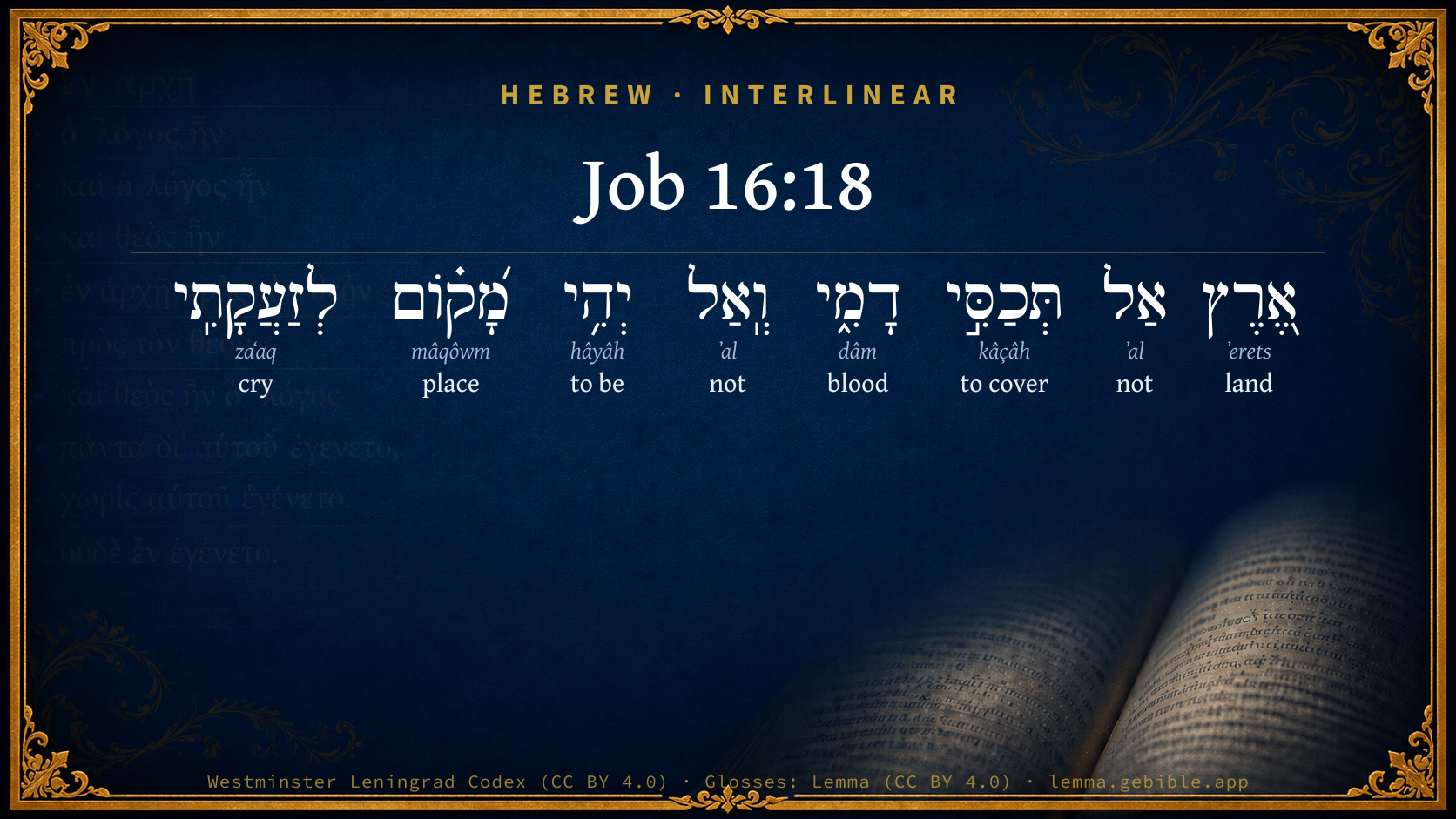
Job 16:18

Hebrew (Westminster Leningrad Codex) Job 16:18 appears in the Hebrew Old Testament. The text above is from the Westminster Leningrad Codex. Each word links to its Strong’s number, a concise gloss, and parsing drawn from the Open Scriptures Hebrew Bible morphology. Click any word for its full Brown-Driver-Briggs (BDB) entry.
Download image
Cite this verse

Job 16:18 (World English Bible). Public Domain. Lemma interlinear Bible study tool, https://lemma.gebible.app/v/job/16/18.

Show BibTeX & RIS
BibTeX
RIS
English Translation
"Earth, don't cover my blood, Let my cry have no place to rest.
World English Bible · Public Domain
Download a study sheet

One document with this verse’s original text, its word-by-word gloss line, the meaning frame, cross-references with their text, attributed commentary, and full source and license credits — printable, and it pastes into notes with its structure intact.

This verse Autodidact and up

Study sheet (.html) Plain text (.txt)

A passage Seminary Student

Up to 50 verses in one chapter. A passage sheet keeps up to 6 commentary sources and 12 cross-references per verse, in the order this page ranks them, and says so on the sheet whenever that leaves anything out. Ask for a single verse and you get the Autodidact verse sheet above.

Everything on this page stays free to read, with no account — the sheet is a download of what is already on screen, not access to it.

Want to remove ads? Support Godless Engineer
Compare translations 3

The same verse in 3 English versions, stacked beneath the original-language interlinear above. Click any original word for its lexicon entry.

Each is an independent rendering of the whole verse — the interlinear is not word-aligned to these translations.

Highlighted words mark where these versions differ — a whole-verse word diff, not a word-by-word alignment.

  • World English Bible Public Domain
    "Earth, don't cover my blood, Let my cry have no place to rest.
  • King James Version Public Domain
    O earth, cover not thou my blood, and let my cry have no place.
  • unfoldingWord Literal Text CC BY-SA 4.0
    Earth, do not conceal my blood, and may not be a place for my cry.

unfoldingWord Literal Text — © unfoldingWord, licensed CC BY-SA 4.0. Word-aligned USFM3 via Door43 (git.door43.org/unfoldingWord/en_ult).

Versions to compare (up to 4)

3 of 4 selected

Show all 18 translations

Every available English version of this verse, each an independent rendering of the whole verse.

  • World English Bible Public Domain
    "Earth, don't cover my blood, Let my cry have no place to rest.
  • Berean Standard Bible Public Domain
    O earth, do not cover my blood; may my cry for help never be laid to rest.
  • Majority Standard Bible Public Domain
    O earth, do not cover my blood; may my cry for help never be laid to rest.
  • King James Version Public Domain
    O earth, cover not thou my blood, and let my cry have no place.
  • American Standard Version (1901) Public Domain
    O earth, cover not thou my blood, And let my cry have no `resting' -place.
  • Revised Version (1885) Public Domain
    O earth, cover not thou my blood, and let my cry have no resting place.
  • Geneva Bible (1599) Public Domain
    O earth, couer not thou my blood, and let my crying finde no place.
  • Douay-Rheims (1899) Public Domain
    These things have I suffered without the iniquity of my hand, when I offered pure prayers to God.
  • Young's Literal Translation Public Domain
    O earth, do not thou cover my blood! And let there not be a place for my cry.
  • Literal Standard Version CC BY-SA 4.0
    O earth, do not cover my blood! And let there not be a place for my cry.
  • Unlocked Literal Bible CC BY-SA 4.0
    Earth, do not cover up my blood; let my cry have no resting place.
  • unfoldingWord Literal Text CC BY-SA 4.0
    Earth, do not conceal my blood, and may not be a place for my cry.
  • Darby Bible Public Domain
    O earth, cover not my blood, and let there be no place for my cry!
  • World Messianic Bible Public Domain
    “Earth, don’t cover my blood. Let my cry have no place to rest.
  • Webster's Bible Public Domain
    O earth, cover not thou my blood, and let my cry have no place.
  • Free Bible Version CC BY-SA 4.0
    Earth, do not cover up my blood. May my cry find no place to hide.
  • Bible in Basic English Public Domain
    O earth, let not my blood be covered, and let my cry have no resting-place!
  • JPS Tanakh (1917) Public Domain
    O earth, cover not thou my blood, and let my cry have no resting-place.

Literal Standard Version (2020), Covenant Press — licensed CC BY-SA 4.0. Text via the HelloAO Bible API (eBible.org). Unlocked Literal Bible (unfoldingWord) — licensed CC BY-SA 4.0. Text via the HelloAO Bible API (eBible.org). unfoldingWord Literal Text — © unfoldingWord, licensed CC BY-SA 4.0. Word-aligned USFM3 via Door43 (git.door43.org/unfoldingWord/en_ult). Free Bible Version, Dr. Jonathan Gallagher — licensed CC BY-SA 4.0. Text via the HelloAO Bible API (eBible.org).

Word by word

More ways to search: Search by grammar → Find every occurrence → Compare this word →

Practice this passage: Drill this verse → Learn its vocabulary →

About this verse

These counts appear in no published source. They are computed here, from the morphology-tagged text and Lemma’s own curated glosses. What Lemma adds →

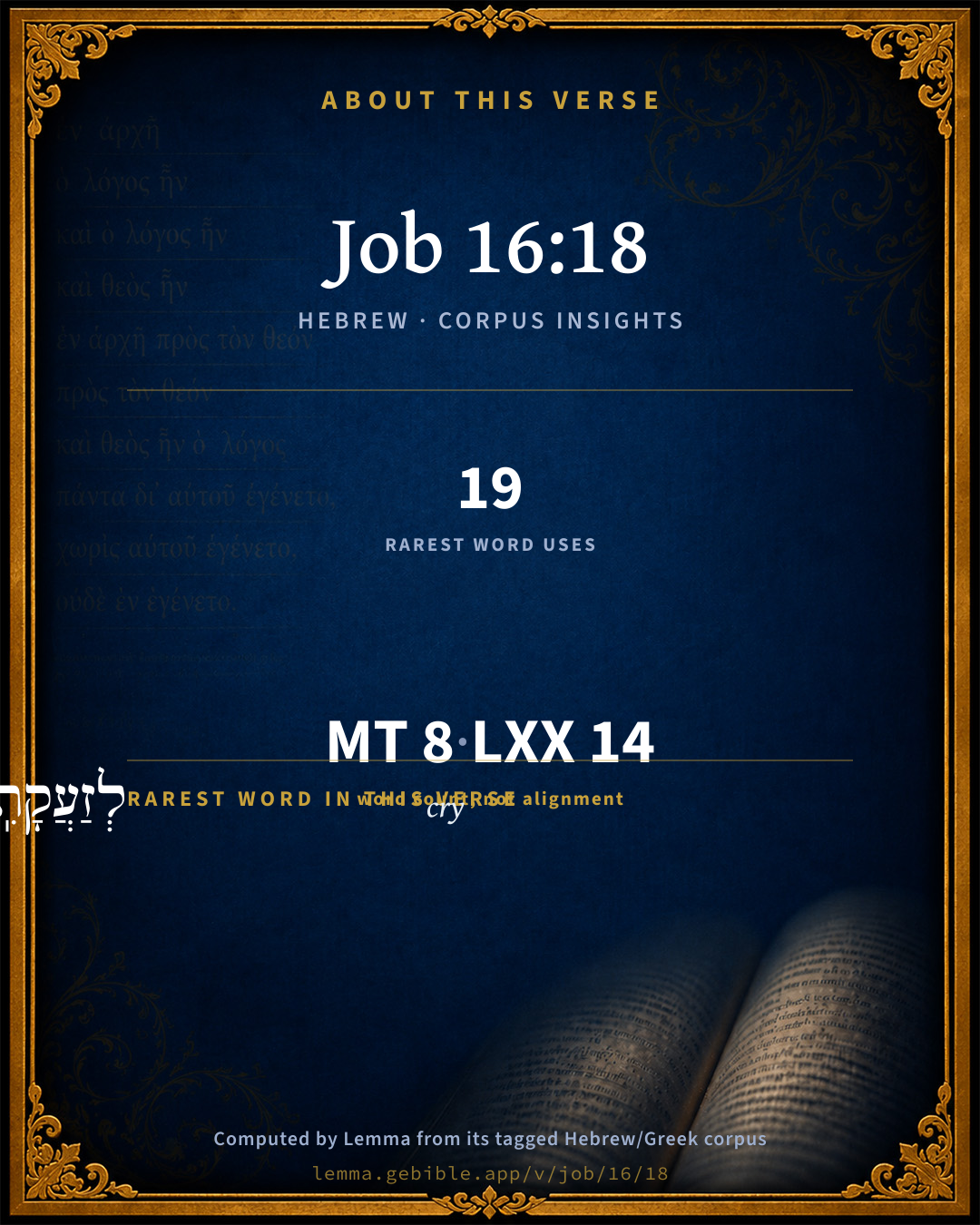
8
words
7
distinct lemmas
Wisdom
section

Notable vocabulary

The rarest word here is לְזַעֲקָתִֽי cry H2201 — appearing just 19 times in the whole Hebrew Bible.

Shared distinctive vocabulary

לְזַעֲקָתִֽי cry H2201 occurs in 19 verses of the Hebrew Bible. Also found in:

Grammatical profile

  • 2 verbs
  • 4 nouns
  • 2 particles

Verb forms

  • תְּכַסִּ֣י Piel · Jussive
  • יְהִ֥י Qal · Jussive

Repetition

A word recurs within this verse — often emphatic in Hebrew:

  • אַל not H408 ×2

Hebrew & Septuagint length

In English translation the verse runs 13 words from the Hebrew and 13 from the Septuagint (LXX English) — the same length.

A rough comparison of the two English renderings, which tokenize alike — not a word-level alignment.

Word counts can differ between the Hebrew and the Greek without any difference in meaning — e.g. the Hebrew direct-object marker אֵת has no separate Greek word, and Greek often adds the article ὁ.

In the original languages it is 8 Hebrew tokens and 14 Greek tokens — but the two are counted differently (Hebrew bundles its prefixes and suffixes into one token; the Greek is in lemma form), so that isn’t a like-for-like length.

Cross-references

10

Topical passages linked to Job 16:18 in the Treasury of Scripture Knowledge — connected by theme and wording, ordered by reader-vote popularity; previews shown in the World English Bible.

  • Isaiah 26:21 For, behold, Yahweh comes forth out of his place to punish the inhabitants of the earth for their iniquity: the earth also shall disclose her blood, and shall no more cover her slain.
  • Ezekiel 24:7 For her blood is in the midst of her; she set it on the bare rock; she didn't pour it on the ground, to cover it with dust.
  • Genesis 4:11 Now you are cursed because of the ground, which has opened its mouth to receive your brother's blood from your hand.
  • Psalms 66:18–19 If I cherished sin in my heart, The Lord wouldn't have listened.
  • Nehemiah 4:5 and don't cover their iniquity, and don't let their sin be blotted out from before you; for they have provoked [you] to anger before the builders.
  • Job 27:9 Will God hear his cry, When trouble comes on him?
  • Isaiah 1:15 When you spread forth your hands, I will hide my eyes from you; Yes, when you make many prayers, I will not hear. Your hands are full of blood.
  • Isaiah 58:9–10 Then shall you call, and Yahweh will answer; you shall cry, and he will say, Here I am. If you take away from the midst of you the yoke, the putting forth of the finger, and speaking wickedly;
  • Jeremiah 22:29 O earth, earth, earth, hear the word of Yahweh.
  • James 4:3–4 You ask, and don't receive, because you ask with wrong motives, so that you may spend it for your pleasures.

Cross-references courtesy of OpenBible.info (CC BY 4.0).

Hebrew and Greek witnesses Masoretic Hebrew ↔ Greek Septuagint

The same verse in the two great witnesses to the Old Testament, shown verse-for-verse.

These are two independent witnesses, not word-aligned to each other, and the Septuagint is shown in lemma (dictionary) form.

Hebrew Job 16:18 Masoretic · Westminster Leningrad Codex

אֶ֭רֶץ אַל תְּכַסִּ֣י דָמִ֑י וְֽאַל יְהִ֥י מָ֝ק֗וֹם לְזַעֲקָתִֽי

"Earth, don't cover my blood, Let my cry have no place to rest.

World English Bible · Public Domain

Greek LXX Job 16:18 Septuagint · lemma form

γῆ μή ἐπικαλύπτω ἐπί αἷμα ὁ σάρξ ἐγώ μηδέ εἰμί τόπος ὁ κραυγή ἐγώ

Yet there was no injustice in my hands, and my prayer is pure.

LXX2012 (modern English Septuagint) · Public Domain

On this verse, Keil & Delitzsch discusses the Septuagint’s reading. Read the note in Commentary ↓

Hebrew: Westminster Leningrad Codex (CC BY 4.0). Greek: Septuagint (public domain); English from LXX2012 (modern English Septuagint) (Public Domain). How the Septuagint differs from the Hebrew →

Commentary

Notes on Job 16:18 from classic Christian and Jewish commentators (each source and its license shown beneath its notes). The classic Christian expositions comment on the surrounding passage and are grouped to its opening verse, so a note may address several verses; the Jewish commentaries on the Tanakh (Rashi and others) are per-verse, so they appear only where the commentator wrote on this verse.

Lemma curates 59 commentaries, every one of them public domain or Creative Commons licensed, each selected and text-cleaned for this edition rather than reprinted as found. About our sources →

The Cambridge Bible for Schools and Colleges

gen. ed. J. J. S. Perowne

18. God’s destructive enmity will bring Job to death, though there is no wrong in his hands and his prayer is pure (Job_16:17). This feeling makes him appeal to the earth not to cover his innocent blood. He shall die, but it is an unjust death, and his blood shall lie on the bosom of the earth open, appealing to heaven for vindication, and uttering an unceasing cry for justice.

let my cry have no place] i. e. no resting place, where it should cease and be dumb and penetrate no further. His “cry” is his cry for reparation, as in Gen_4:10 “The voice of thy brother’s blood crieth unto me from the ground.” His “blood” is, of course, a figure; it does not imply actual bloodshed, but merely a wrongful death; but it cannot mean anything short of death, because the figure is taken from a violent death. The word is used in a similar way, Psa_30:9, “What profit is there in my blood, in my going down to the pit”? where death at God’s hand from sickness seems referred to. On the idea that uncovered blood is blood calling for reparation see the remarkable passage Eze_24:7-8; cf. Isa_26:21.

Ch. Job_16:18 to Job_17:9. Job, dying a martyr’s death, beseeches God that He would uphold his right with God and against men, and give him a pledge that He will make his innocence appear

In Job_16:12-14 Job described the terrible hostility of God, who dashed him to pieces, laid him in ruins and poured out his soul to the ground—brought him unto death. Then the other thought rose in his mind that all this befell him though he was innocent both in life and in spirit. Here he comes to the point at which he always loses self-control—when he realizes that in spite of his innocence he is held guilty. This is an overwhelming feeling, and under it Job either wildly challenges the rectitude of God, as in the first cycle of speeches; or he flings off from him altogether the form of things in the present world, and forces his way into another region, where such perversions cannot prevail and where the face of God, clouded here, must be clear and propitious. This second direction, entered upon first in ch. 14, is pursued in the present passage, and reaches its highest point in ch. 19. Already in ch. 10. Job had drawn a distinction between God of the present, who persecuted him as guilty though he was innocent, and God of the past, whose gracious care of him had been wonderful; though there he grasped at a frightful reconciliation of the contradiction: God of the present, who destroyed him, seemed the real God, and His past mercies were no true expression of His nature (see on Job_10:13 seq.). In ch. 14. Job reached out his hand into the darkness and clutched at another idea, a distinction between God of the present who would pursue him unto death, and God of the future—God when His anger should be over-past and He would yearn again towards His creature, the work of His hands (see on Job_14:13 seq.). This God of the future was God as He is in truth, true to His own past dealing and to man’s conceptions of Him. It is on this line of thought that the present passage moves.

The two great ideas which fill Job’s mind in all this discourse are, first, the certainty of his speedy death under God’s afflicting hand; and second, the moral infamy and the inexplicable contradiction to his conscience which death in such circumstances carries with it. The first, his speedy death, Job accepts as inevitable, and he cannot restrain his contemptuous indignation at the foolishness of his friends, who talk as if something else were possible (Job_17:2-4; Job_17:10-16). But such a death under the hand of God meant to Job the reprobation of God and the scorn and abhorrence of men. And it is against this idea, not his mere death, that Job wrestles with all his might. This is the meaning of such a death; but it cannot be that God will allow this obloquy and injustice to overwhelm His innocent creature for ever. His blood will utter a ceaseless cry for reparation. And even now he has in heaven one who will witness to his innocence. And he prays to God that He would maintain his right with God and against men.

It is impossible to escape the conclusion that Job prays or hopes for this vindication not before but after death. For he contemplates dying an unjust death—his blood will cry for vengeance. His present unjust afflictions will bring him to the grave. But these fatal afflictions are just God’s witness to his guilt. Any interference of God, therefore, to declare his innocence cannot take place in this life, for an intervention of God to declare his innocence, all the while that He continued to declare him guilty by His afflictions, could not occur to Job’s mind.

The passage Job_16:18 to Job_17:9 embraces two sections similar to one another, each of which contains a fervent appeal to God, followed by words which support it, Job_16:18 to Job_17:2, and Job_17:3-9.

The Cambridge Bible for Schools and Colleges (gen. ed. J. J. S. Perowne; Cambridge University Press, 1878–1918) — public domain. Text from a community e-Sword module.

Trapp's Complete Commentary

John Trapp

Job 16:18 O earth, cover not thou my blood, and let my cry have no place.

Ver. 18. O earth, cover not thou my blood] Job had made a high profession of his innocence and integrity. This he further confirmeth, 1. By an imprecation against himself. 2. By an appeal to God, Job 16:19. In this imprecation or wish of his (which Mr Broughton taketh to be meant by the foregoing words, Also my prayer is pure, rendered by him thus, But my wish is clean, saying, O earth, cover not, &c.) he hath an eye, no doubt, to the history of Abel’s blood, shed by Cain, Gen 4:1-15, and it is as if he should say, If I have committed murder or any the like wickedness, cover it not, O earth, but do thy office by crying out against me; yea, cry so loud to God for vengeance, as to drown the voice of my supplication.

And let my cry have no place] A most pathetic speech, able to move the heart of his friends to relent to hear it, and straightway to alter their opinion of him, while he thus bespeaketh the earth, and maketh res mutas mortuasque, the dumb and lifeless creatures his hearers.

John Trapp, A Commentary or Exposition upon All the Books of the Old and New Testament (1647–1656) — public domain. Text from a community e-Sword module.

Whedon's Commentary on the Bible

Daniel D. Whedon

18. Cover not thou my blood — He speaks of his sufferings under the figure of blood that has been wrongfully shed. “Blood,” says Grotius, “denotes every kind of immature death.” The ancients attributed to blood, unjustly shed, a cry that excited God to vengeance; an opinion which may have sprung from the case of Abel, Gen_4:10. “When the earth covers the blood of the slain it seems to cloak injury.” — Drusius. See also Isa_26:21; Eze_24:7-8. The Arabs say the dew of heaven will not descend upon a spot watered with innocent blood; and their poets fancy that the poison of asps distils from the dead body of the slain, and continues to do so till he is avenged, that is, sprinkled with fresh blood. (See HERDER, Hebrews Poetry, 1:195.) Job will have nothing to do with a human goel; he transfers his cause to a divine being (Job_19:25) who he believes will finally avenge his blood.

No place — In sense of resting place.

First strophe — God, the witness of the innocent blood which his own wrath hath shed, cannot but plead with God for justice, though man, the victim, be in the article of death. Job_16:18 - Job_17:2.

Job’s faith again appeals from God as he seems, to God as he must be.

Daniel D. Whedon (gen. ed.), Commentary on the Old and New Testaments (1874–1909) — public domain. Text from a community e-Sword module.

Keil & Delitzsch

C. F. Keil & F. Delitzsch

18 Oh earth, cover thou not my blood,

And let my cry find no resting-place!! -

19 Even now behold in heaven is my Witness,

And One who acknowledgeth me is in the heights!

20 Though the mockers of me are my friends -

To Eloah mine eyes pour forth tears,

21 That He may decide for man against Eloah,

And for the son of man against his friend.

22 For the years that may be numbered are coming on,

And I shall go a way without return.

Blood that is not covered up cries for vengeance, Eze 24:7.; so also blood still unavenged is laid bare that it may find vengeance, Isa 26:21. According to this idea, in the lofty consciousness of his innocence, Job calls upon the earth not to suck in his blood as of one innocently slain, but to let it lie bare, thereby showing that it must be first of all avenged ere the earth can take it up;

(Note: As, according to the tradition, it is said to have been impossible to remove the stain of the blood of Zachariah the son of Jehoiada, who was murdered in the court of the temple, until it was removed by the destruction of the temple itself.)

and for his cry, i.e., the cry (זעקתי to be explained according to Gen 4:10) proceeding from his blood as from his poured-out soul, he desires that it may urge its way unhindered and unstilled towards heaven without finding a place of rest (Symm. στάσις). Therefore, in the very God who appears to him to be a blood-thirsty enemy in pursuit of him, Job nevertheless hopes to find a witness of his innocence: He will acknowledge his blood, like that of Abel, to be the blood of an innocent man. It is an inward irresistible demand made by his faith which here brings together two opposite principles - principles which the understanding cannot unite - with bewildering boldness. Job believes that God will even finally avenge the blood which His wrath has shed, as blood that has been innocently shed. This faith, which sends forth beyond death itself the word of absolute command contained in Job 16:18, in Job 16:19 brightens and becomes a certain confidence, which draws from the future into the present that acknowledgment which God afterwards makes of him as innocent. The thought of what is unmerited in that decree of wrath which delivers him over to death, is here forced into the background, and in the front stands only the thought of the exaltation of the God in heaven above human short-sightedness, and the thought that no one else but He is the final refuge of the oppressed: even now (i.e., this side of death)

(Note: Comp. Kg1 14:14, where it is probably to be explained: Jehovah shall raise up for himself a king over Israel who shall cut off the house of Jeroboam that day, but what? even now (גם עתה), i.e., He hath raised him up (= but no, even now).)

behold in heaven is my witness (הנּה an expression of the actus directus fidei) and my confessor (שׂהר a poetic Aramaism, similar in meaning to עד, lxx ὁ συνίστωπ μου) in the heights. To whom should he flee from the mockery of his friends, who consider his appeal to the testimony of his conscience as the stratagem of a hypocrite! מליצי from הליץ, Psa 119:51, my mockers, i.e., those mocking me, lascivientes in me (vid., Gesch. der jd. Poesie, S. 200. The short clause, Job 16:20, is, logically at least, like a disjunctive clause with כי or גם־כי, Ewald, 362, b: if his friends mock him - to Eloah, who is after all the best of friends, his eyes pour forth tears (דּלפה, stillat, comp. דּלּוּ of languishing, Isa 38:14), that He may decide (ויוכח voluntative in a final signification, as Job 9:33) for man (ל here, as Isa 11:4; Isa 2:4, of the client) against (עם, as Psa 55:19; Psa 94:16, of an opponent) Eloah, and for the son of man (ל to be supplied here in a similar sense to Job 16:21, comp. Job 15:3) in relation to (ל as it is used in ל ... בּין, e.g., Eze 34:22) his friend. Job longs and hopes for two things from God: (1) that He would finally decide in favour of גבר, i.e., just himself, the patient sufferer, in opposition to God, that therefore God would acknowledge that Job is not a criminal, nor his suffering a merited punishment; (2) that He would decide in favour of בן־אדם, i.e., himself, who is become an Ecce homo, in relation to his human opponent (רעהוּ, not collective, but individualizing or distributive instead of רעיו), who regards him as a sinner undergoing punishment, and preaches to him the penitence that becomes one who has fallen. ויוכח is purposely only used once, and the expression Job 16:21 is contracted in comparison with 21a: the one decision includes the other; for when God himself destroys the idea of his lot being merited punishment, He also at the same time delivers judgment against the friends who have zealously defended Him against Job as a just judge.

Olsh. approves Ewald's translation: "That He allows man to be in the right rather than God, and that He judges man against his friend:" but granted even that הוכיח, like שׁפט followed by an acc., may be used in the signification: to grant any one to be in the right (although, with such a construction, it everywhere signifies ἐλέγχειν), this rendering would still not commend itself, on account of the specific gravity of the hope which is here struggling through the darkness of conflict. Job appeals from God to God; he hopes that truth and love will finally decide against wrath. The meaning of הוכיח has reference to the duty of an arbitrator, as in Job 9:33. Schlottm. aptly recalls the saying of the philosophers, which applies here in a different sense from that in which it is meant, nemo contra Deum, nisi Deus ipse. In Job 16:22 Job now establishes the fact that the heavenly witness will not allow him to die a death that he and others would regard as the death of a sinner, from the brevity of the term of life yet granted him, and the hopelessness of man when he is once dead. מספּר שׁנות are years of number = few years (lxx ἔτη ἀριθμητά); comp. the position of the words as they are to be differently understood, Job 15:20. On the inflexion jeethâju, vid., on Job 12:6. Jerome transl. transeunt, but אתה cannot signify this in any Semitic dialect. But even that Job (though certainly the course of elephantiasis can continue for years) is intended to refer to the prospect of some, although few, years of life (Hirz. and others: the few years which I can still look forward to, are drawing on), does not altogether suit the tragic picture. The approach of the years that can be numbered is rather thought of as the approach of their end; and the few years are not those which still remain, but in general the but short span of life allotted to him (Hahn). The arrangement of the words in Job 16:22 also agrees with this, as not having the form of a conclusion (then shall I go, etc.), but that of an independent co-ordinate clause: and a path, there (whence) I come not back (an attributive relative clause according to Ges. 123, 3, b) I shall go (אהלך poetic, and in order to gain a rhythmical fall at the close, for אלך). Now follow, in the next strophe, short ejaculatory clauses: as Oetinger observes, Job chants his own requiem while living.

Keil & Delitzsch — Biblical Commentary on the Old Testament (1861–1891) — public domain (CC PDM 1.0). Text via the HelloAO Bible API. (Old Testament only.)

Tyndale Open Study Notes

Tyndale Open Resources

16:18-22 Job expected his suffering to prove fatal (7:7, 21; 10:20-22); he pleaded with God to reveal his innocence even if he died first.

16:18 Job’s blood would cry out that he had been innocent and that he had suffered undeservedly (cp. Gen 4:10-11; Isa 26:21; Ezek 24:7-8).

Tyndale Open Study Notes — © Tyndale Open Resources, licensed CC BY-SA 4.0. Text via the HelloAO Bible API.

Geneva Bible (1599)

Geneva Bible translators

Let my sin be known if I be such a sinner as mine adversaries accuse me, and let me find no favor.

Geneva Bible (1599) marginal notes — public domain. Text via Bolls.life.

Jamieson, Fausset & Brown

Robert Jamieson, A. R. Fausset & David Brown

my blood--that is, my undeserved suffering. He compares himself to one murdered, whose blood the earth refuses to drink up until he is avenged (Gen 4:10-11; Eze 24:1, Eze 24:8; Isa 26:21). The Arabs say that the dew of heaven will not descend on a spot watered with innocent blood (compare Sa2 1:21).

no place--no resting-place. "May my cry never stop!" May it go abroad! "Earth" in this verse in antithesis to "heaven" (Job 16:19). May my innocence be as well-known to man as it is even now to God!

Jamieson, Fausset & Brown — Commentary Critical and Explanatory on the Whole Bible (1871) — public domain (CC PDM 1.0). Text via the HelloAO Bible API.

Adam Clarke's Commentary

Verse 18. O earth, cover not thou my blood] This is evidently an allusion to the murder of Abel, and the verse has been understood in two different ways:

1. Job here calls for justice against his destroyers. His blood is his life, which he considers as taken away by violence, and therefore calls for vengeance. Let my blood cry against my murderers, as the blood of Abel cried against Cain. My innocent life is taken away by violence, as his innocent life was; as therefore the earth was not permitted to cover his blood, so that his murderer should be concealed, let my death be avenged in the same way.

2. It has been supposed that the passage means that Job considered himself accused of shedding innocent blood; and, conscious of his own perfect innocence, he prays that the earth may not cover any blood shed by him. Thus Mr. Scott: -

"O earth, the blood accusing me reveal;

Its piercing voice in no recess conceal."

And this notion is followed by Mr. Good. But, with all deference to these learned men, l do not see that this meaning can be supported by the Hebrew text; nor was the passage so understood by any of the ancient versions. I therefore prefer the first sense, which is sufficiently natural, and quite in the manner of Job in his impassioned querulousness.

Adam Clarke's Commentary on the Bible (1810–1826) — public domain. Text from a community e-Sword/MySword module.

Ellicott's Commentary for English Readers

(18) Let my cry have no place.—That is, “Let there be no place in the wide earth where my cry shall not reach: let it have no resting place: let it fill the whole wide earth.”

A Bible Commentary for English Readers, edited by Charles John Ellicott (1878–1897) — public domain. Text from a community e-Sword module.

John Gill's Exposition

Also now, behold, my witness is in heaven,.... That is, God, who dwells in the heavens, where his throne is, and which is the habitation of his holiness, and from whence he beholds all the sons of men, and their actions, is the all seeing and all knowing Being; and therefore Job appeals to him as his witness, if he was guilty of the things laid to his charge, to bear witness against him, but if not to be a witness for him, which he believed he would, and desired he might:

for my record is on high; or "my testimony"; that can testify for me; who is an "eyewitness" (k), as some render it, before whom all things are naked and open; who has seen all my actions, even the very inmost recesses of my mind, all the thoughts of my heart, and all the principles of my actions, and him I desire to bear record of me; such appeals are lawful in some cases, which ought not to be common and trivial ones, but of moment and importance, and which cannot well be determined in any other way; such as was the charge of hypocrisy against Job, and suspicions of his having been guilty of some notorious crime, though it could not be pointed at and proved; see Sa1 12:3, Co2 1:13.

(k) "oculatus meus testis", Schultens.

John Gill's Exposition of the Whole Bible (1746–1763) — public domain (CC PDM 1.0). Text via the HelloAO Bible API.

Albert Barnes' Notes on the Bible

O earth - Passionate appeals to the earth are not uncommon in the Scriptures; see the notes at Isa 1:2. Such appeals indicate deep emotion, and are among the most animated forms of personification.

Cover not thou my blood - Blood here seems to denote the wrong done to him. He compares his situation with that of one who had been murdered, and calls on the earth not to conceal the crime, and prays that his injuries may not be hidden, or pass unavenged. Aben Ezra, Dr. Good, and some others, however, suppose that he refers to blood shed “by” him, and that the idea is, that he would have the earth reveal any blood if he had ever shed any; or in other words, that it is a strong protestation of his innocence. But the former interpretation seems to accord best with the connection. It is the exclamation of deep feeling. He speaks as a man about to die, but he says that he would die as an innocent and a much injured man, and he passionately prays that his death may not pass unavenged. God had crushed him, and his friends had wronged him, and he now earnestly implores that his character may yet be vindicated. “According to the saying of the Arabs, the blood of one who was unjustly slain remained upon the earth without sinking into it; until the avenger of blood came up. It was regarded as a proof of innocence.” Eichhorn, “in loc” That there is much of irreverence in all this must, I think, be conceded. It is not language for us to imitate. But it is not more irreverent and unbecoming than what often occurs, and it is designed to show what the human heart “will” express when it is allowed to give utterance to its real feelings.

And let my cry have no place - Let it not be hid or concealed. Let there be nothing to hinder my cry from ascending to heaven. The meaning is, that Job wished his solemn protestations of his innocence to go abroad. He desired that all might hear him. He called on the nations and heaven to hear. He appealed to the universe. He desired that the earth would not conceal the proof of his wrongs, and that his cry might not be confined or limited by any bounds, but that it might go abroad so that all worlds might hear.

Albert Barnes' Notes on the Bible (1834–1885) — public domain. Text from a community e-Sword/MySword module.

Haydock's Catholic Bible Commentary

Hand, which has not been defiled with any injustice. (Menochius) --- When. Hebrew, "and my prayer was pure." I never neglected this sacred duty, (chap. i. 5.) as my friends accuse me, chap. xv. 4. (Haydock) --- They continued in their false accusation: so he repeats the same true answer. (Worthington)

George Leo Haydock (1774–1849), Haydock's Catholic Family Bible and Commentary, 1859 edition — public domain. Excludes Psalms (Douay-Rheims chapter numbering differs from Protestant) and Deuterocanonical books (Catholic canon only).

Matthew Poole's English Annotations

My blood, so called not actively, to wit, his own blood; but passively or objectively, i.e. the blood of others shed by him, and lying upon his conscience. The earth is said to cover that blood which lies undiscovered and unrevenged; of which See Poole "Gen 4:10", See Poole "Gen 4:11"; See Poole "Isa 26:21", But, saith Job, if I be guilty of destroying any one man by murder or oppression, as I am traduced, O Lord, let the earth disclose it; let it be brought to light, that I may suffer condign punishment for it.

My cry; either,

1. Passively, to wit, the cries and groans which I have forced from others by my oppressions; let those cries have no place to hide them. Or rather,

2. Actively, the cry of my complaints to men, or prayers to God; let them find no place in the cars or hearts of God or men, if this be true: or, no place, i.e. no regard, or no power or success; in which sense God’s word is said not to have place in evil men, Joh 8:37; and Esau not to

find place of repentance, Heb 12:17, i.e. all his entreaties and tears could not prevail with his father to repent of and retract the blessing given from him to Jacob.

Matthew Poole's English Annotations on the Holy Bible (1683–1685) — public domain. Text from a community e-Sword/MySword module.

The Pulpit Commentary

O earth, cover not thou my blood! There was a widespread belief in the ancient world that innocent blood, spilt upon the ground, cried to God for vengeance, and remained a dark blot upon the earth till it was avenged, or until it was covered up. Job apostrophizes the earth, and be-seethes it not to cover up his blood when he dies, as he expects to do, shortly. And let my cry have no place; i.e. let it have no hiding-place, but fill earth and heaven. Let it continue to be heard until it is answered.

Vers. 18-22. Job to God: 2. An appeal to God against God.

I A SUBLIME INVOCATION. "O earth, cover not thou my blood, and let my cry have no place!" (ver. 18).

1. The explanation of the language. The allusion seems to be to Gen_4:10, where the blood of Abel is represented as crying to God from the ground for vengeance upon its destroyer; and Job, in the lofty consciousness of his innocence, while momentarily anticipating death, calls upon the earth not to drink up his blood, but to permit its cry to "urge its way unhindered and unstilled towards heaven without finding a place of rest." But the student may consult the Exposition.

2. The import of the language. It contains a declaration on the part of Job that, though about to perish, he was innocent; and, since he regarded God as the Author of all his sufferings, it was virtually an accusation of God as the Shedder of his innocent blood. The style of address here employed is certainly not one that a good man may with safety imitate.

II A CONFIDENT APPEAL.

1. To what quarter? Not to his friends who had mocked him (ver. 20), but to God himself who had assailed him, to whom nevertheless he clung as for dear life, and whom he describes by a threefold characteristic.

(1) His name; Eloah, the All-powerful Supreme, in contrast to man, to strong men and weak men alike, who are all at the best but dust; the mighty Maker of this universal frame, who giveth power unto the faint, and to them that have no might increaseth strength, (Isa_40:29) and who hath revealed himself most graciously as a Refuge for the oppressed. (Psa_9:9 Deu_33:27 Jer_16:19)

(2) His occupation; that of a Witness, an Eye-witness, whose eyes are in every place, beholding the evil and the good, (Pro_15:3) as those of Christ, the faithful Witness, are in the midst of the golden candlesticks; (Rev_2:1) and in particular whose eyes run to and fro throughout the whole earth, to show himself strong in behalf of them whose hearts are perfect toward him. (2Ch_16:9) The thought that God is a constant Eye-witness of everything on earth, and a silent Spectator of all that transpires within the deep places of the human heart, may fill the wicked with alarm, but is fraught with special comfort to the saint.

(3) His dwelling-place; the heights, or heaven. God has three dwelling-places eternity, the Church, and the saint"s heart; (Isa_57:15) and he is never really absent from the third any more than from the second or the first. But when the saint, by reason of doubt, sorrow, or sin, cannot perceive him in the second or third, he may always find him in the first, seated on his high and glorious throne of grace.

2. In what spirit? Clearly

(1) with firm faith. "Behold, my Witness is in heaven;" the first personal pronoun pointing to the existence of appropriating faith. So David says, "The Lord is my Shepherd". (Psa_23:1) And

(2) with confident expectation. "Behold! a note of triumph, as if a gleam of bright exultant hope had already begun to make sunshine in the sufferer"s soul.

III A FERVENT SUPPLICATION.

1. The earnestness of Jobs prayers. They were:

(1) Persistent. His friends mocked him, accused him of impiety, insinuated that he had abandoned the habit of devotion; but, in spite of slander and misrepresentation, he continued "instant in prayer." Not fitful and intermittent devotion succeeds with God, but habitual and continual. Therefore pray without ceasing. It is a high mark of grace to be able to persevere in well-doing, and to keep on praying in face of opposition and ridicule from friends.

(2) Tearful. Job presented not cold, formal, and listless petitions to the throne of grace, but warm, urgent, and forceful entreaties. When the eye waters, the heart melts. It is the stream of penitential feeling, or the flood of believing desire, which, welling up from the soul"s depths, sends liquid drops through the open gateway of the eye. David mourned after God with. (Psa_42:3) The father of the lunatic boy cried out with tears, "Lord, I believe". (Mar_9:24)

2. The burden of Jobs prayers.

(1) That God would plead with himself in behalf of man; i.e. that he would vindicate Job against himself, by declaring him (Job) to be innocent, What Job here desired for himself has in a more exalted sense been done for all men by Christ, who through his cross has made intercession for the transgressors" not to demonstrate their sinlessness or integrity, but to establish their righteousness before God.

(2) That God would plead for the son of man against his friend; i.e. for Job against his friends, who wished to put him down as a hypocrite. This also God will do for all, if not here, in a future world. "Then shall the righteous shine forth as the sun in the kingdom of their Father". (Mat_13:43)

IV A PATHETIC REASON.

1. The brevity of life"s term. "When a few years are come" (ver. 22). The short period of life that still remained would soon be ended. Time flies with all, but especially with the dying.

2. The hopelessness of man"s return from the tomb. Then I shall go the way whence I shall not return. (cf. Job_10:21)

Learn:

1. That the God of faith alone is the true God.

2. That faith"s God is found in the page of revelation and in Jesus Christ, not in the mere conceptions of the human mind.

3. That faith"s God is the enemy of no man, but the Friend of all.

4. That the ear of faith"s God is never heavy that it cannot hear, or his hand shortened that it cannot save.

The Pulpit Commentary (1880–1919), ed. H.D.M. Spence-Jones & Joseph S. Exell — public domain. Text from a community e-Sword module.

John Wesley's Explanatory Notes

Earth - The earth is said to cover that blood, which lies undiscovered and unrevenged: but saith Job, if I be guilty of destroying any man, let the earth disclose it; let it be brought to light. Cry - Let the cry of my complaints to men, or prayers to God, find no place in the ears or hearts of God or men, if this be true.

John Wesley, Explanatory Notes Upon the Whole Bible (1754–1765) — public domain. Text via the GEBible commentary corpus.

unfoldingWord translationNotes

Door43 World Missions Community

Earth, do not cover up my blood

Jobs speaks to the "earth" directly even though it cannot hear him, to add strength to his statement. The earth is personified as purposefully covering up his blood after he dies. AT: "I wish my blood would not soak into the ground but that it would remain on top of the ground as proof of how I died" (See: Apostrophe and Personification)

Earth, do not cover up my blood

Job speaks of himself dying as if he would be murdered. Here his "blood" is a metonym referring to his death. AT: "Earth, when I die, do not hide how I died unfairly" or "Let it not be hidden how I died unfairly" (See: Metonymy)

let my cry have no resting place

Job speaks of wanting everyone to know what happened to him as if his "cry" were a person that never stopped testifying to what happened to him and never rested. AT: "let everyone hear about what has happened to me" (See: Personification)

see

Job uses this word to draw attention to what he says next. AT: "listen"

vouches for me

"testifies that I am righteous"

on high

This is an idiom. AT: "in heaven" or "in heaven on high" (See: Idiom)

translationWords

earth

blood

rest

testimony

heaven

unfoldingWord translationNotes — © Distant Shores Media and the Door43 World Missions Community, licensed CC BY-SA 4.0. Source: git.door43.org/Door43/en_tn.

Rashi

Rabbi Shlomo Yitzchaki (Rashi)

and let there be no place in the earth to absorb my cry, but it should ascend to heaven.

Rashi on the Tanakh — English translations: “The Judaica Press complete Tanach with Rashi, translated by A. J. Rosenberg” (CC BY 4.0); “Pentateuch with Rashi's commentary by M. Rosenbaum and A.M. Silbermann, 1929-1934” (public domain); “The Metsudah Tanach series, Lakewood, N.J” (CC BY 4.0); and “The Book of Joshua, Metsudah Publications, 1997” (CC BY 4.0). Text via Sefaria.

Lesson kit

Teaching starters — assembled from the data on this page, not authored interpretation. Every prompt links to the verse data it draws on. Edit before teaching.

Job, in the Wisdom, opens this verse with 8 words (7 distinct Hebrew lemmas). Its most distinctive word is zaʻaq (“cry”). A historical commentator’s framing appears above. Read the whole chapter for the surrounding context.

Discussion questions

  1. What does “cry” (zaʻaq) contribute to the verse as a whole?
  2. How does Genesis 18:20, which shares the word «cry», read alongside this verse?
  3. What does the repetition of “not” (2× in this one verse) do in this verse?
  4. These translations render this verse differently; the difference is in the English rendering, not the original. What questions does that raise?
  5. «תְּכַסִּ֣י» is a Piel Jussive verb. How does that grammatical form shape the action described?
  6. Compare how The Cambridge Bible for Schools and Colleges and Trapp's Complete Commentary read this verse. Where do they agree or differ?

Things to notice

Reading settings

Reading text

Shown beneath each verse's original-language words.

Old Testament
Old Testament edition

Read the OT as the Masoretic Hebrew (MT) or the Greek Septuagint (LXX).

English shown for the Greek Septuagint (in the Hebrew ↔ Greek comparison).

Comparing translations? Open the Compare panel on any verse page to stack up to four side by side.